Here’s where the Democrats are. This tells you almost everything you need to know. Donald Trump collected hundreds of billions of dollars in tariffs while resetting the world trade system to an America First default. If he is forced to give those hundreds of billions of dollars back, he won’t be giving them to American citizens. He will be shoveling that money into the gaping maw of the very corporations he tariffed. If that happens, it will mean the courts have forced the administration to take revenue that belongs in the Treasury and transfer it to soulless entities that have ever wanted only one thing: everything.
Do you remember when Democrats used to talk about the one percent and the 99 percent? Do you remember all the warnings about how dangerous it was to allow the rich to grow fat and powerful on corporate welfare? I’m not saying they ever truly believed it. Now you know they don’t. It was a slogan to rile up the rank and file. The Democrats are the party of the corporate state. They are the party of transnational capitalism. They are the political functionaries of the wealthy who fund their campaigns and reap the returns on their investment.
Democrats blow their cover when they go on television and celebrate the fact that hundreds of billions of dollars—money that could reduce the deficit, lower federal interest payments, and free up resources for the American people—will instead be handed back to corporations. Corporations will not use that money to strengthen the nation. They will use it to further consolidate their power, automate away jobs, offshore production, and deny millions of Americans the opportunity to work and provide for their families.
I have demonstrated in numerous essays that the Democratic Party is the party of transnational corporate power. They have long aligned themselves with global capital over the American worker. They oversaw the decimation of American manufacturing. They presided over the destruction of private-sector labor unions. They facilitated the erosion of wages for working Americans—not only by enabling offshoring, but by supporting policies that increase labor competition at home.
Democrats do not believe this country belongs uniquely to its citizens. To them, you are not a stakeholder in a national project. You are an interchangeable unit of labor in a global production system. Your value is purely instrumental. Your purpose is to generate surplus value for corporations so that executives and investors can enrich themselves in global markets. You are not really a citizen. You’re an input. You are not a participant in sovereignty. You are a factor of production.
That is why Democrats celebrate when policies that strengthen national economic sovereignty are dismantled. Trump’s attempt to revive a nationalist political economy—rooted in the industrial strategy associated with Alexander Hamilton and the early development of the United States—threatened the world system from which their donors profit. They are jubilant at its destruction because their patrons benefit from America’s subordination to global capital.
Although Democrats do not advocate communism, their policies produce outcomes that echo insights articulated by Karl Marx and Friedrich Engels in The Communist Manifesto. Marx supported free trade because he believed it would immiserate workers and destabilize national systems. Marx and Engels believed workers would ultimately overthrow capitalism. They would be the gravediggers who would bury the corpse of the old system. Today’s transnational corporate order offers no such resolution. Instead, it points toward something older and more hierarchical: neofeudalism. Workers are to dig their own graves.
The most frustrating part is that the dynamics behind this transformation are neither invisible nor inexplicable. They are the predictable result of identifiable political and economic choices. Yet the public is never educated about political economy or America’s true economic history. The media, owned by the same corporate forces that benefit from these policies, shape the narrative. They daily pump out propaganda, and the propaganda they pump out is that anything that appears to hurt Trump is good for America. And half the nation—with eyes wide shut—laps it up like dogs eat sick.
What the corporate media are really doing is providing cover for policies that weaken the American worker and strengthen transnational capital. And the party that represents those forces—the party that facilitates this transfer of power—is the Democratic Party.
One of the most striking differences between classical liberalism and contemporary progressivism concerns the moral grounding of individual rights. For liberals—and in many respects conservatives as well—the defense of individual rights does not arise from selfishness, but from principle. For progressives, whether a person enjoys free speech rights depends on whether progressives agree with them or are prepared to tolerate them, considering group identity.
The liberal tradition, rooted in thinkers such as John Locke and later articulated in American political thought, holds that rights belong to individuals as individuals. Freedom of conscience, freedom of speech, freedom of the press, and freedom of association are not privileges reserved for those whose views we approve; they are universal guarantees that apply precisely when disagreement or offense occurs.
To tolerate only agreeable speech is not to believe in free speech at all. Thus, when a liberal encounters ideas that offend or contradict his own, he defends the speaker’s right to express them—not because he is indifferent, but because he believes the principle must apply equally to all.
By contrast, progressivism often appears organized less around principle than around outcome and what the progressives deem virtuous. The commitment to speech and expression is conditional: speech is defended when it advances approved moral or political aims, or personal promotion, but curtailed when it is judged offensive and contrary to imposed norms based on progressive ideology, or damaging to identities the progressive deems worthy and valid.
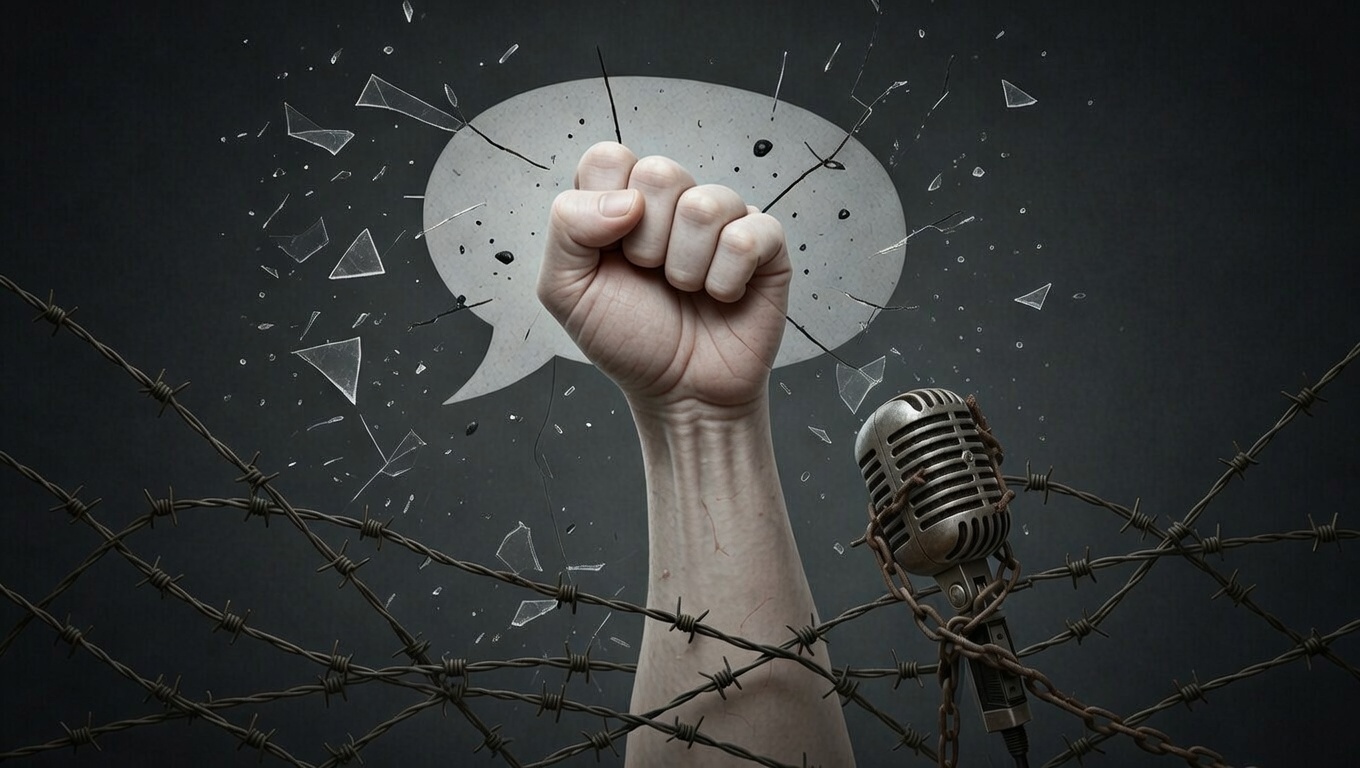
Image by Grok
In the progressive framework, rights function instrumentally rather than universally. The result is a tendency toward censorship or “shutting down” opposing viewpoints in the name of protecting others from harm. This leads to the paradoxical tactic of valorizing harassment, intimidation, and violence to suppress speech. The slogan “Punch a Nazi,” which gained popularity after Richard Spencer was punched in the face in Washington DC on Inauguration Day 2017, is without shame heard in progressive circles.
I say that it is paradoxical because punching opponents in the face for their opinions is not merely infantile, but is a fascist tactic. Benito Mussolini’s philosophy of fascismo was deeply rooted in the veneration of violence. Mussolini saw violence as a transformative and virtuous force. He viewed tolerance as a sign of cowardice and decadence. For him, struggle was the natural and essential purpose of life. Standpoint appoints the fascist as the arbiter of what speech is tolerable, and thus establishes, either officially or de facto, an office of the commissar.
Using violence to counter speech is a Nazi tactic. Ironic, no? Should people also use violence against those who espouse Islam? Islam is clerical fascism. Why should Islam be off limits? See where it goes?
Besides, these morons don’t even know what fascism is. They punch people… https://t.co/Ix7o07FO6V
This conditional approach marks a departure from liberalism properly understood. Liberalism insists that rights are collective in their universality—everyone enjoys them equally—not collective in the sense that they may be withdrawn for the sake of ideological conformity. When rights are treated as permissions granted only to the virtuous or the aligned, the logic shifts in an authoritarian direction.
This is an inherent tendency in progressive thought. Progressivism is an expression of corporate statism. As such, it is not democratic, but coercive and technocratic. As the world witnessed during the COVID-19 pandemic, as long as the tyranny of public health was not in Trump’s command, progressives were eager to compel others to get jabbed with an experimental mRNA shot, remain in their homes, socially distance, and wear masks. Corporations were encouraged to censor, deplatform, and discipline those who challenged the authority of officially sanctioned experts.
At its core, then, the disagreement is not merely political but philosophical. Liberalism treats individual rights as principled, universal, and equal; progressivism treats them as contingent and strategic. The distinction reveals two different understandings of freedom: one grounded in equal liberty for all persons, and another grounded in the management of speech and expression to secure preferred political and social outcomes.
The Shocking Psychology of Liberal Women…🏳️🌈
Novelist and cultural critic Lionel Shriver joins me for a provocative conversation on immigration, national identity, childlessness, and the psychology driving progressive politics.
But there is something else here that must be confronted. You can see this in the manner in which progressives use speech, such as in protests. Lionel Shriver, in her interview with Winston Marshall, captures the selfishness of speech among progressives (and causes me to reconsider my thesis concerning progressive self-loathing, although making oneself the center of the play and hating oneself are not mutually exclusive). The liberal commitment to freedom of expression and speech is a selfless act. It promotes individualism rather than any single individual. The progressive makes a fetish of the self. It’s all about them.
This explains the phenomenon of virtue signaling. Virtue signaling lies at the heart of the rhetoric of “inclusion,” which is really about viewpoint discrimination—disapproved ideas are excluded for the sake of promoting selected identity and opinions. Policing speech is wrapped in a pseudoethics derived from a preference-based morality based on utilitarianism, a type of consequentialism.
Progressives can move from protest action to protest action easily, whatever its content—pro-Palestinian, pro-immigrant, etc.—because each protest action is an opportunity for them to draw attention to themselves, taking advantage of a context that elevates their esteem and their worldview. The content of the action is secondary, if not altogether incidental. The action is first and foremost about vanity and constructing a world in which the progressive standpoint is hegemonic, and thus privileges the progressive. It is an egoistic expression of the self.
Ultimately, the progressive depends on power to impose this situation on others—a situation that, if allowed to prevail, will negate the foundation of the American Republic. It has already weakened the government’s commitment to principle. Liberalism, on the other hand, seeks a government that prevents such oppressive power from being exercised. Progressives loathe the Republic for precisely this reason: foundational law checks their egos and the post-liberal world they seek to establish.
The liberal commitment to free speech is rooted in altruism, the sentiment that one does not declare for oneself what he’s not prepared to defend for others. Speech is not the exclusive domain of whatever ideology he subscribes to. The liberal works from an actual moral ontology. The progressive uses free speech egoistically. It’s a tool he uses to advance his politics and elevate his persona—and suppressing the speech of others is likewise a tool to achieve the same end. He is obsessively concerned with how others perceive him, to the point of shallowness or narcissism. The hair dye, septum, and other piercings, clothing, the buttons and stickers, pronouns, screaming, whistles, and noisemakers, and all the rest of it—these appear to draw the attention of others. Progressives are clowns who want to be taken seriously. We should take them that way, as the world they seek spells the end of freedom.
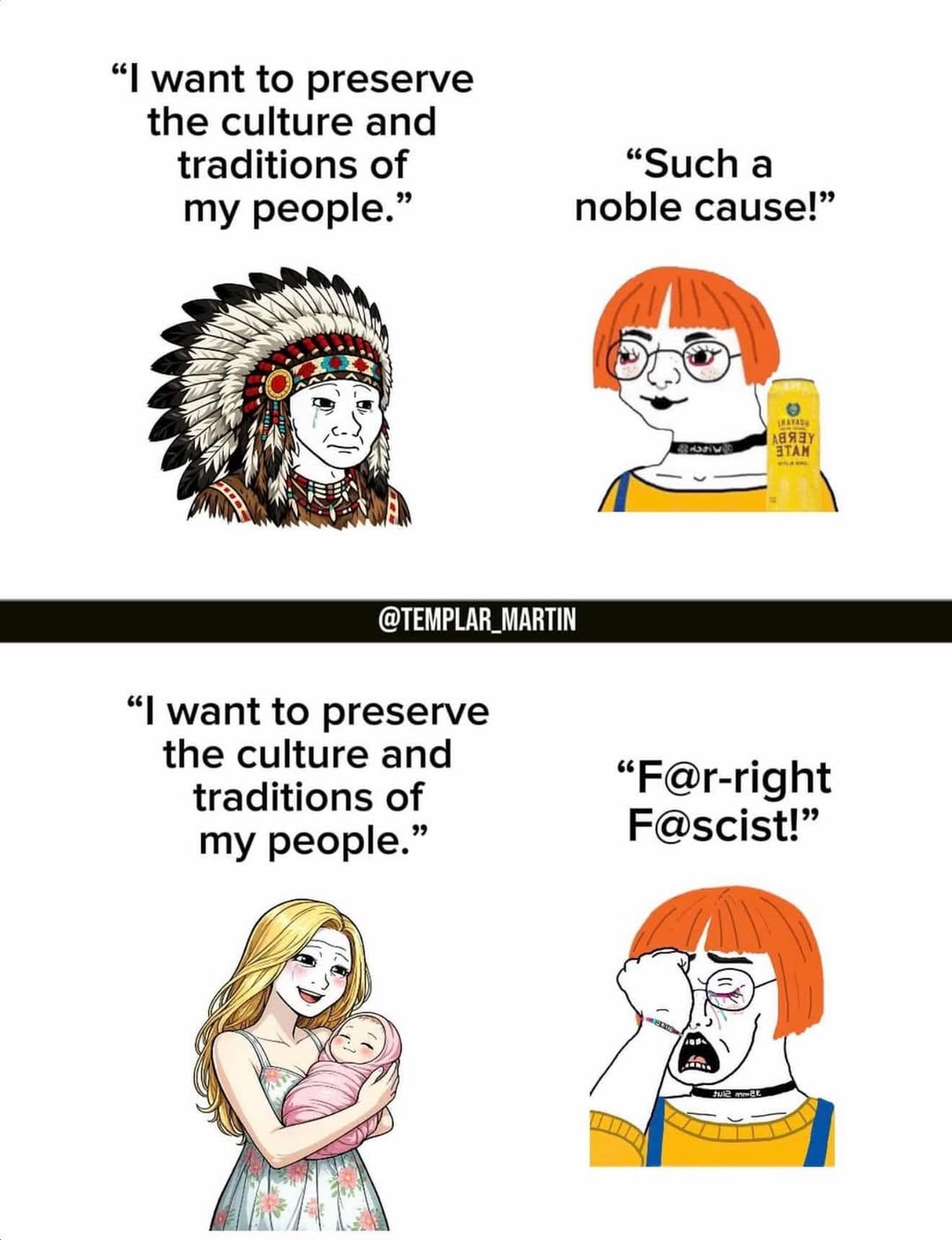
I came across a meme today that highlighted a striking double standard. On the left side of the top panel, there’s a man in a headdress essentially saying, “We just want to preserve our culture and traditions of my people.” On the right, a person with blue hair, piercings, and all the rest of it responds, “Oh, that’s so noble.” Below that, the left panel shows a white mother and her child saying the same thing as the headdress man: “We just want to preserve our culture and way of life.” But on the right, the blue-haired person replies, “Far-right fascist!”
Popular meme on a double standard
It’s a disturbing cartoon (which is pre-bunked by the claim that the post originates with a racist content maker) that speaks to something deep about what’s happening in society. Why can’t native white people make the same claim that American Indians can? How was it even possible for a few boats crossing the Atlantic to colonize and take over an entire continent? How is it that a word black people use all the time is forbidden for white people to use? Why is free speech constrained by a particular frame regulating racial matters?
As the Hodge Twins observe, minority groups in America—and immigrants—want power. Not all of them (maybe not most of them), but their leaders do, at least from what we see. They can’t use force against the majority, since they’re outnumbered. So, they use rhetoric to delegitimize the majority and advance their goal of undermining cultural and national integrity. Immigrant advocates can argue that assimilation is an attempt to destroy their culture, and they use that to remain in ethnic enclaves that provide a base for power centers that erode the majority culture and weaken it from within.
But whatever rhetorical power these groups have, it must come from outside the group itself. If whites were truly far-right fascists and colonizers who established white supremacy, why would they walk on eggshells, avoiding anything deemed offensive? Why would they allow resistance to assimilation? Why wouldn’t they force it?
White people and minorities who stand with them have been put in a bind: When they want to preserve their majority and culture, it’s portrayed as illegitimate, while minorities’ desire to preserve theirs is seen as legitimate—even though it’s an obvious contradiction. Whites would like for them to assimilate and become part of the mainstream, to become American. That’s a positive move. They’re not trying to erase people; they’re trying to welcome them into the country as countrymen. Their home cultures remain intact. If they want to live by those values, why come here? It’s the people who don’t want America to exist who resist becoming American. That makes it colonization.
But again, there must be some other power at play. One of the tricks the small number of men who crossed the Atlantic used so many centuries ago was to find members of the indigenous population willing to work with them, forming coalitions to expand their numbers. These are called colonial collaborators—enemies within who join with the invaders. We see this today with progressivism. Minority leaders will say America is a piece of shit. Since they’re smaller in number, it shouldn’t matter—except that many other Americans join them and agree: “You’re right, America is a piece of shit.” Tens of millions of Americans hate America. They are conditioned to hate America.
But that’s still not enough to explain it, because we must further ask: Why would Americans do this? Who (dis)2organized them this way? It’s different from the colonization of the Americas, where there was no nation-state—just tribes at war with each other. It was easy to fracture them and ally with one to wipe out another. To be sure, the United States, when built, had its internal rivalries—the biggest being the Civil War. Then, during mass immigration in the late nineteenth and early-twentieth centuries, groups came in and created ethnic enclaves, leading to gangs and other problems—and most importantly, the disorganization of American culture, which progressives promoted with the idea of cultural pluralism, what today we know as multiculturalism. But the patriots stood up and cut off immigration and built a unified nation, keeping whatever powers were above us from dividing us.
Why would I put myself in his shoes? There is absolutely no way I would break into another country and expect to jump the line ahead of actual immigrants who do it properly. Frankly, I don't understand why he's complaining. Once they're gone, life is going to become a lot easier… pic.twitter.com/kRMhwqJiVb
That lasted several decades, but then they opened the borders again, bringing in people from radically different cultures. They organized the colonial collaborators—the progressives who hated the nation anyway—and said, “Join with these minority groups.” I’m thinking about this today because I saw another meme: “You want lower rents? Deport 20 million illegals. You want cheaper healthcare? Deport 20 million illegals. You want cheaper auto insurance?” And so on. Every line makes perfect sense from basic political economy. Yet cities across the United States say, “You can’t come in and deport the illegals who are destroying our quality of life, fracturing our culture, diminishing the majority, and refusing to assimilate”—unlike the previous waves of immigrants brought in for the same ends. Cultural pluralism was rebanded as multiculturalism. Old wine in new bottles.
The questionof who is key. It’s not a conspiracy; this is the biggest project any group could pursue. You couldn’t hide something that big—others know who’s behind it. You can clearly see the Democrats are behind it, but where did they get their power? When Bernie Sanders was asked about open borders in 2015, he said, “That’s a right-wing idea, a Koch brothers’ idea. That’s terrible for working people.” He was right. He doesn’t make that argument anymore because he’s become a colonial collaborator. Every man has his price, they say—and while I don’t think that’s always true, it was for Bernie.
But go back to what he said before he was corrupted: He told the truth about who’s doing this. Not just the Koch brothers, but big capitalist powers and big finance, of which the Kochs are a part. They say it openly sometimes, but other times code it in terms of compassion and empathy—emotional blackmail to shame kindhearted people (which is most of us) into compliance. A lot of people walk around thinking, “Oh my God, wouldn’t it be great if… but I don’t want to look like an asshole” or “We’re all human beings,” blah blah woof woof.
Once you realize it’s transnational corporations and big finance, ask yourself: Do I have interests in common with them? I’m just a working person trying to live in a safe neighborhood, maybe own a house, and save for retirement. I just want my kids to grow up happy, get married, and have children so I can have grandchildren. You know, all the good and normal things. And I want to worship God—or not—if I choose. But I know I don’t want that god. I don’t want people who hate dogs, blast calls to prayer throughout my city, or make women dress in garbage bags. But I’m such a piece of shit for not wanting that. I won’t be a good person unless I let these colonizers run over me.
Make no mistake: These are colonizers, sent by big economic powers. Those powers control the Democratic Party, which is trying to establish a one-party state to open the borders and flood the country. They’re doing it in Europe too. Why are so many people engaged in collective civilizational suicide?
Anyone with eyes wide open can see this. I’m watching Europe being Islamized and lost to multiculturalism. I look at the United States—we’re not as far down that road, but we’re headed there—and I think, how can we let this happen? Why would the people allow it? The fact is, tens of millions of Americans don’t want it, but arrayed against them are the university system, public education, the culture industry (all of Hollywood and the rest of the entertainment Goliath), the mass media, and the administrative state—operating by rules developed by a permanent political class that’s part of this project.
The patriots live mostly in rural communities and small towns; they don’t control the cities where the action is. They control most of the counties, but that’s outside the cities. They’re a big number and could rise, but if they do, they confirm what’s said about them in that meme: “You’re a fascist, far-right.” If people rise to save their nation, they automatically prove the false claim that they’re what the destroyers say they are. Every hegemonic institution conveys this false reality, sucking tens of millions into an illusion that allows the country to be destroyed. This is why patriots need to stop worrying about being called racist, nativist, or fascist. By the progressives’ terms, the Founding Fathers were racist, nativist, and fascist—and indeed they say that as part of their propaganda to destroy the nation: “This country rests on a white supremacist foundation. It’s racist.”
A black man who had learned the truth, left the Democratic Party, and became a Republican, asked a protester, “Who was the first Republican president?” The protester didn’t know. The black man said, “Abraham Lincoln.” The protester looked confused. Abraham Lincoln was a Democrat, right? The Democrats fought against the Confederacy and freed the slaves. Republicans were the racists. That’s what he was thinking. You could see the confusion because many believe this inverted history. He even falsely believed that Lincoln owned slaves. The fact that Lincoln was a Republican and Republicans did all that gets memory-holed. As the conversation continued, the man couldn’t figure it out—he never tested his beliefs against external reality or objective history. What he believed was tribal, reinforced by a group with an inverted view of history and current events, making him resistant to truth. He moves with his eyes wide shut.
This hegemonic project has gone on long enough to produce tens of millions of zombies who will destroy their own country, believing patriots are the fascists and that welcoming non-assimilating people makes them anti-racist. They will destroy the country, believing that they are the good guys. The very idea of nationalism—having an integral nation-state—sounds like fascism to them. Assimilation—integration, welcoming people to become part of our culture (“out of many, one”)—sounds racist: “You want to destroy their culture, erase them.” Well, they could stay where they came from. If they come here, they become part of our culture. Why come to America if you don’t want an America to come to?
Think about the reverse: Suppose white immigrants decided to go to some Sub-Saharan African country. First, black Africans might say, “We don’t want white people here”—their prerogative; there is no right to migrate to another country. Progressives would cry, “Why are white people colonizing a black African country?” Not, “They’re seeking a better life; why are black Africans so mean? Bunch of racists.” No progressive would say that because it’s not part of the mind-space they’ve been indoctrinated into. Suppose black Africans said, “Okay, become part of our country—adopt our culture, learn our language, you’re welcome.” If whites said, “No, we want our own enclave, our own power centers, to change your laws,” The black Africans would say, “That’s not going to work.” Would whites call them racist? See how it doesn’t work outside the ideological frame? When you step outside the frame, it doesn’t make sense. You can see things clearly. This is why you test your ideas and beliefs against independent reality and objective historical narrative.
The double standard exposed in that “racist meme” isn’t accidental—it’s mocking the engineered outcome of a long-term ideological and economic project designed to fracture national cohesion and replace sovereign peoples with atomized, controllable populations. What began as colonial tactics of divide-and-conquer has evolved into a modern form of colonization, where the tools are no longer muskets and alliances with warring tribes, but mass migration from incompatible cultures, relentless propaganda through education and media, and economic incentives from transnational capital that profits from cheap labor, suppressed wages, and eroded social solidarity.
The bind I describe—where preserving one’s culture is branded “fascist” while minorities doing the same is celebrated—is a see core mechanism of this project. It weaponizes guilt, shame, and the fear of social ostracism to paralyze resistance. Patriots are trapped: speak up, and you’re labeled the very thing the propaganda claims you are; stay silent, and the demographic and cultural transformation accelerates unchecked. Yet history shows that empires and nations fall not from external force alone, but when internal collaborators—whether indigenous elites in the past or today’s progressive class—lend legitimacy to the invaders’ cause.
We can know the drivers of the project because we can see them: big finance and corporations that benefit from open borders (as Bernie Sanders himself once admitted in 2015), coded now in the language of diversity, compassion, and human rights to emotionally blackmail the well-meaning. The Democratic Party apparatus, the administrative state, academia, Hollywood, and corporate media form the hegemonic machinery that inverts reality—turning assimilation into “erasure,” nationalism into “supremacy,” and self-defense into “hate.”
But here’s the turning point we must seize: this illusion is cracking. In the United States as of early 2026, the second Trump administration has already deported hundreds of thousands, prompted millions more to self-deport, and slashed unauthorized border arrivals to historic lows through aggressive enforcement and expanded detention. Resources are shifting toward American citizens—lower strain on housing, healthcare, and wages in affected areas—proving the political economy I highlighted in that second meme isn’t abstract theory; it’s delivering tangible relief. The cities and blue enclaves that once resisted are increasingly isolated as federal power reasserts itself.
Europe’s trajectory is grimmer: projections show Muslim populations continuing to rise sharply (e.g., toward twenty percent in Germany, higher percentages in Sweden by mid-century), with visible cultural shifts in major cities fueling debates over Islamization and multiculturalism’s failures. Yet even there, populist pushback grows, as ordinary people reject the narrative that preserving their heritage is illegitimate.
The zombies I describe—those indoctrinated into tribal inversions of history, blind to objective reality—will always exist in large numbers under sustained propaganda. But they don’t need to win. Patriots don’t need universal approval; they need resolve. Stop internalizing the slurs. The Founding Fathers built this nation without apology for their identity or purpose. Lincoln preserved the Union against division. If defending borders, enforcing laws, and expecting newcomers to adopt the American way makes one a “fascist” by progressive standards, then let them sling the mud—because the alternative is surrender.
Test everything against reality: step outside the frame, reverse the scenarios (whites demanding enclaves in Sub-Saharan Africa or elsewhere), and the hypocrisy collapses. The project relies on that frame staying intact. Break it by speaking plainly, organizing locally, supporting enforcement, and refusing shame. The country isn’t lost yet—it’s waking up. They’re trying to tell you that they’re dreaming, but you are awake now. The question isn’t whether the destroyers can be stopped; it’s whether enough patriots will act before the illusion becomes an irreversible demographic fact.
Preserve the nation not out of hate, but out of love for what it was built to be: a unified people—out of many one—under laws, language, and values that made it exceptional. If we fail to defend that, there will be no America left for anyone to come to and assimilate into. The time for walking on eggshells is over. The time for clarity and courage is now.
The Congressman from Florida’s 6th Congressional District, Randy Fine, an observant Jew, has triggered Islamophiles—and even some virtue signalling conservatives (Megyn Kelly, for example)—with a post defending dogs in the face of the Islamist takeover of the West. In Islam, dogs are “unclean.” There is a debate about whether this is obvious in the doctrine; however, it is a widespread belief among Muslims. Practically speaking, when Muslims run the world, the relationship between man and canine will be fundamentally altered.
If they force us to choose, the choice between dogs and Muslims is not a difficult one.
Islamophiles are portraying Fine’s post as a call for genocide. This is an absurd characterization, which I will come to in a moment. But what allows progressives to portray his post in this way is by omitting context, which is typical of how the enemies of freedom operate, and the false belief that Muslims represent an ethnic or racial group, a falsehood suggested by the propaganda construction of “Islamophobia.”
For context, Fine is responding to a post by the pro-Palestinian activist Nerdeen Kiswani.
Finally, NYC is coming to Islam. Dogs definitely have a place in society, just not as indoor pets. Like we’ve said all along, they are unclean.
Where do Muslims get this idea? According to the Hadith, particularly in the writings of Sahih al-Bukhari and Sahih Muslim, among other things, angels do not enter a house with a dog. The only purpose of dogs permitted in Islamic belief is herding and hunting. Even here, to keep a dog in the house is unclean. The naïve might soothe themselves by noting that Muslims are not in command of Western democracies. But New York City just elected an Islamist to be its mayor, Zohran Mandami. And Sadiq Khan of the Labour Party has been the Mayor of London since May 2016. These won’t be democracies if this trend is allowed to continue.
To return to Fine’s post, I want to illustrate by way of analogy why the congressman’s post cannot be a call for genocide. But before I get to that, what is genocide? Genocide, as originally conceived by Polish-Jewish lawyer and jurist Raphael Lemkin in 1944, referred to the deliberate and coordinated destruction of a national, ethnic, racial, or religious group, not only through mass killing but also through actions aimed at eliminating the group’s existence as a social and cultural entity.
Lemkin combined the Greek word genos (race or tribe) and the Latin -cide (killing) to describe a process that could include physical extermination, prevention of births, forced transfer of children, and the destruction of cultural, economic, and political institutions. His concept emphasized intent—the purposeful effort to destroy a group, in whole or in part—and influenced the legal definition later adopted by the United Nations in the 1948 Genocide Convention, which formalized genocide as an international crime.
However, Lemkin’s definition is too expansive. Lemkin’s original concept included not only mass killing but also cultural, social, and economic destruction—what he called “cultural genocide.” If genocide includes destroying identity, institutions, language, or traditions without physically killing a group, the term overlaps with assimilation and colonization, which dilutes its meaning and, furthermore, condemns nation-building as a serious human rights abuse. Under this definition, nations based on individualism and universal human rights can be falsely portrayed as oppressive projects and delegitimized or punished on that basis. The common trope on the left that the West is genocidal is the consequence of Lemkin’s expansive definition.
At the time of the legal adoption of Lemkin’s definition in international law, the United Nations intentionally narrowed genocide to specific acts committed with the intent to destroy national, ethnic, racial, or religious groups. However, even this definition is too expansive, since it arbitrarily elevates religion as a special form of ideology without any rational basis for doing so. Belief in a god or gods makes religion no different from an ideology that promotes any other potentially pernicious notion. The same is true for nationalist movements based on ideas that are destructive in practice. I hasten to emphasize that not all religions or nationalist movements are harmful. But some are, and the survival of freedom depends on our recognizing this fact.
Consider religious systems that advocate genital mutilation to mark individuals as members of a tribe. Male circumcision in the Islamic systems is widely permitted in the West. However, some Islamic cultures mutilate the genitalia of females. This is generally not permitted in the West. The tolerance of one and not the other makes no rational sense since both types of circumstances damage the genitalia and alter their function. To be sure, prohibiting either does not destroy a religious group in the UN’s narrowing of Lemkin’s definition, but a more expansive definition can argue that erasing a chief marker of a religious group erases that group in part.
This is also true for other ideologies that are not rationally different from religions that practice gender mutilation. Gender identity disorder is the obvious analogue. Here, based on the quasi-religious belief that a girl can be born in a boy’s body, the queer tribe is declared erased when the practice of genital mutilation is prohibited. Indeed, this is the language used by trans activists in defending the practice of genital mutilation, found in the rhetoric of “trans genocide.” (See Mamdani, DSA, and Child Mutilation; Trans Day of Vengeance Cancelled Due to Genocide.)
The existence of nationalist ideology that is potentially destructive in practice is also relevant here. As with the genocidal desire of Hamas to wipe the Jews from the face of the planet, National Socialism seeks the erasure of Jews from the planet, not by wishing the end of the Jewish religion (as the atheist Karl Marx did in his wish that all religion would end, which necessarily includes Judaism), but by wishing the end of Jews as an ethnicity or race. Crucially, wishing the end of Islam rationally precludes the wish to erase those who subscribe to Islam since Muslims are neither an ethnic group nor a race.
That a world without Nazism would be a better world is a common moral intuition. However, we shouldn’t avoid recognizing that the claim raises a philosophical question: Does expressing such a view amount to endorsing harm against people, or is it a legitimate moral condemnation of an ideology and a desire that the ideology should disappear from the earth, or at least be prohibited from acquiring political power? A careful argument shows that rejecting Nazism targets a system of beliefs and political practices, not the inherent worth of persons, and therefore does rise to the threshold of genocidal intent. Such an argument illustrates the inherent problem with Lemkin’s definition.
Nazism—historically institutionalized by the National Socialist German Workers’ Party—was not merely a set of private opinions. It was a comprehensive political ideology that justified aggressive war, authoritarian rule, racial hierarchy, and state-sponsored persecution of ethnic groups. The ideology’s consequences were not accidental; they followed from core doctrines about political authority (anti-democratic and illiberal) and race. To judge that a world without such an ideology would be better is therefore to make a moral evaluation about the content of the ideology and its practical outcomes: fewer justifications for state violence against minorities, fewer wars of aggression, and a prohibition against ethnic and racial persecution.
The philosophical distinction at stake is between condemning beliefs and condemning persons. Beliefs and ideologies are contingent; people acquire them through upbringing, persuasion, propaganda, and social conditions. All these are changeable. At least in a free society (apostasy in Islam warrants the death penalty), persons who once held extremist views may later reject them. To oppose an ideology—and this includes religion—is thus to oppose a framework of ideas, not to deny the humanity of those who hold them. Indeed, if beliefs can change, then the moral response to harmful ideologies often involves education, lawful restrictions, persuasion, and social pressure, such as ridicule and shaming, rather than violence against individuals as a first resort. Assimilation is thus a powerful tool in the arsenal against the spread of pernicious cultural and religious practices.
This distinction protects a basic moral principle: from the view of universal human rights, individuals possess moral standing independent of their political commitments. Liberal democratic traditions, in particular, hold that even those with repugnant views remain persons under the law. Denazification does not erase individuals who subscribe to National Socialism; it erases or marginalizes National Socialism. The same is true with resistance to Islamization. The Muslim as a person is not erased with the erasure of his ideological beliefs.
Punishment or restriction is justified not only when people commit crimes or incite violence, but when their ideological practices threaten the survival of a nation. Opposition to Nazism or Islam is not merely manifest because people hold objectionable opinions; rather, opposition is to these opinions in action or the potential for their manifestation in practice. Therefore, rejecting Nazism as an ideology is compatible with recognizing the rights of individuals and opposing extrajudicial harm, as well as defending a population—including those who may be conscripted in the ideology or who wish to escape it—from the possibility of the ideology becoming manifest in action. Because both Nazism and Islam are ideologies, and moreover highly similar, the same must be true with respect to Islam. To argue otherwise is to engage in the fallacy of special pleading.
Saying that a world without Nazis would be better need not be a call for violence against those who subscribe to National Socialism or Islam (which I oppose); it can instead express the hope that such destructive ideologies lose their appeal, fail to spread, or are replaced by more humane philosophical and political visions, and manifest that hope in assimilation and the other methods I have identified above. The ethical task is not to eliminate persons but to reduce the influence of ideas that historically have produced immense suffering. In short, condemning Nazism and Islam—the wish that these systems either did not exist or are only held by a few who are kept from power—is a moral judgment about an ideology’s consequences, not a denial of human dignity. A world without destructive political doctrines would ideally arise not through persecution, but through the gradual triumph of education, institutions, and social norms that make such doctrines unnecessary and unattractive. However, when faced with existential threats, the resort to coercion must remain on the table.
This is the point of Randy Fine’s post. Wrenched from context, and with the assumption that Muslims are analogous to an ethnic, national, or racial group, a false claim is socialized that defending the West from pernicious ideologies constitutes genocide. Nothing could be further from the truth. The condemnation of Fine’s preference for dogs over Islam is an attempt to entrench tolerance for a pernicious ideology that seeks the erasure of democracy and freedom.
Jesse Jackson died today. This essay is not a reflection on his career and legacy (I leave that to others). Instead, I want to use the occasion of Jackson’s passing to emphasize a point about free speech. This concerns an attempt to suppress my speech in the spring of 2024. At the same time, the moment does recall an attempt to derail Jackson’s criticisms of Barack Obama, who, in the context of his successful 2008 campaign for president, was appealing to the white vote by condescending to black Americans.
Of course, it shouldn’t have mattered if I had. There is this thing in the United States called free speech. You may have heard of it (you can brush up on it by going here: Republicanism, Free Speech, and the Illiberal Impulse). It’s part of the fundamental law of the American republic. This is how we know that progressives do not believe in the American way: they police language and seek to use the government to do the dirty work of authoritarian desire.
I work at a public university, and the petition was an attempt to persuade the administration to deprive me of my rights. The university did not act on the petition, but employees at other public institutions have been disciplined and even terminated for uttering certain words and opinions. This is the result of progressive infiltration of academia, which is, as I shown and will again show here, antithetical to the foundation of the American Republic, which rests on classical liberal principles.
Progressivism is rooted in a particular strain of liberalism called utilitarianism, which rests on the philosophical foundations of consequentialism. Consequentialism is the ethical theory that the moral rightness or wrongness of an action is determined solely by its outcomes or consequences. Such a system is necessarily preference-based, and there is no check on the means to achieve those ends apart from arbitrary statute, which requires the unjust exercise of power. (See Moral Authority Without Foundations: Progressivism, Utilitarianism, and the Eclipse of Argument.)
Utilitarians believe government action should be judged by what produces the greatest happiness for the greatest number, including how policies make people feel. If a word offends people, if it makes them feel bad, and the government acts to protect them from offensive speech, because government action lacks a fixed moral ontology, whatever means it deems necessary to achieve that end may be justified. This leads to majoritarianism, which America’s Founders explicitly rejected as the tyranny of the majority. James Madison did not even like that word for this reason (see America is a Republic). Utilitarianism is at best a form of soft totalitarianism, in which those who are offended by speech may, if they acquire sufficient power, suppress those who utter it.
By contrast, the Founders subscribed to a deontological liberalism grounded in a moral ontology that defends individual rights—including the right to speak in ways others may find offensive—these found in natural law, which is discerned through reason and observation. A government founded on individual rights protects the man from the mob, permitting each person to speak and write freely without government interference. However much one may wish never to hear certain words or opinions, the authority to control speech must itself be subject to moral limits. This framework guarantees equality in the truest sense: every person possesses the same right to speak and express opinions. There is no right to not be offended. (See Epistemic Foundations, Deontological Liberalism, and the Grounding of Rights.)
This distinction has profound implications for the kind of democracy we will enjoy—or suffer. The system established by the Founders is a republican form of government, in which the will of the people operates within constraints that protect individual liberty. It is anti-totalitarian by design. The alternative, advocated by progressives—majoritarianism—contains no inherent safeguard against tyranny. If 51 percent of the population voted to enslave the remaining 49 percent, there would be no principled basis within that framework to prevent it. Only statutory law could intervene, and such a statute would itself rest on arbitrary authority rather than inviolable principle.
Therefore, freedom of conscience, speech, writing, and association are not merely beneficial to the individual wishing to exercise such freedoms, but are foundational to democratic systems that provide immunity from tyranny that would extinguish the democratic rights of every individual to affect the system. Without the right to utter contrary opinions or to freely hold objectionable thoughts, I cannot persuade others to join me in expressing a collective desire to change circumstances. I cannot share observations that might result in mutual knowledge. I cannot criticize actions that I regard as harmful.
And this is precisely why progressives police language. The main reason the petition was circulated is that I oppose the gender identity doctrine. I show that gender identity is a false construct—or in any case an unfalsifiable claim—and can therefore demonstrate why gender affirming care is an unethical practice. I can also show why preferred pronouns involve misgendering, recoded as their opposite. I can show many other things, as well. Those who want to silence me do so because their project depends on mass ignorance about the ramifications of queer doctrine, and they know I am persuasive. If the truth about gender is allowed to spread, their politics are doomed, and this they must prevent—and the free speech right is there to prevent them from successfully doing so. Ideally, they would pursue rational arguments to counter my opinion, but since there is no rational rebuttal to my position, they seek to silence me instead.
That was the point of my 2008 essay. The media sought to shame Jackson for his language because he was using the slur to criticize Obama’s anti-black propaganda, a strategy Obama put central to his campaign for president. Obama condescended to blacks to reach the white audience whose votes he needed to win office. He was convinced that the best way to garner white support was to say things he believed white people think but are afraid to say. Jackson knew what Obama was up to, so the mass media had to delegitimize Jackson to prevent the spread of mutual knowledge.
Back in the 1970s, our teachers made us memorize the Preamble to the US Constitution in high school: “We the People of the United States, to form a more perfect Union, establish Justice, ensure domestic Tranquility, provide for the common defense, promote the general Welfare, and secure the Blessings of Liberty to ourselves and our Posterity, do ordain and establish this Constitution for the United States of America.”
When George Washington sent troops to Eastern Pennsylvania to suppress the Whiskey Rebellion, he was called a king and a tyrant. Would progressives (if there were then such a thing) have called him those things? When Abe Lincoln ordered troops to kill Southerners in the Civil War, he was called a king and a tyrant. Would progressives agree? Ulysses Grant sent troops to address racial violence in the South and confront the Ku Klux Klan. Surely progressives wouldn’t oppose that. Dwight Eisenhower sent troops into Little Rock to force racial integration. John Kennedy sent troops to Alabama and Mississippi for the same reason. Were Eisenhower and Kennedy fascists?
Democrats have manufactured a subjectivity, reinforced by progressive hegemony over academia, the culture, industry, and mass media, in which the President is represented as an authoritarian. It’s a ruse: posit the President is a fascist; rebel against civil authority; when he does what past presidents did, claim he proved his fascism; then use the proof to deepen the resistance.
Democrats dwell on January 6, 2021. It was an insurrection, they say—the worst calamity since Pearl Harbor. It wasn’t nearly as bad as the Summer of 2020, truth be known. Untoward things were going on at the Capitol, but some patriots did get caught up in the moment that day. However, the difference between January 6 and the continuous left-wing rebellion is that the January 6 crowd acted to save their beloved country. The left-wing rebels, in contrast, have something more radical in mind: the destruction of a loathsome nation. To be sure, both sides want power. But what do the neoconfederates want power for? The same thing the Confederates did before them. We stopped the Confederates with violence. How, with the fascist trap set, can we stop the neoconfederates?
* * *
When it’s their president, progressives want a decisive and uncompromising leader. They don’t want a president who’s going to cave to the Republicans. They want a bold leader who’s going to pursue their agenda. Republicans will put up opposition, and they may call the other side’s man names, but since the dominant sense-making institutions are all biased towards progressivism, this doesn’t delegitimize a Democrat president. We all know that their man isn’t really Stalin. It would sound silly to call him that. We know that the Democratic Party is not really pushing socialism, even if the Democratic Socialists of America say they are (more on that in a moment).
But when a populist Republican occupies the White House and doesn’t assume the role of controlled opposition, he becomes Hitler. A liberal businessman from Queens (with a gay Treasury secretary), Trump is a stubborn man elected to pursue an agenda on behalf of the American people. He’s the type of president Democrats wish they had. But Trump is from the wrong side of the aisle. So, rather than accept that they lost the election like Republicans do when they lose, Democrats burn down the house.
Americans loved Trump when they watched him on The Apprentice because they saw a decisive leader. He was asked all the time by progressive talking heads, “When are you gonna run for president?” But the second he decided to do that, the progressives lost their composure. When they lost the election, they lost their minds.
Losing elections is normal in a democracy. Indeed, it’s a sign of democracy. The losers go back to their huts and think about how they’re going do a better job of messaging and try to win the next election. But progressives don’t work from the premise of democracy. When they lose, they don’t do what a respectable political party does; instead, they attempt to delegitimize the government and toss its elected leader.
The chaos of the last decade is due not merely to Trump, but to progressive resistance to democracy itself. Trump’s not doing anything out of the ordinary. He’s enforcing the law and representing the will of the people. The voters wanted a president who would reconfigure the world trade system. They wanted him to close the borders and deport illegal aliens. They wanted a man who would protect women’s opportunities and safe spaces.
All these facts point to a fundamental difference between Democrats and Republicans. At least today’s Democrats. Democrats today are remarkably authoritarian. They not only want to win elections by any means necessary; they want to prevent the opposition from having any say about what happens to their democracy. They can’t accept the democratic way because they abhor it. It gets in their way. They have already promised to impeach Trump if they regain the House.
In this sense, the Democrats’ smears of fascism and Hitler represent a projection of their authoritarian tendencies and the desire to have their own charismatic leader, one who will impose his will on the American people. They see in Trump their wish. Only he’s working from the wrong side. This is why Democrats don’t want election integrity. They seek a one-party state.
Ex-Marxist David Horowitz once said that, for the left, the issue is never the issue. The issue is the revolution. According to Horowitz, activists on the left don’t care about the specific issue they claim to champion on any given day. The slogans are interchangeable. Anti-ICE resistance is a moment to cause chaos to confirm that a duly-elected president is an authoritarian and expand the struggle. Whatever the issue—Black Lives Matter, No Kings—these are means to an end: the destruction of national sovereignty and the overthrow of the American System.
But it would be a mistake to believe that the communists on the street are really behind this moment. They’re useful idiots for something entirely different. The mob desires revolution, to be sure, but the destination is handed down from on high. The plan is to replace national economies with a transnational corporate state.
It is naïve to believe that the elites organizing the resistance would trust the rabble to run world government. They know, like I know (you know it, too), that the mob is not up to the task of governance. But mobs can do the dirty work, and their task is to destabilize the West to open the way to the New World Order, where useful idiots become the marginal figures they were destined to be.
CNN is reporting new polling that shows that fewer than one in ten Democrats identify themselves as conservative, which, in accurate political science language, means classically liberal. CNN polling from last year shows that one-third of Democrats now identify as socialist. Among those 35 years and younger, four in ten identify as socialist. That number must be enormous now. The CNN polls vastly underestimate the degree to which the Democratic Party has become a socialist party. Richard Baris’ polling finds that nearly two-thirds of Democrats identify as socialist. He finds that the Democratic Party has, over the last several years, been on a glide path to authoritarianism. Socialism is antithetical to the American way.
But what kind of socialism? The “democratic socialist” brand is just that: an Orwellian deception deployed to disguise the actual socialism Democrats advocate. Democrats advocate the French version of socialism first delineated by Henri de Saint-Simon in the eighteenth century. Saint-Simon’s vision of socialism was world technocracy, a system in which administrators, experts, industrialists, and (industry-aligned) scientists run society. There’s another word for that: transnational corporate statism.
Those on the right who are quoting Horowitz today have it only half right. (Steve Bannon, do you have your ears on?) The issue is never the issue—that part is right. But the revolution is not communist in essence. Nor is it in form. It is the very thing progressives project onto Trump: a new and improved fascism.
The expectation is that Democrats will regain the House of Representatives. If that happens, America is in trouble. Those conservative Democrats are in the wrong political party. The Republican Party is the home of classical liberalism. It’s time for that eight percent to come home.
Here’s an example I see all the time on social media and in street interviews: “Donald Trump is a trust fund baby.” The blankface dummy in supervillain garb repeats this as if it is a remarkable and essential truth. (We see this also in the constant repetition of the irrelevant fact of Trump’s felony conviction. See “Trump is a Felon!” The Squawking of Party Parrots.)
Trump inherited an estimated $177 million from his father, Fred Trump, when the family real estate empire was sold after Fred’s death in 1999. Trump received at least $413 million total over his lifetime through inheritance, gifts, trusts, and loans. When Trump entered the White House in January 2017, Forbes estimated his net worth at about $3.5 billion. As of February 2026, his net worth is estimated at roughly $6.6 billion, fluctuating mainly due to real estate holdings and stock valuations.
The talking point denies the truth: the man took the millions he inherited and made himself a multi-billionaire, not only in real estate but also in, among other ventures, producing a successful TV show that ran for several years. The Apprentice was not just a hit—it topped the ratings charts at various points, making Trump a household name. How is this the record of a “failed businessman”?
“Because he declared bankruptcy many times.”
Trump himself has never declared personal bankruptcy. Six of his companies filed for Chapter 11 bankruptcy between 1991 and 2009, mostly involving casinos and hotels. However, this is not unusual in large-scale real estate, where developers commonly use bankruptcy strategically to restructure debt while protecting personal wealth, and many successful real estate billionaires have had multiple corporate bankruptcies during their careers. The fact that bankruptcy is a tool in successful business practice is mundane. You may not like it, but it is, and it’s not like personally declaring bankruptcy (there is no shame in that, either).
“And now he has bankrupted the Kennedy Center!”
Trump did not bankrupt the John F. Kennedy Memorial Center for the Performing Arts. When he assumed the position of chairman of the board, artists, performers, and production companies—cultural elites programmed with progressive ideology—boycotted the center and canceled their engagements. Ticket sales plummeted and, as a result of organized protest, the center now faces financial and operational strain. A planned two‑year closure for renovations was exaggerated into existential concerns about the institution’s cultural standing and future stability. “He even put his name on the building!” He won’t be president forever. A future president can take it off.
“But the East Wing!”
Stop and address the question. How is Trump a “failed businessman”? Clearly, he isn’t. He is on the list of the 400 richest individuals in the United States—and he earned that status as a successful businessman. This is the diametric opposite of the zombie’s portrayal.
But there is a deeper question: why does any of this matter? So Trump inherited money from his father. So Trump’s business ventures have occasionally run into financial difficulty. So a handful of his companies declared bankruptcy. So Trump put his name on a building. Hardly unusual for a wealthy man.
Is that the problem—that he is rich? Is it class envy? Nietzschean Ressentiment—the deep, internalized resentment of the failed and self-perceived powerless towards the self-actualized and successful that shapes slave morality?
At the founding of the country, George Washington’s relative wealth in his era—landholdings, stocks, etc.—made him the undisputed richest individual in the country. Ponder that, if you will: the richest man in America became America’s first President. Moreover, Washington faced serious financial difficulties at times in his life. He managed these deftly and died a wealthy man.
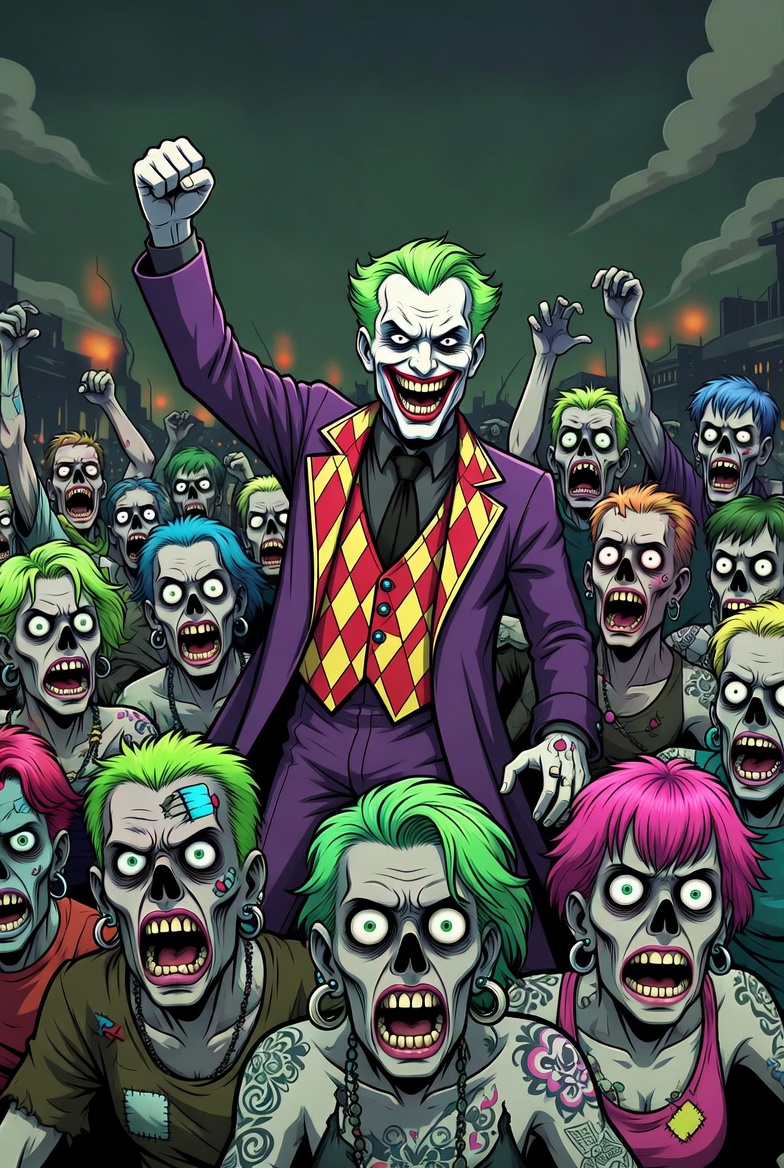
Try explaining this to a zombie. It won’t work. Try explaining fascism to a zombie. Same blank stare. Rudimentary biology draws the same reaction. Zombie mode is an impenetrable state of mind. Progressives lumber about seeking brains because their own have atrophied.
This mental state is akin to the phenomenon of a programmed assassin—an individual who is the product of conditioning, ideological influence, and manipulation to kill without fully autonomous intent or moral deliberation. The programmed assassin is not a rational actor but a tool—shaped by external forces, e.g., leveraged personal grievances, psychological conditioning, or radical ideologies—that, on command, channels action toward a specific target. The culmination of layered manipulation, obsessional drives, and social pressures programs an individual to commit violence. (We see this in Islam, as well, with the suicide bomber phenomenon. See Message to the Rank-and-File Progressive; Alliance of Death Cults: The Rise of Lethal Misanthropy in the West.)
That example might seem extreme. But it’s the same dynamic that lies behind the flipping of a switch that causes thousands to take to the streets (to join the professional agitator who earns his living at it), one day chanting and waving signs with the slogan “Free Palestine!”, the next day, “No Kings!”, and the day after that, “ICE Out!”
When a zombie driver follows around ICE officers rounding up child molesters and rapists illegally present in our country, says, “I don’t care,” after an ICE officer generously explains that they are doing—that’s zombie mode. It’s the mind state that lies behind an activist mashing the accelerator pedal when an ICE officer walks in front of her car, or the “constitutional observer” bringing a firearm to an organized effort to interfere with law enforcement operations. (see Wokedom and the Problem of Lethal Altruism; also “Assault Me, Motherfucker!” Suicidal Altruism and the Politics of Suicide Contagion; “The Whole System is Guilty!”)
Have you ever seen the Fleischer Studios Superman cartoon from the 1940s, “The Mechanical Monsters”? It’s like that. The mad scientist, Dr. LeHah, controls the robots with a big console full of levers and switches. There’s a dramatic moment where he flips a switch, and the robots immediately stop what they’re doing—I think in one scene they’re raiding a bank—and switch to another task, obeying his commands instantly. LeHah has total control over mechanical soldiers responding to a single will. (I have used this analogy before, see Robots and Zombies Assemble! We Must Have War!)
This is the purpose of “inclusion” in progressive circles: appealing to disordered personalities to amass an army of robots. This explains why, when most of America has awakened to the madness of gender identity doctrine, Democrats introduce legislation to recognize “trans rights,” including in the list of demands everything ordered personalities reject. It’s a signal to the zombies that Dr. LeHah is still at the controls. (Before Andrew Wilson’s appearance on Joe Rogan’s podcast, I was writing about this. In addition to the essays I have already embedded, see Deviance as Doctrine: The Post-Liberal Moral Revolution; The Politics of Disaster Capitalism.)
To take this analogy to its logical conclusion, in those Fleischer Superman cartoons, Superman isn’t just fighting generic villains; he’s defending ordinary people, society, and the foundational moral order. He stops criminals and mad scientists who threaten the safety and stability of everyday life. In later serials, protecting the public and upholding law and order evolved into the catchphrase, “Truth, justice, and the American way.” Superman is not the Nietzschean Übermensch (“Overman”). The Man of Steel is the personification of our civilization. And this is why progressives will never understand MAGA.
Progressives have turned the world into a living manifestation of a Fleischer Studios cartoon—with some DC Comics villains mixed in (see my 2019 essay Joker and the Mob).
It is striking how pro-capitalist ideologues react when capitalism is described as exploitative. They often assume that the claim is an attack on capitalism itself. Nothing could be further from the truth.
In political economy, exploitation is a descriptive, analytical concept—not a moral verdict. It refers to a structured process by which value is extracted from resources found in ecosystems, labor, land, raw materials, and social capacities within a given mode of production.
To say that labor is exploited, in this sense, is simply to describe how surplus is generated and appropriated through institutional arrangements like wage labor, property rights, markets, and the state.
The surplus is the portion of total social labor that exceeds what is necessary to reproduce the labor power of workers and the material conditions of production at a given historical level. It is the product of surplus labor time—labor performed beyond what is required to produce workers’ means of subsistence—and it appears in capitalism as surplus value, later distributed in transformed forms such as profit, interest, and rent.
The social surplus is not defined by individual firms or transactions but at the level of society as a whole, reflecting a class relation in which one class controls the conditions of production and appropriates the surplus produced by another.
How the social surplus is generated, appropriated, and allocated determines the structure, dynamics, and historical trajectory of a mode of production, making it a central analytical category rather than a moral judgment.
The term identifies a mechanism of value transfer; it does not, by itself, determine whether that mechanism is lawful, fair, or socially desirable.
Image by Sora
This usage differs sharply from the popular meaning of exploitation, which typically implies abuse, coercion, or illegality. In everyday discourse, exploitation is often synonymous with injustice and wrongdoing. In political economy, by contrast, exploitation can be entirely legal, routine, and foundational to economic organization.
Classical political economists and Marxian theorists alike use the term to explain how profits, rents, and surplus arise under capitalism and other modes of production. Whether exploitation is seen as efficient, inevitable, or unjust is a separate question from whether it exists.
The confusion arises when descriptive and normative levels of analysis are collapsed.
Descriptively, exploitation names a relationship: one actor or class systematically extracts value produced by another through socially recognized rules. Normatively, scholars and political actors may argue that such extraction is justified, unjust, or reformable—but those judgments are not contained in the term itself.
Put another way, treating exploitation as inherently immoral imports ethical conclusions into what is, at its core, an explanatory concept.
Within political economy, exploitation functions much like terms such as accumulation, appropriation, or surplus extraction. It allows analysts to map how economies actually work before taking a position on how they ought to work.
I wrote this essay following a discussion on a Facebook thread by the Working Families Party (WFP), in which pro-capitalist ideologues attacked my observation that the WFP errs in suggesting that capitalism is uniquely problematic because of its exploitative practices. (The WFP also errs in its support for mass immigration, which is intrinsically harmful to American working families.)
The pro-capitalist ideologues misunderstood my initial post, where I argued that one cannot eliminate exploitation without overthrowing capitalism. But even this point was misread: since all economic systems are exploitative in some form, eliminating capitalism would not eliminate exploitation as such.
One finally admitted that I was right, but said that, since exploitation originally conveyed wrongdoing, I was misleading people. But the earliest meaning of the term did not originally mean wrongdoing. Its earliest meaning was neutral and economic. People misunderstand because they are uncharitable and can’t be bothered to learn. But I can be bothered to educate.
Here’s the reality: The problem of exploitation cannot be “solved.” Exploitation is inherent in humanity’s relationship with nature—including relations among humans themselves. This is true even in hunter-gatherer societies.
The question, then, is whether the system within which exploitation occurs is just. That is a moral question about capitalism as a system, not about exploitation per se. When we examine what constitutes a just system of exploitation, we have to ask whether our lives are better under one productive modality compared to another. Are we better off now than we were or could otherwise be? This question is not only about the material conditions, but also about whether we are free.
The effort to portray the SAVE Act as “Jim Crow 2.0” has backfired spectacularly. By implying that black Americans are incapable of registering to vote or obtaining valid identification, Democrats condescended to a community they claim to protect. The new angle is that millions of women will be disenfranchised because they changed their last names upon marriage and would face burdensome processes to vote. This is false.
In the United States, marriage and taking a husband’s last name do not affect US citizenship. Citizenship remains unchanged regardless of whether the spouse is a US citizen. No declarations, filings, or special permissions are required to maintain citizenship status. A woman who adopts her husband’s surname automatically remains a full US citizen with all associated voting rights.
Democrats have also falsely asserted that the SAVE Act requires a passport to vote, noting that millions of Americans lack one and would therefore be barred from participating. In reality, the Act does not mandate a passport for voter registration. It permits other forms of identification and documentation to verify identity and eligibility, ensuring the process remains accessible.
The SAVE Act balances voter accessibility with election integrity. It would be illogical for Republicans to enact a law that disenfranchises millions of their own voters.
Democrats’ bold misrepresentations reveal their true opposition to election integrity measures—as detailed in my recent essay on Freedom and Reason. Such blatant falsehoods expose their motives and their apparent belief that the public can be easily swayed by propaganda. (See Democrats Gaslight Americans Over Election Integrity, as well as the comments sections.)
The SAVE Act passed the House yesterday on a near-party-line vote, with only one Democrat—Rep. Henry Cuellar of Texas—voting in favor. The Senate remains the primary obstacle. Republican Sen. Lisa Murkowski of Alaska has publicly stated her opposition to the bill (now often referred to as the SAVE America Act in its updated form). All Senate Democrats have also indicated they will oppose it.
With the Senate requiring 60 votes to overcome a filibuster on most legislation—and Republicans lacking that threshold—the bill cannot realistically advance without bipartisan support, unless the filibuster rule is set aside.
Tom Homan, a good and decent man, was put in a difficult—and frankly embarrassing—position when he was forced to draw down federal forces in the Twin Cities. He just held a press conference explaining the drawdown.
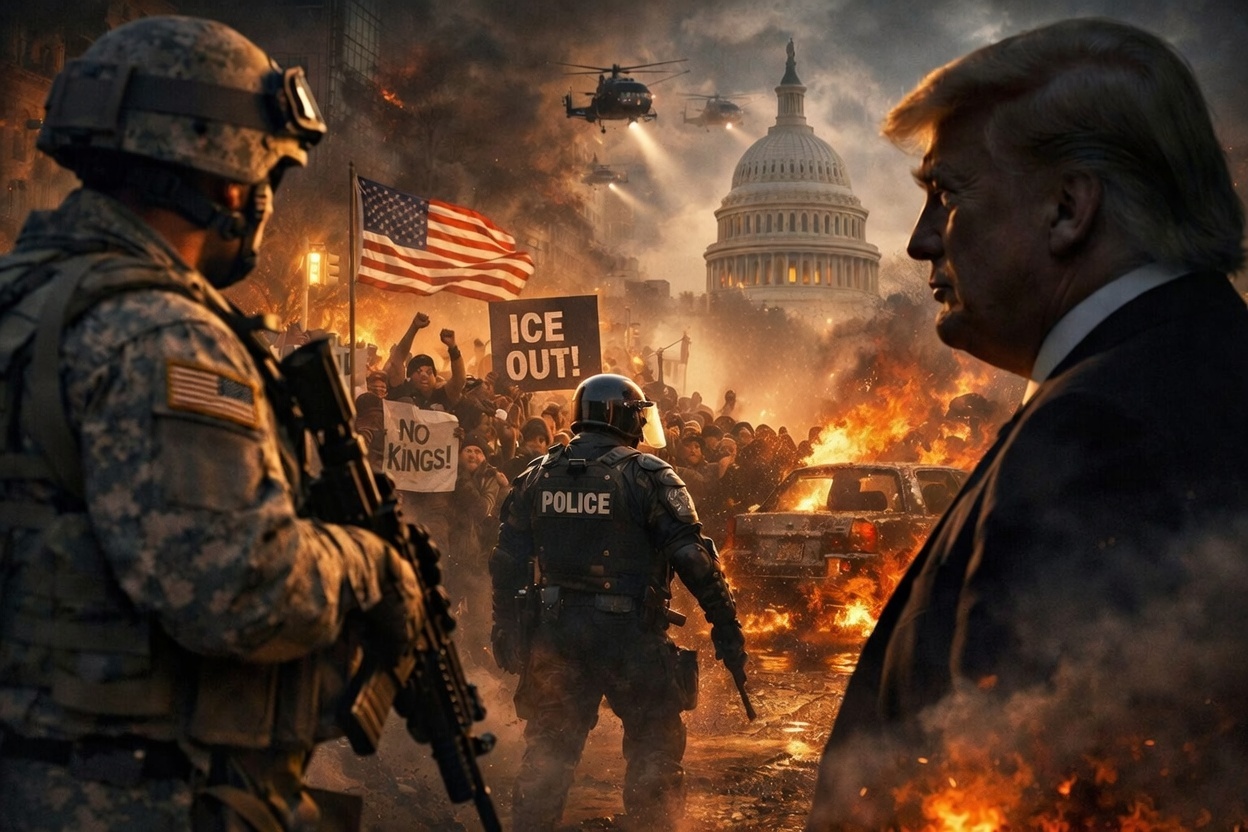
I liked the job Bovino was doing. Alongside “No Kings!” and the rest of it, “ICE Out!” is part of a color revolution. The mob—and the operatives who organize it—are bankrolled by NGOs funded by transnational financiers and the Chinese Communist Party. (See “The Whole System is Guilty!”)
I want Trump to nationalize the Minnesota National Guard, send federal troops into Minneapolis and Saint Paul, roll up the mob, and arrest the operatives (see Send in the Troops; The New Confederates and the Return of States’ Rights). I want the federal government to identify these funding networks and prosecute them.
We need to smash this threat to American sovereignty. Maybe there’s a master strategy here. But perceived weakness emboldens the forces seeking to knock America out of its position as world hegemon.
That’s bad for us—and bad for the world.
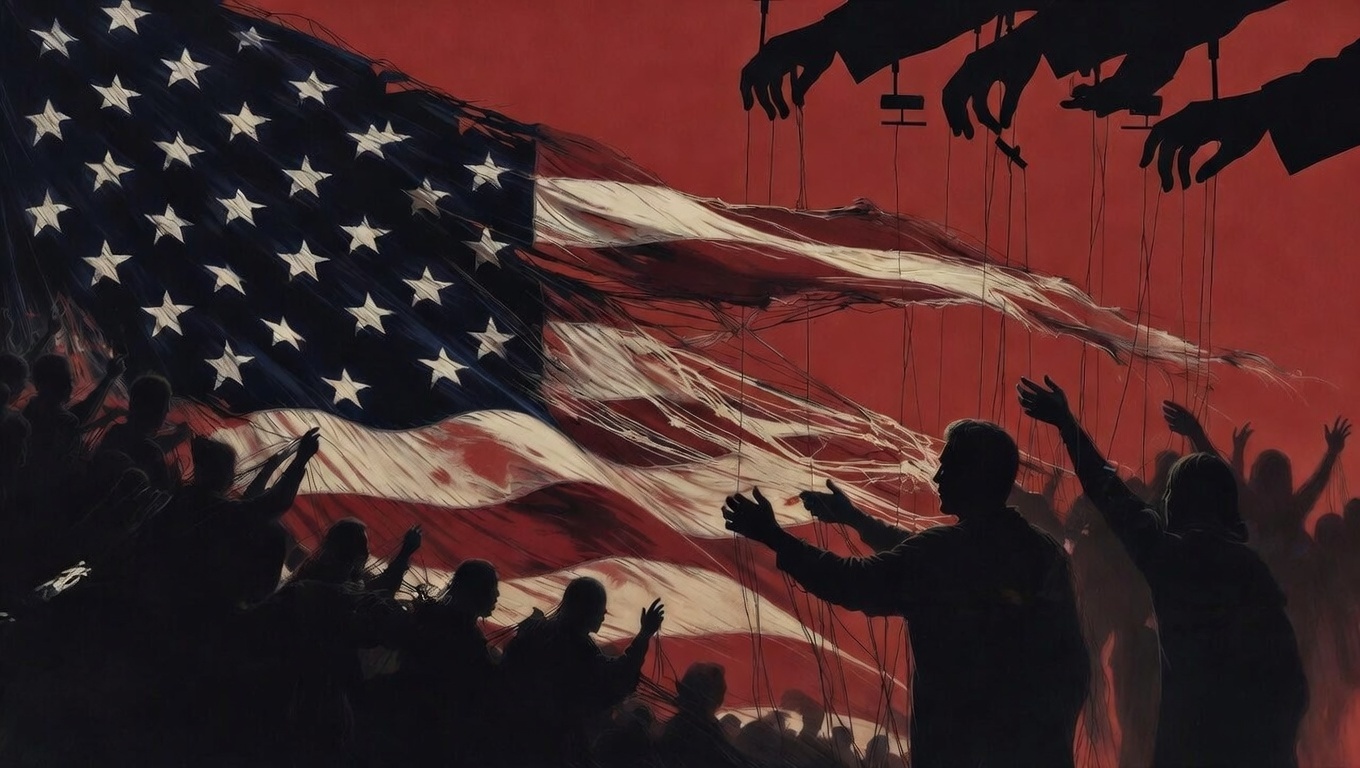
Image by Grok
I noted this during Trump’s first term, and again in several recent essays: Trump appears too hesitant to do what previous presidents have done—federalize the Guard and deploy troops into cities and states where mayors and governors are in rebellion against the laws of the Union—because he doesn’t want to validate the false accusation that he’s an authoritarian.
They’re going to call him an authoritarian anyway. Worse, they’ve already branded him a fascist. So what does he have to lose by exercising his lawful federal authority to bring rebellious states and cities to heel, and to pursue the enemies of America and Western freedom? If he does this, I can almost guarantee his poll numbers will rise. They’ve already jumped five points in the most accurate poll—Rasmussen—buoyed by an expanding economy following his restoration of the American System.
I don’t understand why Trump officials don’t begin every press conference with images of violence against law enforcement officers. This would build public support for decisive executive action to quell the ongoing insurrection. There is no shortage of such images. Why are Republicans allowing progressives to win the propaganda war? The battle for men’s minds is central to the defense of any nation.
We cannot sustain this level of tolerance for sedition in the United States. There should be zero tolerance for rebellion against the Republic.
The national government is the supreme law of the land. Article VI, Clause 2 of the U.S. Constitution states:
“This Constitution, and the Laws of the United States which shall be made in Pursuance thereof; and all Treaties made, or which shall be made, under the Authority of the United States, shall be the supreme Law of the Land; and the Judges in every State shall be bound thereby, any Thing in the Constitution or Laws of any State to the Contrary notwithstanding.”
There comes a point when the patience of saints becomes pathological. Didn’t Trump just release a major policy document warning of civilizational erasure? Why isn’t he acting on it? Are his words hollow? Where is the man of action we were promised?
The same applies to the toleration of the Islamization of the West. Why are we allowing Muslims to establish de facto autonomous towns and cities in the United States? Americans know about Dearborn, Michigan, and the Twin Cities in Minnesota. But when I tell them about what’s happening in Texas, they’re stunned. Trump knows. The last people on earth who should practice suicidal empathy are those charged with defending the nation.
We have to put our foot down. Sometimes boots are necessary—especially when the Republic is threatened from within. At that point, decisive action becomes an imperative.
Steve Bannon, host of War Room and a stealth advisor to the President, often places Trump in the same league as George Washington and Abraham Lincoln. But if Trump is to belong in their company, he must do what they did. Both used military force to confront states and cities defying the U.S. Constitution—the Whiskey Rebellion and the Civil War. It’s Trump’s turn to be a man of action. (See A Man of Action Must Act to Be Such a Man.)
Rank-and-file progressives riot whenever they’re out of power. Democrats don’t believe in democracy. They hate what America stands for. They want technocratic control guided by corporate-state ideology (see The Real Threat to Liberty Isn’t Trump—It’s Technocratic Rule).
Technocracy negates not only democracy but liberty itself. COVID-19 demonstrated this clearly. States locked down their own citizens, acting in concert with other countries across the global North. American progressives wanted vaccine passports and mandatory masking—ritualized obedience enforced by the state.
There must be consequences for tyranny. Action exposes the dystopian future Democrats have planned for America.
Trump supporters rationalize the President’s actions as four-dimensional chess. Perhaps this is meant to protect the midterm elections—or, more immediately, to secure funding for DHS. Maybe the goal is to make it safe for Senators to pass the SAVE Act. However, I remain convinced that the best way to shore up popular support for this presidency is to do what previous presidents have done: exercise federal authority with clarity and force. We shall see.


 freedom and reason