“Now we command you, in the name of our Lord Jesus Christ, to keep away from believers who are living in idleness and not according to the tradition that they received from us. For you yourselves know how you ought to imitate us; we were not idle when we were with you, and we did not eat anyone’s bread without paying for it; but with toil and labor we worked night and day, so that we might not burden any of you. This was not because we do not have that right, but in order to give you an example to imitate. For even when we were with you, we gave you this command: Anyone unwilling to work should not eat. For we hear that some of you are living in idleness, mere busybodies, not doing any work. Now such persons we command and exhort in the Lord Jesus Christ to do their work quietly and to earn their own living.” (2 Thessalonians 3)
Yes, open to interpretation. And that’s the problem. People who advocate social justice should really stop appealing to the Bible. Do I think people who can work should work? Yes, in a system where they receive the value of the labors, where they do not labor under the illusion of the promise of eternal life, or in order to give the church money, but instead labor alongside their brothers and sisters in the here-and-now and on the promise of social provision on the basis of need—guaranteed and not dependent on the whim of charity. As long as illusion prevails—as long as people prefer painkillers to changing structures—we’re stuck.
Jesus Driving the Merchants from the Temple
I don’t agree that Jesus was a social justice advocate. He doesn’t advocate for overthrowing unjust social structures. Instead, he threatens people who don’t believe him with Hell and Hell’s angels (argumentum ad baculum—fitting for the son of the god of the Bible). He tells people to love their enemies and turn the other cheek. He tricked people with conjurer tricks. He told the poor, sick, and downtrodden that their reward was not of this earth but of the life hereafter—as long as they worshipped his father. Those are the words of a charlatan., not a social justice advocate.
“Congress shall make no law respecting an establishment of religion, or prohibiting the free exercise thereof; or abridging the freedom of speech, or of the press; or the right of the people peaceably to assemble, and to petition the government for a redress of grievances.” — First Amendment to the United States Constitution (adopted 1791).
The Virginia Statute for Religious Freedom, drafted in 1777, introduced into the Virginia General Assembly in 1779 by Thomas Jefferson, enacted into state law on January 16, 1786, disestablished the Church of England in Virginia and guaranteed freedom of religion. Here are the crucial points annotated:
“[O]ur civil rights have no dependence on our religious opinions any more than our opinions in physics or geometry.” In his 1802 letter to the Danbury Baptist Church, President Jefferson noted that the government cannot reach opinion but only actions. Emphasis on opinion. Freedom of opinion does not give you the right to act in any manner you wish. “Believing with you that religion is a matter which lies solely between Man & his God, that he owes account to none other for his faith or his worship, that the legitimate powers of government reach actions only, & not opinions, I contemplate with sovereign reverence that act of the whole American people which declared that their legislature should ‘make no law respecting an establishment of religion, or prohibiting the free exercise thereof,’ thus building a wall of separation between Church & State. Adhering to this expression of the supreme will of the nation in behalf of the rights of conscience, I shall see with sincere satisfaction the progress of those sentiments which tend to restore to man all his natural rights, convinced he has no natural right in opposition to his social duties.”
“No man shall be compelled to frequent or support any religious worship, place, or ministry whatsoever, nor shall be enforced, restrained, molested, or burthened in his body or goods, nor shall otherwise suffer on account of his religious opinions or belief, but that all men shall be free to profess, and by argument to maintain, their opinions in matters of Religion, and that the same shall in no wise diminish, enlarge or affect their civil capacities.” Opinions and beliefs. You cannot be punished or constrained on account of these. You are free to profess your religious opinions and beliefs with due recognition of time and place constraints. You cannot stand in a physics or geometry classroom and profess your Christian faith or through your expression of faith disrupt the teaching of physics and geometry. You are free in the public square and in your places of worship free to express these opinions and practice these beliefs—as long as they do not interfere with the liberties of other persons.
“The impious presumption of legislators and rulers, civil as well as ecclesiastical, who, being themselves but fallible and uninspired men have assumed dominion over the faith of others, setting up their own opinions and modes of thinking as the only true and infallible, and as such endeavouring to impose them on others.” A whereas clearly intended to delegitimize the supposed power of religious entrepreneurs in their endeavor to impose their religious opinions on others and compel other’s beliefs.
“To suffer the civil magistrate to intrude his powers into the field of opinion and to restrain the profession or propagation of principles on supposition of their ill tendency is a dangerous fallacy which at once destroys all religious liberty because he being of course judge of that tendency will make his opinions the rule of judgment and approve or condemn the sentiments of others only as they shall square with or differ from his own.” This is a nice statement of the principle that freedom of religion requires freedom from religion. I cannot be free to hold an opinion concerning a religion or the absence thereof if I am forced to suffer the religious opinions of others. Simply put, your profession of faith can dictate neither my consciousness nor my liberty.
“Even forcing him to support this or that teacher of his own religious persuasion is depriving him of the comfortable liberty of giving his contributions to the particular pastor, whose morals he would make his pattern, and whose powers he feels most persuasive to righteousness, and is withdrawing from the Ministry those temporary rewards, which, proceeding from an approbation of their personal conduct are an additional incitement to earnest and unremitting labours for the instruction of mankind.” That we have come to a place where churches are excused from the burdens of paying for government in light of this reveals a profound betrayal of the founding principles of religious liberty.
I just contacted my senator (Ron Johnson) and told him to vote no on this reckless tax cut. There is no evidence supporting the claim that lower top income tax rates grow the economy. There is no evidence supporting the claim that higher top income tax rates stifle economic growth. Indeed, high top marginal income tax rates—rates exceeding 90 percent—are historically associated with sustained economic growth and shallower business contractions. In contrast, lower top marginal income tax rates—rates set at levels we are moving to with the present tax bill—have historically been associated with erratic economic behavior and deeper business contractions with anemic periods of expansion. Lower tax rates are moreover associated with larger budget deficits, which are then used to justify cuts in public and social investments, investments (education, infrastructure, etc) that are associated with sustained economic development and more widely shared prosperity, as well as providing social support for the needy among us—the elderly, children, and the disabled.
The theory that tax cuts produce growth misunderstands the role effective demand plays in economic development. When there is effective demand the rich invest to meet demand, and they do this with other people’s money, not with tax savings. Cutting top income rates only make rich people richer. And while they may consume more, they are a small portion of the population consumption and cannot represent sufficient demand to drive investment. Effective demand is a mass phenomenon and is had when the masses are consuming at a level sufficient to trigger investment in production.
With growing redundancy in an increasingly mechanized and automated and globalized society, effective demand is hamstrung even with investment in production and, therefore, public spending is needed more than ever to make up effective demand—to plug the hole in the circuit of production.
What the tax cut will achieve in the current context of late capitalism is a shrinking economy which will be used to further reduce government activity in the very sectors that are actually associated with growth and shared prosperity. It will spur calls to further privatize public services. It will feed the downward spiral into third world conditions in the first world.
I am being charitable in my analysis, assuming that those who support this policy don’t understand the mistake they’re making. That is certainly true for many of them. I have friends who run small businesses who are hoodwinked by this talk of lower taxes, which, if this bill is passed into law, will actually squeeze them and pull their wealth upward—while leaving them behind.
However, the people pushing this policy understand the consequences of the bill. At least in terms of the immediate future. This is yet another phase in the class war to curtail democracy and personal liberty by destroying those pieces of the republican machinery and social democratic legacy won by previous generations that empower working people, i.e., the great majority of Americans, those who get up everyday and either go to work or look for work, fight the wars, and buy the goods and services, mostly by going into debt, that feed the bankers and business peoplers who are the only ones who will gain anything if this bill becomes law.
But the gains are in the end unsustainable. The fact that the rich will benefit in the present and near future will not stop the inevitable collapse of the capitalist system if these policies continue. However smart they are, in the end, the tax cutters only think they are clever. Just as they have been with our environment, their recklessness here represents a boomerang. Unfortunately, we are all in the boomerang’s path.
I recently presented a paper as a professional conference in which I argued that criticism of Islam—what is often referred to as “Islamophobia”—is not racist because Islam is not a race (obviously). However, I find compelling Maajid Nawaz’s argument that the denial of the human rights of individual Muslims that manifests itself as the left-wing practice of shutting down criticism of Islam with accusations of bigotry carries within it a racist impulse. The assumption that individuals in Muslim-majority countries and communities, because they are members of racialized minority groups (black and brown people), are on-board with the homophobic and patriarchal character of fundamentalist Islam—that, while it is no good for white Western Europeans to be saddled with Christian fundamentalism and to be told that is it bigotry to criticize the Judeo-Christian tradition (that’s the march of liberal secularism, after all), it’s not only okay for black and brown peoples living in Muslims communities to be so saddled and so told, but that it is bigotry to speak out against their suffering (homosexuals, women, free thinkers).
Those on the left who fetishize Islamic dress, attitudes, and practices reduce Individuals to a stereotype of what it means to be an authentic Muslim, while at the same time fail to acknowledge the coercive and cultural forces that compel individuals to appear certain ways, and in so doing fail the reformers across the Muslim world, thus lending tacit support to the Islamic fundamentalists. Imagine struggling under the yoke of fundamentalist Christianity and those outside that community accepting as representative of the individuals in that culture the claims made by Jerry Falwell and Pat Robertson and other fundamentalist Christian leaders. Imagine hearing that criticisms of the homophobic and patriarchal values in Christian scripture and advanced by such fundamentalist leaders as Mike Pence was anti-Christian bigotry, in a word, “Christophobia.” It’s not hard for me to imagine the sinking feeling I would have as an atheist living in the Bible Belt to hear such arguments against my liberty. Because I have felt it.
The reality of oppressive structures does not depend on whether those who are oppressed see or struggle against their oppressors. Oppression is an objective matter. It exists when individuals do not have equal rights, when they are not treated as persons before the law, when their bodies and labors are exploited. When we hear that we cannot speak for oppressed people because we are not oppressed or that those who are do not believe they are, and we fall into silence, we betray the individual. Identity politics becomes a thought-stopping tactic, designed to selectively muzzle critique. But man, science, and human rights are universal. These should form the basis of our politics, not ideology.
Pictures are surfacing of white men, hunters and fishers, wearing the clothes of the card-carrying-NRA right-wing conservative, deploying their aluminum boats to rescue flood victims. They’re rescuing people of all ages, ethnicities, and races. They are Christians. Trump-supporters. There is an opportunity here for the media to promote white Christian nationalism as a compassionate and charitable force in the world, to say that, while there are admittedly some (only a few) white nationalists who are violent, there are others who work tirelessly to help the victims of natural disasters. And in a very direct and personal way. They aren’t donating money. They are risking their safety to help in the most immediate and intimate way. They aren’t using it for public relations to promote their ideology. At least they seem pretty humble. Yet, by not dwelling on these acts of charity, the news media has avoided promoting white Christian nationalism. Perhaps because of the violence associated with it? Except that the media have, despite the waves of terrorists attacks across Europe and the United States, despite widespread misogyny and homophobia in its ranks, chosen to promote Islam as a compassionate and charitable force in the world by writing stories about Muslim charity surrounding the Texas flood. Muslims, we are told, are good Samaritans. There is a double standard at work here. But more importantly, it is misguided to believe that charitable work gives anybody a reason to feel good about an ideology and its adherents. White nationalists and Muslims helping flood victims by risking their safety or by donating money tells us nothing about whether white nationalism or Islam are good or bad things. The KKK cleans up trash by the roadside. It’s a big deal for them, in fact. They adopt highways in order to repair them. Does that make the Klan and its ideas desirable and their members good?
It is not helpful to the cause of reducing religious extremism and marginalizing religious zealots – a necessary task if we are to have a society free of religious oppression and violence – to remind us that most believers are good people. Religious people are our family, friends, and neighbors. In our experience, most religious people are good people. It would be more helpful if, instead of devoting so much time apologizing for and defending religious belief and criticizing those who object to religion, believers put their energy towards reforming their religion.
Here’s a good place to start: admit that the authors of your religious texts and doctrines were men, not supernatural beings, and unambiguously and repeatedly condemn all texts and doctrines that preach the subordination of women, the persecution of homosexuals, earthly or eternal discipline and punishment for those who do not accept religious claims, and the myriad other exclusive and hateful beliefs. It really isn’t credible for religious people to claim that they have nothing to do with religious extremism, oppression, and violence but then refuse to condemn texts and doctrines that advocate extremism, oppression, and violence. It will not do to say that the texts and doctrines are “misinterpreted” when the deplorable actions of believers reasonably follow from the texts and doctrines in question – texts that are said to be at the very least inspired by a god.
Religious extremism is enabled by those who insist on the integrity of texts and doctrines that promote oppression and violence. Unless you openly deny that the commandments and sanctions in these texts come not from a god but from men, you are complicit in the crimes that occur in that god’s name. Rationalizing texts and doctrines that are the source of extremism and oppression gives license to those who make war on society in pursuit of a deeper commitment to faith. You cannot remain a moral person and at the same time rationalize genocide, slavery, patriarchy, heterosexism, and terrifying children with stories of eternal damnation. Morally upright persons condemn the texts and doctrines that advocate such things.
It is not the critique of the atheist, the humanist, and the secularist that should be the focus of moderate religious conversation about faith. The faithful should stop worrying about us. You need to worry instead about those among your ranks who threaten the freedom of everybody, including you. The ultimate threat of religious imposition on law and government and education and gender relations, and, yes, religious liberty, is the negation of a free and open society. The liberty that protects your right to believe what you will about the cosmos is the very same liberty that prevents others from forcing you to believe that they believe about the cosmos.
If the faithful really want their religions to survive, if they really mean it when they say they want to promote peace and harmony instead of division and exclusion, then they need to demand that those who claim to share their values practice their faith in way that aligns with the universal and secular and humane values of democracy and liberty. Ultimately, those who reject these doctrines, and who are committed to freedom, will have no choice but to protect democracy and liberty from the threats to it. Free people have a right to defend themselves from backwardness and tyranny.
When left-wing extremists perpetrated violence against those expressing their opinions in public, my condemnation of them and their arguments is swift and unambiguous. I disassociate myself from them and explicitly reject the doctrine they claim justified their actions. Yet when Muslims throw gays from towers or drive trucks through crowds, I don’t hear the Muslim community condemning the texts and doctrines that promote violence against human beings. In fact, when I look at the polls, I see significant numbers of Muslims who think these actions are right and even necessary. When I see conservative Christians making racist, homophobic, and transphobic statements and pushing legislators to pass laws strengthening white male heterosexism, I don’t see Christians condemning those texts and doctrines that condone slavery and promote homophobia. What I hear instead is rhetoric about “loving the sinner but not the sin.”
Instead of asking atheists, humanists, and secularists to moderate their tone or back away from their unflinching criticism of religious belief and practice, join them in the struggle to secure religious liberty for everybody. If reasoned and scientific belief is important to you, if a world free of religious bigotry and violence is what you desire, then you should take up our arguments, not defend the text and doctrines that provide the motive for religious discrimination and violence. Take up the light and help lead the way out of medieval darkness.
My criticisms of Barack Obama and Hillary Clinton (and George Bush and Bill Clinton before them) treat these politicians as personifications of the establishment, which, theorized in greater detail below, is the prevailing network of elites and offices managing global capitalism. Capitalist globalization is the great evil of our day. It is the primary cause of resource depletion, environmental destruction, falling standards of living, and failing welfare states, and plays a major role in the spread of Islam, an ideology destructive to democracy and human rights. Skeptical of multiculturalism, immigration, transnational trade and blocs, and interventionist foreign policy, the presidency of Donald Trump is a disruptive, albeit probably steerable element in the globalist project. Anxiety among elites helps motivate public hostility towards the Trump presidency, concerns disguised as popular appeal and effectively conveyed to the masses through the corporate media, a mechanism the success of which rests on a broad-based conditioned response.
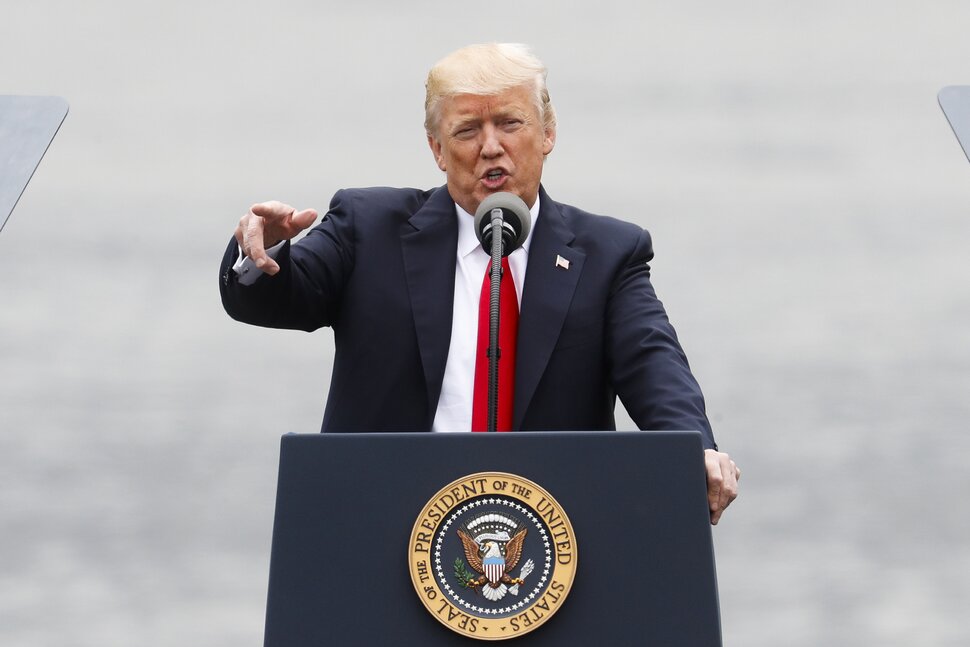
President Donald Trump speaks during a June rally in Cincinnati.
These points are not an endorsement of the Trump presidency. Although not the fascist many would liken the public to believe, Trump is authoritarian (a result of his business style, and, in this way, he is no different than most business leaders), a nationalist, racially prejudiced, and a sexist. To be sure, his conservatism is moderated by some long-held liberal opinions, but opportunism makes liberal attitudes expendable. He is loathsome person and far from an ideal political figure, or even a practical one, for those committed to left-wing politics. The points I make here aim to elucidate the underpinnings of the culture of outrage that has grown up around Trump and explain why impeaching Trump, aligning the Trump administration with establishment goals, or electing the next Democratic Party nominee are not paths to a lesser evil, but, on the contrary, serve to further entrench and legitimize the establishment project. Instead of seeing the Trump phenomenon as an opportunity to reinforce the hegemony of the two-party system, it should be seen as a moment to theorize the problem of global capitalism and build a mass-based alternative to the status quo, one that eschews identitarianism and puts class politics central to the struggle for justice and liberation. The future of humanity depends on an effective anti-capitalist movement. Anti-Trumpism does not in itself advance the cause of the democratic socialist project (not to be confused with the politics peddled by Bernie Sanders).
The interpretation of establishment behavior presented here is informed by several theoretical insights, primarily Antonio Gramsci’s theory of hegemony, which elaborates Marx’s observation that “the ruling ideas of any age are the ideas of the ruling class.” Gramsci conceptualizes hegemony not merely as an exercise in the coercive control of the opposition, but the perpetual manufacture of consent and cultural management of the masses, supporters, and opponents. In Gramsci’s view, the state, in its stable form, is not reducible to government, but is an apparatus that incorporates elements of “political society” – i.e. legislative, executive (bureaucracy), and judicial powers – and “civil society,” or what has traditionally been defined as that network of private institutions, with economic structures, the prevailing mode of production, constituting the network’s foundation. In modern capitalist states, consensus is manufactured primarily in the civil societal region, which distinguishes it from historical (and a handful of present-day) state-managed propaganda systems. Crucially, a Gramscian analysis resists the reification of political economic reality that the analytical distinction between political and civil society risks; which is to say that, in the concrete, political and civil societal dynamics converge and must be analyzed in terms of their intrinsic relations and activities carried out to secure and advance these arrangements. This includes corporate management of political activities (hence the two-party system in the United States).
What the ruling class under capitalism has long recognized is that efficient and comprehensive management of populations requires the manufacturing of the consent of the masses, obtained by permitting limited sharing of the social surplus and participation in political decisions sufficient to convince the majority that they have a stake in conformity and perform a substantive role in the political life of modern bourgeois society.
In theorizing hegemonic power in Western capitalist states, world systems theorist Immanuel Wallerstein reminds us that liberalism and democracy are not twins, but opposites, with liberal democracy facilitating capitalist hegemony by simultaneously extending and managing popular participation in decision making. In an essay published in Peace, Stability, and Legitimacy (1994), he writes that “democracy and liberalism are not twins, but for the most part opposites. Liberalism was invented to counter democracy The problem that gave birth to liberalism was how to contain the dangerous classes.” He explains: “The liberal solution was to grant limited access to political power and limited sharing of the economic surplus-value, both at levels that would not threaten the process of the ceaseless accumulation of capital and the state-system that sustains it.”
In contrast to limited democracy, or republicanism, popular democracy, to use C. Wright Mills’ conceptualization, exists when every person has a meaningful say in the decisions that affect them. “Democracy means the power and the freedom of those controlled by the law to change the law, according to agreed-upon rules—and even to change those rules,” writes Mills in The Sociological Imagination; “but more than that, it means some kind of collective self-control over the structural mechanics of history itself.” “In essence,” he continues, “democracy implies that those vitally affected by any decision men make have an effective voice in that decision.”
Capitalism depends on this never being the prevailing state of affairs and thus its agents emphasize the republican problematic (see the Federalist Papers). When the democratic element begins to disrupt the capitalist imperative, the state becomes more restrictive, a condition marked, in part, by an increase of surveillance and police powers. To convey this dynamic, Gramsci famously used the metaphor of an iron fist in a velvet glove: when the soft touch doesn’t work, the gloves come off. Fascism and Nazism are the most extreme forms of the capitalism with its gloves off. It is crucial to recognize that the presidency of Donald Trump does not represent a moment where the gloves have come off. The gloves came off a long time ago with the expansion and militarization of the police, mass incarceration, and the surveillance state that emerged from the 1960s. However, capitalist states also, and more frequently, disempower opposition through reformism (with obvious benefits to the working class and the poor) and control over labor through segmentation of work and scientific management (Gramsci spends considerable time analyzing Fordism and Taylorism as effective strategies for controlling, and more efficiently exploiting workers).
The other methods of control are propaganda and ideology. In late capitalism, the corporate media plays the major role in engineering consent around establishment ambition. The propaganda apparatus legitimizes capitalist hegemony by, in the United States for example, drawing the political gaze to the two major parties and marginalizing alternatives that may represent the interests of working people (the Green Party, for example). Another approach focuses on organizing what French Situationist Guy DeBord calls the “Society of the Spectacle” or, to borrow language from the Frankfurt School and critical theory, the “Culture Industry.” The Culture Industry keeps the masses occupied with virtual reality activities and away from class consciousness and serious political work, hence the emphasis on the politics of entertainment, consumerism, and debt. The industry atomizes the working class at a new level of alienation and cooptation. The ideology of capitalism obscures the problems caused by the system by attributing them to the moral failings and poor choices of individuals. Poverty, street crime, and interpersonal violence are portrayed as the work of the poor and minorities, not the result of a exploitative system that impoverishes a significant portion of the population and pits individuals against each other under conditions of artificial scarcity and status seeking. In this way the prison-industrial complex and the welfare state do the ideological work of blaming the victims of capitalism.
For whom and for what is consent being engineered? C. Wright Mills usefully labels the US establishment “the Power Elite.” The Power Elite is the intersection of corporate, executive, and military power, embodied in what Mills calls the military-industrial complex. Cold War liberalism reigned in Mills’ time. The prevailing ideology advancing the interests of the Power Elite today is neoliberalism and neoconservativsm, marked by the progressive privatization of the social democratic apparatus, or what Gramsci called the “regulated society” and capitalist power projection globally justified by a rearticulated Cold War liberalism. Neoliberalism represents a new enclosure movement, incorporating public functions in the private sphere, extracting public wealth for private benefit without significant weakening of their control function, deepening Adorno’s “administered world.” Neoliberalism is the private capture of public revenue streams while maintaining the outward appearance of a commitment to public services. Abroad, the ideology of the dominant capitalist class fraction takes the form of advocating permanent war-time footing marked by aggressive military interventionism and adventurism around the world. These alignment of both major parties with these approaches mark the existence of what Gramsci called a “historic bloc.”
The Power Elite remains relatively stable despite occupants of executive and legislative offices. Stability is achieved through ideological consistency, shared class position/sensibilities, elite grooming of personnel, and the existence of the “deep state,” an enduring network of government employees pursuing long-range goals of the capitalist state independent of democratically-elected officials. Mike Lofgren is largely responsible for putting the concept of the deep state into the mainstream. In an essay distributed by Bill Moyers, Lofgren writes,
There is the visible government situated around the Mall in Washington, and then there is another, more shadowy, more indefinable government that is not explained in Civics 101 or observable to tourists at the White House or the Capitol. The former is traditional Washington partisan politics: the tip of the iceberg that a public watching C-SPAN sees daily and which is theoretically controllable via elections. The subsurface part of the iceberg I shall call the Deep State, which operates according to its own compass heading regardless of who is formally in power.
The deep state is the network of national security, including the defense and intelligence services, both private and public, most obviously the Pentagon, the NSA, and the CIA; law enforcement agencies, primarily the FBI, the Justice Department, and the Department of Homeland Security; and Commerce and Treasury, with its linkages to the Federal Reserve and other financial institutions, public, quasi-public/private, and private. It is through the financial and military apparatus that the deep state connects to the transnational system of global capitalism.
Operating with this theory in mind, the culture of outrage that has developed around Donald Trump, a television personality who is himself a spectacular product of the Culture Industry, can be understood as a moment in the control of popular consciousness, an exercise in reestablishing the limits of the politically possible after several years of alternative, albeit politically immature action threatening to break through the partisan ideological barricades into the popular mainstream, counterhegemonic action unfortunately deformed by impoverished and distorted understanding of the nature and state of late capitalism (e.g. Occupy Wall Street, Black Lives Matter). The Trump phenomenon represents an unpredictable element in modern bourgeois politics, his popular support part of a series of disruptive waves across the surface of mass control. Thus one may not wish to see Trump as president, but at the same time recognize the establishment is committed to delegitimizing his presidency for reasons that serve the desire of the Power Elite over against the interests of the working class.
To understand why the establishment seeks to delegitimize Trump, consider three things that the president has done that those sharing to popular democratic values should in principle applaud:
Pulling the United States out of the Trans-Pacific Partnership and revisiting the North American Free Trade Agreement. Capitalist globalization has harmed US workers, disrupted the ways of life for billions of people around the planet, stifled democratic social movements, especially in the capitalist core, and harmed the natural environment. In addition to questioning the trade agreements that enable the entrenchment of globalization, Trump sympathizes with Brexit and the dismantling of the European Union, which will weaken transnational capital and global finance. Successful socialist revolutions occurred in the context of interstate capitalism (and were undermined by globalization). Because of the mobility of capital and cooperation of states under transnational capitalist arrangements, globalization is disruptive to proletarian movements. Marx and Engels write in The Community Manifesto, “the struggle of the proletariat with the bourgeoisie is at first a national struggle. The proletariat of each country must, of course, first of all settle matters with its own bourgeoisie.” Capitalist globalization at once means the unification of the world’s bourgeoisie and the fracturing of the world’s proletariat. Thus the world has witnessed the balkanization of national communities with the expansion and entrenchment of globalization. Multiculturalism, discussed next, further enhances proletarian fracturing through the spread of identitarian politics.
Raising consciousness concerning the threat of Islamic terrorism by giving permission to people to accurately describe the danger of Islam without having charges of “Islamophobia” taken as seriously as they have been in recent years. By calling on elites to call it what it is, Trump has struck a blow to the multiculturalist campaign to sell Islam as a harmless cultural difference that Western society should embrace. As Christopher Hitchens and others emphasize, Islam is a totalitarian patriarchal movement that threatens the secular arrangements of the West, arrangements essential for preserving individual liberty and rights and an open society that are in turn essential for moving the democratic project forward. However much one may disagree with the specifics of the executive order restricting immigration from a handful of Muslim-majority countries, without an aggressive program to assimilate Muslims into Western society, reduction of Muslims immigration into the United States allows the country to avoid many of the problems Europe is experiencing. The positive situation in the United States is, in turn, emboldening efforts in Europe to restrict immigration and do something about the burden placed on the welfare state, the fragmenting of community, and crime and violence. Understanding the benefits of suppressing Islamization requires understanding multiculturalism in light of the hegemonic needs of the ruling class (more on this in a moment).
Rethinking US permanent war footing. Trump has made it clear that the US invasion and occupation of Iraq was wrong and that US action in Syria is misguided. Indeed, his constant attack on Bush’s foreign policy during the Republican primary debates served to weaken not only the consensus manufactured around that policy, and not only harm the party identified with the policy, but by extension weaken the appeal of Democrats, who carried the policy forward. Trump has sought to ratchet down tensions with Russia, a nuclear power, possibly pulling the United States back from the brink of a new cold war. To be sure, Trump’s foreign policy has been inconsistent where he has acted to please the establishment (his actions in Syria, for example), but this brings us to the reasons why the establishment is so aggressive in the campaign to delegitimize Trump.
Each of these accomplishments/directions is antithetical to the goals of the globalists. The so-called “free trade” systems are designed to reap bigger profits by reducing labor costs in the West (never mind the contradiction that leads to realization crises as these amount to moments of creative destruction). Trump wants to reconfigure global trade, shifting from integration of national economies driven by maximizing profits among transnational corporations to (primarily) bilateral negotiations based on national economic interests. Globalists desire multiculturalism and open borders because it functions to weaken the working class and increase access to cheap pools of labor. Muslim immigration is particularly beneficial to elite ends; Muslims are encouraged by dogma to proselytize while resisting assimilation with the West, and many on the identitarian left consider Muslims to be a persecuted minority thus choosing “protecting” them over defending and advancing working class interests. Characterizing resistance to immigration as “bigotry” and “xenophobia” facilitates the maintenance of a super-exploitable labor supply and the undermining of popular community by ordering authorities and shaming workers into silence. Permanent war footing intends to keep the world safe for corporations. Military spending compels subsidies from taxpayers, as well as mops up redundant workers (approximately 2.5 million in the US, matching the approximate number of redundant workers in the prison-industrial complex), guaranteeing profits to corporations while controlling populations at home and abroad. Islamic terrorism is functional to the maintenance of a vast surveillance and police apparatus (as well as a ready force for destabilizing Third World governments). Ostensively designed as an apparatus to defend against terrorism, the surveillance state is used to monitor the range of left-wing groups struggling to advance working class economic interests, weaken the imperialist war machine, and defend the biosphere.
Thus we see in Trump over against Clinton and her ilk the personification of the fractional division in the class and social structure of the United States resulting from the transnationalization of not only economics but of law and politics and control. The incorporation of the United States in an integrated global economic system has differentiated the bourgeoisie into nationally-oriented elites, who have traditionally emphasized economic policies benefitting domestic firms, and globally-oriented elites, who push for deeper transnational integration of government, law, and economics, which benefit transnational corporations. These differences entail different political rhetorics, with nationally-oriented elites emphasizing nationalism, patriotism, and protectionism, while the transnational elites emphasize internationalism, multiculturalism, and free trade. Trump is representative of nationally-oriented elites, which is why he speaks about reawakening industrialization, limiting immigration, realigning foreign policy in a more traditional international system over against transnationalism. Although nationalist rhetoric is not the end socialists seek, it is nonetheless disruptive to the transnational project, thus creating an opening – a disjunctural moment, if you will – for alternative politics. However distasteful one finds nationally-oriented sentiments, opposition to them in a manner that advances the globalist agenda is detrimental to democratic socialist politics.
The establishment wanted Clinton to be the Democratic Party nominee and president of the United States because of her vocal support for neoconservative policy and desire to ramp up tensions with Russia. They also wanted her because of her support for a Grand Bargain on entitlements. Despite his support for war, Bernie Sanders’ foreign policy commitments are too uncertain, and he is too staunch a defender or social democracy, so the elite engineered the Democratic primary to put forward a Clinton candidacy. The Power Elite sought a continuation of the Obama Administration, whose function was to entrench the globalist order by projecting a multi-racialist/multi-cultural personality onto US imperialism. Clinton allowed elite planners to leverage identity politics to advance the globalist agenda. Her campaign was built on identitarian (“I’m with her”) and anti-Trump sentiment. Clinton was the perfect politician for the globalist order.
Trump is an imperfect politician for the globalist order. He was never groomed for leadership and potentially threatens the stability of capitalist hegemony. Indeed, his campaign and presidency, despite his unpopularity, have already troubled establishment aims. Trump’s bombing of Syria is a case in point. The establishment has been worried since the campaign that he would not take up the neoconservative approach to the Middle East and Central Asia. To be sure, when Trump was pressured into “doing something about Assad,” he was immediately praised for his behavior. And there were other scattered moves that caused the press to announce that “Trump became president today” – words of encouragement. But he has been stubborn on the question of Russia. The establishment’s attempt to make Trump appear as a puppet of Russian leader Vladimir Putin has harmed its credibility.
The US presidential election of 2016 was never as simple as Clinton being an imperfect candidate, Trump’s obnoxious rhetoric, hyperbole about fascism, the persona of the Republican Party, or the lesser of two evils. To be sure, Trump’s tone unsettles, but given everything that has transpired so far, it is far from clear that Trump is the greater evil. Politics depend on a theory of prevailing macro-social, political, and cultural dynamics. Clinton ran on advancing the agenda of transnational elites, whose methods are extending capitalist logic into every human system and creating a seamless system of mass control. Clinton was the choice of the establishment. The effect of false and fragmented consciousness about establishment goals means that popular protests against Trump undermine resistance to globalism by either expressing a desire to see Trump align with globalist goals or effectively seeking his replacement with career politician Mike Pence, a man with no independent thoughts, ready and eager to do the bidding of the establishment.
What the left should be doing is withdrawing consent from the two-party system and building a unified socialist politics against the prevailing hegemony. The effort requires resisting spectacular politics and developing a sense of political realism. That means, among other things, trading the world of outrage over offensive tweets, awkward handshakes, and boorish comments for serious political engagement. This is why my approach to the daily outrage over something Trump said or did is to mock it. Avoiding the freak-out is not a defense of Trump, but a recognition of the fact that the reason we’re supposed to be outraged is to get the masses in line with the establishment agenda. My refusal to freak-out is a refusal to get in line. I hope you don’t get in line, either.
Note 9.13.2018: Since writing this, the Trump administration has aligned with establishment goals in Syria, Russia, and North Korea. It has been revealed that those around him are deceiving him in order to shape decisions that advance the establishment agenda. What was a disruptive force is being reduced to a distracting twitter feed, under the cover of which the United States working class is being fleeced.
Religion is an ideology. An ideology is a system of beliefs/myths and practices/rituals that justify and reproduce particular social arrangements by normalizing hierarchy and systematically hiding power. An ideology is a subjectivity, an ideational system, serving as a guide to thought and behavior, shared by a number of people, which distorts reality in order to benefit some over others. An ideology may be associated with a particular culture or worldview; but it may also exist as a transcultural phenomenon, organizing thoughts and behaviors of individuals across cultures. Patriarchy, heterosexism, and so forth are examples of ideologies that cross cultures and may intersect with or embed in other ideologies.
Christianity and Islam are examples of transcultural ideologies. Neither is tied to a single culture (defined as beliefs, customs, norms, etc., of a particular group, space, or time), ethnicity (defined as membership in a group with a common cultural, linguistic, or national tradition), or race (previous definitions synonymous with ethnicity, now as membership in a group based on shared physical traits or phenotype, a classification system that has largely been debunked as actually describing something in the domain of biological phenomena).
For example, many Arabs (an ethnicity, albeit sometimes racialized) are Muslim. But so are many Asians, as well as many Africans and some Europeans. In fact, more Indonesians identify as Muslim than Arabs, yet most Indonesians neither speak Arabic nor identify with Arabic culture. Moreover, many Arabs are not Muslim, but are Christian or identify with some other religion. The fact that Muslims are a multicultural, multiethnic, and multiracial grouping, widely distributed geographically, identifiable because of their religious identity, makes the reduction of Islam to any one of these other concepts a fallacious operation.
Any attempt to reduce an ideology to ethnicity or race is itself an ideological strategy to place that ideology beyond the reach of rational criticism. To draw an analogy, those who organized the ideology of classical liberal economics sought to put the class struggle beyond criticism by portraying political economic phenomena, except where it was artificially distorted by human intervention, as elements of a natural system, in much the same was as biology is an admitted natural system, and then claiming itself to be a science of a domain of reality.
Race is itself the product of the ideological system we call racism. It is not a biological phenomenon, as I have said. Nor is racism. But there are attempts to treat both as such. And that’s an ideological activity in itself. Indeed, in this way, while religion is not analogous to race, it is analogous to racism, and the classifications these ideologies create – believers, infidels, sinners, etc., for the former, whites, blacks, Asians, etc., for the latter – are suspect. The main difference is that, thanks to secularism, we have pluralism in religion, meaning that Western society formally accepts that one can switch religions and even, to some degree, stand outside any religious system, albeit not always without consequence, but is not ready to accept raceless or transracial persons. This fact is yet another reason religious identity cannot be reduced to racial identity.
The conflation of criticism of Islamic doctrine and practice to racism despite (a) substantial race-ethnic diversity among those who subscribe to this ideology and (b) a category error in likening idea systems to demographic categories (however suspect these categories are) is distorting our secular approach to governance, replacing a common systems of rights based on objective human conditions with cultural and moral relativism determined by a multiplicity of ideological standpoints. This phenomenon, which has wide-ranging political and legal implications (such as oppression and violence dressed in civil rights language), must be explored not only in its own development, but also through a comparison with Christianity, an ideology likewise based on the Abrahamic tradition, but for which the analogies of race and racism are not routinely applied.
What will we permit people to deny about their ideologies? Religious people claim that their good deeds are motivated by their religious beliefs. Charity is often characterized as Christiancharity. Martin Luther King, Jr.’s strategy of non-violence is said to work from Christianlove, or agape, which means that loving a God who has so much love for people demands charitable action. Charity is a form of worship that is promoted by faith belief. Christians like to ask in situations, “What would Jesus do?” Ibrahim Hooper of the Council on American-Islamic Relations (CAIR) asks, “What would Muhammad do?”
Members of religious groups are eager to own the laudable character of their faith deeds (to what extent faith belief is necessary for charity is a question beyond the scope of this essay). They should be just as eager to own the less positive aspects of their religious belief. In the case of Muhammad, we read in the Qur’an and the Hadith about his acts of compassion. But we also read about his acts of cruelty and hatred. It is said that Muhammad was a perfect man. Muslims are to emulate his character and manner (however much they are destined to fall short). Acts of compassion, cruelty, and hatred are all included in the range of choices available to Muslims in emulating God’s last prophet (which differ considerably from the range of choices available to Christians emulating Jesus). The disassociation with the downside (complicated by the denial that there is a downside) of the world’s major religions is a common feature of faith belief. And the extent to which this keeps the faithful from literally practicing their religion is a good thing.
On February 26, 1993, in bombing the World Trade Center, Muslims killed six and injured more than a thousand people. On September 11, 2001, in an attack on the World Trade Center in New York and the Pentagon in Washington DC, Muslims killed 2,996 people and wounded more than 6,000 others. On November 5, 2009, at Fort Hoot, near Killeen, Texas, a Muslim killed 13 people and injured more than 30 others. On December 2, 2015, at a Christmas Party in San Bernardino, California, two Muslims killed 14 people and injured 22 others. On June 12, 2016, in a Nightclub in Orlando, Florida, a Muslim killed 49 people and wounded 58 others.
Taking just these five incidents (from a universe of incidents of Muslim violence), and focusing only on the United States (one of many countries affected by Muslim violence), Muslims have killed 3,078 persons and injured more than 7, 000 people, mostly civilians, but also military personnel, police officers, firefighters, and rescue workers. These incidents were not random attacks. They were inspired by the ideology of Islam. They were not contrary to the actions of Muhammad or the spirit of the doctrine.
Muhammad was a warlord who sought to spread the doctrine of Islam through subjugation of surrounding populations. Like Muhammad, Muslims spread Islam wherever they live and migrate, encouraging others to become devout believers, and hoping that, one day, sharia will be the law of the land and that all people, whatever their religion, will have to submit to that law and pay tribute to the Islamic state. The end goal is to see the entire world under the rule of Islam. Not all Muslims believe such things. But hundreds of millions of Muslims do. Just as hundreds of millions of Christians desire global Christian hegemony (but with Jesus meek and mild, not Muhammad the warlord). Islam is the fastest growing ideology in the world, presenting a unique threat to freedom and security around the world, and its militancy is intensifying.
The goals of Muslim extremists are analogous to those of white nationalists: a world where totalitarian ideas form the basis of the law and dictate public and private relations and interactions. Yet those who argue that white supremacies should not be allowed to organize, publicly assemble, or openly express their opinions because their racist beliefs and opinions represent an extremist ideology, not only fail to make the analogous argument vis-à-vis Muslims, but instead rally around Muslims, defending Islamic ideology and practice as a “religion of peace,” claiming that Muslims are a persecuted minority who should be allowed to engage in their cultural practices, such as the sexist imposition of patriarchal modesty rules (these practices are sometimes even celebrated by non-Muslims), unmolested by secular rational norms.
When Muslims act violently, the response is not condemnation, as typically happens when white nationalists engage in violence, but marches expressing “solidarity” with Muslims. Islam’s defenders accuse those who act consistently with respect to doctrines of aggressive violence of bigotry, smearing them with the label “Islamophobe.” Imagine antifascists being accused of “fascophobia” – as if fear and loathing of hateful, divisive, extremist ideology could be irrational – and you will get a sense of the hypocrisy inherent in progressive Islamophilia (the irrational adoration of Islam).
The oft-repeated objection that most Muslims are not violent and, therefore, there is no cause for concern over the spread of Islam, is made rather irrelevant by the fact that most white nationalists are not violent, either. That most white nationalists are non-violent does not make white nationalism acceptable. To be sure, some white nationalists are violent. But, as evidenced by the thousands of deaths and injuries from the five Muslims attacks cited above, some Muslims are violent, too. In fact, in the United States and Europe, Muslims are responsible for far more violence over the last twenty-five years than white nationalism. The reality is that, because of the content of its doctrine, and because of the aggressive violence it produces, Islam is not a “religion of peace.” Violence in the name of Islam is not a deviation from the doctrine, but an expression of the doctrine.
Should Islam by banned? Should Muslims be barred from sharing their doctrines in public? No. This would be a violation of an individual’s right to express his opinions, associate with those who believe as he does, and assemble in public and collective announce that belief. The current disagreement over whether we should let white nationalists express their extreme opinions in public bears on the question of whether Muslims should be allowed to do the same. If the position taken is that we should not, then, if we wish to be consistent and avoid discriminating against people, we shouldn’t allow Muslims to express their extreme opinions in public, either. On the contrary, we must protect the right of Muslims, as well as white nationalists, to freely express extremist views in public gatherings. “Sharia for everyone!” “Death to America!” “Behead the infidels!” “Butcher those who mock Islam and its Prophet!” “Liberalism go to Hell!” “Democracy and freedom much fall!” “Islam is the solution!” as repugnant and terrifying as these slogans are, they are protected speech by the First Amendment to the United States Constitution.
Individuals have a right to believe what they want to and to express those beliefs in public. Likewise, individuals have the right to tell the truth about what those views represent, the role they play in producing violence, and condemning those beliefs. Those of us who recognize the threat extremist ideologies pose need to be more assertive with our right to freely express the truth.
I am an atheist and a socialist. My disbelief in God offends people. My socialist views are widely believed to desire the enslavement of humanity and are blamed for the deaths of tens of millions of people in the twentieth century. There are people who find my views too offensive and dangerous to tolerate. Should I be censored?
If radical and extremist opinions are criminalized, then the state will have license to target atheists and socialists for repression, as they have in decades past. If it is widely accepted that dangerous opinions justify violence, then socialists and communists are at greater risk for violence, state and popular. If I assemble with others and publicly proclaim my politics, then anticommunists can say that my identity, my opinion, my presence, provoked the attack on my person, that I am to blame for their violent actions against me, that their actions are just.
It is absurd to argue that people understand the threat of fascism but see the good of socialism and draw a distinction. Don’t deceived yourself. That distinction does not exist in popular thought. Even if it were supposed to be otherwise, fascists may reasonably ask why their views are being suppressed while the views of socialists and communists are permitted an audience with understood immunity from violence. The moral character of communism will be viewed in relative terms, or in terms that uphold the status quo. Communism will be depicted—as it already is—as yet another dangerous ideology to be suppressed, by law or by force. This is why, in some states around the world, those that sacrifice their civil liberties, all “totalitarian” and “extremists” symbols are restricted. And don’t you anarchists think they won’t come after you.
Free speech and assembly is what allows me to meet and discuss politics with my comrades. It’s why I can write this post with a sense of a degree of safety. It’s why any of you can say what you want say.
The ideals of free thought and assembly to one side, it is of immediate practical interest to me, as an atheist, as a socialist, that the fascist’s right to assembly and free speech is protected and that the brand of anti-fascist ideology that seeks criminalization of fascism and advocates violence against fascists be marginalized. Those who argue for the suppression of speech and thought, fascist or anti-fascist, are, at the very least, equally dangerous to human freedom, however the ideology is dressed morally, because they undermine the grounds for free exchange of ideas and opinion. Anti-fascists who do not seek to suppress speech and assembly, who do not advocate violence against those expressing their opinions are not a threat to my interests.
There are two types of anti-fascists. There are the authoritarian types and there are libertarian types. I used to proudly proclaim my anti-fascism. But I have become cautious as the distinction between authoritarianism and libertarianism among those claiming antifascist politics is collapsing. For those of you who advocate aggressive violence, you imperil my freedom. But you also imperil your own freedom and the freedom of those you claim to defend.
We’re living in a dangerous time when confronting opinion with violence (not as metaphor or virtual play, but as actual physical action) is encouraged and celebrated. The advocacy of aggressive violence, albeit generally protected expression, increases the risk of more violence, including government suppression of assembly and speech. Those who respond to opinion with violence are in part responsible for pushing the nation towards the authoritarian path. Those calling for the suppression of speech and assembly are making a whip for their own backs. Those who believe in keeping an open and democratic society must therefore remind others of the morality and practical value and strategic use of violence and, by extension, nonviolence (see Martin Luther King, Jr. for the arguments concerning the use of nonviolence in political action; this essay focuses on the use and ethics of violence).
Violence may be an end or a means to an end. For those who like to fight, injure, kill, maim, and rape, it is an end, an expression of frustration or hatred or power, or a type of thrill. Committing acts of violence make some people happy, give them joyful memories, bragging rights, and trophies. In these instances, one may conceptualize violence as a means to such ends. The line is a bit blurry. However, this type of violence is rarely justifiable (except, perhaps, in sport, where both parties agree to combat). As a clear means to an end, violence can be right or wrong depending on the ends its users seek and how they use it. Violence used to obtain things that others genuinely need cannot be justified. Violence used to maintain the conditions of exploitation or oppression cannot be justified. Violence used to eliminate, punish, or silence others for their associations, beliefs, expressions, or lineages, on these grounds alone, cannot be justified.
There are three conditions that justify violence: (1) self-defense; (2) protection of targets of unjust violence; and (3) the overthrow of exploitative or oppressive conditions.
If you are attacked, you have the right to use force sufficient to end the attack and save yourself – after exhausting reasonable options (such as your duty to retreat). You are defending your right to life and health, which are essential to the freedom you have an inalienable right to. If a child is threatened with bodily harm, you have the right to use force to negate that threat for the same reason. If you are being oppressed, you have the right to overthrow your oppressor, again for the same reason. Slave revolts, for example, although illegal, are morally justified. The violent overthrow of capitalism is also morally justified—after all other avenues of obtaining liberation have been exhausted. The overthrow of tyranny is defense of freedom. All of these forms of violence are defensive acts.
The moral and practical uses of defensive violence have an associated ethics. Even when justified, violence must be used in proportion to the magnitude of the threat. You have the right to repel a threat. You do not have the right to pursue an attacker who is retreating. You do not have the right to engage in excessive violence in repelling a threat. You do not have the right to kill the deposed leaders of the toppled government. You do not have a right to be cruel or moved by malice or revenge. You cannot torture to save lives. Justifiable violence must be a rational exercise. To the extent that persons were using violence in self-defense or to protect others who were under assault in Charlottesville, violence exhibited on August 13, 2017 may be justified. However, much of the violence witnessed and documented was not.
There are clear examples of white nationalists using wrongful violence in Charlottesville. Indeed, aggressive violence by white nationalists constitute the worse offenses that occurred in Virginia. The beating of Deandre Harris in a parking garage by white supremacists was a horrific display of racial hatred – and slow to get media attention. The murder of Heather Heyer and the maiming of scores of other persons by a white supremacist James Alex Fields, using his car as a weapon, appeared to be motivated by hate and politics. If so, this was an act of domestic terrorism. Fields has been charged with counts of second degree murder, malicious wounding, and hit and run with attendant failure to stop with injury. The US Department of Justice has opened a civil rights investigation. The US Attorney General has characterized Fields’ actions as terrorism.
The aggressive violence used by antifascists to silence white nationalism was unjustified. It is never appropriate to use violence against persons exercising their right to express an opinion, whatever that opinion it is, in whatever non-violent manner that opinion is expressed. Violence in these instances is a means to illiberal ends: the suppression of the rights to speech and assembly. Government’s duty is protect these rights. The fact that a person expresses hatred towards other people is not physical aggression. Expressing an opinion does not physically harm a person or others, nor does it represent an actual moment of oppression or tyranny. Ideas and words are not violence in themselves.
The potential for white nationalist violence is a perennial problem and there are indications that it is increasing. The government must act decisively to quell this threat through surveillance, education, and policing where violence occurs. Control over weapons is key to reducing the risk of death and injury. We already have models to deal with the potential for white nationalist violence (e.g. the tactics used to deal with the problem of Islamism).
However, wrongful violence committed by anti-fascists is a growing problem, as well, and the state has a duty to protect people from this form of aggressive violence. Education is an important step in reducing the problem of anti-fascist violence (for example, emphasizing the morality of violence and the ethics surrounding its use). In the meantime, a larger police presence where anti-fascist violence is likely could reduce harm to persons and damage to property.
Two cases illustrate the problem of anti-fascist violence.In May, 2017, a teacher at Diablo Valley College in Berkeley, Eric Clanton, attacked and injured seven Trump supporters in the head with a U-lock bike lock. Some of the injuries were severe. A police search of his home turned up anti-fascist flags, indicia, pamphlets, and patches. Clanton was charged with several felonies.In July 2017, Yvette Felarca, a Berkeley public school teacher and organizer of the pro-violence anti-fascist organization “By Any Means Necessary,” or “Bamn,” was arrested for attacking a man in June in Sacramento in June 2016 and for inciting a riot. Just as with the assaults by Clanton, Felarca’s violent actions were captured on videotape. In early August, 2017, she was arraigned on counts of assault, participating in an illegal riot, and causing a riot.
We condemn these actions, not because we disagree with the motivation behind them, but because the unjustified use of violence is wrong. The appropriateness of violence is not determined by the opinions or ideology people hold or express; the correct use of violence is determined on objective moral grounds that transcend politics and ideology. Action is governed by the universal and transhistorical logic of civil and human rights, the core of which is the right of all people, regardless of their attitudes and beliefs, to be free of suffering and safe from violence.
The images, video, and eyewitness accounts of anti-fascists punching, kicking, bludgeoning, and pepper spraying white nationalists are particularly disturbing to those of us who operate with strict ethics in the use of violence because anti-fascists share so many of our values. We, too, condemn racial hatred and bigotry. We, too, are opposed to ethnic nationalism and white supremacy. We, too, protest injustice and prejudice and demand an end to discrimination. But we also observe the moral and ethical use of violence (and nonviolence).
Also disturbing is the ideological defense of aggressive violence and the shaming of those who object to it on moral grounds. If we are going to have moral authority in condemning the unjustified and unnecessary use of force and violence, then we must put aside ideology and hold all parties accountable for wrongful action. If it is wrong for one side, then it is wrong for the other side. This is a basic and timeless moral rule. Moreover, the ideological defense of aggressive violence sanctions violent action for those who share progressive values. Mainstreaming aggressive violence expands the risk of harm not only to white nationalists, but to peaceful protesters and bystanders. Not all, but a very active minority of antifascists believe they have a special right and moral authority to endanger people’s lives and wellbeing. They don’t.
Anti-fascist violence is counterproductive. As we have seen in previous events (for example, in Berkeley, in early February 2017, over the appearance of Milo Yiannopoulos), antifascists are eager to use violence. As in other places, they went to Charlottesville looking to rumble. Without violence, the world would have hardly been moved to think about a small group of white men (a crowd size of 100-200, even after widespread promotion of the event) gathered to proclaim support for a Civil War memorial and chant the atavistic desires of moral imbeciles who never went away (obnoxious white supremacy is not a new thing) but remain few in number. Now the racists enjoy a larger audience. And, for some observers, they look a bit like martyrs; antifascist violence created an opportunity for white nationalists to claim that their legal exercise of assembly and the free expression of their opinions was violently suppressed by those who do not have a legal or moral right to restrict their speech or to physically engage them.
The moral substance of the far right and the far left couldn’t be more different. It’s the difference between those who crave belligerence, rationalize inequality, oppress women, persecute gays, and wreck the environment versus those who seek peace, equality, and justice, and work to preserve the biosphere. Peacemaking expresses love of humanity. It’s the far right who deems members of certain groups unworthy of human consideration. The far left works with a different morality. This is why left-wing violence must be held to a higher standard.
If violent antifascists and anarchists are actually agent provocateurs, then this needs to be exposed with hard evidence. Otherwise the claim will be dismissed as a manifestation of conspiracism. But there’s a problem here. Even if right-wing machinations could be shown to be true for some cases, is it plausible that this could be true for every case?If violent leftists are not agents of the state or right-wing groups, and it seems more likely they are not than they are, then the complaints about the media creating a false balance, while in substance true, is not only made possible by antifascist and anarchist violence, but by those who support it or fail to criticize it. Perception counts for a lot. Politics is about changing the public mind. If you don’t want the media focusing on left-wing violence, and using it to diminish the significance of growing white nationalism, then condemn it.
Here are two basic rules to follow: (1) be out front in your support of free speech, association, and assembly; (2) be clear in your opposition to the use of aggressive violence from every side—the police, white nationalists, left-wing activists. There is a straw man being floated by those supporting violent confrontation that goes something like this: those who oppose aggressive or violent confrontation of persons exercising their First Amendment rights want to have a dialogue with white nationalists.Protecting First Amendment rights has nothing necessarily to do with the particular content of speech or the desire to engage in particular acts of dialogue. It has to do with the protecting the right of every individual to hold and express opinions, freely associate with others, and assemble publicly to share opinions—and that means seeing, hearing, and reading opinions as much as uttering and writing them.
What about defensive violence? Even defensive violence is problematic when persons using it put themselves in a position that makes resort to it more likely. Peacefully walking into a gathering of KKK members does not justify their use of violence against their opponents. But knowing that the resulting riot will be used by the media to paint both sides as problematic, perhaps it is unwise to make it possible for others to claim that the left is provoking an altercation with their presence. What is to be gained by showing the world that the KKK is violent? Is there anybody who doesn’t already know this? You can try to change the media frame by protesting it. Has that worked? Or you can avoid providing the media with material to frame. It’s not as if the media will explain to the public the difference between aggressive and defensive violence.
Of course, law enforcement should protect the community from white nationalism, not from left-wing activism. Efforts must be directed at pushing the police in that direction. This is not helped by enabling situations where the police have reason to turn their attention to the left. The left should to set the peaceful example of public politics. The left should show the public why it is different from far right-wing protestors.Aggressive and violent confrontation, even if it reduces the frequency and size of white nationalist gatherings, is counterproductive to the goal of building a mass movement because it alienates potential participants. It reinforces the commitment of the passive majority to not get involved with popular action—or, worse, to support repressive police control of protests. Violent protests suggest to the majority that the left does not have a viable agenda for solving their problems (and, frankly, at this time, does it?). Remember, the left isn’t trying to help the far right. How are riots going to solve the difficulties families face in America? How will costumed street fighting help them pay their mortgage, hospital bills, and for college?
We need to be better teachers. Teachers who teach the people that speech is not violence, that violence is not an appropriate means to silence the opinions of others, and to respect the moral ground and consistently observe the ethical rules that govern the justifiable use of violence. We need a united front against the threat of white nationalism. This means enlisting members of the majority in moral concern about the risks to democracy and freedom extreme right-wing ideology presents. We need them to see the extreme right as the source of belligerence. The left should be the nonviolent and rational alternative. We aren’t trying to persuade Nazis. We’re trying to persuade the persuadable. They’re our audience.



 freedom and reason