I would like to transcend the framing of Alexandria Ocasio-Cortez’s response to The Economist’s story No Sex Please, We’re Millennials — that the magazine is feeding Incel arguments — and point out the potential benefit of one-quarter of young adults not having sex, namely the promise of low fertility rates.
But the empowerment of women has put in capitalism’s way a barrier: stable or lower rates of fertility. Lower fertility rates have thrown a monkey wrench into the capitalist machinery. This is why capitalists are so hot for open borders. In the 1960s they threw open the nation-state to large-scale immigration and offshoring in order to weaken the power of labor. Globalism is a strategy to raise the level of profit over against the standard of living of workers in the developed world. Following the 1960s, wages and compensation where decoupled from productivity. With fertility rates in the developed world plummeting, the globalists have become ever more aggressive in marginalizing populist democratic politics that resists the denationalizing forces threatening the affluent world labor built.
Resisting neoliberalism and globalism have never been more important. The debate over populist versus progressive politics is the pivot. If populism wins, it means a better life for the generations that follow. Lower fertility rates mean slower population growth or, even more desirably, a smaller population – as long as we restrict the number of people coming into our countries. In other words, we have to avoid spoiling zero growth by allowing ourselves to become the pressure value for unsustainable population growth in the developing world. We must lead by example and help the developing work lower its fertility rates.
Falling rates of fertility mean a potentially smaller ecological footprint while at the same time allowing for a greater standard of living. Fewer workers makes the labor commodity more valuable and this imposes upward wage pressure by raising the value of the labor commodity over against the demand for labor. In other words: a more democratic future means lower unemployment rates, more people gainfully employed (think about, for example, the surplus population capitalists ghettoized during the twentieth century — they’re still there suffering), with higher incomes, as well as greater tax revenues and lower rates of welfare utilization. Put yet another way, in plain Marxist language: flat-growth or smaller population means greater individual and family shares of the social surplus. Rising relative prosperity, if more equitably distributed, would come without raising consumption levels, as shares consumed by future individuals in a growing population become available for concrete individuals in a stable or smaller population. All this is good for our Mother Earth.
All this jazz about the “demographic crisis,” about how the West needs foreign workers to come toil for us and pay taxes to support our aging populations (thus reducing human beings to instruments for Western purposes) is propaganda calculated to trick people into accepting the economic needs of the capitalist elite. Guess what? Foreign workers grow old, too. But before the do, they also have children. And more children enlarge and speed up the treadmill of production destroying the biosphere in which we all must live. We have to jettison this nonsense that population control is eugenicist or racist. Population matters. Ecosystems have carrying capacities. We are exceeding ours.
The United Kingdom-United States participation in the 1953 overthrow of Iranian prime minister Mohammad Mossadegh and their support for the king Mohammad Reza Pahlavi, the Shah of Iran, is something I would have, had I been alive and aware of at the time, opposed and protested. With rare exception, I am a non-interventionist. The intervention, orchestrated by the MI6 and the Central Intelligence Agency was driven by Western imperialist desire, which I oppose on principle. Mossadegh was a social democrat whose reforms threatened foreign capitalist interests, in particular the British claim on the Anglo-Persian Oil Company.
However, the negation of Persia that came with the establishment of an Islamic republic in Iran on April 1, 1979 does not follow from the imperialist behavior of the capitalist Anglosphere in 1953, but rather represents the work of an authoritarian movement determined to Islamize Iran and drive from Asia western notions of individual liberty, human rights, and democracy and the failure of leftwing forces to grasp the significance of this movement.
Indeed, after 1962, the Shah’s progressive White Revolution threatened the traditional Islamic structures that had long stifled that country’s development by enfranchising women, nationalizing resources, and profit sharing in industry. Rapid industrialization and cultural modernization resulted from the Shah’s project. It was to this progress that Shia Islamists reacted. Moreover, rising expectations alongside growing prosperity brought new political demands.
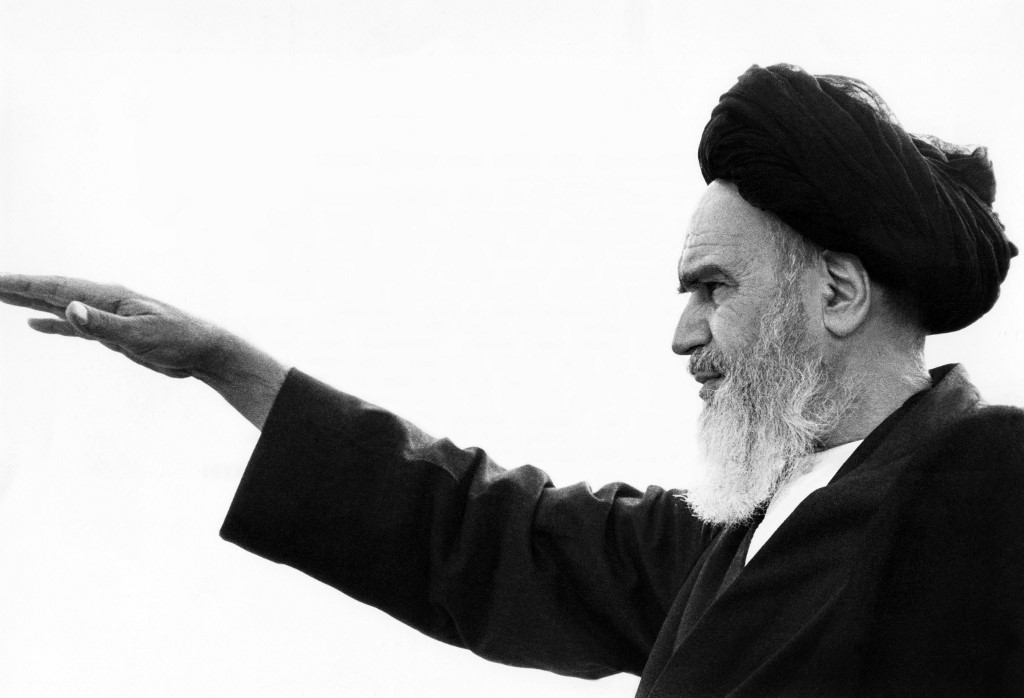
Ayatollah Ruhollah Khomeini
Marxists need to tell a more nuanced story of the rise of the Islamic republic, and this story should be informed by irreligious criticism. Contemporary Marxist thought seems to have forgotten its roots in antitheism, and as a result downplays or misses entirely the role religious ideology plays in world history relatively independently of material forces. It even confuses religious ideology with race and ethnic categories. These failures are largely the failure of Marxists to immunize the left from the corrupting perversions of postmodernist ideas.
The standard leftwing account of the Islamic Revolution attempts to compress more than a quarter century of history between the 1953 intervention and the 1979 overthrow of the 2,500-year-old monarchy founded by Cyrus the Great. According to this interpretation, the Iranian republic was a boomerang effect, a case of chickens coming home to roost.
A lot occurred during this 26 year period. The events of 1953 were immediately preceded by a split between Mossadegh and Ayatollah Abol-Ghasem Kashani. Mossadegh understood that Shia Islam had deep roots in Iranian society and cultivated a working relationship with the clerical community. Kashani had been a valuable ally in the effort to emancipate the energy sector from foreign control. However, Kashani sought more influence in governmental affairs. When Mossadegh, a staunch secularist, rebuffed him, Kashani joined pro-monarchy Ayatollah Behbehani alongside the Shah and participated in the British-American plot to overthrow the prime minister. Thus Islamists betrayed the prime minister.
There were other Islamists who helped undermine Mossadegh, as well, for example the terrorist Feda’ian-e Islam (Self-Sacrificers of Islam), who demanded compulsory public prayer, Islamic dress code, the expulsion of women from government service, and the prohibition of alcohol. Crucially, the Islamists supported the Shah, also a secularist, because they wanted to rid themselves of a secularist they believed was undermining their authority in Iranian society. However, the Shah’s White Revolution caused a rift between the Shah and the clerics who had supported him. Islamists support secular politicians and regimes only when they believe it advances their goals of spreading and entrenching Islam.
It was amid the White Revolution that the Ayatollah Ruhollah Khomeini, the future Supreme Leader of a theocratic Iran, rose to power. He aimed to thwart the Shah’s progressive agenda and establish sharia (Islamic law and government) over against the people. Khomeini was arrested and detained and eventually was forced into exile for more than a decade, first in Turkey, next in Iraq (he was expelled by Saddam Hussein in 1978), and then in France.
In exile, Khomeini wrote his Hokumat-e Islami: Velayat-e faqih (Islamic Government: Governance of the Jurist). From there, he instigated uprisings in Iran, drawing government action to suppress rebellion. Taking advantage of the Shah’s political liberalization (under pressure from the Carter Administration), the Iranian left helped widen the path for Islamist success by expanding and amplifying popular protests. The Tudeh Party, Organization of Iranian People’s Fedai Guerrillas, and People’s Mujaheddin, while opposed to clericalism, contributed to the disorder that advanced Khomeini’s goal of establishing an Islamic government. Khomeini’s movement, velayat-e faqih, or Guardianship of the Jurist, spread propaganda exaggerating the extent of government repression. Anti-western leftists disseminated the misinformation in the West (French postmodernist philosopher Michel Foucault perhaps most famously).
For his part, the Shah made errors in the 1970s that helped strengthen the Islamists over against the people’s interests. The presence of tens of thousands of foreign workers drew the ire of Iranian nationalists. Austerity measures worsened conditions coinciding with the migration of unskilled workers from the countryside into the cities. The Shah’s decision in 1976 to change the Iranian calendar to the ascension of Cyrus from the Islamic Hijra (the year Muhammad migrated from Mecca to Medina) triggered Islamists always on the lookout for grievances with which to agitate for their cause.
The Shah was sent into exile in January 1979. Khomeini returned from exile the following month to millions of adoring fans. Khomeini’s movement ideology became the basis of the Constitution of the Islamic Republic of Iran. The Grand Ayatollah became the Supreme Leader. This is how secular law and government were smashed.
It was not a response to UK-US intervention or the Shah’s authoritarianism that this happened, but rather Islamist reaction to progressive reforms and to western cultural influences and political and economic freedoms drove the turmoil. It was a negation of the Enlightenment, to the progress brought about by science and liberal ideas, such as the emancipation of women, which, while preferably unfolding in the context of a democratic system, can and does develop within monarchies.
It is paradoxical to celebrate the Islamic Revolution on the grounds that it overthrew an authoritarian secular regime since the Islamic Revolution established an authoritarian theocratic state, one in which women were returned to the previous status as patriarchal subjects. The ideology that fueled the countermovement against these values explicitly advanced the view that western cultural influences had to be eradicated as they corrupted Iranian society. The Revolution was simultaneously authoritarian, patriarchal, illiberal, and anticommunist, thus finding its analog in fascism.
The Marxist and quasi-Marxist groups that helped destabilize the Shah’s government found their movements hoisted upon their own petards. Perhaps it is out of embarrassment that so many Marxists rationalize the Islamic Revolution as a substitute for the failure of their political strategies and tactics in Iran.
In the end, it was a tragic thing that happened to one of the great civilizations in world history. That Iran was modernizing and its citizens were enjoying widespread freedom and prosperity makes its regression into theocracy all the more tragic.
Too often, a reflex follows the principled position against US clandestine interference in the internal affairs of foreign nations, one that blames subsequent events on the initial clandestine action. In the case of Iran, the Revolution was not a delayed reaction to UK-US action, but the work of a reactionary project to withdraw Iran from world progress. I would have opposed military intervention under Carter for the same reason I would have opposed Eisenhower’s 1953 action (also because it might have been counterproductive, undermining the Shah’s authority by even more closely linking it to Western influence). But had the Carter administration intervened and prevented the Islamic Revolution, the people of Iran would likely be better off today. Indeed, the region would likely be a lot better off than it is today.
Update (June 18, 2019): Given the saber-rattling of late with respect to Iran, I think it is helpful to recall this talk given by Bernard Lewis in 2009:
A man in a social media forum told me that school shootings were a result of secularism. The government took God out of school and that’s why kids are killing their peers and teachers. However, the more secular a society becomes, the less is the level of violence in it, I pointed out. In fact, religion, especially the Abrahamic traditions, are rather strongly associated with violence. It’s not video games, either, by the way. The more video games there are, and the more graphic their depictions of violence, the less violent a society becomes, everything else being equal. What else do you think might explain the phenomenon?
He couldn’t say. I pointed out that violence is associated with the relative absence of non-stressed emotionally-available attuned parents (co-presence is not enough), the presence of patriarchal structures and misogynistic attitudes, and these are generally religion based. Then there is the disappearance of the individual into tribal life where grievances are exaggerated, trauma from maltreatment specifically but alienation generally, and the availability of guns and the gun culture, which includes militarism.
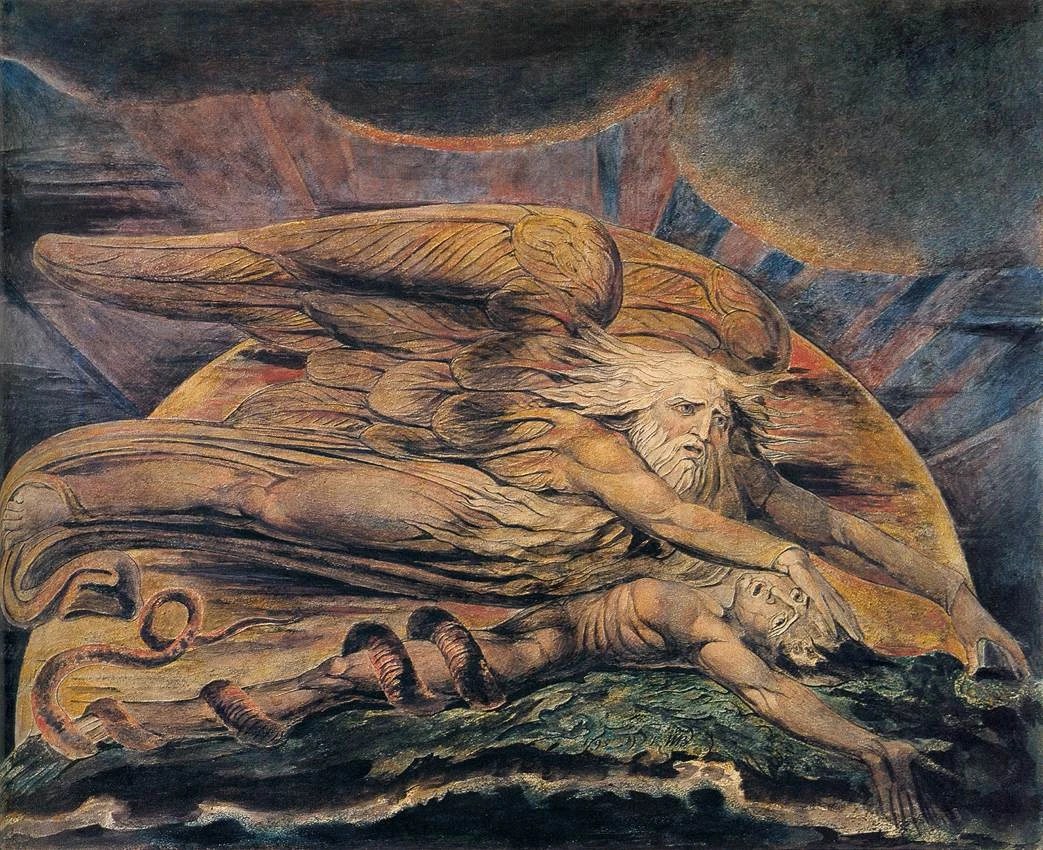
Elohim Creating Adam by William Blake
“Respectfully, sir, you misread the nature of what secularism is and does,” he interrupted me me. “It is, among other things, responsible for more than 1.5 BILLION with a B murders of unborn infants worldwide just since 1980. True, there was a violence connected with religion (not just the Abrahamic religion.) However, it is not God who does the violence, whether people believe in Him or not. It’s the peoplein his name who do the violence.”
I responded to his reference concerning reproductive freedom:“That women cannot have their bodies commandeered by the state, stripped of their humanity, and forced to function as brood mares for theocrats driven by superstition, fables, and mythology is hardly the degenerate outcome you suggest. Indeed, it is a great advance for humanity that women are emancipated from the traditional religious and patriarchal structures that previously dictated to them how their bodies shall be used. To return to the barbaric period in which the state forces girls and women to have babies is a bizarre and cruel atavistic desire. It certainly shatters any claim to moral integrity. A moral person does not do that to women.”
I continued: “On the question of God, yours specifically, Yahweh, granting his existence, I will also grant you that your god does not always do the violence directly. Yahweh allows violence to be visited upon people by failing to stop it. So all the aborted fetuses are ultimately his responsibility because he has the power to stop abortions. Otherwise you would be saying that Yahweh lacks the power to stop evil. So you’re in a bind there. What is more, it seems rather obvious that Yahweh does plenty of evil directly.”
“Consider the violence he will visit upon persons in the afterlife who do not submit to him. I’m an atheist. I was never baptized. My fate will be a terrible one, and it will be entirely because Yahweh—the maker of all things—created hell and will throw me into it. Because I am a good person, what Yahweh will do to me is evil. I can be good all my life but if I do not recognize the passion of his scapegoat, I cannot enter heaven. Yet, I can rape children all my life, he will not stop me, and I can then accept his human sacrifice (Jesus) and I will live in eternal bliss.”
I finished with this: “Yahweh is a psychopath.” He never responded.
Religion divides people into categories in order to control them: believers (devotees of the ideology), infidels (nonbelievers or believers in something else), heretics (critics and reformers), sinners (rule breakers), blasphemers (insulters of gods and prophets), and apostates (faith-leavers). Appealing to nature, myth, and virtue, religion creates an order to the world—a master plan for those inside and outside its walls. It uses multiple strategies to separate people into categories of things and maintain its sway over the population. Tribal marking, indoctrination, violence, and shaming are just a few of these ways. These categories are features of a system of control that parallels other control systems, such as fascism, white supremacy, and the patriarchy.
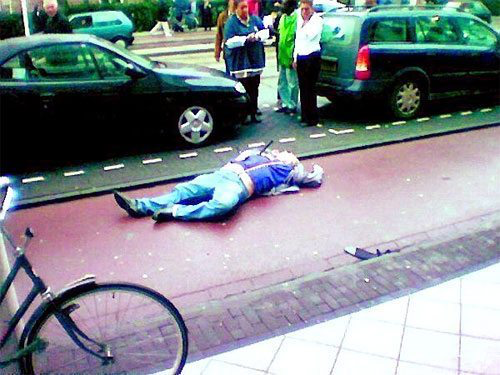
Dutch filmmaker Theo van Gogh lies dead in the street
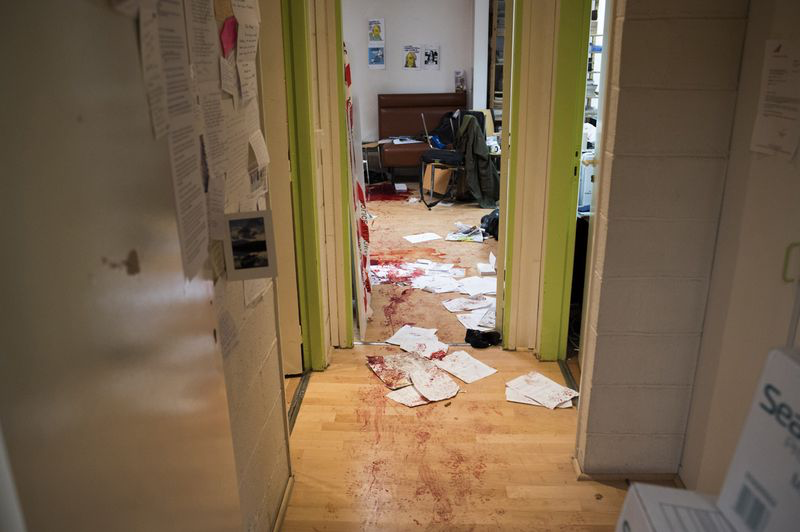
Examples of violence by Muslims as a means of control are numerous. In 1988, Salman Rushdie’s The Satanic Verses was met with protests from Muslims in several countries and death threats were made against his person, compelling governments to place Rushdie under constant police protection. In 2004, Dutch filmmaker Theo van Gogh was assassinated for his film Submission, the killer leaving a note on the knife pinned to van Gogh’s chest threatening Ayaan Hirsi Ali, the author of such works as Heretic and Infidel, and script writer for Submission, with death. Like Rushdie, Ali required constant police protection for many years. In 2005, the Danish newspaper Jyllands-Posten published cartoons depicting Muhammad, the result of a competition inspired by the withdrawal of a children’s book on the life of Muslim prophet out of fear of retaliation for transgressing Islam’s irrational aniconism. Upon the publication of the cartoons, violence erupted in many Muslim-majority countries and in the West, including attacks on the Danish and other European diplomatic missions. Christian churches and Christians were targeted with violence. In 2015, men raided the offices of the French satirical weekly magazine Charlie Hebdo and killed a dozen people for publishing cartoons offensive to Muslims.
Massacre of cartoonists at at the offices of Charlie Hebdo, French satirical weekly magazine
These killings represent a campaign of terror to impose Islamic blasphemy rules on secular society. The evidence of the success of the campaign is considerable. In 2009, Yale University Press published a Bowdlerized version of Jytte Klausen’s The Cartoons That Shook the Worldabout the Jyllands-PostenMohammad cartoon competition that resulted (not from the competition, but from the offense Muslims took to it) in the deaths of dozens of persons with the cartoons expurgated. Readers could read about a controversy surrounding offensive cartoons but could not see for themselves the cartoons that causes the offense. Yale University Press removed not only the cartoons but other images of Muhammad, as well. As Christopher Hitchens noted in Slate in 2009, an illustration by “Gustave Doré of the passage in Dante’s Inferno that shows Mohammed being disemboweled in hell” was removed. “These same Dantean stanzas,” Hitchens warns, “have also been depicted by William Blake, Sandro Botticelli, Salvador Dalí, and Auguste Rodin, so there’s a lot of artistic censorship in our future if this sort of thing is allowed to set a precedent.”
Another method of control is the expansion of law punishing criticism of Islam and Muslims. Strict control over thought and expression has already been achieved in many Muslim-majority countries through the imposition of the law. But this is not good enough. On September 28, 2012, Reuters reported that “Muslim leaders were in unison at the United Nations arguing that the West was hiding behind its defense of freedom of speech and ignoring cultural sensitivities in the aftermath of anti-Islam slurs that have raised fears of a widening East-West cultural divide.” What had offended the Muslim community this time was a short film, Innocence of Muslims. The movie was associated with riots in many Muslim-majority countries, as well as in some Western countries, riots that included attacks on diplomatic missions. The Turkish Foreign Minister (Ahmet Davutoglu) said it was time to put an end to the protection of Islamophobia masquerading as the freedom to speak freely. “Unfortunately, Islamophobia has also become a new form of racism like anti-Semitism,” he said. “It can no longer be tolerated under the guise of freedom of expression.” President Asif Ali Zardari of Pakistan, where more than a dozen people were killed in protests against the film, demanded insults to religion be criminalized. One after another, Muslim leaders delivered a version of this sentiment. Outside the UN building hundreds of protesters chanted, “there is no god but Allah.” One placard read: “Blaspheming my Prophet must be made a crime at the UN.”
It is one thing for a believer to hold himself accountable to the blasphemy rules of his religion, albeit it is problematic to suppose that it is appropriate for him to be held to such account by the others, but it is another thing altogether to hold to account a member of a free society for the rules of a belief system to which he does not subscribe. Nonetheless, western governments have becoming increasingly receptive to these demands. In 2008, the Canadian publication, MacLean’s, the nation’s leading newsweekly, was tried in the British Columbia Human Rights Tribunal for an article, “The Future Belongs to Islam,” that argued that the rise of Islam threatened such western values as free thought and expression. The court held that the article was “destructive,” “intolerant,” and “xenophobic,” but dismissed the case on the grounds that that it did not have jurisdiction over published material. That admission does not negate the fact that the Tribunal brought a case against a newsweekly for publishing a critique of religion in the first place. It does, however, highlight the irony of potentially punishing journalists for writing stories critical of an ideology that punishes journalists. In 2008, The New York Timesreported that Brigitte Bardot, an animal rights activist, was fined $23,000 in a French court for provoking racial hatred by criticizing a Muslim ceremony involving the slaughter of sheep. In spring of 2017, the Canadian parliament debated an “anti-Islamophobia” motion, M-103, sponsored by liberal MP Iqra Khalid. Conservative MPs raised an objection over the focus on the term “Islamophobia” (which was conflated with “systemic racism” in the measure) noting that it could be interpreted to include criticisms of Islam. Human rights expert and former Liberal Justice Minister, Irwin Cotler, advised Khalid to strike the word “Islamophobia.” Khalid said she was unwilling to “water down” her motion. The measure passed down party lines. Tarek Fatah, Canadian secular and liberal activist and founder of the Muslim Canadian Congress, noted that right-wing Islamic groups in Canada celebrated Khalid’s measure as a victory for the movement. Popular TV host Asif Javaid argued that the measure echoed the agenda of Islamists and Islamic extremists in North America who advance the international Muslim Brotherhood agenda to silence any criticism of Islam.
Remains of the World Trade Center
On February 26, 1993, bombing the World Trade Center in New York City, Muslims killed six and injured more than a thousand people. On September 11, 2001, in yet a second attack on the World Trade Center, Muslims killed 2,996 people and wounded more than 6,000 others. On November 5, 2009, at Fort Hoot, near Killeen, Texas, a Muslim killed 13 people and injured more than 30 others. On December 2, 2015, at a Christmas party in San Bernardino, California, two Muslims killed 14 people and injured 22 others. On June 12, 2016, in a Nightclub in Orlando, Florida, a Muslim killed 49 people and wounded 58 others. Taking just these five incidents from a universe of incidents of Muslim violence, and focusing only on the United States, Muslims have killed 3,078 persons and injured more than 7,000 people, mostly civilians, but also military personnel, police officers, firefighters, and rescue workers. These incidents were not random attacks. They were inspired by the ideology of Islam. They were not, as President Obama suggested when he said the San Bernardino shooters embraced a “perverted version of Islam,” contrary to the actions of Muhammad or the spirit of the islamic doctrine. They were inspired by his example. As I wrote in Assert Your Right to Tell the Truth:
Muhammad was a warlord who sought to spread the doctrine of Islam through subjugation of surrounding populations. Like Muhammad, Muslims spread Islam wherever they live and migrate, encouraging others to become devout believers, and hoping that, one day, sharia will be the law of the land and that all people, whatever their religion, will have to submit to that law and pay tribute to the Islamic state. The end goal is to see the entire world under the rule of Islam. Not all Muslims believe such things. But hundreds of millions of Muslims do. Just as hundreds of millions of Christians desire global Christian hegemony (but with Jesus meek and mild, not Muhammad the warlord). Islam is the fastest growing ideology in the world, presenting a unique threat.
It was in this context that future president Donald Trump called for a “total and complete” ban on Muslims entering the United States “until our country’s representatives can figure out what is going on.” He was criticized for this by the usual suspects—the White House, the Pentagon, the United Nations, as well as British Prime Minister David Cameron and French Prime Minister Manuel Valls (the Blarist Socialist Party member who endorsed Emmanuel Macron after pledging to support the Socialist candidate). But other Republican presidential candidates responded to the San Bernardino in a manner that echoed Trump’s frustration. Chris Christie argued that “this is a new world war and one that won’t look like the last two. And this is one where it’s radical Islamic jihadists everyday are trying to kill Americans and disrupt and destroy our way of life.” Jeb Bush: “If this is a war, and I believe it is since they have declared war on us, we need to declare war on them.” It struck me at the time that this was the right spirit to express. If our way of life was being threatened in this serious of a manner, a range of responses should at least get a hearing. The political left was horrified that anybody should express ill will towards a pet ideology they had relied upon to signal tolerance and their progressive ecumenical bona fides (you’ve seen the bumperstickers). After all, Muslim women look so exotic.
These events point to the problem of defining irreligious criticism—a crucial element in the creation of liberal secular societies based on scientific reason and human rights—as bigotry, let alone racism. The laws and conventions that are being extended to the case of religious criticism and mockery, whether one thinks they go too far or not far enough in their given domains, are based on a desire to marginalize fascist, racist, sexist, and homophobic speech—expressions deemed to strengthen the position of oppressive ideologies in society. Irreligious criticism is designed to do the opposite of this: to suppress oppressive ideologies, ideologies that seek to fracture the moral worth of human being in order to control populations for the sake of a few. In the case of their application to antitheism, such laws and conventions intend to stifle criticism of an oppressive ideology by lumping irreligious speech with hate speech. This is the reverse of what hate speech laws are designed to do.
Crucially, the inclusion of irreligious criticism in hate speech laws is not aimed at protecting religion generally. Nobody who seeks to shield Islam and Muslims from criticism and ridicule is suggesting extending hate speech laws to include similar treatment of Christianity, a religion whose followers did not erupt in violence with the release of Monty Python’s 1979 satire Life of Brian. (Indeed, Mormons see the Broadway musical, The Book of Mormon, as a chance to peacefully proselytize.) It is an effort to suffocate popular resistance of the greatest threat to western civilization since National Socialism.
What emerges over the course of this discussion, “The Battle Over Free Speech: Are Tigger Warnings, Safe Spaces and No-Platforming Harming Young Minds?” from Intelligence Squared, is the left side of panel confirming its belief that minorities should have a veto over what other people see, say, and hear. Their reasoning is that group identity represents a collective-subjective set of opinions to which all members subscribe or would subscribe (if they weren’t falsely conscious). Moreover, some groups come with “collective traumas” that empower their spokespersons to make demands upon members of those groups who, by virtue of their identity, are responsible for those traumas.
Kehinde Andrews speaks for himself and his interpretation of the world. Yet he presumes to speak for a collectively-shared abstract point-of-view with which he identifies and attributes to many others. He believes this point-of-view—his point-of-view—should have the authority to reorganize society, especially the university, by designating exclusive spaces and censoring some opinions while elevating others. No white people in this space. More black voices in that discussion. And so on. If being black were like being Muslim, and Andrews a cleric, then we would have an answer to the question: who appointed Andrews to make choices for others? (After all, the cleric is authorized to speak for the group of believers). But being black is a demographic category. It is not an ideology in itself, albeit it is the product of an ideology; it is not a politics per se. Indeed, being identified as black (or white) should neither signal nor obligate a politics at all. As an audience member at the end of the discussion points out, Andrews doesn’t speak for him.
The reality is that Andrews wants to control speech with which he disagrees and in order to do that he—and by extension his group—needs to control the spaces in which speech is exercised. This is an authoritarian desire, one rationalized by claims of abstract victimhood. Andrews justifies his censorious impulses on the grounds that the most free and open system in history is inherently racist. White advantage is the default, baked into the liberal view of free speech. This is the post-liberty vision of antiracism. Antiracism requires a closed and controlled system that presumes as proven that which it has not demonstrated. It is an effort to manufacture a truth and include everyone into it. This involves as a fair amount of bullying and intimidation, as we have seen on colleges campuses. Antiracism disrupts the dialectic by shouting down points-of-view deemed unacceptable.
Diversity programming at California State University
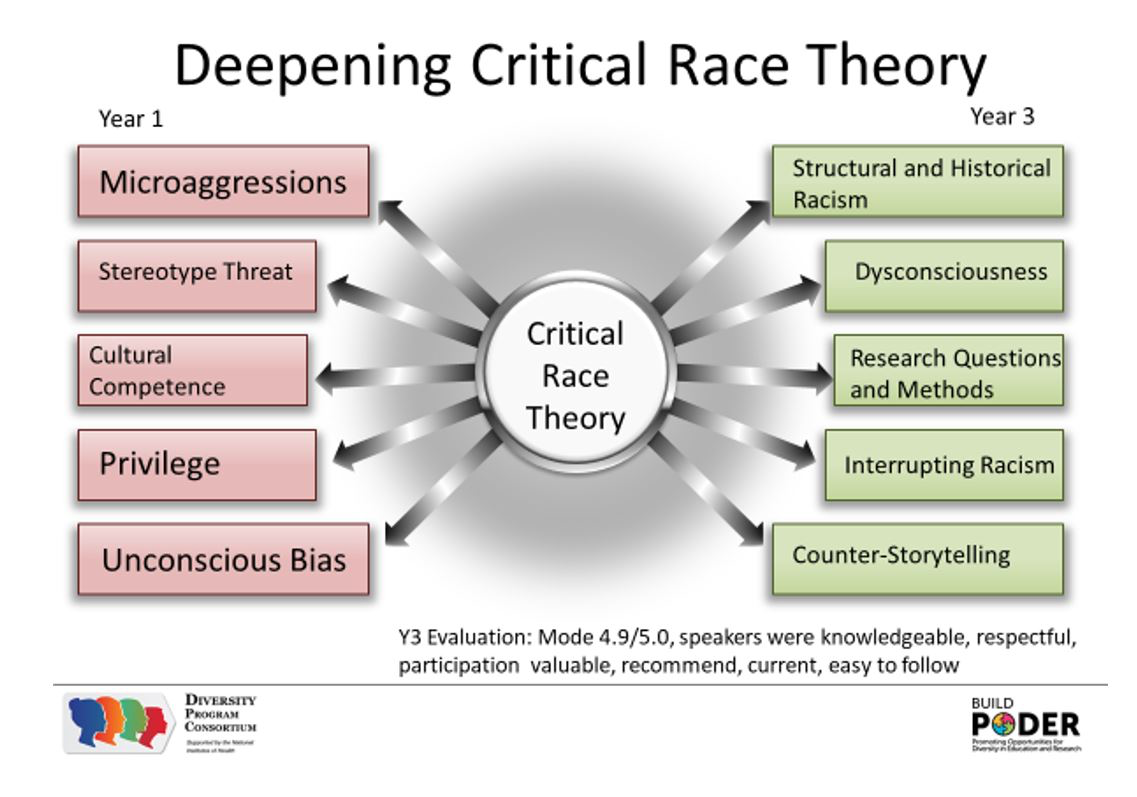
When I was in graduate school, I was seduced by Critical Race Theory, or CRT. CRT incorporates into its analysis of law critical theory, a set of ideas drawn from the social sciences, for example anthropology and sociology, and the humanities, particularly art and literary criticism. Critical theory is a product of the cultural turn in Marxist thought by scholars associated with the Frankfurt School. However, critical theory was warped by the postmodern turn in the academy, that is the social constructionism of structuralist and post-structuralist thinking devolving to a radical relativism denying the existence of a single reality. Postmodernism functions as a carnival mirror, warping Marxist insight by reducing ontology to the supposed collective consciousness or should-be consciousness of social position (actually the multiplicity of social positions intersecting in a person), thus rejecting the premise of a universal reality and fracturing the truth with the blunt ideology of epistemic relativism. At the same time, postmodernism asserts that knowledge exists in a matrix of power that allows some knowledge forms to dominate others. Thus the claim to a universal method of interpretation, i.e. science, is a reflection of the power asymmetries. Science is dominant ideology. Truth claims can therefore have no real external verification for there is no common method with which to evaluate them—except the claim that all knowledge and thus our lives represent a projection of position and power.
Taking up this paradoxical position, CRT portrays the world as a struggle between the “perpetrator perspective” and the “victim perspective.” The perpetrators and victims are not actual persons but personifications of abstract collective positions based on skin color. Actual persons are absorbed into these collective identities or positions. As such, people are the signifiers of a truth. The perpetrator perspective demands concrete persons be identified and held responsible for some crime or injustice if a causal argument can be sustained with evidence, with the burden of proof resting with persons who make accusations. CRT holds that this position manufactures an illusion that the world is composed of individuals and establishes adjudicative rituals that function to perpetuate white supremacy. The sustaining logic is self-serving for the perpetrator identity. The victims perspective demands that justice reckon group disparities with intercorrelations of abstract categories which then serve as proof of injustice. Remedies that affect everybody in the opposing groups follow. The fact of group disparities is proof of discrimination and everybody in the advantaged group is responsible for plight of everybody in the disadvantaged group, even if those disadvantages cannot be demonstrated to exist at the individual level. Both the demands of actus reus and mens rea are exposed as convenient devices. The demand shifts to the subjectivity of the victim. We have to believe them.
The logic of CRT looks a lot like the logic of racism, where individuals are organized into groups based on ancestry or blood quantum rules and then regarded or punished on the basis of this. However, following postmodern logic, central to the problem of injustice is grouped power, and the perpetrator, defined as white, especially the white male, has all of it. In this view, all white people are the perpetrator. According to Peggy MacIntosh, white people wear an invisible knapsack of power and privilege tools they wield as a practical matter throughout their lives. Whites have developed the free and open system in order to perpetuate and entrench their racial power. Law is facially neutral. Indeed, the racial system, the system of white supremacy, its culture of whiteness, is global, and the West, sans the colonized subjects internal to it, is the cause of global injustice. Because of this, the West should be compelled to abdicate its right to cultural integrity, its structures of democracy, freedom, and human rights, as defined by the Enlightenment. A postcolonial world demands a post-rational reckoning. So great is this truth that Jane Elliot gets to traumatize, with minority students watching, white students in diversity/sensitivity training sessions. (Elliot is white. So is MacIntosh.) These moments look a lot like the scenes witnessed during Mao’s Cultural Revolution. Or at some talks on university campuses where minority students and their allies disrupt events chanting slogans and shaking big-character posters and mobbing speakers.
The victims of whiteness are all nonwhite persons (except Uncle Toms) and especially persons who are not white male. The victims are victims by virtue of not being perpetrators, and the evidence of their victimhood, when not by definition, represented in the form of selected aggregated statistics that indicate group disparities. Negating the white man’s formula, correlation is causation.
With CRT, one need not identify a concrete perpetrator or a concrete victim, but rather assert victimhood and assign guilt on the basis of skin color, the marker of group affiliation. To borrow language from Imre Lakatos, in order to sustain this position—to wit: reducing concrete individuals to a demographic category is the negative heuristic that lies at its core—one has to strap on a belt of positive heuristics, rules of thumb that come in the form of slogans, such as Patricia Bidol’s formula “racism = prejudice + institutional power,” or Stokely Carmichael’s “black power” assumption that such an abstraction as the “total white community” could without direction possess agency. The positive heuristics belt does a good job of keeping up the standpoint’s pants as long as the standpoint remains embedded in a research program in which arguments can successfully avoid checking assumptions, a pattern of avoidance reinforced by social pressure to defend the negative heuristic at the core. CRT is thus an ideological program that has manufactured a rhetoric to give an appearance that some deep discovery has been made: abstract forms are prior to concrete people. Of course this is a very old idea. The abstract forms constitute the essential reality, and these preassign plaintiff and defendant designations while shifting the burden of proof.
In the discussion, Eleanor Penny argues that the arguments against her position should be viewed with suspicion because they hail from the perpetrator’s perspective, a position that has cleverly constructed a system of rhetorical traps that legitimize the oppressive system that privileges them. Jonathan Haidt is accused of laying the traps even while Penny excuses him for not intending to. He is both a perp and a dupe. Because she is, as a woman, a member of a victim group, her argument enjoys an epistemic privilege; it is to be accepted because her identity gives it credibility. Moreover, because she is a member of the victim class, it is her turn to run the institutions. A woke white person would agree and stand down.
When I left graduate school, the spell of CRT wore off, and, in part, thanks to my renewed commitment to antitheism that emerged in the aftermath of the Party of God attacking the United States on September 11, 2001, I came to realize that CRT is neither a scientific program nor a rational approach to reforming law and politics, but something akin to a religious program in which participants are to accept, on faith, that there are some who, by virtue of their skin color and the inherited victimizations of their ancestors, should be allowed to hold others accountable for things they did not actually do or even could have done. Skin color is a stigmata that sorts and designates individuals in a prejudicial way. I am asked to stop opposing racism—as I have my whole life—but to see myself as a racist because I was born white. I don’t get to control the definition of racism because of who I am. Social justice requires redefining the term. The best I can ever be is an ally, as if I were in a war and the only way to lessen the severity of my war crime were to defect from a side I never chose to stand with in the first place. However, I can never really defect since I am essentially white (ask Rachel Dolezal) and thus instead will have to submit to the judgment of others eternally. If a sin is forever and collectively and intergenerationally applied, then I can always be asked to pay penance. Repent on pain of being accused of not confessing to unearned advantages and privileges responsible for the pain and suffering of others. Unrepentant sinners are the worse. A fallen person must admit he is fallen before he can get better. To deny being a racist is to confess to being one. Resistance twice convicts.
I used to make arguments from this point of view and felt like I was making compelling antiracist points. But this way of looking at the world only appears antiracist because it feigns an other-interested position. Atonement and submission signal virtue. White folks trying to get into heaven. Moreover, it’s counterproductive: granting that racism explains present circumstances (and it surely does explains some of it), how could this view generate any solution to the problem that could avoid perpetrating the same crime it condemns? Choosing sides doesn’t shift the paradigm.
There is a very real problem today with people treating islam, which is an ideology, as if it were analogous to gender, race, or sexual orientation, which are either imposed social constructs or modes of being that do not affect anybody really. Many on the left and right have failed to grasp the fundamental distinction between these things. They are prone to category error (see Analogy at the Level of the Logic of Oppression and Casual Conflation of Categories). Indeed, islam and fascism are analogous to sexism, racism, and heterosexism, not their potential and real victims. All these are ideologies with oppressive potential. The error takes an oppressive ideology and treats it as if it were the person that ideology oppresses. It may very well be that a person ensnared in fascist relations is oppressed (is that not why we oppose fascism?), but the solution is not celebrating his oppression by taking a day out of the year and dress in a brown shirt, or to march down the street condemning fascophobic bigots, but rather to help emancipate that person from that hateful ideology in which he is ensnared. We seek the latter out of humanist love. It would be to abandon the man to pretend as if his oppressive belief were something to be defended and protected from criticism and ridicule.
Tragically, this confusion is more a problem on the left than the right these days. And that makes it more of a problem for all of us, since it is the left that is promoting islam—the worst and most widespread hateful ideology in the present epoch—and working to derail with civility and speech codes and other suppressive tactics those defending democracy, freedom, and secularism from totalitarian creep. This is why multiculturalism is such a stupid and dangerous practice: it fractures society. There is no rational reason to celebrate islam if one condemns fascism. Both ideologies are authoritarian, backwards, divisive, exclusive, hateful, heterosexist, irrational, oppressive, patriarchal, and totalitarian. Islam demands submission to divine command and a prophet (a man who, if he actually lived, hallucinated conversations with an angel who told him which musical instruments were okay to play), both incontrovertible and revealed. Fascism demands submission to the führer and his cult of personality (which claims to do god’s earthly work), both incontrovertible and revealed. They are the same class of idiocy.
To be sure, we are, as people who believe in free thought and expression, precisely because we are not authoritarian, obliged to tolerate both of these dreadful belief systems. But let’s understand what we mean by toleration. To tolerate belief means that we do not discriminate against those who believe such things merely on the fact of their believing. You own your mind and your opinions. I want you to be free. We defend the right of persons to be muslim or fascist or racist or sexist or whatever as long as these things remain within the confines of their thoughts and expressions, the latter conveyed only in appropriate places at appropriate times. Tolerating opinion does not mean tolerating actions and behaviors when these create impositions for others around them.
Tolerating belief does not in any fashion require me or you to enable ritual acts when they interfere with legitimate secular pursuits or violate the rights of persons. A man does not get to pray to god or chant racist slogans in my child’s public school. There are other spaces for this man to do those things in (in mosques, on Facebook, at Confederate monuments). And I am not going to beg him to go there and do them. I am going to demand that he be removed if he will not cease his behavior. We have no obligation to create any special spaces for these beliefs to ritually manifest; we have only to defend those spaces in which he is free to utter his opinions however stupid and hateful. Tolerating islam and fascism do not obligate me or you to appreciate, enable, or facilitate hateful expressions. We have no obligation to welcome people who believe these things. Why should we be happy to see a fascist walk into a room, to hold up a poster telling him that we appreciate his presence, and cheer his arrival at the airport? What’s wrong with people who do this? They don’t understand. So we educate. We have no obligation to make our secular spaces dedicated to rational pursuits comfortable for those who profess backwards and irrational beliefs. Indeed, as rational and moral persons, we should strive to marginalize such beliefs for the sake of democracy, freedom, and justice – and to help emancipate people from these beliefs. We do not allow parents to mutilate the genitalia of their children in order to mark them as members of tribes they did not – cannot choose or refuse to join.
I oppose islam and fascism because I support the rights of children, free thinkers, homosexuals, and women. These folks are more useful to humanity than the irrational ideologies that program monsters. I oppose the chaining of the mind and the rending of the body. The islamization and fascistization of society must be resisted through intolerance of their ritual practices and the marginalization of such irrational beliefs through relentless criticism and ridicule. Those who push islam and fascism into spaces that have been walled off to division and hatred – the true safe spaces in a democratic society that must be progressively expanded to include more and more people in them – undermine the basis of free and open societies, that is secularism. Yes, people have the right to argue against these arrangements. But they do not have the right to be free from criticism, demand others tolerate their actions and behaviors, or overthrow these arrangements without resistance. They do not have the right to demand that I accommodate them in their ideological role. Any law or policy that supposes they do is bad law and policy.
The struggle for democracy and freedom is eternal. This is because the enemies of liberty are relentless. To see leftists join the barbarian in this struggle is disheartening and, frankly, terrifying. This is why so many rural and working class Americans reject progressive politics. They recognize the threat they represent to their way of life. Leftists alienate potential comrades by embracing bad ideas. The left should be about human rights, individual liberty, and working class politics. These are the politics that will win the day for the good of humanity.
Some Confederate memorials and monuments should be relocated to museums. Also, we should rename some of our public buildings. I know people who disagree with my opinion on this topic. Most of them are very fine people. They are good people who disagree with me. We can disagree with each other and not believe the other person is a bad or evil person. Indeed, I am not here to argue the Confederate monument issue. I am here to argue for the freedom of speech and against the attitude of zealotry in politics.
Consider the problem of Islam. According to Islamic doctrine, a man named Muhammad held conversations with an angel named Gabriel who transmitted to him God’s word. The word is patriarchal, heterosexist, and intolerant. The world would be better off without Islam (religion altogether). Are there no fine Muslims? Would it be appropriate to disrupt a public gathering of Muslims in which Islamic opinion was being expressed? Is it appropriate when Muslims use violence and intimidation to protest expressions with which they disagree? Are Muslims justified in murdering cartoonists who depict Muhammad in their satire?
The practices of reducing those with whom you disagree to very bad people and disrupting their public and permitted events is the attitude of the zealot. Zealots hear contrary speech as if it were blasphemy. Zealots treat disagreeable people as if they were heretics. Operating according to a rigid doctrine that comes with a license to dehumanize others and lord your beliefs over them is the mark of an intolerant attitude. Politics organized in this fashion undermines the conditions of a free and open society.
The free speech right means that holding and expressing opinions with which others disagree is protected by the state. Attempts to shut down public and permitted speech using violence and intimidation is a violation of that right. Recently, I posted an example of white supremacists disrupting speech critical of white supremacy. Those disrupting the speech have a right to their opinion, but they do not have a right to prevent others from expressing theirs. They left voluntarily. But forcible removal from the location would have been justified. Likewise, antifascist action that disrupts the public and permitted expression of opinions with which the antifascist disagrees moves beyond the free speech right. It is not an expression of the free speech right to disrupt public and permitted expression of opinion by others. (I am not suggesting that everybody who supports keeping Confederate monuments and memorials is a white supremacist.)
I hear the objection: Are you saying that white supremacist and antifascist opinions are equivalent? The question is irrelevant. Opinions don’t have to be equivalent in moral worth to recognize that the right to express them is possessed equally among all persons. If the right to free speech was only reserved for those whose opinions were agreeable no such right would be necessary. You would, in fact, live in a totalitarian society. In as free society, however, white supremacists and antifascists (and Muslims) have an equal right to express opinions in the proper places at the proper times.
The moral worth of opinions has no bearing on equal access to the free speech right. The state cannot determine speech on the basis of its content either by interfering with it or by allowing others to interfere with it. Interfering with that right without justification – and disagreeing with an opinion is not a justification for interfering with that right – justifiably draws criticism. And good people can disagree.
This talk was delivered to the Midwest Wisconsin Sociological Society in Chicago, April 2019.
Recently, in Norway, there was consternation over the problem of “the queue,” the long wait for convicted offenders to enter prison due to the limited capacity of correctional facilities and prohibitions on overcrowding. As time in the queue is spent beyond custodial control, public concern was expressed in growing support for the law and order rhetoric of right-leaning political elites and pundits. The situation carried implications for foreign-born persons in Norway. Today, about a third of Norway’s prison population is of foreign background—this in a country where more than 80 percent of the population has no migrant background. Norway remains highly regarded for forward-leaning penal philosophy and low rates of recidivism; however, shifts in the sociocultural and political winds could complicate its reputation. This paper examines in a preliminary way the intersections of demographics, politics, and criminal justice processes in Norway’s efforts to eliminate the queue.
Foreign bodies in this talk refers to those in Norway who are foreign-born or Norwegian-born to immigrant parents (or, more rarely, persons with four foreign-born grandparents). Norway, like much of the world, determines such matters by the method of jus sanguinis, or hereditary-based citizenship. Norway’s foreign-born population is approaching one million, 84 percent of whom are immigrants, which is considerable given an overall population of 5.3 million. Significantly, immigration has increased since the early 1990s, to 17.7% in 2019 from 4.3% of the population in 1992. I chose the phrase “foreign bodies” for the title of my talk in light of the MSS conference thematic to capture the objectification of human beings in the dynamic of coercive control—that is, as objects to be controlled for the politics sake.
Norwegian prisons are known for their progressive penology, distinguished by a focus on limiting what, in his 1958 The Society of Captives, Gresham Sykes called the “the pains of imprisonment.” The emphasis is on humane treatment of prisoners and the principle of normality, which means maintaining full citizen rights with only deprivation of or reduction in liberty as the consequence of lawbreaking, avoidance of isolation, thus diminishing the problem of prisonization and enhancing successful reentry into society, and inmate access to Norway’s wide and generous range of public services through the import model, or reliance on resources and personnel from local communities. Overcrowding is forbidden under Norwegian human rights law. This has traditionally included a prohibition on double bunking. This rule has historically meant that many offenders wait to enter prison if there is no available space. This is known as the detention queue, or, typically, just thequeue. Convicts are considered in the queue if the turnaround from conviction to prison is longer than two months. The striking feature of this situation is that they may wait in the queue for as long as 2-3 years. Depending on rate and type of sanctions, and length of prison sentences, the queue’s size is variable over time. Public opinion about the queue is shaped by perceptions of crime, evolving moral sentiments, and shifts in political attitudes.
A prison cell in Norway
Context of Research Project
I traveled to Scandinavia in the summer of 2018 to gauge the feasibility of a research project into the efficacy of the Nordic model in reducing recidivism. This was my third trip to Scandinavia, having previously spent the summers of 1989 and 2006 in Sweden and Denmark. My initial plan was to determine the degree of access to relevant authorities, experts, and data sources in Göteborg, Sweden’s second largest city, a diverse urban population of approximately 500,000 persons (about a million in the metropolitan area). As with many cities in Sweden, Göteborg is experiencing a rapid pace of cultural transformation across several areas of social life, including ethnic and religious diversity, politics, welfare, and work. The urban and changing spaces of Göteborg present real-world opportunities for scholars interested in the study of social problems and public policy. There I met with criminal justice professionals—police officers of various ranks, including forensics pioneer detective Jan Olsson.
As things unfolded, I gained access to educational and correctional institutions around Stockholm and Oslo. With an urban population of 1.5 million (2.3 million in the metropolitan area), Stockholm is Sweden’s largest city, and the most populous city in Scandinavia. The trip to Stockholm involved meetings with researchers at the Swedish Prison and Probation Service (SPPS), or Kriminalvården, in Liljeholmen, a district in the Stockholm archipelago. There, I was briefed by a policy officer for the European Organization of Prisons and Correctional Services (EUROPRIS). In Norway, I traveled to the University College of Norwegian Correctional Service (KRUS), or Kriminalomsorgen, in Lillestrøm, northeast of Oslo, and met with experts there.
Race, Ethnicity, and Immigration
Although Norway does not have a history of racism comparable to that of the United States, racial and ethnic minorities are overrepresented in its criminal justice statistics, albeit not to the degree seen in the US. Changes in the racial and ethnic composition of its prisons reflect to some degree Europe’s changing demographic profile. As in the United States, with the emergence of globalization, changing labor market needs, and migration pressures, Europe has been growing more diverse. Nearly 18% of those living in Norway are immigrants or their close descendants. Roughly half are from non-western societies, mainly Africa, Central Asian, and the Middle East. The rest are from Australia, Europe, especially Poland and Lithuania, and the Americas. Immigrant communities in Norway are largely urbanized. Immigrants comprise one-third of the city of Oslo, accounting for most of Oslo’s population growth (Oslo is one of the fastest growing cities in Europe). As with Sweden and other Scandinavian countries, Norway is mindful of assimilation. For example, proficiency in Norwegian is required for citizenship. Nonetheless, ethnic enclaves have emerged and persist. See Susanne Søholt and Terje Wessel’s Contextualizing ethnic residential segregation in Norway: welfare, housing and integration policies (2010).
These facts are noteworthy given the insecurity migrants face in host countries and criminogenic pressures surrounding their situation. The large numbers of migrants have strained the capacity of the welfare state (a system already compromised by neoliberal devolution) to optimally deliver social services. A shortage of housing has led to indigency and overcrowding. The intersection of ethnic enclaves and split-labor market have concentrated poverty and joblessness. Labor force attachment is difficult for those with poor language skills and relative deficits in cultural and social capital. The wage differential is significant due to the skills gap (Norway is a technologically-advanced economy). Nonetheless, Norway has managed to retain comparatively low recidivism rates despite these changes. At the same time, part of managing the situation has brought reductions in newcomers through the implementation of stricter immigration rules, as well as shifts in the criminal justice process.
Norwegian Correctional Service, Lillestrøm
On Wednesday, June 27, 2018, I traveled by train from Stockholm to Oslo. The next morning, I took the train from Oslo to Lillestrøm for a meeting organized by Tore Rokkan at the Norwegian Correctional Service. The Correctional Service replaced the Prison Board (Fengselsstyret) in 2002. Located eighteen kilometers northeast of Oslo, Lillestrøm is the administrative center of Skedsmo Municipality in Akershus County. This county is home to the notorious Akershus Fortress, which for many years maintained a stable of prisoners who were leased to various business and municipal entities for cheap labor. It became known as Slaveriet, or “The Slavery,” for this reason. It has since become a museum.
Rokkan is Associate Professor at the University of Oslo and University College of Norwegian Correctional Service, where he works in the Department of Research. In his capacity at the University College, Rokkan is associated with the Staff Academy, or KRUS. KRUS is responsible for training prison officers, as well as production of knowledge about crime control and offender rehabilitation. (It takes two years of education to be a prison guard in Norway. Among other things, recruits are trained in ethics taught from a humanist standpoint. In the United States, you are required to have at least a high school education. Some states require some college credit. But it is minimal. The training regime is typically 6-12 months.)KRUS works closely with Correctional IT services, or KITT, which is responsible for the development and implementation of IT systems in the agency, a site of rapid transformation. The goal is to develop comprehensive informational flows between all agencies in this area, coordinating units with relative operational independence. Agency independence is a feature of the Nordic administrative system. The Norwegian correctional service is governed by the Norwegian Ministry of Justice and Public Security, which also governs law enforcement and immigration control. The service is organized into a hierarchy headed by the Correctional Services Directorate (or Kriminalomsorgsdirektoratet), responsible for administrative and professional management. Until very recently, the directorate supervised five regional administrative units, which has since been replaced by topical divisions, organized by topical areas, such as women’s issues and immigration. At the local level, there are the prison and probation offices that handle offenders. Municipalities are responsible for services, training, education, and health (the 57 municipalities are being reorganized into 17). All of these services are embedded in a network that comprises the public function in charge of rehabilitating offenders, the import system. Due to considerable prison-to-prison variation, there is a desire for more across-system uniformity. And the shift in methodology away from aggregate cross-sectional study of social patterns, such as the link between inequality and crime, and towards longitudinal life-course models with a focus on within-subject change.Rokkan and I spoke about a great many things over the course of the day. But we kept coming back to the queue and immigration and their implications for Norwegian politics.
Shift in Politics
Critical to understanding recent developments in penal philosophy and practice is the changing dynamic of the political milieux. Norway, as with other Scandinavian states, has long been noted for its social democratic tendencies. With a few short gaps, Norway was governed by the Labor Party (Arbeiderpartiet) from 1945-1981. From 1981-1997, the political pendulum swung between Labor and Conservative (Høyre)-led center-right governments. Much of the political turmoil surrounded Norway’s relation to economic regionalization, emerging awareness of the problem of climate change, and the growth in immigration. The European Economic Area is the EU plus Iceland, Liechtenstein, and Norway. Norway is also a party to the Schengen agreement.
A left-center government, comprised of Labor, Socialist Left, and Center parties, took over in 2005 under the centrist leadership of Jens Stoltenberg (current secretary general of NATO). Stoltenberg was prime minister when, in July 2011, rightwing terrorist Anders Breivik bombed the prime minister’s office building, killing eight, and then massacred 69 at a Labor Party youth camp on Utøya, an island forty-five kilometers from Oslo. Breivik was given a special type of sentence, containment, or preventative detention, which allows for infinite post-carceral incapacitation with five-year reviews. Stoltenberg and his coalition was damaged politically by what was seen as a massive security failure. Anundsen led the charge in undermining Stoltenberg over the Breivik affair. This came against the background of rising anxiety about crime and immigration and the associated trend in populist right sentiment.
In 2013, four parties ranging from right to center won a total of 96 of 169 seats, well more than needed to compose a majority. While the Labor Party remained the largest party, its coalition collapsed, ending eight years of rule (2005-2013). In 2013, Stoltenberg relinquished his position to Erna Solberg, leader of the Conservative Party. Conservatives were joined by the Progress Party (Fremskrittspartiet) and enjoyed the support of the Liberal Party (Venstre) and Christian Democrats (Kristeleg Folkeparti). The situation underscored the Labor Party’s plight and social democracy in Norway. Amid good economic conditions with low unemployment, the right prevailed on promises of better public services, increased spending on education and public infrastructure, tax cuts, means-testing welfare recipients, and stricter immigration controls.
Despite losing seats in the 2013 election, the Progress Party has remained highly influential. Unlike the shunning of the Swedish Democrats by other parties following the recent Swedish elections, in which the populist right put on a strong showing, the Progress Party plays a significant role in shaping the policies of the rightwing coalition governing Norway. Its leader, Siv Jensen, has long voiced concerns about creeping Islamization (snikislamisering), seen, for example, in the demand to incorporate the hijab into the police uniform and providing halal food and Islamic education in prisons and schools. Over time, her voice has grown more strident on the subject. She now identifies Islam as the most significant problem confronting Europe, referencing the situation in Rosengård district in Malmö, Sweden as evidence for the problems of assimilation. Her rhetoric of creeping Islamization has given way to warnings of open Islamization. Another figure in the party is Per Sandberg, first deputy leader from 2006-2018. Along the way, he served as acting ministers of Migration and Integration and Justice, Public Security, and Immigration. His views are to the right of Jensen’s. Moreover, he has been sharply critical of the Nordic model, especially the newer penology practiced as prisons such as Halden. He has described its residents as enjoying “hotel-standard” accommodations. These views are becoming increasingly common, leading to greater popular support for the Progress Party. Another member, Anders Anundsen, played a key role in establishing Norway’s relationship with the Netherlands in the project to transnationalize the correctional function.
Changes in Crime Control Policy
Despite the relative autonomy of Norway’s administrative agencies, which remain committed to the restorative justice model, the rightwing coalition affected crime control policy, mainly in conveying urgency in clearing out the backlog of persons entering the correctional system. The backlog had grown because of a rise in serious crime and the number of criminal convictions was complicated by Norway’s rule against overcrowding. While property crime has declined in Norway (a trend seen throughout the Western world), there has been an increase in violence and maltreatment and sexual offenses, the latter due in part to changed definition that expands the scope of sexual offense, but not entirely. The violence represents increase in gang violence, with more guns and drugs. There are more people being sentenced, but the sentences are lighter for property crimes and traffic offenses Immigrants from Central and South Americans, Eastern Europe, Middle East, and North Africa are overrepresented in crime and are perpetrating most of the serious crimes. Western Europeans and North Americans are unrepresented in criminal perpetration, as are educated immigrants. Patterns of over and underrepresentation apply across offenses.
Lengthy sentences are rare in Norway. The longest sentence allowed in Norway is 21 years (not including preventative incapacitation). The average prison sentence in Norway was 75 days in early 2000s. However, it grew to around 85 days, which, combined with rising conviction rate, enlarged the queue. The rise in crime led experts and the public to believe that this was because of a diminished capacity to mete out swift consequences for lawbreaking. The queue was believed to lie at the heart of the problem: the time between conviction and imprisonment militated against the deterrence effect. “We are experiencing more violence and more thefts,” said Cari-Hugo Lund, a Norwegian judge, in 2003. “When I hand down a sentence, invariably the person in the dock will ask when their sentence will begin. Invariably I have to reply, ‘I simply don’t know’.” Moreover, crime victims had to live with the worry that their attackers were still at large. To be sure, murderers and rapists were jailed immediately, but perpetrators of domestic violence weren’t. Eva Frivold, a lawyer in Askim, reviewed a case in which a woman badly beaten by husband was attacked again before his cell became available. For those who had to wait, anxiety and uncertainty plagued their days. (Andrew Glasse in Oslo and Olga Craig. 2003. “Sorry for the wait sir, your cell is ready now.” The Telegraph. See also John Pratt. 2008. “Scandinavian Exceptionalism in an Era of Penal Excess.” British Journal of Criminology48: 275-292.)
Authorities approached the problem of the queue in a number of ways. A constellation of strategies involved more finely differentiating risk and more deliberately distributing persons across a variety of correctional options, from drug courts associated with treatment to electronic home monitoring for traffic, drugs, and property crimes, which freed up prison space for a wider range of violent offenders. One of the more notable approaches under the new government was transnationalizing part of its correctional function, what Eugene Kantorovich calls “Gaolbalization.” (See Eugene Kantorovich’s November 19, 2012 “Prisoner Offshoring, or Gaolbalization,” in The Volokh Conspiracy. URL: http://volokh.com/2012/11/19/prisoner-offshoring-or-gaolbalization/. At first, in 2013, Norway sought to lease space from Sweden. Norwegian Minister of Justice Anders Amundsen, a member of the Progress Party, sent a request to Sweden for prison space. The Swedish government considered establishing what it called the “Norwegian convict zone” in anticipation of a change in crime rates. However, the arrangement would have required significant legal changes and the Swedish government ultimately rejected the request. Amundsen next turned to the Netherlands. According to the Dutch prison service, the Netherlands’ prison population had (as of 2012) been falling continuously since 2008. As a consequence, Dutch prisons were suffering from chronic undercrowding. The Netherlands was already working with Belgium to address overcrowding there. Thus, Norgerhaven Prison in the Netherlands became a unit of Norway’s Ullersmo Prison.
Under the terms of the lease, arranged for three years, starting September 2015, with a two-year option, the prison was placed under Norwegian management but employed Dutch correctional officers. The fact that two out of three inmates in the queue were foreign nationals was a particular point of concern for Anundsen. He had pursued (over the objections of the Liberal and Christian Democratic parties) a policy of aggressive deportation. This policy was extended to the arrangement with the Netherlands. About one-third of gaolbalized foreign-born convicts were deported after serving their sentence there.[i]Norway’s contract with the Netherlands expired August 31, 2018. Norway decided not to extend the lease. By then, it had slashed the queues, in part by securing allowances for limited double bunking, but also through renovation and new construction, as well as increased use of alternative strategies, such as electronic monitoring. The reoffending rate is low with electronic monitoring, but this is in part because those suitable to its use are less likely to reoffend. Norgerhaven thus afforded Norwegian prison officials time for expansion, maintenance, and retooling penal strategy. The experience with gaolbalization has been dubbed the “Dutch effect.”
Conclusion
Racial and ethnic disproportionality in Norway’s prisons is explained by the shift in priorities against the backdrop of human rights law and rehabilitative approach that govern corrections in that country. In Norway, there is a progression through the system: high security first, then stepped-down progression towards liberty. Two-thirds of prisoners in the system enjoy early release if native-born. They have families, work, speak the language, and so on; they are more easily reintegrated with the community on the basis of a strong social support network and inherited cultural capital. The foreign-born do not enjoy the features of established and stable citizenship. Nor do authorities find it reasonable to devote resources towards rehabilitating those Norway plans to deport. Thus, steering toward capacity while eliminating the queue has resulted in overrepresentation of foreign bodies in prisons. The changes yielded the results it sought, perhaps most notably, the re-election of the Erna Solberg government in 2017 and the expansion of the rightwing coalition. The Liberal Party joined the coalition in 2018, followed by the Christian Democratic Party in 2019.
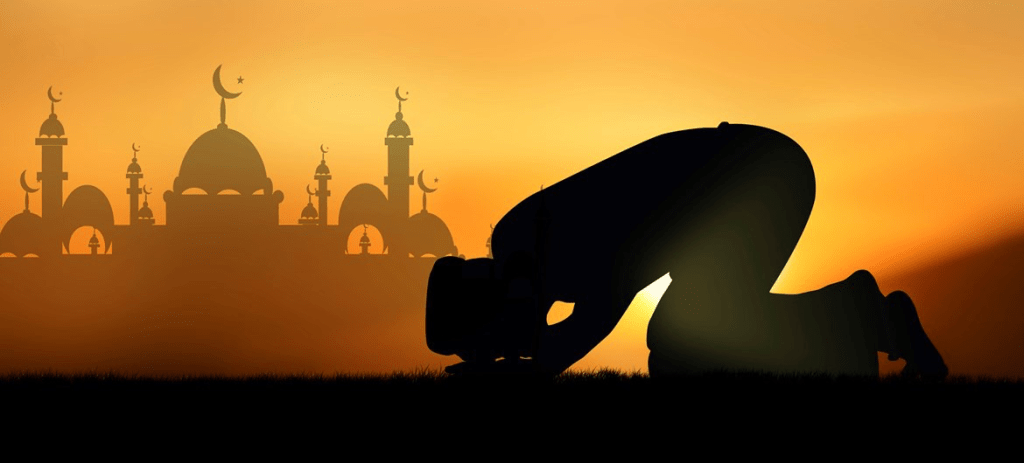
As Peter Beinart notes in his op-ed “Ilhan Omar’s Deeply American Message,” published in The Atlantic, Omar explains that, rather than keeping her religion private, she expresses it openly as a way of affirming that, in America, she need not hide who she is to enter the public square. “I tweet out verses of the Koran,” she explained. “I say As-salaam alaikum and Alhamdulillah”—“Peace be unto you” and “All praise is due to God alone”—“because I want” Americans “to get comfortable” with “what they mean.”
Yes. Just as fundamentalist Christians want their views to be comfortably accepted by those who don’t share them or who are threatened by them. Just as, in their agenda to fold their ideology into everyday thought, fundamentalists demand their views be heard in government offices and in public schools. Fundamentalist Christians say “Jesus is Lord” and “The path to salvation is through Jesus and Jesus alone” to get people “comfortable” with “what they mean.” It’s not enough to have churches where they can pray and talk to each other about their beliefs. They want to use the public space to proselytize, to mainstream their religious ideology, to normalize a belief system that claims the existence of a supreme being to which every person should submit and a divine law to which everything should be subject. They complain constantly about being the victims of anti-religious bigotry by liberals and atheists who resist this campaign. There’s a war on Christianity. Haven’t you heard?
Not all Christians do this, of course. Many Christians accept the place of faith in a secular society. They recognize the separation of church and state. They love their country and respect its founding principles. If they always put “God first” in their own lives (a scary thought, but they have that personal freedom) they don’t insist others suffer along with them. They don’t whine about being the victims of anti-religious bigotry when people criticize their faith and note the terrible things Christians have done on the basis of that faith. But the zealot does. Indeed, it’s a mark of zealotry to complain about irreligious criticism, to express fantasies about being a persecuted minority in a society that defends religious liberty, to compare criticism of their beliefs to attacks on people for their skin color or sexual orientation. We hear it a lot. Where are the mainstream newspapers and TV news shows on this terrible bigotry?
A zealous religious propagandist might dream up a word like “Christophobia” and use it to smear critics of his faith in an attempt to silence objections to its content, effects, and spread. We’d expect that from zealots. But it would be quite troubling if the mainstream media reflexively took up this propaganda term and used it to suppress criticism of the Christianist campaign to force Christianity into government and politics.
Imagine the headline: “Democrat’s Criticism of Mike Pence’s views on homosexuality is blatant Christophobia.” Or imagine the media defending a prominent white nationalist from criticism after he described the Christchurch massacre in New Zealand as “some person did something.” Imagine the howls going up about “fascophobia.” It’s not hard if you assume a situation in which the media is peddling Christianity or white nationalism. Otherwise, why would they do such a thing?
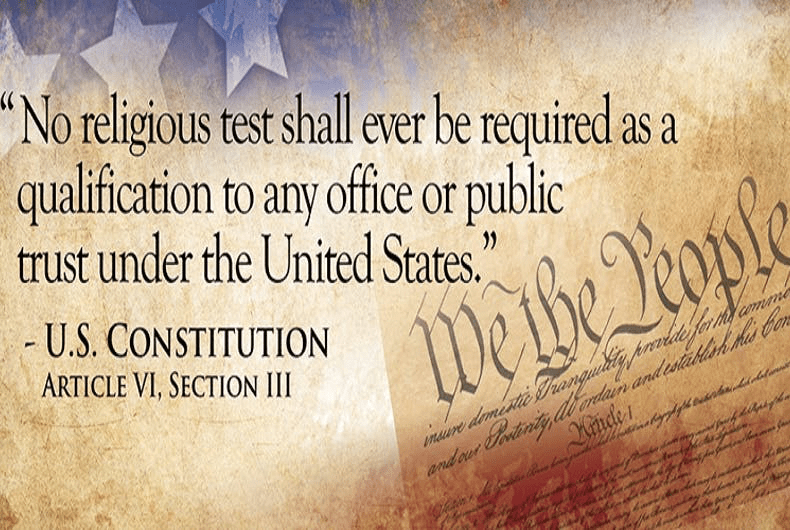
Supreme Court Justice Clarence Thomas, a Catholic, is critical of Senate Democrats’ attempts to apply religious tests to Roman Catholic judicial nominees. “I thought we got away from religious tests,” he remarked this year during (you guessed it) Pepperdine University School of Law’s annual banquet. Thomas was referring to Article VI of the Constitution, which states that “no religious test shall ever be required as a qualification to any office or public trust under the United States.” It’s one of my favorite parts of the Constitution. I cite it frequently.
But Thomas is confused about what “no religious test” means. It means not compelling a person to swear an oath to a religion or to profess a belief in religion at all. It doesn’t mean finding a person unfit for office because of his ideology. That would require turning off one’s brain. Ask yourself: Does it matter whether a person is a fascist? Hell yeah, it does. We are only obliged to tolerate somebody’s beliefs. If the man keeps his religion to himself or merely expresses a religious point of view at the appropriate time and place, then we are in no position to oppress him. At the same time, we are under no obligation to enable or welcome or respect his religious opinions. And we are free to ask him about his religious views and reject his candidacy on account of them.
There is nothing oppressive about keeping Catholics off the court if they can’t keep their Catholicism out of their judgments (and it appears they can’t). Nor is there anything oppressive about keeping Muslims out of government if they can’t keep Islam out of politics (ditto here). Why on earth would any rational person expect other persons to disregard what candidates for public office think about the world in determining whether they are fit to judge the affairs and fates of other people? We’re now supposed to ignore facts and rubber-stamp the installment of demagogues and zealots in power? Pardon me, but this is an insane interpretation of secularism.





 freedom and reason