Race and Democracy

My opposition to identity politics is rooted in deep democratic sympathies. To illustrate, let me take the paradigm of identity politics: race. There is nothing more undemocratic.

In racialized systems, individuals are compelled to belong to a race and expected to behave in a manner consistent with whatever doctrine can be made to appear to be associated with or “normal” to that racial designation. Richard Ford puts this well in Racial Culture: A Critique (2005) when he notes that, although “there is no necessary correspondence between the ascribed identity of race and one’s culture or personal sense of self,” identity politics produces “compulsory” enactment of “prewritten racial scripts.” Ford argues that “group difference is not intrinsic to members of social groups,” thus rejecting the notion that identity can be essentialized. Instead, he contents, it is contingent upon “the social practices of group identification.”  

Despite it being a demographic category, incapable of agency (which sociologists conceptualize as a telic ability/capacity unique to individuals), self-appointed (i.e., unelected) spokespersons tell those they claim as their own how to think and behave at the risk suffering ill-repute or some negative sanction. If a black person deviates from the hegemonic doctrine of blackness, then he risks a derogatory epithet. A white person, on the other hand, is expected to deviate from the doctrine of whiteness lest she risk s being labeled a racist. To claim virtue, a white woman must admit her white privilege and declare herself an ally or even a race traitor (which is not to say she can ever escape her whiteness, which she wears like an invisible knapsack).

Again, demographic categories have no collective agency. Race is a designation based on who you (allegedly) are, not on what you actually think or do. There is no deliberative decision-making process in a racial group. Race is not a democratic institution. It’s not a voluntary associational group to which one can consent or from which one can withdraw. (If anything, as a structure, race limits the ability/capacity of agents.) David Duke doesn’t represent me by virtue of sharing my skin color. Neither does Bernie Sanders. My race tells you nothing about my politics, my religion, my taste in food or music, or my sexuality. If you think you can tell me who I am on the basis of my skin color, then you are stereotyping on the basis of race—and guess what that makes you? Well, that depends, since only some people can be a racist by virtue of their skin color (I know the drill).

The assumption that race represent collective agency is the trick that allows people to tie culture to race. That way, when one criticizes culture (which human beings should do since culture is a mixed bag of enabling and disabling thoughts and actions), you can be accused of racism—or antiracism if the culture you criticize is attributed to the right demographic. But the very notion that culture is an expression of race—that is, that values, thoughts, behaviors, tendencies, etc., things that can validly differentiated by skin color and other superficial phenotypic features – is the essence of racism. Racism roots the mind in two false biological propositions: (1) the mind flows from the genes and (2) humans can be meaningfully racially differentiated on the basis of genetics. The first proposition is found in the claim that whites are more intelligent than blacks. The second is found in the claim that whites really are different from blacks. Both claims find no purchase in anthropology. So the answer to this question: “Why do people over there act like that?” can never be “Because they’re black.” The scientific explanation would be something like this: The people over there act like that because they are socialized in a culture that provides the myths and rituals that guide their behavior. And that has nothing to do with race.  

Critical race theory (CRT) and its variant critical race feminism (CRF) constitute an enterprise based on this error. CRT/CRF manufacture a system of concepts—not a theory, but an ideology – that permits the reification of abstractions by disappearing concrete indidivudals into demographic categories, hypostatizing them, substituting identity for human agency. CRT/CRF then “theorize” that colorblindness—defined as the act of rejecting the practice of determining the fate of an individual based on her skin color—is racist in-itself. This is indeed a strange alchemy: the man becomes most racist when he chooses colorblindness. CRT/CRF identifies advocacy of colorblindness as a feature of what it calls the “perpetrator’s perspective.” White people who are not allies prefer this standpoint because it systematically benefits them. The antithesis of the perpetrator’s perspective is the “victim’s perspective,” which assumes that every person in a minority group is a victim. This victimhood can lie outside of consciousness, hence the need for race consciousness (except if you’re white).

Richard Thompson Ford provides one of the more lucid explanations for how material inequality is reproduced without laws requiring inequality in his 1994 article “The Boundaries of Race: Political Geography in Legal Analysis,” in Harvard Law Review. Ford contends that public and private actors cooperate to construct “racially identified spaces.” Such spaces define political boundaries that determine and condition the distribution of individuals, economic resources, and political power. These spaces are externally imposed or emerge from divisive structural forces. A myth has grown up around this that the surrounding racialized spaces are “quasi-natural,” “prepolitical,” or primordial associations of individuals. In fact, these spaces are political creations that accumulate—after they are formed—a “natural” history, developing an “organic” social organization. Scholars must, therefore, to take care to avoid mistaking effect for cause.

Richard Thompson Ford

Central to Ford’s argument is the promotion of race-neutral policy that has become the main component in a strategy to create and maintain racialized spaces: “racially identified space interacts with facially race-neutral legal doctrine and public policy to reinforce racial segregation rather than to eliminate it gradually.” Understanding how race-neutral policy perpetuates and even intensifies racial segregation is a key to understanding the situation the United States faces today. Indeed, it has been the exploitation of the ignorance of the public and most experts about the reality of race as structural power, and the relationship of the law to this reality, that lies at the heart of the assault on affirmative action, and the prevailing legal thinking that puts substantive civil rights goals virtually out of reach.

Like many CRT scholars, Ford advances his argument with a thought experiment. He asks us to imagine a society with two groups—one black and one white—that are differentiated only by visible physical variation.  Because of a history of racial discrimination in Ford’s invented society, blacks earn significantly less income and own substantially less wealth in comparison to whites. Over the past thirty years or so, whites have come to understand the sin of racial discrimination and have abolished the legal structure that had formally maintained the system of discrimination. Moreover, the society installed a regime of public education on the subject of race and succeeded in eliminating race prejudice. This society, Ford asks us to accept, is color-blind. Ford’s exercise desires to prove fallacious the argument that, with de jure discrimination and race prejudice eliminated, the racial divide should, with time, disappear.

Before reform, Ford’s society had in place a system of racial segregation in which each of these municipalities consisted of two enclaves, black and white, or municipalities incorporated as white or black. These municipalities, decentralized and geographically defined governments, are political units that tax their citizens and use the revenues to provide public services, education, utilities, and infrastructure. “Thus,” Ford notes, “the now color-blind society confronts a situation of almost complete segregation of the races—a segregation that also fairly neatly tracks a class segregation.”  

In those municipalities that are “racially mixed,” even though public services are equally distributed among the neighborhood, whites have, because of their higher incomes, amassed more wealth, as larger homes, larger bank accounts, etc. The black-white cities would therefore have substantially inferior public services compared to exclusively white cities who would enjoy a higher average tax base (or would at least enjoy a lesser tax burden given same level of services). Exclusively black cities would be in the worst position of the three types of municipalities, with considerably inferior public services and/or higher relative taxes. 

Under such circumstances, whites in “mixed” cities would have an economic incentive to leave or secede from the city; and unincorporated white areas would also have a reason to resist being incorporated in the mixed cities. However, it seems a reasonable assumption that blacks would favor the superior public services (or lower tax burden) of white neighborhoods and would, if they had the means, move there. If this occurred, it might be assumed further that over time economic segregation would replace racial segregation. 

This outcome depends on a false assumption, namely that residential segregation has not economically hamstrung blacks. Residential segregation affects employment opportunities and economic status for three reasons. First, since education is financed by local taxes, there would be different levels of educational opportunity and outcome. Those who enjoyed superior educational facilities would be better trained for the higher income jobs. Second, informal social networks would be racially differentiated, and these would act as barriers against outsiders entering the privileged jobs sectors. Third, the market value of homes would present with marked inequity depriving black families of the collateral necessary to buy homes in white neighborhoods.

The history of residential segregation would have created (and would continue to generate) deficits in what some have imagined as “social capital.” As a result, blacks would have substantially lower incomes, earning lower wages and probably suffering higher levels of unemployment (given what would surely be an undercapitalized neighborhood). Given these disadvantages, poor blacks would be unable to move into privileged neighborhoods. On the other end, whites would understandably be reluctant to give up their privileges to relocate to black neighborhoods (for they would suffer inferior public services and higher taxes). The outcome would be, absent intervention, the reproduction across generations of economic inequity. “At some point an equilibrium might be achieved: generally better-connected and better-educated whites would secure the better, higher-income jobs and disadvantaged blacks would occupy the lower-status and lower-wage jobs.” 

One of the important features of Ford’s imaginary society is that these outcomes occur without the presence of racial prejudice or a racial ideology. “There is no racist actor or racist policy in this model, and yet a racially stratified society is the inevitable result.” On purely economic grounds, that is, those of rational self-interest, the structure of racial segregation perpetuates itself. This is what I refer to elsewhere as objective racism. It is objective because its existence does not depend on the consciousness of actors. It is a species of racism because the effect is to privilege one group of people over another, a group identifiable only by their previously racialized physical features. “Even in the absence of racism, then, race-neutral policy could be expected to entrench segregation and socioeconomic stratification in a society with a history of racism,” Ford writes. “Political space plays a central role in this process. Spatially and racially defined communities perform the ‘work’ of segregation silently.” 

Identity politics contents that blacks exist in a world that has all the features and dynamics of Ford’s model and more: the conscious struggle by whites to secure racial privilege by actively denying blacks the opportunity to achieve substantial racial equality by taking off the table the right to secure redress for racially differentiated outcomes. These outcomes are said by those who oppose substantive racial equality to either be the result of historical inequities or the fault of the disadvantaged. Those who advance the former believe that over time racial equality will be achieved. But, as Ford demonstrates, even under the most ideal circumstances, this is impossible and so this viewpoint effectively advocates the status quo. Those who advance the latter—that the fate blacks suffer is of their own doing—explicitly advocate the status quo while at the same time express a desire to absolve whites of any responsibility for the fate of their black brothers and sisters.

However, since this reframing means one no longer has to identify a specific perpetrator upon whom to lay guilt and responsibility (the old discrimination test), that is, since perpetration is an automatic collective action by virtue of being born into the perpetrator group, this formulation convicts everybody with a particular skin color of a crime. Individuals of a certain race are all guilty (or all victims) by definition. No specific facts need be shown, no individual need be tried, only statistical abstractions represented as prima facia evidence of some thing need to be provided (if any facts need providing at all). How can such a conclusion/verdict ever be falsified? It assumes as proven that which should require proof but is never proven nor provable. This is not rational. It’s a theological argument. And like theology, it alienates us from our species being. What do we call presuming the guilt of all those with a particular skin color?

Did you ever wonder why it seems that we can’t have a broad democratic community where individual interests are represented in deliberative decision-making processes? The answer is, in part, because racial consciousness, with offensive or defensive, doesn’t see individuals. Instead of our species ties, race consciousness sees the world as made up of antagonistic groups—not material class relations, I hasten to stress, but imagined communities based on ideology—that are intrinsically oppositional. Unlike class antagonism, which are resolved by transcending class-based system through socialist revolution, the problem of race does not have a material solution. At least not one any moral person would advocate. The only way to transcend race is to give it up. Like religion. You have to stop practicing it.

Verse 4:34 of the Qur’an

“Men are the protectors and maintainers of women, because Allah has given the one more (strength) than the other, and because they support them from their means. Therefore the righteous women are devoutly obedient, and guard in (the husband’s) absence what Allah would have them guard. As to those women on whose part ye fear disloyalty and ill-conduct, admonish them (first), (Next), refuse to share their beds, (And last) beat them (lightly); but if they return to obedience, seek not against them Means (of annoyance): For Allah is Most High, great (above you all).” (Translation: Abdullah Yusuf Ali)

In this passage, Allah, through the angel Gabriel, instructs Muhammad to tell the people that beating women is appropriate if they are disloyal or behave badly, and if they they do not respond to admonishment or withholding of affection. If they continue to be disobedient then they are to be beaten until they become obedient again. Because the Qur’an is eternal and infallible, delivered to mankind by an angel to a perfect man (Muhammad), and because a good Muslim submits to Allah, then women of this faith accept this preachment. Because sura 256 of Al-Baqara of the Qur’an, in the most charitable reading, says that “there is no compulsion in religion,” that under no condition should an individual be forced to accept a religion against her will, women who submit to their husbands in this way have chosen to do so.

Maajid Nawaz handles a call

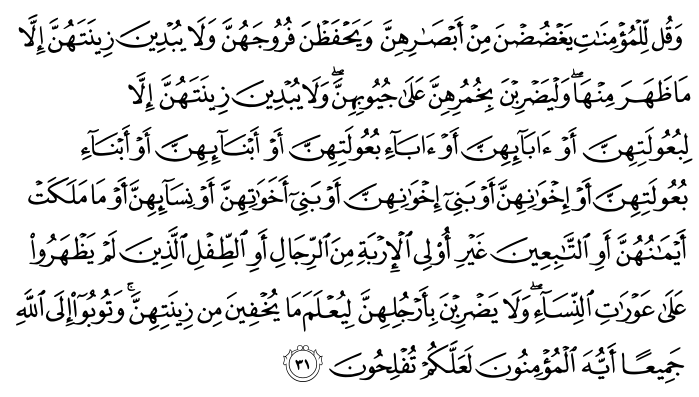
Now consider the argument by some feminists and women identified as Muslim that women who wear the hijab do so by their own volition and that it is therefore a feminist symbol of empowerment. Here’s the passage sura 24:31:

Again, using the Abdullah Yusuf Ali translation: “And say to the believing women that they should lower their gaze and guard their modesty; that they should not display their beauty and ornaments except what (must ordinarily) appear thereof; that they should draw their veils over their bosoms and not display their beauty except to their husbands, their fathers, their husband’s fathers, their sons, their husbands’ sons, their brothers or their brothers’ sons, or their sisters’ sons, or their women, or the slaves whom their right hands possess, or male servants free of physical needs, or small children who have no sense of the shame of sex; and that they should not strike their feet in order to draw attention to their hidden ornaments. And O ye Believers! turn ye all together towards Allah, that ye may attain Bliss.”

Those who criticize the hijab point out that it is the Arabic word for “cover” derived from hajaba which means barrier, to partition, to screen, to shelter, to veil. It refers not merely to garments covering the body and head, but to religious-based norms of modesty and morality. Thus women, to be moral, must be modest, and this means covering the body and head. In some interpretations this means covering the face also. The hijab also suggests gender segregation, which we see in mosques and other public spaces. There is an attempt to blunt this criticism by claiming that women are not forced to don the hijab but do so to please Allah. But the same can be said for sura 4:34. Women are not forced to be beaten by their husbands, but submit themselves to beating out of deference to the Qur’an.

How could this be a feminist argument? It’s not. It’s patriarchal propaganda.

Refusing the Normalization of Religious Belief

Reflecting on a lifetime of confrontation with religion, I find that I am incapable of accepting the normalization of religious faith. No apologies. It’s not a flaw. I accept that religion is normal from a statistical standpoint. But that doesn’t make it true. Or harmless. There are societies in which sexism is normative. Does that make justifications for sexism true or good?

As for its truth value, religion is a type of ideology. According to Ted Honderich (The Oxford Companion to Philosophy), an ideology is a collection or system of normative beliefs and values possessed by persons beyond purely epistemic reasons. Epistemic refers to knowledge, which is confirmed or verified belief. In other words, ideology relies on assumptions and beliefs about the world that have no factually demonstrable or logically necessary basis. Moreover, the claims of religion are plainly false. They systematically confuse predicate and subject. In truth, nature exists independent of the philosophies the mind has developed to understand it. Minds are the products of brains, which result from the evolutionary dynamic of natural history. Social relations as well have truths independent of the justifications for them. Indeed, human beings invented religion and the things belonging to it in order to justify oppressive social relations.

Religion is not good because it has made life difficult for people I love. Including me. But it has also made life difficult for hundreds of millions – billions – I could never know. (One cannot say this about nature as natural forces carry no intent.) Consider these three passages from the religious texts of the two most popular religions, Christianity and Islam.

The first two come from the Pentateuch, which is the scriptural foundation of the Abrahamic traditions (using the New English Translation). Leviticus 18:22 states: “You must not have sexual intercourse with a male as one has sexual intercourse with a woman; it is a detestable act.” Two chapters later this prohibition is repeated with the punishment prescribed. Leviticus 20:13 states: “If a man has sexual intercourse with a male as one has sexual intercourse with a woman, the two of them have committed an abomination. They must be put to death; their blood guilt is on themselves.”

Those of the Christian faith who wish to keep their religion going but find these verses objectionable instruct us to read the scriptures from the standpoint of contemporary moral understanding. This admits that God is not a being that exists beyond history but a human construction. Given this, what makes God necessary? What is its authoritative value if we may disregard those bits that offend us? And what stops others from faithfully adhering the demands of the text? It is important to keep in mind that Islam takes over the biblical story of Lot (Lut) to condemn homosexuality, which in many Muslim-majority countries is punishable by death. For a lot of religious people cherry picking is not an option.

The third passage is found in the Qur’an sura 4:34 (Abdullah Yusuf Ali translation): “Men are the protectors and maintainers of women, because Allah has given the one more (strength) than the other, and because they support them from their means. Therefore the righteous women are devoutly obedient, and guard in (the husband’s) absence what Allah would have them guard. As to those women on whose part ye fear disloyalty and ill-conduct, admonish them (first), (Next), refuse to share their beds, (And last) beat them (lightly); but if they return to obedience, seek not against them Means (of annoyance): For Allah is Most High, great (above you all).” The Qur’an instructs men to beat their wives which presupposes the right of men to control women, the foundation of the patriarchy. The refusal of even some women who identify as Muslim to reject the inerrancy of the Qur’an – see my blog entry Qur’an Verse 4:34 – is a stark reminder of the danger of failing to delegitimize scripture.

Admittedly, I have trouble suffering zealots. But I tolerate people who believe in gods. I even count them among my friends. What I endeavor to stress is that if I am to be confident in my criticisms of Christian belief, I must also judge Islam by the same standard. To make an exception for Muslims that I do not make for Christians is also a failure of courage.

Anti-Abortion

These anti-abortion bills are horrific. But I don’t understand the argument for exempting pregnancies on the grounds of rape. If abortion is wrong because it unjustly takes the life of a person, then why would the fact that the fetus’s father is a rapist – or anything else – change anything? We are not punished for the crimes of our fathers. We don’t kill the children of rapists. The rape is not their fault. 

The bills are horrific because they violate the personal sovereignty and bodily integrity of women. The parentage of the fetus is irrelevant. The life and liberty of the mother are the only relevant factors.

For more in-depth argumentation around this issue see my July 2, 2008 essay The Fetus is a Person. Now what? There I argue that “[t]he demand for the state to control the reproduction of women is an authoritarian one, one that is entirely incompatible with the principles of liberty underlying the legal and moral order necessary for a free society.” I reference Judith Jarvis Thompson’s famous analogy in that essay, so readers will want to check that out if they are not familiar with Thompson’s argument.

See also my April 2, 2013 piece Abortion is Really About Freedom. In that essay I write, “The question of the permissibility of abortion is not about the status fetus but the right of a woman (or any person) to determine what purposes her body is used for, presuming she is not a slave (and if she it, she must be liberated).” And this: “Personal autonomy is the first right – every person must be free from oppression. Life can be and often is sacrificed to preserve this right. If a woman cannot determine how her body is used, she is not free.”

Muslims are Not a Race. So why are Academics and Journalists Treating Them as if They Were?

In their 2009 article, “Refutations of racism in the ‘Muslim question’,” published in Patterns of Prejudice (43 [3-4]: 335–54), Nasar Meer and Tariq Modood “identify a variety of reasons why the notion that Muslim minorities could be subject to racism by virtue of their real or perceived ‘Muslimness’ is met with much less sympathy than the widely accepted notion that other religious minorities in Europe, particularly Jewish groups.” However, Jews are not merely a religious group, but are an ethnicity in the way Arabs are, whereas the Muslim identity spans many ethnicities (and races). Nobody would suggest that anti-Arab sentiment, to the extent that phenotypic features associated with that ancestry are racialized, is not analogous to racism (albeit the term of “ethnicism,” that is prejudice based on ethnic origin, would be more usefully applied). At the same time, criticisms of Judaism, if by this we mean Jewish religious thought and practice, is not anti-Semitic; it is a critique of ideology, not of race or ethnicity.

Muslims in modesty dress

A year earlier, Nasar Meer, this time with Tehseen Noorani, published a sociological comparison of anti-Semitism and anti-Muslim sentiment in Britain in The Sociological Review (56 [2]: 195–219). They write, “Across Europe activists and certain academics are struggling to get across an understanding in their governments and their countries at large that anti-Muslim racism/Islamophobia is now one of the most pernicious forms of contemporary racism and that steps should be taken to combat it.” This assumes as proven a claim for which Meer and Noorani could provide no evidence. It is simply a conflation of opposition to an ideology and those who advocate that ideology – in the same way one might oppose Fascism and Fascists – with the practice of racism. Similarly, R.D. Johnson, Haluk Soydan, and Charlotte Williams, writing in Social Work and Minorities: European Perspectives (1998), describe Islamophobia as the new form of racism in Europe, asserting that “Islamophobia is as much a form of racism as anti-Semitism, a term more commonly encountered in Europe as a sibling of racism, xenophobia and intolerance.” But anti-Semitism is a form of prejudice against Jews on the basis of their ethnicity. Muslim is not an ethnicity.

In a 2007 article in Journal of Sociology (43 [1]: 61–86), “The resistible rise of Islamophobia: Anti-Muslim racism in the UK and Australia before 11 September 2001,” Scott Poynting and Victoria Mason define “Islamophobia as anti-Muslim racism and a continuation of anti-Asian and anti-Arab racism.” By assertion a propaganda term that attempts to pathologize opposition to Islam is also said to indicate racism, this despite the obvious fact that Islam is not a race but a religious faith. It moreover conflates a religious faith with a particular racial group that includes many religious faiths (Asian) and with an ethnic category that presents with many religious faiths (Arab). There are in fact millions of Asians and Arabs who are Christian. Imagine an article arguing the following definition of a concept published in the Journal of Sociology: “Christophobia is anti-Christian racism and a continuation of anti-Europe and anti-North American racism.” It sounds no less ludicrous in its original formulation. Presumably, this article enjoyed peer-review.

In 2011, Sabine Schiffer and Constantin Wagner, in “Anti-Semitism and Islamophobia – New Enemies, Old Patterns,” published in Race and Class (52 [3]: 77-84), disclaim “that to compare Islamophobia with anti-Semitism is not to equate them. But finding some parallels might help German society to combat a growing and dangerous anti-Muslim racism.” Here’s that construction again: “anti-Muslim racism.” In what way is a religious faith analogous to race? Every time you hear this construction substitute for it in your mind this construction: “anti-Christian racism.” Does it still make sense? If it doesn’t, then it “anti-Muslim racism” doesn’t make sense because they are not merely analogous but are species of the same genre. Yet Schiffer and Wagner continue as if they have something profound to say. They do this by leaning on the Jewish experience: “The achievement in the study of anti-Semitism of examining Jewry and anti-Semitism separately must also be transferred to other racisms, such as Islamophobia. We do not need more information about Islam, but more information about the making of racist stereotypes in general.” In other words, you don’t need to know that Islam is a patriarchal heterosexist ideology that seeks to put all human thought and endeavor under divine command interpreted by male clerics. You only need to focus on the fact that some persons don’t like Islam and thus must be because of racist stereotyping. What they actually mean, then, is that we need to make up shit about racist stereotyping by expanding the concept of racism to cover things that are not only not the stuff of racism but aren’t even analogous to the stuff of racism.

That same year, in “The Idea of ‘Islamophobia’,” published in World Affairs, Alan Johnson argues that “Islamophobia” can sometimes be nothing more than xenophobia or racism “wrapped in religious terms.” Note how this flips things. It would be accurate to say that the charge of Islamophobia is a way of reacting to criticisms and concerns about a political and religious ideology that wraps them in the language of racism in order to delegitimize them. Of course, before one could wrap her racism in religious terms, there would actually have to be racism, and since a Islam is not a race, there is nothing there to wrap. Thus, despite his hedging, his claim means to confuse the reader about concepts derived uncontroversially from observations of the real world. Johnson’s argument is ideological.

It is curious to scholars and politicians pretend as if Muslims have no ideology, no belief system, but rather should be treated the same as a black person or a homosexual, especially when this collapsing of concepts would be obviously unwarranted for such ideological groups as Fascists and Christians. How is criticism of Muslims for their beliefs concerning homosexuals any different than criticism of Christians for their homophobic beliefs? Why should criticisms of the treatment of women under Islam be any different than criticisms of Christians for their patriarchal and misogynistic beliefs? Why is it bigotry for homosexuals and women – and free thinkers such as myself – to worry about the influence of Islamic doctrine on law, government, and social relations generally in spaces which decades, indeed centuries of struggle have marginalized the oppressive characteristics of religion? Robert Miles and Malcolm Brown in 2003 write that “Islamophobia is usually based upon negative stereotypes about Islam which are then translated into attacks on Muslims.” But the same can be said for negative stereotypes of Fascism which are then translated into attacks on Fascists, attacked that are cheered by the same persons who condemn such attacks on Muslims. 

Kevin Dunn, Natascha Klocker, and Tanya Salably, in a 2007 article “Contemporary racism and Islamophobia in Australia – Racializing Religion,” published in Ethnicities (7 [4]: 564–589), contend that contemporary anti-Muslim sentiment in Australia is reproduced through racialization. “These are not old or color-based racisms,” they write, “but they do manifest certain characteristics that allow us to conceive a racialization process in relation to Muslims.” They ask us to consider “the racialized pathologies of Muslims and their spaces.” But what we are actually talking about is criticism of an ideology and concern about those who practice this ideology. Again, substitute some words and see if it still makes sense. What would it mean to talk about “the racialized pathologies of Christians and their spaces”?

According to Gabrielle Morainic, the increasing “Islamophobia” in the West is related to a rising repudiation of multiculturalism. She concludes that “Islamophobia is a ‘phobia’ of multiculturalism and the transruptive effect that Islam can have in Europe and the West through transcultural processes.” See her 2004 “Multiculturalism, Islam and the clash of civilizations theory: rethinking Islamophobia,” in Culture and Religion: An Interdisciplinary Journal (5 [1]: 105–17), for more. This term “transruptive” is obviously an Orwellian linguistic maneuver to avoid the actual word “disruptive” because the latter might indicate an empirical truth about multiculturalism, namely its culturally disorganizing impact on communities that depend on shared value systems upon which to build political and social solidarity.

Consider Erik Love’s 2013 review of Deepa Kumar’s Islamophobia and the Politics of Empire and Junaid Rana’s Terrifying Muslims: Race and Labor in the South Asian Diaspora in Contexts (12 [1]: 70–72): “Taking these two works together, Kumar and Rana put forth a strong argument that while Islam is certainly a religion, and not a race, and Muslims (like all religious communities) are a highly diverse group in terms of ethnicity, nationality, and even racial backgrounds, Islamophobia is in fact a form of racism.” We are asked to accept as true that which is admitted to be false. It’s as if O’Brien’s demand of Winton in George Orwell’s Nineteen Eighty-Four to see something plainly false before him as true has become an academic standard. “Both books,” Love writes, “effectively provide historical accounts showing the parallel development of Islamophobic discourses alongside other forms of racial bigotry and discrimination.” This is a typical argument running through the literature and journalism on this subject, that while Islam is “certainly” a religion and not a race, Islamophobia is “in fact” a form of racism. It asks us to jettison concerns for validity in concepts and precision in language for a propaganda campaign.

Journalists are eager to get in on obscuring the character of anti-Islamic sentiment. Writing in The Guardian, Nesrine Malik has a “Message to Richard Dawkins: ‘Islam is not a race’ is a cop out.” Malik admits that “technically” “Islam is not a race,” but then states that there is a “strong racial dimension to Islamophobia” noting that Muslims in the UK are mostly African, Asian or Arab. (That Arabs are considered white in the UK seems to have completely escaped Malik.) Disentangling the intersection of race and religion is, of course, an analytical exercise, which would depend on uncovering the motive for the action. Malik does none of this yet concludes that saying that Islam is not a race is a “cop out,” because although “Islam might not be a race…using that as a fig leaf for your unthinking prejudice is almost certainly racist.” This is a fallacious argument, since criticism of Islam and its devotees is no more a form of prejudice than are criticisms of Fascism and its devotees. Criticizing somebody for being black, on the other hand, is racist. Malik continues, “A focus on the academic distinction between religion and race is often used as a fig leaf for prejudice and outright bigotry.” Again, rational norms are problematic. In point of fact, the distinction between religion and race is rapidly disappearing in the academy – but only with respect to Islam. For Christianity, the distinction is maintained and no academic discourse on the problems of Christianity is smeared by accusations of bigotry. 

Tom Chivers, who blogs for The Telegraph, also goes after Richard Dawkins for his criticisms of Islam because he doesn’t distinguish between ideology and adherents to ideology. Even notable critics of Islam, such as Ayaan Hirshi Ali make this distinction. But criticizing people for holding an ideology is a distinction without a real difference. If there were no Fascists, discussions of Fascism would be about history. Ideologies affect other people when they are realized through human actors and their actions. Chivers also takes Dawkins to task for pointing out that the Muslim world has not produced very many Nobel laureates, an argument that Dawkins borrows from Neil DeGrasse Tyson (a man who nobody to my knowledge accuses of Islamophobia or racism). Chivers claims that Dawkins implies that this is “because [Muslims are] stupid, or brainwashed…by their religion.” (Chivers puts it in a self-sealing manner. It is accurate to say that Muslims are persons brainwashed by religion. This is true of all believers.) Chivers expects a scientist should also examine “other institutional or non-institutional dimensions on the lack of progress in Muslim societies, such as poverty and the scarcity of other resources” (as if that work is never done). “In other words,” he writes, “claiming that Muslims are exceptionally backward and attributing this to Islam is tantamount to racism and Islamophobia.” Why is it racist to attribute poverty to a backwards ideology that puts faith and superstitution ahead of scientific reason and fact?  It’s not. Indeed, it seems Chivers is quite interested in seeing those whose brains are chained to irrational ideology remain that way by branding criticisms of their backwards beliefs “racist.”

Malik, who adores the word “technically,” has a go at Dawkins on this score, as well (see her “Richard Dawkins’ tweets on Islam are as rational as the rants of an extremist Muslim cleric”): “After I wrote about Richard Dawkins’s snide attack on the supposed dearth of Muslim scientific and cultural achievement, some critics hit back along these lines. It is acceptable to criticize and belittle Islam because it is a religion, not an ethnic grouping – and therefore fair game.” Note what she says here. She is not complaining about the denial of educational or occupational opportunities on the grounds of religious opinions or identity, but the idea that it is acceptable to criticize and belittle religious opinions or identity. Yet the latter is completely acceptable in Western society, as is evidenced by the Monty Python comedy, The Life of Brian. The idea that one should be accused of bigotry for religious mockery is an extremist position. Religion is fair game. It has to be. Our freedom and future depends on it being fair game.

Islam in practice affects human beings in a manner analogous to Fascism in action: violent jihad, patriarchy and misogyny, persecution of homosexuals, intolerance of blasphemy and apostasy, loss of bodily autonomy, and so on. Islam is an oppressive totalitarian ideology that seeks to put everything under the command of sharia (Islamic law) and clerical rule. To be sure, not all Muslims actively pursue this goal, but it follows from the ideology they embrace. The grim truth is that the terrorist organization ISIS is not a deviation from or a perversion of Islam but a valid interpretation of it. In form and content, a clean separation between Islam and Muslims is no more valid a distinction to make as that separating Fascists from Fascism. The ideological work of making criticisms of Islam and Muslims appear to be a form of racism is a program to obscure this truth of Islam in order to mainstream its doctrine and practices in world. The left could hardly be expected to do the same for Christianity and Christians. So a deeper question is the genesis of the leftwing Islamophile. Why are the mainstream Islam by smearing its critics as “racist”? This is an urgent question.

Those who argue for the restricting the speech of Fascists, for preventing them from publicly expressing their opinion, including those who advocate the use of violence against Fascists on the grounds that Fascism represents a threat to freedom and democracy, but who at the same time accuse those who criticize Islam and Muslims as “bigots” and “Islamophobes,” who protest anti-Islamic sentiment, contradict themselves in a fundamental way: condemning one form of oppressive totalitarian ideology and practice while, not only defending, but embracing another form of oppressive totalitarian ideology and practice that more closely parallels fascism than any other currently being articulated. There is nothing special about religion that makes criticism of it and its adherents any different than criticism of any ideology and its devotees. The claim that religion is analogous to race and sex – and not analogous to racism and sexism – is perpetuated by a need (conscious or not) to keep the masses in thrall of myth and ritual.

For the record, as a civil libertarian, I defend the right of people to believe and express crazy ideas. My arguments about this problem do not suggest an official antitheism or the persecution of individuals based on their beliefs. I am committed to a free society in which ideas are freely held and shared and it is by virtue of this commitment that I am compelled to criticize those beliefs and expressions that prefer a different world, a world in which I am censored or punished for antitheist blog entries. Where I draw the line is at action. If it is not enough for a Muslim to hold a personal belief in Islam and that Muslim seeks to compel others to participate in the practices that belief demand, that’s when we have a problem. And that is just as true for Christians, as well.

As Christopher Hitchens put it May 7, 2007, “I’m perfectly happy for people to have these toys, and to play with them at home, and hug them to themselves and so on, and to share them with other people who come around and play with the toys.  So that’s absolutely fine.  They are not to make me play with these toys.  I will not play with the toys.  Don’t bring the toys to my house, don’t say my children must play with these toys, don’t say my toys might be a condom – here we go again – are not allowed by their toys.  I’m not going to have any of that. Enough with clerical and religious bullying and intimidation.  Is that finally clear?  Have I got that across?”

The Good News: Millennials and Fertility

I would like to transcend the framing of Alexandria Ocasio-Cortez’s response to The Economist’s story No Sex Please, We’re Millennials — that the magazine is feeding Incel arguments — and point out the potential benefit of one-quarter of young adults not having sex, namely the promise of low fertility rates. 

Cartoon from The Economist, May 2, 2019

As Karl Marx observed, the imperative of capitalism drives demography, its scope and its segmentation (for a length discussion of this see The Urgency of Population Control and Appreciating the Accomplishments of the Developed World). Capitalists seek more workers in order to increase the size and depth of the industrial reserve and drive down wages.

But the empowerment of women has put in capitalism’s way a barrier: stable or lower rates of fertility. Lower fertility rates have thrown a monkey wrench into the capitalist machinery. This is why capitalists are so hot for open borders. In the 1960s they threw open the nation-state to large-scale immigration and offshoring in order to weaken the power of labor. Globalism is a strategy to raise the level of profit over against the standard of living of workers in the developed world. Following the 1960s, wages and compensation where decoupled from productivity. With fertility rates in the developed world plummeting, the globalists have become ever more aggressive in marginalizing populist democratic politics that resists the denationalizing forces threatening the affluent world labor built.

Resisting neoliberalism and globalism have never been more important. The debate over populist versus progressive politics is the pivot. If populism wins, it means a better life for the generations that follow. Lower fertility rates mean slower population growth or, even more desirably, a smaller population – as long as we restrict the number of people coming into our countries. In other words, we have to avoid spoiling zero growth by allowing ourselves to become the pressure value for unsustainable population growth in the developing world. We must lead by example and help the developing work lower its fertility rates. 

Falling rates of fertility mean a potentially smaller ecological footprint while at the same time allowing for a greater standard of living. Fewer workers makes the labor commodity more valuable and this imposes upward wage pressure by raising the value of the labor commodity over against the demand for labor. In other words: a more democratic future means lower unemployment rates, more people gainfully employed (think about, for example, the surplus population capitalists ghettoized during the twentieth century — they’re still there suffering), with higher incomes, as well as greater tax revenues and lower rates of welfare utilization. Put yet another way, in plain Marxist language: flat-growth or smaller population means greater individual and family shares of the social surplus. Rising relative prosperity, if more equitably distributed, would come without raising consumption levels, as shares consumed by future individuals in a growing population become available for concrete individuals in a stable or smaller population. All this is good for our Mother Earth.

All this jazz about the “demographic crisis,” about how the West needs foreign workers to come toil for us and pay taxes to support our aging populations (thus reducing human beings to instruments for Western purposes) is propaganda calculated to trick people into accepting the economic needs of the capitalist elite. Guess what? Foreign workers grow old, too. But before the do, they also have children. And more children enlarge and speed up the treadmill of production destroying the biosphere in which we all must live. We have to jettison this nonsense that population control is eugenicist or racist. Population matters. Ecosystems have carrying capacities. We are exceeding ours.

Who’s Responsible for Iran’s Theocratic State?

The United Kingdom-United States participation in the 1953 overthrow of Iranian prime minister Mohammad Mossadegh and their support for the king Mohammad Reza Pahlavi, the Shah of Iran, is something I would have, had I been alive and aware of at the time, opposed and protested. With rare exception, I am a non-interventionist. The intervention, orchestrated by the MI6 and the Central Intelligence Agency was driven by Western imperialist desire, which I oppose on principle. Mossadegh was a social democrat whose reforms threatened foreign capitalist interests, in particular the British claim on the Anglo-Persian Oil Company.

However, the negation of Persia that came with the establishment of an Islamic republic in Iran on April 1, 1979 does not follow from the imperialist behavior of the capitalist Anglosphere in 1953, but rather represents the work of an authoritarian movement determined to Islamize Iran and drive from Asia western notions of individual liberty, human rights, and democracy and the failure of leftwing forces to grasp the significance of this movement.

Indeed, after 1962, the Shah’s progressive White Revolution threatened the traditional Islamic structures that had long stifled that country’s development by enfranchising women, nationalizing resources, and profit sharing in industry. Rapid industrialization and cultural modernization resulted from the Shah’s project. It was to this progress that Shia Islamists reacted. Moreover, rising expectations alongside growing prosperity brought new political demands. 

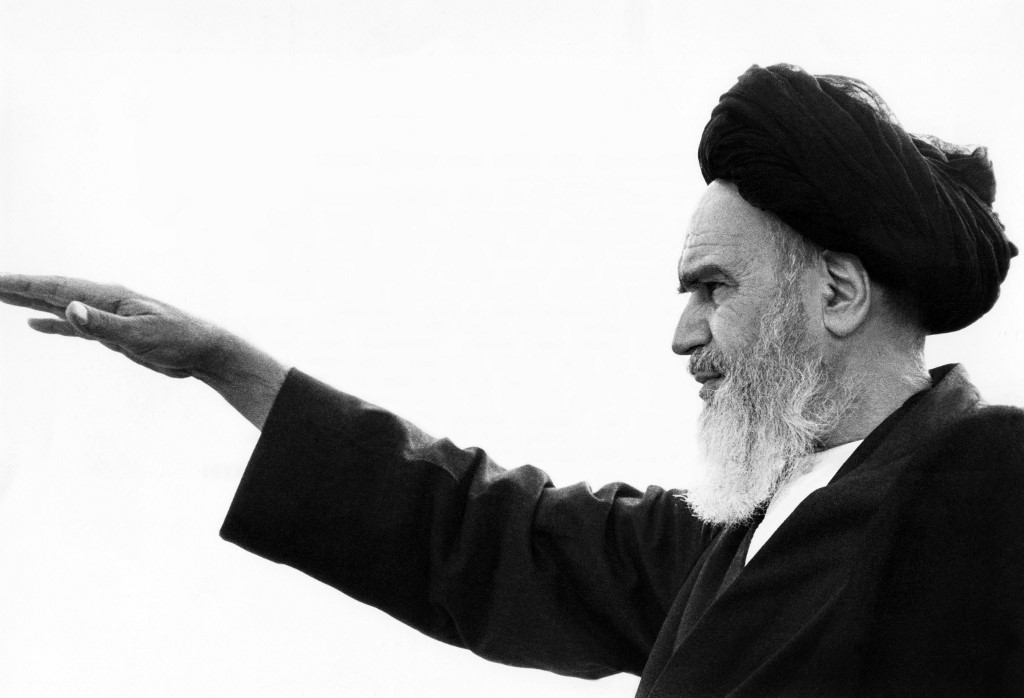
Ayatollah Ruhollah Khomeini

Marxists need to tell a more nuanced story of the rise of the Islamic republic, and this story should be informed by irreligious criticism. Contemporary Marxist thought seems to have forgotten its roots in antitheism, and as a result downplays or misses entirely the role religious ideology plays in world history relatively independently of material forces. It even confuses religious ideology with race and ethnic categories. These failures are largely the failure of Marxists to immunize the left from the corrupting perversions of postmodernist ideas.

The standard leftwing account of the Islamic Revolution attempts to compress more than a quarter century of history between the 1953 intervention and the 1979 overthrow of the 2,500-year-old monarchy founded by Cyrus the Great. According to this interpretation, the Iranian republic was a boomerang effect, a case of chickens coming home to roost.

A lot occurred during this 26 year period. The events of 1953 were immediately preceded by a split between Mossadegh and Ayatollah Abol-Ghasem Kashani. Mossadegh understood that Shia Islam had deep roots in Iranian society and cultivated a working relationship with the clerical community. Kashani had been a valuable ally in the effort to emancipate the energy sector from foreign control. However, Kashani sought more influence in governmental affairs. When Mossadegh, a staunch secularist, rebuffed him, Kashani joined pro-monarchy Ayatollah Behbehani alongside the Shah and participated in the British-American plot to overthrow the prime minister. Thus Islamists betrayed the prime minister.

There were other Islamists who helped undermine Mossadegh, as well, for example the terrorist Feda’ian-e Islam (Self-Sacrificers of Islam), who demanded compulsory public prayer, Islamic dress code, the expulsion of women from government service, and the prohibition of alcohol. Crucially, the Islamists supported the Shah, also a secularist, because they wanted to rid themselves of a secularist they believed was undermining their authority in Iranian society. However, the Shah’s White Revolution caused a rift between the Shah and the clerics who had supported him. Islamists support secular politicians and regimes only when they believe it advances their goals of spreading and entrenching Islam.

It was amid the White Revolution that the Ayatollah Ruhollah Khomeini, the future Supreme Leader of a theocratic Iran, rose to power. He aimed to thwart the Shah’s progressive agenda and establish sharia (Islamic law and government) over against the people. Khomeini was arrested and detained and eventually was forced into exile for more than a decade, first in Turkey, next in Iraq (he was expelled by Saddam Hussein in 1978), and then in France.

In exile, Khomeini wrote his Hokumat-e Islami: Velayat-e faqih (Islamic Government: Governance of the Jurist). From there, he instigated uprisings in Iran, drawing government action to suppress rebellion. Taking advantage of the Shah’s political liberalization (under pressure from the Carter Administration), the Iranian left helped widen the path for Islamist success by expanding and amplifying popular protests. The Tudeh Party, Organization of Iranian People’s Fedai Guerrillas, and People’s Mujaheddin, while opposed to clericalism, contributed to the disorder that advanced Khomeini’s goal of establishing an Islamic government. Khomeini’s movement, velayat-e faqih, or Guardianship of the Jurist, spread propaganda exaggerating the extent of government repression. Anti-western leftists disseminated the misinformation in the West (French postmodernist philosopher Michel Foucault perhaps most famously).

For his part, the Shah made errors in the 1970s that helped strengthen the Islamists over against the people’s interests. The presence of tens of thousands of foreign workers drew the ire of Iranian nationalists. Austerity measures worsened conditions coinciding with the migration of unskilled workers from the countryside into the cities. The Shah’s decision in 1976 to change the Iranian calendar to the ascension of Cyrus from the Islamic Hijra (the year Muhammad migrated from Mecca to Medina) triggered Islamists always on the lookout for grievances with which to agitate for their cause.

The Shah was sent into exile in January 1979. Khomeini returned from exile the following month to millions of adoring fans. Khomeini’s movement ideology became the basis of the Constitution of the Islamic Republic of Iran. The Grand Ayatollah became the Supreme Leader. This is how secular law and government were smashed.

It was not a response to UK-US intervention or the Shah’s authoritarianism that this happened, but rather Islamist reaction to progressive reforms and to western cultural influences and political and economic freedoms drove the turmoil. It was a negation of the Enlightenment, to the progress brought about by science and liberal ideas, such as the emancipation of women, which, while preferably unfolding in the context of a democratic system, can and does develop within monarchies.

It is paradoxical to celebrate the Islamic Revolution on the grounds that it overthrew an authoritarian secular regime since the Islamic Revolution established an authoritarian theocratic state, one in which women were returned to the previous status as patriarchal subjects. The ideology that fueled the countermovement against these values explicitly advanced the view that western cultural influences had to be eradicated as they corrupted Iranian society. The Revolution was simultaneously authoritarian, patriarchal, illiberal, and anticommunist, thus finding its analog in fascism.

The Marxist and quasi-Marxist groups that helped destabilize the Shah’s government found their movements hoisted upon their own petards. Perhaps it is out of embarrassment that so many Marxists rationalize the Islamic Revolution as a substitute for the failure of their political strategies and tactics in Iran.

In the end, it was a tragic thing that happened to one of the great civilizations in world history. That Iran was modernizing and its citizens were enjoying widespread freedom and prosperity makes its regression into theocracy all the more tragic.

Too often, a reflex follows the principled position against US clandestine interference in the internal affairs of foreign nations, one that blames subsequent events on the initial clandestine action. In the case of Iran, the Revolution was not a delayed reaction to UK-US action, but the work of a reactionary project to withdraw Iran from world progress. I would have opposed military intervention under Carter for the same reason I would have opposed Eisenhower’s 1953 action (also because it might have been counterproductive, undermining the Shah’s authority by even more closely linking it to Western influence). But had the Carter administration intervened and prevented the Islamic Revolution, the people of Iran would likely be better off today. Indeed, the region would likely be a lot better off than it is today.

Update (June 18, 2019): Given the saber-rattling of late with respect to Iran, I think it is helpful to recall this talk given by Bernard Lewis in 2009:

Government Took God Out of Schools and other Complaints.

A man in a social media forum told me that school shootings were a result of secularism. The government took God out of school and that’s why kids are killing their peers and teachers. However, the more secular a society becomes, the less is the level of violence in it, I pointed out. In fact, religion, especially the Abrahamic traditions, are rather strongly associated with violence. It’s not video games, either, by the way. The more video games there are, and the more graphic their depictions of violence, the less violent a society becomes, everything else being equal. What else do you think might explain the phenomenon?

He couldn’t say. I pointed out that violence is associated with the relative absence of non-stressed emotionally-available attuned parents (co-presence is not enough), the presence of patriarchal structures and misogynistic attitudes, and these are generally religion based. Then there is the disappearance of the individual into tribal life where grievances are exaggerated, trauma from maltreatment specifically but alienation generally, and the availability of guns and the gun culture, which includes militarism.

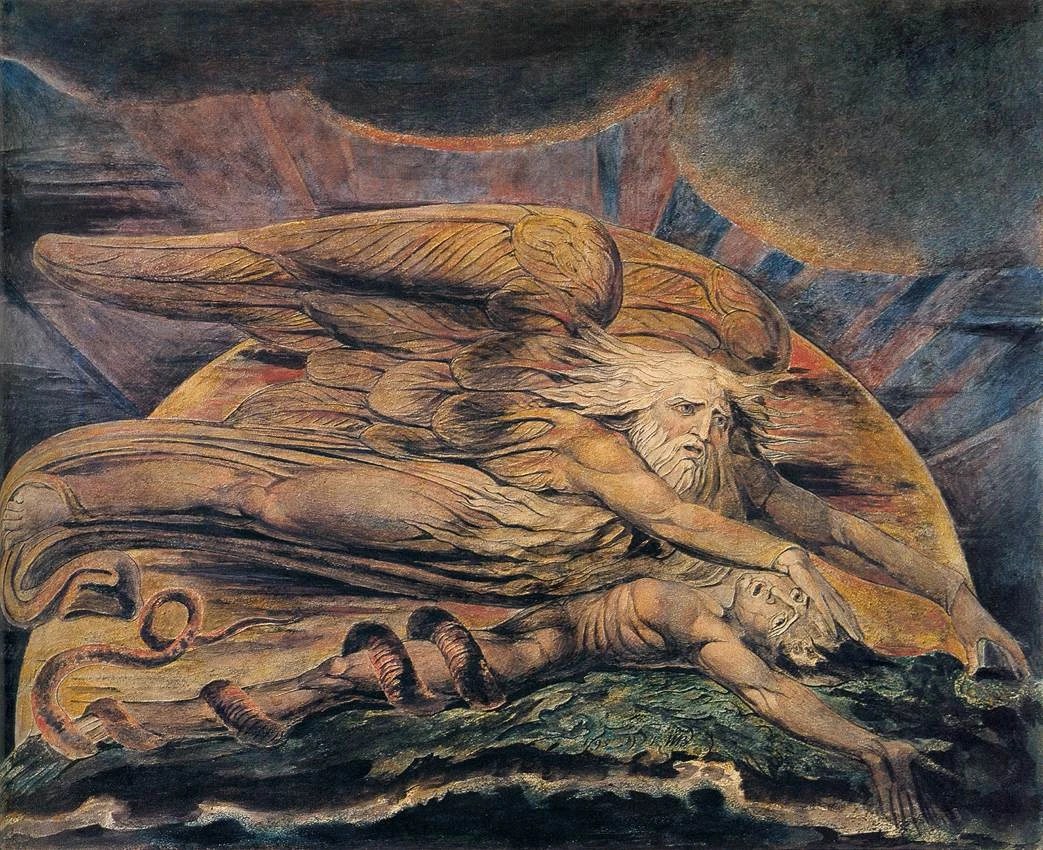
Elohim Creating Adam by William Blake

Respectfully, sir, you misread the nature of what secularism is and does, he interrupted me me. It is, among other things, responsible for more than 1.5 BILLION with a B murders of unborn infants worldwide just since 1980. True, there was a violence connected with religion (not just the Abrahamic religion.) However, it is not God who does the violence, whether people believe in Him or not. It’s the people in his name who do the violence.

I responded to his reference concerning reproductive freedom:That women cannot have their bodies commandeered by the state, stripped of their humanity, and forced to function as brood mares for theocrats driven by superstition, fables, and mythology is hardly the degenerate outcome you suggest. Indeed, it is a great advance for humanity that women are emancipated from the traditional religious and patriarchal structures that previously dictated to them how their bodies shall be used. To return to the barbaric period in which the state forces girls and women to have babies is a bizarre and cruel atavistic desire. It certainly shatters any claim to moral integrity. A moral person does not do that to women.

I continued: On the question of God, yours specifically, Yahweh, granting his existence, I will also grant you that your god does not always do the violence directly. Yahweh allows violence to be visited upon people by failing to stop it. So all the aborted fetuses are ultimately his responsibility because he has the power to stop abortions. Otherwise you would be saying that Yahweh lacks the power to stop evil. So you’re in a bind there. What is more, it seems rather obvious that Yahweh does plenty of evil directly.

Consider the violence he will visit upon persons in the afterlife who do not submit to him. I’m an atheist. I was never baptized. My fate will be a terrible one, and it will be entirely because Yahweh—the maker of all things—created hell and will throw me into it. Because I am a good person, what Yahweh will do to me is evil. I can be good all my life but if I do not recognize the passion of his scapegoat, I cannot enter heaven. Yet, I can rape children all my life, he will not stop me, and I can then accept his human sacrifice (Jesus) and I will live in eternal bliss.

I finished with this: Yahweh is a psychopath. He never responded.

Threat Minimization and Ecumenical Demobilization

Religion divides people into categories in order to control them: believers (devotees of the ideology), infidels (nonbelievers or believers in something else), heretics (critics and reformers), sinners (rule breakers), blasphemers (insulters of gods and prophets), and apostates (faith-leavers). Appealing to nature, myth, and virtue, religion creates an order to the world—a master plan for those inside and outside its walls. It uses multiple strategies to separate people into categories of things and maintain its sway over the population. Tribal marking, indoctrination, violence, and shaming are just a few of these ways. These categories are features of a system of control that parallels other control systems, such as fascism, white supremacy, and the patriarchy.

Dutch filmmaker Theo van Gogh lies dead in the street

Examples of violence by Muslims as a means of control are numerous. In 1988, Salman Rushdie’s The Satanic Verses was met with protests from Muslims in several countries and death threats were made against his person, compelling governments to place Rushdie under constant police protection. In 2004, Dutch filmmaker Theo van Gogh was assassinated for his film Submission, the killer leaving a note on the knife pinned to van Gogh’s chest threatening Ayaan Hirsi Ali, the author of such works as Heretic and Infidel, and script writer for Submission, with death. Like Rushdie, Ali required constant police protection for many years. In 2005, the Danish newspaper Jyllands-Posten published cartoons depicting Muhammad, the result of a competition inspired by the withdrawal of a children’s book on the life of Muslim prophet out of fear of retaliation for transgressing Islam’s irrational aniconism. Upon the publication of the cartoons, violence erupted in many Muslim-majority countries and in the West, including attacks on the Danish and other European diplomatic missions. Christian churches and Christians were targeted with violence. In 2015, men raided the offices of the French satirical weekly magazine Charlie Hebdo and killed a dozen people for publishing cartoons offensive to Muslims.

Massacre of cartoonists at at the offices of Charlie Hebdo, French satirical weekly magazine 

These killings represent a campaign of terror to impose Islamic blasphemy rules on secular society. The evidence of the success of the campaign is considerable. In 2009, Yale University Press published a Bowdlerized version of Jytte Klausen’s The Cartoons That Shook the Worldabout the Jyllands-PostenMohammad cartoon competition that resulted (not from the competition, but from the offense Muslims took to it) in the deaths of dozens of persons with the cartoons expurgated. Readers could read about a controversy surrounding offensive cartoons but could not see for themselves the cartoons that causes the offense. Yale University Press removed not only the cartoons but other images of Muhammad, as well. As Christopher Hitchens noted in Slate in 2009, an illustration by “Gustave Doré of the passage in Dante’s Inferno that shows Mohammed being disemboweled in hell” was removed. “These same Dantean stanzas,” Hitchens warns, “have also been depicted by William Blake, Sandro Botticelli, Salvador Dalí, and Auguste Rodin, so there’s a lot of artistic censorship in our future if this sort of thing is allowed to set a precedent.”

Another method of control is the expansion of law punishing criticism of Islam and Muslims. Strict control over thought and expression has already been achieved in many Muslim-majority countries through the imposition of the law. But this is not good enough. On September 28, 2012, Reuters reported that “Muslim leaders were in unison at the United Nations arguing that the West was hiding behind its defense of freedom of speech and ignoring cultural sensitivities in the aftermath of anti-Islam slurs that have raised fears of a widening East-West cultural divide.” What had offended the Muslim community this time was a short film, Innocence of Muslims. The movie was associated with riots in many Muslim-majority countries, as well as in some Western countries, riots that included attacks on diplomatic missions. The Turkish Foreign Minister (Ahmet Davutoglu) said it was time to put an end to the protection of Islamophobia masquerading as the freedom to speak freely. “Unfortunately, Islamophobia has also become a new form of racism like anti-Semitism,” he said. “It can no longer be tolerated under the guise of freedom of expression.” President Asif Ali Zardari of Pakistan, where more than a dozen people were killed in protests against the film, demanded insults to religion be criminalized. One after another, Muslim leaders delivered a version of this sentiment. Outside the UN building hundreds of protesters chanted, “there is no god but Allah.” One placard read: “Blaspheming my Prophet must be made a crime at the UN.”

It is one thing for a believer to hold himself accountable to the blasphemy rules of his religion, albeit it is problematic to suppose that it is appropriate for him to be held to such account by the others, but it is another thing altogether to hold to account a member of a free society for the rules of a belief system to which he does not subscribe. Nonetheless, western governments have becoming increasingly receptive to these demands. In 2008, the Canadian publication, MacLean’s, the nation’s leading newsweekly, was tried in the British Columbia Human Rights Tribunal for an article, “The Future Belongs to Islam,” that argued that the rise of Islam threatened such western values as free thought and expression. The court held that the article was “destructive,” “intolerant,” and “xenophobic,” but dismissed the case on the grounds that that it did not have jurisdiction over published material. That admission does not negate the fact that the Tribunal brought a case against a newsweekly for publishing a critique of religion in the first place. It does, however, highlight the irony of potentially punishing journalists for writing stories critical of an ideology that punishes journalists. In 2008, The New York Timesreported that Brigitte Bardot, an animal rights activist, was fined $23,000 in a French court for provoking racial hatred by criticizing a Muslim ceremony involving the slaughter of sheep. In spring of 2017, the Canadian parliament debated an “anti-Islamophobia” motion, M-103, sponsored by liberal MP Iqra Khalid. Conservative MPs raised an objection over the focus on the term “Islamophobia” (which was conflated with “systemic racism” in the measure) noting that it could be interpreted to include criticisms of Islam. Human rights expert and former Liberal Justice Minister, Irwin Cotler, advised Khalid to strike the word “Islamophobia.” Khalid said she was unwilling to “water down” her motion. The measure passed down party lines. Tarek Fatah, Canadian secular and liberal activist and founder of the Muslim Canadian Congress, noted that right-wing Islamic groups in Canada celebrated Khalid’s measure as a victory for the movement. Popular TV host Asif Javaid argued that the measure echoed the agenda of Islamists and Islamic extremists in North America who advance the international Muslim Brotherhood agenda to silence any criticism of Islam.

Remains of the World Trade Center

On February 26, 1993, bombing the World Trade Center in New York City, Muslims killed six and injured more than a thousand people. On September 11, 2001, in yet a second attack on the World Trade Center, Muslims killed 2,996 people and wounded more than 6,000 others. On November 5, 2009, at Fort Hoot, near Killeen, Texas, a Muslim killed 13 people and injured more than 30 others. On December 2, 2015, at a Christmas party in San Bernardino, California, two Muslims killed 14 people and injured 22 others. On June 12, 2016, in a Nightclub in Orlando, Florida, a Muslim killed 49 people and wounded 58 others. Taking just these five incidents from a universe of incidents of Muslim violence, and focusing only on the United States, Muslims have killed 3,078 persons and injured more than 7,000 people, mostly civilians, but also military personnel, police officers, firefighters, and rescue workers. These incidents were not random attacks. They were inspired by the ideology of Islam. They were not, as President Obama suggested when he said the San Bernardino shooters embraced a “perverted version of Islam,” contrary to the actions of Muhammad or the spirit of the islamic doctrine. They were inspired by his example. As I wrote in Assert Your Right to Tell the Truth:

Muhammad was a warlord who sought to spread the doctrine of Islam through subjugation of surrounding populations. Like Muhammad, Muslims spread Islam wherever they live and migrate, encouraging others to become devout believers, and hoping that, one day, sharia will be the law of the land and that all people, whatever their religion, will have to submit to that law and pay tribute to the Islamic state. The end goal is to see the entire world under the rule of Islam. Not all Muslims believe such things. But hundreds of millions of Muslims do. Just as hundreds of millions of Christians desire global Christian hegemony (but with Jesus meek and mild, not Muhammad the warlord). Islam is the fastest growing ideology in the world, presenting a unique threat.

It was in this context that future president Donald Trump called for a “total and complete” ban on Muslims entering the United States “until our country’s representatives can figure out what is going on.” He was criticized for this by the usual suspects—the White House, the Pentagon, the United Nations, as well as British Prime Minister David Cameron and French Prime Minister Manuel Valls (the Blarist Socialist Party member who endorsed Emmanuel Macron after pledging to support the Socialist candidate). But other Republican presidential candidates responded to the San Bernardino in a manner that echoed Trump’s frustration. Chris Christie argued that “this is a new world war and one that won’t look like the last two. And this is one where it’s radical Islamic jihadists everyday are trying to kill Americans and disrupt and destroy our way of life.” Jeb Bush: “If this is a war, and I believe it is since they have declared war on us, we need to declare war on them.” It struck me at the time that this was the right spirit to express. If our way of life was being threatened in this serious of a manner, a range of responses should at least get a hearing. The political left was horrified that anybody should express ill will towards a pet ideology they had relied upon to signal tolerance and their progressive ecumenical bona fides (you’ve seen the bumperstickers). After all, Muslim women look so exotic.

These events point to the problem of defining irreligious criticism—a crucial element in the creation of liberal secular societies based on scientific reason and human rights—as bigotry, let alone racism. The laws and conventions that are being extended to the case of religious criticism and mockery, whether one thinks they go too far or not far enough in their given domains, are based on a desire to marginalize fascist, racist, sexist, and homophobic speech—expressions deemed to strengthen the position of oppressive ideologies in society. Irreligious criticism is designed to do the opposite of this: to suppress oppressive ideologies, ideologies that seek to fracture the moral worth of human being in order to control populations for the sake of a few. In the case of their application to antitheism, such laws and conventions intend to stifle criticism of an oppressive ideology by lumping irreligious speech with hate speech. This is the reverse of what hate speech laws are designed to do.

Crucially, the inclusion of irreligious criticism in hate speech laws is not aimed at protecting religion generally. Nobody who seeks to shield Islam and Muslims from criticism and ridicule is suggesting extending hate speech laws to include similar treatment of Christianity, a religion whose followers did not erupt in violence with the release of Monty Python’s 1979 satire Life of Brian. (Indeed, Mormons see the Broadway musical, The Book of Mormon, as a chance to peacefully proselytize.) It is an effort to suffocate popular resistance of the greatest threat to western civilization since National Socialism.

Committing the Crime it Condemns

What emerges over the course of this discussion, “The Battle Over Free Speech: Are Tigger Warnings, Safe Spaces and No-Platforming Harming Young Minds?” from Intelligence Squared, is the left side of panel confirming its belief that minorities should have a veto over what other people see, say, and hear. Their reasoning is that group identity represents a collective-subjective set of opinions to which all members subscribe or would subscribe (if they weren’t falsely conscious). Moreover, some groups come with “collective traumas” that empower their spokespersons to make demands upon members of those groups who, by virtue of their identity, are responsible for those traumas.

Kehinde Andrews speaks for himself and his interpretation of the world. Yet he presumes to speak for a collectively-shared abstract point-of-view with which he identifies and attributes to many others. He believes this point-of-view—his point-of-view—should have the authority to reorganize society, especially the university, by designating exclusive spaces and censoring some opinions while elevating others. No white people in this space. More black voices in that discussion. And so on. If being black were like being Muslim, and Andrews a cleric, then we would have an answer to the question: who appointed Andrews to make choices for others? (After all, the cleric is authorized to speak for the group of believers). But being black is a demographic category. It is not an ideology in itself, albeit it is the product of an ideology; it is not a politics per se. Indeed, being identified as black (or white) should neither signal nor obligate a politics at all. As an audience member at the end of the discussion points out, Andrews doesn’t speak for him.

The reality is that Andrews wants to control speech with which he disagrees and in order to do that he—and by extension his group—needs to control the spaces in which speech is exercised. This is an authoritarian desire, one rationalized by claims of abstract victimhood. Andrews justifies his censorious impulses on the grounds that the most free and open system in history is inherently racist. White advantage is the default, baked into the liberal view of free speech. This is the post-liberty vision of antiracism. Antiracism requires a closed and controlled system that presumes as proven that which it has not demonstrated. It is an effort to manufacture a truth and include everyone into it. This involves as a fair amount of bullying and intimidation, as we have seen on colleges campuses. Antiracism disrupts the dialectic by shouting down points-of-view deemed unacceptable.

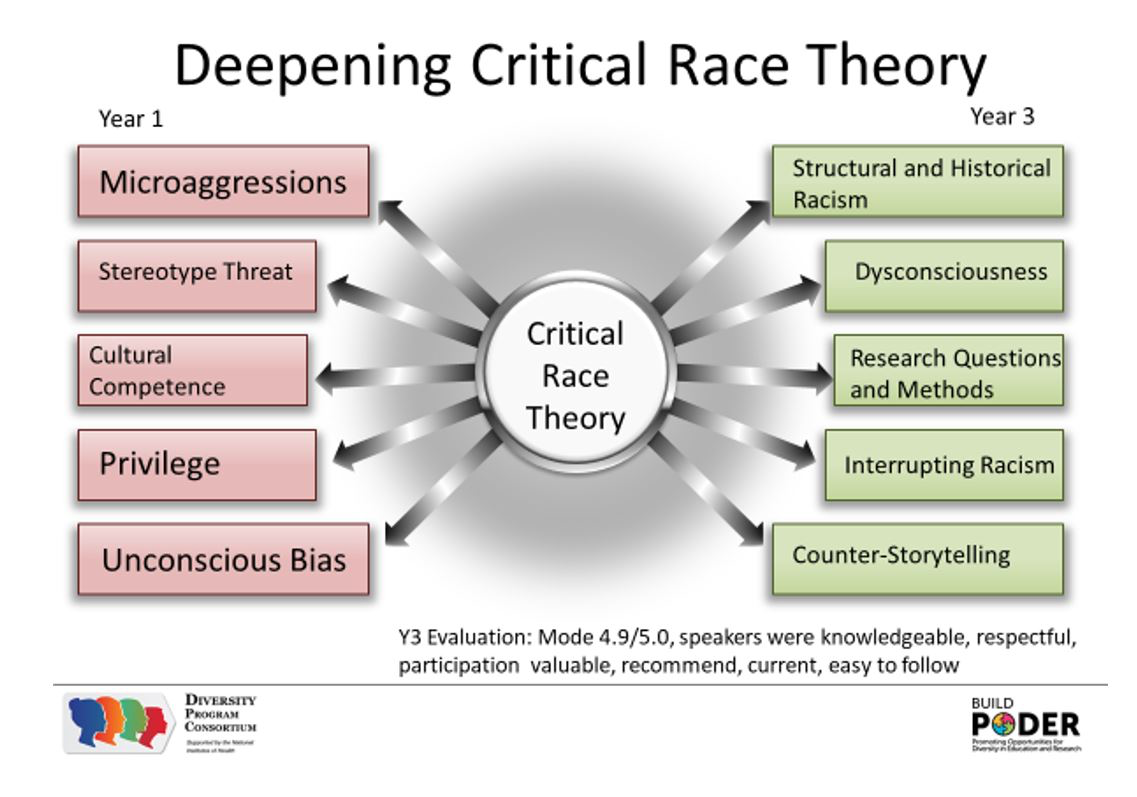
Diversity programming at California State University

When I was in graduate school, I was seduced by Critical Race Theory, or CRT. CRT incorporates into its analysis of law critical theory, a set of ideas drawn from the social sciences, for example anthropology and sociology, and the humanities, particularly art and literary criticism. Critical theory is a product of the cultural turn in Marxist thought by scholars associated with the Frankfurt School. However, critical theory was warped by the postmodern turn in the academy, that is the social constructionism of structuralist and post-structuralist thinking devolving to a radical relativism denying the existence of a single reality. Postmodernism functions as a carnival mirror, warping Marxist insight by reducing ontology to the supposed collective consciousness or should-be consciousness of social position (actually the multiplicity of social positions intersecting in a person), thus rejecting the premise of a universal reality and fracturing the truth with the blunt ideology of epistemic relativism. At the same time, postmodernism asserts that knowledge exists in a matrix of power that allows some knowledge forms to dominate others. Thus the claim to a universal method of interpretation, i.e. science, is a reflection of the power asymmetries. Science is dominant ideology. Truth claims can therefore have no real external verification for there is no common method with which to evaluate them—except the claim that all knowledge and thus our lives represent a projection of position and power.

Taking up this paradoxical position, CRT portrays the world as a struggle between the “perpetrator perspective” and the “victim perspective.” The perpetrators and victims are not actual persons but personifications of abstract collective positions based on skin color. Actual persons are absorbed into these collective identities or positions. As such, people are the signifiers of a truth. The perpetrator perspective demands concrete persons be identified and held responsible for some crime or injustice if a causal argument can be sustained with evidence, with the burden of proof resting with persons who make accusations. CRT holds that this position manufactures an illusion that the world is composed of individuals and establishes adjudicative rituals that function to perpetuate white supremacy. The sustaining logic is self-serving for the perpetrator identity. The victims perspective demands that justice reckon group disparities with intercorrelations of abstract categories which then serve as proof of injustice. Remedies that affect everybody in the opposing groups follow. The fact of group disparities is proof of discrimination and everybody in the advantaged group is responsible for plight of everybody in the disadvantaged group, even if those disadvantages cannot be demonstrated to exist at the individual level. Both the demands of actus reus and mens rea are exposed as convenient devices. The demand shifts to the subjectivity of the victim. We have to believe them.

The logic of CRT looks a lot like the logic of racism, where individuals are organized into groups based on ancestry or blood quantum rules and then regarded or punished on the basis of this. However, following postmodern logic, central to the problem of injustice is grouped power, and the perpetrator, defined as white, especially the white male, has all of it. In this view, all white people are the perpetrator. According to Peggy MacIntosh, white people wear an invisible knapsack of power and privilege tools they wield as a practical matter throughout their lives. Whites have developed the free and open system in order to perpetuate and entrench their racial power. Law is facially neutral. Indeed, the racial system, the system of white supremacy, its culture of whiteness, is global, and the West, sans the colonized subjects internal to it, is the cause of global injustice. Because of this, the West should be compelled to abdicate its right to cultural integrity, its structures of democracy, freedom, and human rights, as defined by the Enlightenment. A postcolonial world demands a post-rational reckoning. So great is this truth that Jane Elliot gets to traumatize, with minority students watching, white students in diversity/sensitivity training sessions. (Elliot is white. So is MacIntosh.) These moments look a lot like the scenes witnessed during Mao’s Cultural Revolution. Or at some talks on university campuses where minority students and their allies disrupt events chanting slogans and shaking big-character posters and mobbing speakers.

The victims of whiteness are all nonwhite persons (except Uncle Toms) and especially persons who are not white male. The victims are victims by virtue of not being perpetrators, and the evidence of their victimhood, when not by definition, represented in the form of selected aggregated statistics that indicate group disparities. Negating the white man’s formula, correlation is causation.

With CRT, one need not identify a concrete perpetrator or a concrete victim, but rather assert victimhood and assign guilt on the basis of skin color, the marker of group affiliation. To borrow language from Imre Lakatos, in order to sustain this position—to wit: reducing concrete individuals to a demographic category is the negative heuristic that lies at its core—one has to strap on a belt of positive heuristics, rules of thumb that come in the form of slogans, such as Patricia Bidol’s formula “racism = prejudice + institutional power,” or Stokely Carmichael’s “black power” assumption that such an abstraction as the “total white community” could without direction possess agency. The positive heuristics belt does a good job of keeping up the standpoint’s pants as long as the standpoint remains embedded in a research program in which arguments can successfully avoid checking assumptions, a pattern of avoidance reinforced by social pressure to defend the negative heuristic at the core. CRT is thus an ideological program that has manufactured a rhetoric to give an appearance that some deep discovery has been made: abstract forms are prior to concrete people. Of course this is a very old idea. The abstract forms constitute the essential reality, and these preassign plaintiff and defendant designations while shifting the burden of proof.

In the discussion, Eleanor Penny argues that the arguments against her position should be viewed with suspicion because they hail from the perpetrator’s perspective, a position that has cleverly constructed a system of rhetorical traps that legitimize the oppressive system that privileges them. Jonathan Haidt is accused of laying the traps even while Penny excuses him for not intending to. He is both a perp and a dupe. Because she is, as a woman, a member of a victim group, her argument enjoys an epistemic privilege; it is to be accepted because her identity gives it credibility. Moreover, because she is a member of the victim class, it is her turn to run the institutions. A woke white person would agree and stand down.

When I left graduate school, the spell of CRT wore off, and, in part, thanks to my renewed commitment to antitheism that emerged in the aftermath of the Party of God attacking the United States on September 11, 2001, I came to realize that CRT is neither a scientific program nor a rational approach to reforming law and politics, but something akin to a religious program in which participants are to accept, on faith, that there are some who, by virtue of their skin color and the inherited victimizations of their ancestors, should be allowed to hold others accountable for things they did not actually do or even could have done. Skin color is a stigmata that sorts and designates individuals in a prejudicial way. I am asked to stop opposing racism—as I have my whole life—but to see myself as a racist because I was born white. I don’t get to control the definition of racism because of who I am. Social justice requires redefining the term. The best I can ever be is an ally, as if I were in a war and the only way to lessen the severity of my war crime were to defect from a side I never chose to stand with in the first place. However, I can never really defect since I am essentially white (ask Rachel Dolezal) and thus instead will have to submit to the judgment of others eternally. If a sin is forever and collectively and intergenerationally applied, then I can always be asked to pay penance. Repent on pain of being accused of not confessing to unearned advantages and privileges responsible for the pain and suffering of others. Unrepentant sinners are the worse. A fallen person must admit he is fallen before he can get better. To deny being a racist is to confess to being one. Resistance twice convicts.

I used to make arguments from this point of view and felt like I was making compelling antiracist points. But this way of looking at the world only appears antiracist because it feigns an other-interested position. Atonement and submission signal virtue. White folks trying to get into heaven. Moreover, it’s counterproductive: granting that racism explains present circumstances (and it surely does explains some of it), how could this view generate any solution to the problem that could avoid perpetrating the same crime it condemns? Choosing sides doesn’t shift the paradigm.