Interesting story in The Hill today. There, in the context of Oprah Winfrey’s new talk show, Emmanuel Acho is found declaring that white people “run America.”
This sounds a lot like a conspiracy theory I have heard before. The CEOs and Fortune 500 companies that comprise collective white rule, aren’t these disproportionately run by Jews? Isn’t the conspiracy that Jews and their gentile white allies run America? This is Louis Farrakhan’s thesis (Farrakhan is the leader of the Nation of Islam). Dressing it up in the pseudo-intellectualism of woke social science doesn’t make it any better.
In real life, is it not actually the case that capitalists and their functionaries run America? Isn’t this a capitalist society? We don’t live in an apartheid system. Any privileges white people enjoyed were abolished more than half a century ago. How does the out-of-work white coal miner in West Virginia living in a trailer addicted to fentanyl made in China and carried into the United States by Mexican cartels enabled by lax border controls figure into the white ruling caste? I am trying to understand the logic of this vast white conspiracy to run America.
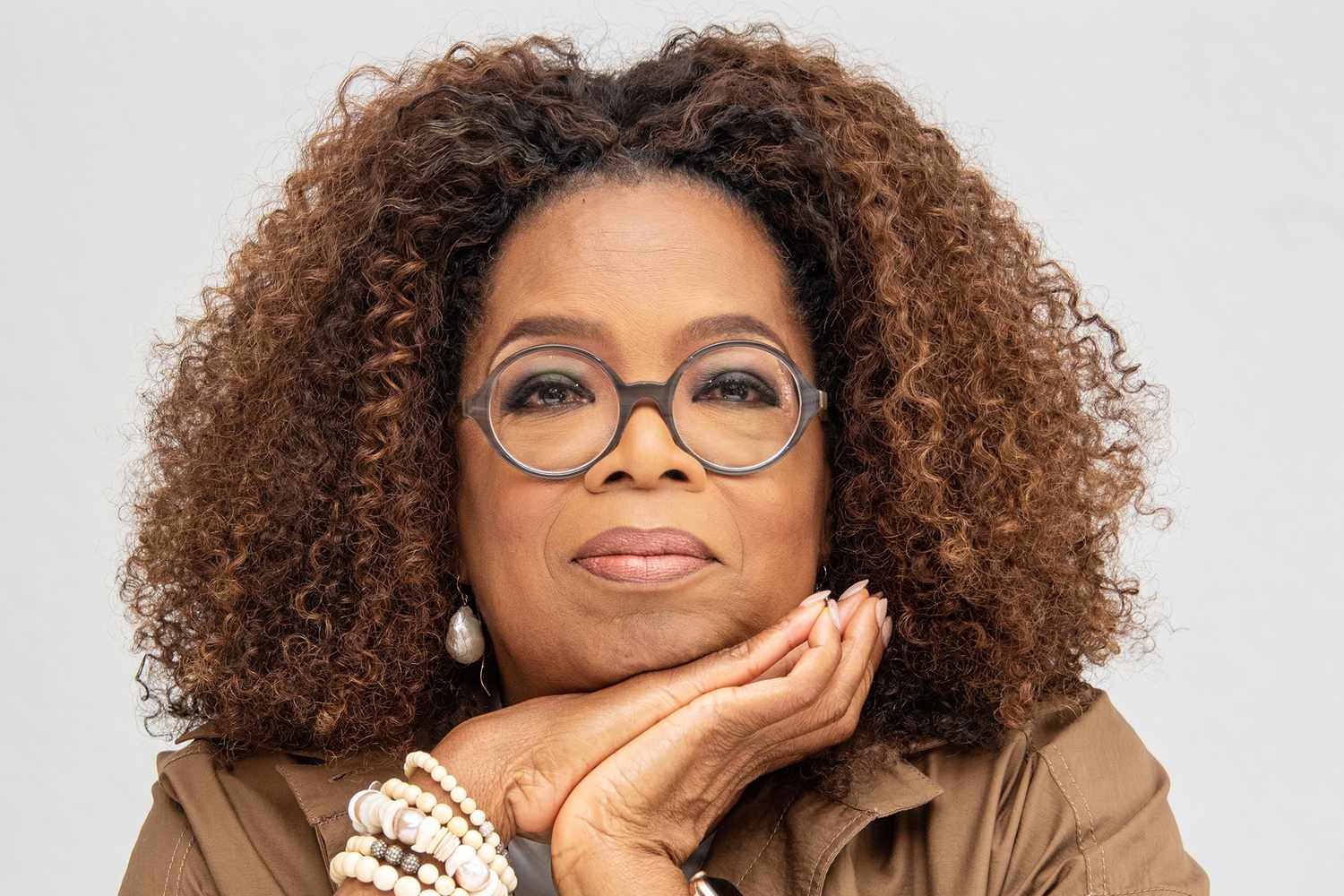
Acho’s comments were made on Winfrey’s new interview show “The Oprah Conversation.”
If whites run America how did Oprah Winfrey get to be so filthy rich? And she’s not the only one. What about Herman Cain? To be sure, progressives mocked him for dying from COVID-19 (because they are so full of empathy), but he was a highly successful black businessman.
I could go on all day giving examples of prominent and wealthy black men and women. One of them served two terms as president and remains wildly popular. Are prominent and successful blacks like Winfrey and Obama part of the white cabal to run the world? Or is Winfrey a capitalist and Obama a functionary for the capitalist class like so many wealthy white people are?
I hope my comrades can see what is going on here. Capitalists sow racial division to disrupt proletarian consciousness. They’ve been doing it for hundreds of years. At different moments in history the system of racial antagonisms gets tweaked for effectiveness. The contemporary version is the rhetoric of “white privilege.”
Winfrey is part of the prevailing hegemony that has taken up the language of “fragility” and “caste” to perpetuate the system of class privilege—a privilege she enjoys.
Said the billionaire made a billionaire by her overwhelmingly white audience. What a fraud. https://t.co/aNoUrga6SP
I am reminded by (black political economist) Adolph Reed, Jr.’s observations sitting in a room from of prominent and successful blacks talking about white privilege and white racial oppression. I don’t think I even need to repeat those observations here. The paradox is obvious.
“We saw a man face down on the pavement, pinned beneath a car, and above him another man, a man in uniform, his skin lighter than the man on the ground, and the lighter man was bearing down on the darker man, his knee boring into the neck of the darker man, the lighter man’s hands at his sides, in his pockets — could it be that his hands were so nonchalantly in his pockets? — such was the ease and casual calm, the confidence of embedded entitlement with which he was able to lord over the darker man.
“We heard the man on the ground pleading with the man above him, saw the terror in his face, heard his gasps for air, heard the anguished cries of an unseen chorus, begging the lighter man to stop. But the lighter man, the dominant man, looked straight at the bystanders, into the camera, and thus at all of us around the world who would later bear witness and, instead of heeding the cries of the chorus, pressed his knee deeper into the darker man’s neck as was the perceived right granted him in the hierarchy. The man on the ground went silent, drained of breath. A clear liquid crept down the pavement. We saw a man die before our very eyes.
“What we did not see, not immediately anyway, was the invisible scaffolding, a caste system with ancient rules and assumptions that made such a horror possible, that held each actor in that scene in its grip. Off camera, two other men in uniform, who looked like the lighter man, were holding down the darker man from the other side of the police car as dusk approached in Minneapolis. Yet another man in uniform, of Asian descent and thus not in the dominant caste, stood near, watching, immobilized, it seemed, at a remove from his own humanity and potential common cause, as the darker man slipped out of consciousness. We soon learned that the man on the ground, George Floyd, had been accused of trying to pass a counterfeit $20 bill, and, like uncountable Black men over the centuries, lost his life over what might have been a mere citation for people in the dominant caste.”
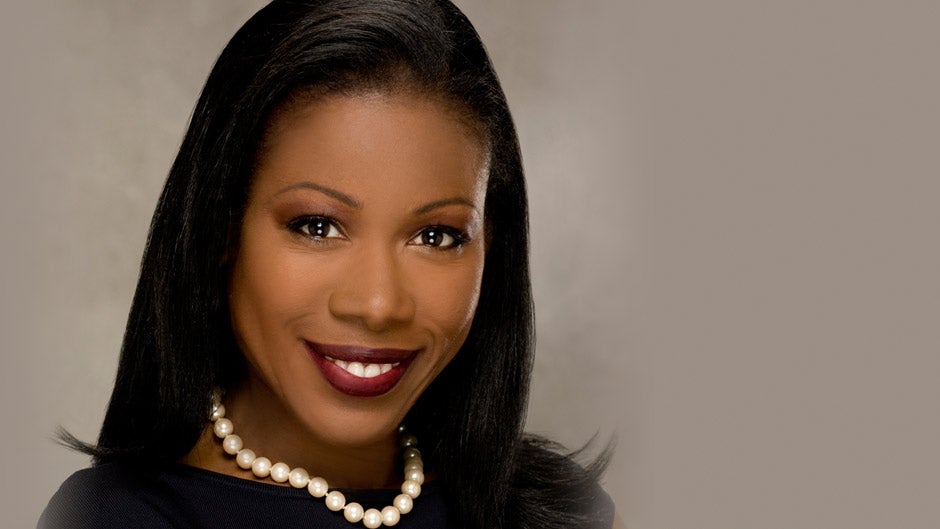
Isabel Wilkerson, author of Caste.
Dear Isabel Wilkerson,
Have you heard of Tony Timpa? White man. Cops suffocated him. He begged for air. And his mother. Look into it. Then get back to us with your wise answer to this question: What is the “invisible scaffolding” that causes cops to kill roughly twice as many white males than black males each year? What are the “ancient rules” at work here? And the tell us why you and others keep perpetuating a myth about systemic racism in policing. I think I know why, but it would be nice to hear it from you.
I have described myself as a populist and a nationalist. As you might imagine, as a man of the left, I get a lot of questions about this. People think these terms indicate right-wing sympathies—worse, and this is because corporations have effectively associated populism and nationalism with far right-wing ideology, sometimes even fascistic tendencies. This plays heavily in a narrative about my changing politics, as if consumers of my public comments on governance and politics were unaware before the presidency of Donald Trump of my strident criticisms of corporatism, globalization, neoconservativism, and neoliberalism, as well as my open sympathies for classical liberalism, civil libertarianism, and democratic republicanism.
The reality is that a pathological reaction to Trump presents as cognitive tunnel vision wherein either one is a progressive devotee to corporatist-globalist ideology committed to diversity, equity, identity, and inclusion or a white supremacist—or self-loathing minority. As I pointed out in a recent blog, the constellation of beliefs held by progressives reflect a deep disturbance in the collective thinking of self-convinced left identitarians. At this point it has become a religion in all aspects sans explicit belief in a god.
Right-wing politics are of course not intrinsically fascistic even if my politics could be said to be right wing. Right-wing ideas encompass a range of beliefs including liberal capitalism, a belief and a system far preferable to the bureaucratic-corporate utopia for which the progressive pines and in which all of us increasingly dwell. Indeed, this system is a source of the deformation of left-wing thought. But populism and nationalism are not intrinsically right wing. Populism and nationalism may be left wing or right wing or an amalgam of ideas and values found in these standpoints. As I have said before, the bifurcation point is less about left-right and much more about the following divides: democracy-technocracy, libertarianism-authoritarianism, nationalism-globalism, populism-progressivism, republicanism-corporatism. I fall on the left side of all these bifurcation points. Unfortunately, today, most people who self-describe as “on the left” fall on the right side of all these bifurcation points.
We see the way corporations use the left-right divide to manipulate the public and advance their agenda in a recent opinion piece in The Daily Beast (echoing many other MSM opinion pieces of late) Why Is the Right So Obsessed With Hydroxychloroquine? The piece, by William Sommer, the platform’s tech reporter, rambles about right-wing voices who support the drug while ignoring completely the many doctors and scientists whose work demonstrates the clear benefits of hydroxychloroquine in clinical data and academic papers, for example, Harvey Risch, distinguished epidemiologist at the Yale School of Public Health. Risch’s work (see his article in The American Journal of Epidemiology) is promoted on the Steven Bannon’s right populist webcast War Room: Pandemic.
The straw man of “right-wing” advocacy of hydroxychloroquine is contrasted with amplified media reports of progressive scientists and their technocratic allies in the regulatory bodies of the medical-industrial complex (FDA, CDC, NIH) finding that hydroxychloroquine is ineffective and even dangerous. Among the more amplified reports was the May 22 The Lancet article “Hydroxychloroquine or chloroquine with or without a macrolide for treatment of COVID-19: a multinational registry analysis.” You won’t hear much about the article today. If you follow the link you will see why. The point is that scientific work that contradicts the financial interests of pharmaceutical corporations (hydroxychloroquine is a cheap genetic drug) is delegitimized by locating it on a political side. This in turn reinforces in the public mind the connection between right-wing sentiments and populist-nationalism and the danger populism presents to public health.
When you understand what populism is the framing described above makes sense. Populism is an egalitarian political movement and philosophy that promotes the interests and opinions of the common people over against concentrated and narrow power. As in the case of the medical-industrial complex, we see the institutions of the progressive movement in full regulatory capture, that is, regulations in the service of legitimizing corporate products and services to facilitate capitalist accumulation, while restricting public access to cheap and effective drugs and interventions. We see the same thing with environmental regulations and resource management (see The Anti-Environmental Countermovement). Populism involves a critique of establishment power where it prevails and affirms the right of sovereign people to collectively determine their fate by popular democratic means. Populists are suspicious of elites because they are suspicious of hierarchies and concentrated power. Hierarchy and concentrated power carry corrupting effects. We see this clearly in the framing of therapies for the treatment of COVID-19.
Who are these elites? Those in position of power in the administrative state, corporate media, culture industry, higher education, the medical-industrial complex, the military-industrial establishment, and science and technology firms. This is the technocracy (see Paul Diesing’s 1992 How Does Social Science Work? for the distention between democratic and technocratic science). Elites put their narrow interests—and often the interests of foreign agents external and internal—above the people’s interests. Large corporations and wealthy oligarchs cannot represent the interests of the common man and woman. Government captured by these forces is alienated from the popular will. Sheldon Wolin tells us in his 2010 Democracy, Inc.: Managed Democracy and the Specter of Inverted Totalitarianism, “Inverted totalitarianism, although at times capable of harassing or discrediting critics, has instead cultivated a loyal intelligentsia of its own,” He writes. “Through a combination of governmental contracts, corporate and foundation fronts, joint projects involving university and corporate researchers, and wealthy individual donors, universities (especially so-called research universities), intellectuals, scholars, and researchers have been seamless integrated into the system.” Wolin is no longer with us, but if he still were I would urge him to recognize that harassing and discrediting critics has become a core tactic of corporate governance.
Populism holds that the nation is synonymous with the people, that is the citizens organizing a government to reflect their interests in a juridical system defined by policed borders that lie at the center of politics. The people are sovereign, and the government belongs to the people. The government promotes the general welfare, protection of individual rights and due process. This is democratic republicanism. to provide a concrete example, in a popular democratic system, the demonstrated efficacy and safety of hydroxychloroquine would enjoy government-facilitated distribution throughout the population. The regulatory agencies as federal, state, and local levels would not interfere with the doctor-patient relationship and the freedom of doctors to prescribe off-label. Any government official who would conspire with business to prevent patients from getting the medicine they want in order to preserve the possibility of profits from the patenting of new drugs and therapies would prove immediately scandalous. The media under a popular democratic system would expose such corruption, not cover it up as it does under the present elite technocratic system.
Since corporate power folds left-wing sentiments into its hegemonic control structure, the establishment media disregards the history of left populism and focuses instead on right populism. When audiences hear the word populist, as well as nationalist, they are presented with such figures as Jean-Marie Le Pen and the National Front. As I However, in the United States, the first populist movement emerged from the interior of the United States and from the South in the 1880s and 1890s. Represent a democratic mass movement, farmers organized against bankers and politicians of the Northeast. In the twentieth century, Senator Huey Long’s campaign for wealth sharing pushed Franklin Roosevelt to expand the depth and reach of his New Deal programs, as did the End Poverty in California movement, led by Upton Sinclair.
It is crucial to avoid confusing left populism with progressivism, the latter technocratic movement from above to expand and deepen the social logic of corporate governance. When Occupy Wall Street emerged in the context of the 2008-2009 financial crisis, it presented itself with populist tones with the rhetoric of the 1%. And the Independent senator from Vermont, Bernie Sanders ran his 2016 bid for the Democratic nomination using this language. Both Occupy Wall Street’s thematic was incorporated into the progressive establishment of the Democratic Party and suffocated. By 2019-2020, Sander’s message had become a thoroughly progressive one, seen, for example, in his shift away from advocacy to immigration restrictions and adopting the neoliberal line.
Donald Trump also took up a populist spirit in the 2016 election and this led him to victory. Trump’s populism, which shared many of Sander’s positions, grew out of a movement on the political right. In 1992, Ross Perot, a billionaire from Texas, launched the United We Stand campaign, it’s centerpiece opposition to the North American Free Trade Agreement (NAFTA). This movement established the Reform Party, and in 1996, Pat Buchanan ran on its anti-globalization, anti-immigrant, and anti-neoliberal platform. Also, during the 2008-09 financial crisis, the Tea Party movement emerged as an attack on neoliberalism. This set the stage for Trump in 2016, the core elements reflected in his anti-establishment and anti-globalization campaign. Trump has been involved in the right populist movement since the 1990s and his election and presidency steered the Republican Party away from its neoliberal and neoconservative character, which had brought it into alignment with the Democratic Party.
Right populism is a trans-Atlantic phenomenon. There is the aforementioned National Front in France, now led by the daughter of its former leader, Marine Le Pen. There is also the Freedom Party in Austria and the United Kingdom Independence Party (UKIP), led by Nigel Farage, which succeeded in leading the British working class to greater independence from Europe with the Brexit referendum in 2016. This was followed by the election of Conservatives in 2020, led by Boris Johnson, which finally recognized Brexit in law. At the heart of these developments is Euroscepticism, a standpoint critical of globalization and immigration. Latin America is also a site of populism across the ideological spectrum. On the left, it has come in the persons of Evo Morales in Bolivia, Rafael Correa in Ecuador, Daniel Ortega in Nicaragua, and Hugo Chavez in Venezuela. On the right, Brazil’s Jair Bolsonaro is most notable. The resounding victory of Narendra Modi and the Bharatiya Janata Party victory brought populist nationalism to India. Modi has won two consecutive terms with a full majority.
What are populists responding to? The power of transnational corporates and affluent cosmopolitan elites amassing wealth and privilege from neoliberalism and globalism and a rigged political system that entrenches these policies. These developments have come at the expense of working families. Resistance to these forces was accelerated by the financial crisis of 2008-2009, which was a trans-Atlantic affair. Mass immigration, competition over jobs, and the unraveling of Western norms of values heighten class antagonisms across the European continent, especially as the open border structure of the European Union (EU) facilitated the wide distribution of immigrants throughout Europe. The distress was rendered acute by the migrant crisis in the 2010s. The imposition of austerity and the heaping upon of scorn by the EU on the PIIGS (Portugal, Italy, Ireland, Greece, and Spain) was an insult to working people particularly affected by globalization. These developments brought to awareness the inability of the corporate form of capitalism even in its social democratic and progressives forms to deliver on bourgeois promises to build a just and sustainable future for the Western proletariat, to solve the problems of inequality and poverty as well as the diminishment of the Western norms and values of democracy, liberalism, and secularism.
I earlier said how important it was to distinguish between populism and progressivism. The more vocal among self-described leftists in the United States identify themselves a progressives and contrast this to rightwing populism, smearing the latter as fascists, nativists, racists, and xenophobes. Progressives do this while appealing to populist rhetoric, claiming to represent the people, while furthering the neoliberal and neoconservative aims of the corporatist-globalist establishment. Perhaps nobody has done a better job to putting the distinction between populism and progressivism in historical context than the late Richard Grossman co-director of the Program on Corporations, Law and Democracy. Grossman at once shows how the founding of the United States secured the power of a minority of the opulent while simultaneously laying the foundation for a dynamic republic responsive to popular movement politics.
Grossman identifies the development of corporatism and progressivism, with its legacy of administrative and regulatory law, as establishing a governing framework that undermined the dynamic potential of our democratic republic, leading to a corporate state, and it was the defeat of populism and the institutionalization of progressivism that locked in corporate power. Banking, insurance, manufacturing, real estate, transportation. He identifies how the corporate media, for example Bill Moyers, sold the lie that progressivism represents farmer and worker interests by lumping the two together thus erasing the stark differences between them. Populism sought to end the privilege or special rights of the corporations, to make institutions democratic and responsive to popular will, to subordinate the corporate entity to democratic government. The essence of populism left and right is the people controlling their communities, owning their labor to better their ends, and commanding the mechanisms of governance and the levers of social institutions for the sake of all families and communities.
Blake consults The Economic Policy Institute (EPI) for this statistics: less than 13 percent of white students attend a school where a majority of students are black.
Stop and reflect on the absurdity of this factoid. Blacks are only around 13 percent of the US population. How would one propose substantially raising the percentage of whites going to majority black schools when blacks are not even the largest minority in America? Go ahead. Try to work out the math in your head.
Speaking of minorities, perhaps blacks might ask how it came to pass that they were demoted from the largest minority in America—while disproportionally relegated to impoverished neighborhoods in progressive-run cities. Maybe they should look into why the jobs blacks used to do are now occupied by members of the new largest minority. Whose policies accomplished that? (Hints: New Deal, Great Society).
CNN is all in on painting whites as racists, describing even white liberals as “dangerous” (we know they have assumed all along that conservatives are). Are whites dangerous because the neighborhoods where they are the majority do better on such key social metrics as education, health and well being, crime and violence, and entrepreneurial activities?
Why is the situation of racial inequality always pitched as a zero-sum game? “Unless more White people are willing to give up something to change the racial makeup of where they live and send their children to school, there will be no true racial awakening in America.” Give up what?
Civil War, Reconstruction, Civil Rights—these weren’t moments of “true racial awakening”? Who sneaked those three Amendments into the Constitution? How did the Civil Rights Act of 1964 happen? Did it happen?
Once more we see the work of antiracist ideology in erasing collective memory of American progress in race relations.
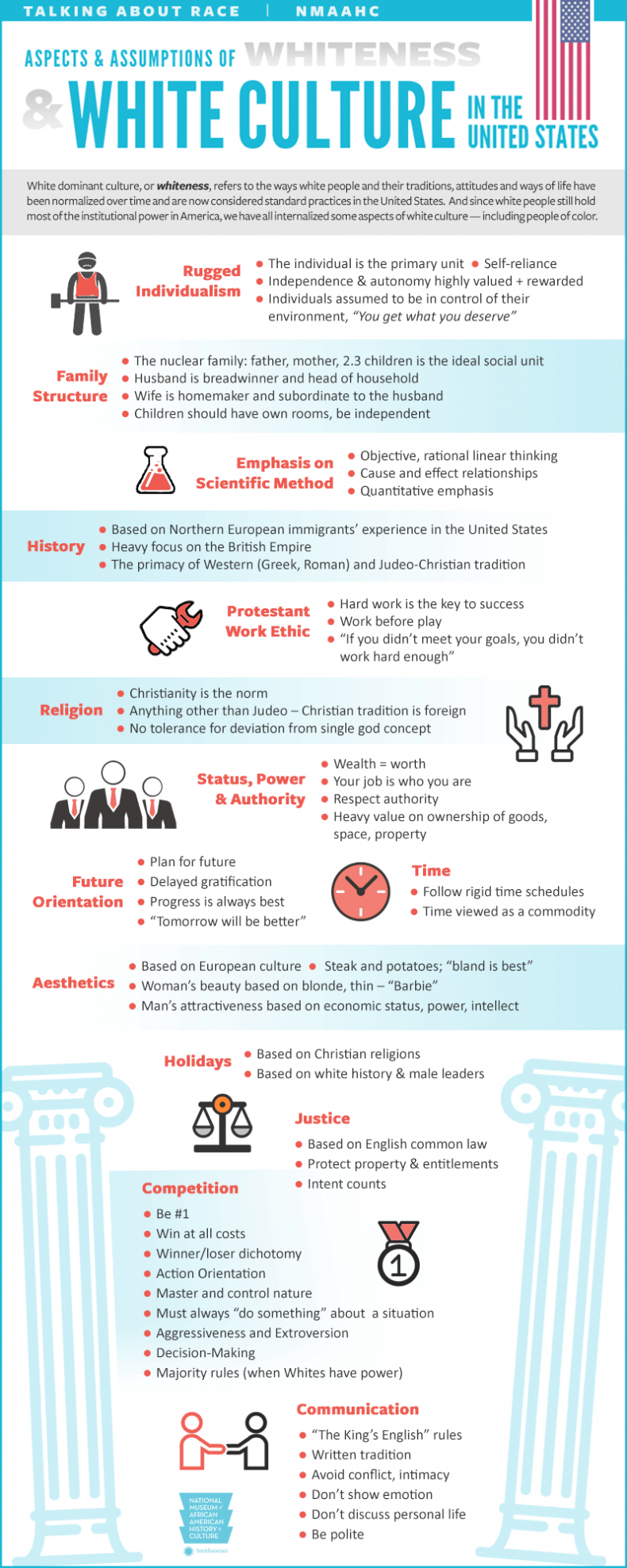
Why, if we are promoting racially-integrated communities and schools, do progressives push divisive identity politics? Who is it that teaches our children and tells their parents to see race first and persons second? Who is it that defines? (See the chart below.) Western norms and values, individualism and industriousness, as “white culture”? Who is it that systemically glosses over the chief determinant of life chances—social class.
Chart appearing on the Smithsonian National Museum of African American History & Culture, subsequently taken down after a query from Newsweek.
If we want integration (and, of course, we do), then we need to get back to the ethics of humanism and the politics of social class. Stop saying colorblindness is “racist.” Stop demanding group rights over individual rights. Stop perpetuating the myth that individuals are meaningfully subdivided by race. Stop racially essentializing culture.
There are no laws stopping black people from living in majority white neighborhoods and sending their children to majority white schools. So knock off this nonsense about white people having to give up something for the sake of justice as if they are the cause of inequality and poverty in America.
Look instead at the structure of capital ownership and control. Determine which group actually controls the way life happens in a society run by corporations.
White people don’t run things. That’s not how it works. This is not an apartheid system. We got rid of that more than fifty years ago.
Welcome to “Double Throw Down Thursday” (not really a thing, but for today’s blog, what the hell). Trump has managed to get the establishment twice worked up in a week. First, HUD Secretary of Ben Carson is changing housing policy and Trump likes it. Then Trump suggests delaying the 2020 election. The latter tweet comes just in time to distract the public over the shit show put on by House Democrats during the testimony of Attorney General William Barr. Sometimes Trump can’t get out his own way. Okay, a lot of times he can’t get out of his own way. Let’s begin with the “call” to postpone the 2020 presidential election.
With Universal Mail-In Voting (not Absentee Voting, which is good), 2020 will be the most INACCURATE & FRAUDULENT Election in history. It will be a great embarrassment to the USA. Delay the Election until people can properly, securely and safely vote???
Media darling Anthony Fauci, the nation’s top infectious disease expert, recently said that we could get back to some normalcy by the end of the year. He’s excited about the SARS-CoV-2 vaccine that uses novel technology to (hopefully—profitably) provoke immunity in people against a virus that well more than 99 percent of people survive. In his tweet, amid the constraints of a pandemic, Trump is asking a question about timing. I don’t agree with delaying the election. I do have a problem with universal mail-in voting. But I remind readers that, when Wisconsin governor Tony Evers actually called for a delay in voting (I opposed this move, for the record), progressives lined up behind him. Then they hurled insults at Republicans for rebuffing Evers’ call.
The spate of news stories about Trump wondering out loud whether a delay in the election should be considered given the pandemic and the problems with universal mail-in voting (loss of national solidarity, not being able to conduct on-the-spot exit polling useful for detecting voter fraud, and other things—see NPR’s recent article on how mail-in voting is fraught with problems) are written in a sensationalistic manner to leave the impression that the president aims to establish a fascist dictatorship. My Facebook newsfeed is chockfull of panic over Trump’s pending fascist dictatorship. Mission accomplished.
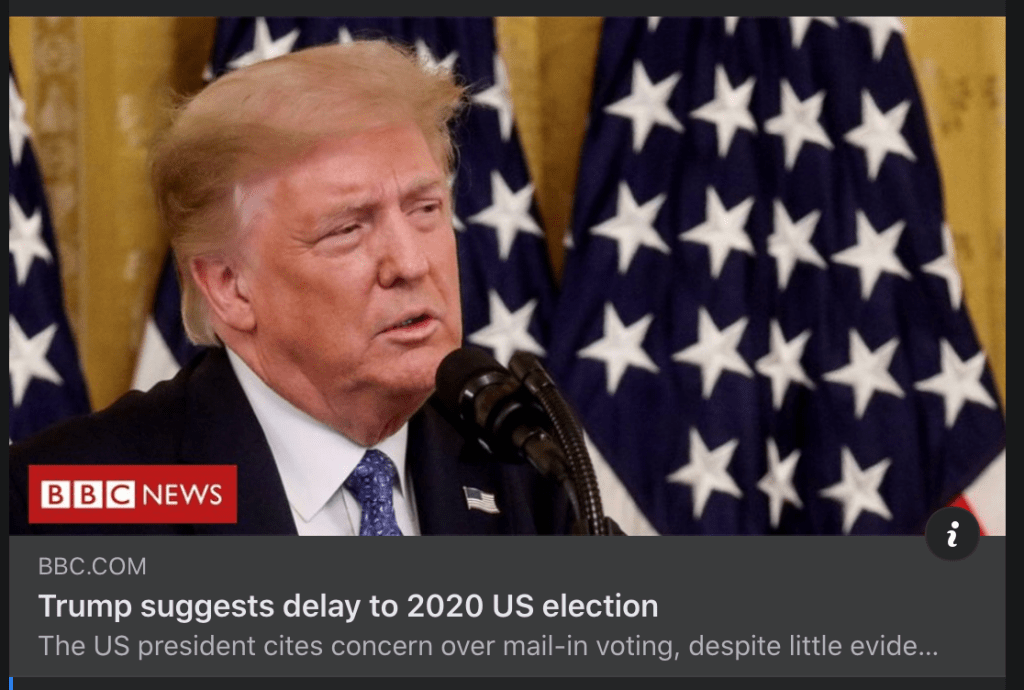
Here’s the BBC’s take. I should say “takes.” Note the different headlines. The BBC changed the headline after at first “misrepresenting” the president’s tweet. That the BBC did this is important since its reach is global. Bring on the panic.
The BBC’s edited headlineThe BBC headline before it was edited
Here’s more fake news from CNN: “Trump Floats Delaying Election Despite Lack of Authority to Do So.” Maybe this is just a badly worded headline. Is it referring to Trump’s lack of authority to delay the election or his lack of authority to ask whether the nation ought to consider a delay given the pandemic? But can we really be charitable with CNN given its clearly established pattern of Trump-bashing?
According to the story, “Trump has no authority to delay an election, and the Constitution gives Congress the power to set the date for voting. Lawmakers from both parties said almost immediately there was no likelihood the election would be delayed.” There you go. As CNN itself notes, Congress sets the vote. This is a constitutional republic that has stood for more than two centuries. It has survived civil war and world war. Republicans quickly pushed back against the idea. No problem. We can move on.
Not so fast. “Trump’s message provides an opening—long feared by Democrats—that both he and his supporters might refuse to accept the presidential results.” Only Democrats are allowed to refuse to accept the results of a presidential election (see Gore v Bush 2000). But wait, what does this have to do with delaying an election? When Evers called for postponing the election in Wisconsin, did that tell us that he was prepared to refuse to accept the results of the election when it was actually held? (See also Republicans openly challenge Trump’s tweet on delaying election.)
The frenzy over Trump’s tweet is nothing new. The hysteria began the day Trump was elected. Today’s freak-out is yet another instantiation of the globalist-corporatist effort pushed by the establishment media and the Democratic Party to undermine the legitimacy of a democratically-elected presidency by spreading fear, ginning up public outrage, and fomenting “popular” resistance to imaginary and misrepresented things. The panic presumes Trump is a fascist. The panic reinforces that presumption.
Round and round we go. Chicken Littles are running amok on my Facebook newsfeed. A segment of the population has become addicted to cortisol. And I am trying very hard to not to slide into misanthropy. But I digress….
This is a not merely a double standard on the progressive side. Progressives are projecting onto Trump their irrational beliefs about this president and the current situation. At the same time, many of the same people who think Trump will postpone an election—or refuse to accept the results of the election—in order to establish a fascist dictatorship embrace a regressive tribalist countermovement endeavoring to undermine democratic-republican institutions and restrict civil liberties and rights. The real extremism in America today is Antifa and Black Lives Matter, groups tearing down and blowing up stuff to convince Americans to abolish the police and dismantle the nuclear family.
I get why marketers use social media to determine attitude and desire. As a sociologist, I have before me a detailed ethnographic record from which I can distill worldviews. After more than a decade of observation, I conclude that the people who think Trump is a fascist are mostly the same people who think that the chaos in our cities is “peaceful protest,” equate speech and even silence to “violence,” while opposing the deployment of law enforcement to quell actual violence, call for the shuttering businesses and forcing everybody into PPE, clamor to see everybody by force or shame jabbed with vaccines using novel technology, reject therapeutics not endorsed by big pharmaceutical companies who have captured our regulatory agencies, call for keeping our children homebound and away from their peers and teachers, and push globalization and mass immigration at the expense of American families (who should be dismantled anyway along with their “privileges”).
If you examine these attitudes closely you, too, will probably see an overarching ideology at work. Progressives express a loss of faith in the institutions of Western civilization that they themselves have sown with their rhetoric and actions. We are seeing a self-fulfilling prophecy at work. Progressives sow discord over imaginary or hyped up threats and then cry “fascism” when patriots stand up to them and rise to defend the republic. All this is managed by a vast propaganda apparatus. It’s a project.
* * *
…Your housing prices will go up based on the market, and crime will go down. I have rescinded the Obama-Biden AFFH Rule. Enjoy!
We see more of this in the fallout over the resent HUD decision. Grace Panetta, columnist for The Business Insider (and granddaughter of life-long Democratic operative Leon Panetta), put the spin on this one to make Trump out to be a white supremacist stoking racist fears.
Last Thursday, HUD Secretary Ben Carson (himself a frequent target of outrage and ridicule by progressives) announced that his office would rescind the 2015 Affirmatively Furthering Fair Housing regulation that required state and local governments seeking federal housing funding to collect data on demographics and living conditions and, importantly, to show that they were not perpetuating racial discrimination. Trump voiced support for the change in the tweets above.
Housing advocates immediate criticized the rule change claiming that it would allow discriminatory housing practices. For example, the National Low Income Housing Coalition said the rule change “represents a complete retreat from efforts to undo historic, government-driven patterns of housing discrimination and segregation throughout the US” and would “allow communities to ignore the essential racial desegregation obligations of fair housing law.”
Panetta writes, “Wednesday’s tweets were among Trump’s most explicit overtures to white fear and grievance in his bid to win back suburban voters who have been staunchly repudiating the GOP since he took office.” This move comes, she notes, amid evidence that Biden is beating Trump among white, college-educated, and suburban voters. Trump’s alleged strategy is to scare white voters over Biden’s housing plans, namely that said policies would make their neighborhoods less safe and desirable. Panetta cites this tweet in support of her accusation:
The Suburban Housewives of America must read this article. Biden will destroy your neighborhood and your American Dream. I will preserve it, and make it even better! https://t.co/1NzbR57Oe6
Panetta tells the readers of Business Insider that many observers find Trump’s references to “suburban housewives” and his linking Biden with crime and disorder in the suburbs “appear to stem from an outdated view of suburbs as almost completely occupied by wealthy white people who are fearful of crime and distrustful of diversity in their communities.” The article points to a PEW survey indicating that “today’s suburbs are far more racially and economically diverse than those of the mid-to-late 20th century, when ‘white flight’ propelled many white Americans to flee urban areas for suburbs.” (You can read about these developments here, as well.)
Why does Panetta and her ilk assume Trump is playing to white suburban fears of yesteryear rather than to the diverse suburban fears that exist today? Are black and brown suburbanites unconcerned about the effect of low income housing on property values and the problems of crime? (There is, after all, an association.) Or is it only white people who are concerned about property values and crime? Remember, Trump is making a major play for black and brown votes in his reelection strategies. Panetta is not only making assumptions about Trump’s intent; she is assuming that low income housing and criminality is a function of black and brown people and she does this in the face of the PEW survey she has right in front of her.
When Panetta quotes Paul Waldman’s July 21 op-ed in The Washington Postthat “the idea that Biden wants to ‘destroy the suburbs’ makes no sense,” that this idea is “only coherent if you think that an increase in racial diversity would ‘destroy’ the suburbs, which means that the suburbs only exist if they’re all-white,” she is along with Waldman assuming Trump is talking about the problem of racial diversity and not about the impact of low income housing on property values and the problem of criminality. Again, why assume this? Why assume that the only threat to property and person in suburbs is from racial minorities—many of whom now live in the suburbs?
Waldman calls Trump’s rhetoric race-baiting. But who is actually doing the race-baiting? Why does low income housing and crime always have to be about black and brown people? Why is concern for these problems only to be found among whites who are then accused of racism for expressing it? Could the concern be about social class and economics?
Panetta and Waldman and others feel comfortable broadly generalizing about race relations while avoiding the class question because they operate from the premise that the president is a white supremacist and that fear of crime can be reduced to race. They are in the media elite bubble. Indeed, they are so committed to the presumptions of the hegemony in which they imbibe that, without any reflection or self-doubt, and without any evidence, they attribute to the president motives that are not apparent.
* * *
People really have to stop freaking out every time Trump tweets something. Folks are being played. Not by Trump. By the people who want you to panic over populism. How would it be possible that Trump could just stay in office beyond his term or bend the Constitution to his ends? It’s incredible that he’s stayed in office this long given the efforts of the deep state to drive him out. Law enforcement would walk into the White House and perp walk the man out. There’s no Mussolini or Hitler moment in our future. Not from Trump, at least.
If you want to understand the real power dynamics in the world read C. Wright Mills’ The Power Elite, Sheldon Wolin’s Democracy, Inc., David Korten’s When Corporations Rule the Earth, Bill Robinson’s Promoting Polyarchy, Joel Kotkin’s The Coming of Neo-Feudalism.
Trump and the populists worldwide are outsiders to the globalist-corporatist order. We should be so lucky that they could have a lasting impact of things (we might get back our republic and our liberties). Indeed, why you are conditioned to freak out about Trump is to push you into the arms of the nexus of world historical power: the network of transnational corporations working hand in hand with the Chinese Communist Party.
You are being played and I only wish you’d feel a bit more shame about that instead of the self-righteous bullshit you keep slinging.
The conservatism before Donald Trump was neoliberal and neoconservative. The New Right forged under Reagan fell away very quickly (and was really ever only strategic and largely cosmetic). Neoliberalism and neoconservatism are subservient to corporate governance and transnationalism. This explains the remarkable continuity from George H.W. Bush through Barack Obama—privatization, regime change and endless wars, the trade deals, enabling CCP imperialism, the woke progressive takeover of the culture industry and administrative state apparatus, mass immigration. The two-party system has operated during this people via the social logic of globalist-corporatism.
In opposition to the politics and policies of establishment Republicans, Trump—and one sees this, as well, in Great Britain with Brexit and the recent blowout of Labor by Conservatives—represents a return to nationalist populism, reflecting the yearning of working people in the US and the UK to get the keys to their country back. Populism has the potential to bring working people of all stripes together to blunt the effects of globalization. It has already achieved quite a bit.
Its success is why we see an unprecedented effort, facilitated by neoconservatives in the Republican establishment, for example John Bolton, whose philosophy roots in Cold War progressivism, to delegitimize a sitting president. Trump represents a real problem to the denationalizing project that progressives and globalists have been pushing for decades. If Trump is turned out of office, the establishment believes, it will be able to get the project back on track. As I have blogged about, this explains Russiagate and the impeachment over the Ukraine affair.
Biden and the return of the neoliberal/neoconservative establishment to full power would be very bad news for working people and the future of liberal democracy across the trans-Atlantic system. On the other hand, it would be very good news for the Party of Davos and the Chinese Communist Party. These are the forces that are feeding Antifa and Black Lives Matter with both money and ideas. Western civilization is at a crossroads. The establishment project to do in Trump and populism should deeply concern rank-and-file conservatives. But really it should concern all of us who care about liberty and democracy.
There is a rhetoric advanced by establishment Republicans and their rank-and-file supporters that attempts to isolate Trump, painting as a demagogue who stands alone against reason. This rhetoric is profoundly elitist. We see it in the claims that Trump makes policy with an eye towards reelection, as if doing what the people would deem worthy of casting a vote for a sitting president is somehow contrary to the national interest. In fact, it is contrary to the interests of the globalists who can’t wait to get back in the drivers seat. The elite are attempting to disappear tens of millions of people. The “deplorables” Clinton dismissively called them. That’s what they elite think of workers in the heartland.
Those of us on the left shouldn’t speak that way about working people not because it’s condescending (it is), but because it denies reality. The states Trump took from the Democrat column were blue collar states. Voters knew what they were doing: they were rejecting the neoliberalism and neoconservatism that degraded their communities and undermined their livelihoods and squandered and spilled treasure and blood. Workers in Great Britain knew what they were doing when they voted in the Conservatives.
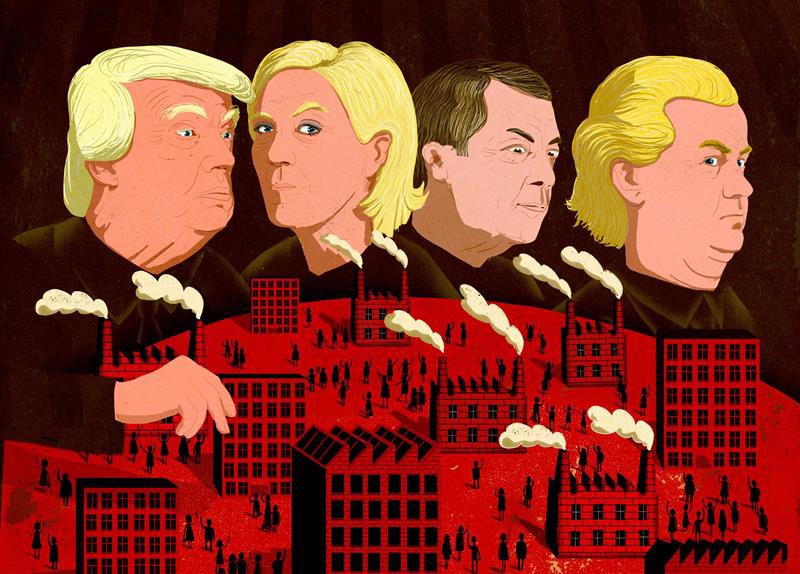
Illustration: Craig Stephens
Workers and small business owners knew what they were doing when they rejected all those many establishment Republicans who tried to take down Trump during the primaries. There was a reason he blew away the entire field: he made an argument that resonated with the people. He didn’t regurgitate establishment talking points or hesitate before fear of media framing. He spoke frankly about the decline of America and, in unapologetic terms, about its greatness.
For those who say Trump stands for nothing but himself, I have followed Trump’s career for decades and he definitely stands for something other than himself. He has been remarkably consistent in what he stands for, in fact. He and those around him present a coherent set of policies and offer a clear direction for America to move in. They mean to—and already have on many fronts—re-shore industry, end regime change and endless wars, restore public order and economic security to working class communities, and marginalize the People’s Republic of China. Trump’s personal interests and his vision of the national interests coincide. He doesn’t stand up there alone. This is a movement. And it’s trans-Atlantic in character. We see populism on the rise throughout the Western hemisphere. It’s catching fire in China, as well. All of this has the globalists terrified.
People are distracted by the tweeting. I get it. Trump says outlandish things. He trolls people. I don’t pay attention to all that, frankly. One has to look for the signal in the noise, as Steven Bannon is fond of saying.
In the final analysis, you don’t judge persons, policies, or nations by what they think or say of themselves. You judge them by what they do and what they accomplish. The neoliberal/neoconservative consensus had its chance. We saw what the managed decline of the American republic and Western civilization has wrought for the people. The people won’t long survive more of that.
I am not a Trump supporter. I am a supporter of the populist mood that has swept hundreds of millions of people across the world into an emerging resistance movement against the transnational project to denationalize the West and replace Enlightenment values of liberty and democracy with those of bureaucracy and technocracy. Trump did not start the resistance movement. He is a manifestation of it. It will survive his presidency. At the same time, his administration has become something of a bulwark against the forces of globalization. I do not, therefore, dread his reelection.
I want public schools to reopen. There are real emotional and psychological costs to children stuck at home and in front of screens. Opportunities to acquire crucial knowledge and skill sets are being cut off—knowledge and skills that cannot be transmitted virtually. Social interactions necessary for normal cognitive and personal development are constrained, indeed deformed, by remote learning. We are told that a novel virus presents a challenge to reopening. Otherwise, it would be business-as-usual.
But business-as-usual is a problem in itself. Indeed, more concerning than the effects of COVID-19 is the degree of wokeness in progressive social programming and the expectation that children and young adults, as well as staff and teachers, will embrace social justice doctrines surrounding race and gender. Children and young adults are conditioned to be hyper-judgmental and hyper-sensitive. Others are ostracized for being born a certain way and on that account taught to self-loathe, to feel ashamed for things they could not possibly have done, to apologize for the wrongdoings of others, even including corpses.
Indoctrinating youth with the language of theoretical antagonisms developed by cloistered academics, limited by disciplinary matrices, moving in abstract conceptual worlds, and justified in their motivation by artificial entitlement and esteem, antagonisms pushed by an odious grievance industry grasping for unearned things, a sophisticated language painting some children and young adults as racist and sexist on the basis of color of their skin and their anatomy, while teaching others that they are the victims of oppression and trauma and deserving of special rights on account of these, all the while nourishing the worst personality disorders of narcissism and sociopathy, the fruits of which we are seeing playing out on the city streets of America and Europe today—the consequences of all this will in the long run prove far worse than any wrought by SARS-CoV-2.
I am sympathetic to those parents who are reluctant or who refuse to send their children into a totalizing environment that commands their attention for the better part of their waking hours five days a week and sometimes more. I oppose in principle vouchers for religious schools, but at the same time I can see that it is unfair to allow some parents with means to shield their children from progressive indoctrination while effectively compelling those with little ability to exercise choice to send their children back into this environment. I am sympathetic with taxpayers who wonder why their resources are being marshaled to fund programming that runs down the very culture that has allowed so many of them to have a good life.
For those of us who do continue to allow these institutions access to our children, we need to do a better job of arming students emotionally and intellectually to resist indoctrination and to challenge teachers on the things they say—and to not permit the exercise of disagreeable speech to be suppressed under the guise of discipline. Parents should periodically debrief their children to learn what it is that they’re “learning” and to address teachers and administrators directly with their concerns.
How did this happen? That is a long story beyond the scope of this essay. But the bottom line is that schools should not be teaching quasi-religious notions. It is not the place of administrators, staff, and teachers to disseminate social justice doctrine. As a parent, I would never tell the children of other parents how their children are supposed to think of themselves or think of others beyond treating persons as individuals and on the basis of behavior and character. To be sure, I have a problem with parents who fill their children’s heads with such hateful and divisive nonsense. Teaching children to judge people on the basis of race and gender under cover of such progressive rhetoric as “antiracism” is insidious. I would never presume to humiliate or shame a child or a young adult because of her or his phenotypic characteristics. But to have partisan interests reflected in public education in order to reinforce the obnoxious teachings of a segment of the population only doubles down on the problem.
I see the effects of the programming in the acquiescence of my colleagues in higher education to ideological struggle sessions cloaked in such Orwellian language as “diversity and equity training,” their equanimity prepared by their socialization in the institution of public education. As part of this structure, I feel a special burden to speak up about the direction it has taken. I am moreover, as a sociologist, acutely aware of the subtle forces that coerce education professionals to participate in reproducing that structure.
Public education is shot through with subversive political projects of this sort. Public schools should not, for example, insist that children and young adults tolerate exclusive and oppressive religious doctrines, such as those teachings imposing modesty dress on girls or condemning homosexuality, as merely “other cultural practices.” It is not the purpose of public education to validate any given ideology or deform a person’s ability to distinguish right from wrong by invalidating ordinary moral judgment as “ethnocentric.” In cultural terms, public schools have only to uphold the liberal values of autonomy, creativity, equality, free thought and expression, humanism, individualism, and secularism to do the right thing. For these are the values that allow persons the chance to manifest more fully the human right to self-actualization.
I expect some will find this essay insulting. Offense-taking does not negate facts and experiences. I remind the audience that I am the son of teachers and a teacher myself. I have children in public schools. My wife is a education professional. I study pedagogy and have reviewed the curricular materials of public schools and, more than once, spoken up about them. I confess, I should speak up more frequently and more vociferously than I have. So here we are. (Moreover, it is a shame that the best criticisms of the problem come not from the left but from the right. See There Is No Apolitical Classroom, The Silence of the School Reformers, and Woke History Is Making Big Inroads in America’s High Schools.)
I recognize that many teachers disseminate propaganda handed down to them from on high. But here staff and teachers have an important role to play by challenging their administration over content or in practice avoiding transmitting the worst aspects of woke programming. Teachers should not wait for parents to probe their children for information in order to intervene. Teachers know better than anyone how reluctant parents can be to challenge authority. Teachers have a responsibility to not harm children with programming that can cause distress, engender guilt, or stigmatize.
The problem of indoctrination in education runs deep. The unraveling of the Enlightenment that woke ideology advances (postmodernism, poststructuralism, and all the rest of it) is part of a project reflecting decades of managed decline of Western civilization by corporate power and its functionaries in the culture industry and the administrative apparatus. These insidious notions are the result of a long march through our institutions by those who mean to undermine the values of personal and popular sovereignty that mark Western civilization as the pinnacle of world-historical development.
The goal of the project is obvious in its effects. And that’s why we have to confront the problem. And why we have to confront it now. We risk losing everything that has made our societies just and successful. Those who desire to fundamentally change Western society know how important it is to get at our children. It is our civic duty to protect them from it.
Early in the interview shared below, Coleman Hughes notes the huge wealth gap between Jews and Protestants and the fact that hardly anybody is interested in that matter. Indeed, if a person is interested in the wealth gap between Jews and Protestants he is viewed with suspicion. Is there not at least a whiff of antisemitism when a Protestant is interested in why Jews as a group do so much better than Protestants do as a group?
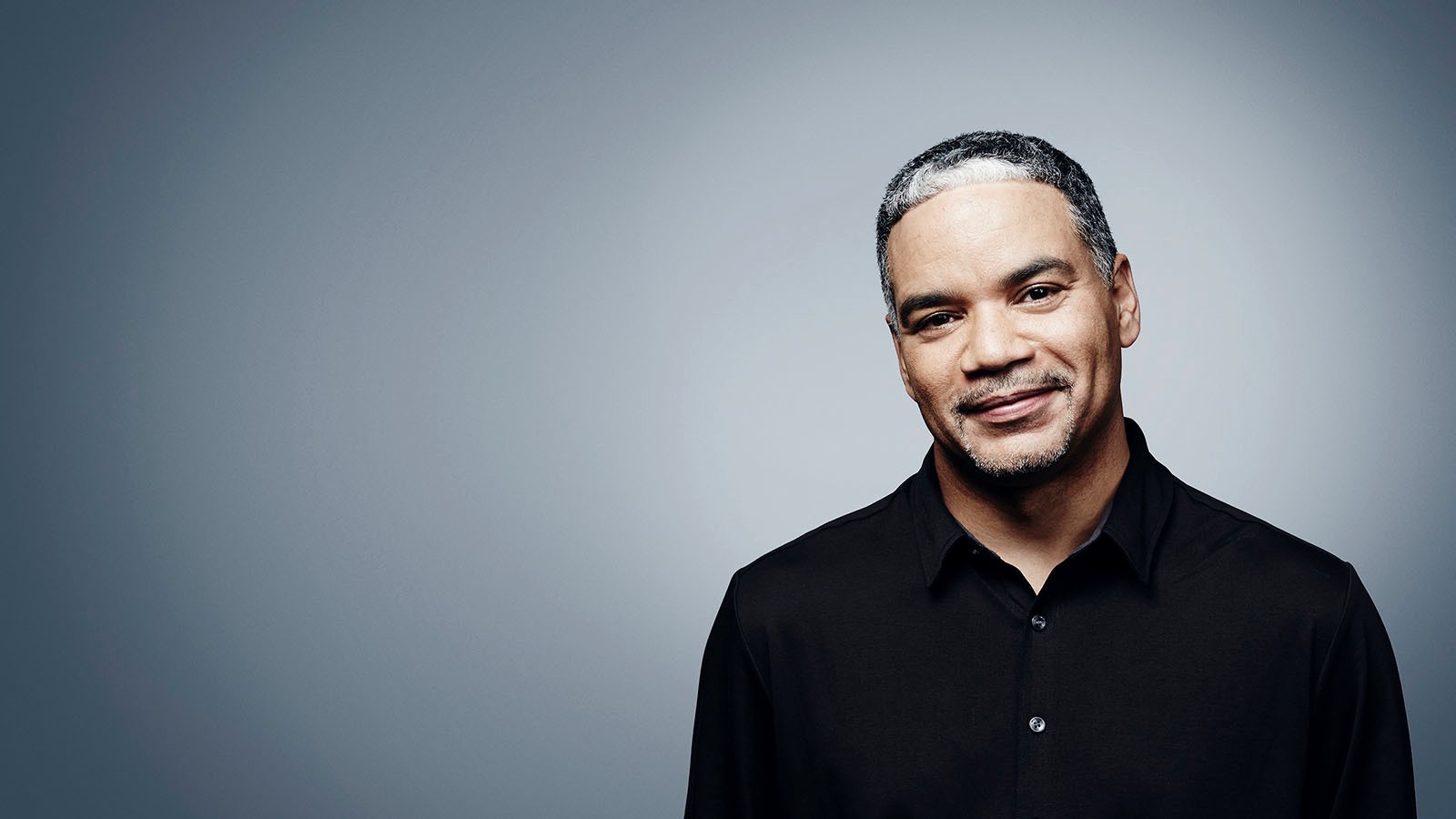
Coleman Hughes a fellow and contributing editor at City Journal.
We can push Hughes’ premise a bit more. If the person interested in the question argues that the reason there is such a gap is because the Jews have organized a system of institutions and organizations and occupy influential positions within this system that allows them as a group to amass privilege over time and accumulate a disproportionate share of the wealth, what social scientists call “cumulative advantages,” then the suggestion becomes an indication of antisemitism. Sounds conspiratorial, no? Does the explanation have the Jewish plan of control in hand? Are there laws on the books that protect and advance the ability of Jews to manipulate society in such a fashion? No? It’s just the way the system works? Jewish power is built into the DNA of society, is that the claim?
An imaginative Protestant seeking to blame Jews for his situation could certainly construct an elaborate theory about dynamics and structures in Western history that explain this disparity. Social science provides jargon for the construction of all manner of abstract things and “social facts” supposed to work forces on people. But I think we all know what that theory would be called in this case and what would happen to the person who advanced it.
It would remove all doubt about the question of antisemitism if the person pushing the theory of Jewish privilege and supremacy demands on the basis of his theory the reorganization of society to redistribute the wealth held by Jews to Protestants.
Yet it is not merely okay for blacks and their “allies” to blame whites for the wealth gap between their respective groups; it is expected. Those who object to antiracism are treated with the same scorn as a Protestant who wonders why Jews as a group are so much better off are than Protestants. Ibram X Kendi, Director of the Boston University Center for Antiracist Research, whose theory of “antiracism” makes all whites who do not agree with him racist, tells us that it is racist to oppose reparations. Kendi is celebrated on the left and by the establishment media.
Ibram X Kendi, Director of the Boston University Center for Antiracist Research
The antiracist standpoints normalizes anti-white racism. Whereas a Protestant runs the risk of being accused of antisemitism for asking why Jews are so well off as a group, the black person demanding reparations from white people for something their distant ancestors may or may not have done is bravely seeking the justice due him. This expression is given a lot of leeway. Some black nationalists even pull Jews into the scope of their theory of the black-white wealth gap and, unlike the white Protestant who would be crucified for doing such a thing, are able to maintain associations with groups like Black Lives Matter, darlings of the establishment, without much scrutiny. How dare white people tell black people which oracles to consult, right? As if criticizing rabid antisemites like Louis Farrakhan should be avoided because some black people wish to sidestep vile and potentially embarrassing and hypocritical associations.
Even though the demand for reparations is made in a society that abolished slavery more than 150 years ago—even though the demand is made for blacks whose ancestors were never exploited and oppressed by the structures theorized to still disadvantage blacks after so many decades—even though some who will get reparations are descended from tribes who sold the ancestors of other black people into slavery—the characterization of all whites as privileged and collectively profiting from skin color and guilty of an intergenerational sin is viewed as a noble cause. White privilege rhetoric blames an entire race of people for the situation of blacks as a group. Blood guilt, rightly never tolerated in explanations of Jewish affluence and status, has become the prevailing theory of racial disparities and, moreover, the policy ground upon which racial equity is to be achieved.
To be sure, there was racial slavery in the United States. This is a historical fact. And that fact does have something to do with the development of post-slavery America. If you feel the need to point that out (which in my experience many people do), then you are missing Hughes’ point. Hughes need not ponder the substance of the Jewish question for a second for his point to work. One does not need to spend any time working out odious theories about Jewish affluence. It is for this reason that reparations is such an unhealthy obsession: it is driven by race prejudice. The hatred and loathing of white people has become so severe—paradoxically increasing in the wake of the elimination of actual structures privileging white people—that whites are now expected to self-hate and self-loathe in ritual confession. The truth is the opposite of what Kendi writes in his Atlantic article: it is advocacy for reparations that is racist. This should be obvious. But we are in an era where people are easily manipulated by feelings of guilt installed by antiracist programming. One cannot safely assume people see through the deception.
More than 150 medical experts, nurses, scientists, and teachers have signed a letter to political leaders urging them to shut down society and start over to contain the coronavirus pandemic. The letter was organized by PRIG, or the Public Interest Research Group, a network of non-profit organizations with the goal of politically change American in a progressive direction. Envisioned by that notorious scold Ralph Nader in 1971, PRIG recruits its activist army mostly from colleges and universities.
“Right now we are on a path to lose more than 200,000 American lives by November 1st,” the letter asserts, “Yet, in many states people can drink in bars, get a haircut, eat inside a restaurant, get a tattoo, get a massage, and do myriad other normal, pleasant, but non-essential activities.”
Of course, all the “normal” and “pleasant” activities people engage are essential for the survival of the bars, hair salons, restaurants, tattoo parlors, and all the other businesses that make our communities vibrant and prosperous and the dreams of entrepreneurs come true. The “normal” and the “pleasant” are also essential for health emotional and psychological states, access to which is rapidly dwindling for our children.
“Continuing on the path we’re on now will result in widespread suffering and death,” the letter warns on apocalyptic tones. “And for what?” For all those things that PRIG designates “nonessential.” And for more than that. To not sink the economy even deeper into depression and all the suffering that calamity entails. For the sake of the “normal” and the “pleasant.”
What the letter signers recommend is insanity. They demand enough daily testing to tag everyone with flu-like symptoms and an army of contact tracers to track all current cases. They demand the shuttering of all nonessential businesses. Restaurants should only provide take-out service. People should only leave their apartments and houses to obtain food and medicine or fresh air and exercise. Governments should mandate masks in all situations and ban interstate travel.
In other words, society should not longer be free and open and citizens should be forced into strict rules of obedience to demands articulated in a letter by medical experts, nurses, scientists, and teachers with the correct opinion.
The Authoritarian Revolution
* * *
Last night, I listened to a virtual debate about mandatory masks at the board of supervisors in the country where I live. It became obvious early on that the logic given to rationalize mandatory mask wearing to combat the coronavirus could be easily retooled to rationalize mandatory vaccination. “We do this not for our own protection, which is admittedly a personal choice,” the argument went, “but for the protection of others.” The same argument could also be marshaled for rationalizing the same mandates for combatting the spread of influenza viruses, rhinoviruses, adenoviruses, and other coronaviruses, all of which are lethal and crippling.
But if we apply the logic of masks and vaccines and quarantine for SARS-CoV-2 to other things—and people should wonder why we don’t—then the good life will be increasingly difficult to come by. And that’s just fine in the opinion of an increasing number of our fellow countrymen.
What the scolds don’t tell you is that tens of thousands of people die every week from all sorts of causes. They die from heart attacks, strokes, chronic respiratory conditions, cancer, automobile accident, alcoholism, drug overdoses—it is a list too long to review here. Normal weekly deaths in the United States average around 60,000. That is a lot of death. And a lot of that death is preventable. If we shut down society, banned cars, forced people to eat only certain foods, banned a range of chemicals, strictly prohibited alcohol and drugs, etcetera, we could drastically reduce the rates of death and disease. Of course, we don’t do a lot that. We determined a long time ago that the good life comes with risks. But for how long?
We are on a dark path towards an authoritarian society. Our governments are normalizing germophobia—the pathological fear of microbes. Authorities and activists are pathologizing healthy people, teaching citizens that their fellow humans are by default diseased and dangerous. Creating fear and suspicious are important elements in establishing an authoritarian order. The panicked animal seeks the sheltering arms of the parens patriae. While this doctrine has its place—most obviously in the necessity of public safety—a new attitude seeks the totalitarian expansion of state power to curtail the “normal” and “pleasant” activities of healthy people.
* * *
The pandemic is occurring at the same time pundits and politicians are telling us that white people are racist and that their racism infects Western culture and law. Indeed, racism is in the Western DNA. Paradoxically, the free people of the West are told they have no right to except to be safe from criminals in their homes and their communities. Public safety is a racial privilege, a luxury white people do not deserve (black and brown people are collateral damage). Of course, the police will enforce the mask mandate—and the vaccine mandate when it’s finally handed down. Civilians throwing avocados at fellow shoppers without masks won’t get the job done. The contradiction is understood in light of a new ethic: criminal deviancy is allowed, even encouraged, while liberty is criminalized.
What explains this contradiction? Western culture is the source of democracy, humanism, individualism, liberalism, republicanism, and secularism. The ethics of civil liberties and human rights began there and spread throughout the world—where they are met with resistance from authoritarian forces. Now the West must resist its diminishment at the hands of a new authoritarian force: corporate power.
By reducing the West to white supremacy and rejecting it on this basis, under the cover of mass hysteria and for the sake of personal and exclusive opulence, a global power elite is dismantling the foundations of freedom, progress, and justice. They are removing the obstacles to total control of human life. The People’s Republic of China and the Islamic sharia are not condemned for their totalitarianisms, but held up as solutions to the problems of the free and open society. Democratic systems, with their respect for personal sovereignty and choice, are in decline everywhere. Manufactured crisis is a gun to put a wounded Enlightenment out of its misery.
What lies at the end of this dark authoritarian path is global neofeudalism. Western values emancipated large segments of humanity from the old feudalism, elevating individuals from the lowly status of serf, servant, slave, and subject to that of citizen. Freed from the oppressions of the tribe and traditional social arrangements, autonomous persons constituted a sovereign people granted control over their destinies and expected to take responsibility for their actions. Western man now find himself being retribalized and returned to serfdom—a new serfdom with a new king: the transnational corporation.
I am getting questions about the text beneath my name on my Facebook profile. It reads: “Teacher, musician, humanist, democrat, feminist, libertarian, republican, socialist, skeptic, infidel.” I cannot be all those things, people are telling me. I am even being told this by people who are not even my friends on Facebook (people are checking out my Facebook page).
I presume that teacher, musician, humanist, feminist, skeptic, and infidel is not what screws people up. By infidel I mean that I stand outside any religious system. I am an atheist. The rest is clear enough, I think. I will nonetheless discuss my understanding of these terms in a moment. It is the democrat, libertarian, republican, and socialist tags that gets people, so let’s begin with these
Democracy is a political system in which individuals enjoy collective power to determine the things that directly affect them. A democrat is a person who advocates for a substantial degree of political and social equality of people. In ancient Greece, the demos was constituted by the ordinary citizens in a city-state. My democracy advocates for the widest scope of popular sovereignty possible that does not interfere with personal sovereignty.
This is where my libertarianism comes in. A libertarian is a person who advances a political and moral philosophy emphasizing personal sovereignty. The focus is on freedom and autonomy. Libertarians are concerned with defending individualism, choice, and voluntarism. Libertarianism is a political philosophy articulating traditional liberal values: free thought and speech, freedom of association and assembly, and secularism or religious liberty (freedom of and freedom from religion). A libertarian is concerned with principled defense of civil liberties and individual rights. Defending liberty is an important piece of democratic republicanism wherein public and personal rights are balanced in a manner enlarging and deepening freedom and self-actualization. The US Bill of Rights is the paradigm of the libertarian conception of liberty.
A republican is a person who advocates for the establishment and preservation of a republic, that is a representative form of government comprised of citizens (as opposed to absolutism over the subject). The republicanism I advance is democratic and libertarian one: a government founded on a constitution with a bill of rights shaped by the pragmatism of common law. I embrace popular sovereignty for citizens with constitutional protections extended to all persons residing within the juridical boundaries of the republic. A republican rejects inherited authority, such as an hereditary monarch.
I identify as a democratic republican. A democratic republican is a person who believes in popular sovereignty with limited government with respect to individual liberty and protection of civil rights. That I am a humanist follows from this. I am also on this account a liberal and a secularist. I am a feminist because I believe in the equality of individuals.
Please note that the tag is small “d” democrat. It does not refer to Democrat, as in the Democratic Party. If I had meant to indicate that I would have capitalized the word. Same with republican. I am not referring to political parties but to political philosophies. I support neither of the two major parties currently running the United States. The political parties who go by these names do a very poor job of reflecting the political philosophies from which their names are derived. They have become organs of corporatist and globalist forces. They undermine popular sovereignty and work technocratically not democratically. Our democratic-republican system is in danger of being canceled by bureaucratic-corporate power.
I do realize that the socialism part is confusing. This is because of the pervasive character of bourgeois ideology in capitalist societies. Socialism refers to a type of economic system wherein workers and communities have substantial control over and collectively benefit from the means of production. Those who produce goods and services own and control the means of their production for the good of themselves and their families and ultimately their communities. Socialism does not negate democracy (it may in fact enlarge it), republicanism (republic governments can exist with socialist economics), or libertarianism (there is no inherent reason why collective ownership and benefit limit individual freedom—these may actually expand opportunities to be freer).
Of course, socialism can appear with association with a variety of types of government arrangements. It can exist in an authoritarian political and legal framework in which the state controls the means of production. Or it can appear in a democratic-republic wherein the workers enjoy a substantial degree of control over the means of production. Because I am a democrat, my socialism is democratic socialism operating within the framework of a secular republic wherein citizens are empowered to make these determinations. Because I am a humanist, economic decisions citizens make are informed by reason and science. Because I am a libertarian, individuals are free to determine what they will do with their share of the social product with due consideration for the rights of others.
Okay. I said I would define the other terms.
I mentioned this several times. Humanism is a scientific and ethical worldview emphasizing human agency and human rights. Humanism is an epistemological stance eschewing dogma and superstition for evidence and critical thinking. I am also a Marxist and some assert that the mature Marx was an anti-humanist. It is beyond the purpose of this blog to get into this (I address this elsewhere), but I do not agree Marx was anti-humanist. Indeed, Marx’s advocacy for the full emancipation via social revolution of humanity from the alienating conditions of segmented social arrangements is quintessentially humanist in substance; alienation is unfreedom, and therefore a distortion of species being.
Feminism is politics advocating sexual equality and opposing patriarchal organization of communities. A feminist affirms the right of girls and women to exist as autonomous individuals and not subordinates to men or the norms of masculinity. A feminist holds special regard for the unique character of women and for this reason staunchly defends personal sovereignty, bodily integrity, and reproductive freedom.
An infidel is a person who does not believe in religion or who holds a religious view different from the one his accuser holds. I am the first sort, usually defined, given the intensity of my infidelity, as antitheism. An antitheist is more than an atheist—either the type of atheist who has insufficient reason to believe religious claims or the type of atheist who knows the claims of religion are false on reasonable grounds—but rather a person who finds religion objectionable. I tolerate religious belief because I am a libertarian. For the same reason, I oppose the imposition of religion.
Skepticism is a rational attitude towards truth claims, the default position of which is doubting the truth of any significant claim without compelling evidence or reason. Knowledge is verified belief or information. This does not mean that knowledge is fixed and eternal. It means that knowledge is based on facts gathered and studied via rigorous methodology with a readiness to consider contrary evidence (disconfirmation). Skepticism means that discovery and the dialectic informs consciousness; if one encounters facts or argument that cast doubt on what he believes, and if he can no longer sustain his belief using reason (not ideology), then he modifies or abandon that belief. A key aspect of skepticism is charity in argument, that is working through contrary claims with an open mind.
Nothing in my tag line contradicts anything else in my tag line. The confusion represents an inadequate understanding of political theory and, really, a lack of creativity in thinking about political possibility. My mind changes on matters of substance. But the principles identified in my tag line have been my guiding principles for decades.





 freedom and reason