There is great concern expressed in MAGA circles about surging Pennsylvania GOP Senate candidate Kathy Barnette. The MAGA crowd was already troubled by Trump’s endorsement of physician Mehmet Oz in the Senate race. But they had to defer to the former president and de factor party leader. Then Barnette effectively attacked Oz and WEF favorite David McCormick during a recent televised debate, which endeared her to the populist-nationalists. The got Steve Bannon and the War Room involved. Her position on abortion, decidedly pro-life and featured in a powerful campaign ad, also garnered attention.
Pennsylvania US Senate candidate Kathy Barnette with Republican rivals, Newtown, Penn, May 11, 2022
But MAGA is not the only group Barnette has concerned, and that is what I want to talk about in today’s blog. The establishment media is now mobilizing to undermine Barnette’s candidacy (which, for the record, I do not support). CNN ran a hit piece yesterday titled “Surging GOP candidate Kathy Barnette has long history of bigoted statements against gays and Muslims.” Reported Andrew Kaczynski and Em Steck tell the CNN crowd, that the candidate “has a history of anti-Muslim and anti-gay statements.” Their reporting speaks to the hardcore of their audience: “In many tweets, Barnette also spread the false conspiracy theory that former President Barack Obama is a Muslim.” This is sure to get a few backs up.
While she has said a lot of objectionable things about gays, CNN uses her comments on Muslims to push Islamophilia under the guise of condemning bigotry. The tone of the story is such as to suggest that her views on Islam and Muslims are worse than her antipathy towards gays. It’s not as if the things Barnette has said about Islam and especially Muslims is entirely unproblematic. For example, in the passages I will share in this blog, her rhetoric about discriminating against religious worldviews may suggest a weak understanding of freedoms of conscience and expression. However, the argument she makes regarding why it is not racist to reject Islam and, moreover, by implication, the appropriateness of objecting to this ideology, is in line with arguments I have made on Freedom and Reason. Indeed, at points, her argument sounds as if it were cribbed from my blog. This gives me a chance to reinforce my position.
“You are not a racist if you reject Islam, or if you reject Muslims, because they are not a race of people. They are a particular view. They are people that have a particular view of the world, and we have a right to discriminate against worldviews.” Again, I am uncertain of what Barnette means about discriminating against worldviews. Discrimination against citizens on the account of the ideological views they espouse is wrong. Nobody should be punished because they are a Muslim. But we should discriminate against Islamic views in the sense that we should keep strictly apart from our laws and policies the doctrines of Islam.
Moreover, as Kenan Malik has told us, humans are culture-bearers. They bring their culture with them when they migrate. Islamic extremism and fundamentalism are incompatible with American culture, representing threats to the security and, more generally, the integrity of the United States. Immigration law and policy should take into account the seriousness of those threats. Barnette is correct when she points out that there is nothing racist about anti-Islamic sentiment. Muslims do not comprise a race of people so criticism of Islam cannot fall in that category. Being a Muslim is not even an ethnic identity. Even more than Christianity, Islam is a religious ideology in the purist sense of the term, with emphasis on ideology. This point becomes clearer when we take up the next quote by Barnette.
“We discriminated against Hitler’s Nazi Germany view of the world, right? That was a worldview. That’s how he saw the world around him. And we discriminated against it. We rejected it.” Why? “Because that’s a particular view of the world that we don’t agree with.” This may be jarring given the pro-Islamic propaganda aggressively pushed by the corporate state, but it is correct analogy. Like German National Socialism, Islam is an ideology. All religion is an ideology. But not all ideology is as hateful as Nazism and Islam. Just as there is no obligation to embrace Nazism merely because it is the sincerely-held belief of some people, there is no obligation to embrace Islam. Indeed, the expectation is that the morally-upright citizen condemns Nazism, only tolerating its expression in light of First Amendment norms (and the instinct is to not even allow that). This means allowing but countering its expression with prejudice.
To put this another way, there is nothing unjust about feeling or expressing prejudice towards Nazis. To make those expressing such repugnant ideas uncomfortable and unpopular may be construed as discrimination in the sense of prejudicial treatment of a category of things. It seems this is what Barnette is saying. If there is no difference between Nazism and Islam as things of a category (of course the systems have different content but are nonetheless ideologies of similar form), that is a pernicious ideology, then Barnette has expressed bigotry only in the technical sense that she holds an obstinate attachment to a belief, opinion, or faction, i.e., she believes and is of the opinion that Islam is objectionable and that Muslims are purveyors of an objectionable view in exactly the same way it is expected of morally-upright persons to believe and express the opinion that National Socialism is objectionable and that Nazis are purveyors of an objectionable view. We often don’t think of bigotry (or chauvinism) in positive terms, but this is one meaning of bigotry. The right or wrong of it is a matter of standpoint. What is acceptable and unacceptable bigotry depends on whose goose is being cooked. We want Nazis to lose. Why not Muslims?
Barnette articulates her position cogently: “We have the right to discriminate against worldviews because all views are not morally equal. All views are not equal. So we have the right to reject it. And let me just say offhand, I reject how Muslims see the world.” I agree with this, especially in an ideology’s effects. Consider genital mutilation. One’s religion may advocate the practice. I will condemn that advocacy. I will moreover advocate laws forbidding the practice. Does that makes me anti-whatever religious doctrine seeks to and does violate the human rights of children? Sure. But it also puts me on the side of the angels. I am also right to condemn and limit within Constitutional parameters doctrines that would and do violate the human rights of gays and women. Though I struggle with this as a civil libertarian, I am sympathetic to the French ban on the hijab.
Despite holding entirely objectionable views on homosexuality, Barnette is pushing back against the extreme cultural and moral relativism of the postmodernist establishment, which in its hatred of the West, finds anti-Western ideologies laudable and especially finds a view analogous to Nazism worthy of smearing a candidate for US Senate by accusing her of bigotry in the sense of unreasonable prejudice against a person or people on the basis of their membership of a particular group. But opposition to Islam is not unreasonable. It is, like opposition to Nazism, an entirely reasonable standpoint. Why the two ideologies are not treated the same by those in charge of the culture industry is explained by the hegemony of progressive ideology. And that’s the point of calling out CNN for its Islamophilia.
Delaware Attorney General Kathy Jennings says she is “deeply troubled” following the news of the stop and search of a bus carrying members of the women’s lacrosse team of Delaware State University, a historically Black university, last month in Georgia. Delaware State University President Tony Allen has called for investigation, framing police action in this case as racially oppressive.
The team bus was illegally traveling in the left lane and drug dogs indicated the presence of contraband. I don’t trust these dogs. But it is fairly typical to use them during traffic stops. The officers may have lacked probable cause. Let’s find out. Those who read my blog know that I am a Bill of Rights left libertarian and it always troubles me when I hear about incidents like these. It sounds like overpolicing. On the other hand, there was something going on that day. The police had stopped several vehicles that day and on another bus they did find contraband. This usually indicates that the police received a tip.
Dr. Tony Allen will chair President Biden’s Board of Advisors on Historically Black Colleges and Universities
However, the question of racial profiling is a different question. Allen expresses the prevailing narrative concerning racial profiling in today’s policing practices in dramatic terms. “The resultant feelings of disempowerment are always the aggressors’ object,” he said. This assumes that the officers—who, according to the department, did not know the race of those stopped before they were stopped—purposefully acted to produce feelings of disempowerment and, moreover, its suggests that they were racially motivated to do so. The complaint is about a “racial encounter.” Is this any encounter where detainees are black?
I have been thinking a lot about this matter over the last few years (see my July 2020 essay Policy Presuming “White Privilege” Violates Equal Protection Under the Law). I teach criminal justice courses and one of the books I use in my upper-division criminal justice process class is Epp et al.’s Pulled Over, which claims to be able to show implicit racial bias on policy stops. I have to be critical of the materials I use in the classroom and I detect a problem in this narrative regarding racial profiling. Suppose this had happened to an all-white athletic team. Whites get pulled over by the police all the time. Could they claim that race motivated the officers’ behavior? It’s possible race did play a role (racial bias works in all directions), but the claim would have to be backed by evidence. The burden would be not on the police to do an investigation to find out whether race played a factor. The burden would be on those claiming that the police racially profiled them.
For sure, the public would find a claim by a white man being racially profiled incredible. The reality is that, despite being pulled every day, whites cannot without facing great skepticism claim that the police act towards whites with racial bias. It’s almost always when the detainees are black or brown that the claim is made, and the charge is almost always made on identitarian grounds not on evidentiary ones. We see this with lethal officer-civilian encounters, which I have written about extensively on Freedom and Reason. But the standard must remain the same for everybody. If one makes a claim that racial bias played a role in a police stop, then the person making this claim shoulders the burden to show this. Identitarianism irrationally flips the burden and stands on the grounds of presumption.
Is it statistically true that blacks are disproportionately pulled over by the police? Yes. But it is also true that blacks are overrepresented in crime and are more likely to be stopped on that basis. This does not excuse the practice of investigatory stops dressed in the clothes of traffic stops, which this case may or may not have been. I am on record opposing veiled investigatory stops (this is the value of Epp et al’s book). But veiled stops are conducted across races. People are pulled over for all sorts of reasons, from the type of car they drive to the length of their hair. In any of these cases, the burden to show bias rests with those who claim to have been affected by it. The fact that blacks are disproportionately stopped is not in itself evidence of racial bias.
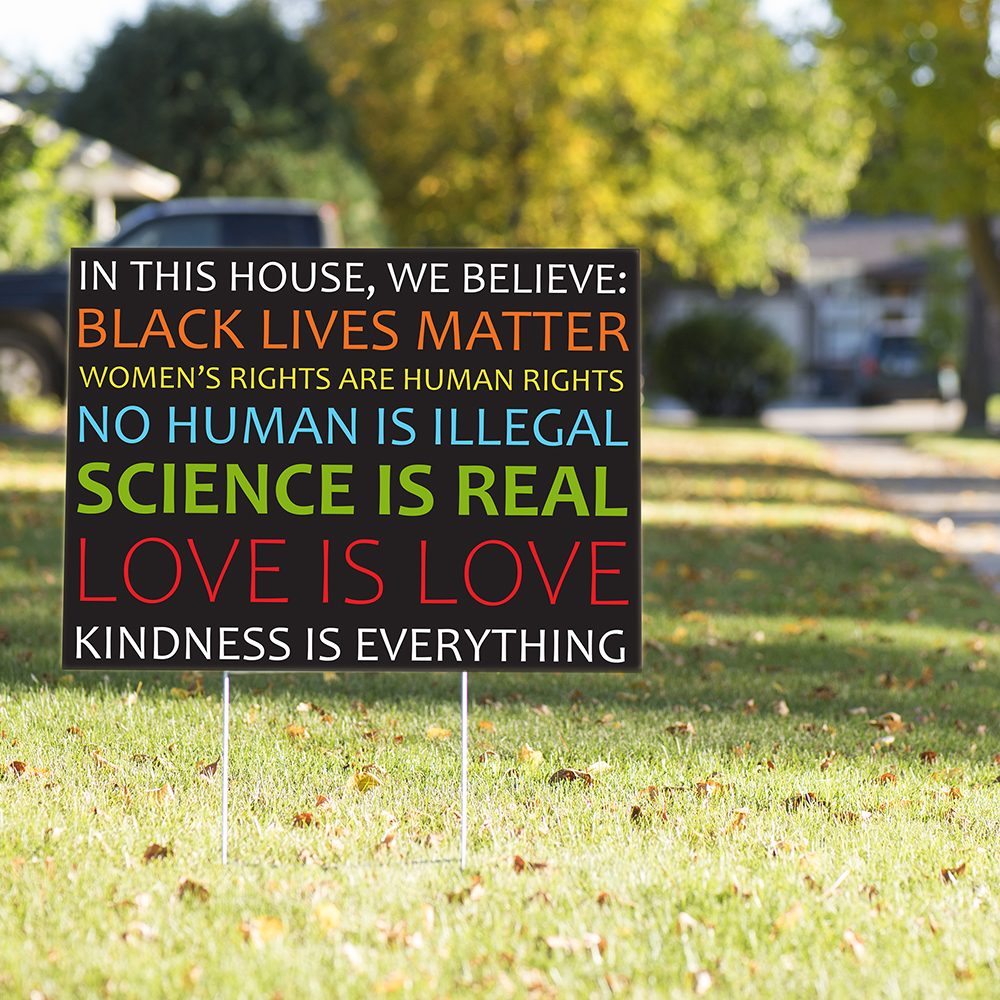
Have you seen this sign? I see it or a version of it all the time. I walk a lot, and the neighborhood where I live is teaming with progressives, and these are the slogans of progressivism. “Love is love” is a meaningless stab at a tautology. “Kindness is everything” is dangerous. One need not be kind to aggressors or invaders. Indeed, human survival depends on hard-headed refusal to universalize kindness. The naïve expression of humanitarianism embedded in this sentiment in turn inspires the slogan “No human is illegal,” admonishing us to remember that those who cross national borders without authorization should not be referred to as illegal aliens or immigrants; at worst they are unauthorized or undocumented. But crossing national borders without authorization is illegal, so it’s really an expression of open borders. Of course women’s rights are human rights. Women are humans. My last few blog entries on abortion rights have concerned that matter. I will direct you there. A slogan won’t do.
The weird conflation of epistemology and ontology aside, the “Science is real” slogan is at odds with belief in Black Lives Matter, since the movement is based on claims exposed as demonstrably false by the lights of science. It’s this problem that I want to address in this essay, namely the progressive claim to stand with science—to “follow the science,” as the faithful say—and the rejection of scientific claims that stand outside the political-ideological parameters of the woke progressivism. You may have noticed that, by virtue of being progressive, progressives know more than those they suspect of being something other than that—which is anybody who doesn’t chant the slogans. Woke progressivism is like a zealous religious attitude. The snobbish attitude is endemic to the progressive mindset in the same way that fundamentalist Christians know they have the scoop on the world. The rank-and-file behaves as if they are among the elect. In contrast, the man who is not progressive, whatever his background or qualifications, is a backwards neanderthal because he doesn’t rehearse the progressive lines.
One can see this in the debates around the SARS-CoV-2 virus. During the COVID-19 pandemic hysteria, my arguments, despite being science-based, were dismissed ostensibly because I am not trained in the areas progressives deem relevant. Even assuming their parameters, one would still have to claim that a PhD in any scientific field is not a fungible skill, that understanding how to think and work scientifically does not apply across domains. This reflects a poor understanding of science and scientific training. I have empirical research published in peer-reviewed academic journals. I know how to conduct and consume research. “Are you a doctor?” is the frequent question. Yes, actually, I am. And I am a scientist. To be sure, concepts and theories are abstracted from the concrete realities of the various domains, and there is something to be said for expertise, but the basic methods by which the specific is worked into the general remain the same. (See The Cynical Appeal to Expertise.)
Yet even those doctors and scientists with expertise in the areas progressives deem relevant but who also break with the prevailing narrative—that a narrative prevails and we all know what the terms of the narrative are proves the claim that progressives have captured society’s major institutions—are dismissed as crackpots and bigots, as rightwingers and reactionaries. And in both instances, there is a profound contradiction at work. In disagreements over scientific matters, when progressives cite the alleged absence of expertise of the person with whom they disagree, they at the same time disqualify themselves on the same grounds. If I cannot make a science-based claim because the subject matters pertains to a domain for which I am not specialized, then how does the person who points this out presume to make science-based claims or, for that matter, know whether I am right or wrong? How do they get to argue from the lay position yet I am disqualified even though I am a scientist? And all those doctors and scientists with expertise in the fields of epidemiology, immunology, virology, etc. who disagree with the thoroughly corporate-captured CDC, FDA, and WHO, by what lights do progressives judge them? By the edicts of the very governmental agencies the norms of science demand we subject to skeptical inquiry? How do they know who to trust? They’re progressives, that’s how, and the regulatory apparatus of the corporate state they bow down to told them what to believe.
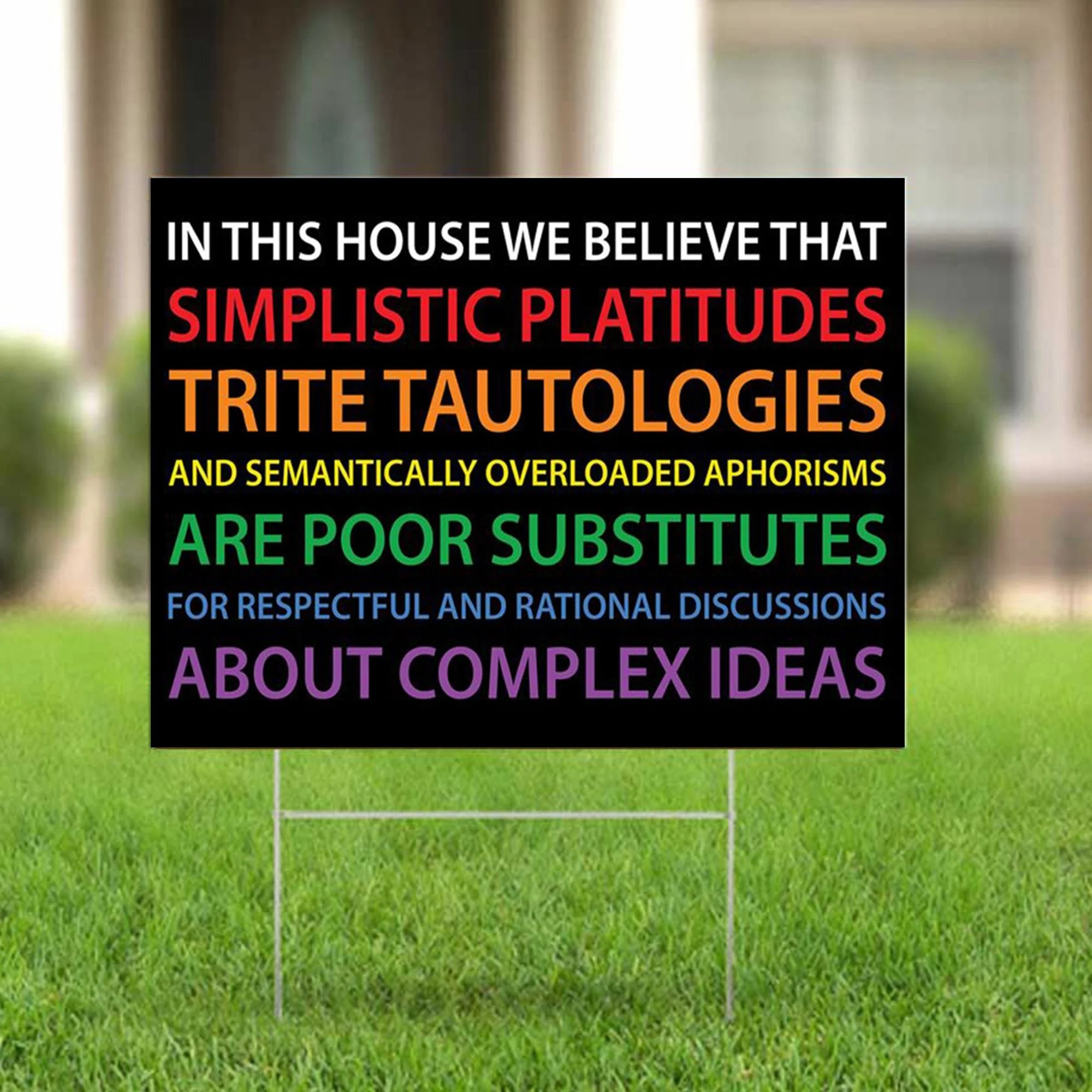
For progressives, it’s all ideology all the time, and the ideology in play is a projection of the technocratic desire of corporate statism. They confuse science with the edicts of regulatory agencies because of their faith in Big Brother. In the end (or at least close to it), I was right about COVID-19. Why? Because I am a scientist? Sure. But, more importantly, because I am not a progressive. Progressivism is a species of ideological blindness. It makes a virtue of appeal to authority and dresses it in a degree of condescension befitting a religious attitude. “Science is real” has the same vibe as “Jesus is the way and the truth.” Indeed, progressives sound a lot like Christians. When hailing from the left, they’re practically indistinguishable. It’s as if Jesus had blue hair. This is why, if you were inclined to put a sign in your yard, the sign shared below would adequately represent the scientific humanist spirit, while at the same time pointing out the stupidity of the ideology that pretends to.
I am in complete support of women’s access to abortion services, but what difference does it make to somebody who believes abortion is murder whether the fetus is the product of incest or rape over against other pregnancy causes? We don’t kill children because their parents are related or because the father is a rapist. You don’t punish children for the crimes of others. The fetus is a child in the eyes of those who believe abortion is murder. The only reasonable exception given this premise is life of the mother, since then killing the fetus is analogous to self-defense.
Is this the candidate you should support for GOP Senator of Pennsylvania?
Complaints from those who support women’s access to abortion services over arguments that conceptualize life as beginning at the moment of conception of fertilization as well as the question of viability are also ineffective in this debate. Really, if one is being honest, one must grant that life at conception. Fertilization is the conception of a new human life. That’s biology. As for viability, suppose the fetus is viable at fifteen weeks, are authorities going to ask the woman seeking an abortion to undergo surgery to safely remove the fetus so it can grow in some other incubator artificial or living?
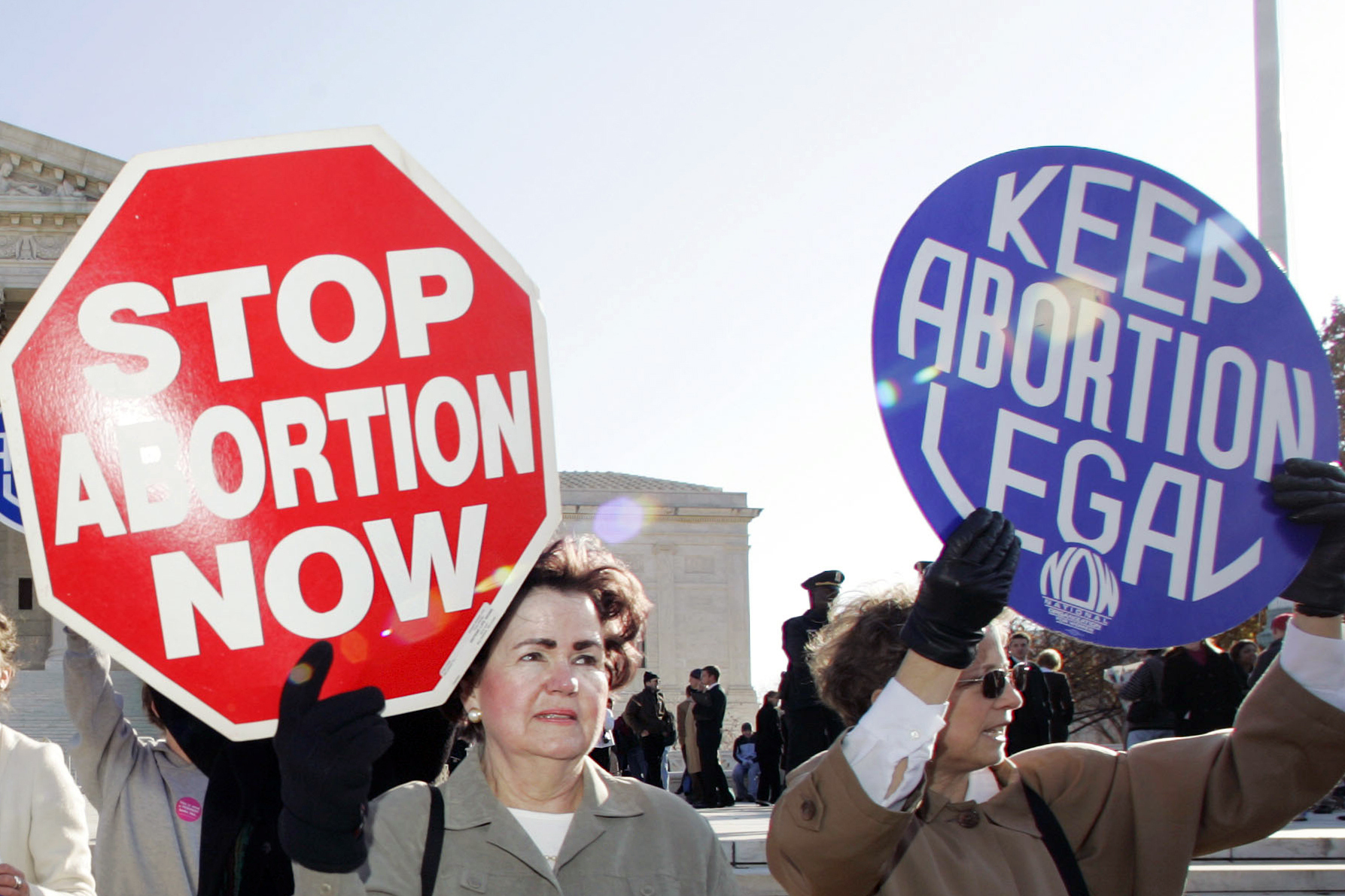
Outside the U.S. Supreme Court, Washington, November 2005.
The only viable argument for abortion is from liberty—appeal to the rights to bodily autonomy, personal sovereignty, and medical privacy. The woman doesn’t want to have the fetus inside her. That is the only criterion that matters. She needs no justification except that it is her body and therefore her choice. She can have something living in her body removed if she wants. To stop her from removing a fetus is to deprive her of fundamental rights to life, liberty, and property. That’s tyranny. Her choice is none of your business. Stop being such a busybody.
“But doesn’t the fetus have those rights, too?” Does the person breaking into my house? Does the person trying to enslave me? Each have their rights inviolate until they violate the rights of others. My rights supersede theirs because they have no right to break into my house or enslave me (police with warrants and the judge who sentences me to hard labor have neither broken into my house nor enslaved me). Likewise, nobody has the right to use my body to sustain the life of another. It is an unjust interference with my liberty. You cannot have my kidney. It’s mine. I will decide what happens to it. This is true for every other part of my body.
How can it be, then, that the state can force her to sustain with her body the life of another person? A woman has the same rights that I have as a man. You cannot use her uterus to sustain the life of another person any more than you can use my kidney for this purpose (or any other). This would make women uniquely subjects of the state. It’s not only tyranny but discrimination on the basis of sex.
Currently, some 800,000 people have end-stage kidney disease, requiring either dialysis or a kidney transplant for survival. There are more than 50 thousands deaths every year from nephritis, nephrotic syndrome and nephrosis, making kidney disease the tenth leading cause of death in America. Think of the lives saved if the state were to commandeer the healthy kidneys of Americans, most of whom have two healthy kidneys yet only need one. That most Americans would register outraged if the state were to announce such a life-saving program, yet many cannot muster the same outrage when it comes to the bodily autonomy of women, reveals a deep-seated patriarchal reflex. The desire in action reduces women to second-class status, making women objects of other people’s designs and purposes. It represents the supreme objectification of women.
I don’t want to hear conservatives talk about individual liberty if they’re not prepared to defend the clearest instantiation of it. If you support restricting abortion, then your liberty talk is in bad faith. Spare us your hypocrisy.
* * *
Afternoon note (same day): Protests at the homes of Supreme Court justices is profoundly authoritarian. I hear the incitement to violence against the judges—“If abortions aren’t safe, then neither are you.” An independent judiciary is one of the pillars of a free and rational society. It’s an expression of proto-fascistic mentality to attempt to intimidate judges into voting your politics or sharing your argument.
There is a vast difference between protesting the White House, Congress, or the Supreme Court and showing up at the homes of politicians and judges in a threatening manner. Every person has a right to be secure from the mob and to live a quiet, private existence. A judge’s home is not a legitimate site of protest any more than a woman’s body is a legitimate site of state control.
Where is the Biden Administration on this outrage? Jen Psaki says the president “strongly believes in the Constitutional right to protest. But that should never include violence, threats, or vandalism. Judges perform an incredibly important function in our society, and they must be able to do their jobs without concern for their personal safety.” Words are not enough—especially not these words: “I think the president’s view is that there’s a lot of passion, a lot of fear, a lot of sadness from many, many people across this country about what they saw in that leaked document. We obviously want people’s privacy to be respected. We want people to protest peacefully if they want to protest. That is certainly what the president’s view would be.” Sounds more like encouragement and sympathy that condemnation.
Perhaps the national guard should be deployed around the homes of justices and the mob physically removed by police from these neighborhoods. Public safety suggests it. For sure this is stupid politics. Democratic strategist Paul Begala nails it when he says, “This is wrong, stupid, potentially dangerous, and politically counterproductive.” Exactly.
It would have helped a lot I think had those who believed in the right of women to not be incubators had also been vocal in their support of the right of individuals to not be quarantined, masked, and vaccinated.
I recently asked friends on Facebook to reflect on who has always been consistent on the question of bodily autonomy and medical privacy. Because Facebook continually punishes me for the content of my posts by lowering them in the news feed (at least they tell me they’re doing it; Twitter just shadow bans), it took a while before somebody asked me who I was asking them to remember. The answer, of course is me. I am the person who has been consistent on the question of bodily autonomy and medial privacy. I say this not to pat myself on the back, but to isolate one of the core problems in today’s politics: the abandonment of principle for partisanship in the rhetoric of left versus right.
The person who asked about who I was talking about remarked that “it’s odd how the same people who felt wearing a mask during a pandemic was tyrannical overreach by the gubment but forcing a women to carry a child she does not want is perfectly fine.” He is an extreme partisan on the side of the Democratic Party who frequently mocks conservatives by portraying them as hicks. He suggested that “if men could bare [sic] children those same people would me amassing with weapons to attack SCOTUS or congress.” I responded snarkily: “Just like the people who oppose restrictions on abortion were okay with forcing people to wear masks, locking down society, and mandatory vaccination.” He liked that comment because he had missed the point.
Alas, my provocation failed. I wanted somebody to scold me for drawing an equivalency between abortion and the COVID-19 pandemic. The equivalency is undeniable. The counterargument I anticipate is the argument that proves the point. “Masks and vaccines save lives. You don’t have the right to appeal to bodily autonomy and medical privacy when you could be carrying a virus that may sicken and even kill others.” I’m not imagining this line of attack. We heard this from progressives for months. Well, what does abortion do? If the state can force people to wear masks, quarantine, and receive mRNA injections to save lives, then does it not follow that the state can force people to carry a fetus to term? Preventing abortions save lives. The fetus is alive. There’s no getting around that. The fetus is a member of our species. It only has yet to be born. The question of life, viability, etc., is beside the point.
Please don’t forget—or if you don’t know my stance, read by blog—I support a woman’s right to be free from the practice of forced childbearing. I support this right on the same grounds that I support a woman’s right to free from the practice of forced vaccination. The death of a fetus or a grandmother is not as important as the liberty of the mother and granddaughter. I work from principle and the same principle operates beneath both actions. Abortion isn’t the right. Abortion is an instantiation of the right in question. The right is freedom from state tyranny. The demand is the defense of life, liberty, and property—our lives, our liberty, and property in self. Think of all those who were killed because they tried to deny the life, liberty, and property of others. Those weren’t murders.
I told my Facebook friend that the sides have been misspecified. By that I meant that the partisan divide, the way politics is articulated, force the same contradiction on both sides, where the principle of liberty is corrupted by ideology. The right wants the state to force people to give birth to save lives. The left wants the state to force people to receive mRNA injections to save lives. Yet, almost for sure, failing to force women to carry a fetus to term costs lives. The source of the contradiction is failure to obey principe. If principle is the consideration, then the sides are these: either the state strictly controls our bodies and our liberties for the sake of others, which is a perverse form of humanitarianism (a culture of masochism), or bodily autonomy and medical privacy are excluded from state control except where the state defends and upholds those rights. The sides are authoritarianism versus libertarianism.
Partisan politics confuses the matter even more with the recklessly deployment of the word “democracy.” The Washington Post runs the headline “In draft abortion ruling, Democrats see a court at odds with democracy.” That’s a weird take, since one of the primary arguments against Roe v Wade is that it circumvents the will of the people in those states who have voted to end or restrict the practice of abortion; a majority in support of abortion rights in New York is not a majority opposed to abortion rights in Mississippi. In fact, Roe was at odds with democracy when it was handed down.
That is, in fact, the conservative’s argument and it’s profoundly hypocritical in light of the constant rhetoric from that side about how the United States is a republic not a democracy. Conservatives do want democracy, conceptualized in its worst form as majoritarian, to determine not only whether women have to carry a fetus to term, but whether gays have access to the institution of marriage. But these are not things society should ever subject to majority rule, as they are rights, and rights are for individuals to determine, not the collective. The collective is only obligated to defend rights. Reproductive freedom is not a matter of majority rule any more than slavery is. It’s not even an analogy.
One last thing. If there is no right to privacy, as we have heard conservatives say concerning the basis of Roe (see my recent blog on the problems with the 1973 decision), then on what principle does the Fourth Amendment rest? “The right of the people to be secure in their persons, houses, papers, and effects, against unreasonable searches and seizures, shall not be violated, and no Warrants shall issue, but upon probable cause, supported by Oath or affirmation, and particularly describing the place to be searched, and the persons or things to be seized.” If there were no right to privacy assumed in that amendment, then why would there be any problem with the state arbitrarily violating the security of my person, house, papers, and effects? Violation of personal security in the manner described in the amendment necessarily presumes privacy.
Politico is reporting that the Supreme Court has struck down Roe v Wade (1973), as well as Planned Parenthood v Casey (1992), according to a draft majority opinion, penned by Justice Samuel Alito, circulated inside the court and obtained by Politico. That this is (to my knowledge) the first Supreme Court decision ever leaked to the press is a central issue that must be taken up by the government. How it was leaked is an interesting question; why it was leaked and who leaked it even more so.
Abortion rights supporters and anti-abortion demonstrators outside the Supreme Court, November 2021.
However, I knew Roe was doomed and that its demise was just over the horizon. I told my wife and my mother only a month ago that the Supreme Court would soon overthrow Roe. I have been feeling this in my bones for a long time. In May 2007, in a short blog, Judging the Religious, I write, “If one day the Supreme Court is dominated by Catholics, we will be justified in worrying about reproductive freedom in America.” However, it was not only the composition of the Court that spelled the precedent’s demise. Roe was doomed from the beginning because Roe was a bad decision—not because it legalized abortion, but because it is bad law.
Before I tell you why it’s bad law, I want to make sure you understand my position on the matter of abortion. I am a libertarian. I stand entirely on the side that demands the right of individuals to control their bodies. This right is paramount not only for women, but for all consenting adults. I have blogged about this many times over the years. Here are three representative pieces, one from 2008, a second from 2013, and a third from 2020, if you want to understand my argument: The Fetus is a Person. Now What?; Abortion is Really About Freedom; Liberty is America’s raison d’être. Preserving Reproductive Freedom for the Sake of the Republic.
Why is Roe a bad decision? “Roe isn’t really about the woman’s choice, is it?” late associate justice to the Supreme Court Ruth Bader Ginsberg told the University of Chicago Law School in May 2013. “It’s about the doctor’s freedom to practice.” She characterized it this way: “it wasn’t woman-centered, it was physician-centered.” In an earlier New York University lecture in 1992 Ginsberg argued that Roe should have focused on a Texas law that “intolerably shackled a woman’s autonomy” by permitting abortion only when the mother’s life is in danger.
“Suppose the Court had stopped there,” Ginsberg said in 1992, “rightly declaring unconstitutional the most extreme brand of law in the nation, and had not gone on, as the Court did in Roe, to fashion a regime blanketing the subject, a set of rules that displaced virtually every state law then in force.” “Would there have been the twenty-year controversy we have witnessed, reflected most recently in the Supreme Court’s splintered decision in Planned Parenthood v. Casey?” she wondered rhetorically. “A less encompassing Roe,” she answered herself, “might have served to reduce rather than to fuel controversy.”
In its ruling, penned by associate justice Harry Blackmun, the Court held that a set of Texas laws concerning abortion violated the constitutional right of privacy, which Blackmun held to be implicit in the due process clause of the Fourteenth Amendment, which states that no state shall “deprive any person of life, liberty, or property, without due process of law.” However, the Court rejected Jane Roe’s assertion of an absolute right to terminate pregnancy in any manner and at any time. It instead attempted to balance a right of privacy with state interests in regulating abortion. In its attempt at compromise between right and power, the Court constructed an arbitrary set of rules and imposed them on every state, thereby dooming Roe to failure in the long run.
I have always found it strange that that the court avoided appealing to the rights to liberty and property explicit in the Fourteenth Amendment and instead appealed to the right to privacy, which, while necessarily assumed by the Constitution (for example, the Fourth Amendment only works if privacy is the underlying principle), does not appear in the text of the amendment in question. My view is that the Court should have accepted Roe’s assertion. Liberty demands that a human beings cannot be forced to sustain the life of another human being with his own organs. How can you be free under those conditions?
Moreover, property in ones body, which is the foundation of the property right, repels the power of the state to use ones property for whatever arbitrary ends it seeks. What possibly could be the justification for commandeering the woman’s body to use as an incubator? As I have argued elsewhere, does this not represent the essence of tyranny? This isn’t about running a railway through the middle of your estate. This is about running the railway through your body.
Politically, the pending decision may function as a monkey wrench thrown into the populist takeover of the Republican Party. The populists were well on their way to dominating the 2022 midterm elections and continuing their transformation of establishment politics. The ruling should motivate progressives to get out the vote, with the effect of slowing the Republican advance. At the same time, violent protests, which are highly likely (we’re already seeing the signs) may work against Democrats in the midterms.
Beyond the midterm elections, there needs to be a post-Roe national strategy dedicated to expanding the right of women to unfettered reproductive freedom. This strategy must be focused on liberty and bodily autonomy. In this fight, progressives are among our worst enemies. With demands for lockdowns, masks, vaccine mandates and passports, censorship, speech codes, etc., progressive attitudes complicate the argument for freedom. Indeed, Democrats are responsible for the conservative character of the court by driving people into the arms of the Republican Party with their woke nonsense. (See The principle that sustains compulsory vaccination is broad enough to cover cutting the fallopian tubes; On the Ethics of Compulsory Vaccination; Biden’s Biofascist Regime.)
Woke progressivism also alienates Americans with its incessant and irrational focus on identity. We are already hearing a lot about how the composition of the Supreme Court, being majority male, tells us something about how Roe gets overturned. Yet the Supreme Court that established the Roe precedent was all male. We should remember that those who abolished slavery were all males. All white males. Brown v Board of Education. All male. All white. The 1964 Civil Rights Act? Out of 535 congresspersons, there was a grand total of fourteen women in Congress in 1964. There were only five black congressmen in 1964. Oh, and associate justice Amy Coney Barrett is female.
What matters is not skin color, chromosomes, or gonads, but ideas. We don’t need restrictive moralism from either the right or the left. We don’t needs an overbearing administrative state. American politics require a radical course correction. Libertarianism must take its place at the heart of American politics. We must return to our liberal roots.
Remember, when the United States was founded, most states continued to operate under the English common law right to abortion, which permitted the termination of a pregnancy before fetal movement (quickening). Laws criminalizing abortion did not appear until the late 1800s. Abortion is a fundamental right stretching back millennia. Remember also that, before Roe, abortion was legal in several states and will likely continue to be legal after Roe is overturned.
Our struggle is to extend to each citizen regardless of the state in which they reside access to what should be understood as a fundamental personal right. To do this, we must reclaim an authentic politics of human freedom and begin again.
* * *
Note (5/4/2022): I am not disparaging my Catholic friends. I am drawing upon an understanding of Catholic ideology. If you understand Catholicism, then you can probably understand what I’m saying. There is a lot of history behind my prediction.
Until the emergence of the New Right in the 1970s, which was a reaction to overbearing progressivism and concomitant suffocation of liberal values by Democratic Party ideology, Protestants didn’t much care about abortion. Certainly not in any organized way. Catholic side-switching fused other conservative tendencies to give right populism cachet in the Republican Party, which Southerners found attractive in the post-Civil Rights period. Progressivism crushed populism on the left and American became deeply polarized along cultural lines. Democrats abandoned the working class and individualism, as well as embraced neoliberalism (having already embraced globalism), and millions of working people gravitated to the conservative movement. The end of Roe is ultimately the consequence of woke progressivism clearing the path for conservative Catholicism to replace liberal Protestantism and secular Judaism on the Court.
I’m no oracle. I have gotten things wrong, but not very often. And this one I saw coming from miles away. My predictive ability has to do with a methodology of maximal objectivity. That methodology depends on a perspective rooted in secular humanist and left-libertarianism. These elements comprise a standpoint that’s resistant to the corrupting effects of partisan political-ideology (albeit, political-ideology still constrains me). This standpoint is why I alienate Democrats and Republicans alike. They don’t know what I am. That’s okay. Just look at my record.
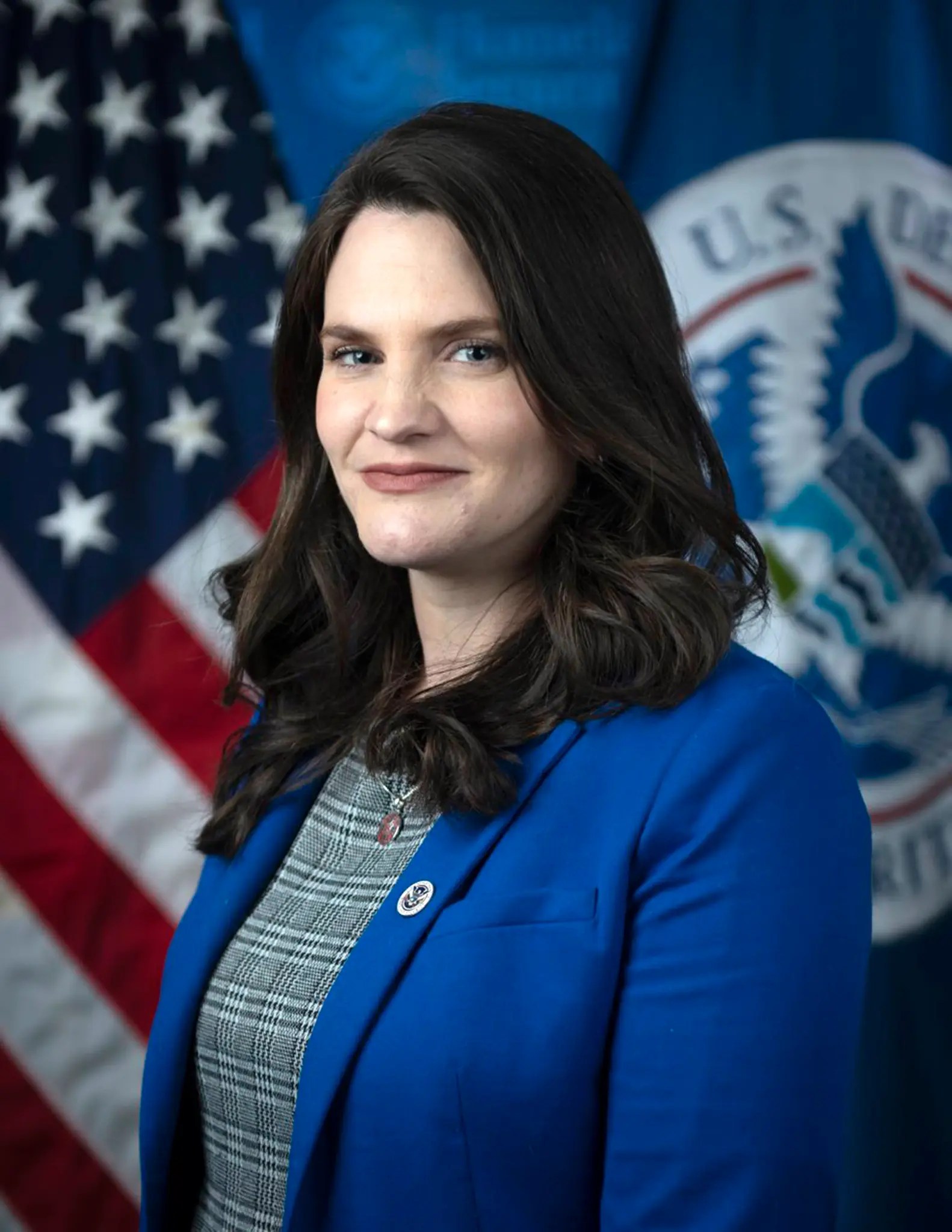
On April 27, 2022, during a 2023 budget hearing before the House Appropriations Subcommittee on Homeland Security, only a few days after President Obama expressed regret over not doing more to combat “disinformation” (see Obama for Commissar), DHS director Alejandro Mayorkas revealed the existence of the Disinformation Governance Board (DGB), a new organ of the Department of Homeland Security. Nina Jankowicz, formerly a “disinformation fellow” at the Wilson Center (named after the progressive president Woodrow Wilson) and an adviser for the Ukrainian Foreign Ministry, where she managed programs for the National Democratic Institute, has been appointed the director of the DGB.
Director of the Disinformation Governance Board of the Department of Homeland Security Nina Jankowicz
America’s inaugural Disinformation Czar is author of the July 2020 book How To Lose the Information War: Russia, Fake News, and the Future of Conflict. An alum of Bryn Mawr College, Jankowicz holds a Master’s degree from Georgetown University’s School of Foreign Service. From the description of the book (from the website of publisher Bloomsbury): “Since the start of the Trump era, the United States and the Western world has finally begun to wake up to the threat of online warfare and the attacks from Russia, who flood social media with disinformation, and circulate false and misleading information to fuel fake narratives and make the case for illegal warfare. The question no one seems to be able to answer is: what can the West do about it?”
Jankowicz has a history of spreading disinformation, amplifying both the so-called Steele Dossier, the discredited work of British ex-spy Christopher Steele used by the Democratic National Committee to falsely link Donald Trump’s campaign and presidency to Putin and the Russian government (the “Russian hoax” for short), and a letter signed by more than 50 former senior intelligence officials (including five head spooks of the CIA) asserting that emails belonging to Joe Biden’s son Hunter Biden implicating the Biden family in international criminal activity were likely a Russian disinformation campaign. Jankowicz appears to have found the ideal vehicle through which to channel her cracked understanding of how the world works.
You may have seen the term "color revolution" floating around social media the past few days.
Despite her reputation in government circles, most Americans were introduced to Jankowicz in a video shared recently on Twitter that dates from September 18, 2020 in which she either engages in disinformation concerning the nature of the color revolution (see my blog “A New Kind of American Radicalism”: The Campaign to Portray Ordinary America as Deviant and Dangerous to learn about the color revolution and its application to the United States during the presidency of Donald Trump) or exposed her profound ignorance of the way the world actually works. In either case, this tweet, which amounts to a lie, and Jankowicz’s work more generally, if trusted, functions as disinformation, misdirecting public concern in a direction that benefits the corporate state establishment and the transnationalist project, of which she is an enthusiastic participant.
After it was announced that Elon Musk would buy out Twitter, it appeared that the extensive throttling I have experience since returning to that platform to promote my blog was lifted (or was at least lessened). Whatever happened, my blog about Musk buying Twitter (Elon Musk and the Peril of Free Thinking) generated more attention than usual. In comments and messages, people expressed wonder about my characterization of the present situation as fascism. As readers of Freedom and Reason know, I have blogged extensively about the new fascism, the signs of which are everywhere, the creation of the DGB the most recent, so I invite visitors to read my blog.
The sledgehammer rhetoric of left-right, etc., and faulty understanding and ignorance of fascism has people staring blankly at the signs. Some in the establishment media spin concern over a formal Ministry of Truth as rightwing paranoia. The Daily Beast carried the headline “Fox News Hosts Rage Against New Government Disinformation Board.” But the usual wall-to-wall defense of authoritarian measures in the current order of things has yet to emerge. And, while Orwellian language is deployed (“Big Brother” and “Ministry of Truth” are trending), there is not mention of the fascism problem. I keep hoping that with the progress of the system, as more and more of what I say will happen happens, that people will look around them and say, “Damn, this looks a lot like fascism.” Of course, by then it may be too late. It may already be too late.
Have we not all heard those who challenge establishment narratives with contrary accounts mocked for operating from “alternative facts”? Surely you are familiar with the progressive refrain, “You are entitled to your opinions but not to your facts,” as if “the facts” are beyond question—as long as they’re those facts approved by “the authorities.” Appeal to non-approved facts, such as those known to biology, are met with terms indicating bigotry and even disordered psyches. When mocking and shaming fail to dissuade those challenging power, charges of “misinformation” and “disinformation” are leveled and demands to censor raised and directed at those owning and managing the means of communication.
The Biden administration on Thursday unveiled an international Declaration for the Future of the Internet howl endorsing efforts to curb online “disinformation” and “harassment.”
In the case of the Internet, which was initiated by US government in the late 1960s with the creation of ARPANET (Advanced Research Projects Agency Network), funded by the Department of Defense, those means belong to the people. The Internet is a public utility and it is of significance that the logic of the infrastructure on which the global operating system, namely the World Wide Web, depends was invented by the nation with the most expansive free speech protections known to humanity. These protections should indicate the norms of the system in perpetuity.
These protections were presented in their definitive form in the First Amendment of the US Bill of Rights, ratified in the late eighteenth century, which states, “Congress shall make no law respecting an establishment of religion, or prohibiting the free exercise thereof; or abridging the freedom of speech, or of the press; or the right of the people peaceably to assemble, and to petition the Government for a redress of grievances.” There are no qualifications placed on the rights enumerated therein. Crucially, the First Amendment is not a list of government powers, but the explicit identification of the rights of the American people—the sovereign in a democratic republic.
Freedom of expression was recognized as a right of global humanity in Article 10 of the Universal Declaration of Human Rights (UDHR), adopted by the majority of the world’s nations in 1948. Section 1 of that article states, in part: “Everyone has the right to freedom of expression. This right shall include freedom to hold opinions and to receive and impart information and ideas without interference by public authority and regardless of frontiers.” This is considered international law.
Recognition of this right was reinforced in Article 18 of the International Covenant on Civil and Political Rights (ICCPR) adopted in 1966, which states in several section: “Everyone shall have the right to hold opinions without interference. Everyone shall have the right to freedom of expression; this right shall include freedom to seek, receive and impart information and ideas of all kinds, regardless of frontiers, either orally, in writing or in print, in the form of art, or through any other media of his choice.”
Unfortunately, however, section 2 of Article 10 of the UDHR lists potential restrictions of the right that contradict section 1: “The exercise of these freedoms, since it carries with it duties and responsibilities, may be subject to such formalities, conditions, restrictions or penalties as are prescribed by law and are necessary in a democratic society.” It then identifies justifications for such laws: “the interests of national security, territorial disorder or crime, for the protection of health or morals, for the protection of the reputation or rights of others, for preventing the disclosure of information received in confidence, or for maintaining the authority and impartiality of the judiciary.” That’s quite an expansive list.
The ICCPR also identifies potential restrictions on the free speech right, specifying that “these shall only be such as are provided by law and are necessary: (a) For respect of the rights or reputations of others; (b) For the protection of national security or of public order, or of public health or morals.” Furthermore, it states in the next article: “Any advocacy of national, racial or religious hatred that constitutes incitement to discrimination, hostility or violence shall be prohibited by law.”
Consider the justification “for the protection of health” (specified as “public health” in the ICCPR). This is the basis of governments characterizing as and restricting “misinformation” challenging claims made by, for example, the World Health Organization during the COVID-19 pandemic. Thus one can see how the exceptions provide powerful and politicized and corporate-captured entities with the tools to rationalize and even depoliticize corporate state propaganda.
Consider also the problem of irreligious criticisms. At what point does criticism of Islam rise to the level of “religious hatred that constitutes incitement to discrimination”? Why is it wrong to advocate hatred of a religion, which is a species of ideology, that preaches doctrines that themselves promote hatred and discrimination? Why is Islam (or any other religion) different from any other ideology, such as National Socialism? To put this another way, why are we allowed to promote hatred of National Socialism and not Islam or any other doctrine? Ruthless criticism of doctrine is hate speech in whose eyes? Who decides?
Recently I argued (see Obama for Commissar) that it is not the role of executives to determine the truth of information or theories. These are determined over time dialectically in courts of law and science. I cited Alex Jones and his theory concerning the role of inter-dimensional demons in world affairs and rhetorically asked if this is false theory. No more so than the theory that a man met with angel in a cave and received a revelation from God. Do we really want the government to declare Islam disinformation or a conspiracy theory and remove it from social media platforms? Of course not. But why is it protected—even declared off limits from speech promoting hatred—while Alex Jones is forced into bankruptcy? (See my Project Censored article, Defending the Digital Commons: A Left-Libertarian Critique of Speech and Censorship in the Virtual Public Square, as well as my interview on the Project Censored show out of Berkeley on the Alex Jones case.)
Elites believe that the masses are too naive to determine for themselves what is misinformation. If the Internet is an open system, then the people will come to believe false things. Disinformation, they tell us, is a threat to democracy. What do they mean by democracy? Really they mean technocracy. You surely noted without me telling you that the world’s major religions are not included among the false things the people will come to believe. These are useful to power. And they are hardly democratic systems. Indeed, when you study the matter, the only false things that trouble those who seek tighter regulations of the systems of communication are those things that undermine the legitimacy of various elite projects and the authority of the elite generally.
Crucially, religion is not a system that people take up because they are naive; history shows that people are compelled to adopt religious doctrine because an elite control the means of communication and punish in various way those who deviate from it. This fact is as true for everything else as it is for religion. Elites have throughout time controlled the means of ideological production and determined the content of its transmissions in order to control the people in a fashion that suits exclusive interests of power. It must be remembered that it was only with the advent of the Enlightenment and the emergence of the free speech right and various means of popularly distributing information—of whatever sort—that the stranglehold elites held over the public mind was loosened and religion and other ideologies were pluralized and, in may places, marginalized in the lives of people.
How did homosexuals break free of compulsory heterosexuality? Not because elites forced the masses to ally with gay liberation. Elites were opposed to the normalization of homosexuality. But they no longer controlled the minds of the masses in this area. That was because the free speech right allowed for the criticism of those doctrines that inspired and perpetuated laws oppressing homosexuals. This development testifies to the capacity of the individual to determine what he shall believe in the absence of a requirement that he believe what an elite says he should. Often all it takes for justice to prevail, or at least to get things moving, is the removal of constraints on the ability of people to make up their own minds. Did elites believe homosexuality was unacceptable? Yes. But now it is acceptable. This is but one of a myriad of examples one could cite in making the case for unfettered speech.
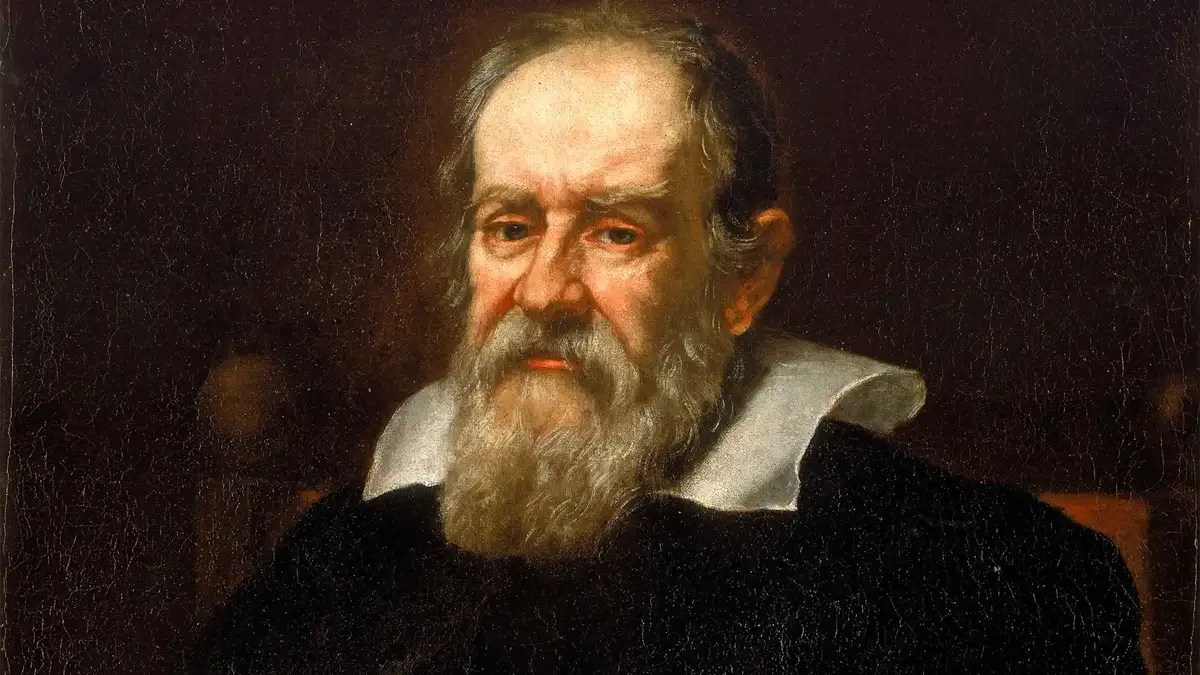
Galileo Galilei, whose Dialogue the Church banned. The man himself was placed under house arrest for life.
The intrinsic good of a maximally open system of free thought is no more true that in the realm of scientific development. Imagine an official proclamation by the corporate state that the laws of physics must be fixed in a particular way and that any information that challenges the official formulation is misinformation worthy of suppression. This was the case before the advent of robust free speech. Recall the history of when the Church insisted that the arrangement of the celestial bodies that adorn the heavens could only be one way. Why is it any different when doctors and scientists challenge claims made by pharmaceutical corporations and powerful medical associations and government organizations? Do these bodies not act as the Church in the days of Copernicus and Galileo when they censor contrary views? Again, who shall decide the truth? Who shall be commissar?
As I noted in my previous blog, Elon Musk and the Peril of Free Thinking, the European Union, which has embraced all of the restrictions suggested by the UDHR and the ICCPR, reminded Elon Musk, which has reached an agreement to buy out the social media platform Twitter, that he must comply with EU regulations on policing online content or face severe penalties. As I reported, in an interview with the Financial Times yesterday, Thierry Breton, EU Commissioner for the Internal Market, told Musk that Twitter must cooperate with the EU’s rules on content moderation, including the pending Digital Services Act, which will require large tech platforms to remove illegal content, such as “hate speech.” I told readers that this situation should alert everybody to the inherent problem with globalization: if a US-based corporation in charge of an effective public utility is required to bow to European Union rules, and these rules concern fundamental rights guaranteed by the United States Constitution, then the rights of Americans are potentially violated by an outside entity.
We learned today that powerful countries in the nascent new world order have been formulating a global scheme concerning the future of the Internet. According to The New York Post, “Biden staffers lead 50-country pledge to ‘reclaim’ internet, fight ‘disinformation’.” Beyond the headline: “The Biden administration on Thursday unveiled an international ‘Declaration for the Future of the Internet’ with 50 other countries, slamming the policies of ‘authoritarian’ governments — while endorsing efforts to curb online ‘disinformation’ and ‘harassment’.” The Declaration, is written in lofty terms that anybody who cares about the fundamental right to freely transmit and receive information can support. Smartly, the document avoids getting bogged down in the concrete struggles over internet freedom we are witnessing in the trans-Atlantic system. The various state mass surveillance apparatuses and the censorship of information by social media platforms go unmentioned.
However, one can read between the lines threats to the very freedoms the Declaration claims to defend. And context and statements made around the declaration leave little doubt. Under the section titled “Protection of Human Rights and Fundamental Freedoms,” the signatories pledge to “combat violence online, including sexual and gender-based violence” and “make the Internet a safe and secure place for everyone, particularly women, children, and young people.” Given the emerging definition of violence on the woke left, which includes the concept “harmful speech,” behind which lurks the notion that speech is a form of violence (including even silence), and in light of international law, will censorship of such speech be necessary to create this safe and secure space for these groups? For example, if criticism of transgenderism is deemed harmful to those alleged to suffer from gender dysphoria, or who claim to have been born in the wrong body, will this criticism be disallowed for the sake of safe space? The use of this term “safe space” in the context of woke progressive politics should alarm those who care about liberal freedoms.
The following bullet point is also troubling: “Promote safe and equitable use of the Internet for everyone, without discrimination based on sex, race, color, ethnic, national or social origin, genetic features, language, religion or belief, political or any other opinion, membership of an indigenous population, property, birth, disability, age, gender identity or sexual orientation.” Does this bullet point strictly refer to unhindered Internet access for all those categories identified? Or do the terms “safe” and “equitable” signal variable access to the Internet based on power asymmetries and the progressive stack? What if members of a group find that the Internet contains content that they and their allies believe discriminates against them by preventing them from safely using the Internet?
Seemingly aware of the signals the document sends, the Declaration attempts to assuage the concerns the defenders of liberal freedoms will have by offering this bullet point: “Reaffirm our commitment that actions taken by governments, authorities, and digital services including online platforms to reduce illegal and harmful content and activities online be consistent with international human rights law, including the right to freedom of expression while encouraging diversity of opinion, and pluralism without fear of censorship, harassment, or intimidation.” Have we not already seen the inherent problems with this given the justifications outlines in international human rights law? How will human rights be redefined with the evolution of the new world order? Whose version of human rights will prevail? That of the Chinese Communist Party? In 1990, the Muslim-majority nations en masse substituted for the Universal Declarations of Human Rights, adopted in 1948, the Cairo Declaration on Human Rights in Islam, which presented a set of rights reflecting the conservative Islamic values of Sharia, i.e., Islamic law, which by their very nature conflict with fundamental freedoms protected by the former declaration. How will the Internet everywhere be affected by Sharia?
The Declaration for the Future of the Internet insists on the global character of the system. Therein lies the problem. It is a declaration based on the entrenchment of globalism, which is led by transnational corporate power, represented by, among other elite groups, the World Economic Forum. By what mechanism will such a declaration keep the Internet maximally free when governments across the world, some of them wielding tremendous economic and military power, have laws that limit content based on cultural and religion norms and political ideologies, limitations that will inevitably limit content for those nations where such content is protected by free speech rights? The Declaration for the Future of the Internet itself states: “Access to the open internet is limited by some authoritarian governments and online platforms and digital tools are increasingly used to repress freedom of expression and deny other human rights and fundamental freedoms.” This is accomplished in part by states claiming that the Internet in maximally-free mode creates unsafe spaces for the populations under their control. It should not escape of anybody that the United States and the European Union increasingly resemble the forms of government the document warns about.
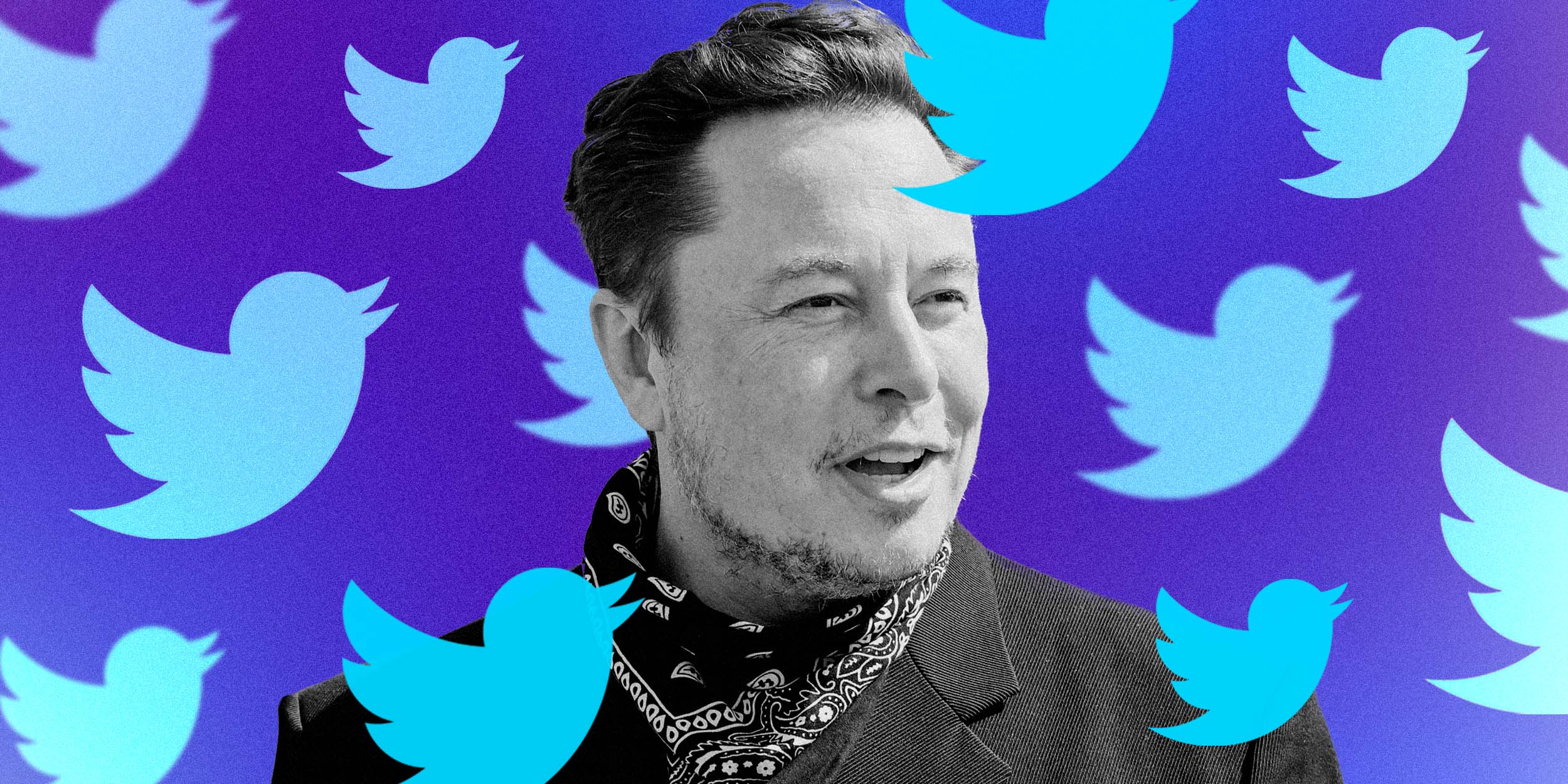
Joy Reid and Anand Giridharadas took to the MSNBC airwaves to condemn exemplary US citizen Elon Musk, the successful African-American engineer who just purchased the social media platform Twitter for $44 billion, characterizing his play as motivated by fear of “a future of abundant, equitable speech.” Giridharadas told Reid, “This future in which there would actually be more abundant and equitable speech terrifies the crap out of people like Elon Musk.” Giridharadas did not explain how he knew Musk was terrified or what the term “equitable speech” meant. The author of the 2018 Winners Take All instead went on a rant about all the awful things that might happen now that Twitter is in the hands of capitalist elites—as if it wasn’t before Musk bought out the company.
MSNBC’s Musk Twitter graphic
Progressives are so paranoid and biased—so sure they have the truth—that they’re asking questions about Twitter now after being purchased by Elon Musk that they could have asked about Twitter before Elon Musk bought out the social media platform (like “They might rig elections!”), but didn’t ask because Twitter under old management was doing for their side what they think Elon Musk is going to do for his side now that he owns the company—whatever his side is. To clarify, I am not saying questions they did not think to ask. Grievance-operated human woke machine Sunny Hostin filled in the missing information, telling the audience of The View that Musk bought Twitter for “straight white men.” As I will show in a moment, the concept of “equitable speech” informs Hostin, as well.
Back over at MSNBC, Nicolle Wallace deployed the Hitlerian term “the big lie” to reframe vote rigging in the 2020 presidential election to segue into a rant about “disinformation,” reporting that Musk, with his “more expansive views on speech than Twitter’s current management, has sent shock waves through much of the anti-information political universe.” She warned about the “power and peril of rampant disinformation,” citing examples provided by The New York Times, namely the 2016 US president election, in which the wrong candidate won, and the Brexit vote that same year, which resulted in the wrong choice being made. These bad outcomes occurred because, according to the Times, social media companies opted not to “wade too deeply into what people say on their sites.” What people said on their sites polarized the American and British electorate and caused them to make bad choices.
The Trump experience, which the establishment nobly disrupted from start to finish, and COVID-19, which failed to convince the masses to demand Chinese-style totalitarianism, had social media companies realizing that, for the sake of the agenda, they had to fix the problems of open systems, reframed by the Times as “anger, lies, distortions and division that left some people feeling exhausted and cynical about the world around them,” “some people” referring to those who make bad choices. Wallace cites the elation on the right and the panic on the left as the metric determining the degree of horror in the moment, already determining for her listener what is evil and what is good, her empathic voice clearly identifying which side she is on. Wallace laments (with a touch of snark) that, even if Trump is busy with Truth Social, the social media company he established to get around his Twitter ban, his wicked followers will make good use of Twitter and this, she more than implies, is a terrible thing because it enables Trump.
“If you own all of Twitter…you could secretly ban one party’s candidate…”
This is partisan sides-taking in superficial terms—Democrats versus Republicans, progressives versus conservatives, left versus right. But this not about that. It’s about democratic-republicanism and liberalism versus technocracy and authoritarianism. The point is not whether capitalist elites own Twitter. This is a capitalist society managed by the institutions they control. It is what it is. The question is whether we want elites owning Twitter who believe in the core Western values that make us free and independent people, such values as cognitive liberty and critical discourse, or, over against that, elites owning Twitter who despise those values and use exclusive control over information networks to dismantle Western civilization. The project of managed decline of the American Republic proceeds by disrupting free and open spaces. To be sure, it matters which class is in control. But it also matters which capitalists are in control. The capitalist class is not a monolith. It’s fractional.
For the establishment, it’s not really the fear that Musk will do to them on the new Twitter what progressives did to liberals and conservatives on the old Twitter. Free speech advocates are rarely hypocrites even if they warn about authoritarians making whips for their own backs. The smarter progressives know this. And that is what scares them; it is precisely the promise Musk has made to allow Twitter users to do now what they were not allowed to do before, and that is to speak more freely.
This is why the European Union moved quickly to remind Musk that the peoples of Europe do to enjoy the same levels of cognitive liberty and free expression Americans do. Musk must comply with EU regulations on policing online content or face severe penalties. In an interview with the Financial Times yesterday, Thierry Breton, EU Commissioner for the Internal Market, told Musk that Twitter must cooperate with the EU’s rules on content moderation, including the pending Digital Services Act, which will require large tech platforms to remove illegal content, such as “hate speech” (see The Guardian). This situation should alert everybody to the inherent problem with globalization: if a US-based corporation in charge of an effective public utility is required to bow to European Union rules, and these rules concern fundamental rights guaranteed by the United States Constitution, then the rights of Americans are potentially violated by an outside entity. Are you still unclear about what motivated the pro-Brexit vote?
Here’s what is at stake for corporate state elites. The establishment needs to control the narrative in order to control the population in order to perpetuate the conditions that perpetuate the status quo—the status quo that protects their power and privilege. Perpetuating the status quo requires censorship because knowledge of how the system works raises awareness about whose interests the system serves. If you want people to stand in line for vaccines that don’t confer immunity but generate billions for pharmaceutical companies that make the big media buys, then you don’t need people on social media talking about how vaccines don’t confer immunity and generate billions for the pharmaceutical companies that make the big media buys.
We were provided an example of this in today’s news. National Public Radio (US state media) reports that antibody studies have confirmed what I have been saying for months now: Most Americans have been infected with the COVID-19 virus. However, “CDC officials stressed that people should still get vaccinated, because vaccination provides the strongest, broadest protection against getting seriously ill.” There is evidence to this effect, but the reporting skirts the central problem with the vaccine narrative, namely that the vaccines do not confer immunity. They are not, in fact, vaccines, but anticipatory or prospective therapeutics. Those who consult scientific work ignored by the establishment media and actively censored by social media platforms have known this for more than a year. But most people don’t make the effort to consult scientific work that lies beyond that which is selected for them by the corporate state. As a result, they are unaware that the vaccines do not confer immunity (but they are starting to become suspicious). Without this knowledge, many do not reach the logical conclusion: why are business firms and governments mandating vaccination if these vaccines do not confer immunity? It’s not that there is no public health interests in products that reduce risk of severe illness. However, metabolic disorder (obesity, etc.) is the single greatest risk factor for severe illness and business firms and governments are not mandating strict diets for fat people.
Capitalism is not intrinsically illiberal (capitalism is a liberal value). But capitalism in the grip of progressivism is like an animal with a parasitic infection of the brain; it means the thing is not acting right. Progressivism is the antithesis of liberalism; it stands opposite to liberalism’s chief values, among these autonomy, humanism, and individualism. And progressives have never been more authoritarian than they are right now. They don’t even try to hide their disdain for freedom; today’s progressive openly portrays liberal values as racist and rightwing. Very bad people believe in free speech, they tell us. Free speech makes bad things happen—like Trump and Brexit. Yet it’s the woke demagogue who is zealously committed to realizing in practice the anti-democratic ideology of the corporate state. We cannot trust woke elites with our freedoms precisely because they reject the very foundation upon which those freedoms stand.
A new euphemism for centralized corporate/state censorship was just emitted by @JoyAnnReid and @AnandWrites.
The woke today are coding their need to censor and cancel speech with which they disagree as virtue promoting “equitable speech.” What does that mean? Greenwald is right that it is a euphemism for “content moderation.” But it goes deeper that this. It hooks up censorship to the greater social justice enterprise. The equitable distribution of some thing presumes that the present distribution of that thing is unfair. In the world of social justice that means that somebody because of skin color or some other demographic characteristic has something somebody else doesn’t have because of that demographic characteristic. Insert the progressive stack and asymmetrical power relations here. The corollary of equitable speech is “inclusive speech,” which presumes that some speech can make some people feel excluded, and so speech must be constrained by the feelings of others. Not just any others, but others who have been shorted in the distribution of some thing or another. Equitable and inclusive speech seek one thing: to murder diverse speech. Substituting diversity of skin color, gender identity, etc., for diversity of thought and expression, the social justice logic confuses rights with privileges.
Woke is not about awareness of (social) injustices and oppressions. Woke is about shaping opinion and perception to disrupt class consciousness and solidarity and justify ever greater technocratic control over people’s lives. Manufacturing grievances is a means to these ends.
Not that the organizers of social justice campaigns are confused. They want stuff. But not everybody can have the stuff the woke influencers claim for them. It is a capitalist society, after all. The influencers instead mean to get the attention of the corporations who need influencers to do the street-level work of securing hegemony for corporate rule so they can get the stuff for themselves. So when we’re instructed to go look up the meaning of woke in the dictionary (Sunny Hostin tells us to do this), the expectation is that we will find no more than a word describing concern for injustice and oppression. Who is not for that? But woke is not about awareness of injustice and oppression. Woke is about shaping mass opinion and perception to disrupt class consciousness and worker solidarity and justify ever greater technocratic control over people’s lives. Manufacturing grievances is a means to these ends.
The woke progressive is the new fascist. He does not want a free and open society where people have access to ideas good and bad, right and wrong. Fascists do not trust the masses. To the fascist mind, people are the problem. The fascist seeks to order a tightly-managed network of systems that control what people think—that align the public mind to a narrative beneficial the central authority. The fascist does not genuinely care about the normative order that sustains the traditions of a free society. That he loathes traditions and norms in obvious in his actions. He decouples institutions from that order and turns the major institutions of society into weapons to advance his political-ideological agenda. Societal institutions—culture, family, etc.—are seen only in those instrumental terms. This explains what you see happening all around you.
Do we have a popular social movement to overthrow this fascist power? No. Not yet. Probably not for a while. But we do have Elon Musk. He’s no savior. (Who needs saviors?) But right now, he may be the best we got. At the very least, the ability to speak freely will allow us to help other see what we already see. And building mutual knowledge—while disrupting the prevailing narrative—is essential to building the mass-based movement necessary for overthrowing corporate rule. This is why elites fear and loathe Elon Musk. They cannot trust him.
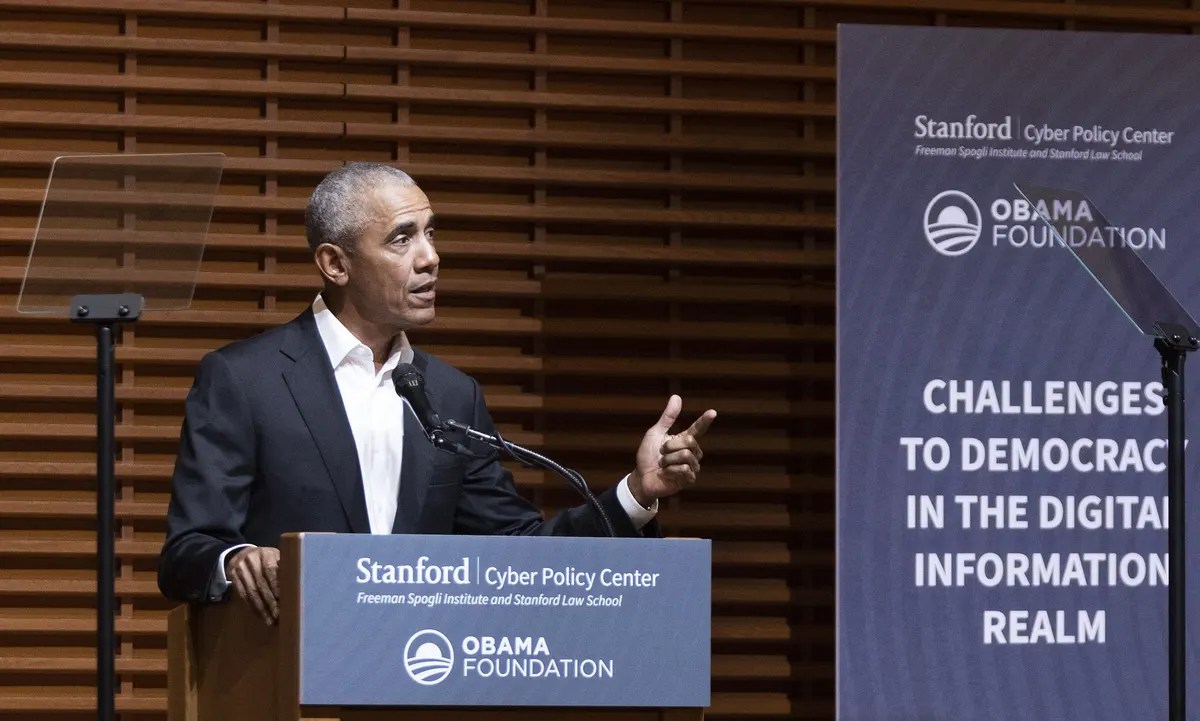
“What does still nag at me though was my failure to fully appreciate at the time just how susceptible we had become to lies and conspiracy theories, despite having spent years being a target of disinformation myself,” Obama said during a speech at Stanford University on the dangers of disinformation.
It is not the role of executives to determine the truth of information or theories. These are determined over time in the open dialectically or in courts of law where people adjudicate facts. Consider Alex Jones and his theory concerning the role of inter-dimensional demons in world affairs. Is this false? I think it is. Is it crazy? No more crazy than thinking a man hung on a cross rose from the death and will save all those who declare their faith in him from eternal torment. I think that theory is false, too. But do we really want the government to declare Christianity disinformation or a conspiracy theory and remove it from social media platforms?
This desire to combat disinformation is troubled by a very basic truth that Freud noted a century ago. When one person believes something that can’t be true, he is delusional. If he alone believes he talks to an entity no one else can see or hear, then he is crazy. But if millions of people believe something that can’t be true, that the man who talks to an entity they cannot see is really communicating with a spirit, then they are experiencing an illusion. The individually real, which is subjective (and sometimes disordered), becomes collectively real with others and orders things. It becomes what French sociologist Emile Durkheim called a “social fact.”
Shortly after losing his podcast, Obama addresses Stanford University
Obama, would like for particular illusions—Christianity, Islam, Judaism—to prevail (even if he believes in none of them) over other illusions. Those illusions are useful to power. Other illusions not so much. And so these constitute disinformation and conspiracy theories. But it is a conflict of interests to allow the very real entities who wield cultural, economic, political, and social power, i.e., the state and the corporation, to decide for us which illusions we are allowed to have and which are to be censored and cancelled.
Obama said, “You just have to flood a country’s public square with enough raw sewage. You just have to raise enough questions, spread enough dirt, plant enough conspiracy theorizing, that citizens no longer know what to believe.” But what is sewage or dirt to Obama may not be sewage or dirt at all. It is Obama’s opinion that the things with which he disagrees are sewage or dirt. His concern that citizens no longer know what to believe is that they may come to believe as he wished they would not. His example is COVID-19 vaccination. “Around one in five Americans is still willing to put themselves at risk and put their families at risk rather than get vaccinated,” Obama said. People are dying because of “disinformation.” Indeed, individuals submit to vaccination after being told they are safe and effective and then suffer death or injury caused by the vaccine or contract and spread the virus on the basis of a false believe the vaccine confers immunity.
Part of the reason it’s hard to bring about change is because we live in a media environment that elevates falsehoods as much as truths, and divides people as much as it brings them together.
“In recent years, we’ve seen how quickly disinformation spreads, especially on social media,” Obama tweeted. “This has created real challenges for our democracy.” What Obama is channeling is the spirit of technocracy. He is not defending democracy. He does not believe in democracy for the masses. He is an elitist. It’s not that elitists believe the masses are too stupid to choose for themselves the illusions that will guide them. They do. But more importantly, they believe that, left to their own devices, the masses will choose the illusions that threaten the power of the class he represents, the corporate class. For the illusion may in fact be truth. And truth can be very dangerous for those whose power and privilege depends on lies.
Freedom means that people are allowed to manufacture and believe illusions that they desire as long as they do not impose these illusions on those who do not or cannot consent to them. Mature consenting adults can be furries together. To compel others to believe with them that they are what they say they are, which is the work of the state and corporate power, is tyranny. Let furries be furries. Let others disbelieve in spirit animals and admit this without fear of consequence—and freely share their thoughts on social media.





 freedom and reason