Annie Lennox is sad because celebrities were “completely silent” on Palestine at the Grammys. Does Annie not know how fast fashion changes? She should. Palestine is like so last year. Like Annie. Keep up, Annie. It’s ICE Out now.
The slogan, “no one is illegal on stolen land” means that, if a country exists on land originally taken from indigenous peoples though conquest and colonization, then it is inconsistent to label migrants as “illegal” for crossing borders established by that same state.
The slogan is illogical.
Modern states and current citizens are generations removed from historical land seizures—and these seizures were rarely illegal to begin with, as they were the result of negotiation, or the spoils of conquest and war. Existing borders and immigration laws are legally established regardless of alleged past injustices.
Contemporary immigration policy and Indigenous land claims are separate issues that when brought together produce a contradiction that resolves in the following way: if it was illegal for Europeans to colonize North America, then it is illegal for non-Europeans to colonize North American.
Billie Eilish at the Grammys
It follows that, just as indigenous peoples should have kept out Europeans if they wanted to keep the land that they stole from others, according to the terms the elite-backed rabble chants in the streets (and clowns at Culture Industry circuses), the descendants of European colonizers—American citizens—should keep out the non-European colonizers and remove those who are already here.
This is not stolen land. It legally belongs to us—the American citizen. Those who are on it who shouldn’t be are illegal. Just as strangers are not allowed in my house unless I invite them in, strangers are not allowed in my country with permission. They are not “our neighbors.” They are thieves—stealing our resources, our opportunities, our property, and our votes. America spoke loudly on November 5, 2024. We don’t want strangers in our home.
Today, on social media, fed up with fanatical posts elevating Alex Pretti to the status of martyr, I wrote, “You can honor Pretti’s life by not inserting yourself into law enforcement operations. If you don’t like immigration law, elect people who will change it. Don’t substitute direct action for the democratic process. Argue for your ideas like a mature adult. Take your failure to persuade others like a dignified and rational person—in stride. Don’t succumb to the madness of crowds. Don’t assault federal agents and police officers, especially if you are carrying a firearm.” I feel obligated to meet the madness with reason. Not that I think that as one man I can convince my fellow man to turn back from the path of irrationalism. I can only add my voice to those who also feel such an obligation.
After I wrote these words, and after leaving numerous comments on various accounts comparing the arrest of Don Lemon for storming a church and terrorizing children to “fascism,” I reflected once more on my sociological training and what it has to say about the madness the world is witnessing on the streets of American cities. In the past, I have informed my commentary by turning to C. Wright Mills and his kind. This time, however, modernization theory came to mind. Modernization theorists, most notably Harvard sociologist Talcott Parsons (who famously developed the concept of the “sick role”), argued that societies differ in the value orientations that shape social institutions and guide roles within them. Parsons distinguished between modern and premodern societies, the latter marked by primitive rituals and values. There, I thought, is a great source of applicable insight.
The applicability of modernization theory has dawned on others, which is why progressives and radicals have worked so hard over many decades to discredit it. With the rise of postmodernism and postcolonial studies in the academy, modernization theory was accused of rationalizing colonialism, imperialism, and Western oppression of Third World peoples. “It’s a racist theory!” students were told by their teachers. I know, I was among them. Now I see why I was taught to think this way: discrediting social theory supporting freedom and reason is part of the project to delegitimize Western rationality and the ethic of individualism to prepare populations for incorporation into a new world order: transnational corporate neo-feudalism. I’m not saying that my teachers, the most influential among them Marxists, were consciously part of the project. Indeed, it took me several years to come to terms with the reality that they had been duped and become functionaries of a project organized by those whom they continue to proclaim disdain for—and that I, too, had been bamboozled by those unwittingly conscripted in a war against the West.
This attitude followed me out of graduate school into my current teaching position, where it was institutionally reinforced. Professional tribalism is a powerful force. I learned that the department, then called Social Change and Development, was originally called Modernization Processes, back in the 1960s, when the university was founded as one of several progressive institutions of higher education. Those who came to the university in the 1970s, fresh from campus cultures radicalized by the student socialist movement and cultural revolution—a British Marxist historian, a world historian enamoured with Maoist China, and others with similar proclivities—changed the name because of what modernization suggested, namely that the Global North was superior to the rest of the world.
Over time, as I have explained in essays on Freedom and Reason, my early socialization in deontological liberalism allowed me to overcome progressive indoctrination. The greater the distance from my programming, the more obvious it became—and the more those theories I had been told to reject made sense. In this essay, I will show how modernization theory provides a useful analytical frame for understanding the madness the world is witnessing on the streets of American cities.
Following the founding sociologists Emile Durkheim and Max Weber, Parsons understood modernity as a distinctive stage of social development characterized by functional differentiation. In modern societies, social functions become separated into specialized institutions or systems—such as the economy, education, law, politics, and science—each governed by its own norms and forms of rationality. Whatever its downsides (explored in depth by Weber), this differentiation allows societies to handle greater complexity and achieve higher levels of efficiency. This development also requires new mechanisms of coordination and integration to maintain social order. This imperative transforms moral sensibilities (this was Durkheim’s lifework).
For Parsons, modern society is held together not primarily by kinship or tradition, but by formal institutions and shared universalistic values. Parsons classified societial types by pattern variables, which are presented in his 1951 book The Social System. I detail them below, but to overview, modern societies emphasize achievement over ascription, universal rules over particularistic ties, and individualism over collectivism, excepting the rational state, i.e., modern nationalism, which balances liberty with popular will.
Central among modern values is a commitment to individual rights, rationality, and the rule of law, which are institutionalized through bureaucratic organizations (here is where most of the downsides are found), democratic governance, and merit-based education and occupations. Parsons rightly saw modernity as an evolutionary advance in which social order is maintained through value consensus and the effective integration of parts in a differentiated social system. In modernity, the individual becomes the focus of moral philosophy. The old values are not merely moribund in complex systems; they are pathological.
A key distinction noted above is ascription versus achievement. In traditional societies, status is assigned at birth through ancestry and maintained by caste systems, whereas modern societies emphasize achievement, i.e., granting status based on education, personal accomplishment, and skills. No longer is status ascribed, chaining the person to a preordained station. Now, ideally, a person is free to become what he will, what he has the ambition and talent to be, and society is perfected towards this end.
A related shift occurs from particularism to universalism, meaning that instead of obligations and rules being shaped by group membership, modern societies apply generalized regulations and standards more equally across people. This is embodied in the principle of equal treatment before the law. A man is endowed with rights by Nature’s God, that is, by natural law to be discovered in natural history, not in social constructions of power. Gone—at least they are supposed to be—are collective and intergenerational guilt and punishment. Human rights replace the relative morality of tribes.
Equality of treatment based on individualism is closely tied to the continuum Parsons distinguished between collectivity orientation and self-orientation. Whereas traditional societies emphasize duties to clan or tribe, modern societies give greater legitimacy to individual goals, personal advancement, and self-expression. We see this idea at work in Abraham Maslow’s hierarchy of needs, where the end goal is self-actualization, which requires the state to secure the fundamental needs of citizens, such as public safety, and promote the nuclear family and societal tranquility.
Crucially, Parsons identified emotive postures associated with the orientations, contrasting affectivity with affective neutrality, noting that traditional social relations are associated with overly emotional expression within roles, while modern institutional life and logics—bureaucracies, courts, education, rational discourse, workplaces—require emotional restraint so that decisions are consistent and impartial.
Taken together, these shifts describe a transformation from tightly bound, tribalistic social orders to more impersonal, individual-centered, rule-based systems characteristic of modern technologically-advanced societies, societies that have fundamentally improved the lives of people wherever they have arisen and been sustained.
The last one—affectivity versus affective neutrality—is especially crucial to examine in the present moment, given the emotive pathologies of progressivism and its affinity with Islam, which constitutes the Red-Green Alliance. However, we see regression to the primitive in all of them. The readers should therefore keep them all in mind as he progresses through the analysis.
In the context of contemporary progressivism, particularly as manifested in street protests, property destruction, and violence, as well as patterns of harassment and intimidation that mark present-day interpersonal encounters, we observe a striking regression toward the premodern side of Parsons’ pattern variables, most notably in the embrace of affectivity over affective neutrality.
Street-level progressive movements prioritize raw emotional expression as a core mechanism for social change, channeling outrage and solidarity through chants, performative costumes, and ritualistic gatherings that evoke tribalistic fervor rather than the restrained, rational discourse that characterizes modern institutions. Affectivity is evident in the way protesters display symbols and don elaborate, symbolic attire—flags and placards, body paint, neon-dyed hair, and body piercings, most notably the septum ring—signifying emotional allegiance and group identity. The primitive draws to it those who feel left behind by modernity, a subjectivity that, with programmatic grooming, deranges them, preparing them to serve a footsoldiers for those who seek to disorder Western society.
These attributes mirror the ascriptive and particularistic bonds of primitive societies, where loyalty and status are tied to visible markers of belonging rather than achieved merit or universal principles. Such displays transform public spaces into arenas of emotive catharsis, where chants like “No justice, no peace” serve as incantations that reinforce collectivist orientation, subordinating individual nuance to the tribe’s impassioned narrative.
These people 100% think they’re in a movie. It’s a performance. It’s all about their own egos and about imagining themselves as badass rebels fighting “the man.” In reality, they’re privileged little nerds who have zero relationships with working class or poor people and have no… pic.twitter.com/i5TLy5WCra
The insightful Meghan Murphy has it right when she opines, “These people 100% think they’re in a movie. It’s a performance. It’s all about their own egos and about imagining themselves as badass rebels fighting ‘the man.’ In reality, they’re privileged little nerds who have zero relationships with working class or poor people and have no idea how the real world works.”
The individuals in the above X post are the lost individuals Eric Hoffer describes in his 1951 classic The True Believer, in which the desire for a premade identity, combined with an embrace of ideology portraying personal failure at the work of the oppressor, gives rise to extremism and fanaticism.
The attitude we see in Murphy’s post, and the other videos one can watch, in which the mob turns violent after having been entrained by the chanting and marching, stands in stark contrast to the values of modernity, where affective neutrality ensures that social roles—whether in education, law, or politics—are performed with emotional detachment to uphold reason and impartiality, to participate in democratic-republican processes and obey the rule of law.
Progressivism’s emotive pathology thus risks undermining the integrative functions of differentiated societies, fostering polarization instead of consensus. What we are witnessing are manifestations of a style of solidarity out of step with the logic and structure of modern society. This is why progressives substitute for the rational democracy that marks the modern republic, the madness of crowds. Postmodernist ideology has unchained the premodern spirit that modernity had caged.
The parallels with Islamism further illuminate the primitive emotive force that has escaped the cage, as both Islam and woke progressivism exhibit a propensity for affective excess that harkens back to premodern social orders. Islamist protests, much like progressive ones, feature and valorize mass mobilizations, rhythmic chanting, veiled or uniformed costumes expressing tribal affinity that prioritize visceral ideological or religious fervor over the affective neutrality of secular governance.
This explains the quick succession of moral panics—each only a few years or even months after the last one. The Pandemic and the current We’re Next, where those in the clutches of mass psychogenic illness expect to be rounded up by Trump’s stormtroopers and thrown into concentration camps (an utterly fantastical belief), are not the only mass hysterias to occur within the last two decades. The Women’s March, March for Our Lives, Families Belong Together, Climate Justice, Trans Rights, Quiet Quitting, Black Lives Matter, Trans Genocide, Free Palestine, No Kings, ICE Out—these are not isolated, spontaneous grassroots efforts. Rather, they form a series of crazes and uprisings in an ongoing revolution-from-above. The revolution-from-above depends on a large subset of the population being prepared to panic whenever the panic button is pressed.
In both the Islamic and woke progressive cases, the street becomes a theater for enacting tribal rituals that attempt to blend collectivity with particularism, demanding loyalty to the group’s emotive truths—be it “intersectional justice” or “divine will”—while rejecting the universalistic rules that temper passion with reason.
“Why do Muslims pray en masse in streets when they have mosques to pray in?” We hear this question asked frequently. This is why: these are performative politics. This shared regressive dynamic tells us that progressivism, despite its professed commitment to progress, a fake aspiration smuggled into the narrative by the very name of its movement, and despite its desire for an administered world, aligns with premodern affectivity, where irrational emotional expression supplants rational integration. The need for an administered world and primitive emotive expression converge in the authoritarian desire to be controlled by power and tribal identity. This is not a paradox, but the pathology of totalitarian sentiment.
All this is by design. Individualism is an obstacle to authoritarianism and totalitarianism. Orchestrated regression or retardation serves the interests of a transnational corporate class, an elite cadre of global capitalists, institutional power brokers, and technocrats, who operate beyond national borders, leveraging multinational corporations, international organizations, and digital platforms to consolidate control. Unbound by the loyalties of modern nationalism or the constraints of democratic accountability, this class views the differentiated structures of modernity—individual rights, meritocracy, and rational governance—as barriers to their hegemony. By fomenting tribalism rooted in gender, race, and sexual identity, elites engineer a divide-and-conquer strategy that fragments the populace into warring identity silos, each clamoring for group privileges rather than universal justice based on individualism.
In this schema, progressivism’s emotive pathologies are not accidental aberrations but instrumental tools, amplified through corporate media, algorithmic social networks, and NGO funding streams controlled by the transnational elite. Identity-based tribalism revives ascriptive hierarchies, where status is conferred by group membership—be it “oppressed” racial categories, gender fluidity as a badge of authenticity, ethnic enclaves demanding reparative favoritism, or sexual identities elevated to sacred totems—rather than individual achievement.
This mirrors the premodern particularism Parsons described, but weaponized on a global scale: universal rules are supplanted by “equity” mandates that enforce affirmative discrimination, group quotas, and speech codes, all under the guise of inclusion. We know this as “social justice.” Affective excess fuels these divisions, as outrage cycles and panic waves on social media platforms—owned by the same corporate overlords—stoke perpetual grievance and engender trepidation, ensuring that emotional tribal bonds override rational discourse and collective action against systemic exploitation.
The endgame is the realization of global neo-feudalism, a dystopian order where the transnational corporate class reigns as a digital aristocracy, hoarding wealth and surveillance power while the atomized masses, ensnared in identity traps, revert to serf-like dependency. In this neo-feudal landscape, modern individualism is eroded by collectivist mandates—cancel culture enforcements, compulsory diversity trainings, and state-corporate partnerships that monitor “hate speech”—reducing citizens to interchangeable units in a stratified hierarchy. Functional differentiation gives way to a monolithic control grid, where education centers “problematize” history and indoctrinate tribal loyalties, law enforces identity-based reparations, and the economy funnels resources upward through “sustainable” ESG frameworks that mask elite extraction.
Parsons’ evolutionary optimism is thus inverted: what he saw as progress toward an integrative logic appropriate to a technologically advanced civilization becomes a deliberate devolution, orchestrated to dismantle the rational state and replace it with a borderless fiefdom under the thumb of a New Fascism marked by inverted totalitarianism and the managed democracy of a one-party world state.
No polemicist, Parsons’ framework nonetheless warned long ago that such deviations from modern norms and values represent a regressive atavism that threatens the direction of societal evolution that has yielded the fairest and most prosperous societies in human history. Woke progressivism and the praxis of social justice threaten human rights, which are necessarily based on the recognition of universalism of species-being; we are all members of the same species—the unalienable rights inhere in each of us. As affective neutrality is diminished, along with the associated pattern variables Parsons identified, modern society is fracturing under the weight of unchecked emotive primitivism, eroding the very foundations of individual rights and functional differentiation that define progress.
The hour is late. The scenes from the street are, frankly, terrifying. Those seeking to overthrow freedom are portrayed by captured sense-making institutions as the opposite of what they truly are. Make no mistake, they embody totalitarian desire. It’s not too late to turn back to reason and reclaim the modern nation-state. But it would be a mistake to dismiss the peril. The future of Western Civilization is at stake.
This design is not invincible. The resurgence of premodern affectivity, while serving neo-feudal ends, carries within it the seeds of its own unraveling, as fractured tribes can be turned inward to clash in ways that expose the manipulators above. The violence in the streets elevates the visibility of the madness. Those who see it for what it is can, by expanding the scope and depth of mutual knowledge and by ridiculing the rabble, reveal the madness to the broader public: elite-manufacturedchaosexploiting the lost and gullible.
Reclaiming modernity’s core—affective neutrality (the true spirit of sympathy), personal achievement, and universalism—demands a vigilant defense of individualism against both emotive primitivism and corporate totalitarianism. Only through populist resistance and the light of clear reason can societies avert the slide into global serfdom and restore the promise of human flourishing. Emotive primitivism not only imperils the Common Man. Global elites are playing with fire. They must know that they, too, can be burned.
Former CNN talking head Don Lemon was taken into federal custody on January 29, 2026, in Los Angeles, by a team of FBI and Homeland Security agents in connection with a January 18 storming and occupation of Cities Church in St. Paul, Minnesota, during religious services. Federal prosecutors indicted Lemon and others on charges including conspiracy to deprive religious freedom by violating worshippers’ First Amendment rights. Lemon was released the next day on his own recognizance. His next scheduled court appearance is February 9, 2026.
Lemon is charged with two federal felony counts. The first, 18 USC. § 241, Conspiracy Against Right of Religious Freedom at Place of Worship, makes it a federal crime for two or more people to conspire to injure, intimidate, oppress, or threaten someone in the free exercise of a right secured by the Constitution or federal law, including the right to religious freedom. The statute was originally enacted during Reconstruction to combat organized efforts to suppress civil rights, such as those by the Ku Klux Klan.
The second count, 18 USC § 248, Injuring and Interfering with the Right of Religious Freedom (the FACE Act), prohibits the use of force, threat of force, or physical obstruction to injure, intimidate, or interfere with individuals because of their religious exercise at a place of worship. The statute explicitly covers places of religious worship, ensuring that attacks or intimidation targeting churches, synagogues, mosques, and similar venues are federal crimes.
Lemon outside the Edward R. Roybal Federal Courthouse in Los Angeles yesterday. (Image source)
Even if we grant that any hack with a camera and a microphone is a “journalist,” the First Amendment is not a license for journalists to violate the civil rights of American citizens. Lemon documented the facts that condemn him: He was one of the organizers of the raid on the St. Paul church (he recorded himself in the planning process), as well as participating in harassing and intimidating congregants, actions not only violating the FACE Act (which the Biden regime vigorously pursued) but, more fundamentally, the foundational law of a republic explicitly protecting religious liberty. (See Manufacturing Their Own Christs: The Violence of Progressive Christianity.)
Predictably, progressives are out in force this weekend defending Lemon and others, squealing about Trump’s fascism. But isn’t government action in this case more accurately described as antifascist? Politically-motivated mobs storming churches and terrorizing congregants while their propagandists video and participate in harassment and intimidation—that’s the fascism analogue. The government is acting to hold those engaged in civil rights violations and other crimes accountable. The FBI and Homeland Security are upholding the liberal freedoms that lie at the foundation of the American Republic. That’s the opposite of fascism. (See The New Fascism of the Left: A Critical Analysis of Contemporary Antifascism; Would you know fascism if you saw it?)
We all know that progressives would, without hesitation, condemn such behavior if it were the KKK doing it. During Reconstruction, the Klan frequently attacked black churches, which were central to black community life. They beat congregants, burned churches, and murdered pastors and religious leaders to intimidate black communities and suppress political participation. After Reconstruction, the Klan’s focus expanded to include anti-Catholic and anti-Jewish violence. The Klan targeted religious institutions that were seen as politically or socially “threatening” to their vision of America. What reason did those who stormed Cities Church give for having done so? They claimed the pastor’s alleged ties to Immigration and Customs Enforcement as their motive. Their attack was explicitly politically motivated.
We must remember that the Klan engaged in arson, beatings, and intimidation of clergy and acknowledge that history in the present. We see the same thing in the actions of Antifa and Black Lives Matter. Recall in late May 2020 in Washington, DC, during rioting over the death of George Floyd, Antifa and BLM set on fire the historic St. John’s Episcopal Church—the “Church of the Presidents”—just across Lafayette Square from the White House. Remember the broken windows and graffiti the rioters visited upon the surrounding properties? Remember how the Secret Service had to evacuate President Trump and his family to a secure underground bunker beneath the White House when crowds gathered around the Executive Mansion and clashed with law enforcement? Remember how the media mocked Trump for standing in front of the church the next day, Bible in hand, the stench of tear gas still wafting through the air? Now they are entering churches and harassing and intimidating Christians in worship.
Nazis are shown blocking the entrance of a local university in Vienna in 1938
Have folks forgotten—or do they even know—that the Nazi Party had photographers or journalists embedded in their pogroms to publicize their naked power against designated enemies of the people in tandem with public intimidation by mobs and its paramilitary arm to spread fear among targeted communities? Photographers and journalists associated with the movement and party produced images and stories for party newspapers—Der Stürmer and Völkischer Beobachter. These were not independent reporters but loyal party propagandists. These visual records show the targeting of businesses, homes, synagogues, and universities.
Kristallnacht (the Night of Broken Glass), November 9–10, 1938.
Imagine if a MAGA mob with RAV (Real America’s Voice) reporters in tow stormed a mosque and terrorized Muslim women and children while berating the imam. Imagine a RAV journalist harassing congregants, interrogating them about their associations, their faith, and their politics, while those accompanying him block the exits so they cannot escape. What would be the reaction from Democrats and progressives, and the media that fronts their politics? Suppose such a thing occurred during the Biden regime. Would progressives object to the Biden Administration rounding up the mob and their propagandists? Not only would they not object—they would demand it. We all know they would. And Biden would accommodate them as he should.
But progressives have no problem with storming white churches. Where was the outrage among progressives when, in March 2023, Aiden Hale, aka Audrey Hale, a trans-identifying woman, entered the Covenant School, a private Christian elementary school affiliated with Covenant Presbyterian Church in Nashville, and, using multiple firearms, killed three nine-year-old children and three adult staff members? Where was the outrage when, in August 2025, Robin Westman, aka Robert Westman, a trans-identifying man, fired through the window of the Annunciation Catholic Church in Minneapolis, Minnesota, during an all-school Mass attended by students from the adjacent Annunciation Catholic School, killing two children and injuring around 30 others (mostly children)? Progressives do not see the violation or even the murder of Christians as suggesting any urgency in protecting the rights and safety of members of that faith. (What is wrong with Minneapolis? Have you wondered?)
Lemon is a professed propagandist for the neoconfederate movement against the federal government (see The New Confederates and the Return of States’ Rights; On the Road to Civil War: The Democratic Party’s Regression into Neoconfederacy). He explicitly identifies himself as a movement propagandist—a propagandist for a movement that disdains Christianity and the American way of life. The actions that implicate him in federal crimes that he himself recorded are not protected by the First Amendment. He’s a criminal. The Justice Department should throw the book at him, as it should anybody who violates the civil rights of American citizens. Such behavior is intolerable and must be met with the full force of the state.
More than this incident, much of the behavior we see from progressives in the Twin Cities is intolerable. Minnesota is the epicenter of secessionist politics. The actions we see on the streets, and those by the elected officials of that state and the city of Minneapolis, constitute an insurrection against the Union. Our nation has been here many times before. And many times, the federal government has nationalized state militias and deployed military forces to put down the rebellions. Indeed, this is why the Founders replaced the Articles of Confederation with the Constitution. (See Quelling the Rebellion; Our Constitution and the Federal Authority to Quell Rebellion; Concerning the Powers of The US Constitution—And Those Defying Them.)
As I have documented in previous essays, throughout US history, the federal government has deployed military or federal forces to quell insurrections, riots, or enforce civil rights when state authorities failed to maintain order or hold the violators of rights accountable. In 1957, Eisenhower sent federal troops to Little Rock, Arkansas, to enforce the integration of Central High School after the state resisted desegregation. Kennedy federalized the National Guard in 1962 in Mississippi to ensure James Meredith could enroll at the University of Mississippi despite violent white resistance. Kennedy also deployed federal forces to Alabama in 1963, including the National Guard, to protect civil rights marchers and enforce court orders during the Birmingham campaign, which confronted segregationist state officials and mobs. During the Civil War, Lincoln suppressed Southern insurrections. Grant deployed federal troops during Reconstruction to fight Klan violence in the South. In 1968, Johnson used force to quell the unrest following Martin Luther King Jr.’s assassination.
Such actions date to the early days of the Republic. During the Whiskey Rebellion (the subject of an upcoming essay on Freedom and Reason), President Washington responded in 1794 by calling up a militia force of more than ten thousand men from several states, demonstrating that the federal government had both the authority and the will to enforce federal law. The show of force effectively ended the rebellion with minimal bloodshed; the insurgents dispersed, and those arrested were later pardoned, the point having been made that the federal government is the supreme law of the land. We need the 47th President to act with the gusto of our first President (A Man of Action Must Act to Be Such a Man).
Cognitive science is crucial to understanding the deep mass psychological problem that crowds out reason in this moment. The objection from progressives over the arrest of Lemon is a paradigm of what cognitive scientists describe as motivated reasoning, where information is evaluated in a way that protects or advances what one wants to believe and instantiate, rather than what evidence shows and reason dictates. It’s a cognitive error—specifically a systematic bias in how people process information, in which desire or identity steers judgment away from objective evaluation of evidence and towards conclusions that advance movement goals and objectives. (See When Thinking Becomes Unthinkable: Motivated Reasoning and the Memory Hole.)
Motivated reasoning is expected because progressives put partisan ideology and politics over principle. Any means that achieve the ends sought are acceptable. Raiding churches and terrorizing children, obstructing and assaulting law enforcement, harassment and intimidation of citizens, even assassination of conservative leaders—all these are acceptable in light of the end sought: rendering impotent constitutional republicanism. Progressives depend on the assumption that their actions are morally righteous to sustain popular support (see The Manufactured Perception of Moral High Ground). In truth, their actions issue from a profoundly immoral standpoint antithetical to the American way of life.
Popular image on conservative social media corrected to reflect the truth of the New Fascism
Fascist action is euphemized as “antifascism” and “social justice” to obscure the history that progressive street-level actions repeat: the use of mobs and paramilitary forces to defy the federal government and terrorize a population (see The Politics of Grievance: Primitive Rebellion and Rhetoric of Social Justice; Deviance as Doctrine: The Post-Liberal Moral Revolution; The Problem of Empathy and the Pathology of “Be Kind”). The quote that begins my essay Send in the Troops—“ICE is made up of white males who were similar to Hitler’s brown shirts of the 30’s. They were disaffected by the results of the reparations of WWI, and felt powerless. 47 has given them purpose, which is extremely dangerous.”—captures the inverted world progressive ideologues routinely project in their utterances. Factually untrue, the function of such utterances is to turn fascists into antifascists—and antifascists into fascists.
In the Freudian sense, projection is a primitive defense mechanism in which an individual unconsciously attributes their own unacceptable desires, feelings, impulses, thoughts, or traits—aggressive or shameful things that threaten the ego—to another person or external entity, thereby externalizing internal conflict and avoiding direct confrontation with it. They project to displace what cannot be accepted—or must be denied—as part of the self onto the outside world, thereby reducing the anxiety or guilt they experience in the deepest recesses of their psyche to prevent them from being consciously acknowledged. Put simply, progressives are basketcases, and the amplification of the madness presents a very real threat to democracy and tranquility. (See The Rule of Law and Unlawful Protest: The Madness of Mobs; The Phenomenon of Progressive Brain-Locking and Its Role in the Madness of Crowds.)
One man in a MAGA hat peacefully attends the ICE protest in Long Beach, California
The protesters overwhelmed and attacked him. They then violently rip off his MAGA hat and throw it
He runs for his life down the street, the entire mob chases him
Democrats and Progressives talk labor politics. The reality is that they represent the corporate state. They talk about democracy. What they really mean is administrative rule and technocratic control. They champion the plight of black Americans. But they are the reason America’s inner cities are impoverished and crime-ridden. They appeal to the Constitution, but only strategically and in ways that warp the Founders’ intent. They portray riots and obstruction of law enforcement operations by their militias—Antifa, BLM—as free speech. They substitute mobs, harassment, intimidation, and violence for the liberal freedoms and democratic processes. They wrap authoritarianism and coercive action in a rhetoric of justice and rights.
The strident opposition to immigration law enforcement is a window into seeing the unfolding plan and knowing the forces arrayed to advance it. Corporations exploit immigrant labor both for cheap labor and to drive down wages for native-born workers. It’s a documented fact that the exploitation of immigrant labor transfers hundreds of billions of dollars in wages from the native born working class to corporations. However, there is a political strategy that works in tandem with amassing corporate profits. To stay in power, Democrats need immigrants for electoral advantage. Moreover, mass immigration distorts culture, disorganizes society, and undermines worker solidarity. These are tactics in a plan to weaken national integrity and advance the globalization project. The end sought by the forces of chaos is a new world order (see Revealing the Great and Powerful Oz. Alex Pretti is Toto Pulling Back the Curtain). The same plan is evident in the European situation with mass migration and Islamization.
Changing the demographics of the West is not the only piece to pay attention to. On January 28, 2026, the FBI executed a court-authorized search warrant at the Fulton County Elections and Operations Hub (a facility in Union City, Georgia, used for election storage and operations). The warrants were signed by a federal magistrate judge, Catherine Salinas, who agreed with investigators that there was probable cause of criminality in the 2020 election in Fulton County. The warrant cited potential violations of federal election laws, including issues related to the casting, procurement, and tabulation of ballots (there are references to improper handling and fraudulent activity under statutes, e.g., 52 USC § 20511). Salinas authorized the seizure of “all physical ballots from the 2020 General Election,” along with related materials. This action resulted in the removal of thousands of physical ballots, ballot images, tabulator tapes (from voting machines), voter rolls, and other records by law enforcement. Reports indicate that around 700 boxes of materials were seized.
The media scratched their heads over the presence of the Director of DNI, Tulsi Gabbard, at the raid in Fulton County. They’re feigning surprise. Gabbard’s presence is a signal. The 2020 steal was not merely a group of corrupt local Democrats in Georgia fixing an election for their preferred candidate. It was an instance in a global scheme to rig elections to thwart the rise of populism and the resurgent commitments to nationalism that Trump and MAGA represent. And Fulton County is not the instance. There is a fact pattern of similar activities across the United States. Associated with election rigging is lawfare and street violence. This is what lies behind the “No Kings” and “ICE Out” protests and riots and the neoconfederate resistance by Blue State governors and Blue City mayors. Those who believe in the Republic have to come to terms with the reality that all this is coordinated. It’s hard to believe that this could happen in a free society. But it is.
More videos and witness accounts of Alex Pretti—the man shot to death by ICE officers in Minneapolis—obstructing federal law enforcement operations in the weeks before his fatal encounter, have emerged. What they confirm is that Pretti was not only a foot soldier for the transnational corporate project to undermine immigration control, but also an instantiation of the suicidal altruism that is motivating true believers to manufacture the circumstances that potentially lead to their own deaths. (To understand the corporate state project, see The Politics of Disaster Capitalism and Revealing the Great and Powerful Oz. Alex Pretti is Toto Pulling Back the Curtain.)
America may be witnessing the emergence of a destructive phenomenon known as suicide contagion. That contagion is what the insurrectionists in rebellion against the American Republic seek is suggested by the glorification of Pretti by progressives and the corporate media, including dwelling on career in a helping profession (Pretti was an ICU nurse) and the distribution of a digitally altered photograph of Pretti making the man more attractive to an audience who fell in love with Luigi Mangione, the assassin of UnitedHealthcare executive Brian Thompson. Just as Democrats recruit emotionally dysregulated and mentally ill individuals to their cause, they valorize their acts of violence and encourage them to obstruct law enforcement operations with their bodies. (On the popular culture front, Bruce Springsteen, aping the style of Bob Dylan, released yesterday the protest song “Streets of Minneapolis.”)
Suicide contagion refers to the phenomenon whereby exposure to suicide—through personal relationships, media coverage, or community events—increases the likelihood of suicidal behavior among others, particularly vulnerable individuals. It operates through social learning and identification processes, where human primates model behavior they observe, reinterpret suicide as a viable response to distress and situations, or experience heightened emotional resonance after a highly publicized or local suicide. Contagion effects are strongest among the young and within tightly connected social networks (over-integration), and they are amplified by romanticized or sensationalist media portrayals. This is popularly known as the Werther effect, so named after Goethe’s 1774 novel The Sorrows of Young Werther.
In my essay Wokedom and the Problem of Lethal Altruism, I leveraged the insights of the brilliant French sociologist Émile Durkheim and his typology of suicide to identify a growing phenomenon I identify as suicidal altruism. In that essay, my subject was Renée Good, the woman who put herself in a position to die violently by interfering with ongoing federal law enforcement operations and, then, when told by authorities to get out of her vehicle, instead pointed her SUV at a police officer and mashed the accelerator, forcing an ICE officer to use defensive lethal force resulting in her death. Instead of condemnation of her actions, progressive voices elevated her to the position of martyr by focusing on motherhood and her creative endeavors (she was a poet). In this essay, I tie the problem of suicidal altruism to the larger phenomenon that Canadian psychologist Gad Saad has identified as suicidal empathy, which I will define when I come to it.
To elaborate on the concept of suicidal altruism, Durkheim identifies in his 1897 book Le Suicide: Étude de sociologie four overlapping types of suicide: “anomic,” “egoistic,” “fatalistic,” and “altruistic.” Anomic suicide results from a breakdown of regulation, often during periods of rapid social change. Egoistic suicide occurs when individuals are insufficiently integrated into social groups, leading to isolation and weakened social bonds. Fatalistic suicide arises from excessive regulation, where individuals feel their futures are rigidly controlled and hopeless. Altruistic suicide happens when individuals are overly integrated and sacrifice themselves for the group or society, for example, in obligatory or ritual death.
While features of some of the other types of suicide may, to some degree, be inferred in the examples under discussion, altruistic suicide captures the phenomenon the world is witnessing in the insurrection against the federal government, where US citizens are killed by law enforcement taking lethal defensive action. In criminal justice studies, this is commonly known as “death by cop.” This is not the dismissive act of victim-blaming; justifiable homicide prevents victimization. In other words, understanding altruistic suicide is the proper attribution of causal force.
As I explained in that previous essay, suicide is not only the act of a person in taking his life by his own hand, for example, by putting a gun in his mouth and pulling the trigger; suicide is any death resulting directly or indirectly from a positive or negative act of the victim, which the victim knows is very likely to produce that result. When a man, interfering with ongoing law enforcement operations, attacks a federal officer, a felony punishable by up to eight years in a penitentiary, then resists arrest, and is armed, he does so with the knowledge that his actions are likely to provoke a police response that may result in his death. Therefore, one can infer from his actions that his own death was the end he sought.
"AssauIt me, motherfcker!!!" – Alex Pretti on January 13th trying to get injured by federal officers pic.twitter.com/33PBDIiJxN
When we observe a pattern of such actions, we may reasonably confirm the inference. Pretti is seen in the above video demanding that a federal officer assault him. “This is war!” Pretti shouts at the officer. “Look at you! Pepperspray me, bitch! Fucking assault me, motherfucker! Fucking do it! Fucking trash!” He spits on the officer, screaming again, “Fucking trash!” before kicking the vehicle. What the video shows is a man provoking a response from state agents duty-bound to confront aggressors that will endanger his life. Pretti is not the only example. We see in other videos the desire that armed officers exercise force upon one’s person by those who want to make themselves appear as the victims of law enforcement violence. The end they seek is martyrdom. Progressives are encouraging their followers to seek self-destructive ends. They are manufacturing a willing human sacrifice.
This footage is so damning, that you and I both know it will never leave X.
Now we know that Alex Pretti was not a kindly gentle nurse… he was a CRIMINAL!!!
In the video shared above, obtained and narrated by the BBC (the major news organization of the United Kingdom), we see Pretti spitting on officers and damaging their vehicle before officers exit the vehicle to detain him. Pretti’s holstered firearm, presumably the SIG Sauer P320 handgun recovered at the scene of the high-profile shooting that resulted in his death, is visible in the video. Pretti was with a mob of people blocking ICE vehicles (see The Rule of Law and Unlawful Protest: The Madness of Mobs and The Phenomenon of Progressive Brain-Locking and Its Role in the Madness of Crowds). As the mob encircled the officers, the officers were forced to deploy tear gas canisters and pepper balls into the crowd to deter them. Ultimately, Pretti was released, and the officers left.
The BBC notes that this is the gun that federal authorities report Pretti brandished in his fatal confrontation with law enforcement officers on January 24, 2024, in Minneapolis, but hastens to add that video evidence of the shooting contradicts this claim. However, as I explain in Deadly Force and Objective Reasonableness, whether Pretti was brandishing a firearm is immaterial to the validity of the actions law enforcement took to protect their lives and the lives of others. It was enough that an armed assailant was violently resisting arrest and that officers reasonably believed he intended to use a firearm against them.
In his 2026 book Suicidal Empathy: Dying to Be Kind, Gad Saad argues that when societies transform victimhood into moral currency and treat accountability as cruelty, they cultivate what he terms “suicidal empathy.” In his analysis, Western societies have become dangerously skewed in their moral judgments, prioritizing symbolic compassion over evidence, order, and long-term survival.
Saad contends that a distorted form of altruism has taken hold among cultural and political elites, warping ethical priorities and encouraging policies that erode social stability, as we see with open borders and the facilitation of mass migration. This development has produced paradoxical outcomes: protecting offenders over victims, condemning self-defense (except collective action propagandistically defined as such), and privileging ideological narratives over empirical reality.
According to Saad, such trends reflect a broader inversion of moral reasoning, where social cohesion and responsibility are sacrificed to satisfy identity-based politics and virtue signaling, the subject of his 2020 book The Parasitic Mind: How Infectious Ideas Are Killing Common Sense. Saad argues that these developments represent more than misguided policy choices; they indicate a deeper crisis in how societies define justice and truth. Uncritical compassion, detached from consequence and reality, becomes destructive rather than humane.
Although Gaad does not show that exposure to suicide—especially through close social ties—creates emotional and interpretive conditions that make suicide appear understandable, relatable, or even thinkable for others, this is a social psychological mechanism that works in tandem with the macrosociological phenomenon he describes. The parasitic mind disorders individuals, who then, seduced by suicidal empathy, become weaponized against freedom and reason. The social psychological dimension is therefore crucial to understanding the concrete hazard of the macrosociological development Gaad describes. Suicidal empathy is well-documented in the field of suicidology, which conceptualizes the process by which people come to emotionally identify with someone who has died by suicide and, through that identification, become vulnerable to suicidal ideation.
This is rooted in the problem of empathy, which, in my essay The Problem of Empathy and the Pathology of “Be Kind”, I show is a perversion of the concept of sympathy formulated by Adam Smith in his 1759 The Theory of Moral Sentiments. Empathy increases the likelihood of suicide contagion because it dispossesses observers of their capacity for independent, objective, and rational judgment. The individual projects himself into suicidal potential.
As I explain in that essay, empathy, which appears in educational, psychological, and sociological literature in the mid-twentieth century, emphasizing affective capacity (sharing emotions), is a translation of Einfühlung, popularized in psychology by Edward Titchener in 1909, who defines it as the ability to project oneself into another person’s experience. Thus, empathy, which rational actors are condemned of sufficiently lacking, is the weaponization of the innate human tendency to, in attempting to understand another’s situation, imaginatively put oneself in the other’s place and see the world from his emotional state (we see this elsewhere, e.g., in the socialization of gender identity doctrine). If the emotional state is a disordered one, the empathetic risk disordering themselves.
In contrast to the Werther effect, responsible reporting and narratives of irrationality, coping, and recovery, propularly know as the Papageno effect (named after Papageno, a character in Mozart’s The Magic Flute), can have protective effects. This effect captures the actions of the sympathetic to help those with suicidal ideations and tendencies by encouraging them to seek counseling and treatment. If progressives cared about the individuals drawn to their movement, they would not merely condemn the actions we see on the streets of Minneapolis; more than this, they would admit to the pathology evidenced by the actions described in this essay and urge those seeking martyrdom to instead seek help from mental health professionals.
But progressives won’t do this because they need disordered personalities to advance what resembles a fanatical religious movement surrounding the corporate state project to undermine the legitimacy of republican institutions. That this appears as a fanatical religious movement is, in part, because it’s rooted in religion itself (see Manufacturing Their Own Christs: The Violence of Progressive Christianity). This is truly a dark motive and should raise alarms about the potential for suicide contagion and, ultimately, the future of Western Civilization. (I anticipated this development in my 2019 review of Todd Phillip’s film Joker, see Joker and the Mob.)
CNN is reporting that Alex Pretti broke a rib in an altercation with federal agents a week before death. Pretti had a history of physically confronting law enforcement. Evidence is emerging indicating that Pretti was an operative in a highly organized and coordinated clandestine operation to disrupt immigration enforcement in sanctuary cities. This operation is more than domestic. There is evidence that this is a piece of the transnational project to dismantle the American Republic.
This afternoon’s essay expands on my morning essay Deadly Force and Objective Reasonableness. To understand the killing of Alex Pretti, it is necessary to step back and consider intent and context rather than reacting to a simplified narrative. Context matters when evaluating the actions of individuals, law enforcement, and the broader political environment in which such events occur.
In that essay, I asked readers to consider the case of Kyle Rittenhouse. I understand why he carried a rifle in Kenosha. At the time, looting was widespread, and law enforcement was failing to prevent property damage. Rittenhouse and others went to Kenosha for two reasons: firearms deter looting, and firearms are necessary for self-defense in chaotic situations where interpersonal violence is likely. Riots associated with the Black Lives Matter uprising in the summer of 2020 drew Rittenhouse and other patriots to Kenosha.
Rittenhouse was not targeting the police. He was performing a private, informal policing function. When police arrived, he raised his hands and attempted to surrender. When they waved him on, he returned home and later turned himself in. This behavior reflects responsibility rather than malice.
In contrast, the case of Alex Pretti raises different questions. The issue is not whether Pretti had the right to be armed—he did. The crucial question is why he was armed. Unlike Rittenhouse, Pretti was not defending property or deterring looters. Pretti was there to disrupt ICE and Border Control operations. Based on the context, he appears to have carried a firearm to defend himself against federal law enforcement officers. When confronted by police, Pretti resisted lawful orders and struggled with officers. Now we know Pretti has a history of physically confronting law enforcement.
According to available information, Pretti was not merely a protester but an operative in a coordinated effort to obstruct federal immigration enforcement, part of a broader conspiracy to foment insurrection in Wisconsin. This conspiracy allegedly involves political elites and was exposed through access to Signal chat logs organizing these activities.
FBI Director Kash Patel has announced that the Bureau is investigating encrypted Signal group chats in Minnesota that were used to monitor ICE and Border Patrol in the sanctuary city. The chats—first reported by journalist Cam Higby—shared real-time alerts, color-coded vehicle identification guides, and training invitations from state representative Brad Tabke.
The probe follows three shootings since early January, including the deaths of Pretti and Good, during federal operations targeting illegal aliens with criminal records. Patel stressed that the investigation is focused not on lawful, peaceful protest but on incitement and obstruction of law enforcement. The fact pattern indicates a conspiracy to interfere with immigration enforcement that reaches into the upper echelon of Minnesota state government.
To understand the larger context, readers should turn to fellow at the Hoover Institution, Stanford University, Peter Schweizer and his new book The Invisible Coup: How American Elites and Foreign Powers Use Immigration as a Weapon. Schweizer argues that our national debate on immigration focuses almost entirely on what happens after migrants arrive. But we’ve ignored a critical question: who is sending them, and why?
For decades, establishment elites framed mass immigration as a compassionate extension of the American Dream—a peaceful melting pot that would strengthen the nation. You have heard the rhetoric. Yet beneath the propaganda lies a troubling reality. Mass migration has become one of the most potent political tools ever turned against the United States, driven by powerful interests at home and exploited by adversaries abroad. This is the context that explains Minneapolis.
When an armed operative involved in an organized effort to obstruct federal law enforcement fights with officers, the risk of lethal outcomes increases dramatically. Yet many observers ignore this context and accept a media narrative portraying federal agents as having murdered a civilian protester. That narrative oversimplifies the situation and prevents serious analysis.
Let’s presume the ICE officer killed Pretti without justification. Should we abolish ICE? I noted in this morning’s essay that the police kill more than a thousand civilians every year. A handful of those are not justified. Should we therefore abolish the police? If we abolished the police, who would enforce the criminal law? Obviously, the call to abolish the police is effectively a call for more crime and disorder. We might leave it solely to citizens to enforce the law, but take a moment to think about what that would look like. It would be the Wild West, not the good order our constitutional government has established.
The call to abolish ICE is not a rational response to the killing of Alex Pretti—at least not from the standpoint of public safety and national security. Pretti’s killing is being exploited to abolish ICE. If immigration law goes unenforced, the tens of millions of illegal aliens won’t face deportation. Abolishing ICE effectively negates the popular will and leaves the nation vulnerable to forces domestic and foreign that seek America’s destruction—and the West more broadly.
Why isn’t this obvious? Recall George Orwell’s concept “doublethink,” a central control element used by the Party in the dystopian world he describes in Nineteen Eighty-Four. Doublethink is the ability to hold two contradictory beliefs at the same time and accept both as true—often without noticing the contradiction—by selectively forgetting, reinterpreting, or compartmentalizing facts.
However, it’s only doublethink for those who call for the abolition of ICE but do not also call for the abolition of the police because they sometimes kill citizens. It’s not doublethink for those who want to make immigration laws dead letters. They understand that it would take a long time to repeal the immigration laws on the books. And they’re not sure they could achieve that, since immigration control is popular (as it is in every other country on the planet). Abolishing ICE is the quickest route to neutralizing immigration law.
The circumstances of the shooting certainly matter. Video evidence shows that during the struggle, an officer disarmed Pretti. Pretti then appeared to reach for something, and officers observed an empty holster, indicating that a firearm was unaccounted for. Within seconds, someone shouted that Pretti had a gun. From the officers’ perspective, this was a reasonable inference under extreme stress, and they fired. From this perspective, the shooting was justified.
If one argues that Pretti should never have been put in that situation, the responsibility lies not with the officers enforcing federal law but with the organized effort to obstruct immigration enforcement. Federal law is the supreme law of the land, and interfering with its enforcement in pursuit of secessionist aims is what ultimately put Pretti in danger. Pretti is one of a multitude of Americans suffering from suicidal altruism (see Wokedom and the Problem of Lethal Altruism). The transnational elite have weaponized this multitude to carry out their agenda.
Progressives now citing corporate opposition to ICE operations as a reason why ICE should leave Minneapolis should not come as a surprise. Of course, corporations oppose mass deportations, not only to advance the transnationalist agenda, but to exploit foreign labor to drive down wages for American workers and drive up corporate profits. Nor is it surprising that Democrats—the party of the oligopoly leading the transnationalization of the global order—oppose mass deportations. They need illegal aliens for political advantage. These same economic and political imperatives protected the slavocracy in the American South. The economic motive behind chattel slavery is obvious, so I will leave that to one side to focus on the political motive.
Southern planters leveraged chattel slavery into political power in several ways. The Three-Fifths Compromise inflated Southern representation in Congress and the Electoral College by counting enslaved people for apportionment while denying them rights, giving slaveholding states disproportionate influence over federal policy and presidential elections. Wealth generated by slave labor funded political networks and enabled Democratic elites to dominate state governments, shaping laws that protected slavery. At the national level, the “Slave Power” bloc used this enhanced representation to control key committees, broker compromises, and secure federal policies—such as the Fugitive Slave Act and territorial expansion—that preserved and extended slavery.
Understanding this history sheds light on the present and the future. With the rise of transnational corporate power, world elites have put the world on the path to global neo-feudalism. I have written about this matter in several essays since 2020 (see, for example, George Soros, Philanthrocapitalism, and the Coming Era of Global Neo-Feudalism). I have relied on the work of Urban Affairs fellow at Chapman University in Orange, California, who analyzes these dynamics in his book The Coming of Neo-Feudalism: A Warning to the Global Middle Class.
Contemporary capitalism is rapidly becoming a system that mirrors aspects of medieval feudal society—but a high-tech version that encompasses the world. In this framework, economic resources, political influence, and digital power are becoming heavily concentrated among a nexus of elites—technology companies, social planners, and ultra-wealthy individuals. Meanwhile, much of the population faces unstable work conditions and limited economic security, leading to shrinking opportunities, reduced social mobility, and weakened democratic influence.
One important feature of this development is the role of large technology platforms as modern-day “landowners.” Companies that control digital infrastructure, online marketplaces, and data ecosystems effectively set the rules for participation in the digital economy. By charging fees, collecting user data, and controlling access to markets, they extract ongoing value from individuals and smaller businesses that depend on their systems to function. This is rent-seeking on a world scale.
Open borders policies constitute a crucial factor in the global neofeudalism framework because, along with the portability of capital, they expand the supply of labor in ways that benefit large corporations and elites while increasing competition and precarity for workers. When labor (and capital) can move freely across borders without strong protections, employers gain access to a larger, more flexible workforce that can be used to drive down wages, weaken unions, and reduce job security.
This dynamic erodes the bargaining power of domestic workers and accelerates the shift toward contract, gig, and informal employment. In the neofeudalism frame, open borders reinforce a system in which capital and powerful institutions become more mobile and influential, while workers become more dependent, interchangeable, and vulnerable within a globalized economic hierarchy. Global neofeudalism is thus a description of the growing power of corporations and wealthy elites relative to governments. Transnational firms and financial institutions influence policy, shape regulations, and operate across borders in ways that exceed the authority of individual states. This dynamic weakens public oversight and reduces the ability of democratic institutions to regulate economic power effectively.
Associated with global neo-feudalism is neoserfdom, wherein workers are technically independent (indeed, atomization is beneficial to power) but practically constrained by their reliance on corporations and digital platforms. Their ability to change jobs, earn income, or improve their situation is dictated by systems they do not control, limiting their autonomy despite formal freedom. Fanatic opposition to Trump’s efforts to return to the American system and reconfigure the world economy to put nations first—the populist response to globalization—is a manifestation of elite resistance to popular attempts to reclaim democratic republicanism. If populist movements in the West can be defeated, the neoserfdom is the fate of the world population.
Here, Sheldon Wolin’s theory of inverted totalitarianism and managed democracy, detailed in his landmark 2005 Democracy, Inc., is crucial to take up (I have referenced Wolin’s work in several essays on this platform, most recently in The Real Threat to Liberty Isn’t Trump—It’s Technocratic Rule). Managed democracy is the technocratic organization of social life, which is what progressives mean when they talk about “defending democracy.” From their standpoint, reclaiming constitutional republicanism and national sovereignty, i.e., actual democracy that defends individual liberty and represents the popular will, is an assault on the technocratic arrangements they euphemize as democracy.
In global neo-feudalism, the protection of concentrated wealth and private assets centralizes power and undermines democratic forms of governance. Instead of accountable institutions and competitive markets, power becomes privatized and insulated from public influence. Global neofeudalism represents a shift away from liberal capitalism toward a system dominated by entrenched private power structures. Mass immigration must be understood in light of the emergent totalitarian system. History is only accidental to a degree. There are people with power and, as the late Michael Pareti told us, corporate elites have always wanted only one thing: everything. They’ve mobilized suicidal altruism against the open and rational institutions of the Enlightenment to realize what they have always ever wanted.
It’s striking how social media users don’t bother seeking out those who actually understand the subject before making a big deal out of the fact that Pretti had been disarmed by Border Patrol before being shot and killed by other officers, or the fact that so many shots were fired. That he was disarmed is largely irrelevant. Emptying a magazine into a body is unusual in law enforcement. What matters is the context and the reasonable person standard.
The US Supreme Court has established that police use of deadly force is governed by the Fourth Amendment’s prohibition on unreasonable seizures. The leading case is Tennessee v Garner (1985), which held that an officer may not use deadly force against a fleeing suspect unless there is probable cause to believe the suspect poses a significant threat of death or serious physical injury to the officer or others. This decision limits police use of deadly force.
The Court refined the framework outlined in Garner in Graham v. Connor (1989), ruling that claims of excessive force are evaluated under an “objective reasonableness” standard. Courts ask whether a reasonable officer in the same situation would have believed the level of force was necessary, rather than relying on the officer’s subjective fear or intent. Factors include the severity of the alleged crime, whether the suspect posed an immediate threat, and whether the suspect was resisting.
Courts also consider situational factors, such as the suspect’s behavior and the appearance of objects. The officer must reasonably believe the suspect poses a serious risk of death or bodily harm. At the same time, courts recognize that officers make split-second decisions under high stress and give deference to those judgments. This is why shootings of suspects holding ambiguous objects are often legally justified if the officer’s belief is reasonable.
Other cases clarify the standard further. Scott v Harris (2007) confirmed that deadly force can be reasonable when a suspect’s actions pose an imminent danger to others. Kingsley v Hendrickson (2015) reaffirmed that excessive-force claims for pretrial detainees are judged by objective reasonableness, without requiring proof of the officer’s subjective intent.
Taken together, these cases establish that deadly force is constitutionally permissible when a reasonable officer would perceive an imminent risk of serious harm or death, based on the totality of the circumstances. Courts evaluate this from the perspective of officers at the scene, recognizing that decisions often must be made in tense, rapidly evolving situations. Crucially, the belief must be objectively reasonable; if multiple officers act together, reasonableness is generally assumed.
When people ask why officers empty their magazines, the answer lies in psychology, situational dynamics, and training, rather than a deliberate desire to overshoot. In high-stress encounters, officers must react within fractions of a second to perceived life-threatening threats.
Adrenaline and fear may cause the first shot to miss or prompt continued firing until the threat appears neutralized. Stress triggers tunnel vision, an elevated heart rate, and reduced accuracy, often leading to instinctive, repeated firing. Studies show that even highly trained marksmen will fire multiple rounds under extreme stress.
Officers do not have the luxury of reviewing the scene from multiple angles. To illustrate this, I ask students to think of a boxing match. We often watch boxers and wonder why they don’t punch when openings appear or why they don’t avoid telegraphed blows. But that judgment is made from the armchair perspective. Imagine instead being the boxer: you’re getting hit in the face and body, the crowd is screaming, and your body is reacting from muscle memory.
Now imagine being a police officer confronting a man on an icy street in sub-zero temperatures. The armed detainee is not following commands. Multiple civilians are resisting. Bystanders are yelling, whistling, and honking. You look down and see the detainee’s holster is empty—you did not see the other officer remove the weapon. The suspect is rising. If you do not assume that there is a weapon and that the man may act belligerently, you, your fellow officers, and nearby civilians may be shot or injured. You don’t have time for a careful assessment. Officers are yelling, “Gun!” You neutralize the threat.
It’s tragic, but not uncommon. More than 1,000 civilians are killed by police officers every year. Almost none of the shootings are challenged, not because of deference to policing, but because of the reasonableness standard.
Training emphasizes stopping a threat completely, because even wounded assailants can remain dangerous. If the suspect is still moving, reaching for something, or appears aggressive, officers continue firing until the threat is eliminated. Officers are trained to focus on the center mass, aiming for the torso to stop a threat efficiently. Hitting a moving target in dynamic situations is difficult, which naturally leads to multiple shots to achieve incapacitation. You don’t aim for the legs. You aim for the chest.
Pretti’s death is tragic, but it is a textbook example of a good shoot (as was the Renee Good case). Pretti could have avoided his fate had he cooperated with the officers—even better, had he not been there at all (a parent warned him about the risk he was taking). This is the message progressives should be sending to their constituents: do not interfere with federal law enforcement operations.
But Progressives make the opposite argument, and this endangers lives. Condemning law enforcement for enforcing the law and predictable actions based on confusion and training increases the likelihood that protestors will resist lawful commands in the future, thus endangering their lives and the lives of others.
It is the height of irresponsibility—if we don’t assume a darker impulse (which, frankly, for many on that side, I do)—not to explain what happened in Minneapolis over the weekend was the consequence of Prett’s actions and is entirely avoidable if he had stayed home—or, if one chooses to bring a gun to a protest action, follow the commands of law enforcement.
This last point is crucial to grasp. I’m a big proponent of firearms. But I don’t understand why Pretti would bring a gun to a protest, given his purpose that day. Who would he have to shoot other than law enforcement? He wasn’t going to shoot other protestors. He was there as a protester—ostensibly, as the evidence now suggests (I will follow up on this in this afternoon’s essay.)
The Pretti case is not at all analogous to the situation involving Kyle Rittenhouse, who brought a firearm to Kenosha in the summer of 2020 to protect himself from rioters, not from law enforcement. Rittenhouse had no intent to shoot law enforcement. When law enforcement showed up, he tried to surrender. They waved him away (he later turned himself in). Rittenhouse’s actions are exactly how an armed civilian is supposed to act when confronted by law enforcement.
Progressives condemned Rittenhouse for bringing a gun to a protest and were shocked when he was acquitted. Until a few days ago, they still condemned his actions on that day. Now they feign support for citizens carrying arms to protests. They think they have conservatives and liberals cornered for hypocrisy. But the hypocrisy is obviously on their side. Had Rittenhouse been shot by police, I guarantee you that progressives would have said that he had it coming. Had he been convicted, they would have praised the jury.
So which is it, progressives? Should protesters bring firearms to protests or not? The answer to that question depends on whether the weapon is potentially used on violent protesters or whether it’s potentially used on law enforcement.
Remember the National Guard soldiers shot by an assassin in Washington, DC? Who did progressives blame? Not the assassin. They blamed Trump for deploying the National Guard on the streets of DC. They’re blaming the violence in Minneapolis and St. Paul on Trump. This is now a reflex. Progressives blamed the assassination of UnitedHealthcare CEO Brian Thompson by Luigi Mangione on the dead man. They blame the assassination of conservative youth leader Charlie Kirk by Tyler Robinson on the dead man.
If the killing of National Guardsmen is justified by their presence on the streets of Washington, DC (or any other American city), then the killing of any law enforcement officer is justified by his presence. Isn’t that what they’re saying? Pretti is dead because ICE is in Minneapolis. ICE must leave to end the violence.
Progressives mean to turn America into a lawless country—as long as their comrades are the lawless ones.
The ruse worked. Progressives got their way. Trump caved. The Administration is sending Border Patrol commander Gregory Bovino packing. They even appear ready to allow the state to investigate Petti’s death—this in a state whose attorney general, Keith Ellison, endorses Antifa. One need only reflect on the fate of Minneapolis police officer Derek Chauvin and his three comrades to see how justly that state treats law enforcement. Governor Tim Walz appointed Ellison as special prosecutor in the George Floyd case.
Screenshot from a deleted 2018 tweet from Keith Ellison’s Twitter account
“Even if the investigation proves that the shooting was legally justified, I don’t think that even matters.” —Minneapolis Police Chief Brian O’Hara.
Can you imagine any scenario in which those supporting rebellion would not consider law enforcement quelling it excessive force?
Can you imagine any scenario in which those who support the cause of a protester shot and killed by a law enforcement officer would admit that lethal force was justified?
I can’t. We now have two cases—Renée Good and Alex Pretti—where the fact pattern curated from multiple videos clearly shows that officers acting in self-defense, yet those who make martyrs of these two deny what is plainly visible and legal precedent negating mens rea for both. (See Loretta and Richard: The Renee Good Shooting and Correct Attribution of Blame.)
We hear the opposite argument, don’t we? The act of quelling rebellion is excessive force against people protesting an oppressive regime and is, therefore, by definition, illegitimate. The very act of quelling rebellion confirms the thesis that the regime against which the rebels are rebelling is oppressive.
In their 1957 article “Techniques of Neutralization,” Gresham Sykes and David Matza argued that people who violate legal and social norms neutralize guilt and social condemnation through rhetorical strategies that build in assumptions and alter perceptions, allowing them to maintain the appearance of a positive self-concept while rejecting dominant moral frameworks. When the corporate state helps them spread assumptions and alter perceptions, the criminal worldview becomes perceived as the normative one.
What the ICE Out protestors and the corporate state have prepared for America is a catch-22; their framing assumptions are tacitly accepted by most observers. To be sure, both rebels and authorities construct narratives that morally immunize their actions; each side frames itself as justified and the other as illegitimate. This is not a disagreement over facts. This is why facts don’t matter to progressives. This is about moral perception as a social process. But only one side is morally righteous.
The protestors deny responsibility for a situation in which people are dying. Consider the assumptions in place and their classification in Sykes and Matza’s system. “They forced us to rebel; the system leaves us no other choice.” Protestors have a priori negated the right of officers to defend themselves. This is a denial of injury. “One officer hurt doesn’t matter compared to systemic oppression.” The officer has no right to self-defense since he is the oppressor. This is a denial of the victim. “Police are agents of oppression; they’re not innocent victims.” This is the technique of condemnation of the condemners: “The state has no moral authority; its laws are illegitimate.” The appeal to higher loyalties is heard in the rhetoric of “marginalized communities,” “social justice,” and so on. Here, the appeal to moral obligation is shifted upward from law to ideology. Nazis do this. (See “The Whole System is Guilty!”)
Under such presumptions, no leader carrying out his duty to defend peace and tranquility escapes the tag of “oppressor.” Kristi Noem, Gregory Bovino, Tom Homan, Stephen Miller, Donald Trump—they’re all authoritarian, fascist, racist, etc. ICE is the modern-day equivalent Brownshirts. It follows that any law enforcement action carried out at their command is illegitimate. The ethics of anarchism (which are no ethics at all but nihilism) have now become the ethics of the American Republic. The anarchists have already won the ideological battle. Now they’re moving to dismantle the state by delegitimizing its monopoly on violence.
The firearm matters—and the media is hiding it. At the Minneapolis Border Patrol shooting, the suspect was armed with a SIG Sauer P320 AXG Combat, a high-capacity 9mm pistol with a threaded barrel, extended 20–21 round magazine, and a SIG Romeo optic—a setup costing… pic.twitter.com/NECAGsjlbz
In this inverted world, the person killed by the officer is portrayed as a “victim”—a martyr for the righteous cause. The officer’s action confirms the thesis that the government against which the protester is protesting is “oppressive,” that ICE and Border Patrol officers are “murderers.” It doesn’t matter that officers saw an empty holster where a gun just was, and must presume the worst, because if they don’t, lives may be lost, shoot the violent man who is rising from the ground. He was not following lawful commands. He was struggling with the officers. Bad intent was plain. There was a gun. None of this matters.
Americans have to recognize the catch-22 the anarchists have put us in and reject it. We cannot defend a nation or the rule of law if the ugliness of doing so means we stand by idly while the country falls into lawlessness and chaos reigns. That’s textbook suicidal empathy. What do we even have law enforcement for if it is not to do the ugly work of public safety and upholding the rule of law? Anarchists will tell you about a natural order. But it’s not an order founded upon natural law. It’s an order rooted in the law of the jungle. This is why anarchism is the perfect street-level ideology for corporate statism.
This is why I don’t really care about “radiant poet mom of three” or “outdoorsy dog-loving ICU nurse man” or any other sappy rhetoric used to describe dead anarchists. Frankly, neither do those using such emotive language. Laken Riley, raped and murdered by José Antonio Ibarra, a 26-year-old Venezuelan man who had entered the United States illegally, was a nursing student. Do the ICE Out protestors care about the dreams and aspirations of the real victims of criminal violence? I’m not interested in the progressive martyrs except for their humanity. I want them to stop putting their lives at risk for nothing—worse than that, for corporate state power.
Congress has, over generations, passed many bills regulating immigration. Presidents have signed them into law. Presidents take an oath to faithfully execute the laws of the Republic. What on earth are progressives dying for? I can answer that question. I don’t think they can. Objectively, they are dying for corporate greed and the partisan electoral advantage necessary to perpetuate that greed—elite interests that disorganize neighborhoods and diminish the quality of life for working families. Subjectively, they are dying because it is meaningful to their disordered lives. They seek transcendent meaning, and so, like the fanatically devoted woman in John Milius’s Conan the Barbarian, they step off the ledge at Thulsa Doom’s command. (See Wokedom and the Problem of Lethal Altruism.)
It makes sense neither from a rational standpoint nor from the proclaimed choice of comrades (the proletariat). These people have lost their minds. They hate Donald Trump because they’ve been instructed to. They hate the America Trump represents because they have been taught to. Hatred has disordered them. Now they’re biting off the fingers of law enforcement. It’s jungle law. Those capable of this level of madness are capable of running gas chambers. This is Nazi-level insanity.
I know it is frustrating for a person who believes that he is so very right about something (or everything) to be confused when his fellow citizens go in a different direction. But how it works in democracies, especially in republic form, is that, sometimes, your side loses and you have to do a better job next time of persuading fellow citizens to join your side. America chose differently on November 5, 2024. It’s their turn.
If, instead of honoring the popular will and respecting the authority of public institutions, you run out into the street and disrupt civil society, biting off fingers, blowing whistles, and whatnot, then you’re behaving not like a citizen in a constitutional republic, but instead you’re behaving like a child who didn’t get his way. You’d admit, if you were a reasonable human, that this is a very immature attitude. When this happens in a family situation, the responsible and caring parent asserts his or her authority over the child and explains to him that we cannot always get what we want—that we have to be patient and wait our turn. If the child acts out and strikes the parent, then there is an additional lesson to be learned. The same is true when a citizen lashes out at lawful authority.
Sometimes parents do a bad job of raising children with self-control. In those cases, other authorities have to take up the slack. Obviously, a lot of parents haven’t been doing a good job preparing their children for the rigors of living in a democracy by teaching them to keep their hands to themselves. Who steps into the breech if authority is perceived as illegitimate? It then becomes the exercise of naked power. That’s not the druthers of a civilized society.
Robocop (1987)
Remember Paul Verhoeven’s Robocop? Did you pick up on the world-building in that movie? Verhoeven depicts late capitalism as having turned social collapse into a business model. Public disorder becomes a growth sector. Corporate actors prefer crises because crises justify the expansion of their corrupt schemes. The scenario is less about deep state psy-op, which is one’s first impression, than about disaster capitalism.
In Verhoeven’s world, Omni Consumer Products (OCP) plans to rebuild Detroit as a corporate utopia (“Delta City”). This is the Democrats’ Blue City—Detroit, Los Angeles, Portland, Seattle, etc. Progressives and the corporate power progressives sublimate with social justice rhetoric have turned social collapse into a business model. The expansion of their corrupt schemes depends on public disorder, crime and violence, and decadence. The Democratic Party is the organized representative of disaster capitalism. Minneapolis is their demonstration project. So is the state of Virginia, the ancestral home of Thomas Jefferson, James Madison, and George Washington.
To ordinary America, my message to you is toughen up. You have a civilization to defend (see Send in the Troops). For the disorderly American, get over yourselves. Your nothingness should dwell in basements, jails, and insane asylums. To progressives still susceptible to reason, if you have any influence over the herd, and if your conscience is still functional, tell the true believers to go home. Don’t fear being excommunicated. Do the right thing. Your politics are killing people. (See Message to the Rank-and-File Progressive.)
You’re being led by the ring in your septum to believe that ICE and Border Patrol agents are hunting civilians. This is the same lie Black Lives Matter told you about police shooting unarmed black men. None of these deaths would have occurred if civilians were not emboldened to threaten the safety of law enforcement officers.
If common decency mattered, instead of creating more martyrs for the cause, you would tell the radicals you’ve loaded, cocked, and aimed at the federal government to peacefully exercise their free speech rights and not obstruct officers in their duties. There is no First Amendment right to interfere with law enforcement operations.
But you won’t do that because you’re full-blown jihadists now. You celebrate the assassination of Brian Thompson, the CEO of UnitedHealthcare, by Luigi Mangione in December 2024, outside a hotel in Midtown Manhattan. You even named righteous assassination after him: “Mangioning.” You mock the assassination of Charlie Kirk. You despair over the failed attempts on Donald Trump’s life. George Floyd and Renée Good are martyrs.
This explains the affinity between the Red and the Green. This explains your Islamophilia. You have made the ritual Emile Durkheim described as altruistic suicide a part of the revolution-from-above playbook. Martyrdom has now become a central element in the insurrection against the federal republic.
The transnational corporate elites who pull the strings of the marionettes they’ve manufactured—that’s you—are laughing all the way to the new world order. Everybody who supports the ICE Out rebellion has blood on their hands. You added another martyr to the growing list of human sacrifices today. Good job, y’all.
What is the word you like to yell at other people? “Shame!” That’s it. Right back at you.
A “radiant poet mom” weaponizes her two-ton Honda Pilot against Immigration and Customs Enforcement officers in Minneapolis, Minnesota. With her predictable demise, she becomes a martyr for a subversive campaign, organized by the corporate state, against the American Republic.
Three weeks later, in that same city, Border Patrol agents kill a “cheerful ICU nurse” brandishing a firearm. Predictably, the mayor accuses “masked agents” of “pummeling one of our constituents and shooting him to death.” The Minnesota governor, persisting in his defiance of the US Constitution, tells the national government to quit enforcing law and order.
Neoconfederates don’t wait for the facts. It’s all anti-American propaganda all the time. The corporate state media and anti-American forces exploit these and other instances of violence provoked by rebels to fuel a conflagration across a nation now submerged in a historic deep freeze. The incessant blowing of whistles deafening reason. “ICE Out” is yet another installment of a decade-long color revolution.
Color revolution in Minneapolis yesterday, January 23, 2026
A color revolution refers to waves of mass protest movements that challenge or cripple—or even replace—elected governments through the appearance of nonviolent demonstrations and symbolic branding designed to mobilize public support against established authority, often under the banner of democracy.
These movements typically present themselves as spontaneous grassroots struggles for democracy and transparency. In reality, such uprisings are rarely organic; they are encouraged, funded, and strategically guided by transnational corporate interests, opposition parties, NGOs, intelligence services, and the broader cultural, educational, and media apparatus to reshape a country’s political system.
Thus, “color revolution” serves as shorthand for elite-backed regime change. It does not represent an authentic uprising by the masses but instead mobilizes radicalized elements of a population to thwart the popular will by destabilizing society.
In the US context, movements such as the Women’s March, March for Our Lives, Families Belong Together, Climate Justice, Trans Rights advocacy, Quiet Quitting, Black Lives Matter, Free Palestine, No Kings, and ICE Out are not isolated, spontaneous grassroots efforts. Rather, they form a series of manufactured uprisings in an ongoing revolution-from-above.
Parallel to these street-level actions, forces seeking to delegitimize and overthrow governments weaponize corporate-controlled law firms, corrupted government agencies, and partisan judicial bodies to remove—or block from power—representatives of the genuine popular will and defenders of liberal and republican ideals and institutions.
These same forces manufacture successive crises—environmental, political, public-health-related—to keep populations in a perpetual state of fear and subjection. This strategy relies on large segments of the population primed to obey elite-selected experts, self-styled saviors, and manufactured martyrs. The result is recurring waves of mass hysteria and moral panic, often characterized by mass formation psychosis or mass psychogenic illness, which spread through social contagion.
The reservoir of irrational dissent is cultivated by elite-captured cultural and educational institutions that revise history: exaggerating past injustices (while glorifying past rebellions ostensibly aimed at addressing them) and memory-holing the accomplishments and virtues of righteous movements and nations. This tactic is known as engineering a legitimation crisis.
Mass manipulation also involves enforcing a double standard, in which legitimate government actions—law enforcement, military operations, and the like—are deemed acceptable only when exercised by corporate-backed movements and parties. A police riot at the US Capitol on January 6, 2021, is portrayed as an insurrection, while lawful enforcement action is condemned as fascism.
American citizens are now taking up arms against the federal government. They’re martyring themselves in a ritual of altruistic suicide. And Democrats want more than this. Arizona Attorney General Kris Mayes is giving permission for illegal alien invaders to use that state’s Stand Your Ground law to fire upon federal agents. This is insurrection.
At 9:05 AM CT, as DHS law enforcement officers were conducting a targeted operation in Minneapolis against an illegal alien wanted for violent assault, an individual approached US Border Patrol officers with a 9 mm semi-automatic handgun, seen here.
Ultimately, what underlies this multifaceted class war on populations is transnational corporate power seeking to establish a new world order. It aims to deconstruct the interstate system emerging from the Enlightenment and replace it with a neofeudal network of elite-controlled estates, where the fractured masses are administered by cultural and technocratic managers. Donald Trump is the bulwark against the New Fascism. He must be brought to heel.
Since the summer of 2018, the resurrected Freedom and Reason platform has chronicled the elite war on America. You have a front row seat. Stay tuned. Stay frosty.


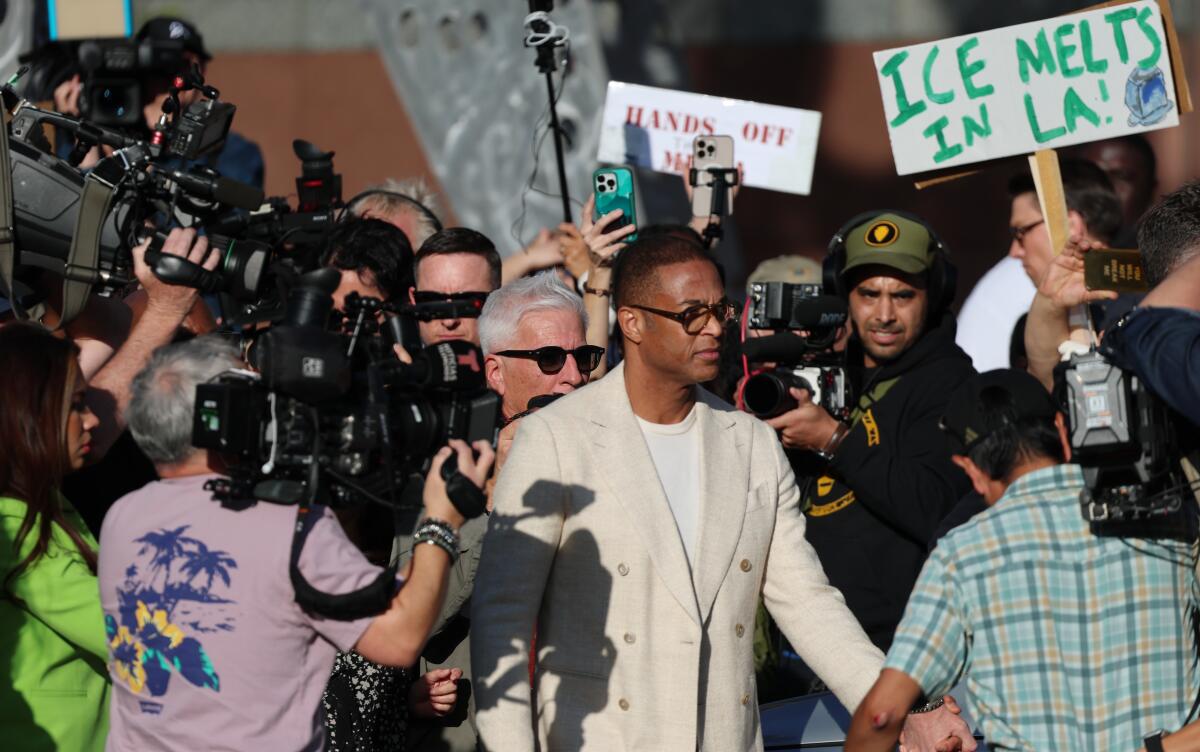
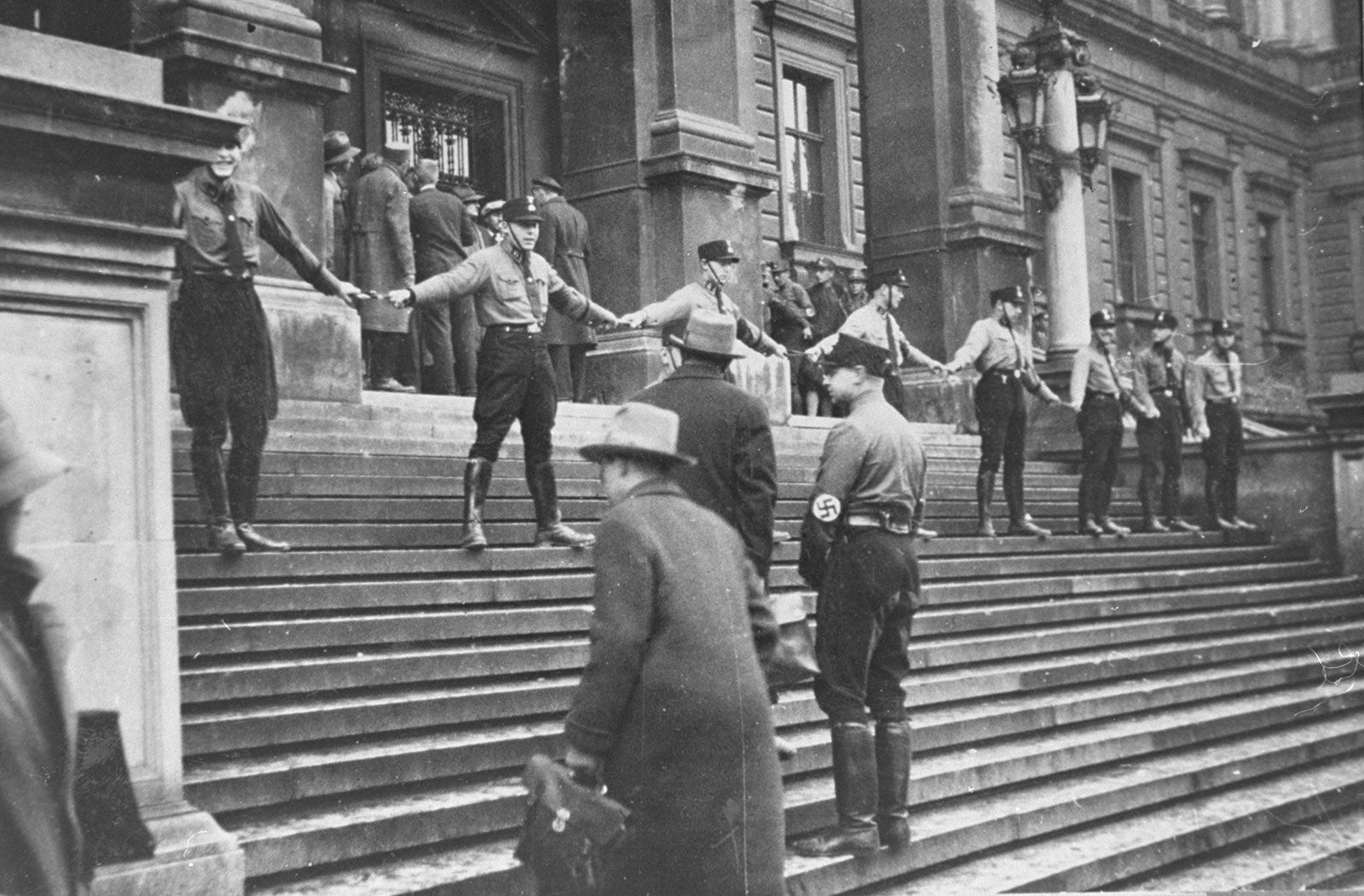
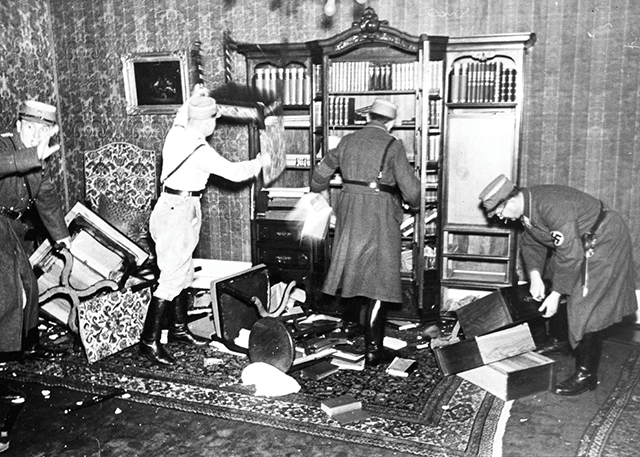
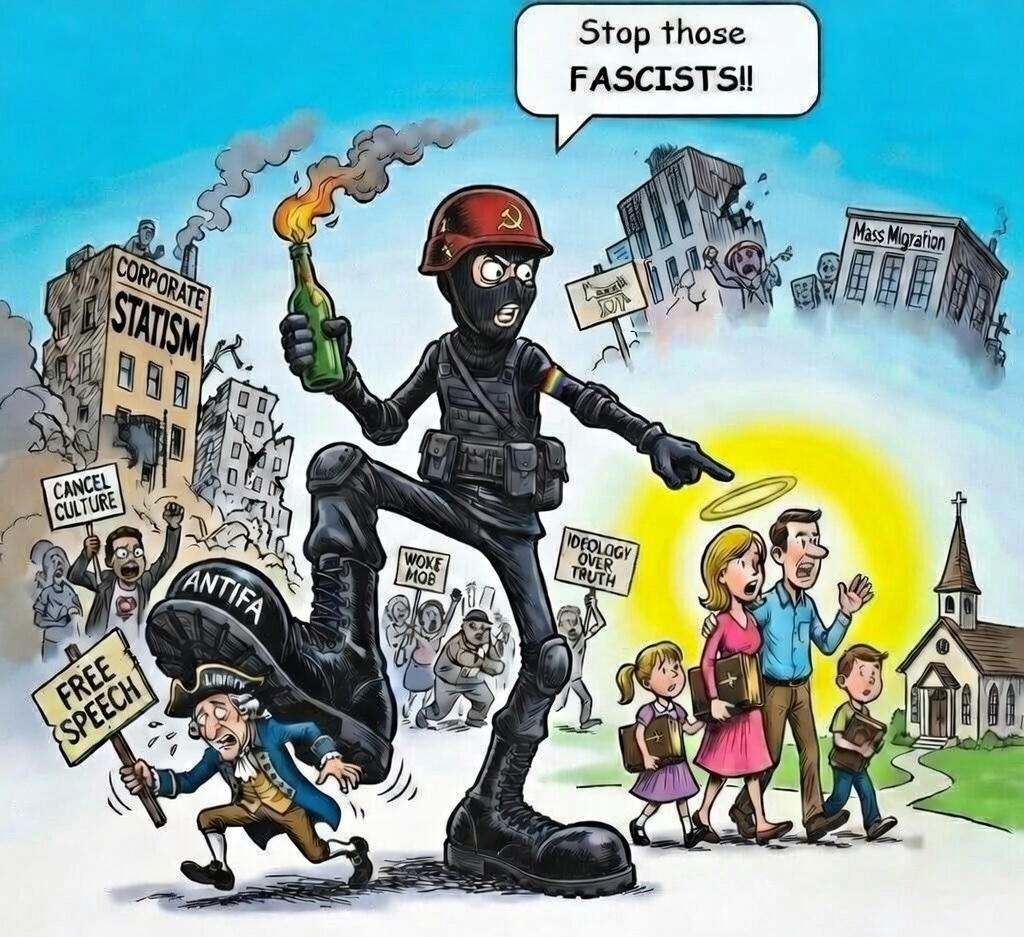
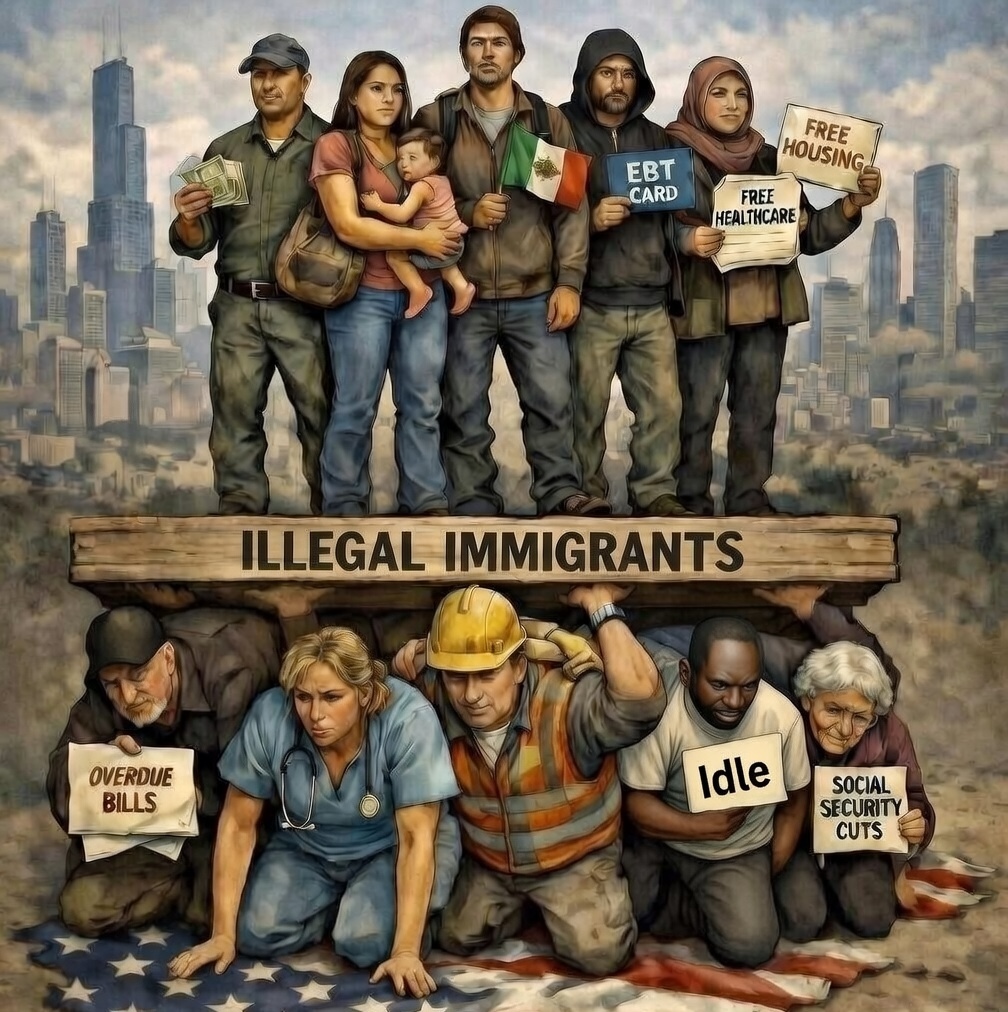

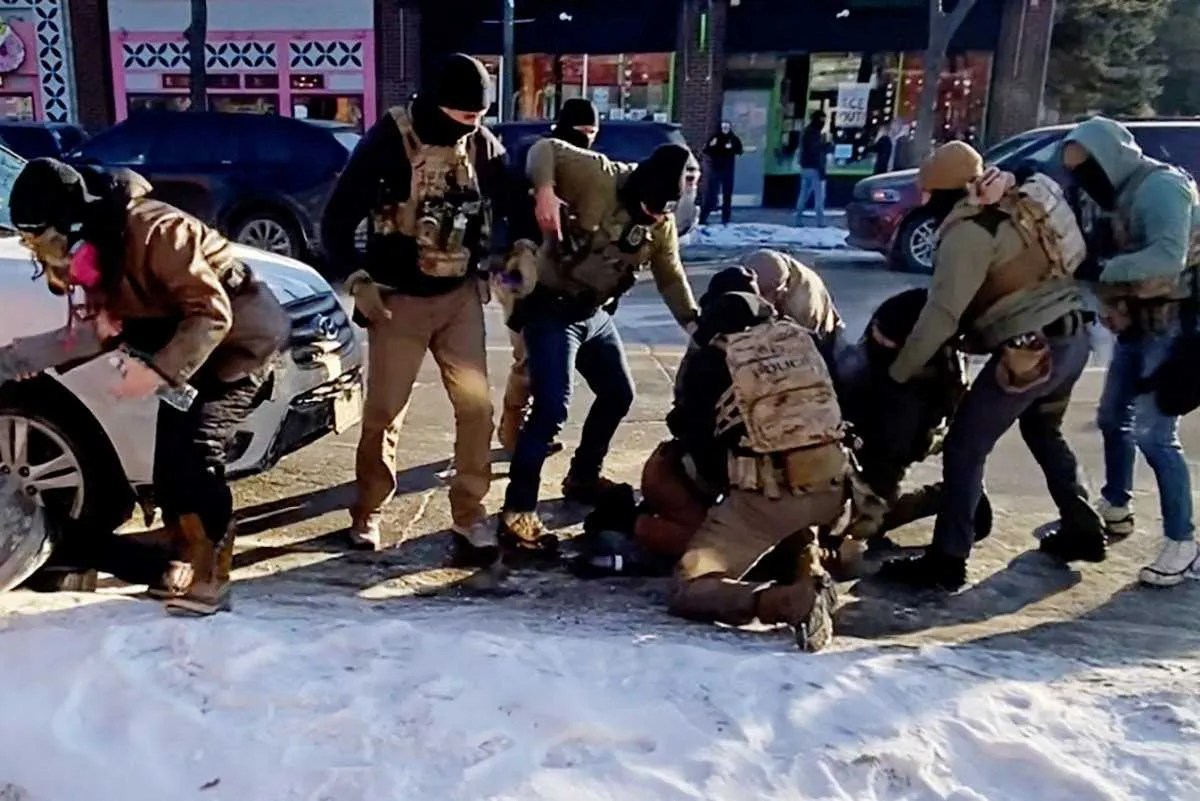
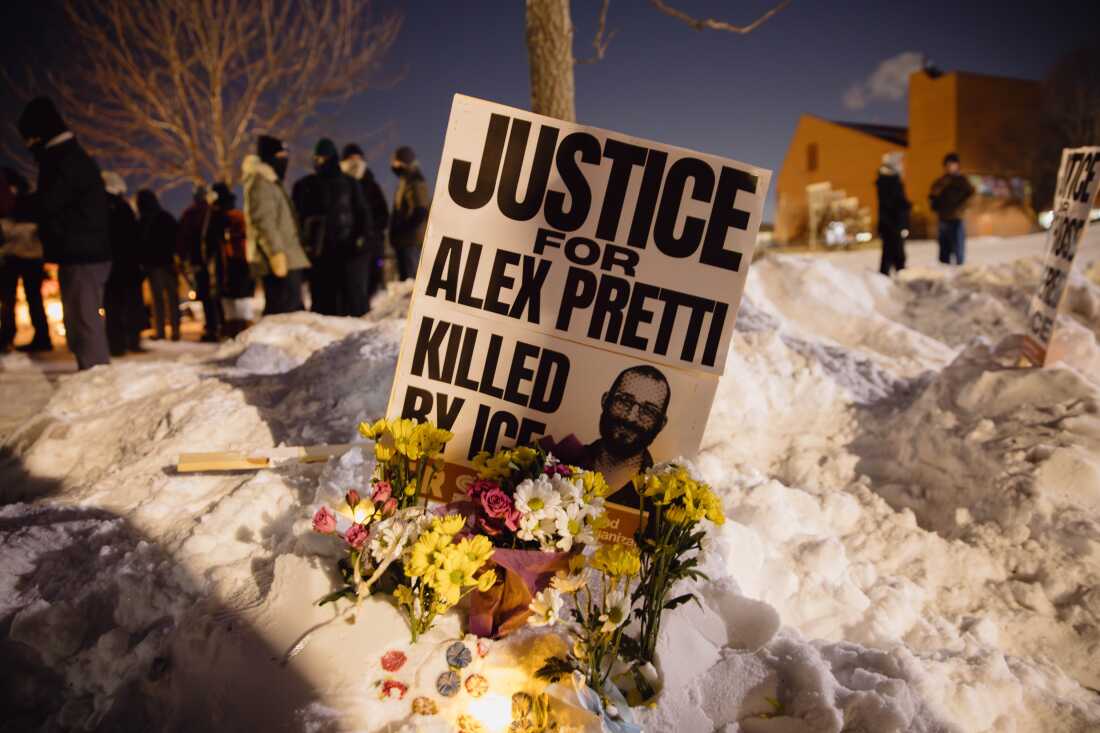
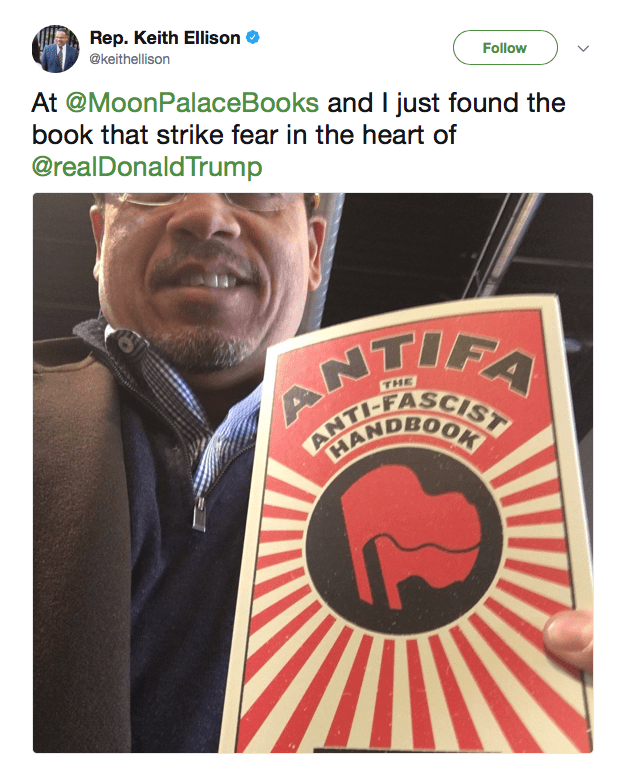

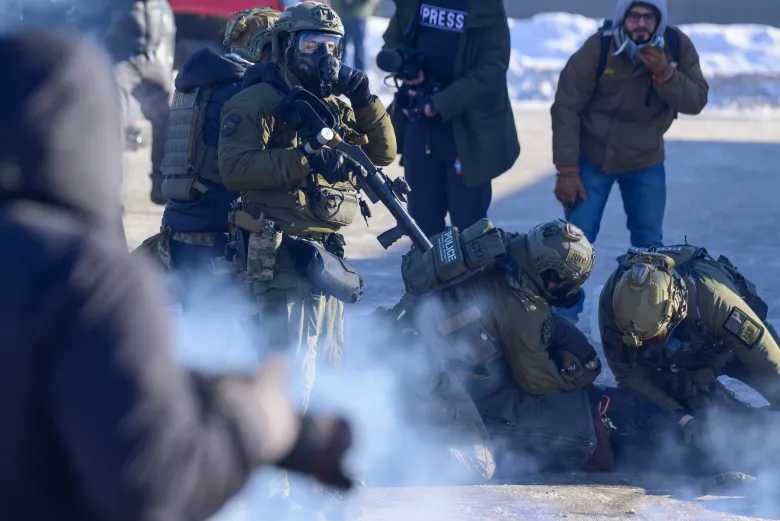
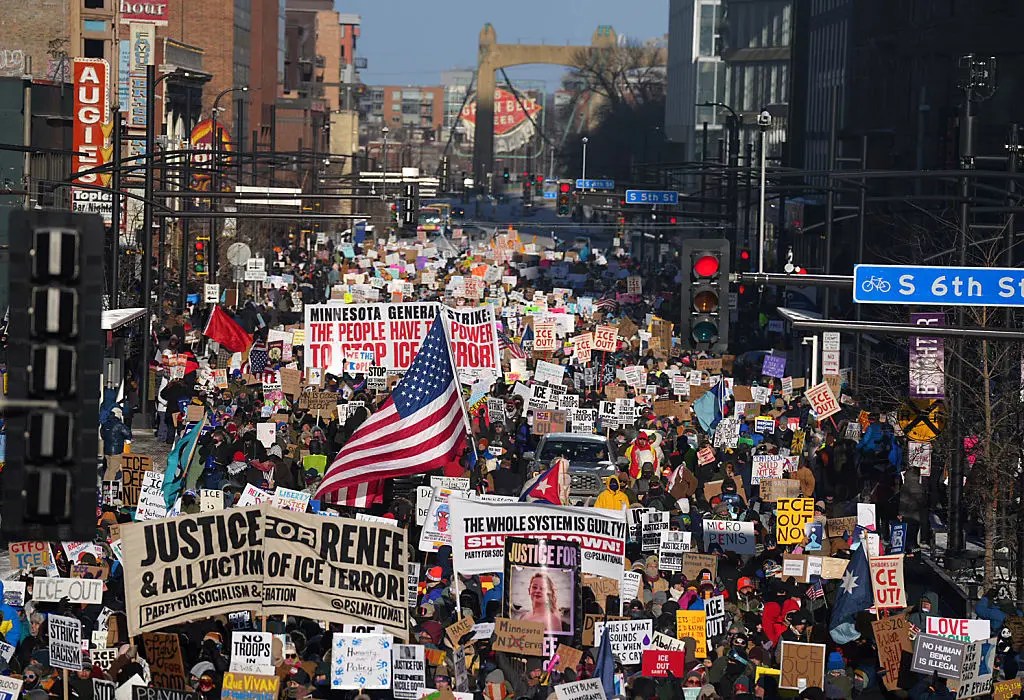
 freedom and reason