Racism (or racialism) is the belief in the inherent inferiority or superiority of particular racial groups, sometimes grounded in pseudoscientific theories about grouped human differences. Noting grouped human differences is not racism (there are obvious phenotypic differences across human populations). Nor is ranking cultures in terms of their relative adequacy in meeting human needs racist (see A Case of Superexploitation: Racism and the Split Labor Market in Springfield, Ohio for an embedded analysis of the difference between culture and race).
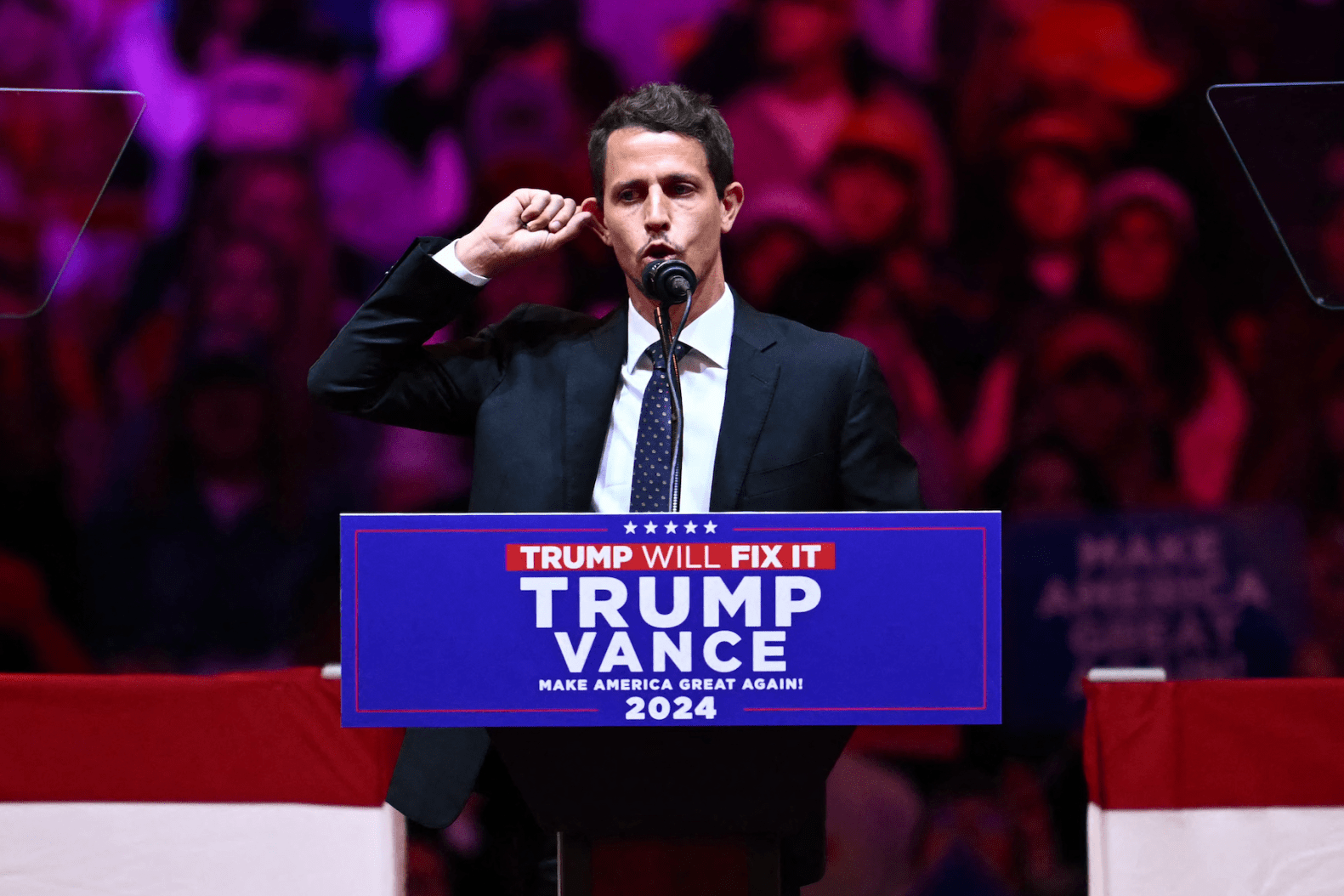
Insult comic Tony Hinchcliffe
Racism is more than prejudice. Racists posit a hierarchical view of humanity based on supposed constitutional or innate differences, seen as fixed and determinative of behavioral, cognitive, and moral capacities. Racism is used to justify the unequal treatment and social stratification of groups. Racism was institutionalized for a time in American history and legitimized by both academic and popular discourse, playing a significant role in justifying slavery, eugenics, and segregation. Those institutions were dismantled more than half a century ago. Today, there are very few racists, and those who harbor racist thoughts tend not to express them in public. However, across the span of these changes, ethnic and racial humor was used to cut the tension of intergroup antagonisms.
A joke about New Jersey is not an example of racism. Neither are jokes about Haiti or Puerto Rico. Branding jokes “racist” is a paradigm of how progressives weaponize language to demonize their enemies. Progressives substitute for comedy what we might term “clapter” (as opposed to laughter) around politically-correct statements. What comedy is allowed should target those perceived to be at the top of the intersectional hierarchy of power, not those at the bottom of the hierarchy. Thus only progressives, i.e., those who manufactured the hierarchy and presume to speak for the downtrodden and powerless, are allowed to poke fun at people over identity. Progressives call this “punching up.”
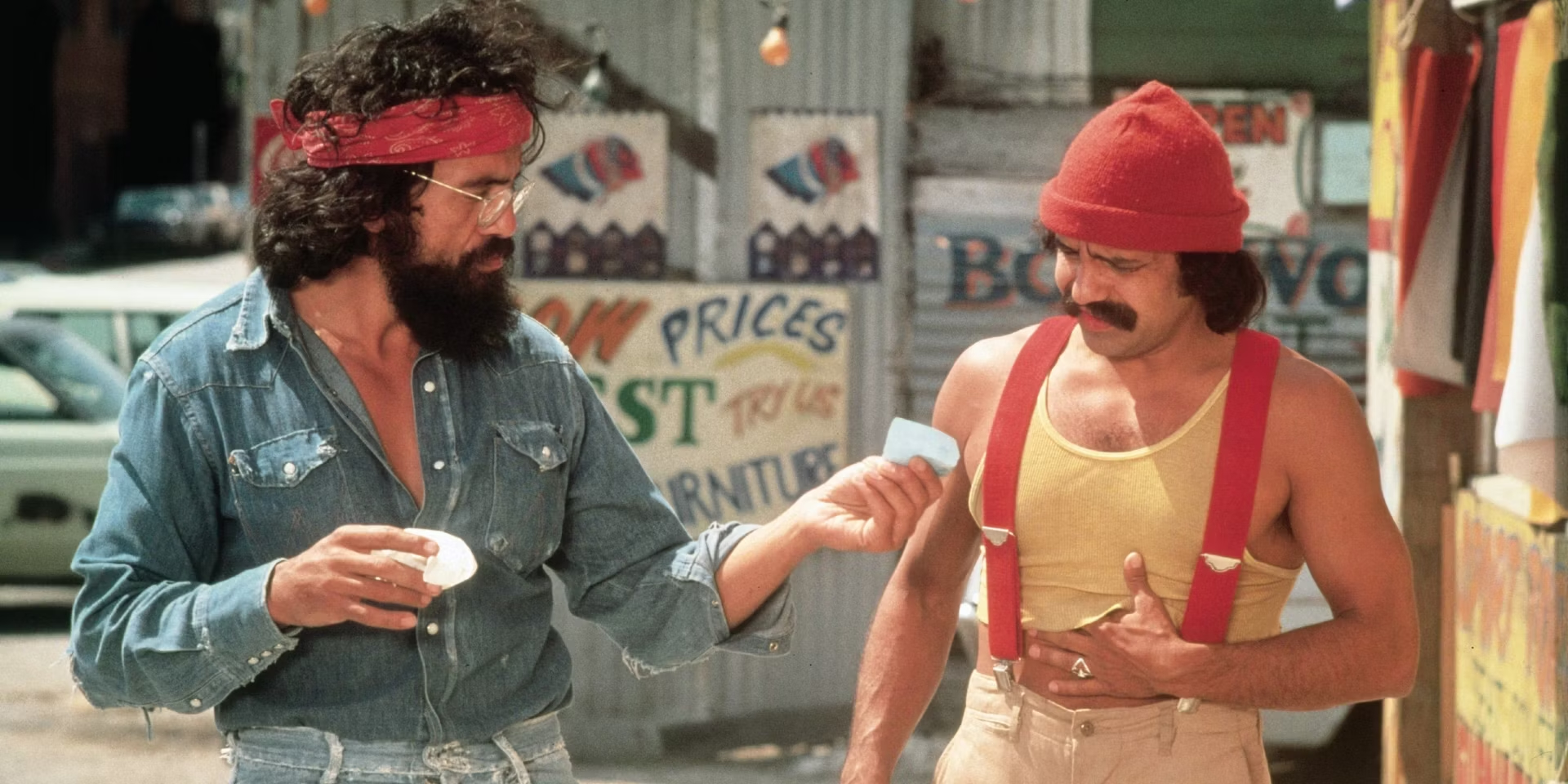
Cheech (right) and Chong (left)
That there are rules to comedy at all—beyond making people laugh—is why I call progressives “joyeaters” and “buzzkills.” I have asked this question of many of my friends from back in the day (the 1970s): could Cheech and Chong even be possible today? Perhaps if they focused their humor exclusively on making fun of straight white Christian men and women. If that were the case I wouldn’t buy any of their records.
Sadly, the Trump campaign is distancing itself from Tony Hinchcliffe, the comedian who spoke last night at Trump’s Madison Square Garden “Nazi” rally. (Never mind that FDR, JFK, Carter, and Clinton also held rallies there—remember the double standard!) “This joke does not reflect the views of President Trump or the campaign,” senior adviser Danielle Alvarez said in a statement. Lame. (“Ableist!”)
It’s not Hinchcliffe who’s the problem. The Trump campaign shouldn’t apologize. It’s the offense-takers and the speech police who are the problem. If someone is offended by a joke about New Jersey, his offense-taking stems from an aspect of group or place-based identity, where the person feels a connection to New Jersey and perceives the joke as a slight to that identity. Slights are felt by the overly sensitive. That’s on the overly sensitive.
Triumph, the Insult Comic Dog
In social science, we can explain this over-sensitivity using social identity theory, where people derive part of their self-esteem and sense of belonging from the groups they identify with—whether that’s based on culture, place, or other affiliations or associations. For those who take things personally, or who want to make a molehill into a mountain, a joke about New Jersey triggers a defensive reaction because it touches on a significant facet of how they see themselves or where they feel a sense of pride.
The jokes told by Hinchcliffe, a stand-up comic who regularly perform on roasts—he has written eight Comedy Central Roasts—and is known for his Kill Tony podcast, are not examples of racism. Hinchcliffe works in the vein of Don Rickles. This is the work of the insult comic. Remember when Rickles performed for Ronald Reagan at Reagan’s second inaugural ball, held at the Washington Convention Center in 1985. Rickles made his career performing ethnic humor, insulting people over their race and religion. Rickles was also a regular on roasts. Remember Triumph, the Insult Comic Dog on Conan? Remember Triumph’s joke about Koreans and dogs at the Star Wars convention?
Would Rickles even be allowed to perform given today’s climate of progressive hegemony over culture industry and legacy media content? No, things have not gotten better since then. It is never better when a small group of extremists who control culture and media smear comedians as “racist” and multiracial/ethnic political rallies as “fascist.” Read this morning’s news coverage to see how much worse things have become. From The New York Times on down, Trump is a candidate whose “rhetoric has grown darker and more menacing.” Here’s the hyperbolic NYTimes piece from which that quote is drawn: “Trump at the Garden: A Closing Carnival of Grievances, Misogyny and Racism.” The progressive bubble constitutes an alternate universe.
We also have to consider that the Trump-Vance campaign picked Tony Hinchcliffe to trick Democrats into leaning into their bogus fascism and racism narratives as their closing arguments down the stretch. Calling Trump a fascist and a racist is one of the reason why he has closed the gap on Harris. The Harris campaign and corporate media and culture industry allies look like woke scolds. Americans hate woke scolds.
Finally, you will enjoy this. Here’s Hinchcliffe and Roseanne Barr promoting a Puerto Rican comedian. Enjoy. Oh, and see the next video, too. It’s a comedian opening for the Harris-Walz campaign slamming Mexicans.
Incorrect. A LOT of Puerto Ricans watch this comedian (K*llTony) and are fans. He spends a lot of time there. Here's a video of him flying a Puerto Rican across the country for free to be in his show, paying all her expenses, to help her launch her own career as a comedian. pic.twitter.com/rj32Q5vA1d
This essay follows up on last Monday’s essay on the Black Lives Matter (BLM) phenomenon. After rereading that essay, I felt it might be useful to apply some theory to more fully explain the dynamic the evidence indicates. Sheldon Wolin’s idea of managed democracy (also known as directed or guided democracy) highlights how corporate power shapes not only governance but also the nature of political dissent, ensuring that social movements remain within boundaries that reinforce rather than challenge the norms of neoliberal capitalism. This dynamic of co-optation transforms genuine populist resistance into commodified expressions of dissent that serve elite interests. Wolin’s theory is a useful frame in which to explain corporate co-optation and astroturf manufacture of (faux)social movements.
If you are unfamiliar with Wolin’s work, see Democracy, Inc.: Managed Democracy and the Specter of Inverted Totalitarianism. I highly recommend the book to you, but I hope that my application of his theory will be clear enough that you won’t have to read that book first to understand the analysis presented here. The core idea I am conveying is that, by absorbing the energy of movements seeking equality and justice, the system of inverted totalitarianism efficiently undermines the possibility of transformative change, leaving the structures of corporate control intact under the guise of supporting progressive causes.
To illustrate, before coming to more recent examples, we can apply the concept of managed democracy to understand the co-optation of organized labor under the New Deal, where corporate interests and a government that advanced those interests worked to redirect labor movements away from more radical aims and towards a controlled form of participation within the system. Under the New Deal, labor unions like the AFL and CIO were granted legal recognition and protections through legislation such as the Wagner Act, which guaranteed collective bargaining rights. However, the state, while seemingly empowering labor, contained it within the parameters of industrial capitalism, ensuring that workers’ demands would not challenge the broader structures of ownership and power. After the war, the CIA even used the unions to undermine popular democratic movements in Europe.
Thus the New Deal represents a moment where genuine labor resistance was transformed into a guided or managed force, one that ultimately stabilized and legitimized rather than threatened the capitalist order. By integrating labor unions into the system through institutionalized bargaining processes, the government effectively channeled labor’s potential revolutionary energy into reformist goals that aligned with the interests of corporate state power. This form of co-optation ensured that labor movements would focus on wage and benefit improvements within the existing system, rather than advocating for more transformative changes that could disrupt capitalist property relations or significantly alter the balance of power between capital and labor. This is the raison d’etre of progressive law and policy.
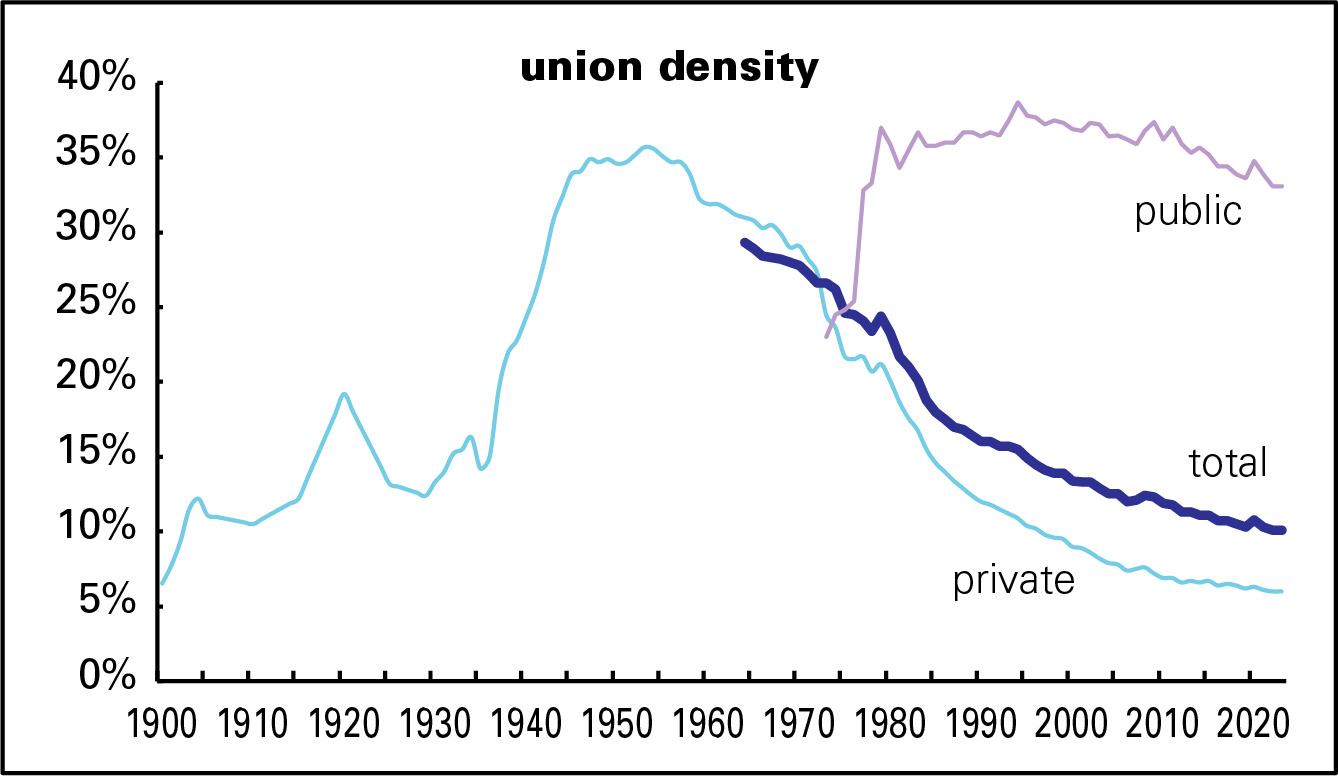
The appearance of democratic participation masked the underlying reality that corporate power remained more than intact but strengthened, as well as the administrative apparatus that advanced its interests. The labor movement’s co-optation under the New Deal effectively neutralized its more radical elements, turning the movement into a regulated entity whose influence was channeled through legal and political frameworks that benefitted elite interests, particularly those of large corporations. Instead of fostering a workers’ revolution or a movement toward socialism, organized labor became a tool for managing dissent, reinforcing neoliberal capitalism by containing labor’s aspirations within a system designed to maintain corporate dominance. To put this in a straightforward manner, the corporate state sucked the energy out of labor. This put the private sector union movement on a path to its present state—union density today stands at only six percent. At the same time, unions density among public sector employees, those who manage the affairs of the corporate state, stands today at 32.5 percent.
The corporate statism of the initial progressive period and the emergence of the United States as world hegemon laid the foundation for the emergence of neoliberalism in which individuals were reconfigured primarily as consumers rather than citizens, shifting focus from civic engagement to market participation. Under the New Deal, the federal government took on a central role in regulating markets, providing social safety nets, and promoting labor rights in response to the economic crisis of the Great Depression. This marked a significant departure from laissez-faire capitalism, as the state ostensibly sought to balance corporate power with social welfare through initiatives like Social Security, labor protections, and public works programs. The purpose of this intervention was to save capitalism and thwart socialism.
New Deal interventions entrenched the idea that economic growth and stability could be achieved through technocratic management of markets. As the state became deeply involved in regulating capitalism for the sake of the system itself, it also contributed to the commodification of everyday life, creating conditions where market logic could eventually permeate ever deeper into society. The individual was reimagined not as a citizen actively participating in civic life and democratic governance, but primarily as a consumer whose power lay in their purchasing decisions within the marketplace. This shift, the shift towards mass consumption to reproduce the circuit of capital represented a profound transformation in the role of individuals in society.
Neoliberalism, while criticizing state intervention in order to invert the hierarchy of power, built on the corporate-statist foundation of the New Deal to promote an economy dominated by large corporate entities. Under neoliberalism, the state’s role became one of facilitating market efficiency and protecting corporate interests rather than directly managing social welfare. Civic engagement, which was central to the New Deal’s progressive vision of democratic participation, i.e., a mechanism for integrating the individuals into the extended state apparatus, was replaced by a focus on individual market participation as the primary means of societal influence. It thus functioned to depoliticize the individual.
This shift from a citizen to a consumer orientation had far-reaching consequences. While individuals became masses trained and directed by the hegemonic apparatus, neoliberalism downplayed the importance of collective political action. The idea of freedom was redefined in market terms—freedom became the freedom to choose between products and services rather than the freedom to influence public policy or hold corporations accountable. This consumerist reconfiguration of American society eroded the public sphere, weakening civic institutions and undermining democratic participation. As individuals became more focused on their role in the economy as consumers, they disengaged from politics, which became increasingly dominated by corporate interests. This not only led to greater economic inequality but also to a more passive populace, less inclined to challenge corporate power or advocate for structural change in light of their own interests, while more easily mobilized for the interests of the corporate overlords.
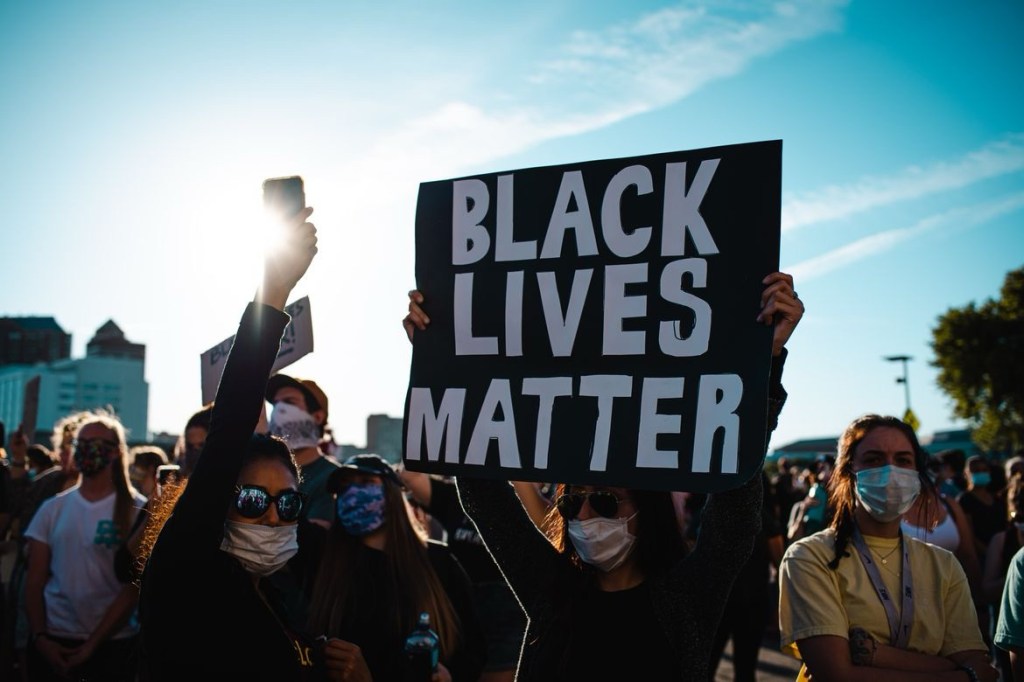
As neoliberalism entrenched, public goods and services became increasingly privatized, and governance shaped by corporate interests, leading to a dominance of corporate logic in decision-making, transferring power that properly belongs to government and the people to corporations and financial institutions that prioritize profit over social well-being. Under these arrangements, the state becomes an instrument of corporate governance. Thus the corporatization of BLM described in my previous essays reflects how ostensibly radical or left-wing causes are negated by corporate interests. As I showed there, while BLM may have begun as a grassroots movement protesting police violence and systemic racism, it has received financial backing from large corporations and foundations. These endorsements align with corporate branding strategies that seek to appeal to social justice causes, enhancing their market appeal while avoiding substantive challenges to capitalism or structural inequality. This corporate support dilute a movement’s radical potential, steering its activism toward symbolic gestures or performative allyship rather than systemic change.
Other left-wing movements have faced similar trajectories, where their alignment with corporate and political elites in service to concentrated power compromises their ability to challenge the deeper roots of exploitation or inequality. Corporations embrace these movements not because of genuine solidarity with their aims, but because it allows them to harness activist energy to deflect criticism and bolster their own power within the capitalist system. In this way, what appears to be anti-capitalist or revolutionary rhetoric is absorbed and neutralized, serving the interests of those it ostensibly opposes. In addition to BLM, other movements that have been corporatized or coopted by corporate and political interests include the Women’s March, Pride, environmentalism, and the Me Too movement. I will briefly survey some of those cases so the reader can get a sense of the pattern.
The Women’s March was initially a grassroots protest against the inauguration of Donald Trump, the Women’s March received endorsements from major corporations and became entangled in mainstream political frameworks. The pussy hat, a pink, hand-knitted hat with cat-ear shapes on either side, became a symbol during the Women’s March, which began on January 21, 2017, the day after Trump’s inauguration. The hats were a protest of Trump’s remarks in a 2005 Access Hollywood recording, in which Trump referred to the way some women throw themselves at celebrities. The hats were an instantiation of defiant reclamation of a derogatory term in the same way that some blacks and gays reclaimed slurs used against them. Reclamation of derogatory terms referring to women express empowerment, resistance, and solidarity among those opposing misogyny and sexism. As the leadership of the Women’s March engaged with Democratic Party elites, it became clear that the movement focused on symbolic actions rather than challenging deeper systemic issues like class inequality and the globalization project which harms the material interests of women. (See The Appeal to Identity: Bad Politics and the Fallacy of Standpoint Epistemology.)
The LGBTQ+ rights establishment, particularly around Pride celebrations, has been heavily corporatized in recent years. Many large companies now sponsor Pride events and publicly support LGBTQ+ rights at the expense of gays and lesbians, as well as women and children. Corporate involvement sidelines demands for women’s rights in favor of marketable notions such as diversity and inclusion, reinforcing the neoliberal status quo without addressing the struggles of those who founded the movement and those who are affected by its corruption at the hands of gender ideology. As I have noted in the past (see The Function of Woke Sloganeering; Is the Madness Unraveling?), one reason corporations align with LGBTQ+ activism (aside from the growth industry of gender affirming care) is the rise of a social credit system that rewards companies for promoting gender ideology. Corporate rankings are influenced by the Corporate Equality Index (CEI), managed by the Human Rights Campaign (HRC), the largest LGBTQ+ advocacy group globally. HRC issues “report cards” for America’s top corporations based on how closely they adhere to the CEI’s guidelines, and companies that earn the maximum points are recognized as the “Best Place To Work For LGBTQ Equality.”
Beyond these incentives, other factors bring these entities together and intertwine them. Organizations like the Open Society Foundation and the Gay, Lesbian, Straight Education Network (GLSEN) contribute significant funding. ESG (environmental, social, and governance scores), a grading system that ranks entities from corporations to governments on their “social responsibility,” plays a powerful role here. Major investment firms like BlackRock back ESG, while groups like the World Economic Forum foster corporate alliances with organizations such as the HRC. The aim is to establish a social credit system that promotes transgressive ideologies like queer theory, creating niche markets around constructed identities and moving Western societies toward a global corporate governance model.
Global movements, such Fridays for Future climate strikes, inspired by Greta Thunberg, have seen corporate and institutional endorsement. Some environmental NGOs and campaigns have aligned themselves with major corporations that engage in greenwashing, i.e., promoting sustainability rhetoric while continuing environmentally harmful practices. Corporate support often shifts the focus from systemic critiques of capitalism’s role in environmental degradation and resource depletion to consumer-driven solutions like “green” products that don’t actually challenge the larger structures of exploitation and environmental destruction. (See my essay and talk The Anti-Environmental Countermovement. See also my award winning article “Advancing Accumulation and Managing its Discontents: The U.S. Antienvironmental Countermovement,” published in The Sociological Spectrum, as well as “The Neoconservative Assault on the Earth: The Environmental Imperialism of the Bush administration,” in Capitalism, Nature, Socialism.)
Initially a grassroots effort to highlight sexual harassment and assault, the Me Too movement was immediately embraced by Hollywood elites and corporate media. The pattern was highly similar to the BLM phenomenon I have described While it successfully brought attention to issues of gender-based exploitation and violence, its alignment with corporate media narratives depoliticized the movement, focusing on individual cases and high-profile abusers while avoiding systemic critiques of the industries that exploit labor and women’s bodies, especially in lower-income contexts. These movements, while powerful in their inception, often face the tension between maintaining their radical demands and the incentives offered by corporate and political alignment, which can steer them away from deeper systemic change.
* * *
Sheldon Wolin argues that in modern liberal democracies like the United States, a form of totalitarianism has emerged that operates differently from historical fascism. Instead of the state controlling corporations and society, with a dictatorial figure in command, corporate power subtly dominates and influences the state, leading to a more dispersed form of control that lacks the centralized authoritarianism seen in historical fascism. Wolin’s “inverted totalitarianism” describes a system where the state and corporate interests are deeply intertwined with the state functioning as a facilitator of corporate power rather than its master. Unlike fascist regimes where the state coerces corporate actors to serve its agenda, in this system, corporations and financial institutions shape and limit government policies. Political leaders and institutions increasingly serve corporate interests, and democratic processes are hollowed out, becoming mere rituals that disguise the reality of elite domination.
Wolin critique of the neoliberal order, where the market, media, and political systems operate in such a way that they perpetuate corporate control without overt authoritarianism, is an analysis for our time. This form of governance allows for significant corporate influence over public policy, including deregulation, privatization, and the weakening of democratic accountability, while maintaining the facade of democracy. A subtle form of domination, inverted totalitarianism avoids the visible repression associated with fascism, relying instead on economic coercion, media manipulation, and consumer culture to depoliticize the citizenry. In short, while classical fascism saw corporations working under a strong, centralized state, Wolin’s analysis inverts this relationship: corporations lead and the state follows, undermining democratic institutions and public accountability in a way that is more diffuse but equally dangerous. His interpretation reflects the rise of corporate oligarchy and technocratic governance, where the lines between public and private power blur, producing a system that serves corporate interests over those of the people.
Using Sheldon Wolin’s concept of inverted totalitarianism, the corporatization of social movements like BLM, Pride, and environmental activism can be seen as an extension of the neoliberal order’s ability to co-opt potential threats to its hegemony. These movements, which begin as grassroots calls for radical reform, are absorbed into the fabric of managed democracy, where dissent is neutralized through corporate sponsorship and alignment with political elites. Rather than suppressing opposition outright, the system co-opts it, turning once radical critiques into market-friendly slogans that leave the deeper structures of inequality untouched. As we approach the November 5 presidential election, it is important to carry this critique into the ballot box when making one’s decision. The Democratic Party is the party of inverted totalitarianism. (See Defending the American Creed.)
Mass immigration has displaced millions of native-born black and Latino workers. That was the point of it all. It was engineered by corporations to displace native-born labor to drive down wages. I have watched over the course of my lifetime (62 years) black workers in agriculture, cafeteria work, custodial services, food production, groundskeeping, housecleaning, and labor-intensive construction and manufacturing replaced by cheap foreign labor. The number of idled black and Latino workers in the projects has swelled over the last several decades while foreign-born labor has progressively replaced them. This development has resulted in family disintegration and extreme child poverty, especially in the black population.
The attitude of progressives tells me that I’m confronting a privileged standpoint that treats black Americans as lazy bodies who don’t want to work. This is the progressive attitude in a nutshell. Rather than having blacks work, progressives have engineered mass dependency in the southern projects and the northeastern and midwestern ghettos to get blacks as far away from white populations as they can get them. It’s no accident that what came on the heels of Civil Rights Act was the Great Society and globalization projects of offshoring and open borders. The legislation passed during that period functioned to relegate primarily black families to disorganized inner-city enclaves while cheap foreign labor replaced them across America. This is no accident.
This rhetoric about how there are no Americans who would do these jobs is designed to obscure the reality that progressive Democrats are behind the oppression and impoverishment of black Americans—first the slavocracy, then Jim Crow segregation, and now ghettoization. It is very wrong that black Americans should have to continue to suffer so that privileged white Americans can have cheap consumer goods. This is the result of Democratic Party law and policies. We won’t turn this around until we get these actors out of power.
I have studied the same things Bobby Kennedy, Jr., has. I know he’s right and I trust his judgment. If he is standing with Trump then how is Trump a fascist? Same with Tulsi Gabbard. Same with Elon Musk. These individuals are libertarian. They believe in the American Republic. They believe in the Constitution.
If that’s not enough, consider that those who are calling Trump a fascist are representatives of the military-industrial complex and the censorship-industrial complex. They are the ones who oppose the freedom to speak and publish. They are the stormbringers. Harris has the security state and the warmongers at her back. These same forces are telling you to fear Trump. Put it together and you can see that the reality the MSN is projecting is the inverse of reality. (See Harris-Walz and the Corporate State)
Karl Marx told us that ideology is a camera obscura (Inverting the Inversions of the Camera Obscura). The image is upside when it’s projected onto the retina. The brain naturally sets right the image. But, with ideology, the brain has to learn to set the picture right. If the structure of reality was immediately evident in the appearance of things then reason would be superfluous. But it’s not, so you have to do the work. Flip the image the MSM is projecting over in your mind and the picture becomes clear. The structure of reality is the opposite of the appearance manufactured by the propagandist.
Learn what fascism actually is—the corporate state
Consider what they have in store for us if they will lie this big.
Trump had low inflation. Harris, high inflation. Harris is telling you that Trump will bring high inflation. Does that make any sense to you?
Trump believes in free speech. Harris does not believe in free speech. Harris is telling you that Trump is an authoritarian. Does that make any sense to you?
Trump did not wage lawfare against his enemies. Harris weaponized the federal government against her enemies. Harris tells you Trump will use the government against his enemies. Does that make any sense to you?
Trump’s presidency was remarkable for the relative absence of war. The government under Harris is associated with major wars in Eastern Europe and in the Middle East. Harris is telling you that Trump’s foreign policy is dangerous. Does that make any sense to you?
Trump left office voluntarily. Harris says Trump will be a dictator? Does that make any sense to you?
You are being told that Trump is everything Harris is not and that this should worry you. But the opposite is true. Harris should worry you. A lot.
Our Counterrevolutionary Duty: Defending the Old Society
“In studying such transformations it is always necessary to distinguish between the material transformation of the economic conditions of production, which can be determined with the precision of natural science, and the legal, political, religious, artistic or philosophic—in short, ideological forms in which men become conscious of this conflict and fight it out. Just as one does not judge an individual by what he thinks about himself, so one cannot judge such a period of transformation by its consciousness, but, on the contrary, this consciousness must be explained from the contradictions of material life, from the conflict existing between the social forces of production and the relations of production. No social order is ever destroyed before all the productive forces for which it is sufficient have been developed, and new superior relations of production never replace older ones before the material conditions for their existence have matured within the framework of the old society.”—Karl Marx
Here’s where we are. Two forms of government are competing for dominance in the United States. Both are operational in the present space but in contradiction to the other. They cannot be synthesized; their incompatibility means that one will have to win out over the other—that is, if we wish to truly free as a people. That makes this a pivotal moment in our nation’s history, indeed in world history. The dialectic will either be resolved with a preservation of the higher unity our nation achieved at its founding—a once-in-a-millennial moment—or result in a New Dark Ages of corporate neo-feudalism. As Theodor Adorno warned us in Negative Dialectics, contradictions do not always resolve in a higher unity.
Old Glory
One form of government in the current context is the aforementioned historic achievement of the constitutional republic founded on the classical liberal values and principles of humanism, individualism, rationalism, and secularism. This is the rights-based basis of the American system of government. This is why our forefathers risked everything to rebel against the British Crown. This is why brother killed brother during the Civil War. This was why millions of young men put their lives on the line to repel the fascist threat to the Enlightenment project. We had one shot at this. We won’t have another moment to make a nation as great as this one. If we lose this, it’s gone forever.
This is the American Creed: “The United States of America as a government of the people, by the people, for the people; whose just powers are derived from the consent of the governed, a democracy in a republic, a sovereign Nation of many sovereign States; a perfect union, one and inseparable; established upon those principles of freedom, equality, justice, and humanity for which American patriots sacrificed their lives and fortunes.” Our freedom requires our dedication to the Creed. You may have your own personal creed, but you also have this one—if you are a patriotic American.
A New World Order
The other form of government is the corporate state and progressive ideology, the praxis of a soft fascism waiting for the Creed to be overthrown in order to establish a hard New Fascism, a system that moves beyond the liberal world order of nation-states to make a global system of authoritarian governance. This New Fascism, what Sheldon Wolin calls “inverted totalitarianism,” in its best moments operates through managed democracy, a fake democracy; in its worst moments, it’s a police state that resorts to selective mob rule (which we witnessed in the summer months of 2020 and may soon witness again if Trump is elected).
If the people (or the system) elect (or install) Kamala Harris, and when the latter form of government is entrenched and the constitutional republic negated, this will fix the totalitarian system over us. History will be erased and revised (it already has to an alarming extent) and we will become a population under transnational corporate rule. Democrats, profoundly illiberal and itching to fully institutionalize technocratic controls over the people, are the party of that class power. They see the working class as the deplorables, the hobbits, the proles. It will be Orwell’s Nineteen Eighty-Four come to life disguised as Huxley’s Brave New World. This monster is already stomping around in its adolescent form.
Not all the people who will vote Republican this cycle have awaken to these facts intellectually, but their common sense (for those for whom common sense still works) is telling them that the Republican Party under Trump has become the party of populist-nationalism, which is what we were at our founding, an identity reaffirmed by the Party of Lincoln in overthrowing the slavocracy, the regime of unfreedom represented by the Democrats and the landed aristocracy that rebelled against the American republic to preserve the feudal way of life (and that established Jim Crow after Reconstruction—and the ghetto after that). This is why patriots like Bobby Kennedy and Tulsi Gabbard have left the Democratic Party and joined the Republicans. They know what time it is.
They know that the future under Democrats is a neo-feudalism, organized by the corporatocracy that rose from the ashes of the slavocracy, where the people are subject populations interred on high-tech estates governed by technocrats in the service of transnational power. The Democrats are open about the plans they have for us. When they say in the above video (please watch it) that they mean to extinguish freedom of speech, they mean it. They mean to take aways your guns and privacy, too. They mean to weaponize the government and the law against their enemies (lawfare). They’re telling you what they want to do to you—you can see it in their actions—and there are tens of millions of functionally un-American citizens who want to do this to you, too—the academic, the culture industry manager, and the propagandist who go by the name “journalist.” They’re the people with or who speak for the people with the signs in their front yards that begin “In this house….”
The future under Republicans is a restoration of the democratic-republican principles that underpin our Constitution and our Bill of Rights, that express the spirit of our Declaration of our Independence. When we say that the goal of populist-nationalism is to deconstruct the administrative state—the unconstitutional, unelected, and unaccountable federal bureaucracy and its army of technocrats—this is what we mean: taking the country back to the three branches, separation of powers, and the federal system that defend individual rights and the relative autonomy of the fifty states. In a word, the Creed. When we say this is the most important election in our lifetime, that’s not that throwaway line. It has never been the case—not in our lifetimes—that we have this stark a choice before us, the choice between Americanism, on the one hand, and anti-Americanism, on the other.
This is why the Democrats run down our founders and demonize our culture, smearing the white majority as racist and ignoring the plight of black Americans they caused, while elevating backward Third World cultures and hateful ideologies and religions, opening our borders to the barbarians they wield to disorder our communities and derail our spirit (the sociopathic overlords are executing the same plan in Europe). They do not believe in the Creed and they will, if they win, snuff it out. It will be a New Dark Ages.
The Democrats are neither socialists nor communists. They are corporatists. We need not argue about which form of authoritarian is more dangerous—corporatism is bad enough. We fought this evil in another guise in the Second World War. We don’t need to guess at this. They’re telling us who they are. Harris has been endorsed by the war machine. Harris has been endorsed by the censorship-industrial complex. Harris has been endorsed by the medical-industrial complex. This is the same person who legitimized the color revolution in 2020. Her party is the party of lockdowns, masks, and vaccine mandates. Her party is the party of NATO and the provocation of war in Eastern Europe, actions that have brought to the threshold of WWIII. This is the party that enabled the Islamists who terrorize Israel. Her party is the party of the PATRIOT Act and the forever wars.
As readers of Freedom and Reason know, I am no longer a socialist. This is because every real-world instantiation of socialism has been totalitarian, and I am a libertarian. At the same time, just as I am a Darwinist because I recognize natural selection is the logic of the natural world, I am a Marxist because Karl Marx saw clearly the logic of the social world. Marx never personally saw really-existing socialism on the societal level, and he would, like me, have been appalled to see how it turns out. For Marx was at heart a liberal man. With this clarification in mind, I want to close with this observation from Marx’s 1859 AnIntroduction to a Critique of Political Economy.
“In the social production of their existence, men inevitably enter into definite relations, which are independent of their will, namely relations of production appropriate to a given stage in the development of their material forces of production. The totality of these relations of production constitutes the economic structure of society, the real foundation, on which arises a legal and political superstructure and to which correspond definite forms of social consciousness. The mode of production of material life conditions the general process of social, political and intellectual life. It is not the consciousness of men that determines their existence, but their social existence that determines their consciousness.”
This is the materialist conception of history. It is a predictive model: “At a certain stage of development, the material productive forces of society come into conflict with the existing relations of production or—this merely expresses the same thing in legal terms—with the property relations within the framework of which they have operated hitherto. From forms of development of the productive forces these relations turn into their fetters. Then begins an era of social revolution. The changes in the economic foundation lead sooner or later to the transformation of the whole immense superstructure.”
We can see the dynamic Marx’s identifies working itself out before our very eyes. At this stage of development, the corporate state’s rise reflects a conflict between the material productive forces of global capitalism and the existing relations of production grounded in the nation-state system and liberal constitutionalism. What once served to advance economic growth and individual freedoms now threatens to become a fetter on further development of corporate control. The relations that once nurtured capitalism’s expansion are transforming into barriers, as corporate power increasingly undermines the constitutional order, shifting towards a technocratic collectivism. This systemic tension signals the revolutionary moment, as changes in the economic base reshape the entire political and legal superstructure, pressing for a fundamental transformation of society. The role of patriots in this moment is to be the counterrevolutionaries.
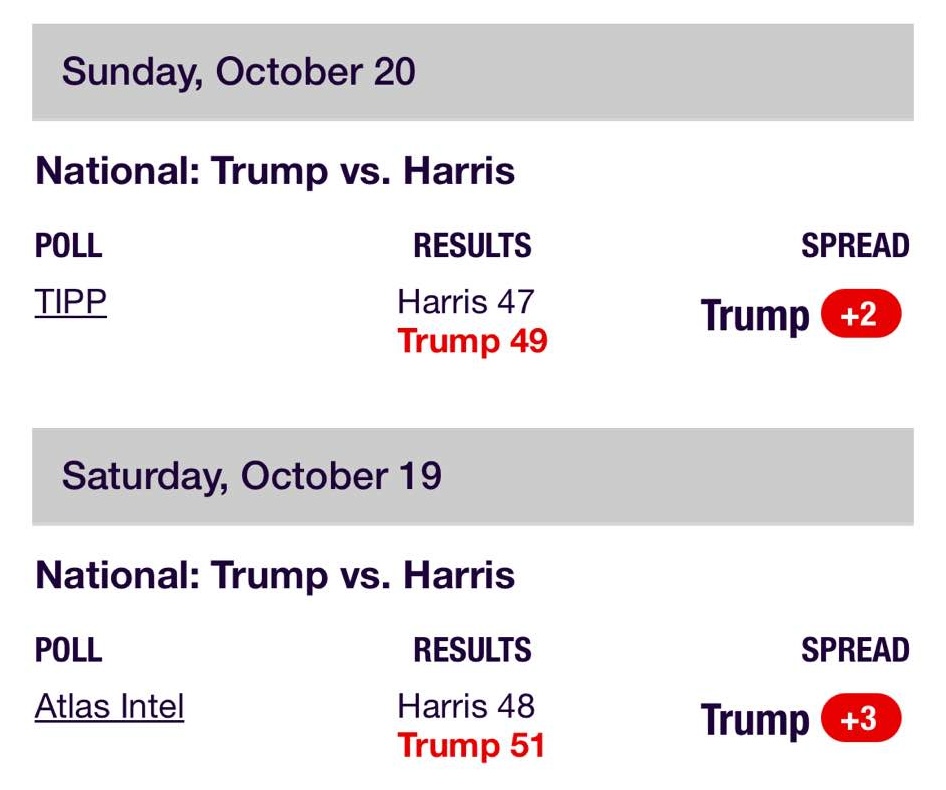
Trumps rise continues. Here are the latest from FiveThirtyEight. The media line is that it’s a dead heat. For reasons I explained yesterday, probably not.
On Thursday of last week (October 17, 2024) I presented a section of a developing manuscript on the legacy of the Black Panthers at the conference Social Change and Resistance: Looking Back to Move Forward organized by the Mid-South Sociological Association (their 50th Anniversary as an organization). The published title of my talk “From Civil Rights to Armed Resistance to Community Empowerment: The Rise and Fall of the Black Panther Party.” The subtitle of my talk was meant to communicate the fall and its legacy. As with organized labor, black liberation has been coopted and negated by corporate power. I am sharing here my prepared remarks with some embedded links to relevant sources.
A decade ago, I published a lengthy encyclopedia article on the Black Panthers in Heith Copes and Craig Forsyth’s Encyclopedia of Social Deviance. I am presently expanding that article into a long-form essay or, possibly, a short book, that explores the journey of black liberation from the 1960s to the present day (you can find a version of the initial treatment here: The Black Panthers: Black Radicalism and the New Left).
Today’s talk takes a section of that work in progress, wherein I explore the trajectories of two significant movements in the history of black activism and community organizing in the United States, the Black Panther Party (BPP) and Black Lives Matter (BLM). While both are rooted in a shared discourse of racial justice, differences in ideology, organization, and political engagement reveal a complex shift in how racial issues have been framed and mobilized over time, suggesting that both movements ultimately move from different standpoints. A key part of the analysis concerns the disposition of the state with respect to social movements.
I argue that to grasp the contrast between these two movements, one must consider the BPP’s history, its theoretical foundations, and the severe repression it faced—subjects covered in my earlier work and forthcoming manuscript—in contrast with the history of BLM and its acceptance by the neoliberal establishment and progressive politics, which have historically been hesitant to embrace militant discourse and praxis.
One interpretation of this acceptance is that social progress has opened the policy ground to critiques of the criminal justice system and more thoroughgoing policy considerations. Another interpretation is that corporate power, and its attendant political apparatus, find ideological advantage in coopting the rhetoric of racial justice. These are not necessarily mutually exclusive.
Source: UCLA News
The BPP was a neo-Marxist movement focused on confronting capitalist exploitation during a time of institutionalized racism and widespread police brutality. The Panthers endured significant state repression, notably through the FBI’s COINTELPRO program, which sought to disrupt and disorganize the BPP through a campaign of disinformation, infiltration, surveillance, and violence, aiming to neutralize the organization by sowing internal discord, undermining its leadership, and bringing disrepute to black liberation movements. J. Edgar Hoover’s description of the BPP as “the greatest threat to the internal security of the country” underscores the extent to which the state viewed the BPP’s Marxist platform as a threat to capitalist stability. There were other targets of COINTELPRO operations, such as the Nation of Islam (NOI). Both the Panthers and NOI, despite significant differences—in particular, the later focused on black separatism—were attempts to build autonomous governance structures from the majority white establishment.
Founded in 1966 by Huey P. Newton and Bobby Seale, the BPP was a Marxist-Leninist organization committed to revolutionary change, advocating armed self-defense and organizing community programs like affinity-based education, free breakfasts, and health clinics in underserved Black communities. The BPP viewed racial oppression as inseparable from capitalist exploitation. Influenced by thinkers like Frantz Fanon, party theorists saw black communities as internal colonies, dominated by the US ruling class, which exploited black labor and maintained control through poverty and police brutality. This intersection of capitalism and white supremacy justified the BPP’s call for revolutionary socialism and self-defense, positioning them against capitalist and state power.
Perhaps no figure illustrates the depth of state hostility towards the Panthers more than Fred Hampton, the charismatic Chicago leader who was assassinated by the FBI and local law enforcement in 1969 in an operation led by Ed Hanrahan, the State’s Attorney of Cook County. His actions, in coordination with the FBI, resulted in the deaths of Hampton and Mark Clark, leader of the Peoria chapter. Hampton’s murder underscored the state’s fear of a revolutionary black movement capable of challenging capitalist power structures. The BPP’s history is thus one of courageous resistance met with violent state repression.
To briefly locate this history in the social structural dynamic to draw the contrast of contexts, the milieu in which the Panthers emerged was organized by broader economic shifts driven by the transnationalization project, marked by outsourcing and immigration, developments that eroded job opportunities for black workers, which, combined with Great Society programs that encouraging reliance on public assistance, idled young men and pushed them out of the household, disorganizing further already disorganized urban communities. (This development accompanies the institutionalization of the black civil rights project. See A Note on Desegregation and the Cold War.)
Joblessness, structural inequality, and family disintegration fueled a rise of crime in black-majority inner city neighborhoods, which the Panthers in part moderated through truces negotiated among street gangs and developing and administering on the ground social supports. Indeed, after the destruction of the Panthers, with inner city conditions continuing to deteriorate amid the mounting crisis of late capitalism, gang violence returned and escalated over the next two decades, associated with the vast expansion of the criminal justice apparatus. (See Scaling Up Reaction Formation: The Case of the Ghetto.)
BLM, which gained national prominence in 2013 following the acquittal of George Zimmerman in the killing of Trayvon Martin. BLM gained further momentum after the 2014 shooting of Michael Brown in Ferguson, Missouri, which sparked widespread protests and debates about police brutality and racial inequality. The shooting became a defining moment for BLM, galvanizing a national movement around the idea of systemic racism in law enforcement. (See my recent Ferguson Ten Years Later.)
Founded by Patrisse Cullors, Alicia Garza, and Opal Tometi, BLM positioned itself as the voice of a new generation fighting against police violence and systemic racism. Unlike the BPP, BLM has operated in a political landscape where the ideas of racial justice and reform are more palatable to those in power. The support it has received from corporate entities and its alignment with political figures, particularly within the Democratic Party, represents a stark departure from the antagonistic relationship between the Black Panthers and the state apparatus. Moreover, unlike the BPP, BLM’s arguments and rhetoric regarding criminal justice reforms have become to some degree institutionalized. This has occurred as counterintelligence efforts have shifted attention from populist left movements to populist right movements framed by a narrative of resurgent white supremacy.
In 2020, Zach Goldberg, then a PhD candidate in political science at Georgia State University, argues in the pages of Tablet that, years before Trump’s election, the media significantly increased its coverage of racism and adopted new theories of racial consciousness (“How the Media Led the Great Racial Awakening”). He writes, “In the wake of the protests, riots, and general upheaval sparked by the police killing of George Floyd in Minneapolis, the United States is experiencing a racial reckoning. The response from America’s elite liberal institutions suggests that many have embraced the ideology of the protesters.”
Writing in the moment, Goldberg observes: “Countless articles have been published in recent weeks, often under the guise of straight news reporting, in which journalists take for granted the legitimacy of novel theories about race and identity. Such articles illustrate a prevailing new political morality on questions of race and justice that has taken power at the [New York] Times and [Washington] Post—a worldview sometimes abbreviated as ‘wokeness’ that combines the sensibilities of highly educated and hyperliberal [by which I understand him to mean progressive] white professionals with elements of Black nationalism and academic critical race theory. But the media’s embrace of ‘wokeness’ did not begin in response to the death of George Floyd. This racial ideology first began to take hold at leading liberal media institutions years before the arrival of Donald Trump and, in fact, heavily influenced the journalistic response to the protest movements of recent years and their critique of American society.”
Goldberg proceeds by way of content analysis of several publications, including the Los Angeles Times and Wall Street Journal, in which the jargon taken for granted during the summer of 2020, was rolled out during the Obama presidency, emerging around 2011. Academics terms proliferated—“microaggressions,” “institutional/structural/systemic racism,” “racial disparity(ies)/gap(s)/ inequality(ies)”—as well as increasing frequency of terms such as “white people,” “whiteness,” “white privilege/racial privilege,” “racial hierarchy(ies),” “white supremacy(ism/ists),” and “racism/racists.” These terms were amplified in other print media, in search engines results, and on social media platforms. The drastic rise of racial rhetoric drove public concern across political groups. (They did the same thing with gender. See Gender and the English Language.)
One may argued that the Democratic Party leveraged the perception these terms created to sidestep addressing the deeper economic inequalities affecting both black and white working-class populations, issues that surfaced during Occupy Wall Street in 2011 in response to the 2008 financial crisis and subsequent recession. Occupy Wall Street framed the struggle as between the “1%” and the “99%.” After initially ignoring the movement, coordinated law enforcement crackdowns resulted in arrests and the violent clearing of protest encampments, drawing criticism from civil liberties groups. There was thus a need to pivot from class-based to race-based politics, to obscure the economic focus central to the BPP’s platform. From an elite standpoint, BLM and identity politics provided a timely diversion, fitting the political moment while distracting from broader critiques of economic inequality. (January 2012 speech Theorizing the Moment: Occupy Wall Street.)
Though Cullors and Garza identified as “trained Marxists,” BLM’s focus is on racial justice within existing institutional frameworks rather than the abolition of capitalism. Unlike the BPP, which demanded community control and an end to capitalist exploitation, BLM emphasized narrow reforms, stopping short of a revolutionary challenge to the economic system. The call to defund the police aligns with this more reformist agenda, focusing on restructuring rather than dismantling the institutions that perpetuate inequality and, in turn, drive crime and the need for public safety measures.
BLM’s integration into mainstream politics has drawn criticism from prominent left figures like Adolph Reed Jr., Cedric Johnson, and Jodi Dean. They argue that BLM’s style of politics emphasizing on identity politics makes it susceptible to absorption into the neoliberal framework. Indeed, BLM’s corporate sponsorship underscores its alignment with the capitalist framework. After George Floyd’s murder, BLM received significant corporate backing, with companies like Amazon, Coca-Cola, Facebook, Google, and Nike pledging billions to racial justice initiatives. Professional sports teams and athletes also became vocal supporters. Leagues like the NBA, NFL, MLB, and MLS incorporated BLM messaging, with players wearing slogans like “Black Lives Matter” and “End Racism,” and kneeling during the national anthem to protest police brutality and systemic racism. These actions are critiqued as performative, leveraging the movement for branding purposes. (See Corporations Own the Left. Black Lives Matter Proves it and What’s Really Going On with #BlackLivesMatter).
Therefore, one possible explanation for corporate and mainstream political support lies in the way BLM’s messaging around racial justice aligned with broader cultural shifts in corporate responsibility and diversity initiatives. From a Gramscian perspective, corporate endorsement of BLM allowed companies to align with a popular social cause without addressing the structural economic inequalities their own practices contribute to. This aligns with what Gramsci described in his Prison Notebooks as a hegemonic project, where opposition isn’t just suppressed but coopted and led. Similarly, for the Democratic Party, BLM’s emphasis on police reform and social justice provided a way to appeal to younger, more progressive voters, positioning the party as a champion of racial equality while sidestepping deeper critiques of capitalist exploitation, which movements like the Black Panthers had prioritized.
* * *
The BPP had a nuanced view of the nuclear family that reflected its broader revolutionary goals. While the BPP critiqued the traditional nuclear family structure, particularly in its patriarchal form, it did not outright reject the family unit. Instead, they reimagined it within a collective framework that aligned with Marxist ideology.
In traditional Marxist theory, the nuclear family is viewed as a product of capitalist society, reinforcing private property, patriarchy, and individualism. The BPP, drawing on these ideas, saw the nuclear family, especially when shaped by capitalism, as potentially oppressive, particularly to women and children. They viewed the traditional family as a space where capitalist and patriarchal values were often reproduced, including rigid gender roles and the subordination of women. At the same time, they critiqued the systemic forces—poverty, racism, and state violence—that harmed black families, leading to the breakdown of community structures.
The BPP prioritized women’s liberation within their movement, rejecting traditional gender roles and advocating for women’s participation in leadership and decision-making. This stance naturally conflicted with the idea of the nuclear family as a patriarchal institution. Many prominent women in the BPP, such as Elaine Brown, contributed to shaping this vision, which placed the liberation of black women on equal footing with the broader struggle against capitalism and racism.
BLM, on the other hand, explicitly critiqued the nuclear family, particularly its patriarchal form, as part of its foundational ideology. In early versions of its platform, BLM stated their commitment to “disrupt the Western-prescribed nuclear family structure,” which they argued was a tool of oppression that enforced rigid gender roles and upheld patriarchal and heteronormative values. Instead, BLM promoted extended kinship networks and “villages” that would raise children and support each other outside of the traditional nuclear family model.
This stance drew criticism from conservative commentators who saw it as an attack on the family structure itself. BLM later softened or removed some of this language from its public platforms. Their emphasis was on creating inclusive family structures that recognized the roles of extended families, non-binary individuals, and same-sex partnerships, as well as supporting single-parent households, especially in marginalized communities.
While both BPP and BLM shared a critique of patriarchy and recognized the ways that the nuclear family could perpetuate inequalities, BLM’s position was more directly aligned with dismantling the nuclear family as part of a broader challenge to heteronormative and patriarchal systems. BLM explicitly linked the dismantling of patriarchal family structures with broader LGBTQ+ and feminist goals. BPP was more focused on reconstructing family life within a collective framework that emphasized community solidarity.
* * *
BLM’s integration into elite institutions may also be understood through the lens of a “color revolution,” where revolutionary rhetoric is simultaneously manufactured and channeled into maintaining the status quo. A color revolution refers to a form of non-violent and violent resistance or protest movements aimed at influencing regime change. These movements are typically associated with the Orange Revolution in Ukraine (2004) or the Rose Revolution in Georgia (2003), which were named after their distinctive symbols or colors associated with the protest. We also saw this with the Arab Spring, which emerged in 2010. They rely on civil disobedience, grassroots activism (often astroturf), and mass mobilization, and they often seek to unseat governments seen as authoritarian, corrupt, or illegitimate.
The popular narrative is that color revolutions are organic phenomenon, but those who follow these developments closely see something different: the role of foreign intervention, NGOs and Western governments, in particular the CIA and other national security state actors. These observers argue that movements can be manipulated and even orchestrated by external powers to advance geopolitical interests rather than genuinely democratic or local aims. This is where the concept intersects with ideas about “manufactured revolution,” where revolutionary energy within a population is co-opted by external actors to destabilize a regime without necessarily creating substantive democratic or populist reforms. We most recently saw this in Ukraine in 2014, where the CIA or other Western intelligence agencies supported far right elements in Ukraine during the 2014 Euromaidan protests and the subsequent conflict (see History and Sides-Taking in the Russo-Ukrainian War).
In recent years, the term “color revolution” has been broadened to describe perceived attempts to undermine or destabilize regimes in a way that benefits transnational interests, especially in opposition to nationalist or populist movements. Governments facing such protests sometimes frame them as being instigated by foreign powers to delegitimize domestic dissent. The connection to the BLM movement in some critiques relates to concerns about the manipulation of grassroots energy by elites to channel frustration into controlled opposition that ultimately aligns with corporate or political establishment interests, rather than radical change.
Claims that BLM may be part of a “color revolution” narrative, manipulated by elites or serving establishment interests, come largely from populist and anti-establishment voices on both the left and the right. Prominent figures and thinkers have advanced these critiques. These critics argue that, even if we assume that BLM began as a genuine grassroots movement against police brutality and systemic racism, it has since been co-opted by corporate, political, and media elites who have shaped its messaging and goals in ways that align with their broader agendas. This view often posits that BLM’s energy was directed away from systemic change and toward reinforcing the power of existing political institutions, particularly the Democratic Party.
Darren Beattie, founder of Revolver News, has explicitly linked BLM to “color revolution” tactics. Beattie’s argument is that BLM protests, along with the broader unrest of 2020, were part of an orchestrated effort to undermine the populist movement and create political instability that benefited Democrats. Michael Benz, a cybersecurity expert, has drawn comparisons between BLM and CIA racial operations in Third World countries.
Evidence supporting these claims centers on many of the observations already made here corporate sponsorship and close alignment with the Democratic Party. With respect to the latter, BLM’s messaging and activism aligned closely with Democratic campaigns, particularly during the 2020 presidential election. BLM leadership, especially figures like Patrisse Cullors, have been criticized for their closeness to Democratic elites and fundraising strategies. However, Cullors has publicly stated her alignment with progressive causes within the Democratic framework, which confirms the movement’s institutional entanglement.
* * *
Elite support served to blunt the momentum of populist, class-based movements that threatened the established economic order and progressive political hegemony. By channeling popular energy into the more manageable discourse of racial justice, BLM’s rise helped deflect attention from broader critiques of economic inequality and class oppression as the Democratic Party moved close to corporate power and the Republican Party fractured along intraclass lines. BLM’s focus on identity politics allowed corporations and political elites to signal their commitment to social justice without confronting the underlying class dynamics that perpetuate inequality. By emphasizing racial injustice through academic terms such as “white privilege” and “structural racism,” elites redirected populist anger away from the failures of neoliberalism and toward identity politics and a seemingly radical politics that does not threaten the corporate state structure. This alignment thus effectively neutralized the potential for a more radical, class-based movement that might have challenged corporate power or sought systemic change beyond the realm of police reform.
My critique notwithstanding, the BPP’s Marxist revolutionary platform directly challenged the economic and political order of the United States, seeking to unite worker liberation with the overthrow of capitalism. BLM, despite radical rhetoric, has been co-opted by corporate interests and operates within a framework that diverts attention from class struggle—indeed, it may have been organized to achieve this purpose. The corporate sponsorship, academic backing, and political alignment with the Democratic Party suggest that BLM serves to maintain the capitalist system rather than threatening it. While the BPP was repressed by state forces through programs like COINTELPRO, BLM is free to operate within the capitalist order, at the very least raising questions about its role in sustaining the very structures its supporters claim it opposes.
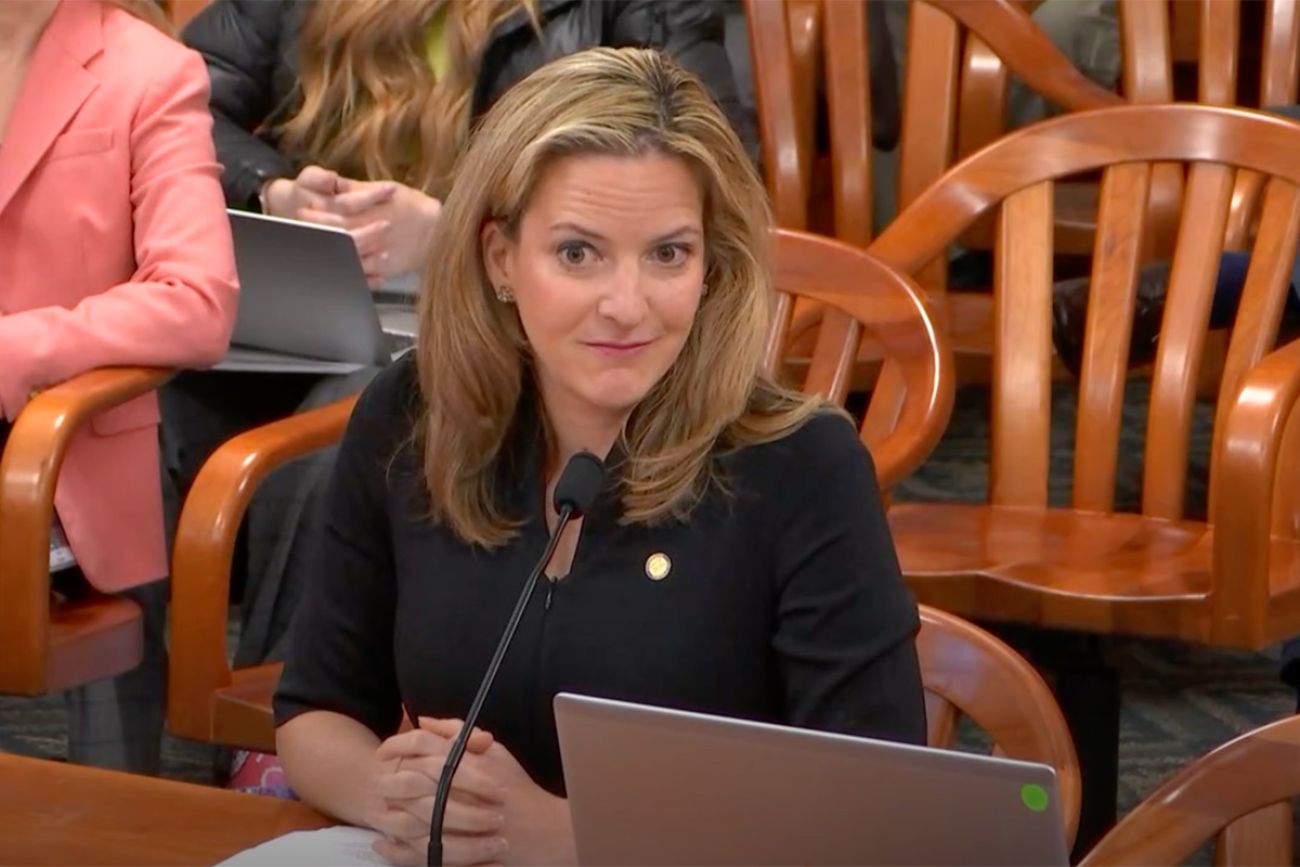
Secretary Jocelyn Benson says that her office “know adversaries to democracy right now are trying to create chaos and confusion and sow seeds of distrust around our very clear and legitimate and accurate and secure processes of running elections, not just in Michigan but around the country. So it’s incumbent upon all of us to look to trusted sources of information like your local election official and use data to evaluate questions, as opposed to people who are running social media companies with particular agendas and who have a history in amplifying conspiracy theories and false information. So in this moment, it will be my responsibility, and really everyone’s, to look and promote and amplify trusted information about our elections so that people can know both where to go with questions and also have faith in the results.” She told the host of Face the Nation that Michigan has set up a website that addresses every single question people have raised and “encourage citizens to go there, as opposed to social media for seeking trusted and accurate information about our elections.”
Jocelyn Benson, Michigan Secretary of State
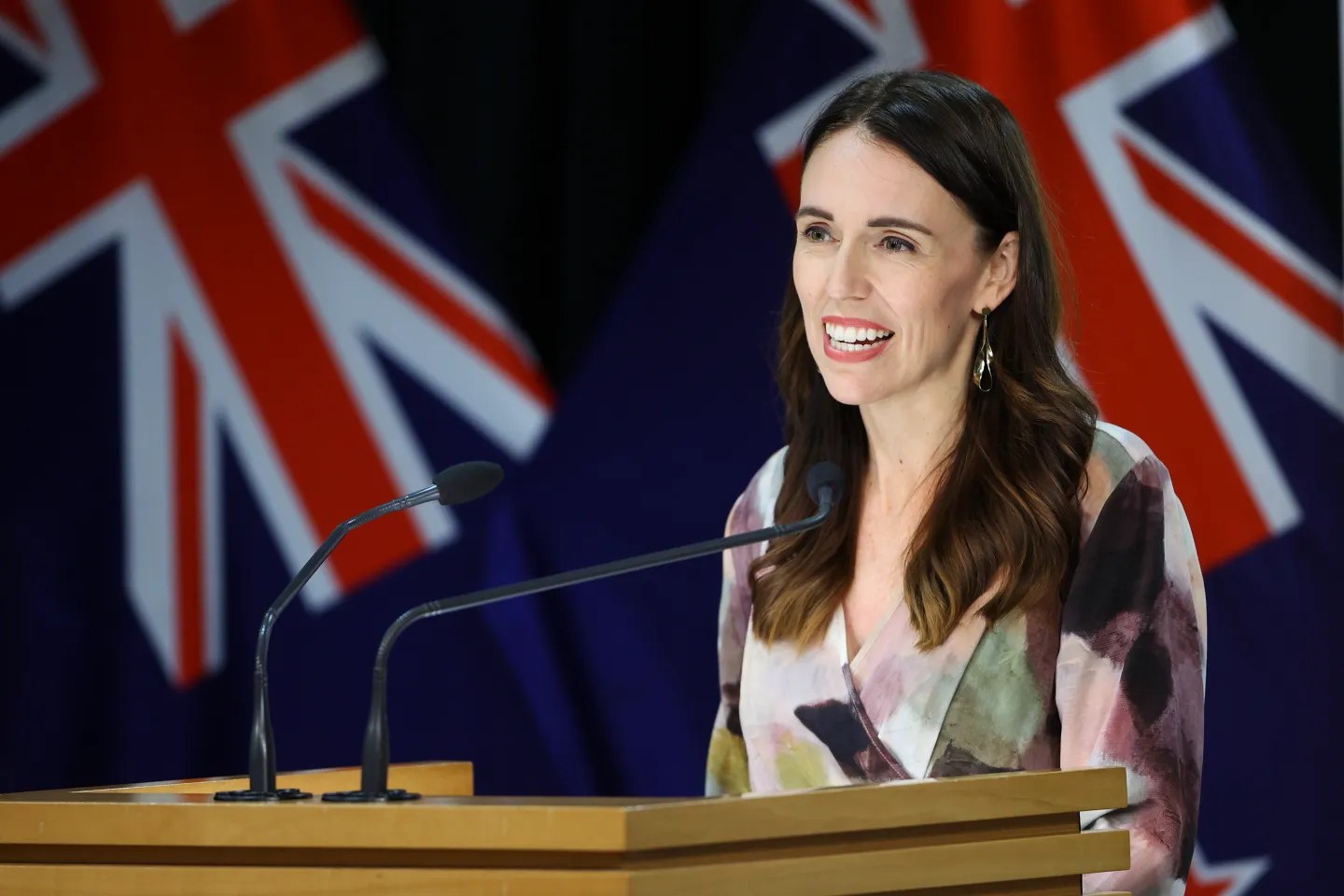
Who are the “adversaries of democracy”? The American people and that other party. How about this term “trusted source”? Remember Jacinda Ardern, Prime Minister of New Zealand, telling New Zealanders to not trust anybody or anything but her and the government of New Zealand? Same thing. “We are your single source of truth,” she said. She set up a website that New Zealanders were directed to use exclusively. Benson says it is our responsibility to “promote and amplify” so-called “trusted sources.” Different state. Same shit. This is the same “trust the science” and “listen to the experts” propaganda they used to lock you in your homes, make you wear a mask, and scare you into injecting into your bodies an mRNA gene therapy developed by the military-industrial complex (arguably the greatest medical scandal in history).
Jacinda Ardern, former Prime Minister of New Zealand
You can trust your government no more than you can trust the Catholic Church or any other power that stands over you. This is the bottom line for a rational being: its default is set to disbelief. You cannot trust your public health department and you cannot trust your local election official. If the latter were trustworthy, then they would demand voter ID and proof of citizenship. There would be no dropboxes, no postal voting, no other scheme to stack vans with votes. Just like the voting machine companies not letting the public see the guts of the devices that record its votes—the government has thrown people in prison who try—they want you gullible or scared. That they aggressively work against election integrity screams corruption.
When government is not transparent, you can safely assume the government is deceiving you. Governments aren’t citizens. Citizens have rights. Governments have powers, and in a free and open society, these powers are vested in them by the citizen. Citizens have a right to keep their thoughts and papers to themselves. They also have the right to see what the government is doing. The government has no right to keep anything from the people.
Until 2020, we almost always knew who won the election the same day we voted. France counts all the votes the day of the election, and France is bigger than every state in America. As of the most recent estimates, France’s population is around 68 million people. In comparison, the most populous US state, California, has a population of approximately 39 million. Why can’t a state the size of Michigan count all the votes by the evening of the day of voting?
There are moments in our history where we did not know the results right away, and the facts surrounding them are instructive.
In 1960, the race between John F. Kennedy and Richard Nixon was extremely close, with the result hinging on a few key states. Although Kennedy was declared the winner the night of November 8, it took several days for recounts and challenges to be settled. It appears now that Nixon probably won that election. Democratic Party cheating was rampant in Illinois (Chicago) and Texas. Those around him urged him to contest the election, but he resisted.
Nixon was declared the winner in Hawaii by a narrow margin, but after a recount requested by the Democrats, Kennedy was awarded the state’s three electoral votes. The controversy over Hawaii’s electoral votes extended into December, with both slates of electors—a slate for Nixon and a slate for Kennedy—cast votes. When the results were certified in early January 6, 1961, Congress ultimately counted the electors for Kennedy.
The election did not hinge on Hawaii, but you might have noticed something interesting about the case. You read that right: two slates of electors. Was anybody prosecuted? No. Why not? Because that’s the way federal law worked until after the 2020 election, when Democrats and establishments Republicans quietly changed the law (see The Project to Entrench Establishment Power: “Clarifying” the Electoral Count Act).
In 2000, in the contest between George W. Bush and Al Gore, the result wasn’t known until more than a month after Election Day, due to the Florida recount and a Supreme Court decision in Bush v. Gore, which effectively decided the election on December 12. For the record, I said then and I will still say now that 2000 was a stolen election. Gore was right to context the results and wrong to give up when he did. It’s okay to say that elections are rigged and stolen because Democrats had no qualms about saying 2000 was stolen.
In 2004, in the contest between Bush and John Kerry, Democrats once more told us that election denialism was fine. And they were probably right that the election was stolen. While Bush was eventually declared the winner over John Kerry on the morning after Election Day, uncertainty about Ohio’s results lingered into the following day. Kerry didn’t concede until November 3 after it became clear that Ohio’s results wouldn’t change. I thought Kerry gave up too early. Ohio’s results stunk like a fish market.
In 2020, allegedly due to the high number of mail-in ballots during the COVID-19 pandemic, counting in key states like Arizona, Michigan, and Pennsylvania continued for several days. The result wasn’t projected by major news outlets until November 7, when Joe Biden was declared the winner over Donald Trump. Can we say that election was rigged and stolen? No. Democrats have declared it treasonous to say that elections are rigged or stolen. They sicced the police state on conservatives who said so. Because they said so, submitting an alternative slate of electors in 2020 became a criminal offense.
I do have this feeling that after November 5, if Trump wins, election denialism will once more be okay.
Everyday the gap shrinks. Above is FiveThirtyEight’s poll of polls. As readers can see, it’s not so much Harris sinking (she is) but Trump rising. For those out there who take refuge in the two-point lead for Harris, remember that she needs to be well outside the margin of error to win this election because (a) polls drastically undercount Trump’s support and (b) the Electoral College.
A significant number of Trump supporters won’t declare their support for Trump on surveys because of social desirability bias. This occurs when people alter their responses to appear more favorable or socially acceptable. In the context of polling, some respondents give answers they believe will make them appear more aligned with social norms, even if those answers don’t reflect their true feelings. This can skew poll results, as it leads to underreporting of controversial or socially disapproved opinions. Trump has been demonized such that some people will not admit they support him.
Moreover, polls oversample Democrats, since a lot of working class people are not home or don’t have the time to respond to polls. Since the Republican Party is the party of working class people, this also skews the data. Trump is almost certainly in the lead nationally when these factors are considered.
The New York Times finds the same trend as FiveThirtyEight. Its poll finds the race even tighter:
Trump is more popular now than he was in 2020 or 2016. What is more, Trump was more popular in 2020 than in 2016—which is why he won more than ten million more votes in 2020 than in 2016.
BREAKING: CNN admits that Trump is more popular at this point in the campaign than during either his 2016 or 2020 campaigns. pic.twitter.com/CdguX3vDHP
There’s at least one obvious reason for this shift. The percentage of Americans who say they have a great deal or a fair amount of trust in the mass media has trended sharply downward over the years, according to a recent Gallup survey.
People are realizing every day that the media (as well as academia and the culture industry—which is why celebrity appeal is not working for Harris) is progressive propaganda and properly losing their faith in the legacy institutions and popular culture that have grown up around the corporate state to control mass consciousness. As they lose their faith in this domain they see Trump more clearly. What they see in place of a monster is a self-made man from Queens with liberal sensibilities and a wicked sense of humor. They like that.
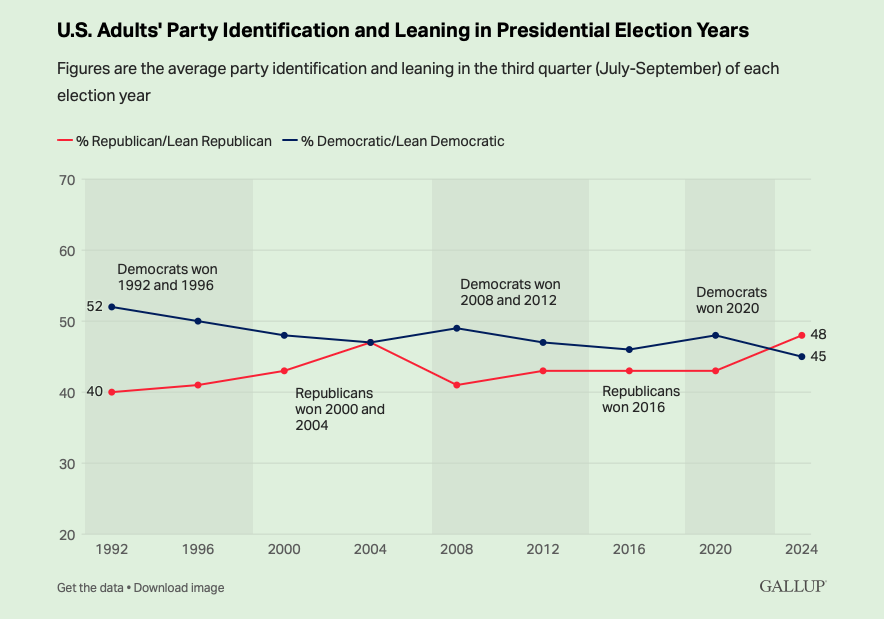
They also see more clearly that the Republican Party is shifting emphasis towards the democratic-republican principles and classical liberal values that underpin the American Republic. This is the attraction of populist-nationalism over against the corporate statism of the Democratic Party and progressive ideology. As a result, more Americans identify or lean Republican than they do Democrat, 48 to 45 percent respectively. Again, social desirability bias likely means that the gap is much greater than indicated by this poll. Moreover, by a five point margin, Americans believe that the Republican Party is better able to handle most important problems facing America, according to Gallup.
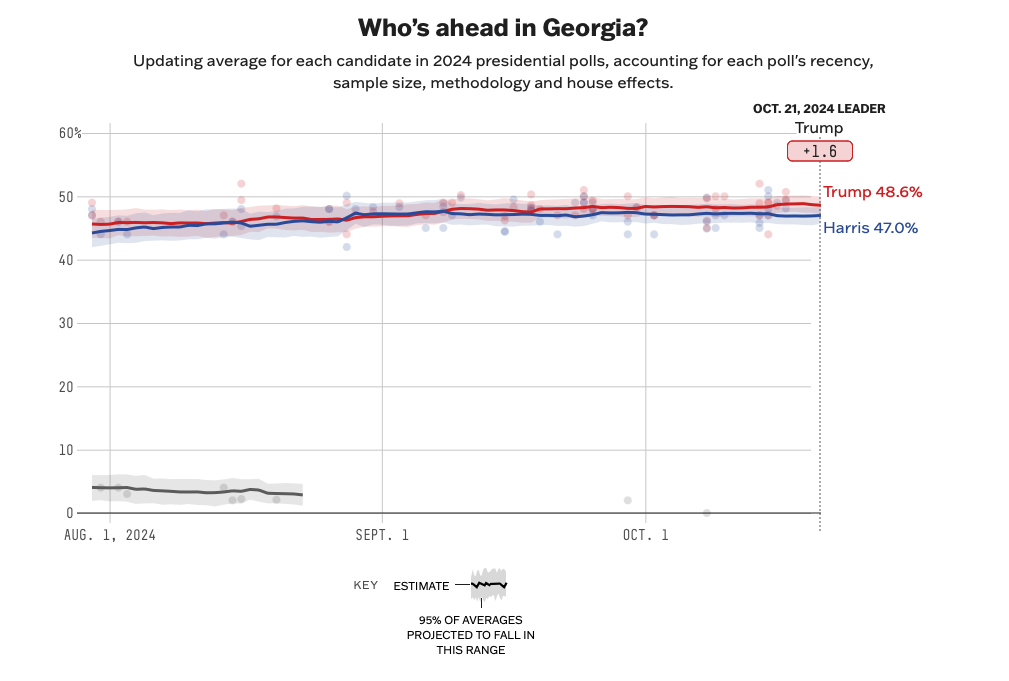
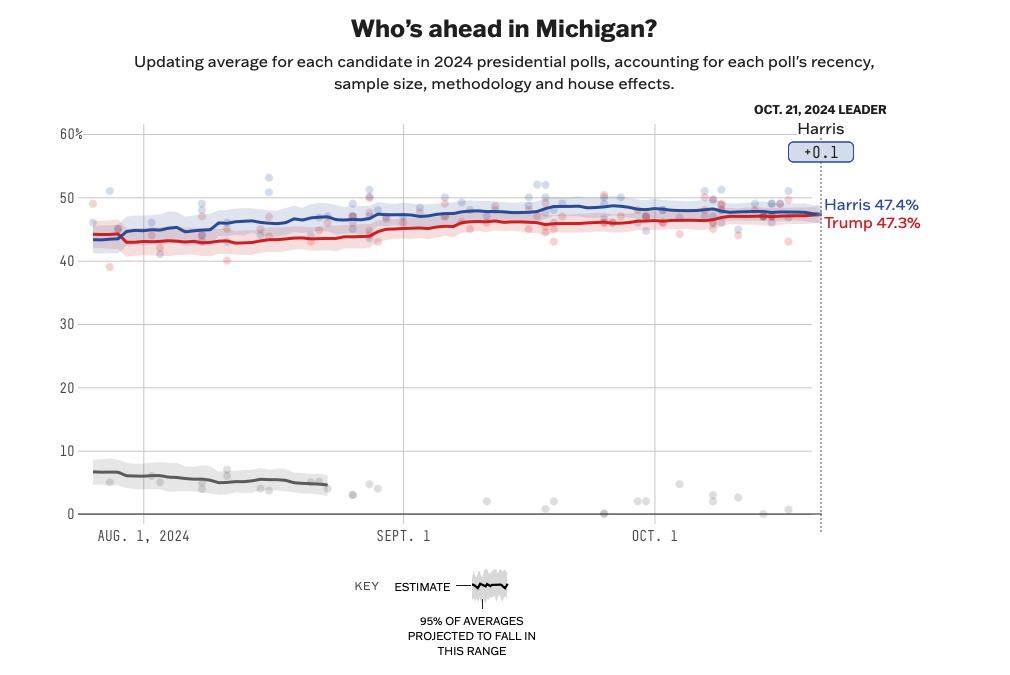
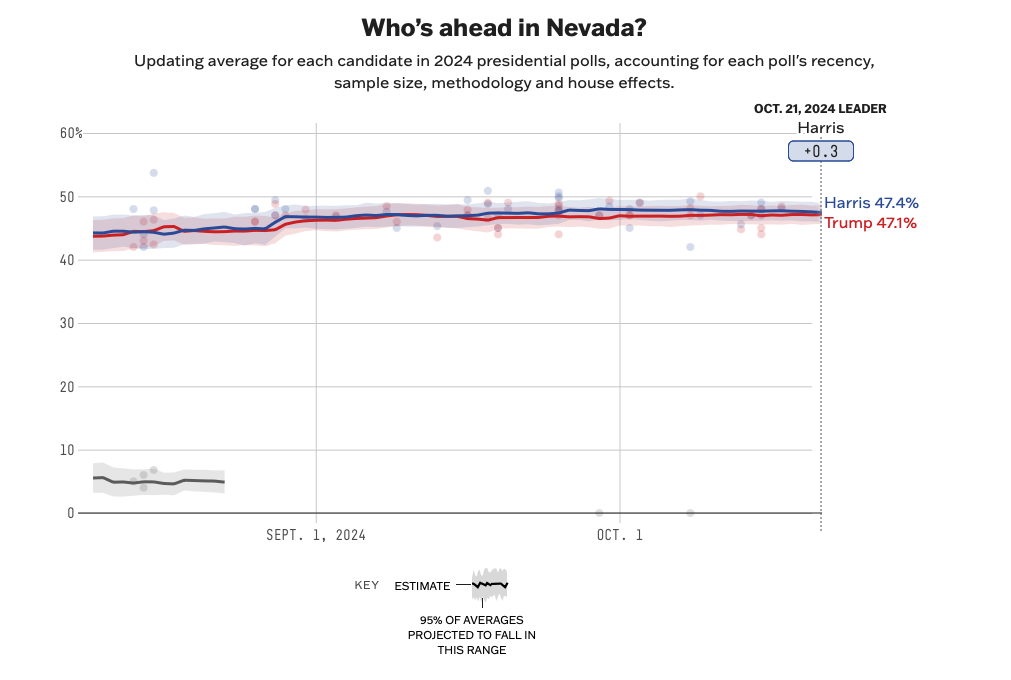
This is the situation in which the Harris campaign finds itself in the battleground states. Trump won 2016 and very like 2020 even though both Clinton and Biden were way up in the polls at this point in the election cycle. For example, Biden is shown here winning Wisconsin by 6.2 percent. On Election Day, he only won by only a few thousand votes. Officially.
In the 1960s, the percentage of foreign-born people in the United States was relatively low compared to earlier periods in American history and compared to today. In 1960, approximately 5.4 percent of the US population was foreign-born, while the remaining 94.6 percent were native-born. This was a period when immigration levels had significantly decreased due to restrictive immigration laws, such as the Immigration Act of 1924, which established national origins quotas that limited immigration from many regions. In 1960, the US population was about 179 million, and estimates suggest there were around 200,000 to 500,000 illegal immigrants. This means that illegal immigrants constituted roughly 0.1 to 0.3 percent of the total population at the time.
The immigration landscape changed dramatically after the passage of the Immigration and Nationality Act of 1965, which abolished these quotas and set the stage for an increase in immigration in subsequent decades. As of 2023, about 14.3 percent of the US population is foreign-born,. This figure has been increasing steadily over the years and represents the highest proportion in over a century. In 2024, with an estimated US population of about 334 million and, using the lowest estimates (provided by DHS) of 11 to 12 million, illegal immigrants now make up approximately 3.3 to 3.6 percent of the population. If higher estimates of 20 to 25 million illegal immigrants are used, they make up approximately 6 to 7.5 percent of the US population in 2024. Whichever number we go with, the percentage has clearly grown, reflecting changes in immigration policy, birder enforcement, and migration trends over the decade.
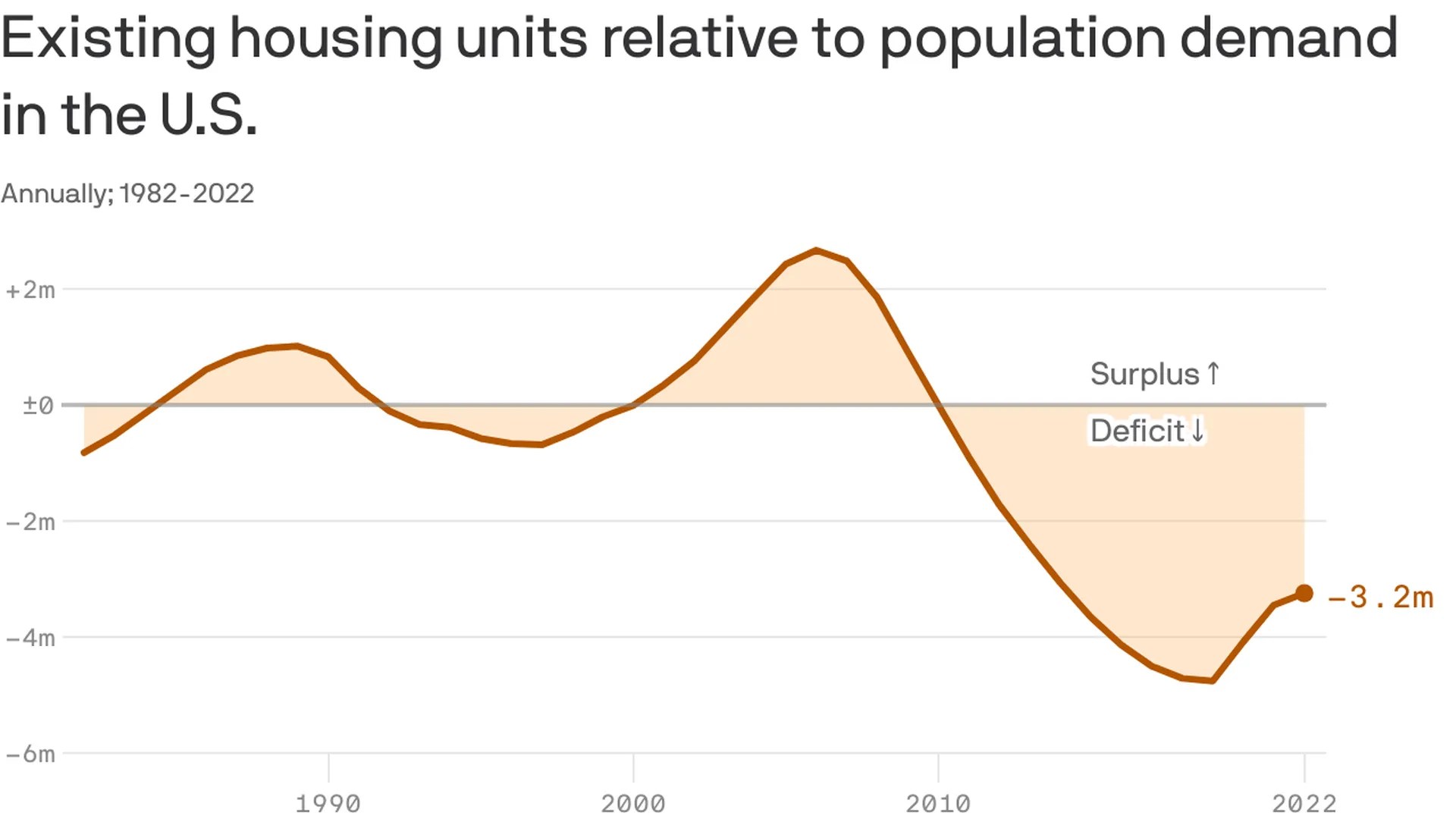
It is understood that the US faces a shortage of millions of affordable homes, especially for low- and middle-income renters. Estimates I have seen suggest a shortfall of 3 to 5 million homes. This shortage has driven up housing prices, making it harder for people to buy homes. It has also contributed to rising rents in many cities, exacerbating the situation. In 1960, the median home price was about $12,700, which, adjusted for inflation, equals approximately $111,760 in 2024 dollars. By comparison, the median home price in 2024 is estimated to be around $416,100, quadrupling of housing prices.
By the 1960s, United States had experienced a post-war housing boom, with a relatively high availability of affordable single-family homes, partly due to government programs like the GI Bill, which helped many veterans buy homes. Fast forward to recent years, the housing market has faced a critical shortage. Based on basic supply and demand principles, assuming the number of housing units remains constant, having millions fewer people in the United States would increase housing availability and bring down prices for native-born Americans and those foreigners legally in our country.
All these figures are easily available on the Internet. It takes only a few minutes to figure all this out. So, ask yourself, why doesn’t the mainstream media explain this to the American people? The answer is simple: the corporate media is part of the project to fundamentally change the demographic composition of the United States, to disorganize its communities and culture, undermine national integrity, and provide a dependent constituency for the permanent rule of the Democratic Party and its fellow travelers in the Republican Party. These are the transnationalists, and cultural pluralism is their strategy to realize their vision of a one world government run by global corporations. (I have written about this extensively on Freedom and Reason. Here is an example from January of last year: An Architect of Transnationalism: Horace Kallen and the Fetish for Diversity and Inclusion.)











 freedom and reason