Academic Anti-Communism

There was an article published many years ago in The Insurgent Sociologist concerning propaganda materials produced by corporations and right-wing academics for use in elementary schools. The propaganda was used in the indoctrination of children in free market ideology. The material discussed the benevolent firms that generously give families food, clothes, televisions, and, of course, jobs. The exploitation of labor power was conveniently left out of the materials, as was the widespread environmental destruction and poverty caused by capitalist relations. The reason for the omission was obvious: why would capitalist-produced propaganda explore exploitation and environmental destruction?

My recent conversation with Steven Barnes, an assistant professor from George Mason University who specializes in the GULag, moves me to write this entry. Barnes takes issue with my posts criticizing Solzhenitsyn. Recall my entries on conservative economist Walter Williams, the man who asks his students exam equations drawn from Old Testament material. Walter also works at George Mason University. So do a large number of right-wing intellectuals. George Mason University is a magnet for right-wing moneybags and is highly influential in producing the propaganda used by bourgeois elites to misdirect Americans. (You can read the record here: Source Watch: George Mason University and here: Media Transparency: George Mason University).

Does this mean that everybody who works at George Mason University is a right winger? Of course not. However, people choose the institutions with which they affiliate, and the ideological character of institutions is relevant in considering the ideological bent of any particular intellectual working there. I chose the department in which I was tenured because it is a critical historical social science unit concerned with progressive democratic politics, civil rights and social justice. One would be right to consider this fact when assessing my politics and scholarly approach. As I always emphasize: consider the source.

In learning about who Steven Barnes is, I ran across a teacher’s workshop, conducted in the spring of 2008 at Duke University (a private religious college), designed to teach high school and middle school teachers how to, in turn, teach students standard anti-communism by comparing the Soviet prison system to the Nazi death camps. I discovered this program because Barnes is on it, his presentation titled “Behind Barbed Wire: The Gulag and the Shaping of Soviet Society.” In participating in the workshop, Barnes is fulfilling one of the thrusts of George Mason University, specifically to organize public schools in the teaching of scientific and historical materials, such as standardized materials approved by the Virginia state legislature. Close to Washington DC, George Mason University helps design the elements of thought that become embedded in national educational standards. Hopefully you can see where I’m going with this; the Duke program reminded me a lot of the corporate materials presented in The Insurgent Sociologist article I mentioned.

Barnes discusses the character of the April 5 Duke event in his comments to this entry, so I will leave him to tell you about that. I wasn’t present at the workshop (I would have been a nuisance), so I am not going to characterize the content of the contributions. What I am interested in is the program description and the way in which it distorts history for ideological purposes. I suppose I could engage in criticism of Barnes for participating in the event, but it is his area of specialization, he is building a record towards tenure, and the event in question is of the sort that his institution looks kindly upon. I won’t begrudge him career advancement. This entry is about institutions and agendas not personalities.

Here is the copy from the Duke program:

The Center for Slavic, Eurasian, and East European Studies at Duke University is pleased to invite you to participate in a unique one-day workshop on Saturday, April 5: REMEMBERING THE GULAG.

The GULAG — the prison camp system that arose in the Soviet Union after 1929 — served primarily as a way to gain control over the entire population, rather than punish criminal acts. The incarceration of millions of innocent people in the GULAG system is correctly seen as one of the worst and most shocking episodes of the twentieth century.

Millions of innocent people were incarcerated in the GULAG, serving sentences of five to twenty years of hard labor. Prisoners in camps worked outdoors and in mines, in arid regions and the Arctic Circle, without adequate clothing, tools, shelter, food, or even clean water. We will never know how many prisoners suffered from starvation, illness, violence, and cold; an immense number of people died. More people passed through the GULAG, for a much longer period of time, than through Nazi concentration camps; yet, the GULAG is still not nearly as well known.

REMEMBERING THE GULAG is intended to introduce participants to this notorious Soviet prison system and its long-lasting effects on Russian society. We will provide middle and high school teachers who participate with the background understanding and curricular materials to introduce their students to it as well.

WHEN: Saturday, April 5, 9 a.m.-4 p.m.

WHERE: Room 320 Languages Building, Duke West Campus, Durham, NC COST: No registration fee. CSEEES is able to provide limited financial assistance for participants who travel substantial distances to attend. CONTINUING EDUCATION CREDIT: CSEEES will provide participating teachers with documentation for CE credit.

The program speakers will be drawn from leading scholars and specialists at Duke and other universities. Each talk will be followed by ample opportunity for questions and answers. The program schedule will be:

9:00 a.m.–Welcome: Dr. Edna Andrews, Director of CSEEES, professor of Slavic & Eurasian studies, Duke University

9:15–“Behind Barbed Wire: The Gulag and the Shaping of Soviet Society,” Dr. Steven A. Barnes, Professor of history, George Mason University

10:15–“‘It’s Impossible to Express’: Stories from Gulag Survivors, ” Dr. Jehanne Gheith, Professor of Slavic & Eurasian studies, Duke University

11:15–Break

11:30–Documentary film: “A Trial in Prague” (2000)

1:00 p.m.–Lunch (on your own)

2:00–“Thinking about ‘A Trial in Prague’: A Discussion of Political Terror and Stalinist Rule in Eastern Europe,” Dr. Chad Bryant, Professor of history, University of North Carolina at Chapel Hill

2:45–Break

3:00–“Camps in the Classroom: Bringing Stalin’s Gulag Alive for Your Students,” Dr. Pamela Kachurin, Professor of art history, Duke University

Curricular and other teaching materials will be distributed to all participants.

You will note a several things about the program relevant to my on-going discussion concerning the use of the GULag history for pro-capitalist propaganda purposes.

First, the not-at-all-subtle idea of the program is to make the Soviet Union appear much worse than Nazi Germany: “More people passed through the GULAG, for a much longer period of time, than through Nazi concentration camps; yet, the GULAG is still not nearly as well known.” There are two claims here: (1) more people passed through the GULag than the Nazi camp system and (2) the GULag is not nearly as well known as the Nazi concentration camps.

The numbers of prisoners who passed through the GULags runs in the millions. Whenever you incarcerate such a large number of persons in a nation as large as the Soviet Union (around 210 million in 1959 just in the Union Republics – compared to 178 million for the US that same year), the number will be large. For example, with prison and jail populations of several hundred thousand running into the millions over several decades in the US, and with average prison sentences running between 2-5 years and average jail sentences six months, the result is tens of millions of prisoners having passed through the US system since the end of the second world war (most of them non-violent offenders and many of them political prisoners, victims of the war on drugs). What about those incarcerated in Nazi camps? The Nazis operated more than 15,000 camps (maybe as many as 20,000) scattered throughout Europe housing millions of prisoners between 1933 and 1945. Records show that more than 6 million, and as many as 11 million, were killed in the Nazi camps, and many millions more were imprisoned but not exterminated.

On a comparative basis, the implication that the GULag was worse than the Nazi prison system in terms of size and scope seems implausible. Taking the period from 1935-1953 for the Soviet Union, a longer period than that of the Nazi system, adding up the numbers does not indicate more prisoners. Taking into account how large the Soviet Union was compared to the size of Germany at this time, the rate becomes much, much higher for Germany than for the Soviet Union. The deeper implication, that the Soviet GULag was worse in terms of function and conditions, is unsupported by the facts and doesn’t make logical sense. The purpose of the GULag was not extermination. It was a prison system in which the vast majority of inmates were imprisoned for non-political criminal offenses. The Nazi system was for the most comprised of individuals incarcerated because of their ethnicity (most Soviet prisoners were Russian) or their political affiliation.

On the question of whether the Holocaust is more well-known than the GULag, this strikes me as hyperbole. I can’t count the number of times when the Holocaust is being discussed that somebody says, “Well, Stalin’s Gulags were worse,” with the audience nodding in approval. The intent of the claim is obvious: communism is worse than fascism. Whenever I discuss the possibilities of socialism, Stalin and the GULags are almost always raised as reasons why socialism cannot possibly work. Never are Hitler and the Nazi concentration camps cited as a reason why capitalism is a unworkable system with respect to freedom (and Nazism is authoritarian capitalism). Moreover, while people know about the numbers of Jews killed in the camps (they have learned the 6 million figure), very few people know much at all about the Nazi prison system itself. Despite overwhelming documentary evidence of the Nazi system compared to the Soviet system, people I meet everywhere know more about the GULag than about the Nazi camp system (of course, most of what they know is wildly inaccurate, which is the point of my writing about it on my blog).

The Duke program language talks about an “immense number” of people dying in the camps, but, as we have seen, the numbers, which are bad enough, are perhaps not as extraordinary on a comparative basis. The vast majority of GULag members survived (at least one to the ripe old age of 89) and were released back into society. Of course I am not saying that people did not suffer in Soviet-era prisons. They did. They still do. Russia maintains a massive penitentiary system – only comparatively larger both in terms of history and population size. Why aren’t these historians writing about this? Why are prisons only bad in socialist societies?

I also want to emphasize that, according to research required by Deaths in Custody Reporting Act (DICRA), approximately 7,000 Americans die in US prisons and jails annually, a figure that Americans never hear about. This number comes with improved prison conditions, advanced medical treatments, and guarantees of health care for prisoners. The further one goes back in time, the worse US prison conditions become. How many people in the US hear about US prison conditions between 1935-1953? In case you don’t think about these things, people die in prisons from disease and old age in the US just as people died in prisons in the Soviet Union from disease and old age. Prison rape and other forms of interpersonal violence are/were problems in both systems.

The claim of “millions of innocent people” being sent to the camps is misleading for it assumes that acts for which persons were being incarcerated were not criminal acts. One must reckon the legally-politically constructed nature of all criminal categories. While I advocate for the release of all non-violent offenders from US prisons and jails, I would never claim that the majority of prisoners are innocent. Most people who go to prison are guilty of the crime for which they were convicted. The same was true in the Soviet period. Now, if you want to argue that the laws were improper, then be my guest. I do it all the time. I don’t think there should be any criminal laws applicable to the consumption of currently illicit substances, such as marijuana and LSD. But if you get busted with pot or acid, then you’re guilty of a criminal offense.

Let me follow up on this matter of crime and punishment, because this point is always lost or ignored in these discussions. The 2.3 million persons in US prisons and jails is not troubling merely because it is such a big number. What’s far more troubling are facts about who is in US prisons and jails. More than two thirds (70 percent) of US prisoners are illiterate (65 percent never graduated high school). Two thirds of prisoners were either earning less than 5,000 dollars annually at the time of their arrest (one third of prisoners) or weren’t earning any money at all at the time of their arrest (one third of prisoners). The US prison system warehouses the poor and uneducated. This is how the prison system under US capitalism is in the service of the US capitalist system. There were poor and uneducated persons in the Soviet prison system, as well, but there was a greater proportion of affluent and well-educated persons in the system compared to the United States. This fact is often used as a criticism of the Soviet system: the system was evil because it incarcerated smart and wealthy people.

This sensibility, almost universally expressed, represents an implicit class politics in favor of the exploiter-oppressors over against the exploited and oppressed. People do not mourn for the plight of the poor and uneducated in the United States. Indeed, the poor are despised and feared. This is part of our Calvinist/social Darwian conditioning. The fact that more than seven million persons under some form of correctional control, the vast majority of which are poor and uneducated, does not disturb Americans because middle America has been trained to hate these people. That 60 percent of prisoners are non-white is a big factor in our lack of collective outrage. We are a deeply racist nation. There is little hue and cry about the warehousing of persons our society has no use for. But if white business leaders started going to prison, then you would hear about it. If white middle class people starting being controlled by the poor and minority populations, then there would protests in the street. The fact that we lock up so many poor and uneducated people reinforces the idea that crime is mainly perpetrated by poor and uneducated people.

But most crime in the United States is not committed by the poor and uneducated. Depending on accounting, street crime costs the country between 4-14 billion dollars annually (and a lot of stolen property is recovered). That may seem like a lot of money (we spend as much or more than this on the Iraq war every week), but compared to other forms of crime, it is a minuscule amount. How minuscule? Employee theft and corporate crime account for nearly half a trillion dollars a year! Another difference between street crime and suite crime is is that the wealthy educated perpetrators of the latter don’t usually go to prison. In fact, many of the most socially and personally injurious practices that occur in US society are not criminalized at all. Why? Because they are perpetrated by rich white men and not by poor minority persons. There is no other explanation for it. It’s the wealthy white men who write the criminal law. Corporations are for the most part free to act in ways that harm people and the environment. This immunity from wrongdoing reflects the character of power in the United States.

In a capitalist society, one without the social safety net of a Scandinavian country, especially one as deeply racist as ours, the criminal justice system represses poor disproportionately minority persons. This is how the penitentiary system came into existence in the first place. The criminal justice system does not serve the interests of the majority of the population in controlling those who do the most harm, namely rich white men. The criminal justice system serves the interests of the minority of the opulent: rich white men. One would therefore expect to see under a dictatorship of the proletariat not the end of prisons but a change in the composition of those prisons, a shift from warehousing almost exclusively poor persons to punishing more affluent and educated persons.

Now we get to the so-called political prisoner. The idea you are supposed to hold is that taking privileged and educated counterrevolutionaries to prison is the supreme mark of a totalitarian society. Yet those who strive to overthrow socialism and restore capitalism aim to return social relations to the practice of exploiting human labor, which is a fundamental violation of human rights. Why should workers allow such a thing to happen? Working people are right to expect that a government representing them would prevent that. Why should a people allow, under the guise of free political expression, counterrevolution that pushes the masses back under the thumb of the oppressor? What would we do to those who attempted to bring back slavery? What do we do with those who practice slavery? If we convict them and send them to prison is this a fundamental violation of their human rights? Or would the violation of human rights occur if we tolerated their actions?

Maybe you believe, like I do, that people have the moral right to organize to overthrow their government. Any law or state that does not represent the interests of the people deserves to be broken and overthrown. But that doesn’t mean that such actions should be legal. Why should they be? After all, it’s true everywhere that overthrowing the government is only legal if you are successful. If you fail, you’re a criminal. It works the same for revolutionary and counterrevolutionary forces. The state represents certain interests over against other interests, and the state will always have built into it mechanisms that resists overthrow in the name of those who interests are contrary to the interests of those the state represents. The fundamental difference is that the exploiters and oppressors are morally in the wrong.

Why is this point so difficult to understand? First, people don’t operate on principle but instead are ruled by ideology. The principle is that if it is illegal for me to overthrow the government, then it is illegal for you to try to retake control after I overthrow it. Second, widespread bourgeois understanding of democracy as a competition between political parties in the context of a separation of politics and economics with citizens casting ballots distorts understanding of democratic practice. What bourgeois intellectuals call democracy is in fact liberalism. In contrast, democracy is rule of the people, and people cannot rule if a minority of the opulent is permitted to rule over the majority (and don’t come back at me with the claims of opulence among the Soviet elite. I already checked that out and the fact is that our elected officials in the federal government have much high salaries than any Soviet official did). Maximizing democracy requires socialist revolution. Once the transition to communism takes place, democracy can manifest. Democracy (or communism) represents freedom pursued to its logical conclusions. Third, too many people believe without criticism that those who aim to exploit other people have a legitimate point of view that must be given a hearing in the public sphere.

If justice were actually being served – that is, if the criminal law and enforcement covered those who commit the worst forms of social and individual harm for the sake of material gain – our prisons would look very different than they look today. But then we would be living in a different society. One cannot expect that our prisons will look like they should as long as capitalism is in place. If there were a socialist revolution, then the prison composition would begin to change, and, oh, how the wealthy would make known the tragedy of their persecution at the hands of the socialist administrators. Oh, the hue and cry when the wealthy are dispossessed. It’s a tragic occurrence from the perspective of the wealthy who live off the work of the masses. The plantation owners likewise cried about the end of slavery. Are we crying about it today? Do you feel any sympathy for the slaveowners?

The idea of the Duke workshop, like so many of these types of affairs, whether intentional or not (and I honestly believe that a lot of propagandists don’t realize their producing or participating propaganda), is to confuse people ideologically by equating the GULag with the Nazi death camp, where millions of persons perished because of their ethnic identity or political affiliations. You will recall that between 5-6 million Jews were exterminated in death camps, along with millions more members of other ethnic groups, along with socialists, communists, and anarchists. The Nazi regime started a world war that left more than 50 million human beings dead, 23 million of them Russians, and countless others injured and traumatized – all in the pursuit of capitalist expansion and entrenchment. The attempt to draw a parallel between Nazi Germany and those atrocities and the Soviet Union is deeply immoral, not only because of the hideousness of the Nazi regime, but also because of the dramatic accomplishments of the Soviet Union in raising hundreds of millions of human beings out of poverty, providing universal health care, and quality education for all. It disrespects the lives lost to authoritarian capitalist terror to paint the social system that defeated the Nazi menace as worse than Nazism itself.

When I see programs such as the Duke program, and I consider all the rhetoric in this country about democracy and freedom, I wonder where are the workshops for high school and middle school teachers to learn about the history of US terrorism in pursuit of capitalist domination? Where are the workshops that educate teachers about the perils of authoritarian capitalism and corporate control over society? Where are the workshops about Western colonialism and imperialism? Where are the workshops about the US classist and racist penitentiary system? Where are the workshops about the exploitative character of capitalism and how labor can organize in resistance to economic oppression? What is the relevance of teaching students about the GULag when the need is to prepare them to deal with capitalist oppression? The relevance is that the capitalist class must indoctrinate children to equate socialism with the GULag, communism with Stalinism (who must be depicted as the anti-Christ or else you are an apologist for terror), so that all other avenues of possible social existence are closed off to them. By systematically hiding the globally oppressive character of capitalism and exaggerating the excesses of the socialist state under historic siege conditions, educators are leading children to conclude that capitalism is the only possible way to exist and remain free. In truth, capitalism is a system of unfreedom and this bullshit they are feeding the children is bourgeois propaganda.

If researchers into the GULag cared about historical truth, they would run a series of conferences in cities around the country explaining to Americans why “facts” routinely cited by politicans and journalists concerning the Soviet-era are either untrue or wild exaggerations. Where are the high profile conferences exposing the work of Conquest, Solshentsyn, and others as erroneous and even fraudulent? Where are the conferences carefully documenting the success of the Soviet Union as an alternative mode of societal organization? Educators are missing a golden opportunity to teach young people how to carefully and objectively reason through and investigate history. They are also failing in their moral duty to teach children about alternative forms of social organizations that could liberate them from exploitation and save their planet from environmental catastrophe.

* * *

My arguments concerning the GULag are directed at those propagandists who exaggerate for political purposes the conditions, and distort the primary purpose of the GULags and who, at the same time, have no interests in condemning the use of prisons for non-violent offenders, prison conditions generally, or the execution of prisoners. My arguments concern consistency in the treatment of historical fact and moral reasoning, as well as humane treatment for all prisoners regardless of type of social system.

When anti-communists exaggerate and distort history they are engaged in the despicable exercise of manufacturing constructing knowledge with the purpose of manipulating people – the goal of which in this case is to close off avenues for historical possibilities that focus on liberating humankind from the indignity of capitalist relations. Its propaganda, and the purpose of it is obvious: communism is to be seen as the worst possible thing that can happen to people and the proof is to found in the vast system of forced labor camps in which millions upon millions of human beings perished under horrible conditions (claims that the facts refute).

These propagandists never fail to ignore the accomplishments of the Soviet people. The history is all bad, in their view. The Soviet Union was hell on earth. Even worse than the Holocaust. And anybody who publishes objective accounts of the history of the Soviet Union and of the GULags, or raises questions about the rampant inconsistencies in anti-communist fact and reason, is branded an apologist for Stalin. These propagandists do not condemn the GULag on the grounds of opposition to prisons, forced labor, or state execution. Indeed, they hold up as the ideal – the USA – a country with the largest prison system in world history (both in absolute terms and relative to the population), a country that exploits prison labor and executes prisoners (including minors and the mentally handicapped). The hypocrisy, clear to all who do not desire to be ideologues, reveals the political objectives.

Here are some facts: Prisons existed in the Soviet Union and continue to exist in post-Soviet Russia, just as prisons existed and continue to exist in the United States and elsewhere around the world. Conditions in Soviet prisons were, and in post-Soviet Russia, are, as they are in many prisons throughout the world, inhumane and deserving of the condemnation of moral persons. Most prisoners in the Soviet Union, as is the case in post-Soviet Russia, and as is the case in the United States, should not be in prison at all, but are non-violent offenders who should be rehabilitated in non-carceral settings.

Here’s the irony: If communism is to be condemned because the Soviet Union, a massive country with a large population, had a large prison system, then capitalism is to be condemned because the United States, a smaller country with a smaller population, has an even larger prison system. Are anti-communists prepared to accept that bargain? In other words, if communism is so bad because of the GULag, then how can capitalism with its vaster prison-industrial complex be better? Here’s another one: Why are those who cry loudest about the GULag the first to speak in favor of harsher punishment and treatment of prisoners? At least this seems to the true from where I’m sitting.

Finally, one of the most disturbing aspects of the anti-communist tendency is its association with anti-Jewish sentiment. This isn’t always true, of course, but the idol of the anti-communists, Alexandr Solzhenitsyn (who also branded opponents of the Vietnam War as genocide enablers), is not alone in characterizing – and not too subtly, either – communism in the Soviet Union as a Jewish plot. Sound familiar? Yeah, communism is worse than Nazism, the anti-communists tell us. So Hitler’s war on the Soviet people was noble after all?

Anything Goes

There’s something quite odd about Solzhenitsyn’s biography. It is alleged that the state took custody of Solzhenitsyn in 1945 when government authorities intercepted a private letter criticizing about Stalin’s war strategy (which ultimately led to the defeat of Nazi Germany). We are provided with photos of Solzhenitsyn in GULag garb, however these were staged photographs; there are no photos of Solzhenitsyn in the GULag. So where was he sent exactly? Because of his background in mathematics and physics, he was sent to a military research installation, often referred to as a sharashka, where he worked on secret state projects. Referred to as zeks, prisoners sent to these research stations were engineers and scientists. Living conditions were much better in the sharashka than in the camps where manual labor was said to be performed. Solzhenitsyn wrote about his experiences in the sharashka in The First Circle.

I find it quite fascinating that Solzhenitsyn was sent to a secret military research installation. This places him among the zeks who produced such weaponry as the Soviet’s atomic warheads. The reality of the conditions of the sharashka are out of phase with the image Solzhenitsyn projects in the staged photographs of his time in the GULags and in his writings. I also find it interesting that, after his release, Solzhenitsyn became a high school teacher in Kazakhstan, teaching mathematics and physics.

Given Solzhenitsyn’s personal experience, along with his penchant for wild exaggeration, several questions emerge. First, why would Soviet authorities permit a dangerous dissident – a dissident so dangerous that he was imprisoned for eight years – to work in a high security Soviet military installation administered by the Ministry of State Security? Why would authorities release a dissident who possessed extensive knowledge of highly classified state projects? Why didn’t they just kill him? He knew too much, after all. He had already been gone for eight years. They could have told his family he died of pneumonia. Yet he was not only allowed to live, but he was allowed to teach high school students math and physics. Why would Soviet authorities allow a dangerous dissident to teach high school students?

Also curious is the apparent fact that, in 1950, while at an camp in Ekibastuz in Kazakhstan (where he allegedly worked as a bricklayer, experiences that are supposed to form the basis of his One Day in the Life of Ivan Denisovich), he was discovered to have a tumor which was removed. The cancer spread and, near death, he was treated at a hospital in Tashkent and was cured of cancer. He writes about these experiences Cancer Ward. Why would a homicidal state apparatus, a thoroughly diabolical machine of repression responsible for mass murder, not only have failed to execute this dangerous dissident live, but would cure him of cancer? Why not let him die? Forget pnemonia, you have the cancer-ridden corpse of the man. Send back photos and a report to his family. Case closed. Instead, a dangerous dissident is allowed to work at a highly classified state research installation, cured of cancer, released from prison and appointed to teach high school students math and physics.

Then there’s the matter of the second round of persecution. Nikita Khrushchev, in his effort to delegitimate Stalinism by “revealing” Stalin’s crimes, found Solzhenitsyn’s gift for embellishing experiences useful, and the state pushed One Day in the Life of Ivan Denisovich on the Soviet public. How does such openness about state repression happen in a totalitarian regime? How is it possible, in a state that is supposed to have killed millions of people, that such a novel could not only appear but be actively promoted by a totalitarian state? Why would Soviet leaders make a czarist and committed anti-communist a national figure?

When Solzhenitsyn started to get on the bad side of Soviet authorities, the writer feared traveling to Sweden to accept the Nobel Prize in 1970 because he believed the Soviet authorities would refuse to let him come home. It’s surprising that the Soviet state would even allow Solzhenitsyn to leave the country in the first place. Why would the Soviet authorities want Solzhenitsyn outside Russia where he would run about spreading his gospel of anti-communism? Why wasn’t he sent back to the GULag? Is it because that would be too obvious? Surely a state as evil and secretive as the Soviet state could have arranged for Solzhenitsyn to have disappeared. If the Soviet state is indeed responsible for the deaths of the tens of millions, many of them political dissidents not nearly as dangerous as Solzhenitsyn, why leave the man alive?

In 1974, with the publication of The Gulag Archipelago in 1972, Leonid Brezhnev said that by law the state could put Solzhenitsyn in prison for treason. “This hooligan Solzhenitsyn is out of control,” he said. The state did indeed convict Solzhenitsyn of treason (the US convicts its citizens of treason, as well). However, instead of imprisoning him, they sent him to West Germany. From Germany, he moved to Vermont, USA, where he became quite a celebrity, freely bashing the Soviet system to the delight of the cold warriors.

This is quite puzzling. As a child, stories of Russian defectors were a routine matter. Athletes and intellectuals were among those escaping persecution behind the Iron Curtain and they became living testimonials to the desire of Russians to escape the daily oppression of the Soviet state. Ayn Rand told Americans that nobody smiled in Russia (she also claimed to have escape when in fact she traveled freely from Russia). All Russians wanted to get out of the country, I was told. Yet Solzhenitsyn’s emancipation from a society that had imprisoned him is treated as a horrible punishment. He was exiled. How does being let loose from the most oppressive state society in history, as the Soviet Union is typically described, come to be described as an act of state oppression? They didn’t imprison him. They didn’t kill him. They simply let him go.

Perhaps it will help to note the character of claims about the Soviet Union and then compare these to the facts in the Soviet archives, an archive that is quite extensive (massive bureaucracies are marvels of record keeping), show that during 1934-53, the GULag population varied from just over 500,000 in 1934 and just over 1.5 million in 1951. Compare these figures with the 2.3 million prisoners in the United States in 2007. The US GULag system has averaged more than two million persons for several years now. Most of the prisoners are nonviolent drug and property offenders. Most of the prisoners sent to the GULags in the Soviet Union were murderers, robbers, and rapists. The vast majority of the prisoners sent to the GULags were released after serving their time, the length of their sentences comparatively shorter than the length of sentences for prisoners in the United States, with around 80 percent of Soviet prisoners serving fewer than five years in prison. Except for the war years, which were exceedingly tough on the Russian people (23 million Russians were killed by the Nazi war machine), death rates in the Soviet GULags was comparable to the death rates in US GULags. This doesn’t say much for the Soviet GULags, but, on balance, they weren’t as bad as US prisons. Nor was their primary purpose political. Moreover, compare the actual numbers reported in the archives to Solzhenitsyn’s claims of 7-8 million toiling in the GULags annually. At one point in the GULag Archipelago he claims that one-fourth of Leningrad was taken to the camps as political prisoners.

Solzhenitsyn’s exaggerations are commonplace among anti-communists. Close examination of the archives finds that authors such as Anton Antonov-Ovsenko, Roy A. Medvedev, Ol’ga Shatunovskaia, Dmitri Volkogonov, and Robert Conquest widely exaggerate the horrors of Soviet repression. As researchers pointed out in the report “Victims of the Soviet Penal System in the Pre-war Years” (American Historical Review, Vol. 98, No. 4, pp. 1017-1049):

Mainstream published estimates of the total numbers of “victims of repression” in the late 1930s have ranged from Dmitrii Volkogonov’s 3.5 million to Ol’ga Shatunovskaia’s nearly 20 million. The bases for these assessments are unclear in most cases and seem to have come from guesses, rumors, or extrapolations from isolated local observations. [T]he documentable numbers of victims are much smaller.

Let’s compare claims to facts. Antonov-Ovsenko claims that that between 1937-38, Soviet authorities arrest 18.8 million people. Medvedev claims 5-7 million. Shatunovskaia claims 19.8. What do the documented numbers? Around 2.5 million. The only one who came close was Volkognov, and he exaggerates by more than a million. Conquest claims that the 1938 camp population was 7 million. Actually, it was under two million. Antonov-Ovsenko claims that the 1938 camp and prison population was 16 million. Conquest puts the number at half that. The record shows that it was one-eighth that figure (two million). Conquest puts the 1952 camp population at 12 million. The record shows that it was 2.5 million. Conquest puts the 1937-1938 camp deaths at 2 million. In fact, the record shows 160,084 camp deaths.

What about executions? Between 1937-1938, Ol’ga Shatunovskaia claims that 7 million were executed. Robert Conquest claims 1 million. Documents shows the figure is 681,692. Executions between 1921-1953, according to Antonov-Ovsenko, numbered seven million (a number exceeding the 5-6 million Jewish deaths under Hitler). The archive reports 799,455. That’s bad enough without exaggerating. The problem of course is that Hitler looks a lot worse in comparison. The propagandists need to get the death counts into the millions. They benefited for quite some time from the fact that there were no records with which to check their claims. Now we have the numbers. So what’s the tactic now? To attack those who argue from facts as Stalinoid apologists.

The Foreign Office, and its Information Research Department (IRD) was a secret worldwide British propaganda network operating against communism and mostly in the Third World. Modelled on wartime psychological warfare operations (PSY-OPS), it employed and associated with right-wing journalists and academics. It distributed its materials through embassies throughout the capitalist world. The idea was not only to prevent peoples living under capitalist oppression the opportunity to consume information about the successes of the socialist world, but to misinform them about socialism and communism. This is known as “black propaganda.” The operation paralleled that of the CIA’s disinformation campaign about the Soviet Union.

Robert Conquest, the man arguably most responsible for creating the massive distortions about the Soviet Union that are now taken as truth by a great majority of people, was a leading “scholar” for IRD. He worked with the Foreign Office until 1956. He then took his propaganda operation into the public domain with a series of books blatantly exaggerating and even inventing atrocities in the former Soviet Union. It seems that IRD proposed that Conquest combine the “data” he had gathered into a book. He produced a ready-made series of eight books called “Soviet studies.” The publisher was Fred Praeger. That’s the same Praeger who published books filled with disinformation at the request of the CIA.

Given what we know, why should we still be seeing in the press statements such as the following? “Mr Putin is a former agent of the KGB which, according to Solzhenitsyn, was responsible for the repression of an estimated 60 million people under the Soviets.” And this: “In 1945, military censors found letters to a friend in which he criticized Stalin. That cost him eight years’ detention in the Gulag camps, where tens of millions people perished.” And this: “He arrived from the east in Magadan, a northern city at the centre of the most brutal chain of camps. He bowed to touch the earth in a tribute to the millions who perished in the camps.”

Think about it. If the corporate news media was about telling the truth, we would have read very different things about Solzhenitsyn and the context in which he worked and became a celebrity. Instead we are given myth. It follows, then, that the corporate media is not about truth telling, but about manufacturing ideology.

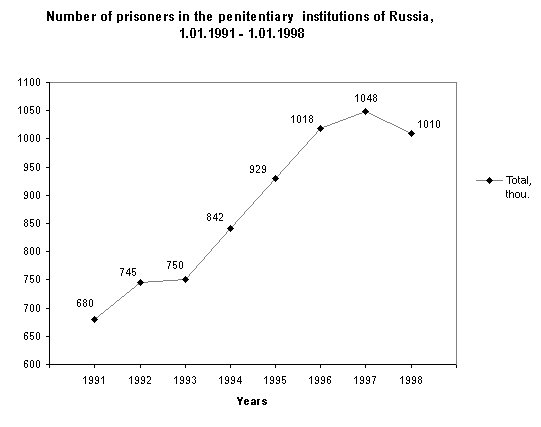
Russian Penitentiary System

Today, Russia has over 1,200,000 prisoners serving time in it’s 840 prisons.

Aleksandr Solzhenitsyn Dies

Aleksandr Solzhenitsyn, arguably the man most responsible for the myriad of distortions surrounding the Soviet socialist system, is dead. Anti-communists revere his name and cite as truth his book, The Gulag Archipelago, because the terrifying image of the massive political prison system, found in Solzhenitsyn’s historical fiction and in the really-existing United States, serve a propagandistic function. High schoolers are often required to read The Gulag Archipelago as part of bourgeois indoctrination.

In Blackshirts and Reds, Michael Parenti wonders:

Some Russian anticommunist writers such as Solzhenitsyn and Sakharov, and many U.S. anticommunist liberals, maintain that the gulag existed right down to the last days of communism. If so, where did it disappear to? After Stalins death in 1953, more than half of the gulag inmates were freed, according to the study of the NKVD files previously cited. But if so many others remained incarcerated, why have they not materialized? When the communist states were over- thrown, where were the half-starved hordes pouring out of the internment camps with their tales of travail?

However, the public is never told about Solzhenitsyn’s theory that the Soviet Union was a creation of elite and wicked Jews, anti-Christian outsiders hellbent on world conquest. It’s true: despite his denial that this is not what he meant precisely, Solzhenitsyn’ work is filled with rabid anti-Jewish sentiment that implies that a Jewish cabal lies behind world history. The Gulag Archipelago dwells on the camp guards with Jewish names. His ethnonationalist tract August 1914 exaggerates Jewish influences in Russian history. And his two-volume tome, Two Hundred Years Together, masquerading as an honest account of the historic relationship between Jews and Russians – as if Jews aren’t Russians – is deeply anti-Jewish. He writes, “the population of Russia, as a whole, regarded the new terror as a Jewish terror.”

He exaggerated about many other things, as well, not least amomg them is his claim about leftwing opposition to the Vietnam War: “But members of the US antiwar movement wound up being involved in the betrayal of Far Eastern nations, in a genocide and in the suffering today imposed on 30 million people there.” The US government was responsible for around 3 million deaths in Indo-China alone during this period. Who exactly did the United States betray by not killing more human beings?

His attack on humanism is reprehensible. In a 1978 speech at Harvard (A World Split Apart ), Solzhenitsyn argues, “If humanism were right in declaring that man is born to be happy, he would not be born to die. Since his body is doomed to die, his task on earth evidently must be of a more spiritual nature.”

The first part of the argument asserts that, if the purpose of being born is happiness, human beings would be immortal. Why? People are unhappy with the prospect of dying in part because people enjoy living. Life makes people happy and, not wanting to be unhappy, and not being able to imagine the content of annihilation, they don’t want to die. People also are unhappy about the prospect of death because they fear suffering. But not everybody who dies suffers. If I pass away in my sleep tomorrow, or if I cease to exist painlessly, surrounded by friends and family, I cannot say that I am now feeling unhappy about these future possibilities. Are some of those who die peacefully unhappy? It’s an odd question. Nobody is unhappy after they’re dead. The dead feel nothing. Do the deaths of others make us unhappy? Yes, of course. But people find ways to become happy again. And the dead do not wish us to be unhappy. So I wonder how it follows that, if one is born to die, one must be unhappy, or, to put it another way, that happiness requires eternal life. It is possible that eternal life could be very unpleasant? Watching the sun explode or go out?

What about the second part of the argument: “Since his body is doomed to die, his task on earth evidently must be of a more spiritual nature”? How did Solzhenitsyn get to spiritual nature from the problem of happiness? Solzhenitsyn is saying that because a human being is born to die, he must be unhappy. Accepting this argument, are we to assume that spirituality presupposes unhappiness? Solzhenitsyn comes from the school of thought that human beings are born to suffer and part of their suffering is a mortal existence where death looms before them. It would have been tidy if Solzhenitsyn had simply boldly made this argument rather than trying to sneak it in through tortured logic concerning what humanists believe – especially since humanists believe no such thing!

For humanists, death has no purpose beyond the meaning we give it. All organisms die. All matter is transformed. This is merely the way it is. There is no intrinsic purpose in any of it. The universe and all the natural things in it do not exist for a reason or a purpose. They just are. It follows that whatever purpose is said to exist for the mortality of organisms is of human origin. Cats have no transcendent purpose in life nor can they make a purpose for themselves. The chief difference between cats and humans on this score is that the latter can manufacture a purpose for the inevitability of death occurring in both species. Since this is the case, why shouldn’t human beings decide that the purpose of life is secular happiness rather than spiritual suffering? There is nothing in Solzhenitsyn’s formulation that says it cannot be so.

Solzhenitsyn plays a rhetorical game. He projects onto humanism his own belief that there must be a transcendent purpose in corporeal existence so that he can then present to his audience the appearance of logical symmetry in order to legitimate the contrary claim, namely, that since man is born to die, his purpose in life must possess a spiritual character. Even if one accepts the premise that humanists believe that human beings are born with a purpose (to be happy), this belief has no bearing on what humanists believe about the purpose of mortality. For the record, as if this were not obvious enough, we should note that humanists do not believe that there is a purpose to life and death. Solzhenitsyn is wrong from the git-go.

Humanists quite reasonably contend that the human experience should be pleasing to our sensibilities rather than destructive to well-being. Why? Because human beings – like all other animals, and even plants – seek surroundings in which they may thrive. Environs that are destructive to well-being cause the opposite effect to manifest; instead of thriving, organisms suffer and perish under conditions hostile to their well-being. With human beings, as apparently with all animals, suffering is incompatible with thriving and happiness, and the latter are usually sought over the former. Only human beings choose to believe life is suffering and actively seek out manners of living that bring suffering – and religion is one of the principle forces driving this absurd and destructive belief.

Of course, where democracy does not obtain, not every person is in the same position to decide what the purpose of human existence is. In hierarchically-arranged society, the powerful few decide for the rest of us what our purpose is to be. This is especially true in religious systems such as the one Solzhenitsyn advocated during his life. In such religious systems, priests and texts tell human beings what their purpose is. They tell us, circularly, that our purpose is suffering here on earth for the sake of escaping a world beyond the pain of the real, that there is eternal life in an ethereal form freed from our corporeal and tragically mortal bodies. Moreover, they tell us that failing to believe in this transcendent purpose, a purpose that rests entirely on faith belief, will be punished with suffering impossible in the real immediate world. So the loving God has created a special place for impossible suffering: Hell. So it is hell on Earth for all and hell after life for those millions who failed to submit to belief in a loving god, a loving god who made you mortal and will torment you for all eternity if you fail to appreciate it.

What humanists desire above all is returning the human beings to an understanding that human social life is collective, that individuality is a product of collective existence, that the real relation is not a vertical and spiritual one between God and Man, but a horizontal and secular one between human beings, and that for each person to have a say-so in determining the meaning and purpose in life, a democratic form of government must be in place. Being ruled by religion, tradition, and/or an authoritarian state imposes upon human beings a purpose they did no choose, one that is usually beneficial to those few elites defining purpose and detrimental to the many who exist under the thumb of the elite. Since human beings make purpose, the choice is clear: either the few define the purpose for the many, or the everybody collectively defines the purpose for themselves.

Thus, while Solzhenitsyn was embraced by anti-communists proclaiming to believe in democracy (over against the authoritarianism of the Soviet state), the man’s views are fundamentally anti-democratic and authoritarian. He believed in subordinating collective and individual decision to the power of religious hierarchy, ethnic tradition, and the nation-state. He believed that the West was decadent for the same reason the Soviet Union was decadent: it had abandoned religion. Ironically, this alleged champion of freedom’s call for restoring the power of religious control, and his condemnation of secularism and humanism, was a condemnation of individual freedom and a call for authoritarian structures.

Let me cut to the chase: Solzhenitsyn’s books are works of historical fiction – or, more accurately, historical falsification. Solzhenitsyn, a hero to authoritarians and racists, was a literary fraud. However, because of the ideological needs of capitalists, namely to manufacture the illusion that the Soviet Union was worse than Nazi Germany (perhaps the most outrageous lie ever told), and because of the intersection of anti-Jewish hatred and anti-communism before the late-1960s, Solzhenitsyn’s hatred of the Jews was glossed over. What is more, he he peddled religion, arguing that without it human life was meaningless, meaningless because morality is suffering without spiritual opium.

The occasion of Solzhenitsyn’s death, especially since so many obituaries are crediting him with telling us about the gulags, provides an opportunity to tell the truth about him. It’s tragic that so many millions of school children have been told that this sanctimonious ideologue’s writings about Soviet history were accurate and that he represents a figure of moral and a profile in courage.

Countering Sarcasm with Flights of Fancy: Hitchens, D’Souza, and My Invisible Purple Tiger

Dinesh D’Souza was so perplexed by a question put to him by Christopher Hitchens in a debate about the existence of God that he didn’t know how to respond, so, he admits, he ducked it. 

Dinesh D’Souza on the Colbert Report

The substance of Hitchens’ question was that, given that Homo sapiens has been on the planet for at least some 100,000 years (and D’Souza implicitly stipulated that the archaeological record should be the basis for the study of prehistory), why did the god of Christians, Jews, and Muslims for 95,000 years do nothing about the miserable conditions of human beings? Why, Hitchens wondered, did only a few thousand years ago this god decided to get involved, revealing himself to a nomadic people in the Middle East? Why then? Why there? D’Souza characterizes Hitchens’ point thusly: “God seems to have been napping for 98 percent of human history, finally getting his act together only for the most recent 2 percent? What kind of a bizarre God acts like this?” 

Before I get to D’Souza’s answer, I have to remark on Hitchens’ point because there is a falsity in it and the purpose of his point needs to be made clear. 

First, the claim that the conditions of human beings were miserable before this god showed up is not supported by the facts. On the contrary, early man lived rather well. Procuring enough to eat was not difficult in most places. One could do this in a few hours a week. The rest of the time was spent engaging in meaningful rituals and story telling. Humankind could hardly have survived as a species if existence was a bad as Hitchens describes. The same is true for other species. They die out where they cannot thrive. Lions spend much of their day lounging about. The world—if unmolested by modern society—is their oyster. This was true with early man. Social class emerged and made life harsh. Did this god bring poverty to us?

Second, Hitchens is being playful here. His argument is a sarcastic one. The premise that there is a god who does or does not intervene is nonsensical. Hitchens’ question is the same as the question: “Why does God hate amputees?” That question is followed by a long discussion about how the Christian god does this and that for people who are sick and distressed but he does nothing for amputees. No amount of prayer will ever restore an amputee’s leg. Since Christians believe in prayer and miracles, it follows that their god has some purpose in not healing amputees, and what could such purpose be that did not depend on their god holding something against them? Is this a loving god?

Now, D’Souza actually took Hitchens’ sarcastic remark as a challenge, went away to research it, and returned with a two-fold response, one that aims to “show that Hitchens has his math precisely inverted” and “reveal how Hitchens’ argument backfires completely on atheism.”  

D’Souza consults Erik Kreps of the Survey Research Center of the University of Michigan’s Institute for Social Research for the first argument. Kreps argues that the number of years is not really important, but rather it is the number of people that is at issue. D’Souza and Kreps cite the Population Reference Bureau which estimates that the number of people who have ever been born is approximately 105 billion. Of this number, about 2 percent were born in “the 100,000 years before Christ came to earth.”

Kreps concludes from this that “God’s timing couldn’t have been more perfect. If He’d come earlier in human history, how reliable would the records of his relationship with man be? But He showed up just before the exponential explosion in the world’s population, so even though 98 percent of humanity’s timeline had passed, only 2 percent of humanity had previously been born, so 98 percent of us have walked the earth since the Redemption.”

D’Souza further attacks Hitchens’ point by making a convoluted argument about intelligence, civilization, and supernatural intervention. First, D’Souza notes that the “basic frame and brain size [of the species hasn’t] changed throughout [its] terrestrial existence.” This statement is true, by the way. The species hasn’t changed throughout its (terrestrial!) existence. Brain size cannot account for any societal evolution in the species. Next, D’Souza states that “Homo sapiens has been on the planet for 100,000 years, but apparently for 95,000 of those years he accomplished virtually nothing. No real art, no writing, no inventions, no culture, no civilization.” This statement is only partly true. There was art, inventions, and culture for tens of thousands of years before the coming of the Hebrew god. There was no writing for most of this time. As for civilization, it depends on how you define the term. If by civilization you mean large-scale state-level societies with a written language, then, true, that didn’t come about until fairly recently (as time reckoned in this type argument goes). In any case, D’Souza rhetorically ponders, “How is this possible? Were our ancestors, otherwise physically and mentally undistinguishable from us, such blithering idiots that they couldn’t figure out anything other than the arts of primitive warfare?”

He continues: “Then, a few thousand years ago, everything changes. Suddenly savage man gives way to historical man. Suddenly the naked ape gets his act together. We see civilizations sprouting in Egypt, Mesopotamia, India, China, and elsewhere. Suddenly there are wheels and agriculture and art and culture. Soon we have dramatic plays and philosophy and an explosion of inventions and novel forms of government and social organization. So how did Homo sapiens, heretofore such a slacker, suddenly get so smart? Scholars have made strenuous efforts to account for this but no one has offered a persuasive account. If we compare man’s trajectory on earth to an airplane, we see a long, long stretch of the airplane faltering on the ground, and then suddenly, a few thousand years ago, takeoff!”

The train of D’Souza’s argument has jumped the track and is art this point deep in the dark and tangled woods. We do have a persuasive account for how this happened and D’Souza is either willfully ignorant of it or has a gift for writing pose without any knowledge of the scholarly record. This enjoys a consensus among those scholars who study these things. The truth as we know it is simply this: Technology advances more rapidly in larger populations because there are more permutations, greater likelihood of success and transmission of information which, in turn, guarantees that it will be combine with other bodies of technological knowledge to create cultural-societal leaps. If one studies the archaeological and anthropological record one will see a slow accumulation of technological advancements, spread through cultural radiation and combination, then qualitative leaps forward in knowledge. 

So while it is true that intelligence is not the cause of this pattern (but rather is caused by evolving societal organization), D’Souza’s explanation is completely inadequate: “Well, there is one obvious way to account for this historical miracle. It seems as if some transcendent being or force reached down and breathed some kind of a spirit or soul into man, because after accomplishing virtually nothing for 98 percent of our existence, we have in the past 2 percent of human history produced everything from the pyramids to Proust, from Socrates to computer software.”

This is absurd. Look at the last thirty years. Look at the technological leaps forward. Note at the telescoping character of technological advancement, each leap based on previous leaps—dramatic qualitative change from incremental quantitative change, every bit of it created by human beings. Is God helping us out with each passing generation? He certainly didn’t keep us out of WWII, a conflict killing some 50 million people. The devil’s doing? Superstitious nonsense. 

Of course, his pitiful attempt to address Hitchens’ sarcasm to one side, D’Souza has provided no logical proof of this alleged god. Neither has he provided a lick of empirical evidence. There is still zero reason to believe in god.

When I raised this issue on the conservative website Town Hall where D’Souza published his essay, I was met with the predictable: “But you can’t prove God doesn’t exist.” People actually believe they say something intelligent when they make this point. If teachers could teach one thing that would vastly improve the ability of individuals to think for themselves it would be to help them understand why this demand is, well, idiotic. Why idiotic? Because nobody can prove the nonexistence of any supernatural entity. 

To wit, I have a giant invisible purple tiger in my backyard. He has wings. He takes my astral body all around the world while everybody else is sleeping. I have been to London, Paris, Moscow, Stockholm, and Sao Paulo—all on the back of my giant invisible purple winged tiger. My tiger must exist because you cannot prove he doesn’t. I must have flown atop his back to all these destinations because you cannot prove I haven’t. He is real because you can’t prove he’s not.

See how stupid that sounds? Unless I were a child, I would sound crazy for believing this. So why are those who claim that an invisible man living in the sky who watches everything we do and will punish us for not believing in him not considered crazy? Why are people who claim to have been abducted by aliens crazy—since they cannot prove it—but people who believe their loved ones are taken up into the clouds after they die admired for their faith in a place called “Heaven”? Are alien abductions true because we can’t prove they’re not? Why are the ancient Egyptians wrong about the character of god (and the number of them), but the Hebrews are right about “His” character? There is no answer for those who demand that such claims must be disproved. Every and all things supernatural that any individual dreams up are real because none of these things can be proven not to exist. If such logic is to be followed, then the person must believe everything that cannot be disproved.

It is for this simple reason that the demand that one prove the nonexistence of supernatural entities is entirely fallacious. This is why the ones who make claims must prove the truth of those claims beyond reasonable doubt. Claims makers—and only claims makers—shoulder the burden of proof.

“Virtually no one knew that intended target, but the accused knew”

Prosecutor Timothy Stone, an officer in the US Navy, told the six-member jury of officers judging the case of Salim Hamdan, bin Laden’s driver, that Hamdan overheard conversations between bin Laden and his deputy, Ayman al-Zawahiri, about the intended targets in the September 11, 2001 attacks. Congress was the fourth target, which makes sense from a strategic point of view. But listen to how Stone put the matter: “If they hadn’t shot down the fourth plane it would’ve hit the dome” (emphasis mine).

I have seen a lot of pictures of the crash site in Shanksville. In every photo I have ever seen of a plane crash, there is a plane. There are seats, luggage, engines, wings, and bodies. But in pictures of the Shanksville “crash” there is no plane. There’s a relatively small dent in the earth and a relatively small amount of tiny debris (or something). We know that, consistent with a shoot down, debris from Flight 93 was scattered over an eight square mile area and fragments of human body were found as far away as three miles. Witness reports in the immediate aftermath were consistent with a shoot down—planes in the sky, a boom, and then a fireball—and witnesses at the crash site reported that, except for a sole engine, any given piece of debris was small enough to fit in a briefcase.

I told friends shortly after 9-11 that it was likely that that the government shot down Flight 93 and that the “let’s roll” story was a propaganda myth. And now there is a Navy officer who appears to confirm what a lot of people have been thinking: the government shot down Flight 93.

Don’t get me wrong. I understand why the government had to shoot down the plane. I wish they had shot down all four planes, to be honest about it. The failure to intercept those planes exposed profound weaknesses in our national defense system. Heads should have rolled after 9-11 and Bush’s should have been the first on the block. Here’s what’s not right: substituting myth for fact. If this is true—if they shot down that plane and covered it or at the very least didn’t come clean about it—then we need another investigation into 9-11. We need to know what happened. The Commission Report is deeply problematic. 

Here’s how Reuters puts it: “United Airlines Flight 93 crashed in a field in rural Pennsylvania. U.S. officials have never stated it was shot down although rumors saying that abound to this day.” Putting it this way, it sounds like lying by omission. “We never said it wasn’t shot down. We just never said it was.” The military has been spinning what Stone said because of the commotion it has caused. The tribunal’s chief prosecutor, Colonel Lawrence Morris, said that Stone was quoting Hamdan in evidence that will be presented at trial. Maybe so. But that’s not what it sounds like. Morris wouldn’t confirm if the “dome” was the US Capitol. How it could is not be?

CNN left out the missile part in their report and followed the quote by saying that the plane crashed in Pennsylvania. The Associated Press did the same. The Washington Post arranged the quote this way: “would have hit the dome…. Virtually no one knew that intended target, but the accused knew.” You should see the Reuters quote for yourself in case they revise it later: Bin Laden driver knew Sept 11 target—prosecutor. They are probably already taking flak for quoting something the rest of the media (at least the several stories I have looked at so far) had the good sense to leave out.

The Laugh Factory’s Jamie Masada isn’t Funny

First, the Laugh Factory fining comedians 50 dollars every time they say “nigger” is rather ridiculous. Anybody should be able to say anything at all in the act of speaking for themselves in a forum created to allow you to speak freely—and humorously.

Furthermore, as a fan of the comedic angles pursued by, for example, Bill Hicks, I understand where bits like that are going. The majority of people who heard Michael Richards’ rant didn’t get it because they haven’t spent any time studying that style of humor. It was difficult to watch Richards apologize for what he said on the David Letterman Show because he knew he couldn’t explain the point of the bit.

Whites lined up to make themselves look like dedicated non-racists by holding Richards up in contrast. “I would never say that word,” they chanted their mantra. I criticize Jesse Jackson for condemning Richards. Jackson uses the word. All this fuss over language is excessive on all sides.

Michael Richards at the Laugh Factory

Now the owner of the Laugh Factory, Jamie Masada, wants Jackson to pay the fine for saying “nigger” during a break of a interview show on Fox News, Fox and Friends, taped on July 6, 2008. This demand is as ridiculous as the Laugh Factory’s policy on using the word.

First, Jesse Jackson wasn’t speaking at the Laugh Factory. He was speaking in the context of a Fox News program, and however much Fox News makes us laugh with their ideological exuberance, they are not the Laugh Factory.

Second, Jesse wasn’t really speaking in the context of anything public. He said what he said privately to the man sitting next to him, Dr. Reed V. Tuckson, Executive Vice President and Chief of Medical Affairs UnitedHealth Group. Jackson was answering a question Tuckson put to him during a commercial break. They never play that part. Jackson was even whispering, which means that he did not intend to be heard.

Tuckson agreed with Jackson, but nothing has been made of that part either. You can hear Tuckson’s approval of Jackson’s complaint. Then there’s the edit and Jackson repeating what he said.

As a curious person, I would like to see what Tuckson said in the edit, but I am not requesting it because it was a private conversation that I shouldn’t have been privy to in the first place.

Indeed, the whole affair is disturbing not because of what Jackson said—a black man calling black people “niggers” is not unusual—but because Fox News broadcast a private conversation, edited it in a way that was designed to distort the context (even though the context is so clear they couldn’t pull it off), claiming Jackson said worse things in order to drag out the affair, drawing the curiosity of the press and public (and me), and did it all this to tarnish Jackson’s legacy.

Bill O’Reilly saying that he didn’t want to release the rest of the material because it would harm Jackson was comically disingenuous.

Why I am Not Voting for Barack Obama

I have in the past pursued a strategy of voting for Democrats to keep Republicans out of office. The Democratic Party does not represent my interests and I have never been a member of the party, but they have in the past been better for working people, minorities, and women than have Republicans. At least that is what I have believed to be the case. Of course, I will not vote Republican in 2008. But I have decided that I will not vote Democrat. I am convinced that an Obama presidency will be worse for working people, minorities, and women.

Barack Hussein Obama

Obama supports restrictions on abortion in a manner contrary to Roe v Wade, even mocking women who pursue abortions out of mental distress as having the blues. Obama agrees with the right-wing Supreme Court justices that there is an individual right to keep and bear arms to be found in the Bill of Rights, thus undermining the ability of state and local governments to defend communities from gun violence. Obama advocates expanding taxpayer funded religious organizations, a violation of the First Amendment, which requires government to remain segregated from religion. Obama defends Israel’s treatment of Palestinians. Obama voted to expand the ability of the Executive branch to spy on Americans, undermining the Fourth Amendment. Obama has made speeches effectively calling for an end to the civil rights movement, blaming the victims of racism for their woes and telling them to pursue strategies that will keep them on the bottom of American society.

The fear that those voting for Obama have of McCain concern war and abortion. They’re afraid McCain will stay the course in Iraq, when we need to get out. And they especially fear that McCain will apppoint justices hostile to abortion rights. I fear these things, too. But, on the question of Iraq, I cannot trust Obama to withdraw the troops. He has made so many claims contradicted by fact or later reversed by his campaign that nothing he says is to be believed. He deceived the south-side Chicago community for years. I expect him to return from Iraq with a different opinion than held before he left. But even if he doesn’t flip-flop on this, he will if he is elected president. He has already stated that he will redeploy troops now in Iraq to Afganistan. His bellicosity on war with Iraq and his uncritical support for right-wing Israel policy in the region tells us that he does not represent a substantial departure from John McCain.

On the matter of abortion, here I have a genuine concern. But there are reasons to not make this election about a single issue. First, Obama has said he supports restrictions on abortion in a manner contrary to Roe v Wade and other federal laws. Abortion is not necessarily safe with this guy. He is insensitive to women’s issues generally. Second, and more important, John McCain, because he is white, male, and pro-life, will face stiff opposition from feminists and other concerned parties if he tries to appoint ideological justices. He may be able to accomplish it, but it will be difficult. Obama, on the other hand, with liberals sacrificing their core principles just to support this man out of a need for a symbolic accomplishment, and with his stated goals to bring Republicans and Democrats together on this and a range of issues, Obama is a risk for putting a centrist justice on the Court.

This brings us to the major reason why I cannot vote for Barack Obama for president: his politics is to erase differences of opinion for the sake of unity. He wants to bring everybody together and find a workable center. But there is no workable center. There is only right and wrong, and centering everything—which is already too far right—allows for a wealth of wrongs to be unloaded on the public and many more to remain. Restricting abortion is wrong. There is no center position on this. Either you support the right of women to be free from state control of their womb or you’re a tyrant who believes the government ought to force women to have babies. It’s an either-or that is clearly attached to a right-wrong. State control over the womb is the most extreme form of tryanny. Mixing church and state is wrong. There is no center position on this, either. Either you support the right of individuals to be free of religious control or you’re a tyrant who believes in forcing religion on people in programs funded by citizens. This is a secular society. Religious societies are tryanny. Religion has too much say-so already.

Take these two together and one can see the danger in Barack Obama. If we allow religious views to mix with state in the degree that he advocates, and if this means that the prevailing religious hegemony takes the leading role in shaping policy, and it will mean this, and that hegemony is Christianity, then abortion rights are immediately in crisis because the more intense a person’s Christianity the more intense is their desire to control women. Christianity as a form of social organization is a patriarchal nightmare for women. Homosexuals are also threatened by this development. 

The Second Amendment only grants states the right to arm men in the context of a well-regulated militia. This meaning of the amendment is unambiguous. It is worded in a way that makes perfectly clear the intentions of the framers. And since militias are ill-prepared to carry out any useful purpose—assuming we mean something different from the National Guard—there is no rational reason that any citizen should have a gun. Individuals own guns because there are no laws forbidding them to. There is no right that allows them to own guns. There is no center position on this. There is no compromising the Bill of Rights.

The same is true for the Fourth Amendment. Our right to privacy is the arguably the single most important right in the entire Constitution. You cannot comprise, as Obama did, on restricting the government from looking into our private lives. Read the amendment. There’s no wiggle room. There are no exceptions for national security. Obama voted away a fundamental right. This is the vote that made it impossible for me to vote for Obama. 

Back in July, Obama slammed the Supreme Court for upholding a ban on late-term abortion. He said it was part of a concerted effort to roll back women’s reproductive freedom. Now he supports a ban on late-term abortion. Feeling good about your endorsement NARAL?

Kerry’s supposed flip-flopping was largely an invention of Republicans. Obama’s flip-flopping is an invention of his desire to win the White House principle be damned. Obama was against the embargo on Cuba before he was for it. Obama was for decriminalizing marijuana before he was against it. Obama was against cracking down on businesses that hired illegal aliens before he was for it. Obama was for Jeremiah Wright before he was against him. Obama was against union contributions to presidential campaigns (calling them “special interests”) before he was for them (when unions started contributing to his campaign). Obama was for the DC gun ban (saying that is was constitutional) before he was against it (after the Supreme Court struck it down). Obama was against immunity for corporate evesdropping before he was for it.  Obama was for public financing of elections before he was against it. Obama was against the death penalty (voting against the death penalty for gang-related murder) before he was for it (for crimes that do not involve murder). Obama was for a gas tax holiday (voting for two of them in Illinois) before he was against it. Obama was against Nafta (said it was bad for workers and that he would force a negotiation) before he was for it (blames heated campaign rhetoric).

In light of these facts, there is no reason to suppose on the range of issues that concern me that McCain would be worse than Obama. Indeed, on some issues, Obama would be worse (the civil rights issue is most disturbing). 

I have been flirting with either the Green Party or the independent run of Ralph Nader. I need to think about it some more. Whatever my choice, if McCain wins, I will have no regrets.

A “Political Lynching”?

Myrlie Evers-Williams, a leader in the NAACP, the wife of Medgar Evers who was gunned down by white supremacists, said yesterday that Barack and Michelle Obama are the target of a “political lynching” in the media. She told a NAACP luncheon that the news media is portraying the Obamas as unpatriotic radicals. She cited in particular The New Yorker cover spoofing attacks on the Obamas as an example (see below). Sadly, Evers-Williams could not miss the point more widely.

“Fistbump: The Politics of Fear,” by Barry Blitt.

First, the establishment news is running Obama’s campaign. It is hardly lynching the Senator. This has been the most biased coverage in favor of a candidate I have ever seen. The media can hardly bring themselves to criticize him. The idea that Obama is the victim of a racially-motivated attack by the corporate media is—sorry, but there’s no other word to use—delusional. 

All you need to do is read the press accounts in the immediate moments of the release of The New Yorker cover. The establishment media collectively acted as Obama’s campaign spokespersons. They were so worried that it would hurt his chances to be president that they opened fire with both barrels on the magazine. To be sure, they’re trying to make it appear that they jumped the gun a little bit. The reality remains: they frenzied. We all saw it. They will write the moment out of history, but they can’t take it back for those of us who are paying attention. 

This was the same over-the-top reaction we saw when Jesse Jackson said Obama was talking down to black people. They panicked over that one, too, thinking that the black masses might start wondering if Obama was in fact talking down to them. Jesse, the white establishment was thinking, still has some clout. So they had to shout him down—even if he only whispered it near a mic he thought was off. This story is still running on strong legs.

Second, speaking of Obama’s condescension towards black Americans, the candidate is harming the black community with his white conservative personal responsibility rhetoric targeting the black family. He blames the victims of racism—and lynching has been a big part of black victimization—for the consequences of racism. Only blacks obsessed with sucking up to the establishment—Ward Connerly, Walter Williams, Bill Cosby—push that racist angle. Blacks are highly critical of the “Uncle Toms” who push this line. So why, instead of advancing a self-evidently paranoid line, isn’t Evers-Williams criticizing Obama for his racially-motivated attacks on the black family?

I am disappointed by the progressive leadership of the black community. To be sure, much of this stems from uncritical loyalty to the Democratic Party. But there’s more to it than that. It’s the worst type of identity politics when persons of an oppressed group support a perceived member of that group because they share a characteristic such as skin color. Blacks are overwhelmingly supporting Obama because he is perceived as a black man who is not a Republican. But, then again, is it partisanship? Would identity politics cause blacks to support a black Republican?

* * *

If you’re having trouble grasping the point of the New Yorker cover, imagine that its target is the 9-11 Truth movement. Its followers believe Bush and Cheney ran a false flag operation on 9-11 in order to seize control of the government. The towers were brought down by controlled demolition. The planes were remote controlled. So forth. Imagine a cartoon cover on a conservative magazine—let’s make it a cover of the National Review—with Dick Cheney as the carnival barker behind the controls of something like a giant Oz machine, his hands on the dials and levers steering robot-controlled planes into towers. Bush is depicted just leaving the towers with wires and a cable splitter sticking out of his pocket. He’s fresh from having just planted the explosives that will bring down the towers in a controlled demolition. Let’s put a book about a goat in his hand. You could have a split scene with Rumsfeld directing a cruise missile into the side of the Pentagon. Barbara Olsen is being whisked away into another dimension by Men in Black. 

Anybody who sees this cover who believes the premise, well, then, the joke’s on them. Those who believe it’s not true will see it as satire—if they are prepared to play along. People are too sensitive about Obama. They aren’t prepared to play along.

Jesse Jackson: Obama “Telling Niggers How to Behave”

I understand why the establishment media can’t bring itself to use the word. They have to make it so scary that it can’t be uttered, not even in an informative context. It’s like the secret name of God. We have to be reduced to first graders. “He said the ‘N-word.’” So I’ll repeat what Jackson said: “Barack … he’s talking down to black people … telling niggers how to behave.” 

Jesse Jackson caught on a hot mic

Now, any fair-minded person knows what Jesse means by this. Whites and blacks who blame black people from the problems of poverty, joblessness, crime, and violence see blacks as “niggers” and the place they live as “Niggertown.” We all know the sentiments. Jackson is bringing some truth to the matter when he says that Obama is “telling niggers how to behave.” That is what Obama is doing. I’m sure each of you at some time or another has used the sarcastic angle of putting yourself in the other point of view and using the language from that standpoint. Jesse was speaking from Obama’s point of view. Jesse is being dramatic. It’s something he does.

Remember when the brilliant comedian Bill Hicks, in protesting the verdict in the Rodney King beating case, talked about Officers “Coon,” “Niggerhater,” and “Keepdarkiedown”? It’s called bitter sarcasm and it’s commonplace among those who know the way some people think about black people.

The “niggers down in Niggertown” line was uttered countless times in the South—and often in the Northeast. It’s easy to channel the sentiment if you’re familiar with history: “The niggers need to stop throwing trash out of their car windows, grow lawns, and fix their screen doors if they want white people to bring businesses back to Niggertown.” Etcetera.

The things Obama says about black people (about fried chicken and whatnot) are the things white bigots used to say all the time about black people. I know hundreds of other whites have heard this because when I heard it when they were standing around me—and getting upset when I disagreed with them! 

Jackson is simply switching “black” with “nigger” to make the point—a effective point if you want to get it. Folks need to stop pretending like they don’t know what’s going on here. Feigned outrage is transparent. 

This episode tells us more about how upset it makes Jackson—and I suspect a lot of other black leaders too afraid to say it in public—that Obama is engaging in racist attacks against the black community by blaming the conditions of blacks on black people, and, adding injury to insult, doing it in front of blacks so that whites can hear it and appreciate a black man saying what they wish they could say. They are rooting Obama on in his talking down to black people.

Watch every white journalists and every black person sucking up to Obama deliberately miss the point. Watch them warp the meaning of the word in this context—in reality, there is no ambiguity in Jesse’s usage of the word—to delegitimize Jackson.

Part of killing off the old civil rights movement once and for all is destroying its leaders. The propagandists of the ruling elite are having a field day with this. They have been waiting for years to banish Jackson to the margins of the movement for justice. (Let’s in ten years if Jackson is relevant at all.)

Racism is not only the belief that someone or group is inferior based on race. Race is a social construction that presupposes a segmentation of social reality. A society is racist to the extent that it divides groups based on selected phenotypic features and then differentially rewards and punishes members of those groups regardless of whether members of these groups realize this is happening to them or for them. Jackson is right when he says that key is structural inequality and that Obama is wrong when he argues that racism is largely a state of mind.

Obama’s rhetoric seeks to dissimulate racism while keeping the divisions going. The result is that the capitalists and their functionaries maintain the status quo that privileges them. This is the central reason why Obama’s blame-the-victim approach is so successful for the perpetuation of racism and so devastating to the civil rights movement.

Jackson was using a slur to criticize Obama’s anti-black propaganda, a strategy that has become central to his campaign for president. Obama talks down to blacks in order to talk over them to the white audience whose votes he seeks. He wants whites to support him and he believes the best way to get this support is to say the racist things some white people think but are afraid to say in mixed company. 

The New Racism

Based on the research by David Sears and John McConahay, Joe Feagin, in his various writings on race, defines symbolic or modern racism as “white beliefs that serious racial discrimination does not exist today and that black Americans in particular are making illegitimate demands for social changes.” This definition, we are told, helps clarify the way the ideological racism evolves in order to maintain the status quo.

Joe Feagin, advocate of the symbolic racism concept

In the early period of racism, the ideology of racism had most people believing that the inequalities among racialized groups were rooted in race, a social construction pitched as a biological reality. Because groups had different natures, the argument went, inequalities between groups are explicable in terms of those differences. There are still many people who believe this.

Of course, the inequalities between racial groups is because of racism, a social system that organizes human populations into hierarchically-arranged groups based on differences in physical appearances and ancestry; the result is differentially rewarded or punished. These inequalities have nothing to do with nature. The ideology of racism, which attempts to naturalize a social construct, justifies unjust social arrangements. Thus racism is a complete ideology: it orders life in a particular way and justifies that order.

Scientists have since debunked the notion of racial nature (see, for example, Luigi Luca Cavalli-Sforza, Paolo Menozzi, and Alberto Piazza’s 1996 The History and Geography of Human Genes). There are no races of humans in nature. With this debunking, the old ideology of racism received a serious blow to its legitimacy. But this did not bring an end to the ideology of racism. Nor, did it bring an end to the material system which that ideology justified. Racism as a objective force ordering group lives continues unabated.

What remains of the old ideology of racism is the notion that different racialized groups have superior and inferior cultural systems. And this idea of superiority and inferiority of cultural systems has been joined with the recognition of the reality that there are no natural differences to strengthen racism rather than weaken it. 

Since many Americans falsely conflate structural racism with the ideology of racism, they wrongly believe that, with the disappearance of the old ideology of racism, serious racial discrimination does not exist today and therefore black Americans are making illegitimate demands for social change. The belief that no serious racial discrimination exists today instructs whites to believe that the situation blacks face today is not caused by racism, but rather is caused by black people themselves. 

By reducing racism to the ideological system that justifies it and then proudly proclaiming that the ideology of racism is dead, yet still retaining the notion of superior and inferior cultural systems, a new racism has emerged that encourages victim blaming. It’s not that blaming the victim was not a component of the old ideology of racism. But in the new system, victim blaming mutates into an opportunity to reinforce the Protestant ethic. White Americans want blacks to have a better life, but, having done enough for blacks already, it’s time for blacks to lift themselves up.

The new racist ideology is far superior to the old one. The new racist ideology does not depend on so obviously false an assumption as intrinsic racial differences. The new ideology of racism allows white and black actors striving to maintain the status quo of whites on top and blacks on bottom to deny that they are racist. Indeed, it allows them to turn ideological racism into an expression of virtue and concern. It allows for a declaration of a colorblind society which self-evidently cannot be a racist society. With this system in force, those members of oppressed group who make grievances against white society are themselves said to be racist because they are making claims based on race.

This is the argument anyway. And it is compelling. At the same time, racial discrimination was much worse in earlier historical periods than it is today. De jure segregation has been abolished and there are many African Americans living in affluence (while the majority of poor people remain white). It is therefore possible that some black Americans are making illegitimate demands for social change. But if one says this, then he is guilty of symbolic racism. Is it possible to recognize that America has made great strides in race relations while admitting there is more to do without having this observation smeared as racist?

The claim of a post-racial order in a society where racialized groups are not longer hierarchically organized is self-evidently false. Racism persists. But to claim that criticism of the claims made by members of the black community and their allies constitutes a new racism is problematic. One can be ignorant or wrong or disagreeable without being racist.