Hate Crimes: Is There a Trump Effect?

Note: This is a preliminary analysis.

We were warned that a Trump presidency would produce a climate of hate putting race and ethnic minorities, religious minorities, and the LGBT community at risk for discrimination and violence. His demogoguery during the campaign and after, as well as policies as president, have targeted Mexicans and Muslims. And, while his rhetoric with respect to the LGBT community has been mixed, his policies towards transgendered persons has been exclusionary. More broadly, his presence as a long-standing cultural right-winger is believed to fuel resentment and identity-group antagonisms. For example, his outspokenness on the alleged perpetrators of a vicious crime against a white female jogger in Central Park, all of whom were black, as well as his doubts about the citizenship of US president Barack Obama, a black man whose father was a Nigerian citizen, are widely seen as evidence of anti-black prejudice.

One way of gauging the effect of Trump’s rhetoric is to examine hate crime statistics gathered and published annually by the FBI. While we wait for the 2018 statistics (the FBI does not update in real time), the 2017 statistics, which cover the first years of the Trump presidency, are available for analysis. These statistics are broken down in various ways, but I am interested in the figures that represent the proportions of victims across different types of hate crimes, as well as proportions within these types. The 2017 numbers show that violent hate was directed overwhelmingly at black, Jewish, and gay male persons. By far, victims of race or ethnic hatred are the largest proportion of hate crime victims, followed by religious minorities. However, one year does not indicate change over time. Fortunately, thanks to the Matthew Shepard and James Byrd, Jr. Hate Crimes Prevention Act of 2009 (18 U.S.C. §249), the FBI has annual statistics from 2011.

In terms of overall numbers, there were 7,173 victims of hate crimes in 2015, 7,615 victims in 2016, and 8,828 victims in 2017. The evidence indicates that there has been an overall increase in hate crime victims. It should be noted that the number of hate crimes in both 2015 and 2016 were lower than the number recorded in 2012, which identified 7713 victims of hate crimes. Taking a longer view, hate crimes increased 14.5 percent between 2012 and 2017, declining in 2013-2015 and then increasing in 2016-2017. It should also be noted that population growth is not figured into the numbers presented. However, the US population grew by nearly 4 percent during this period; the percentage growth in hate crime victims is somewhat tempered by that increase. Crucially, by far, the large increase in proportion was for religious minorities, with Jewish victims of hate crimes comprising most of that increase. 

The following is a breakdown of data for victims of single-bias hate crime incidents for the most recent year, followed by the 2015 and 2016 data with commentary. 

  • In 2017, 59.6 percent of victims were targeted because of offenders’ bias against race, ethnicity, or ancestry. Of these, 48.6 percent were targets of anti-black bias, 10.9 percent were targets of anti-Hispanic or Latino bias, and 2.6% were victims of anti-Arab bias.
  • In 2017, 20.6 percent of persons were victimized on the basis of religion. Of this figure, 58.1 percent were targets of anti-Jewish bias, 18.6 percent for anti-Muslim bias, and 8 percent for anti-Christian. Christians are by far the largest religious group in the country. Within the Christian population, anti-Catholic bias crime was the most frequent.
  • In 2017, 15.8 percent of victims were targeted because of sexual orientation bias (homosexuality and bisexuality). Of these, 57.8 percent of victims were targeted for anti-gay (male) bias. 
  • In 2017, 1.6 percent of victims of hate crimes were targeted because of gender-identity bias (i.e. transphobic violence).

Using 2015 and 2016 figures for comparison, the Trump effect should predict significant changes the proportions of victims subjected to hate crimes consistent with his rhetoric, which was most often directed at Hispanic/Latino persons with respect to ethnicity and Muslims with respect to religion. The effect on Jews is difficult to assess. On the one hand, Trump’s praise of Jews and enthusiastic support for Israel could soften views among his supporters, who are presumed to contain a large proposition of rightwing types (the effect here would be Trump as influencer); on the other hand, his support for Jews and Israel could amplify resentment in this population. Both of these effects are plausible so it may be a wash. Trump’s rhetoric concerning sexual orientation and gender identity have been mixed, but his policies have not been supportive of these communities, so these effects should appear in 2017.

On the popular landscape, Trump as presidential candidate was only on the horizon for 2015, so that year should serve as a good baseline for comparison. We would expect lower numbers in 2015 than in 2017. Trump’s presidential campaign in 2016 featured much of the same rhetoric in question, therefore we expect that the percentages whould also be substantially higher in 2016 than in 2015. 

In 2015, for bias crimes against race, ethnicity, and ancestry, the proportion of victims (59.2 percent) is roughly the same as it was in 2017. This is also the case for 2016 (58.9 percent). Over all, the race/ethnic-based Trump effect with respect to proportions is slight and, in some instances, runs counter to expectations. 

First, on the matter of victimization on the basis of race, ethnicity, and ancestry:

  • The proportion of victims of anti-black bias (52.2 percent) was considerably higher in 2015 than in 2017. Hate crimes against blacks thus declined under Trump by nearly four percent. The downward trend was notable in 2016 (50.2 percent). I do not have an explanation for the decline in the proportion of black American victims of hate crime in the short term. However, in the long term, racial discrimination and prejudice against blacks has been declining for decades. This is likely due to the gains of civil rights and the rising status of blacks in American culture. At the same time, black victims of hate cries continue to represent the largest proportion. At 12.1 percent of the US population, blacks suffer by far the worst overrepresentation among hate crimes victims. 
  • At 9.3 percent, the proportion of victims of anti-Hispanic or Latino bias was roughly a percentage point lower in 2015 than in 2017. The number for Hispanic/Latino victims is the same in 2016 as in 2015. Given the level of anti-Mexican rhetoric, one would have expected there to be significant difference in these numbers, yet there is not much evidence of a Trump effect here. Hispanics/Latinos are the largest ethnic group in the United States (18.1 percent); Hispanic/Latino representation in hate crimes is proportionately much lower than their proportional representation in the population. Although there has been considerable media attention on the plight of Hispanic/Latino people with respect to race/ethnic prejudice and discrimination, it pales in contrast to ant-black sentiment, both in frequency and in proportion.  
  • The victims of Anti-Arab bias constituted 1.1 percent in 2015, a figure considerably lower than the 2017 figure. Anti-Arab bias is a small proportion of hate crimes perpetrated on the basis of race, ethnicity, and ancestry; however, Arabs are a small proportion of the US population (around 1.1 percent according to the Arab American Institute Foundation). The number for Arab victims was nearly the same in 2016 as in 2015 (at 1.3 percent). In other words, for those years, there was no ethnic disproportionality in hate crime victims. Given that Trump did not target Arabs in his rhetoric per se, it might be the case that his anti-Muslim rhetoric carried over to the ethnicity most often associated with the Islamic faith. However, as we shall see, the evidence for this is contradictory.

Next, the matter of victimization on the basis of religion. For 2015, crimes of religious bias was 19.7 percent of the total number of victims of hate crime. This is less than a percentage point lower than in 2017. In 2016, 21.1 percent of hate crimes victims were targeted on the basis of religion. Again, that is less than a percentage point difference. Overall, there is little religion-based Trump effect in terms of proportion of type. However, the greatest increase in hate crime victims was for religious bias. One might expect that this increase involved Muslim victims of hate crimes, but this was not the case.

  • At 52.1 percent, attacks on Jews was considerably lower in 2015 than in 2017. For 2016, 54.4 percent of victims of religious violence were Jews. Again, given Trump’s positive rhetoric regarding Jews and Israel, if there is an effect here, it is by provoking antisemitic resentment among far-right supporters of Trump. It must be stressed that there is a rise in antisemitic hate crimes across the trans-Atlantic community, driven not only by rightwing populism, but also by the increase of Muslims in the West. Antisemitism is rampant in Muslim-majority countries, and migrants from those countries bring their antisemitism with them.
  • At 21.9 percent, the proportion of attacks on Muslims was higher in 2015 than in 2017, the opposite of expectation. The proportion was higher in 2016 at 24.5 percent. The sharp decline in the proportion of Muslim victims of hate crimes from 2016 and 2017 is curious in light of the increase in Arab victims of hate crimes. One would expect these to rise together. But in any case, despite Trump’s anti-Muslim rhetoric, a sharp rise in the proportion of victims of anti-Muslim bias is not forthcoming in the data. In fact, we see the opposite.   
  • Attacks on Christians were much higher in 2015 (12.6 percent) compared to 2017. The downward trend in Christian hate crime victims was noticeable in 2016 (9.9 percent). 

Finally, bias crimes against sexual orientation fell almost two percent over the two-year frame (15.8 percent in 2017 from 17.7 percent in 2015), with 62.2 percent directed at gay males in 2015, a larger percentage than in 2017. The hate crime proportion of victims of gender-identity bias was relatively unchanged.

Perhaps the 2018 numbers will be more revealing, but based on the evidence, the claims of a Trump effect are exaggerated. What increase there is does not match expectations given Trump’s rhetoric.

Migrant Detention Facilities are Not Fascist Concentration Camps

In the aftermath of the attack on the US navel base at Pearl Harbor by Japanese forces, the Roosevelt administration issued Executive Order 9066 (1942) ordering Japanese Americans into internment camps. Most of those rounded up by the government were American citizens, indefinitely interred without trial. The US Supreme Court upheld the constitutionality of Executive Order 9066 in Korematsu v. United States (1944). A majority of justices agreed that national security takes precedent over the rights of citizens and residents of Japanese descent. The camps were dismantled after the second world war in 1945.

A concentration camp is a facility where persecuted minorities or political prisoners are imprisoned without trial. Given this definition, which is the standard one, it is reasonable to consider Japanese Americans to have suffered concentration camps in the United States, albeit many Americas resist that equivalency. Years later, President Reagan affirmed the injustice of Executive Order 9066 and authorized the US government to compensate survivors. What the Roosevelt administration did to the Japanese people living in the United States is widely regarded as reprehensible, even after acknowledging war hysteria and contemporaneous attitudes.

Today, the question of what constitutes a concentration camp is an item on the partisan political landscape. Talk of concentration camps began in the summer of 2018 as the migrant crisis at the US-Mexico border dragged on, a concern that faded as political attention shifted to the pending Mueller report, which, the public was told, was sure to conclude that President Trump was a traitor. Alexandria Ocasio-Cortez reconjured the specter of the concentraiton camp in her Twitter feed, referring to the president a “fascist.” Chuck Todd, moderator for NBC’s Meet the Press, pushed back. Immigration detention centers and concentration camps are “not at all comparable in the slightest,” he said, before suggesting that it was improper to invoke the memory of the Holocaust. Mainstream and social media voices on the left jumped to Ocasio-Cortez’s defense, emphasizing that the congresswoman did not actually refer to “Nazi death camps,” which they insisted are different from concentration camps, or, as Ocasio-Cortez calls them, “dog pounds” and “freezers” stuffed with “1000s of children.”

A U.S. Customs and Border Protection detention center in Donna, Texas

Are immigration detention facilities concentration camps? Because detention facilities, jails and prisons, psychiatric wards, and other places of confinement present as harsh places, it is always important to ask about the purpose or function of a facilitiy. In the second paragraph, I identified the purpose of a concentration camp, a rather extraordinary institution in the modern period, one signaling the presence of war or an authoritarian government. What is the function of an immigration detention facility?

Every country in the world regulates its borders. Borders are part of the modern nation-state, the necessity of controlling national boundaries recognized across the interstate system. Under international law, people are in principle free to leave the country in which they reside. However, international law does not recognize a right to enter a foreign country without authorization. For those seeking asylum, possible justifications identified in international law (“refugee” is defined in the 1951 United Nations Convention relating to the Status of Refugees), many countries have developed a process for determining the veracity of asylum claims.

In many countries, routine procedure involves a stint in a detention facility while claims are being processed and the situation assessed. This is consistent with international law. In 1986, the UN Refugee Agency affirmed that detention is justified for numerous and obvious reasons: “to verify identity; to determine the elements on which the claim to refugee status or asylum is based; to deal with cases where refugees or asylum-seekers have destroyed their travel and/or identity documents or have used fraudulent documents in order to mislead the authorities of the State in which they intend to claim asylum; or to protect national security or public order.”

Given limitations of resources, when persons are detained in large numbers, which can occur during surges in migration, prolonged detention and overcrowding can result. In countries with press freedom and a compassionate public, images and stories of detention facilities, with their fences and armed guards and poignant migrant accounts, provoke visceral reaction and arouse sympathy. This is not a bad thing, but the solution to a migrant crisis is not to abandon law and principle, but to advocate for appropriation of more funds to establish more and better facilities and increase the number of qualified personnel. However, ideologues see political advantage in impressions without qualification and prey on emotion while eschewing reason.

Currently at the southern border of the United States, immigration detention facilities are crowded with persons, many in poor health, most hailing from the three Central American states of El Salvador, Guatemala, and Honduras. The conditions of their detention are far from ideal. Even under generous conditions, confinement can be an unpleasant and, for some, traumatic experience. Nonetheless, persons irregularly entering the United States are afforded due process, and can, if they wish, return to their home country. Because of court-imposed limitations on how long migrants may be detained (established years ago, consistent with the spirit of international law), persons not legally returned to the border’s other side are eventually released in the United States with a citation to appear for a hearing to determine their status. More than forty percent of those released from detention disappear into the United States, skipping their hearings and evading law enforcement. Ninety percent of those who properly cross or show up for their hearings after being released from detention are found to have no legitimate claim under international law to be in the United States and are deported.

We are told that those crossing into the United States from Mexico are refugees. A refugee is defined as an individual with a “well-founded fear of being persecuted for reasons of race, religion, nationality, membership of a particular social group or political opinion [who] is unable or, owing to such fear, is unwilling to return to it.” Central Americans migrants are not members of a persecuted minority. They are not being singled out on account of race or religion. They are for the most part economic migrants looking to work in the United States, to take advantage of the country’s comparative higher standard of living and system of public assistance (who can blame them?). Also among the migrants are members of domestic street gangs (pandillas) and transnational gays (maras), which pose a security risk to American communities. (See “The Northern Triangle, the Migran Flor, and the Risk of Criminal Violence.”)

So are immigration detention facilities concentration camps? For decades now, the nation-states of the world have practiced administrative (or civil) detention of illegal or undocumented aliens. The detention of immigrants in the United States is not arbitrary, but a matter of the rule of law. The system is a legitimate piece of the machinery of the modern democratic republics. There is no violation of international law. The situation at the border may bear superficial resemblance to Japanese American internment during WWII, just as a European prison cell may resemble that of a Soviet Gulag, but in substance, they are not comparable. So the answer is no. It is neither historically nor functionally accurate to compare immigration detention facilities to concentration camps. 

There is no misunderstanding about this for those shocked by Ocasio-Cortez’s comparison. The tone of her texts and videos calls to mind Hitler and the Holocaust. When someone as clever as the congresswoman from New York uses the words “fascist” and “concentration camp” to describe the detention facilities and US immigration policy, her intent is obvious. For all those rationalizing Ocasio-Cortez’s rhetoric, even more see clearly what the congresswoman is doing; she means to portray the current administration in a Hitlerian light, to frighten the public with the specter of Nazism, to upend reason with panic. She enjoys the corporate and alternative leftwing media at her back.

Such rhetoric leverages the emotionalism of historical memory to shame people into open borders. That is the agenda. Capitalist firms want cheap labor for super profits and to drive down working class wages (hence the aggressive push by the Cato Institute and the Koch brothers). There are gaps in the pews of the Catholic Church; a dying Church always seeks congregants. Progressive types need to virtue signal. The campaign is cynical and manipulative. Ocasio-Cortez and her supporters should make the case for the denationalizing of America straightforwardly, without exploiting irrational fear and ignorance in an attempt to sway opinion. The congresswoman knows open borders is unpopular, so she resorts to false analogy.

More than conceptually wrong and ethically problematic (I agree with those who find Ocasio-Cortez’s use of language insensitive to those who actually suffered fascist oppression, who endured the concentration camps of WWII, who lost relatives to Nazism), Ocasio-Cortez rhetoric is politically reckless if she indeed cares about the rebuilding the left in this country. Americans in the heartland know it is an absurd comparison. They understand the difference between immigration detention facilities where people are being temporary held while processed and concentration camps where people are held without good cause and are often waiting to be routed to labor camps and death camps. There are limits to Orwellian tactics. Such hyperbolic rhetoric makes the left appear not merely disconnected from reality but anti-American in disposition.  

It’s not just the legitimacy of the Democratic Party that’s at issue; the interests of the working class, at odds with illegal immigration and open borders, are further alienated from the class consciousness we need to build a popular movement that can tackle the problems we face: class exploitation and inequality, lack of health care, poverty and homelessness, global climate change, mass incarceration. Frankly, I am much less concerned about the Democratic Party than I am about the legitimacy of the left in general. Mass perception paints with a broad brush. The Republican Party is not a worker party. But Republicans are eager to accept refugees from the Democratic Party into their fold. They have been doing this for decades. It is why they control so much of the political landscape. Anti-Americanism bleeds the left of working class support. Every time an image of a leftwing activist holding a placard with the slogan “When was America ever great?” is shared on social media, sympathy for President Trump, and, more broadly, rightwing populism, grows and deepens.

How do we bring down the fever on the left? Perhaps it is useful to suggest to people that they keep in mind the fact that most countries regulate their borders more stridently than the United States, and that those nations with more restrictive policies includes some of the most democratic societies of Europe. Who would think to call immigration detention facilities in Sweden “concentration camps”? According to the Global Detention Project, there are four secure administrative centers in Göteborg and in cities around Stockholm, operated by the Swedish Migration Agency, that hold minors (accompanied and unaccompanied), adult women, and adult men. Is the government of Sweden “fascist”? Hardly. Nor is Sweden exceptional in this regard.

Of course, moral panic is not merely the result of living in a progressive bubble. It has functions, the most immediate of which is delegitimizing a president and stirring up widespread panic to mobilize voters for the upcoming election. What gives this game away?

Noting double standards can be quite revealing. Why did the left ignore the camps and immigrant deaths under Obama? Obama deported nearly half a million illegal aliens in 2012 alone, separating families in the process. Where were the howls of fascism then? Over the course of his presidency, Obama deported million of illegal aliens. But he did it with such class, didn’t he? The pictures of kids in cages used last year to spread hysteria about Trump’s handling of the border crisis were actually taken during the Obama presidency. The public didn’t recognize them because they were not put into the mass media echo chamber. But those “dog pounds” and “freezers” were Obama’s. The corpses in the desert and in Border Control custody were on Obama’s watch. (For more on this, see “Law Enforcement and Family Separation.”) Vice-president Joe Biden takes pride in the Obama administration because there was “not even a hint of scandal.” And that’s true, because it was Obama not Trump.

Ask yourself, why the focus on the immigration crisis now? It’s not as if the crisis subsided to allow Democrats time and space to gin up anticipation over the Mueller report, which turned out to be a dud, or the push for impeachment, which struggled to get any traction (it is opposed by the majority of Americans). That manufactured scandal is petering out. So we’re back to the immigration crisis dressed up with concentration camps and fascist imagery. (Ocasio-Cortez is hardly the first to use language suggesting Nazism in order to demonize the current administration. See my entry “Immigration, Deportation, and Reductio ad Hitlerum,” blogged at the height of last summer’s panic over immigration while I was traveling through major cities in Sweden and Norway witnessing firsthand the fallout from mass migration.) The congresswoman uses this rhetoric in a context that generates meaning. It is disingenuous to obscure the intent of her rhetoric.

While conditions in detention facilities along the UW-Mexico border need to be addressed (it would help if Congress appropriated funds for more and better facilities and more qualified personnel), there is a common sense understanding that border control is necessary and that this involves detaining for a reasonable period those being processed, a common sense understanding that is recognized in international law. But on today’s left there are demagogues who exploit humanitarian crises for propagandistic ends. Alexandria Ocasio-Cortez assures us that she doesn’t “just throw bombs.” But it’s her style.

For the Good of Your Soul: Tribal Stigma and the God of Reparations

[H]e by no means leaves the guilty unpunished, responding to the transgression of fathers by dealing with children and children’s children, to the third and fourth generation.” Exodus 34:7

[T]he moment you give me reparations, you’ve made me into a victim without my consent. Bill H.R. 40 is immoral and a political mistake. —Coleman Hughes

Treating race as an essential feature of human identity is not just a problem in the domain of natural history. It corrupts moral theory, as well. Notions that moral responsibility is carried on our genes or pursued by some transcendent and timeless accountant that informs race identitarianism underpins the resurgence of talk of reparations for African Americans. It is worse than a bad moral theory. It is immoral. And it is divisive.

In a 2018 essay in The Atlantic, linguist John McWhorter characterizes as religious the character of the “third-wave antiracism” that marks the post-civil rights period: “The idea that whites are permanently stained by their white privilege, gaining moral absolution only by eternally attesting to it, is the third wave’s version of original sin.” 

This could not be more obvious in the demand for reparations, a race-based scheme to transfer wealth to African Americans that numerous politicians seeking the nomination of Democratic Party climb over one another to proclaim. It is a demand the vast majority of Americans rightly reject.

A couple of days ago, CNN carried a segment with the headline: “Mitch McConnell: Obama Elected to Make Up for ‘Sin of Slavery’.” One of the guests, Robert W. Lee (a descendant of Robert E. Lee, commander of the Confederate States Army) claimed on behalf of white people responsibility for “white privilege” and lamented “the mess that white people have made” of history. Lee, who is white and a Christian minister, referenced his vocation and explicitly advanced the religious standpoint that “asking for forgiveness” is not enough to take away the sin of whiteness. To make the nation whole, white people must seek “atonement” by “reparating for the sins of the past.”

Yesterday, the House of Representatives conducted a hearing on the question of reparations. Rep. Sheila Jackson Lee, D-Texas, pushing H.R.40—Commission to Study and Develop Reparation Proposals for AfricanAmericans Act, said, “The role of the federal government in supporting the institution of slavery and subsequent discrimination directed against blacks is an injustice that must be formally acknowledged and addressed.”

She appears to have forgotten the three-quarters of a million Americans who died in a nineteenth century civil war to end slavery. Missing also is acknowledgment of the fact that in the following century federal courts desegregated schools and lifted bans on miscegenation, legislatures passed civil rights bills outlawing discrimination against blacks, and administrations implemented a myriad of positive measures to open American institutions to people of all races.

However, the religious bent of her conception of justice was confident and explicit. “God bless us as we pursue the final justice for those who lived in slavery,” she said, clutching her bosom.

The same religious spirit was embraced by Eugene Taylor Sutton, the Episcopal Bishop of the State of Maryland, who told the committee that white people must seek atonement for their sins. “When I’m talking for reparations,” he said, “I’m actually talking to my white brothers and sisters.” “You need this more than we do,” he continued. “You need this for your soul. You need this to be able to look black persons in the eye and say, ‘I acknowledge the mistake, and I want to be part of the solution to repair that damage.’”

On the issue of racism (and everything else), I was born albatross-free. I bear no original sin. I am not responsible for things other people did in the past. I have no sins for which I must atone. I don’t even believe in sin. But guilt-suffering liberal Christians and left identitarians are not satisfied with personal suffering; they wish for others to endure the stigma they have accepted for themselves, that they wield as virtue. It makes them morally superior to those who are in denial. And as long as people feel the need to signal virtue, it gives these moral entrepreneurs power over them.

Reparations depends on disappearing the concrete individual into the abstract group and holding every member of that group, really an aggregate (demography carries no agency) responsible for the deeds of some individuals. It is the mirror image of the racist act of blaming all black people for deeds perpetrated by some individuals identified as black. In the Age of Antiracism, one simply trains race prejudice on white people. All white people are guilty for the deeds perpetrated by individuals identified as white.

In “Race and Democracy” I critique critical race theory, the contemporary ideology that puts the biblical logic of collective guilt at the core of its standpoint with its reification of “perpetrator” and “victim” perspectives. In “Viggo Mortensen and ‘the N-word’: Assigning Collective Guilt through Informal Speech Codes,” I point out that antiracism is “a way of recruiting white people, in the absence of racist motive/action, in the project to affirm the claim that all white people are racist by default.” In “Committing the Crime it Condemns,” I write, “If a sin is forever and collectively and intergenerationally applied, then I can always be asked to pay penance. Repent on pain of being accused of not confessing to unearned advantages and privileges responsible for the pain and suffering of others. Unrepentant sinners are the worse. A fallen person must admit he is fallen before he can get better. To deny being a racist is to confess to being one. Resistance twice convicts.” Most recently, I take a look at the linking of reparations with mass immigration in “Reparations and Open Borders,” an angle that feeds into the false depiction of immigrants as a racial minority.

Replacing reason, the concept of racism is extended in time and space, but in one direction, to force through, via smear and sin, particular laws and policies.

At the hearing yesterday, Congressman Mike Johnson, a Louisiana Republican, was booed as he spoke against the act of levying “monetary reparations” against the living “for the sins of a small subset of Americans from many generations ago.”

Johnson’s is the rational position; living generations are are not responsible for slavery. Causation doesn’t work that way. There is no power possessed by the living to commit injustice in the past. There is no logic beyond the primitive and superstitious to hold individuals responsible for the actions of another individuals—or to hold an entire group or population responsible for the actions of corpses—and that’s no logic at all.

Yesterday was Juneteenth, a day that commemorates the day Texas slaves learned they were free. This was in 1865, two-and-a-half years after President Abraham Lincoln’s Emancipation Proclamation—one hundred and fifty-four years ago. Nobody who perpetrated the crime of slavery has been alive for decades.

I am well aware that proponents of reparations claim not only slavery as the sin for which white America must atone. The horrors of lynching followed. Jim Crow segregation was in existence when my father was born. Grouped inequality along racial lines still exists.

The history Ta-Nehisi Coates cites in his June 2014 Atlantic article is not disputed. What is disputed is the claim that there is a connection between history and conditions admitted to and responsibility for those things. The most charitable thing one can say about the demand for reparations is that it assumes as given what it must prove.

Ta-Nehisi Coates, whose June 2014 Atlantic article reignited the campaign for more reparations for the descendants of African slaves.

Ta-Nehisi Coates says, “Enslavement reigned for 250 years on these shores. When it ended, this country could have extended its hollow principles of life, liberty and pursuit of happiness to all. But America had other things in mind.”

Are the principles of life, liberty, and the pursuit of happiness “hollow”? Or are they the guiding lights that suggest Juneteenth as a national holiday?

America is not a person. It doesn’t have anything in mind. This is the fallacy of reification at its most obvious. However, America is governed by a relatively small number of people influenced by a social class to which most Americans do not belong. But where are the calls in Congress to dispossess the bourgeoisie and dismantle capitalism, the living reason for inequality? Are there no poor whites? No white prisoners?

Which brings me back to that CNN headline. Assumption grossly distorts its characterization of Mitch McConnell’s remarks. While the senator did call slavery a sin (which is giving away too much already), he did not say Obama was elected to make up for it. His point was that electing a black president showed that the United States, a work in progress, is moving forward. And he is right—and simply repeating what liberals were saying in 2008.

People of the United States have made vast strides in eliminating racist structure and sentiment over its history. To listen to Ta-Nehisi Coates, you’d think African Americans are no better off today than they were 1950s or even the 1850s. For they must bring the crimes of the past to the present to find living perpetrators. But the perpetrators are ghosts.

Exodus 34:7 is the logic of reparations. Biblical logic is antithetical to logic of the liberal and secular democratic-republic. Ancient biblical justice is primitive superstitious nonsense. Indeed, the United States is explicitly founded upon a godless constitution with a formal legal wall of separation between church and state. It’s one of the things makes the United States great. Reparations for slavery and apartheid must assume white people are born guilty, with original sin, possessing a tribal stigma, for which they must atone.

I was appalled to see a video of Democrats, on April 4, 2019 in New York City, receiving the anointing of the charlatan street preach and race merchant Al Sharpton (and his National Action Network) for confessing imagined sins to thunderous applause. One by one leading Democratic candidates for president pledged to support Sheila Jackson Lee’s bill to establish a commission on the subject. Holding people responsible for deeds they could not have done or for the deeds of others is immoral and unjust. To take time away from other things to study the problems in Congress is not merely a waste of time and resources but an exercise in mainstreaming ressentiment.

Rejecting reparation for slavery or apartheid is not rejecting the principle of social obligation. As members of a nation-state where individual rights and liberties are recognized and defended, that is as citizens in a liberal and secular democratic-republic, a people have an obligation to provide for the needs of the country. Taxation, including progressive taxation, is not reparations, but a necessary imposition to support the machinery of justice, provide for the common defense, and promote the general welfare. Good government is not a necessary evil, but the machinery of democracy and freedom.

Reparations for slavery or apartheid rests on a different principle. It is rooted in the notion that people owe other people things on the basis of abstract collective identities such as race, ethnicity, or religion. It substitutes the fallacious notion of agency by an imagined community for the actual agency and responsibility of concrete individuals for demonstrable harm caused to others. This is tribal thinking and the greatest accomplishment of the nation-state, and why democratic-republics must be defended against the denationalizing push of capitalist globalization, is the emancipation of the individual from tribal arrangements and defense against the resurrection of such arrangements.

The promise of the modern nation-state is liberation of persons from obligations to race, ethnicity, and religion. This is why we reject the racial state, ethnonationalism, and theocracy. Race, ethnicity, and religion are not yet phantoms because race, ethnic, and religious merchants still truck in imagined communities. They desire to chain the individual to mythic and unjust notions. Race, ethnic, and religious conflict persist because moral entrepreneurs are determined to sell the public an alchemy turning cosmic obligation into concrete debt. It is a movement that strikes at the rational foundation of Western civilization. This must be resisted.

Whether biological or theological, the race essentialism that underpins racism and antiracism keeps race and racism alive in the twenty-first century. This way of thinking is indeed a mistake—a mistake that fractures the proletariat, an actual collectivity resulting from the logic inhering in the material forces of production. Reparations perpetuates the irrationalism of superstitious thinking. It is a mistake we cannot afford to make anymore. It is bending the arc of history away from justice.

Reparations and Open Borders

Suketu Mehta’s The New York Times op-ed, “Why Should Immigrants ‘Respect Our Borders’? The West Never Respected Theirs,” collapses in the second sentence when he affirms his support for reparations, a probably unworkable and, more importantly, thoroughly immoral justice claim. He then trudges through the ruins of his argument, compiling a familiar list of grievances: colonial adventures, foreign wars, global inequality (development and underdevelopment), and climate change.

Suketu Mehta

The list is real and, while interpretations of causal forces vary, the historical record is not disputed. Originating in the West less than a millennium ago, capitalism spreads outward from Europe to incorporate the world by the end of the twentieth century. But how are my sons responsible for any of the items on Mehta’s list? One is a college student. The other is in high school. Hardly colonial masters. They moreover lack supernatural powers to conjure the past injustices Mehta wants to hold them responsible for.

Mehta presumes that crimes of past generations implicate the living. But there is no rational logic that will get him there. Whatever reasoning one might charitably identify would be biblical and primitive: God encodes sin in ancestral lines because (some) victims are righteous. I bear the mark of Cain in this particular theological exercise, I understand. I am a white man of European descent. There are persons in my family line who owned slaves. I am cursed.

All this is superstition. Europeans and their descendents aren’t a tribe. They are at best a myriad of what Benedict Anderson calls “imagined communities.” As such they aren’t automatically responsible for anything—certainly not for merely being. Moreover, nobody is responsible for the actions of his ancestors.

Most European natives and immigrants were not members of the social classes that organized colonial adventures. The vast majority of Europeans and their descendants were peasants and serfs, farmers and workers. They didn’t own slaves. They didn’t perpetrate genocide. Even if one supposes the vast wealth held by the rich today was acquired mostly at the expense of persons outside the West, how could the majority of Europe’s descendants be responsible for the decisions of powerful elites?

If history matters, then we must never forget that the rich got rich from exploiting peasants and serfs, the farmers and workers of North America and Europe. Mehta’s argument asks us to forget this by drawing false dividing lines. He lumps by race and culture. But history is organized primarily by social class, and these relations cut across geographical boundaries in a world economy.

Moreover, because of his method of division, Mehta treats as intrinsic to the West that which the forward thinking in the West fought to overcome: slavery, war, absolutism, and economic exploitation—all things that preceded the West, that were incorporated into the West during its expansion. For example, slavery was taken over from the Islamic world, which, unlike the West, never produced an abolitionist movement. It was the Christian West that abolished slavery. European imperialism abolished slavery elsewhere.

Mehta’s essay is a fine example of the identity politics that is so antithetical to economic justice: fractions of the working class pitting themselves against other fractions of the working class, fractionated by an ideology that those who demand reparations and open borders perpetuate through the praxis of ethnicized and racialized thinking. 

It is a fine example of the theological character of this politics, as well. Mehta judges the West to have sinned mightily against the world and demands it pay penance, collectively. He demands that the West open up its home to the world so the downtrodden may take what moral entrepreneurs like Mehta think they deserve by virtue of location of birth and accident of history.

The tragedy compounding tragedy is that these eruptions of racial and ethnic resentments are not merely unnecessary—they keep us off the road to justice. The way to deal with the problem of inequality is to replace capitalism with a socialist economy that provides access to the means of production to all those willing and able to work (with support for those who can’t) independent of race and ethnicity. 

History helps us understand the past. But is inadequate for telling the living how to solve the problems of the present. Why are people poor today? Because a handful of people have a lot money they don’t really need, and they get it from people who work. Capitalism lies in back of colonialism. Capitalism is the source of inequality in real time. 

In some sense, Mehta grasps the problem of capitalism. Others recognize this in his work. Economist, and progressive advocate of a more humane capitalism, Nobel Laureate Joseph Stiglitz agrees, telling his audience that Mehta’s book, This Land is Our Land: An Immigrant’s Manifesto, “reveals the deep forces that propel [immigrants] on their journeys.” Refugee rights lawyer Becca Heller writes that Mehta’s book: “lays bare the structural inequalities forcing millions of migrants to flee their countries of origin.”

But Heller also praises The Land is Our Land for its “fearless and brutally honest look at the rise and inevitable fall of national borders and those who seek to enforce them.” And, really, this is what Mehta’s argument is about: open borders. Identity merchants like Mehta aim to shame the West into accepting the plunder of its resources.

Turnabout is fair play is the ethic that lies behind this; by the lights of a quasi-religious cosmology of justice, the West has long had it coming. Heller tells us that “powerful nations have an obligation to welcome those they have uprooted.”

Those who defend the nation-state are the bad guys. The “anti-immigrant forces.” The “populist ideologues.” The pages of liberal and leftwing media are full of rhetoric smearing working people who believe that governments exists to protect their rights and their livelihood.

Rather than address the problem of capitalism, Mehta turns to the ancient logic of kin punishment, giving the West a choice: reparations or open borders. He, along with Heller and her ilk, pine for the collapse of the interstate system, replaced by a world ruled by transnational corporate power that directs labor flows to undermine the living standards of those who led the world in economic and technological innovation, who advanced the superior values of secularism, liberalism, individualism, and human rights, and who sacrificed blood and treasure to defend those values against the threat of global fascism.

Since, in Mehta’s mind, I am responsible for the sins of the West, then he surely won’t mind if I answer for the West. I don’t accept his proposition.  

The Courage to Name the Problem

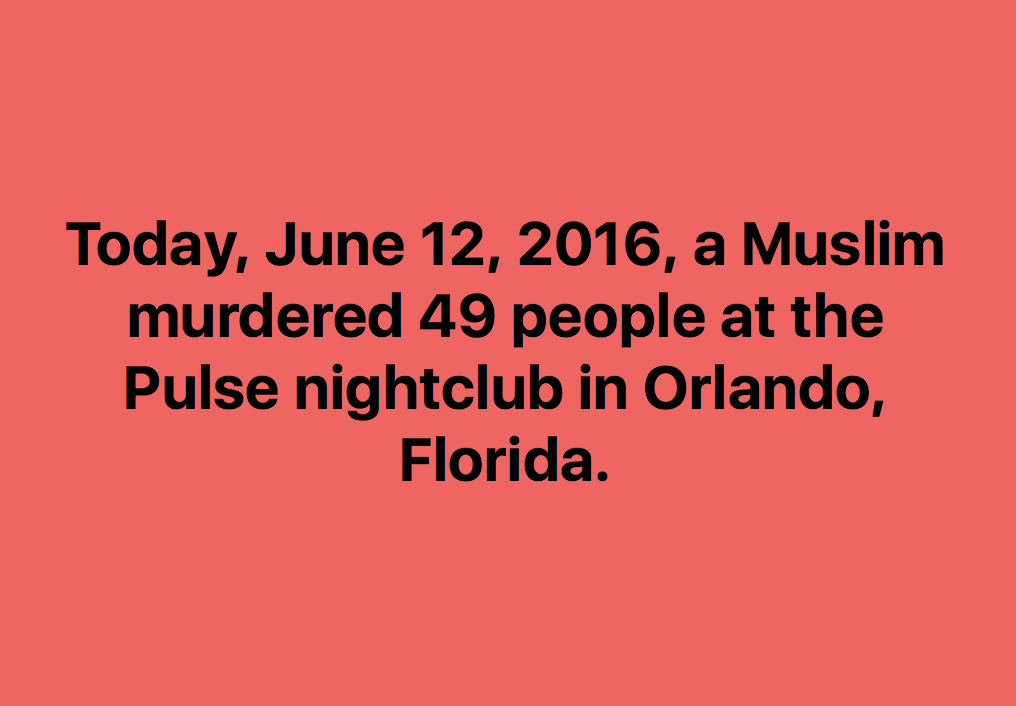
Yesterday, on my Facebook timeline, I reflected on the third anniversary of a massacre that occurred in a gay nightclub, Pulse, in Orlando, Florida, in which 49 human beings were murdered by a Muslim. My commemoration of this crime simply noted the facts:

New York based writer Doug Henwood, known for his newsletter Left Business Observer, among other things, wondered why I noted Omar Mateen’s faith. What was the point of highlighting his religion? he asked. The answer was obvious, I thought: Islam provided the motive for Mateen’s actions. Moreover, that Islam provided the motive was not speculation or interpretation, but lay explicitly in the things Mateen wrote and said. He declared himself an “Islamic Solider,” a “Soldier of God,” and he told a 9-1-1 operator: “Praise be to God, and prayers as well as peace be upon the prophet of God.”

Henwood and I are not friends on Facebook anymore (not my choice), but the encounter made me think some more about how weird the left’s relationship with Islam has become. I am not talking about the postmodern left. One expects them to fetishize the “other.” It was after all none other than Michel Foucault who propagandized for the Ayatollah Khomeini’s Islamic Revolution while working in Iran as special correspondent for Corriere della Sera and le Nouvel Observateur. But Henwood is something of a Marxist. Why would a leftwing Marxist-type take offense at naming the regressive ideology that motivated Omar Mateen’s actions? More generally, why do leftwing Marxists apologize for an ideology that oppresses and advocates violence against women and homosexuals?

I have written about the problem of Islam on this blog before (see, for examples, Orland and Religion and Threat Minimization and Ecumenical Demobilization). What I am writing today will echo some of what I have already said. But I feel the need to write down the thoughts that have been banging around in my head since yesterday because the episode provides a ready illustration of the problem secularists face in defending a free society, as well as the challenges to the building of a secular society unpinned by socialist arrangements. Antitheism is an essential part of the Marxist critique of capitalism. On February 7, 1844, in Deutsch-Französische Jahrbücher, Marx published these words: “The struggle against religion is, therefore, indirectly the struggle against that world whose spiritual aroma is religion.” Yet Marxian leftists are distancing themselves from Marx. This is a serious problem.

* * *

What I have been thinking about is double standard. When I note the religious identity of a person who takes terrorist action or commits a hate crime based on dogma associated with his identity, the response depends on which religious identity I am noting. The response is different when the person is a Christian than if the person is a Muslim.

If the person is Christian, then I will almost always be judged to have acted properly or perceived as just stating the obvious. I rarely take flak for criticizing Christianity. When I do, it is always always from a fundamentalist Christian. Folks from other religious faiths or those who are not very or not at all religious almost never object to anti-Christian rhetoric. For example, when I note that a Christian bombed an abortion clinic, this is treated as acceptable. It is not controversial that I claim the man’s religious faith probably explains why he targeted an abortion clinic. He believes that God puts souls in fetuses to make life and that he has an obligation to do his part to protect those lives.

If, on the other hand, the religious identity of the perpetrator is Muslim, then I will be judged to have acted improperly by calling attention to this fact. I violate an unspoken rule on the contemporary left when I say that a Muslim massacred people in a gay nightclub: It is okay to call out religion if the religion is associated with western civilization. Mormonism and Scientology are absurd belief systems. South Park makes fun of them. No problem. But if it is a nonwestern religion, especially Islam, then it is either an irrelevant detail or bigoted. Even when Islam is directly implicated, as was clear in Omar Mateen’s communications, it should not be characterized as causative. The motive must be found somewhere else.

We see this double standard at work in the treatment of women in religion. Margaret Atwood’s The Handmaid’s Tale, a story of the plight of women under the thumb of Christian theonomy, is celebrated by feminists, and much is made of the way the women in that story are segregated and covered, yet the same feminists celebrate the hijab and are silent on the practice of gender segregation in Islam.

In the aftermath of the Pulse nightclub massacre, the double standard confused the public about what caused the shootings. The media and the social media left told the public that the massacre was caused by homophobia (the concept of toxic masculinity also appeared). But the public was not told that target selection was motivated by a commitment to Islam, even though Mateen expressed this commitment. The public was never told about the loathing that Muslims have for western society, which Mateen explicitly referenced, a society they see as decadent and sinful because it tolerates homosexuality. It was never explained to the public that the West is a safe space for gays and lesbians compared to Muslim-majority countries. The public did not have an opportunity to contemplate that, because of immigration and the embracing of Islam, western space was becoming less safe. The cultural managers in the West did not want the public to think about the character of homophobia that led to the attack because Islam was directly implicated. These acts of omission and obfuscation put gay people in danger. Indeed, it raises the risk for everybody when the media hides the effects of Islamization on western societies and dissembles the goals of political Islam.

The attitude that Islam is incidental to the crime is crystalized in Henwood’s reflexive complaint: “Yeah, but what’s the point of highlighting his religion?” In other words, what does religion have to do with it? It’s a rhetorical question with the actual answer desperately avoided: religion has everything to do with it. Frankly, it’s a disingenuous question. People like Henwood are smart enough to know why Mateen’s religion is relevant in marking the anniversary of this tragedy: if we want to protect the gay community from violence, we have to be honest about the threat religion poses. Unfortunately, for those who mix loathing of the West in with their opposition to capitalist exploitation (a common occurrence on the contemporary Marxian left), the ethic is often “the enemy of my enemy is my friend.”

* * *

Without any apparent reflection on his part, the objection “what does religion have to do with it?” is almost always uttered by somebody who urges the public to blame white supremacy for the actions of persons who target places and people on the basis of racial identity. If authorities don’t make a big deal out of white supremacist identity in the perpetration of violence, for example when a KKK member or fellow traveler shooting up a black church for explicitly racist reasons doesn’t get a terrorist label, then leftists accuse the authorities of having a double standard. Eyes rolling, they put their double standard this way: “When a Muslim shoots up a gay bar, it’s terrorism, but when a white guy shoots up a black church, it’s mental illness.” I have seen this in meme form posted to Facebook or Twitter countless times. 

This way of thinking is massively misguided. The formulation confuses ideology with race. When we know a person is a Muslim we know something about this person. We know he believes in Islam. We know that Islam is anti-women, anti-gay, and anti-secular. We know that if a man takes Islam seriously, if he is committed to the faith, then he is more likely to act on its preachments than somebody who does not take the faith as seriously. Knowing a person is white, on the other hand, tells us nothing about the character or behavioral potential of that person. He may or may not be many things. Yet the left will blame whiteness for all sorts of things (while ignoring the fact that Muslim terrorists are also often white). If the person is white, skin color stands in for ideology. 

For many on the left, being white is a motive in-itself, whereas being Muslim means never having your crimes considering in the light of your beliefs. Being black means the same thing as being Muslim. Consider that the perpetrator of the last mass shooting in the United States was a black man. Has there been any public discussion about how the perpetrator’s identity in the Virginia Beach shooting (which occurred on May 31, 2019 and resulted in the deaths of twelve people and the wounding of five others) disrupts the belief that mass shooting is a white man phenomenon?

Reflexively, many westerners think religion is not a species of ideology, that it is rather something like skin color, or sex, or sexual orientation. When I note that a Muslim committed a crime on the basis of Islamic ideology, I am likely to be reminded that Muslims are peace-loving, law-abiding people who are just trying to raise families and live their lives. An entire people cannot be blamed for the actions of a few individuals claiming to act in the name of Islam, I am told. That’s the logic of racism. If belief enters the conversation, I am reminded that the actions of the terrible few represent a “perversion” of the faith, not its “true teachings.” It is a good thing that the majority of Muslims do not act on their faith. But this doesn’t make the problem of ideology go away. Ideology has consequences. Ideologies come with beliefs. Beliefs motivate action; human beings act on the basis of the beliefs they have about the world. Does that mean they will always act on the basis of their beliefs? Ask any community organizer about how apathy works against praxis. But in every community you have people who are highly motivated to action, and their actions animate their beliefs, and because the beliefs are bad their actions are bad. 

* * *

Millions of people believe doctors who perform abortion are murderers. Only a few people act on this belief and engage in violent actions in defense of innocents. The consequences are lethal. More important than the gun in a man’s hand is the reason why he is shooing the gun. We control guns because we cannot as effectively control religious ideology in a free society. But it is the ideology that is motivating the action. We excuse hateful and oppressive motives when we shut down people who are explaining behavior by its lights. In a free society we depend on criticism of ideology to minimize its harmful effects. We don’t ban it. We interrogate it.

The First Amendment grants the KKK religious liberty and free speech. They meet and perform rituals consist with their doctrine. They light crosses. They wear crosses. Most Ku Klux Klan members (comprising a small percentage of the population) are peace-loving, law-abiding citizens who are just trying to raise families and live their lives. They choose to wear the robes and hoods of the Klan because it represents their faith. People condemn and harass them. They are not allowed to wear their religious garments at work.When it is discovered that a person is a member of the KKK, they risk losing their jobs and their reputations. They may even be violently assaulted because of their beliefs. They are a persecuted minority, made to feel ashamed of their faith. Folks on the left say, “Good, they should feel ashamed. They should give up their hateful ideology.” I agree! The Klan should be blamed for racist violence by a few because their belief system informs their actions. This is why I have all my life been a critic of the KKK. I’m consistent.  

If those who use the accusation of “Islamophobia” to attack the critics of Islam were consistent they might consider calling this phenomenon “Klanophobia.” Klanophobia (along with Fascophobia) is a very real problem in America today. Yet, despite the persecution the KKK suffers, the community of faiths refuses to extend its ecumenical hand to the them. Is it because, unlike other faiths, KKK doctrine declares homosexuality an abomination? No, the Judeo-Christian and Islamic traditions declare this, too. Is it because, unlike other faiths, KKK parents teach their KKK children to think of themselves as part of a group that is different from other groups? No, the Judeo-Christian and Islamic traditions teach their children this, too. Is it because, unlike other faiths, KKK women are expected to assume subordinate roles in KKK family? No, the Judeo-Christian and Islamic traditions have a long history of subordinating women. Why don’t folks on the left see how unfair it is to blame all KKK members for the violence committed by a handful of their members? They see the problem when Islam is blamed for the actions of a handful of Muslims. Yet the Ku Klux Klan is a terrible organization despite the apathy of most of its members.

Of course, the left would have it wrong if they accepted my analogy in the direction of lowering the volume of anti-Klan rhetoric. There is no problem blaming the Ku Klux Klan and other white supremacist organizations and white supremacist ideology generally for the actions of a handful of people acting on white supremacist belief. It is rational to identify the ideology that motivates terroristic and hateful violence. It is wrong to believe the things the KKK espouses and we should say so. In a free society they are free to espouse those beliefs. But we are also free to criticize them and obligated to do so because the KKK is wrong and their beliefs have effects. If we are to be consistent, then the same standard applies to Islam. Like white supremacy, Islam motivates terroristic and hateful violence, not because people pervert its teachings, but because of what the ideology preaches. We have to criticize Islamic belief because it is wrong and it has effects. It hurts people we claim to care about.

Either ideology potentially motivates violence or ideology provides no explanatory power. If you say that Islam cannot be a motive for action, then Fascism cannot be a motive for action. Nor can racism, sexism, heterosexism, etc. The double standard is the result of people choosing sides. They have chosen the side of Islam against secularism, feminism, and the gay community by treating Islam as it were analogous to such things. This is fallacious. It is a very troubling trend on the left.

Lucifer is the Sublimated Projection of Christian Doubt

It appears that the Internal Revenue Service has granted the Satanic Temple (of Salem, Massachusetts) tax-exempt status on the grounds that it is a religious organization. The Satanic Temple was moved to seek tax-exempt status after President Trump’s May 4, 2017 “religious freedom” executive order. In granting the Satanic Temple tax-exempt status, the IRS has expanded the definition of religion to include its antithesis. This is good news.

Hannah Grabenstein/AP

By its own admission, the Satanic Temple does not espouse a theistic metaphysics. It advocates no supernatural explanations. Nor does it express devotion to the divine. Satan, according to leader Lucien Greaves, is symbolic of rebellion against tyranny. Satan isn’t really real in his worldview (Greaves is an antitheist). However, Christians are taught that the greatest lie Satan ever told was that he is isn’t real. For Christians, Satan is using religious liberty to insinuate himself into public life and the Satanic Temple is a demonic ruse.

Satanists do not worship Satan. Why would they? Satanism is opposed to servility of any sort. Satanism is about free will and individual liberty. It’s about dissent and disobedience. Indeed, in this way, Satanism is the most humanist of religions—which suggests that it’s not really a religion at all. Demythologizing Satan makes this clear. And exposes Christianity as a ruse. Let me explain.

The disruptive force in Eden that convinced humans to disobey God is depicted as a talking serpent of some sort, but has been traditionally understood by Christians to be a manifestation of Satan, the Great Deceiver. Eden is a mythical location symbolic of blissful ignorance, paradise, the state into which God placed the first humans. The serpent persuaded the first woman to eat and share with the first man the fruit from the tree of the knowledge of good and evil that grew at the garden’s center. God had forbidden eating this fruit, telling the humans it was lethal. The serpent knew this was a lie. He said, “God knows that when you eat from it your eyes will open and you will be like divine beings who know good and evil” (Genesis 3:5). The good-evil fruit is symbolic of both consciousness and conscience, those things that differentiate us from everything else in the universe. God punished the humans by ejecting them from Eden. And Eden vanished.

In Escape from Freedom, the Marxist-Freudian writer Erich Fromm puts it this way:

The myth identifies the beginning of human history with an act of choice, but it puts all emphasis on the sinfulness of this first act of freedom and the suffering resulting from it. Man and woman live in the Garden of Eden in complete harmony with each other and with nature. There is peace and no necessity to work; there is no choice, no freedom, no thinking either. Man is forbidden to eat from the tree of knowledge of good and evil. He acts against God’s command, he breaks through the state of harmony with nature of which he is a part without transcending it. From the standpoint of the Church which represented authority, this is essentially sin. From the standpoint of man, however, this is the beginning of human freedom. Acting against God’s orders means freeing himself from coercion, emerging from the unconscious existence of prehuman life to the level of man. Acting against the command of authority, committing a sin, is in its positive human aspect the first act of freedom, that is, the first human act. In the myth, the sin, in its formal aspect, is the acting against God’s command; in its material aspect it is the eating of the tree of knowledge. The act of disobedience as an act of freedom is the beginning of reason. The myth speaks of other consequences of the first act of freedom. The original harmony between man and nature is broken. God proclaims war between man and woman, and war between nature and man, Man has become separate from nature, he has taken the first step towards becoming human by becoming an “individual.” He has committed the first act of freedom. The myth emphasizes the suffering resulting from this act. To transcend nature, to be alienated from nature and from another human being, finds man naked, ashamed. He is alone and free, yet powerless and afraid. The newly won freedom appears as a curse; he is free from the sweet bondage of paradise, but he is now free to govern himself, to realize his individuality.

Long before Fromm, Ludwig Feuerbach tackles this matter in his landmark work of materialism The Essence of Christianity (1841). “If,” he writes, “my work is negative, irreligious, atheistic, let it be remembered that atheism—at least in the sense of this work—is the secret of religion itself.” Feuerbach exposes what man calls “Absolute Being” and “God” as in fact “his own being.” Christianity tells us that God created humans. On the contrary, Feuerbach reveals, humans created god. “The power of the object over [man] is therefore the power of his own being,” Feuerbach explains. “Thus, the power of the object of feeling is the power of feeling itself; the power of the object of reason is the power of reason itself; and the power of the object of will is the power of will itself.” This is the argument Satanists make and Feuerbach speaks directly to it: “I would rather be a devil in alliance with truth, than an angel in alliance with falsehood.” Or as a Satanist would put it: Servant in heaven; king in hell. (You can read Feuerbach’s heretical tract here: The Essence of Christianity.)

For humanists, morality is a human construct. It is of earthly origin. It was not gifted to humanity by a transcendent will, but emerges from the ground established by human relations. However, at a certain point in man’s historical development, morality becomes regulated by religion and the authority of the state. Self-government and the recognition of human rights are devised by freethinkers as means to escape this tyranny. But, as Fromm explains, amid the conditions of half-freedom, of negative liberty only, humans are afraid, anxious, and insecure, uncertainty pervades their experience with the world, life becomes dread, and in their angst they display a tendency to escape the burdens of freedom. They find comfort in authority, conformity, and obedience. The desire for servility—the felt need for a father figure to take care of them, to tell them what to do, how to think, how to act—lurks in the alienated conditions of which religion is an expression. Servility is an extreme form of wishful thinking. (Sigmund Freud speaks to the problem of wishful thinking in his essay “The Future of an Illusion“). Felt powerlessness becomes a source of all sorts of authoritarian tendencies. It is expressed by a need to confess one’s powerlessness and give themselves over to a higher power. In shāʾ Allāh.

Satanists use the metaphor of Satan, or perhaps more properly, Lucifer, a rebellious angel, to represent the human struggle against fear and tyranny. Why do I say more properly Lucifer? Of the two entities, typically seen as manifestations of the same force, Lucifer is the better metaphor because of the meaning his name conveys. In ancient Judaism, Satan means “barrier.” For Jews, Yahweh places barriers in front of them, the overcoming of which moves the people to a higher plain of existence. Satan is adversity, personified as adversary, not an enemy of God, but a tool God uses to challenge humans to do better. Evil is an instrument, not a interloper. Lucifer is not a barrier in this way; he owes his character of the impact Zoroastrianism had on late Second Temple Judaism from which the Christian cult emerged, where Angra Mainyu, the god-force of evil, enters the world at the moment of creation and battles Ahura Mazda, the god-force of good, until the Great Renovation (see my essay Zoroastrianism in Second Temple Judaism and the Christian Satan). His name is the Latin name for the planet Venus and meanings “morning star” or “shining one” (in the Greek “dawn-bringer”). For Satanists, Lucifer, the light-bearer, illumniates the barriers that hold back human progress—religion being the chief one in their estimation—to help human beings overcome adversity on their own accord (without prayer, supplication, or atonement). And it is for this reason that Lucifer is the nemesis of God.

Christians view Lucifer as evil because he undermines faith in the authority of God. We are fallen, Christians tell us, because the first humans sought divinity for themselves. Because they were tricked by a devil, we live in dirt and pollution—that is, sin. Our salvation lies in submission to God and redemption by the blood sacrifice he gave us in the crucifixion of his only son Jesus. Jesus is the truth and the light, not Lucifer. In his demonstration of devotion to God, Abraham was given a ram as a substitute for his son Isaac. To demonstrate his loyalty to humanity, God sacrificed himself. Christians are taught that Satan works continually to undermine our appreciation of this extraordinary offer in order to capture our eternal souls for himself and drag us down into hell. He does this by sowing doubt—and doubt is the unpardonable sin. But this is still not enough for the Devil. Lucifer is a wicked angel who covets God’s station, seeks to replace God on the eternal throne, to be God.

Overthrowing God and putting man in God’s position—to reduce God to man—is what Feuerbach seeks in The Essence of Christianity. Demolishing religion is what Karl Marx seeks throughout his project to de-alienate human existence (see his “A Contribution to the Critique of Hegel’s Philosophy of the Right“). In the eyes of the humanist, the struggle between God and Lucifer can be interpreted as a grand metaphor for replacing faith with reason, for elevating man to the exalted station sought by Satan, to become, as the serpent promised Eve, as divine beings.

When I was a child, my father was a Church of Christ preacher. I do not recall ever believing in God, but I do remember being frightened in Sunday school by the underground threat of the Devil. Seeing my fear, my mother told me there was no such thing as the Devil.

But why fear the Devil? Lucifer is the spirit of the Enlightenment. The Counter-Enlightenment—those who wish to limit us in spirit and nature—is the anti-humanist demand that, like frightened children, we rush into the comforting arms of faith-belief, that we subordinate ourselves to a transcendent authority that is really only the alienated creation of humanity, used by the unscrupulous to shape and control us.

Obituary: The Internet

The Internet contained a flaw. It allowed unfettered access to information and the opportunity for people to make up their own minds about things. Unlike network TV. Unlike cable TV. The Internet’s promise/poison was unfiltered.

Now that flaw is being fixed. And with it how we understand free thought. It is no longer about reason and debate. Out with the dialectic. In with emotion and identity. The people cannot be trusted. Feelings is the new truth. Unreflective, personal feelings. Were you offended by that thing you didn’t have to watch? Did a voice transgress (acceptable) dogma? Does it bother you that people are somewhere talking about things that hurt your feelings? Destroy the heretic. Smash his blasphemy. Cut the feed.

Too many Americans are frighteningly eager to relinquish their liberty by claiming for corporate power autonomy and rights it should never have. “But it’s their companies!” Yeah, that’s what the white supremacists said before the Civil Rights Act stopped businesses from banning black people from places of accommodation.

When everything is in the Cloud, will the companies that own the Cloud decide what content people store there? Why not? Why can’t Gmail determine the content of the emails that are transmitted using its service? Imagine if AT&T censored your phone calls because it objected to the content of your conversations. Why not? They’re a private company. Want to talk about whatever that was you were talking about? Form your own phone company, then.

There is no end to thought control once the people accept the premise that corporations can determine for the public what ideas can and cannot be transmitted. It is a call for cerebral hygiene.

Those advocating corporate tyranny cite the First Amendment and then dismiss it. Go home, Freedom. You’re drunk. But the First Amendment—even if irrelevant, which I do not concede—is not the final word on free speech. Personal liberty to express and receive information and opinion is a human right. That cannot be justifiably limited by corporate power. “Everyone has the right to freedom of opinion and expression; this right includes freedom to hold opinions without interference and to seek, receive and impart information and ideas through any media and regardless of frontiers” (Article 19 of The Universal Declaration of Human Rights).

Even by its own lights, human beings retain rights not enumerated in the US Constitution. “The enumeration in the Constitution of certain rights shall not be construed to deny or disparage others retained by the people” (Amendment 9 of the US Bill of Rights). We retain the right to freely transmit and receive information and opinion. Where in the US Bill of Rights does it say we have no right to this? Doesn’t the Constitution establish a free republic? “The powers not delegated to the United States by the Constitution, nor prohibited by it to the states, are reserved to the states respectively, or to the people” (Amendment 10 of the US Bill of Rights). We retain the power to determine what information and opinion we have a right to freely transmit and receive. Where in the US Bill of Rights does it give corporations carte blanche the power to control the transmission of ideas and opinions?

The Internet is a public utility. It is a gift to the world from the people. It is ours, and corporations use it with our consent, with our permission, tacit as it may seem. Corporations pay us a fee to use it and are accountable for misusing it. Violating our civil rights by censoring ideas is a misuse of a public utility. That’s why it is wrong to keep blacks or Muslims or MAGA hat wearing Trump supporters out of restaurants. A free society doesn’t put property used for public means over the civil rights of human persons.

People have rights whether recognized or not. And the people should have the recognized power to announce and protect their rights. When in justice.  Which we’re not. We’re in the clutches of corporate despotism. As long as this remains the situation, this situation will dictate the truth—or, more accurately, “truths.”

Corporations are state-sanctioned entities. That’s why they they’re chartered. They’re extensions of government power. But the government has become an extension of corporate power! Money-power has corrupted our democratic republic.

And people are down with this. Citizens are asserting the power of corporations over their government—over their sovereignty. They’re pining for unaccountable private tyranny. They desire to be subjects not citizens.

They think they’re telling other people what to think and celebrating the quashing of objectionable speech. They got this or that person censored or fired or beat up. They’re winners. But really, they want to be told what to think. They’re losers. This is masochism.

Kenan Malik: Assimilation, Multiculturalism, and Immigration

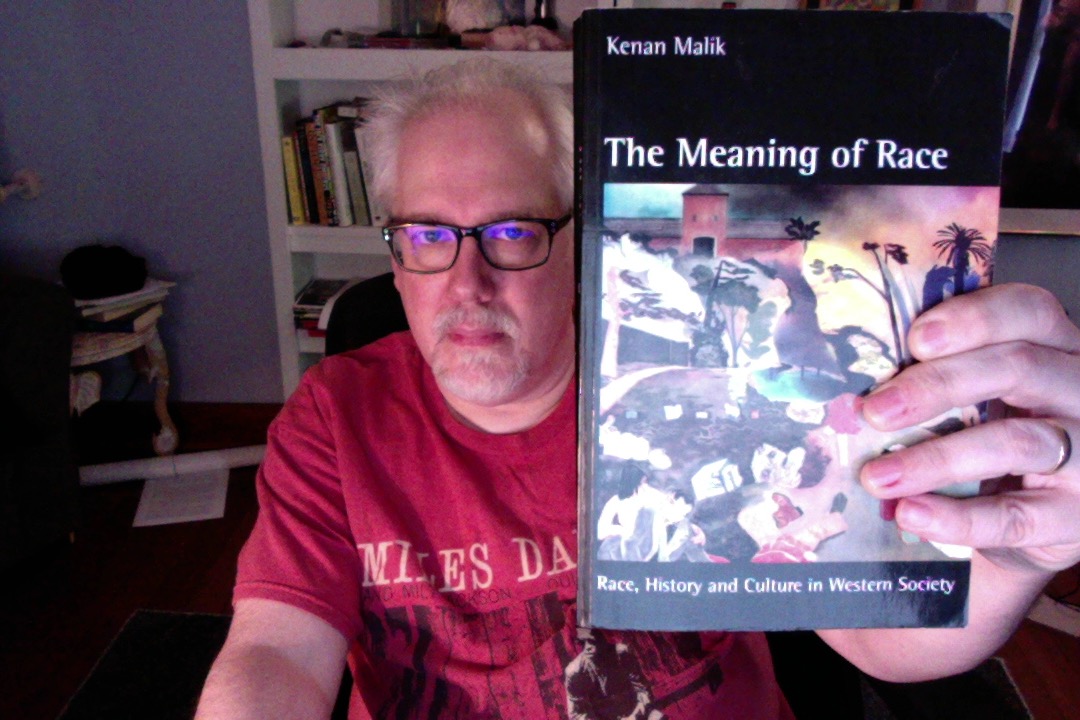
Kenan Malik’s book, The Meaning of Race (1996), left quite an impression on me when it came out. I was a graduate student at the University of Tennessee studying the intersections of class, race, and punishment, and my professor Asafa Jalata assigned the book, hot off the press, in his seminar on the political economy of racism. Upon my initial reading of The Meaning of Race, enveloped in the postmodern culture of the late-1990s university, and laboring under the spell of critical race theory, yet still viewing myself as a humanist and a Marxist, I was simultaneously suspicious of and intrigued by Malik’s universalist and individualist assumptions, which one could easily see informed his analysis. Returning to the book after leaving graduate school, I realized what had so intrigued me: Malik was calling on readers to shift their suspicion from the rightness of reason to a recognition of postmodernism as an anti-humanist assault on modernity, a reaction to the Enlightenment. I came to see identity politics as the atavistic product of the postmodernist call to seek refuge in faith-belief, to recultivate the relativistic and antagonistic sensibilities of religious-style cognition and division – to, in other words, embrace group-based truths (fictions/antagonisms) at the expense of materialism and human rights.

Malik has a more recent book, Strange Fruit: Why Both Sides are Wrong in the Race Debate, published in 2008. I was unaware of this book before only yesterday as I had not explored the body of Malik’s work, having felt that the value of The Meaning of Race was made sufficiently obvious to me in the context of my new-found antitheism in the wake of the terrorist attacks on the United States on September 11, 2001.

However, trying to understand the recent controversy over transgenderism led me down a string of YouTube videos to an interview Malik did in 2008 with Kerry Howley, then editor at Reason magazine. The interview was published on April 5, 2018, by Bloggingheads (it is posted at the end of this essay) and its relationship to the initial interest is (over quite a temporal and relational distance) is thanks to libertarian Marxist thinking that informs intellectuals associated with the British publication Spiked, which grew out of Living Marxism, which has in back of it the long shadow of the Revolutionary Communist Party and the personality of Frank Furedi (whom I will blog about in the near future). I digress.

Malik’s frame in Strange Fruit is, as with his The Meaning of Race, pro-Enlightenment: universalist, individualist, pro-free speech, and secularist. He usefully distinguishes for Howley and listeners the mainstream enlightenment (Kant, Locke, Hume) from the radical enlightenment (Leibnitz, Condorcet), while at the same time emphasizing that liberalism and Marxist have in common a universalist outlook and a commitment to equality (albeit, I should add, differently articulated in history and thought). Against these commitments, conservatism, which is anti-universalist, and seeking a return to faith, stands as the counter-enlightenment, an antithesis expressed as the romantic.

But things have become inverted, Malik argues. At the start, the left was universalist and materialist, celebrating the emancipation of the individual from the parochial, while the right was particularist and collectivistic, obsessed with the transcendent. Today’s left has abandoned universalism for ethnic particularism and multiculturalism, while the right has embraced a distorted universalism expressed in faith of the free market, manifest in doctrine of neoclassical economics. This is not exactly correct. As I have blogged about, the left has embraced this distorted universalism, as well. Multiculturalism is an expression of the neoliberal logic of global capitalism, where the culture industry divides and subdivides the population and celebrates diversity for the purposes of niche market creation and atomizing the population while manufacturing a commitment to equality. But Malik is right that the consciousness expressed by the modern left is very much a religious-like consciousness, where Benedict Anderson’s imagined communities are assumed to be the reality in which individuals are necessarily disappeared. And, overall, Malik’s understanding of racism and race is the state-of-the-art, recognizing human variation and its association with ancestry without reifying the social construct of race as a biological reality.

In her interview of Malik, Howley (currently professor at the University of Iowa’s Nonfiction Writing Program), asks a fine question about the history of nation-states, about how, before the great wars, the empires were polyglots, but then, after the wars, broke up into ethnonationalist units that constructed their own histories (various national myths) to justify their political-juridical integrity. Malik responds that nationalism is about overcoming the parochial aspects of any territory by instilling the universalist impulse. Malik contrasts this with the problem of the imposition of one particularism on other particularisms. However, he doesn’t formulate this argument very well, and pivots off of a cliché. I have blogged about this extensively (you can read for example here: Secularism, Nationalism, and Nativism). My argument about the modern nation-states emancipating the individual from religion and tribal identity operates with a firm distinction between ethnic and civic nationalism. But Malik buys into Howley’s frame (and I suspect I know from where it came, which I will discuss in a moment) and turns to third world nationalist movements for a contrast, explaining that many of these were progressive. This assumption is a holdover from the sentiment that resistance to western imperialism was generally progressive (Malik is a former Trotskyist), a claim disproved by evidence, which is not to say that imperialism was desirable, just that third world nationalists movements weren’t, either.

What Malik appears to be doing here is pitching a cultural-historical political movement that contrasts with European nationalism. I am not impressed with this argument, either, and it is probably the reason why his views on immigration – he is a supporter of open borders or free migration – clash with his argument against multiculturalism. Presumably he is not open borders in the same way that economic libertarians are. The paradox tripping him up, I think, is that balkanization is occurring amid globalization and cosmopolitanism, something Jalata pointed out in his seminar, while the interstate system in the interregnum between mass migration periods was far more universalist in outlook – and the incubator for socialist transformation. This is the Marxist outlook and, although Malik remains something of a Marxist, I don’t believe he has considered deeply enough the arguments Marx makes in “On the Jewish Question” and (with Engels) The Communist Manifesto. Thus anti-imperialist nationalist movements are excused for their ethnic commitments, while the civil nationalism of Europe is conflated with the ethnonationalist tendency Malik rightly abhors. This rather simplistic view of the nation-states, however, does help us understand Malik’s support for open borders.

At the time of the release of Strange Fruit, John Gray, political philosopher and former School Professor of European Thought at the London School of Economics and Political Science, went after Malik in an essay simply titled “Strange Fruit, by Kenan Malik,” published in The Independent. The essay appears roughly four months before Malik’s discussion with Howley and it appears to provide the inspiration for her question (she had prepared her interview well). Gray begins his review by noting novelist Joseph Roth’s lament in one of his stories of the spread of nationalism across the European continent, a movement Roth sees as a degradation of the multinational Austro-Hungarian Empire. (Never mind that multinational presupposes the nation in the ethnic sense that horrifies Roth and that the genocide of the Armenian people – Christians exterminated at the hands of Muslims – occurs in the context of the Ottoman Empire. Or that it was that particular genocide that formed the basis of Raphael Lemkin’s definition.) “If the ramshackle Habsburg monarchy collapsed,” writes Gray, Roth “feared the result would be xenophobia and ethnic mass murder.” Gray notes that, by the time Roth’s story appeared in the mid-1930s, this had happened and it was only to get worse. Gray then wonders: “Was this just a detour in the onward march to a brave new world where everyone will be treated equally? Or did it – as Roth suspected – reveal a darker side of modernity?” Gray then turns to Malik, describing him as a “pious disciple of the Enlightenment” who “cannot tolerate the thought that some of the last century’s worst atrocities were by-products of modern Enlightenment thinking.”

Gray notes, as do I, that “[n]ationalism is a modern doctrine linked with liberal ideas of self-government.” However, Gray uses this association to argue that liberalism is responsible for the horrors of ethnonationalism in Europe during World War II. Despite its counter-Enlightenment sensibilities and mobilization of Christian anti-Semitism, Gray argues, Nazism “was able to make use of a tradition of ‘scientific racism’ that belongs squarely within the Enlightenment.” Gray must be careful here since he knows that counter-Enlightenment work and Christian anti-Semitism suggest a deviation from the the liberalism that Malik defends. But he wants to make Hitler’s racial theories appear as a result of the Enlightenment (this is Malik’s focus in The Meaning of Race), thus conflating liberalism and illiberalism. The argument aligns with Richard Weikart’s From Darwin to Hitler: Evolutionary Ethics, Eugenics, and Racism in Germany, a work financed by The Discovery Institute and supplemented with the webpage, DarwinToHitler.com. What is missing in Gray’s argument is that racial science was a perversion of evolutionary science by reactionaries who sought to use naturalistic arguments to rationalize and justify political ideology, something that Gray himself does in his indictment of humanity as inherently limited by its own nature (more on that in a moment).

Gray defends his thesis by noting that “belief in science and progress is part of the Enlightenment creed.” Indeed. “So why does Malik resist the conclusion that these racists were, despite the ersatz character of their so-called science, Enlightenment thinkers?” he wonders. Doesn’t the use of the adjective “ersatz” answer Gray’s own question? Scientific racism is neither scientific nor progressive (although it is part of progressivism, which isn’t very progressive). Gray’s own answer – “Malik is not greatly interested in the history of ideas” – is not a very good or useful one (it doesn’t help that it’s incorrect). Nor does noting Malik’s “overriding concern . . . with current controversies about multiculturalism and relativism” help. To be sure, “Malik is horrified by the way liberal opinion has embraced cultural difference.” And Gray agrees: “He has a point. Multiculturalism – the notion that society and public policies should be organized around cultural groups with different histories and identities – was a thoroughly silly idea.” Moreover, Gray notes but does not take on Malik’s contention “that liberal anti-racists are as guilty of elevating race into the center of politics as reactionary racial scientists.” To quote Malik: “Out of the withered seeds of racial science have flowered the politics of identity.” Gray gives Malik half-credit for this observation before asserting: “Racism and the political assertion of cultural differences are features of the modern era.” True, but that doesn’t establish the validity of Gray argument. Gray is an obscurantist in the style of David Berlinski.

I did not want this entry to be about Gray primarily, but his pessimism provides a nice contrast to Malik’s optimism. It also demonstrates how important it is to take a historical view of things. So let’s continue. “In earlier times wars were fought over religion and resources, as they are today,” Gray writes. “With the rise of doctrines of national self-determination, they began to be fought on culture and identity.” But from where then do doctrines of national self-determination come?

I have written quite a bit on this and I have an essay under construction that explores the matter even further, but it will suffice to say here that, for a philosopher interested in the history of ideas, Gray is surprisingly ignorant of the origins of liberalism (yes, I know that in 1986 he wrote a book called Liberalism). Here’s my take: Liberalism is a view that emerges from the context generated by capitalism, a dynamic system that creates a secular space for its own operation that displaces religion by commoditizing that space. The outlines of capitalism are emergent around 800 years ago (see the work of Immanuel Wallerstein and Janet Abu-Lugod, among others). By the long century (1450-1620) the system had consolidated in Europe sparking by a string of bourgeois revolutions out of which emerged the modern nation-state (which became the norm worldwide in the post-war period).

As I have already noted, it is in the context of the nation-state that the individual is emancipated from the parochial, moving from subject (under absolutism) to citizen (in the republic). The modern concept of individualism, which liberalism philosophically captures, is thus a result of an emergent universalist outlook over against particularism, which does owe something to rational Protestantism, but also to the Enlightenment, and to science, which challenges faith-belief. However, Protestantism is itself a result of capitalist progress, as Catholicism proved to be fetters on the system’s further development, as well as a barrier to secularism. And science adjusts consciousness to the reality of the material world in which it emerges, all the more clearly when dialectical. The nation-state enables this by protecting secular spaces, even while maintaining a state church, and this is thanks to the ascendancy of the bourgeoisie. Michael Tigar 1978 Law and the Rise of Capitalism explores an interesting detail in this development. At first, the bourgeoisie attempted to renovate the law in order to include themselves among the privileged classes (the nobility), but, as the feudal juridical-legal structure proved to be fetters on further development of the system, the bourgeoisie became a revolutionary force. The law began to express the notion of the individual as it was adapted to enable the commodity market, a mentality that progressively colonized the spaces of human experience.

In light of this history, Gray conclusion to his review seems faulty: “When Roth mourned the demise of the Habsburgs, communists and liberals ridiculed his attachment to a pre-modern imperial structure. Yet it was Roth, not the progressive thinkers of the day, who foresaw the horrors that would come from its collapse. There is a lesson here, but it is not one that Malik – for whom progress and modernity are articles of secular faith – can be expected to learn.” Then what does explain the twentieth century? The crisis of world capitalism and the failure of socialism in the West, but that is a subject for another essay.

To understand why Gray thinks these things, it is useful to understand what Gray thinks about things generally. Unlike Malik, who has been consistent in his arguments since the start, Gray’s political journey took him from the Labour left in the 1960s-70s to the New Right in the latter 1970s to New Labour by the 1990s. Today, he is a deep green, anti-humanist, and a professional pessimist. He blames capitalist globalization on the Enlightenment (see his 1998 False Dawn), dismisses humanism and morality as so much religious illusion, and depicts humanity as a plague (see his 2007 Straw Dogs). He is particularly harsh on the meliorist tendency of liberal thought, condemning the liberal notion that humans are unlimited by nature (a straw man) and can improve their situation through the application of science and technology (which they do continually). Gray dismisses the ethic of progress as a secular teleology derived from (a project or sublimation of, if you will) Christian eschatology and the Christian view of human beings as autonomous and separate from the natural world. The liberal impulse is more than utopian, in Gray’s estimation; it is destructive. Gray work is in some respects similar, albeit in a much less sophisticated form, to Zygmunt Bauman’s thesis that genocidal racism – not just the technological ability to carry out large-scale genocide – is the result of tendencies that inhere in modernity (Bauman’s work is derived from Theodor Adorno’s administered society concept and Hannah Arendt’s banality of evil argument, both of which are indebted to Max Weber’s thesis in The Protestant Ethic and the Spirit of Capitalism). Here scientific racism emerges from the rationalist operation of bureaucratic classification.

Let me conclude this entry by bringing it back to the immigration question, since that matter is raised in Malik’s interview with Howley and the tension between immigration and multiculturalism is its stickiest point. Malik claims he is an assimilationist, but assimilate to what? He is not clear at all on this point. Malik says he is a supporter of the French republican assimilationist tradition, but this doesn’t address the question. And in any case, it would seem that this tradition has proven woefully inadequate in protecting French society from the degradation of Islam, which Malik, as a secularist, must also abhor (you would think). He juxtaposes the fear of culture change among the British, American, and French for their resistance to open borders – which assumes a desire for an unchanging culture – to the change immigrants bring as part of the normal way cultures evolve. He reveals his disregard for the integrity of cultural tradition by failing to lament, much to Howley’s distress, the loss of languages. You can see why some have accused the RCP crowd of smuggling rightwing libertarian notions into leftwing discourse. I think the charge is a bit overblown, but there is something there that doesn’t quite sit right with me. I suppose that’s why I am drawn a bit more to the arguments of Douglas Murray and Bruce Bauer on this matter.

We don’t want any part of assimilating Islam to the West. Rather we would like to assimilate individuals to western secularism. But how do you resist the Islamization of societies with governments promoting multiculturalism without controlling immigration? Ideologies come in the bodies of people, some of whom don’t want to assimilate but wish live their lives apart from the decadent relations of their hosts. If liberty means allowing people to hold ideologies destructive to liberal secular societies, which in principle it must, then those whose ideologies are openly antagonistic to liberty should be allowed in only at a pace conducive to assimilation and the progressive elimination of those ideas. Kenan Malik, if his arguments are to be consistent with his stated commitment to modernity, should reconsider his commitment to free migration. He should ponder the cultural and institutional framework for the preservation of the liberal and secular way of life. That means appreciating modernity as the ideational and practical expression of European civilization.

Here is the video of the Howley-Malik conversation:

Gaming Disorder and the Problem of Addiction

ICD-11 (IDC stands for the International Classification of Diseases) for Mortality and Morbidity Statistics (version 04/2019) now includes section 6C51 Gaming Disorder:

Source: ICD-11 for Mortality and Morbidity Statistics

My initial response upon learning this news today was to ask whether this definition could include gymnastics and basketball? What about music? Is a person addicted to music, say, if they prefer playing the guitar over other activities?

I am among those who believe that addiction occurs not in the substance being used, or in this case the activity enjoyed, but in the brain. An addict is a person who finds some thing that stimulates brain circuits chronically under stimulated or insufficient to assuage unpleasant feelings because of trauma or some other biographical or environmental cause. A person seek stimulants, for example, because her norepinephrine levels are poor, and the stimulants provide the level of brain activity that she needs to feel normal.

Leading addiction expert Canadian physician Gabor Maté has found that addiction is, for the most part, the result of trauma and neglect. Consider opiate addition. We’re told that heroin is one of the most addictive substances on earth, yet most people who use heroin (over 90%, in fact) never become addicted to it. They use it recreationally without any lasting negative impacts. Heroin becomes habitual in persons who are addicts, but not in persons who are not addicts. It’s trauma, not heroin, that produces the addict.

One might suspect the same for video games. Most people who play video games never become addicted to them. It’s not video games that are addictive. Rather, persons with addictive disorder risk being consumed by video games.

I am sure that most readers of this blog are familiar with the famous case of the Romanian orphans who were neglected in orphanages. The neglect altered the structure of the brains of these children. Additional research confirmed these findings. When the powerful effects of neglect were recognized, caretakers started picking up the children and holding them. The results, which we now know are biochemical, at the same social, interpersonal, were dramatic.

Human contact produces a hormone in the brain called oxytocin. Oxytocin is the “love chemical.” Without it, the brain does not develop normally. But, like the immune system, the brain circuits that rely on oxytocin to work must be primed by and developed through experience. The experience that triggers the production of oxytocin is social interaction. This is the same mechanism at work in addiction. The heroin addict suffers from low levels of oxytocin, as well as an endogenous opiate endorphin. These deficiencies are caused by insufficient bonding with other persons; it is the result of a failure to sufficiently attach to other human beings. When the addict uses an opiate he feels the warmth and comfort he was denied in earlier experiences. It’s not just the relationship with parents, but the greater social environment that structures the brain. A harsh and individualistic experience alienates a person. The effects of this isolation — or atomization — manifest themselves as addiction and other psychiatric disorders.

Maté is not the only researcher to show this effect. Canadian psychologist Bruce Alexander (a researcher at Simon Fraser) documented this in the 1970s in his Rat Park studies. He found that rats, which are, like many mammal species, highly social animals, placed in cages or Skinner Boxes and addicted to morphine, preferred morphine over anything else (this worked for heroin, methamphetamine, cocaine, and other drugs). These experiments garnered considerable media attention as they played into sensationalist drug war ambitions. However, in his experiment, when rats were allowed to reside in open spaces with other rats, the drugs were not attractive to them even though they were abundant in their free environments. Alexander determined that it was not the morphine that was irresistible to rats. Rather is was the isolation of the Skinner Box that produced conditions conducive to addiction to morphine. He concluded that rats in cages were significantly more like to self-medicate. Combined with considerable historical and anthropological data, he concluded that it was same for people (see his The Globalisation of Addiction: A study in poverty of the spirit, Oxford University Press, 2008.)[1]

What is the mechanism behind this? When wolves, bears, rats, and other animals are caged or constantly stressed their cortisol levels (stress hormones) rise. This makes them unhappy, sick, anxious, and depressed (it is also a cause of obesity, in that excessive cortisol production alters the insulin cycle). Caged, mammals pace and sway, what is called stereotypic behavior. Their coats become dull and patchy. These conditions of unfreedom set them up for addictive behavior. For animals in the wild, running, leaping, and bounding about with their comrades, stereotypic behaviors are absent. The animals are healthy and happy. There is in mammals a drive or need to be free — they are, we can say, determined to be free. If you deprive mammals of stimulation, their brains atrophy and they can lose critical brain functions. They will sit in a cage and feed their brain the stimulation lacking in their lives.

Of course, the brain circuits themselves do not determine the sociocultural systems human produce and live in. Neurotransmitters don’t explain the range of sociocultural variability. The tragedy is that we are not fated to be moral creatures; nature has prepared us to be moral creatures, but segmented systems interfere with the development of our sympathetic (or empathetic) self. And the degree to which the prevailing social order does not allow the organism to accomplish its optimal development — social orders that are authoritarian, disorganized, restrictive, toxic — signals the inadequacy of that social system.

The German idealist philosopher Georg Hegel points out that the standard liberal conception of freedom is superficial — it does not ask why individuals make the choices they make. He theorizes that our choices are conditioned by external and internal forces, so the source of freedom is to be found there, not in the metaphysics of occult forces. The view of the individual agent, authoring its own actions, independent of social, cultural, and historical forces that surround it, mystifies the origins of thought and actions. For Hegel, this condition means that freedom is not judged by degree of separation from society, but rather by degrees of participation and inclusion in society — in collective efforts to shape history for the well being of all the individuals involved. Freedom is not an essential characteristic of unhampered individual activity, but rather results from rational control of individual activity in social contexts. Freedom is present when people able to exert meaningful control over their lives as political and social beings.

The conclusion Marx derived from Hegel’s line of thinking is that democratic control over society’s productive forces and the direction of history lays the basis for human freedom. Or, as C. Wright Mills puts it in The Sociological Imagination: “Democracy means the power and the freedom of those controlled by the law to change the law, according to agreed-upon rules — and even to change those rules; but more than that, it means some kind of collective self-control over the structural mechanics of history itself.” In other words, there is a materialist foundation to freedom, one that touches fundamentally on morality.

There is a real problem in popular science. We hear it in the arguments of Sam Harris and, most polemically in Noam Chomsky, that the remarkable human being — cognitive behavior, moral behavior — is either a miracle or the result of natural selection, i.e. evolved characteristics. But they are not evolved. They are learned. To be sure, the capacity to learn is evolved, but the content is learned. And it is in this process that our brain circuitry is prime and developed. The sociocultural system is variable — it varies over time and across space. Yet humans have eternal needs: creativity, leisure, happiness. Indeed, our neurotransmitters make these possible. The needs are innate. The same needs exist in other animal species. The need for free creative activity and play. The organism depends on a stimulating environment to fully develop. But segmented social systems fail these needs. And, as a result, they damage the person. These deeply alienating conditions create social cages. Addiction is the result.  

Let me take one more example, namely attention deficit disorder (ADD). Everybody can be distracted. Most everybody daydreams. Here we are talking about distraction to the point of dysfunction. Moreover, there are other symptoms associated with this disorder: hyper-vigilance, impulsivity. There is variability in ADD. What explains that? We know it runs in families. Children with ADD are more likely to have parents with ADD. But this is not evidence of a genetic component. Things other than genes run in families. A recent study conducted at Cardiff University in England, published in The Lancet, found no genetic differences in 85% of ADD cases compared with individuals without ADD. What ADD children do have in common is a stressed environment. 

What is the character of environmental systems where ADD becomes a problem? It occurs in families with high levels of stress and the associated release of stress hormones. When an animal is stressed, it produces cortisol, epinephrine, and norepinephrine. These hormones activate the fight or flight response. This is a good thing if the animal is trying to get away from a predator. As long as the sympathetic nervous system is activated for a short period of time, then is allowed to return to normal, it is not a particular problem. But when an animal is trapped, caged, then the constant production of stress hormones makes the animal sick. The body cannot tell the difference between different types of stress. ADD is one of the effects. Constant cortisol releases lead to adrenal fatigue, which interferes with the brain’s ability to focus (medications, such as amphetamines, work because they wake up the brain). We can say that cortisol production is, in a very real sense, contagious; a stressed parent stresses other members of the family. When physicians prescribe amphetamines to children to help them focus in school, the physicians are feeding an addiction.

The good news is that the brain is plastic and improving social conditions can reverse cognitive and emotional problems. The bad news is that it is hard to change the social conditions when so many people refuse to believe that these problems are caused by social conditions in the first place — and when others in a position of wealth and power benefit from the status quo.

Society has a choice: it can treat the psychiatric symptoms, for example, using SSRIs for depression, or it can change the social conditions that cause depression. It can treat the addict (what Maté does at his Vancouver clinics is provide pharmaceutical grade heroin, clean needles, and a safe injection site) or it can change the circumstances that give rise to addiction. Crucially, then, understanding the effect of social relations on psychological health can help us understand psychological maladies — as well as understand the situations of people. This is why empathy is such a big deal.

So the way to deal with the problem of video game obsession is to change the structure of society such that people experience a variety of circumstances that produce the chemicals that put them in a good state mentally. This way they will not seek them in virtual experiences that become habitual, stereotypic. At the same time, one may argue that video games are a reasonable intervention to promote to these ends. What does it hurt? It’s certainly not the cause. And it comes with a positive side benefit: kids are not out in the world finding optimum hormonal levels by getting their kicks with vandalism and violence; rather they are in their rooms getting their kicks virtually. And they’re having less sex, which is manifest in a falling fertility rate. This is good news for the planet. Of course, none of this obviates the root source of the phenomenon: the alienating conditions of corporate capitalism.

Note:

[1] Two major science journals, Science and Nature, rejected Alexander’s first paper. It finally appeared in Psychopharmacology in 1978, a major journal in the field. However, the paper attracted no attention. Simon Fraser University soon withdrew Rat Park’s funding. Several later studies confirm Alexander’s findings — see, for example, Bozarth, Murray, and Wise 1989 work, published in Pharmacology, Biochemistry and Behavior. Alexander’s The Globalization of Addiction argues that cultural dislocation of human beings instigates addictions of all sorts, including addictions that do not involve drugs.

Race and Democracy

My opposition to identity politics is rooted in deep democratic sympathies. To illustrate, let me take the paradigm of identity politics: race. There is nothing more undemocratic.

In racialized systems, individuals are compelled to belong to a race and expected to behave in a manner consistent with whatever doctrine can be made to appear to be associated with or “normal” to that racial designation. Richard Ford puts this well in Racial Culture: A Critique (2005) when he notes that, although “there is no necessary correspondence between the ascribed identity of race and one’s culture or personal sense of self,” identity politics produces “compulsory” enactment of “prewritten racial scripts.” Ford argues that “group difference is not intrinsic to members of social groups,” thus rejecting the notion that identity can be essentialized. Instead, he contents, it is contingent upon “the social practices of group identification.”  

Despite it being a demographic category, incapable of agency (which sociologists conceptualize as a telic ability/capacity unique to individuals), self-appointed (i.e., unelected) spokespersons tell those they claim as their own how to think and behave at the risk suffering ill-repute or some negative sanction. If a black person deviates from the hegemonic doctrine of blackness, then he risks a derogatory epithet. A white person, on the other hand, is expected to deviate from the doctrine of whiteness lest she risk s being labeled a racist. To claim virtue, a white woman must admit her white privilege and declare herself an ally or even a race traitor (which is not to say she can ever escape her whiteness, which she wears like an invisible knapsack).

Again, demographic categories have no collective agency. Race is a designation based on who you (allegedly) are, not on what you actually think or do. There is no deliberative decision-making process in a racial group. Race is not a democratic institution. It’s not a voluntary associational group to which one can consent or from which one can withdraw. (If anything, as a structure, race limits the ability/capacity of agents.) David Duke doesn’t represent me by virtue of sharing my skin color. Neither does Bernie Sanders. My race tells you nothing about my politics, my religion, my taste in food or music, or my sexuality. If you think you can tell me who I am on the basis of my skin color, then you are stereotyping on the basis of race—and guess what that makes you? Well, that depends, since only some people can be a racist by virtue of their skin color (I know the drill).

The assumption that race represent collective agency is the trick that allows people to tie culture to race. That way, when one criticizes culture (which human beings should do since culture is a mixed bag of enabling and disabling thoughts and actions), you can be accused of racism—or antiracism if the culture you criticize is attributed to the right demographic. But the very notion that culture is an expression of race—that is, that values, thoughts, behaviors, tendencies, etc., things that can validly differentiated by skin color and other superficial phenotypic features – is the essence of racism. Racism roots the mind in two false biological propositions: (1) the mind flows from the genes and (2) humans can be meaningfully racially differentiated on the basis of genetics. The first proposition is found in the claim that whites are more intelligent than blacks. The second is found in the claim that whites really are different from blacks. Both claims find no purchase in anthropology. So the answer to this question: “Why do people over there act like that?” can never be “Because they’re black.” The scientific explanation would be something like this: The people over there act like that because they are socialized in a culture that provides the myths and rituals that guide their behavior. And that has nothing to do with race.  

Critical race theory (CRT) and its variant critical race feminism (CRF) constitute an enterprise based on this error. CRT/CRF manufacture a system of concepts—not a theory, but an ideology – that permits the reification of abstractions by disappearing concrete indidivudals into demographic categories, hypostatizing them, substituting identity for human agency. CRT/CRF then “theorize” that colorblindness—defined as the act of rejecting the practice of determining the fate of an individual based on her skin color—is racist in-itself. This is indeed a strange alchemy: the man becomes most racist when he chooses colorblindness. CRT/CRF identifies advocacy of colorblindness as a feature of what it calls the “perpetrator’s perspective.” White people who are not allies prefer this standpoint because it systematically benefits them. The antithesis of the perpetrator’s perspective is the “victim’s perspective,” which assumes that every person in a minority group is a victim. This victimhood can lie outside of consciousness, hence the need for race consciousness (except if you’re white).

Richard Thompson Ford provides one of the more lucid explanations for how material inequality is reproduced without laws requiring inequality in his 1994 article “The Boundaries of Race: Political Geography in Legal Analysis,” in Harvard Law Review. Ford contends that public and private actors cooperate to construct “racially identified spaces.” Such spaces define political boundaries that determine and condition the distribution of individuals, economic resources, and political power. These spaces are externally imposed or emerge from divisive structural forces. A myth has grown up around this that the surrounding racialized spaces are “quasi-natural,” “prepolitical,” or primordial associations of individuals. In fact, these spaces are political creations that accumulate—after they are formed—a “natural” history, developing an “organic” social organization. Scholars must, therefore, to take care to avoid mistaking effect for cause.

Richard Thompson Ford

Central to Ford’s argument is the promotion of race-neutral policy that has become the main component in a strategy to create and maintain racialized spaces: “racially identified space interacts with facially race-neutral legal doctrine and public policy to reinforce racial segregation rather than to eliminate it gradually.” Understanding how race-neutral policy perpetuates and even intensifies racial segregation is a key to understanding the situation the United States faces today. Indeed, it has been the exploitation of the ignorance of the public and most experts about the reality of race as structural power, and the relationship of the law to this reality, that lies at the heart of the assault on affirmative action, and the prevailing legal thinking that puts substantive civil rights goals virtually out of reach.

Like many CRT scholars, Ford advances his argument with a thought experiment. He asks us to imagine a society with two groups—one black and one white—that are differentiated only by visible physical variation.  Because of a history of racial discrimination in Ford’s invented society, blacks earn significantly less income and own substantially less wealth in comparison to whites. Over the past thirty years or so, whites have come to understand the sin of racial discrimination and have abolished the legal structure that had formally maintained the system of discrimination. Moreover, the society installed a regime of public education on the subject of race and succeeded in eliminating race prejudice. This society, Ford asks us to accept, is color-blind. Ford’s exercise desires to prove fallacious the argument that, with de jure discrimination and race prejudice eliminated, the racial divide should, with time, disappear.

Before reform, Ford’s society had in place a system of racial segregation in which each of these municipalities consisted of two enclaves, black and white, or municipalities incorporated as white or black. These municipalities, decentralized and geographically defined governments, are political units that tax their citizens and use the revenues to provide public services, education, utilities, and infrastructure. “Thus,” Ford notes, “the now color-blind society confronts a situation of almost complete segregation of the races—a segregation that also fairly neatly tracks a class segregation.”  

In those municipalities that are “racially mixed,” even though public services are equally distributed among the neighborhood, whites have, because of their higher incomes, amassed more wealth, as larger homes, larger bank accounts, etc. The black-white cities would therefore have substantially inferior public services compared to exclusively white cities who would enjoy a higher average tax base (or would at least enjoy a lesser tax burden given same level of services). Exclusively black cities would be in the worst position of the three types of municipalities, with considerably inferior public services and/or higher relative taxes. 

Under such circumstances, whites in “mixed” cities would have an economic incentive to leave or secede from the city; and unincorporated white areas would also have a reason to resist being incorporated in the mixed cities. However, it seems a reasonable assumption that blacks would favor the superior public services (or lower tax burden) of white neighborhoods and would, if they had the means, move there. If this occurred, it might be assumed further that over time economic segregation would replace racial segregation. 

This outcome depends on a false assumption, namely that residential segregation has not economically hamstrung blacks. Residential segregation affects employment opportunities and economic status for three reasons. First, since education is financed by local taxes, there would be different levels of educational opportunity and outcome. Those who enjoyed superior educational facilities would be better trained for the higher income jobs. Second, informal social networks would be racially differentiated, and these would act as barriers against outsiders entering the privileged jobs sectors. Third, the market value of homes would present with marked inequity depriving black families of the collateral necessary to buy homes in white neighborhoods.

The history of residential segregation would have created (and would continue to generate) deficits in what some have imagined as “social capital.” As a result, blacks would have substantially lower incomes, earning lower wages and probably suffering higher levels of unemployment (given what would surely be an undercapitalized neighborhood). Given these disadvantages, poor blacks would be unable to move into privileged neighborhoods. On the other end, whites would understandably be reluctant to give up their privileges to relocate to black neighborhoods (for they would suffer inferior public services and higher taxes). The outcome would be, absent intervention, the reproduction across generations of economic inequity. “At some point an equilibrium might be achieved: generally better-connected and better-educated whites would secure the better, higher-income jobs and disadvantaged blacks would occupy the lower-status and lower-wage jobs.” 

One of the important features of Ford’s imaginary society is that these outcomes occur without the presence of racial prejudice or a racial ideology. “There is no racist actor or racist policy in this model, and yet a racially stratified society is the inevitable result.” On purely economic grounds, that is, those of rational self-interest, the structure of racial segregation perpetuates itself. This is what I refer to elsewhere as objective racism. It is objective because its existence does not depend on the consciousness of actors. It is a species of racism because the effect is to privilege one group of people over another, a group identifiable only by their previously racialized physical features. “Even in the absence of racism, then, race-neutral policy could be expected to entrench segregation and socioeconomic stratification in a society with a history of racism,” Ford writes. “Political space plays a central role in this process. Spatially and racially defined communities perform the ‘work’ of segregation silently.” 

Identity politics contents that blacks exist in a world that has all the features and dynamics of Ford’s model and more: the conscious struggle by whites to secure racial privilege by actively denying blacks the opportunity to achieve substantial racial equality by taking off the table the right to secure redress for racially differentiated outcomes. These outcomes are said by those who oppose substantive racial equality to either be the result of historical inequities or the fault of the disadvantaged. Those who advance the former believe that over time racial equality will be achieved. But, as Ford demonstrates, even under the most ideal circumstances, this is impossible and so this viewpoint effectively advocates the status quo. Those who advance the latter—that the fate blacks suffer is of their own doing—explicitly advocate the status quo while at the same time express a desire to absolve whites of any responsibility for the fate of their black brothers and sisters.

However, since this reframing means one no longer has to identify a specific perpetrator upon whom to lay guilt and responsibility (the old discrimination test), that is, since perpetration is an automatic collective action by virtue of being born into the perpetrator group, this formulation convicts everybody with a particular skin color of a crime. Individuals of a certain race are all guilty (or all victims) by definition. No specific facts need be shown, no individual need be tried, only statistical abstractions represented as prima facia evidence of some thing need to be provided (if any facts need providing at all). How can such a conclusion/verdict ever be falsified? It assumes as proven that which should require proof but is never proven nor provable. This is not rational. It’s a theological argument. And like theology, it alienates us from our species being. What do we call presuming the guilt of all those with a particular skin color?

Did you ever wonder why it seems that we can’t have a broad democratic community where individual interests are represented in deliberative decision-making processes? The answer is, in part, because racial consciousness, with offensive or defensive, doesn’t see individuals. Instead of our species ties, race consciousness sees the world as made up of antagonistic groups—not material class relations, I hasten to stress, but imagined communities based on ideology—that are intrinsically oppositional. Unlike class antagonism, which are resolved by transcending class-based system through socialist revolution, the problem of race does not have a material solution. At least not one any moral person would advocate. The only way to transcend race is to give it up. Like religion. You have to stop practicing it.