“The legal and philosophic aspects of obedience are of enormous importance, but they say very little about how most people behave in concrete situations. I set up a simple experiment at Yale University to test how much pain an ordinary citizen would inflict on another person simply because he was ordered to by an experimental scientist. … The extreme willingness of adults to go to almost any lengths on the command of an authority constitutes the chief finding of the study and the fact most urgently demanding explanation. Ordinary people, simply doing their jobs, and without any particular hostility on their part, can become agents in a terrible destructive process. Moreover, even when the destructive effects of their work become patently clear, and they are asked to carry out actions incompatible with fundamental standards of morality, relatively few people have the resources needed to resist authority.” —Stanley Milgram
There were four prods when subjects resisted: “Please continue.” “The experiment requires that you continue.” “It is absolutely essential that you continue.” “You have no other choice, you must go on.” Often not reported is that the fourth prod met with the greatest resistance. In fact, in the studies I have looked at, all subjects refused to continue with the experiment when the authority told them, “You have no other choice, you must go on.”
That’s why we are seeing Americans taking to the streets in defiance of the lockdown orders. As the government moved through the prods—“Please shelter in place,” “Public health requires that you shelter in place,” “It is absolutely essential that you shelter in place”—the public followed orders. They still do. It makes them feel like they are part of something greater than themselves, that their choice is for some greater good. But then the government said, “You have no choice but to shelter in place.” And a number of people said, “Fuck that,” and gathered in public to make their defiance known. That’s mutual knowledge. Good for them. What’s wrong with other people that they would submit to destructive demands backed by threat of punishment? And why are they shaming those who are resisting authority—or in this case power, since for power to be authority it must have legitimacy.
I was just out walking in Allouez. I had to wait to cross the street because there were more cars traveling down Baird Street than I have seen on all the other days since the lockdown combined. Once on the other side, on my way to the East River trail, I had to walk in the road repeatedly because the driveways and roadsides were filled with cars. The smell of barbecues filled the air. Music was pumping. People were laughing. Three cop cars huddled by the trail. The looks on the cop’s faces told me they were looking at a level of defiance that they could not deal with (maybe they didn’t want to). This follows the police order that those who engage in precisely the behavior folks were engaged in at that moment would be subject to hefty fines.
What I saw out there today was “Fuck that.” Good for them. Maybe they’re paying attention to the news that this was overblown. Whatever the case, it made me feel good about my fellow man. Roy Batty’s words filled my ears—“That’s the spirit!” And that is a feeling I have been sorely missing over the last several weeks.
As the evidence mounts that the COVID-19 hysteria was an overreaction, for those who have invested tremendous emotional energy in virtue signaling and scolding others—extreme social distancing measures have become articles of faith in what amounts to a cult of safety—seeing friends change their opinion or challenge the opinions of cult members on the basis of facts and logic is so distressing that a pattern of strategic unfriending unfolds. I’m watching the process in real time. This is what happens when a community of zealots sees members of the congregation leaving the faith or realizes that friends were never fellow travelers. Since articles of faith are the most important things in the world to them, giving them meaning and status in a largely imagined community, those who would dissent from the articles of faith become intolerable in their presence. It’s not enough to unfollow them. Excommunication is the only course of action. From their bubblized worldview, this is banishment. They are powerful in their conviction. Now their room is clean.
It’s fascinating to watch the psychology of the unwinding of a moral panic play out on social media. As the evidence mounts that the COVID-19 hysteria was an overreaction, for those who invested tremendous emotional energy in virtue signaling and scolding others—extreme social distancing measures have become articles of faith in what amounts to a cult of safety and petite snobbery—seeing friends change their opinion or challenge the opinion of cult members on the basis of facts and logic is so distressing that a pattern of strategic unfriending and blocking unfolds.
I’m watching an unwinding unfold in real time. Not just on my Facebook page. It’s happening to my wife, as well. She has a different circle of friends, but the unfrienders and blockers have something in common—they share a faith: passion for the Democratic Party and an affinity for progressive politics.
The reaction is typical of a community of zealots when members of the congregation leave the faith or the realization sets in that friends and colleagues were never fellow travelers. Since the articles of faith are the most important things in the world to the self-righteous, giving them meaning and status in a largely imagined community, those who would dissent from them are intolerable in their presence.
It’s not enough to merely unfollow. Excommunication is prescribed. From their bubblized worldview, unfriending and blocking amounts to banishing—they are cleansing. Mighty in their convictions, their room is clean. From the point of view of the vanquished, the zealots are fleeing, chanting slogans with their fingers plugging their ears. They’re gone before the fun begins.
You’d think for all their talk of justice, liberation, and popular democracy these progressives would resist extreme measures that hurt ordinary people. How does a cult of safety and petite snobbery come from the professed ideals articulated and values expressed? There are two psychological pulls that make it easy to manipulate progressives into supporting lockdowns.
The first pull stems from emotional need, the need to scold (self-righteousness) and to virtue signal (self-importance). You might recognize these as the characteristics of the authoritarian personality—conformism and narcissism. Despite the appeal to freedom, progressives fear it—they seek to escape from it—because it opens up space for disagreement. And those who disagree with the progressive articles of faith are not merely wrong; they are immoral and dangerous.
The progressive is an identitarian, and the identitarian’s world is built on imaginary structures of intersecting oppressions. The disagreeable don’t merely hold a contrary opinion. They’re up to no good. In their postmodern view of things, power and feelings—not reason, not facts—control discourse. It therefore follows that discourse is a reflection of power and emotion. The only truth is their doctrine; others who do not adhere to it are apostates or heretics. It’s like any fundamentalist religion. The contrary opinion cannot be considered because it is destructive and oppressive.
The virtue signaling piece is straightforward. Like mass marchers wearing knitted pink pussy hats, the quarantiners and their homemade masks (which they either wear around the house or at least while posing for the selfies they hope will be showered with likes) are the easy signs of wokeness. (This is why, by the way, progressives are so enamored by the hijab. The hijab is a blatant sign of belonging to an imagined community of relative truth. So enamored are they by this sign that some Muslims and their allies have set aside a day of ritual sharing where allies can wear hijabs, too. Are they praying that the ritual will be conducted virtually next swing around the sun? If they go full burqa they won’t even have to wear their masks. Are pussy hats haram?)
The second pull involves a human totem: Donald Trump. The president is the folk devil of their myopic moral universe. The ritual loathing of Trump is so pathological that economic collapse and widespread suffering are acceptable if these discredit the president and hurt his chances for reelection. Two Minutes Hate with a snooze alarm.
Progressives know that presidential elections tend to track economic performance. They are convinced that a failed economy will hurt Trump’s chances for re-election. Since the Trump presidency is the single worst thing to ever befall their country (their trauma and wailing prove it), economic collapse is worth it.
In the Dark Ages, the Inquisitors rended the bodies of the possessed. Evil spirits justified the worst things men could do to other men. Given the relative affluence of progressives, they won’t quite suffer in the way the people they claim to speak for will. But it’ll be worth it. It’s for their own good. After all, suffering is a virtue in their faith—especially the suffering of others (it proves they were victims all along).
The emotional satisfaction of having driven the orange demon from his high place will be golden. The culmination of The Resistance™. They will have quite the symbolic achievement to tout in the end. In their world anyway.
So it is that, in the face of mounting evidence showing that society has probably all along been in the thrall of mass hysteria, progressives frantically toil to keep alive the moral panic with denunciations and dank memes, and by raging at the deplorables. But their bubble is collapsing.
In closing, I want to emphasize that I am not talking about all progressives or Democratic Party supporters in this essay. I am talking about a particular expression of progressive Democratic sentiment that marks the personality type of the true believer. They are common enough that something useful may be said about them. I am sure my wife and I are not the only ones who have experienced their tantrums. But it almost must be said that they do the work of a larger political ideology. By unfriending and blocking, and thus limiting criticism for their claims and opinions, their ritual actions polarize and shrink the universe of debate and discussion. For every public outburst of disgust, there are many others who nod their heads in agreement.
President Trump has once against exposed his ignorance on questions of science. He wondered aloud if there was a way to disinfect lungs savaged by pneumonia. It’s the scandal du jour. While Lysol is warning people not to drink their cleaning products, the American Association of Retired Persons (AARP) has had to issue a message to seniors not to avoid the ER for life-threatening conditions. The overblown claims of journalists, politicians, doctors, and scientists have the elderly so petrified that they’re now avoiding hospitals. Why isn’t that a scandal?
A handful of individuals drinking fish tank cleaner or injecting themselves with disinfectant hurts far fewer people than have been and continue to be hurt by the shuttering of society. It helps to have a sense of proportion when considering the relative scale of stupidity. We could dwell forever and always on Trump’s ignorance (a lot of people do), but what ought to be more concerning are the many experts with their wild projections and damaging prescriptions for dealing with SARS-CoV-2. They did not suggest looking into whether doctors can disinfect lungs. They terrified the public with apocalypse. How did they get it so wrong?
Three major scientific studies have shown that the dangers of SARS-CoV-2 to be overblown. And not by a little. A Stanford University study of antibodies in a large sample of Santa Clara, California residents found the rate of infection to be 50-85 times greater than confirmed cases. A similar study of Los Angeles County, with a similarly large sample, estimated that SARS-CoV-2 infections are 28 to 55 times higher than the confirmed cases Los Angeles County reported at the time of the study. A third study using the same methods estimated that at least 2.7 million New Yorkers have had the virus, far more than those who have tested positive for the virus. These studies indicate that virus is likely no deadlier than the flu, yet the media continues to dwell on false projections and distorted death tolls while mocking the president (who is not a scientist).
ER Physician Drops Multiple COVID-19 Bombshells
Several weeks ago, Neil Ferguson, a mathematical epidemiologist at Imperial College, warned that the United Kingdom’s health service would be overwhelmed with severe cases of COVID-19 and face more than 500,000 deaths if the government took no action. Using the same model, he warned that, with no action, the United States might face 2.2 million deaths. His report prompted Prime Minister Boris Johnson and President Donald Trump to lock down their respective society (although the United States, its structure rooted in federalism, saw wide variability in measures across the country). Our societies are still locked down even after it is clear that these Ferguson’s modeling was wrong. Why isn’t this a scandal?
Some will claim that the lockdown derailed the projections. After all, Ferguson’s model makes these predictions if no action was taken. Great Britain and the United States too action. That the projections did not pan out proves that the actions taken worked. (Good luck, Mr. Trump, receiving any credit for it.)
But the claim that the lockdown altered the trajectory enjoys little evidence. Wilfred Reilly is an Associate Professor of Political Science at Kentucky State University has examined the data and finds no support for the claim that the lockdown played a role in derailing the projections. Using a linear regression model, he found no statistically significant difference between states with stringent restrictions (shelter-in-place orders) over against those with less or without stringent restrictions. (From mark 11:19, listen to The Covid Culture Wars.) Tucker Carlson delivered probably the best commentary during this entirely silly season on the lack of evidence supporting stringent restrictions.
Are coronavirus lockdowns working?
We can see how this happened. But why did this happen? I am still formulating my opinion, but somebody recently asked me what is to be gained by throwing the world into economic depression. Who benefits? That is a great question. Fear facilitates the entrenchment and expansion of police and surveillance powers. In effect, the COVID-19 pandemic has been used as a stress test for popular acceptance of authoritarian government. The public has passed the test with flying colors, enthusiastically indicating their willingness to accept house arrest with little resistance. Many even see shelter-in-place as a virtue and eagerly report those who violate the order to the police. A nation of Gahan Wilson’s snitchy dolls. These attitudes spell the end of a robust defense of democracy and civil liberties. Remember when we were warned that Trump would bring fascism to America? It is remarkable, then, that it’s the left that is demanding the authoritarian clampdown on the free expressions and movement of people.
The calamity suggest more than exposing the stealth authoritarianism of leftwingers. Economic crisis concentrates power in the hands of governments and wealth in financial institutions. It’s not as if governments driving up unemployment to drive down wages, disrupting rising affluence and its associated consciousness, is a new thing. One only has to reflect on the steps made in the 1960s to expose native-born American workers to cheap foreign labor, or recall that, under Reagan, the Federal Reserve under Paul Voelker (rewarded for his judgment with the highest position at the World Bank) threw the US economy into a deep recession in order to deflate the economy and wreck organized labor. Global financial institutions fund projects in poor countries expecting these countries to default on the loan and then use their predicted failure as leverage to dismantle social supports and privatize public infrastructure and natural resources. The generation of enormous debt to justify structural adjustment projects is a triumph of neoliberalism. At this point, derailing the transatlantic populist movements, whose leaders also fell for the absurd projections fed to them, is a priority. It’s the same with war. The United States government lies its way into catastrophic war, wrecks economies, spends trillions, kills and maims millions. And so on. Benefits accrue to powerful entities and people in the midst of calamity. All this is uncontroversial. These are the gales if creative destruction. One doesn’t need to suppose a grand plan, of course; these are functions of calamity.
As for Trump, he should avoid speculating about scientific matters from the podium. The president is not a scientifically-minded person. His questions were imprudent, musings that are better asked in the meetings before the press briefings. But is this really a surprise? What did people think the president knew about such matters? Hearing reports of light and chemical agents killing the virus he wondered aloud if something like that can be done in humans. But it is disingenuous to suggest that he was telling the public to drink bleach or inject Lysol. Reflecting on his utterances, Trump clarified that he was riffing off of what others had said. It was obvious he misunderstood some of it. For their part, the media paraphrased what he said, inserted words, amplified others, and manufactured a confabulation to make it appear as if the president was telling the public to drink bleach and inject Lysol.
The confabulation was generated on the fly, exploiting words actually uttered by Bill Bryan, Under Secretary for Science and Technology at DHS. “We’ve tested bleach, we’ve tested isopropyl alcohol on the virus, specifically in saliva or in respiratory fluids, and I can tell you that bleach will kill the virus in five minutes,” Bryan said He continued, “Isopropyl alcohol will kill the virus in 30 seconds, and that’s with no manipulation, no rubbing. Just bring it on and leaving it go. You rub it and it goes away even faster.” He then added, “We’re also looking at other disinfectants, specifically looking at the COVID-19 virus in saliva.” He also said, “Our most striking observation to date is the powerful effect that solar light appears to have on killing the virus, both surfaces and in the air. We’ve seen a similar effect with both temperature and humidity as well, where increasing the temperature and humidity or both is generally less favorable to the virus.”
The president said, “So, I’m going to ask Bill a question that probably some of you are thinking of if you’re totally into that world, which I find to be very interesting. So, supposing when we hit the body with a tremendous, whether it’s ultraviolet or just very powerful light, and I think you said that hasn’t been checked, but you’re going to test it. And then I said supposing you brought the light inside the body, which you can do either through the skin or in some other way. And I think you said you’re going to test that too. Sounds interesting. And then I see the disinfectant, where it knocks it out in a minute, one minute. And is there a way we can do something like that by injection inside or almost a cleaning? Because you see it gets in the lungs and it does a tremendous number on the lungs, so it’d be interesting to check that, so that you’re going to have to use medical doctors with, but it sounds interesting to me. So, we’ll see, but the whole concept of the light, the way it kills it in one minute. That’s pretty powerful.”
Most of what Trump was interested in is the possibility of light therapy. He’s not off base here, but I don’t have time to get into the benefits of light on disease. But it’s the disinfectant piece the press would key on. Within moments, ABC News reporter Jon Karl asked Bryan, “The president mentioned the idea of a cleaner, bleach and isopropyl alcohol emerging. There’s no scenario where that could be injected into a person, is there?” As is plain from the president’s comments, he said noting about bleach or isopropyl alcohol. Indeed, he almost immediately clarified his remarks: “It wouldn’t be through injections, you’re talking about almost a cleaning and sterilization of an area. Maybe it works, maybe it doesn’t work, but it certainly has a big effect if it’s on a stationary object.” He then raised the possibility of whether UV rays could kill the coronavirus if it was on a person’s skin, in particular if it were on their hands. “If they’re outside, right, and their hands are exposed to the sun, will that kill it as though it were a piece of metal or something else?”
The spin was immediate and relentless. “The president appeared to be suggesting at one point that you can inject disinfectants into people to kill the coronavirus,” CNN’s Jim Acosta said; “We want to caution everybody at home, please don’t do that, please don’t follow the president’s medical advice here.” Nobody thinks Trump is a physician giving medical advice. He did not suggest injecting disinfectants into people. He wondered whether it was a possibility. Charity and accuracy are not virtues wildly held. Jake Maccoby, a former speech writer for the Justice Department under Obama, tweeted that Trump “told people to drink bleach.” Rob Flaherty of Biden for President tweet that “this election is a choice between two competing visions for America [sic]: one that says ‘you should drink bleach to cure viruses’ and another that says ‘do not drink bleach.’”
If the press were not motivated to use these briefings (and every other opportunity) to delegitimize the Trump presidency, then they would have accurately reported what he said and contextualized his remarks. The questions and reporting would have been charitable and responsible in emphasizing the important findings concerning UV light and disinfectants, all of which got lost in the churn of the feeding frenzy—along with critical questions concerning how badly authorities and experts got this thing wrong. Again, read the transcript. Did the president say “bleach” or “Lysol”? Did he say people should drink fish tank cleaner? Remember when the media wanted to blame Trump for that death after he talked about the potential benefits of chloroquine and hydroxychloroquine, a pair of drugs that have been used in the treatment of malaria since the 1940s?
Trump’s problem has always been that he is incurious about many things, while at the same time supremely confident in public intercourse. This combination increases the probability that the president will say things that come to his mind without reflecting on how they sound. Like many narcissists, Trump is a victim of his own hubris. But the president’s personality and style shouldn’t be used as a cover by the media to not do real reporting or to distract the public from good news concerning the virus.
However astonishing Trump musings can be (I had fun with it by recalling the Star Trek episode where Mr. Spock is blinded by bright light to rid his body of a giant virus-like creature), we have to stay focused on the problem: the failure of the media to hold authorities and experts accountable for their reckless treatment and misuse of the science to expand and entrench authoritarian structures. The media hasn’t asked the most important questions because they are gleeful over exercising their power to compel the government to throw people out of work and lock them up in their homes. They’re reveling in their ability to manipulate the public. We’re now in the throes of global depression and the obsession is over a series of questions Trump asked his team from the podium. The media plays a central role in manufacturing the fear that persuades the majority to submit to totalitarian desire. The president’s musings become an intentional distraction in this context.
The media are sowing chaos and confusion. To criticize the press for obsessing over this and for not asking actual critical questions of the government concerning why the scientific-industrial complex got this so wrong is not only a fair criticism to make, it is the criticism we have to make if we’re going to get out from under the massive error, an error for which Trump is, along with the leaders of many other countries, responsible. But the media want that error to continue. They’re not going to ask those critical questions. Effective at first, these task force briefings have become a shit show. Trump should stop holding them or at least appearing at them.
I recognize that the perception of Trump as an idiot is so deeply ingrained in the minds of those who loathe the president that charity in interpretation or refusal to feed the frenzy by piling on will be seen as a rationalization. I did not vote for the president nor will I. I agree with many of his policies (restrictions on immigration and bringing our troops home are chief among them). Joe Biden is certainly not a more desirable alternative. So let me emphasize my opinion that what the president said was ignorant and imprudent. I publicly said so right after he said it. My point is that’s comments are being distorted and used to undermine his presidency and distract the public from the questions the press should be asking.
“Fox News Sunday” host Chris Wallace said on Friday that the state of Maryland emergency hotline had received more than 100 calls from people asking whether it was safe for them to drink a disinfectant. Does it occur to anybody that progressives are smart enough to organize a campaign to call the emergency hotline and ask if it was safe to drink disinfectant in order to manufacture the appearance of a reckless president? If you haven’t considered that possibility, then you are naive about the character of modern propaganda.
In New York, 15,302 people are said to have died from COVID-19. (It’s not that many, but let’s accept the number.) A new study out today estimates that at least 2.7 million New Yorkers have had the virus. That is a death rate of 0.56%. What have I been saying on this blog? If you haven’t yet, read my blog posts.
The public thinking associated COVID-19 is astounding. Mind numbingly idiotic, to be frank about it. There’s a virus. It sickens a small proportion of those it infects. It kills a small percentage of those it sickens. Like other viruses. The flu, for instance. Nothing novel there. So, let’s shut down the economy, bankrupt scores of businesses, throw millions of people out of work and into poverty, causing them to lose investments, housing, and healthcare, and go hungry. That’ll take care of the problem.
The lack of foresight to see that when you do something like “flatten the curve” you are going to at the same time affect everything else is mind-blowing. Everything is interconnected. It’s why we call it a social system. Humans depend on a working economy—the material basis for their existence—for a stable society. For all of capitalism’s faults, which are many, some of which can be tweaked by progressive government, disrupting capitalism by shutting down production and commerce is going to hurt not only the most vulnerable in our society, but those whose relative affluence has rendered the struggles of the poor largely peripheral to their concerns. The resulting consciousness won’t be an exercise in the sociological imagination but a bunch of rightly angry people who will double down on self-interest, forced to the survival rungs of Maslow’s hierarchy.
For now, polls indicate that most Americans think shutting down social life is a good idea. One poll finds that a large majority think people shouldn’t be able to move freely outside. So maybe there is a virus out there that scientists haven’t yet identified that works, or a fungus, like that zombie-ant fungus (Ophiocordyceps unilateralis) that invades the ganglia of ants, taking over their bodies and directing their behavior, making them robots for the fungus’s own purposes. This unidentified virus makes humans lumber to destructive signals as dumb herd animals. Only in the present case, other humans don’t take the zombie-humans and dump them outside the colony to keep others from being similarly affected like the wise ants do, but rather embrace the zombie spirit and become themselves zombies. I’m not a religious man, but I pray I never contract that virus.
When people get panicked and enter the “fight or flight” mode, the acute stress response or hyperarousal state, the general discharge of the sympathetic nervous system that produces a hormonal cascade of neurotransmitters, among them catecholamines, our brain’s native amphetamines, they become hyper-focused on one thing to the exclusion of everything else. Like a drowning person, tunnel vision pushes context and its interrelated and complex exchanges to the peripheral where they vanish from consideration.
Over the past decade, excluding the present year, as many as nearly half a million Americans have died from influenza, with a yearly average of 50 thousand victims. There is not a lot of variation in deaths from year to year; in other words, yearly frequencies hover around the average, although over the last several years, that number has been higher than the average. The CDC says the current number of flu deaths is half the average of the previous period, something like a third of what it was last year. This is a suspicious claim. The predominant flu strain this season is H1N1pdm09, so named because of the flu scare of 2009, when it was a novel influenza type A. Remember that? That was a pandemic, too. Today, we are seeing pneumonia case without an identified cause being attributed to COVID-19. But we do not know if these deaths are from SARS-CoV-2 or from H1N1pdm09 or from some other influenza virus, or even from rhinovirus or another coronavirus.
I tell my students in my research methods classes that an ambiguous or unanswered survey items must be recorded as missing data. A careful researcher who is not imposing his agenda on the data does not guess what a person answered on an item if it is unclear or unanswered. Missing data is missing data. If you have not tested a person for SARS-CoV-2, then you can’t put his death in the COVID-19 category. You can only designate his death as a pneumonia death if that is indeed what he died of. The source of the pneumonia may not even be viral. It may be the result of a bacterial infection. That they are guessing the cause of death, tells us that they are not testing people who sick. How do you know what a person has and determine the course of treatment if you don’t try to determine the cause? What we are seeing from government and public health officials looks a lot like an epic case of fraud. Yet fear has pushed critical thinking out beyond the horizons of the present. We may very well find people asking these obvious questions in the future. But the current attitude is causing the damage now.
People must ask themselves, when possibly more than sixty thousand people died in in 2018-2019 from the flu—that was just last year—why didn’t we shelter-in-place then? I don’t remember any news stories at all about these deaths. Scores of children were killed by influenza that season, as well. Why were the human beings suffering and dying then so unimportant that didn’t even merit our mere awareness of their fate? Americans took it in stride. Why are viral deaths so bad now that Western nations had to sink the world into depression? Why are people not thinking about the consequences? They’re panicked. Tunnel vision. They are moving with the herd off a cliff.
My readers do realize that the United States is the OPEC of agriculture and that the collapse of food distribution systems means people who need food won’t get food? Even from aid agencies? Did the experts think about that? They see crops rotting in the fields and think, “Well, that’s just too bad?” Many hungry people won’t live long enough to get the virus on its next trek around the planet because they will starve to death first. At the end of 2019, 135 million people were living with acute hunger. Acute hunger is the most extreme and life threatening form of hunger. It involves severe undernourishment and is reflected in starvation and wasting. And death. The BBC reports that, with many countries around the world enforcing quarantine, the number in acute hunger is likely to rise to 265 million.
The disruption of supply chains because of the global economic shutdown has made sufficient amounts of pesticides unavailable to those regions affected by locusts. Now locusts are eating food meant for people and livestock. People are having to attempt to physically chase off the locust, running around screaming and banging pans, but hungry locus are not easily dissuaded from eating crops and invading villages. The scenes look apocalyptic. Compounding the problem is that the next generation of locusts won’t be nipped in the bud and successive waves will be hundreds of times larger than the current wave, which is unusually large.
Kenyans attempting to drive away locusts bent on destroying their crops
Is lack of food a “third world problem” and the residents in developed countries not getting a virus that is for most people is cold-like or presents with no symptoms at all too much to bear? I hear people scolding those who would sacrifice lives for the economy. Aren’t they sacrificing lives out of fear of a virus?
The catecholamines principally involved in the acute stress response are epinephrine and norepinephrine. They work like meth in your brain. It’s why people like to be scared when they know they can find relief from the fear. The hormonal cascade associated with acute stress response also works other hormones. One of them is cortisol, the stress hormone. The flight or fight syndrome is supposed to be temporary, to get the organism away from danger or to confront it. Once the danger is gone or vanquished, the organism’s sympathetic nervous system returns to normal. But sometimes the danger—or the perception of danger—persists, and so does the body’s response to it, and the stress of this damages the organism physically and mentally. We must emphasize that the popular phrase “fight or flight” leaves out another phenomenon associated with acute stress response: freeze. It is, in fact, the “fight, flight, or freeze” response. Sheltering in place under COVID-19 fear has provoking little fight in the public, except where they can take to social media and scold their “friends” for trying to live normally. It’s flight and freeze that marks what has become a chronic stress response.
People should take the circumstances of house arrest to ponder the following: shelter-in-place while the world collapses all around you means you will soon have no place in which to shelter. In the meantime, consider new locks for your doors. Maybe get a gun. Enjoy your rush. The high will wear off soon enough.
The sociologist W.I. Thomas famously said, “If men define situations as real, they are real in their consequences.” We call this the “Thomas theorem” or the “definition of a situation.” Folks would do well to include the Thomas theorem in their manner of thinking about the world around them. Our present circumstances illustrate the theorem’s power as well as anything could.
After more than a week of testing, officials in Detroit are finding about a quarter of the residents and staff at the city’s several nursing homes are infected with SARS-CoV-2, the virus that causes COVID-19. Half of those tested are asymptomatic. The nursing home population is expected to have fewer asymptomatic cases than the general population given that the power of the immune system declines with age. The death rate for those in nursing homes is also expected to be higher because of immune system decline, as well as critical comorbidities, including type II diabetes and cardiovascular disease.
In a story published last night by the The New York Post, “Testing shows at least 200K in LA County may have been infected with coronavirus,” journalist David Aaro of Fox News reports that the estimated SARS-CoV-2 infection numbers are 28 to 55 times higher than the confirmed cases Los Angeles County reported at the time of the study in early April. Recall that the Stanford University study of Santa Clara residents found the rate of infection to be 50-85 times greater than confirmed cases. See the podcast above to hear my discussion of this finding.
A few days ago, when I ran a calculation to estimate the proportion of the population with antibodies to SARS-CoV-2, I applied a factor of ten to confirmed cases at the time (see “Future Containment of COVID-19: Have Authorities Done the Right Thing?”). I estimated 1.2 percent of the US population with antibodies and complained that, if the lockdown is keeping the number of infections at bay, it is at the same time interfering with the benefit society would derive from widespread immunity to the virus. The University of Southern California and the Los Angeles County Department of Public Health had found that 4.1 percent of Santa Clara adult population has antibodies to the virus in their blood. This is still nowhere near where it needs to be to approach herd immunity, but one can immediately see that the number of those with the virus is many times larger than those previously confirmed cases. This is powerful confirmation of the the argument I have been making for weeks.
For those who might have supposed that my estimates were overplayed in order to downplay the threat (since I am clearly not a supporter of hysteria and lockdowns, my extrapolations may be perceived as biased), my extrapolations have been very conservative. I said at least ten to twenty times actual infections to confirmed infections and then went with the lower number. To be sure, I am not an infectious disease expert, but I read and write science, grasp statistics, and have an understanding of epidemiological models. As soon as I learned that at least four out of five infections are asymptomatic or present with only mild to moderate symptoms, and, furthermore, based on a common sense assumption about human behavior in the United States, that many of those with flu-like illness don’t see a doctor or get tested (which is why the CDC estimates flu cases), I could see that the death rates were exaggerated. And I said so when it was unpopular to say so. The experts are not only confirming my point, but they’re indicating that governments, journalists, and even the experts got it a more wrong than I initially thought (I admit that I was using a rather small factor to err on the side of caution). Neeraj Sood, professor of public policy at the USC Price School for Public Policy said that the findings “suggest that we might have to recalibrate disease prediction models and rethink public health strategies.” You think? Maybe we need to recalibrate these lockdowns, too.
I am writing all this not to be immodest but to leverage the facts against the claim of testing and contact tracing is the way forward. Given what was obvious and now admitted to, how would authorities know whether any given infected person is the person from whom a sick person contracted the virus or, to put it another way, that those with whom a sick person has been in contact contracted the virus from them and not somebody else? If this thing is as highly contagious as they claim, in the absence of a vaccine to mitigate community spread, the virus is likely everywhere, and the reality of this means that this is not nearly the big deal governments have been making it out to be.
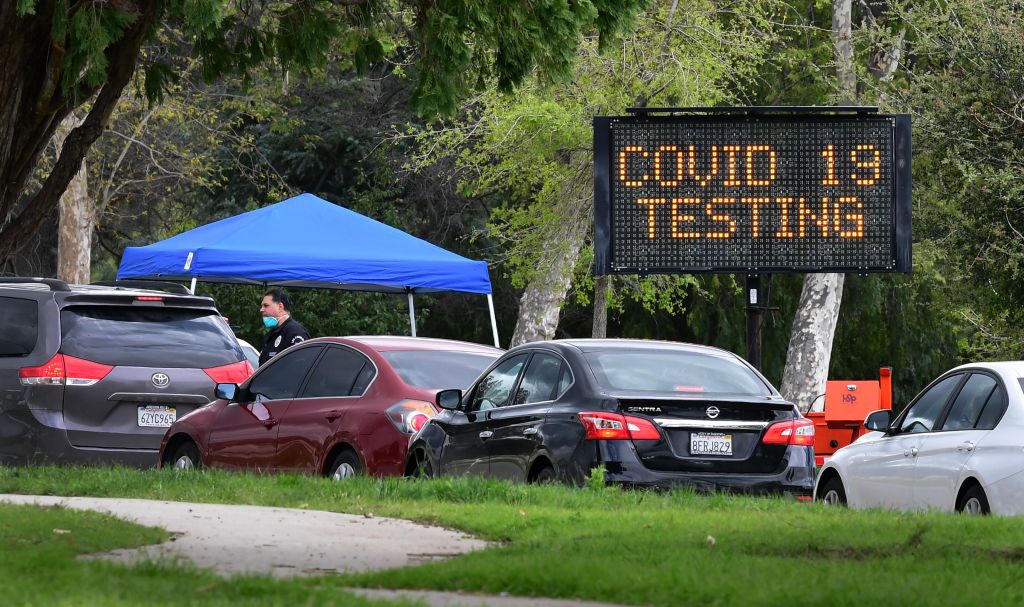
COVID-19 testing center in Hansen Dam Park in Pacoima, California.
In this context, mass testing and contact tracing risks witch hunts that stigmatize people who may or may not have rhinoviruses, influenza viruses, or other coronaviruses. A person gets sick and starts pointing to people he remembers as having the sniffles or a cough. A person who tests positive having to give up the names of everybody with whom he came in contact. I remember in high school getting that call from the Public Health Department asking me if and when I had sex with this or that girl. Given how serious people think SARS-CoV-2 is, we don’t think that will carry the same stigmatizing effect? What can tests show if, as Anthony Fauci said, a person who tests negative today but might have tested positive tomorrow since he actually has the virus? These tests depend on viral loads, which are highly variable across time and individuals. Coronaviruses are a significant part of the viral mix every flu season. There will be false positives and false negatives.
Contact tracing really only works for containment, which is feasible if the outbreak is small and traceable. Authorities use it for measles outbreaks, for example, because herd immunity has been established for this disease and measles is vanishingly rare and occurrences localized. Authorities also use the method in SARS-CoV cases. Most cases of SARS-CoV since the initial outbreak in 2003 are from laboratory accidents with a patient zero.* With SARS-CoV-2 probably having infected between forty and one hundred million people nationwide, testing and contact tracing is a useless method for determining whether to reopen society. Moreover, the same antibodies tests that have confirmed my argument will likely be used to decide who gets the privilege of living freely and those who will be shut in and shut out.
We test people who are sick to determine whether they have SARS-CoV-2 or influenza, etc., as an etiological matter to determine course of treatment or cause of death. Crucially, as I argued in “When a Virus Goes Viral” back in March, the causes of pneumonia are many, not all of them are even viral. If we want to know the cause of an illness, and there is a test for it, then we test for it. In fact, the CDC does not use mass testing to determine the extent of influenza but relies on epidemiological modeling. As a method of controlling community spread, testing is profoundly problematic. We don’t do it with influenza, which killed more people in 2017-18 than COVID-19 has so far this year—and that was with a vaccine.
While it likely won’t halt the spread of this virus, testing and contact tracing will have consequences for freedom and reputation. People will be reporting people who are coughing in public or around their child, and so on. When iPhone apps show the virus in one’s community, folks will shelter-in-place, paralyzed in fear. The consequences of sensory deprivation are devastating on the body and the mind. Fear raises cortisol levels in the blood, causing detrimental health effects. Fear can produce lasting trauma. The fear here is manufactured by a definition of the situation, not by the actual peril faced. In Brown County where I live, the media is reporting an “explosion” of cases (total tested cases are around one tenth of one percent). My friends and colleagues posts of panic are relentless. The fear in their words is palpable. The way their friends and colleagues encourage fear and paralysis is cringe-worthy. I see a lot of people with Stockholm syndrome.
We have to end this madness. Government pronouncements are simultaneously spreading paranoia and a false sense of security. People who test negative today but have the virus, or contract the virus tomorrow or the next day, will think they don’t have it when they do. Those who have had contact with an infected person will be subject to restrictions on their movements and interactions. Or they will self-restrict and self-loathe—leper colonies over a virus with an actual lethality rate more similar to the flu than the absurdly high numbers presented by authorities and journalists. (See “Asking Critical Comparative Questions About the Coronavirus Pandemic” and “We Should Stop Ciriting the Case-ethality Rate for COVID-19—or Start Using it for Influenza.”) We’re seeing in the hysteria the machinery of police and surveillance being emplaced to turn people into community pariahs and neighborhood spies. Now they’re talking about converting census takers into temperature takers. This is so insidious.
Finally, consider the practice of counting as COVID-19 deaths all these deaths from pneumonia that have no confirmed cause. The numbers of death jumped sharply on the change in defining who is a COVID-19 victim. Think about what is going on in the hospitals to make this possible. A person is brought in with pneumonia. The cause could be viral or bacterial or both (or something else). If viral, there are a number of viruses that could by responsible. Testing is so useful, even necessary at this point to determine what the patient has in order to determine the appropriate intervention. Yet these tests are clearly not being done since there are patients dying without tests ruling in or out SARS-CoV-2 infection.
This doesn’t make sense (or maybe it does and my brain won’t let me go there). We’re in the middle of a health crisis involving a novel virus and doctors aren’t concerned with finding out as much as they possibly can about what is making their patients sick? Even if it is to help them? I find this shocking. I tell my students in research methods class that, if they do not have a data point, then it is missing data. You don’t determine data points yourself. This risks shaping your findings towards a predetermined conclusion. Besides, it’s lying.
There is sinister. Given how the dire predictions surround SARS-CoV-2 didn’t pan out, adding pneumonia deaths of uncertain cause to the COVID-19 category gives government and health officials the death tolls they need to come back and say SARS-CoV-2 really was an unprecedented event and that therefore their actions upending our personal worlds and throwing the world economy into turmoil were justified. Including in the COVID-19 totals all pneumonia cases regardless of cause may get the numbers to a bad flu season. But it looks like authorities doing whatever it takes to rationalize throwing the world economy into a depression. Since famine is crouching in the corner, the leaders will need some cover.
Endnote
* Insisting that this virus was not created in a lab is an uncharitable argument resting on the straw man that those who are talking about the P-4 labs in Wuhan are claiming that the virus was manufactured. While that is possible, that is not the claim. The claim is that the virus infected somebody at a lab. You can look this up but, since the first time around with SARS in 2003 (yes, the first SARS-CoV is a coronavirus), one source of infections has been lab accidents. That’s an established fact. So these labs do have various coronaviruses that they are experimenting with and, on more than one occasion, the virus has escaped containment and sickened people. You don’t have to claim SARS-CoV-2 was bioengineered to point to the labs experimenting with coronaviruses as the source of the pandemic. Moreover, China didn’t need to bioengineer a virus to wreak havoc on the world. It only needed to lie about the situation long enough to allow the virus to escape Wuhan and spread around the world and announce its coming with dire predictions of death and calamity. It’s easy to whack an enemy that is ready to cower in fear.
For literally decades I’ve had to correct people on this particular bit of terminology. (More recently, I blogged about this in 2014 concerning “The Cliven Bundy Case.”)
I am hearing a lot of talk lately about “states rights.” States don’t have rights. People do. The most important of those rights are those the state is obliged to protect, for example the right of the people to peaceably gather and freely express their opinions, for example opposition to government policy.
States have powers, not rights. In the United States, a constitutional republic, we have a system of authority that delegates or grants states powers in several areas, while keeping states subordinate to the federal government under the authority of the United States Constitution (the Supremacy Clause). This is why we call our country the “United States”—the states are united under one authority that operates on the principle of federalism.
I appreciate the fact that President Trump understands this relationship. He’s leaving a lot of decisions to states concerning when they’re going to reopen. At the same time he asserts his authority to step in if states badly handle reopening.
The media treats this as if it’s a contradiction. But they don’t understand our system. It is in fact the essence of the United States of America to allow states (and local governments) to make decisions relative to the circumstances of their citizens and residents, not just administratively, but also substantively, while ultimately being answerable to the national government.
States are ultimately answerable to the national government because the citizens of each state are first and foremost citizens of the United States. This is why President Eisenhower could federalize the National Guard and command them in Little Rock (see also Article I, Section 8). Moreover, anybody who’s in the country is ultimately under the authority of the national government.
This is the reason I find sanctuary cities and sanctuary states to be such a deeply troubling development, especially in light of the fact that it’s the national government that is in charge of immigration and borders.
I have lately been seeing a lot of negative comments on my Facebook feed directed at atheists. I am not saying that this is a general trend, just that I have a rather large friends list and I am a bit struck by the sudden surge in nastiness. Could it be the helplessness people are feeling about our present situation is presaging a revival of religious faith? I hope not. That’s a scary scene. Fear and religion is a worrisome combination. Those who cast doubt on faith belief become the enemy under such circumstances. Folks are already in the mood to throw democracy and liberty under the bus. An Inquisition may feel like the logical next step.
Part of it, of course, is the brand of identity politics that fetishizes Muslims, that makes the followers of Muhammad a ritual totem for the anti-Western crowd (there are other ritual totems, but I don’t wish to enlarge the scope of offense-taking), and that makes criticism of Islam blasphemous. Moreover, Islam is exotic. Absurdly, atheism is said to be a cover for something called “Islamophobia.” Is it not curious that the religious beliefs that explicitly negate Islam (you know, Judaism and Christianity) are, by some ecumenical alchemy, unproblematic? Rather, it’s those who do not hold religious beliefs who are the bigots. But, then, atheists have always been the most dangerous people.
It is important to point out for people who draw an equivalency between theism and atheism that these things are not actually equivalent. Indeed, one is a thing, a belief; the other is the absence of a belief in the thing. Atheism is like “aunicornism,” only unicornism is not a widespread belief (although I had a student once insist that unicorns are mentioned in the Bible and therefore belief in them is legitimate), so such a word finds no purchase. Childish beliefs in Santa Claus and the Tooth Fairy need no word indicating the absence of faith in them, either. We recognize that we grow out of them (for obvious reasons) and move on. (It is worth considering that Santa Claus, and now the Elf on the Shelf, are Yahweh-like in their omniscience. They know when you’ve bad or good. They are ritual objects used for the little theists-in-training.)
Theism is the belief in a god or gods, in particular the belief in a personal deity. This belief is a form of faith belief, as there is is no reason, logically or empirically, to subscribe to it. We do not value most belief that has neither logical nor empirical bases. Yet there is this exception carved out for religious belief. You are even permitted to see the faith belief of other religious groups as unwarranted while believing yours is the correct belief on the basis of no reason whatsoever and enjoy entrée in the ecumenical community. More abhorrent than those who believe in different gods from yours (for at least they believe in the supernatural) are those who believe in no gods at all. Those individuals must be singled out for special opprobrium.
So let’s remember for goodness sake that atheism is the absence of belief in a god or gods. Think about how the word “asexual” means the absence of the sexual. Asexual is not a type of sexual. It literally means that some thing is not that thing. If there were no such thing as sexual, then asexual would be a nonword. Likewise, atheism only exists as an designation because there is theism and because theism is, in a way Santa Clausism isn’t, to be believed by reasonable people. If there were no theism, there would be no need for a word that indicates the absence of it.
Thus, I never came to “believe” in atheism because atheism is not a belief. That’s the wrong way to put the matter. The problem many have with me is that I never came to believe in any god. I am not even a failed theist. I am a soulless person (except the soul I manufacture with my creative energies). I have to identify as an atheist because the world has made an assumption, namely that theism is not only a credible position but an important thing to be.
It’s like being uncircumcised. If cutting off parts of the genitalia of little boys were not a standard thing some parts of the world (unfortunately in the part of the world I was born into), we wouldn’t have a word for the absence of genital mutilation. We wouldn’t even be talking about “intact penises.” After all, we don’t talk about intact ears (thank goodness Vincent Van Gogh never became a messiah figure). “Uncircumcised” is another designation the theists have hoisted upon us.
Don’t smear me as a bigot for not believing in rubbish.
It has been clear to me for a long time now that my existence on an ideological landscape divided between conservatives and progressives (the latter of whom are mistakenly called “liberals”) makes my politics confusing to a lot of folks. I am neither a conservative nor a progressive and so my opinions do not align with these standpoints in anything remotely resembling a lockstep fashion. Nor am I a Republican or a Democrat. That’s probably the greater problem since it they can’t count on me for a vote.
The assumption made based on my long-held criticisms of conservatism and the Republican Party, on racism, sexism, and so on, as well as my status as a sociologist, is that I am a Democrat and a progressive. But I am a libertarian socialist whose values run extremely liberal on most things (except economic matters), while my method for grasping the social world is Marxist. In fact, I am an orthodox Marxist, which is more liberal than progressive (an understanding that Neo-Marxism obscures). In other words, I am a humanist who believes in individualism and a set of universal rights associated with species being that may be ascertained through scientific work. I do not subscribe the paradoxical cultural Marxist view that truth is relative and that free speech is a weapon of oppression (a la Marcuse). To the extent that I see imagined communities, I see them as expressions of alienation.
Since my worldview is shaped by these principles and not partisan ideologies, I come to opinions reached not on whether the arguments align with conservative or progressive ideologies or the platforms of the Republican or Democrat parties, but whether they are consistent with my values (democratic, humanist, liberal, rationalist, republican, and secularist) and the dictates of scientific reasoning (which I regard as tied to my values). If you listen to or read my arguments and find yourself wondering why I would express some view in light of other views I have expressed, or not express attitudes you think that I should, for example daily public loathing of Donald Trump, it may be because you are determining the appropriateness of opinions on ideological and partisan grounds rather than through the method I use to arrive at my opinions. You don’t have to use my method, of course. But, by the same token, I don’t have to use your’s.
I am not saying I’m infallible. I have publicly confessed my errors many times. I was wrong to downplay the threat of Islam to humanity in the late 1990s and early 2000s. I was ignorant of the terrors intrinsic Islam. I was too religiously tolerant. More crucially, I suffered on account of peer pressure from an ideological desire to express an absurd level of religious tolerance. I am not proud of this. I am also not proud of failing to appreciate aspects of rational Christianity for its fostering of rationalism and secularism. I regret portraying American in a negative light, for accepting and sometimes even adding to the narrative used by progressives to delegitimize the greatest republic in world history. I regret casting votes for Al Gore and John Kerry. I wish I had cast those votes from another candidate or not cast them at all. At the same time, I have never regretted never voting for Republicans.
Long ago, the American pragmatist William James differentiated between the “once born” and the “twice born.” James was a theologian, so the terminology is especially provocative. He described the once born as having a childlike faith in their opinions. Not just faith in the religious sphere. Adherence to any worldview without reason. (I would add to this class those apologists who use their intellect to keep themselves from doubting.) Once born practice is, in essence, thinking out of reflex (or an act of rationalization). Once born persons enjoy a simple, uncomplicated worldview, one that does not cause them much anxiety. Indeed, their certainty in the convictions cushions the pains of the actual world—a world of uncertainty.
The twice born, on the other hand, may believe exactly what they would have believed had they not been born again, but they do so only after rationally examining their convictions, finding rational justification for them, and obtaining a fuller understanding of them. At the same time, the critical examination of belief causes them to give up many of their convictions, and this can be a great source of angst and anxiety. Twice born people are more likely to be unhappy and dissatisfied. But they are also less likely to be zealots and bigots (remember—bigotry is the attitude of expressing an unjustified certainty in one’s own opinion).
I am not always consistent in my striving to be a twice born person. As I said, I am not infallible. But admitting this is part of becoming ever more reasonable in my thinking. It is ironic that those who accuse others of arrogance are often the epitome of the accusation. They don’t know how to regard free thinking and self-critical people. This is the corruption of partisan ideology on human cognition. Ideology conditions people to believe what is expected from those with whom they identify and to resist deviating from the party line. The method doesn’t check claims against anything but the Manual of Correct Thinking. The consistency partisans seek is not the practice of adjusting consciousness to the world via a rigorous method, but rather by aligning one’s opinions with a ideological checklist. This accounts for most people. So those of us who are not part of the frame become an enigma. And people strongly dislike things they cannot understand from the frame they’ve been given.
Being a Democrats or a Republican is a lot like being a religious fundamentalist. And I’m an atheist.
A party for working people would focus on health, education, income, and retirement security for all people. That means high-quality health care for everybody, a guaranteed job at a living wage or adequate compensation for unemployment and disability, an end to mass immigration and a return to domestic high-value industrial production, free public education through college for all who qualify and job training for those who do not (or do not wish to go to college), and a universal and guaranteed pension program. That’s it. Beyond these guarantees, life should largely be left to individuals to live as they decide. Indeed, guaranteeing basic rights to health, education, work, and leisure allows individuals the maximal degree of freedom to make something of themselves.
A party for working people would guarantee formal equality and promote in law and policy substantive equality. That means it would eschew the progressive politics of law and policies based on demands for equity and diversity. Such law and policies are discriminatory, privileging some individuals over others on the basis of group identities. Indeed, law and policies based on group identity should be categorically illegal. Proposed laws and policies should instead the necessity of individual rights and liberties regardless of race, sex, etc., for freedom’s sake. A working class party that represent all working people would demand that the government guarantee fundamental liberal and secular freedoms for all people, free speech, freedom of conscience, etc. It would explicitly reject political correctness and speech codes and vigorously protect the right of individuals to express their opinions and to be offensive.
A party for working people would operate on populist principles of individual rights and liberties while rejecting the progressive politics of perpetuating corporate power and class hierarchy legitimized by tokenism. A party for working people would promote a strong national government based on liberal and secular values and the ethic of individualism. Obviously, the Democratic Party cannot be that party. It is a progressive corporatist organization that works against the interests of working people and individual liberty. It pushes equity and diversity over equality and merit. It fragments the working class by promoting identity politics and multiculturalism. It interferes with free thought and expression.
I hear people wonder aloud why working people would vote against their own interests by voting Republican, as if Democrats actually represented working class interests. Identity politics and political correctness are not in the interests of working people. Identity politics and political correctness comprise the hegemonic work of progressive capitalist power. This work is about fracturing the working class by identity and then subduing a patchwork of groups through tokenism while marginalizing other groups. It’s a divide-and-conquer politics. The Democratic Party is a dead end.
In light of this, it’s not difficult to understand why so many working class people vote Republican. They see in the Republican Party a negation of the work of the Democratic Party, the latter’s work representing a harm to their interests. Even if the Democratic Party guaranteed health, education, income, and retirement security for all people, it would still be objectionable if it did not also eschew leftwing identitarian politics. The Republican Party is not a viable option in the long run. But neither is the Democratic Party. Folks are going to have to come to terms with that fact.
The CDC estimates that, for the 2019-2020 flu season (last surveillance point was April 4, from the end of September), there were 39 million flu illnesses. The number of positive tests for the flu was 291,241. I will refer to positive tests as flu cases. That’s quite a discrepancy. I explain this in a moment.
The CDC attributes 24,000 deaths to the flu so far this season. That’s a case-lethality rate of 9.7%, or roughly one dead for every ten persons who test positive—a shocking statistic. However, on the basis of the estimated number of actual illnesses, the death rate is 0.75%, or less than one in a hundred.
The multiple used this year to estimate actual cases from positive cases is a factor of 134. There are complex reasons why this number is utilized and you can read about the mathematical models used to make the estimate in the following CDC page: https://www.cdc.gov/flu/about/burden/how-cdc-estimates.htm. The model was developed because epidemiologists are aware that far fewer cases are confirmed by testing than actually exist in the population.
There are 675,243 confirmed cases of and 34,562 deaths from COVID-19 so far. That is a case lethality rate of 5.1%, or roughly half the case lethality rate for the flu based on confirmed cases. However, we must keep in mind that the CDC does not report case lethality rate for the flu. It uses the epidemiological estimates to calculate the death rate.
Applying the same extrapolation as applied by the CDC to flu illnesses this year yields 106 million COVID-19 illnesses. That would put the death rate at 0.63% from COVID-19. Again, the lethality of the SARS-CoV-2 virus is less than that of influenza.
Now, it is unlikely that 106 million Americans have had or currently have COVID-19. I am only applying the multiple to raise the issue about reporting of relative risk.
Consider that he standard estimate for asymptomatic and mild (cold-like) cases is around 80%. Accepting that number, that still represents 21 million flu-like illnesses from SARS-CoV-2. That still seems like a large number (and this would have implications for the degree of herd immunity discussed in my previous podcast). If It is possible that either asymptomatic and mild cases are a greater percentage of the total number of cases or the multiple is smaller for COVID-19 than it is for the flu. But the question we should be asking is why has no multiple been applied to COVID-19 at all?
The comeback will likely be that we don’t yet have the experience with this virus to know to approximate that number, but we surely know the number is significantly greater than zero. If 80% have no symptoms or only mild symptoms, then the majority of cases are not being tested. And there are many with severe cases that are to tested. These obvious facts should be communicated clearly by authorities and the media. All reporting about deaths should emphasize this point.
Or to put this another way, we might ask why there is a multiple applied in the case of flu illnesses. My guess is that, at least in part, a one-out-of-ten case-lethality rate for influenza would provoke calls for social distancing, sheltering-in-place, and quarantine for the flu, and that would make normal life impossible. Smartly, an epidemiological model is applied to reduce the rate of death from the illness.
But the problem here should be obvious. The authorities and the media are comparing apples to oranges—and they are doing so in a direction that makes COVID-19 seems much more deadly than the flu. To be sure, COVID-19 is deadly. It may very well be more deadly. But how much more deadly? For sure, it is not nearly as deadly as the case-lethality rate makes it appear since it is obvious that most cases of SARS-CoV-2 infection are unreported, whereas dead bodies from flu-like viruses rarely go unreported (at least not for long). (And we have seen authorities including the COVID-19 death counts bodies that have not tested positive for SARS-CoV-2.)
We need authorities to come clean on this discrepancy. Not being clear about the relative risks of COVID-19 over against the flu feeds the panic exploited by the federal and state and local governments to justify the sharp and unprecedented curtailment of freedom and democracy. It appears that they have manufactured the panic.


 freedom and reason