When I was a kid growing up in the 1960s and 1970s, agricultural workers, cafeteria workers, groundskeepers, day laborers, custodians, housekeepers, etc., were disproportionately black men and women, as well as many assembly line and construction workers, living in safe neighborhoods with two parents raising children.
A Detroit Factory circa 1914-1918. Photo credit: Library of Congress.
In my dissertation, Caste, Class, and Justice: Segregation, Accumulation, and Criminalization in the United States, published in 2000, which explored a caste-class model of capitalist dynamics, I incorporated elements of the split labor market theory, proposed by sociologist Edna Bonacich in the early 1970s, which explains how labor markets are divided along ethnic, racial, or other social lines. Bonacich theorized that labor markets are split when employers exploit cheap labor, which often comes from minority groups or immigrants, over more expensive native or majority labor. This division creates division in the working class. At the same time, it provides stable employment for those relegated to it.
The theory posits that the dominant group, fearing economic competition and wage reduction, reacts by forming unions, lobbying for restrictive immigration policies, or supporting discriminatory practices to protect their material interests. Employers benefit from this situation as it suppresses wages and disrupts labor unity, generating greater surpluses and making it easier to control the workforce. The theory helps explain the persistence of ethnic and racial conflicts in labor markets and the structural economic forces that perpetuate discrimination. It highlights how economic factors drive and maintain divisions within the workforce.
Today brown immigrants work the jobs blacks used to work at, while millions of blacks are idled in the crime-ridden ghetto of the blue city, their children raised without fathers in the home, with one in three black men earning at least one felony conviction over the life course, many engaged in constant gang warfare. Black men commit most murders and robberies in the United States. This is the result of corporate globalization, off-shoring manufacturing and importing cheap labor, justified by multiculturalism, and Democrats relegating blacks to disorganized inner city areas and progressives addicting them to welfare, creating a subject class who votes for a living instead of working for a living.
The historic shift from black labor to immigrant labor in the United States can be analyzed through the lens of the split labor market theory. This shift is particularly evident in industries such as agriculture, manufacturing, and service sectors. Historically, black labor, especially in the post-Civil War South, was a significant part of the labor market. Black workers were often employed in low-wage, labor-intensive jobs. However, with industrialization and urbanization in the early 20th century, there was a growing demand for labor in northern cities, leading to the Great Migration of blacks from the rural South to the urban North.
Crucially, during the 20th century, US immigration policy underwent significant changes that spurred black migration to urban centers beyond the South and then later transformed them into redundant labor. Early in the century, there was a rising tide of nativism driven by fears of cultural and economic displacement due to increasing immigration. This led to legislative measures such as the Immigration Act of 1917, which introduced literacy tests and barred immigrants from much of Asia. The most restrictive phase came with the Immigration Act of 1924, which established national origins quotas. These quotas favored immigrants from Northern and Western Europe while severely limiting those from Southern and Eastern Europe and Asia. This era of restrictive immigration policies continued through the mid-20th century, coinciding with the Great Depression and World War II, when economic and security concerns further dampened enthusiasm for immigration.
During this period, capitalists in both the North and the South sought cheaper labor alternatives to black workers who had benefitted from economic development during this period. Changing attitudes towards race in the 1960s that promised gains for black Americans were exploited to push open borders. The Immigration and Nationality Act of 1965, signed by President Lyndon Johnson, abolished the national origins quota system. The 1980s saw further action with the Refugee Act of 1980, which aligned US policy with international standards for refugee protection, which open border activists used as cover for the recruitment of economic migrants, and the Immigration Reform and Control Act of 1986, which provided amnesty to millions of undocumented immigrants while imposing stricter border controls (easily skirted by subsequent presidents) and sanctions on employers hiring undocumented workers.
As immigration from Latin America increased in the late 20th and early 21st centuries, Latino workers became the dominant source of cheap labor, Hispanics eventually becoming the largest minority group in America. This shift further marginalized black workers across sectors and maintained the racialized division of labor. Employers continued to benefit from this dynamic by keeping wages low and exploiting the vulnerabilities of immigrant labor, who often had fewer legal protections and were more susceptible to exploitation.
In numerous essays published in Freedom and Reason, I show how the greatest period in American history occurred between closing the borders in 1924 and reopening them in 1965. The period was marked by rising wages and standards of living, safe and orderly communities, racial integration, women’s rights, and a high level of patriotism. Black Americans gained as never before during this period.
Progressives can mock the shorthanding of “black jobs” all they want, but they can’t change the facts of the corporate destruction of the black family and the managed decline of the American Republic. That is what Donald Trump is talking about. If Democrats represented black Americans, that’s what they’d be talking about, too. But they don’t. So they mock. It’s all they’ve got.
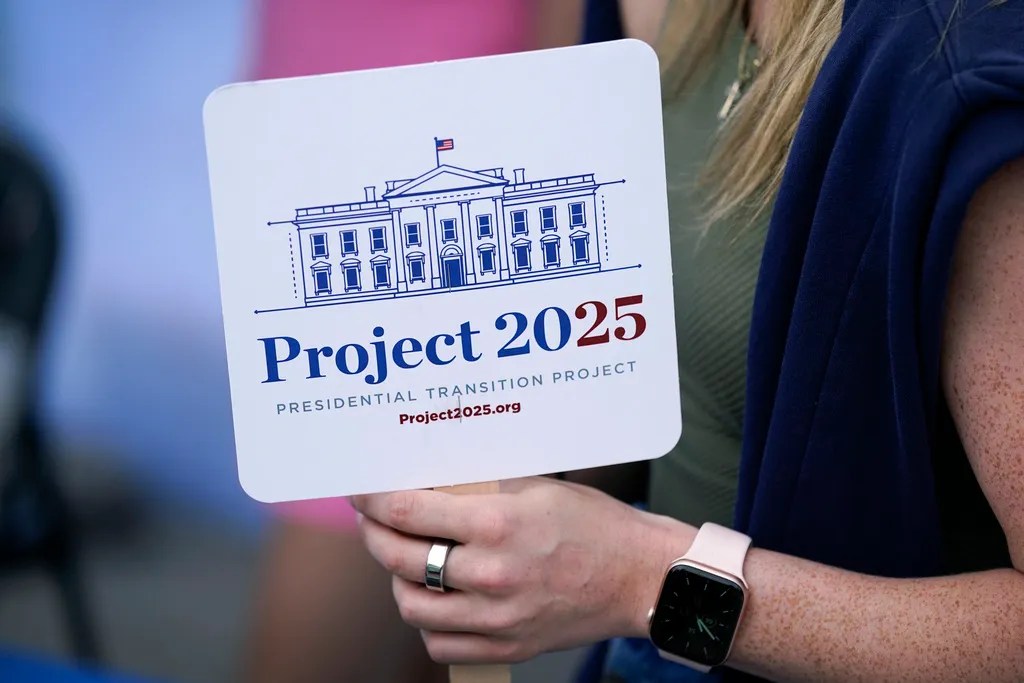
Project 2025 is boogyman of the wonkish. The Heritage Foundation’s executive action plan to change the rules and deconstruct the federal bureaucracy—by shrinking the regulatory apparatus, uprooting ensconced federal bureaucrats, and training a new class of policymakers working from framework of democratic-republican principles and classical liberal values—would have broad support in a Republican Congress, and this terrifies the permanent political class in Washington. Moreover, the Supreme Court is already making moves to reverse enabling precedents, which explains the attack on the Supreme Court.
The overturning of the 1984 Chevron USA., Inc. v. Natural Resources Defense Council, Inc. decision, which set forth a legal doctrine known as “Chevron,” a precedent that mandates that courts must defer to an administrative agency’s interpretation of a statute it administers unless Congress has directly spoken to the precise issue, would be a significant step forward in dismantling the administrative state by taking away its arbitrary power. The doctrine has given federal agencies wide latitude to bureaucrats and experts to interpret and implement laws according to their ideological predispositions.
Project 2025
That this is shop talk is a problem because of the lack of sophistication among those who play an outsized role in shaping our political discourse about administrative behavior and legal doctrines and their relation to political economic regimes. It would help for the “deplorables” (the proles and serfs of America) to understand the system a little better. What is presented as a threat to democracy is the antidote to the totalitarianizing nature of administrative rule. Administrative rule in an advanced society is technocracy not democracy (administrative rule is not democracy in any type of society). Indeed, the objectives of Project 2025 represent a program to return the nation to the robust constitutional republic the Founders envisioned.
Key to the propaganda war against the program is the way the term “fascism” is twisted to turn hopeful projects into evil ones. The cultural managers of the transatlantic sphere portray fascism as populist, nationalists, and dictatorial. Trump is a fascist, the public is told, and if he is reelected that will be the end of democracy. But your betters know that populism means democracy. So what are they really hoping to save? Nationalism in the modern period is the view that the following things are important: cultural and territorial integrity, a common language, an enduring and virtuous creed, the privileges and immunities of citizenship, the rule of law, and the role of one’s country in the interstate world order.
The dictatorial piece is prevented by a constitutional system of checks and balances, separation of powers (into executive, judicial, and legislative), robust federalism, and respect for classical liberal freedoms. At least one would hope so. But the phoenix that rose from the ashes of the slavocracy, inheriting many of the traits of its immolated predecessor, is a fourth branch of government, the administrative state, the inherent design of which is to bypass lawmakers, putting policymaking power in the hands of the technocrats who control the apparatus. This situation puts the apparatus at the whims of ideological predilection, and therefore not governed by the general will as conveyed by its representatives in government.
In theory and in practice, the administrative state and technocratic control is anathema to a representative democracy manifest in the form of a constitutional republic. Unelected, it is unaccountable to a representative democracy. It is moreover unconstitutional; it is not in the Founders’ design. Progressives, the social engineers, have captured the apparatus and direct its powerful bureaucracies. The administrative state is how public health officials were able to trample on our civil rights during the pandemic, to take an obvious example. Another is the imposition of curricular content and uniformity of instruction in public education. The United States is founded as a federated system. The administrative state centralizes power into the hands of a ruling class.
The world’s largest airline pilot union, Air Line Pilots Association (ALPA), which represents over 70,000 pilots worldwide, and brags about its collaboration with United Nations agency on its DEI policies (now there’s some good news), has suggested airmen and airwomen stop using terms purportedly offensive to women and LGBTQ individuals. Because ALPA knows what offends women and LGBTQ individuals.
An example of a noninclusive term is “cockpit.” Now I will never be able to say that word without thinking about a place to put my junk.
According to the 2021 DEI language guide (Newspeak), ALPA lists terms and phrases to avoid for the sake of inclusion. Avoid “masculine generalizations.” I can’t generalize about men? No. In fact, stop using “man” and “men” altogether. Don’t say “manpower,” say “people/human power.” “People power.” Isn’t that a political slogan? (feeling the urge to make a fist)
The guide usefully provides an example: “Who will provide the people/human power to support this event?” How about “Who will provide the manpower to support this event?” Fewer letters. Meaning crystal.
Also, don’t say “guys,” when addressing groups. (Heaven help you if you say “gals.”) But if the gender binary is a myth, then what is “guys” not inclusive of? Never mind, “guys” is also not inclusive of “transgender people and people with different gender identities.”
You knew this was coming (too). ALPA advises against using “mother/father.” Not because the construction sounds hermaphroditic, but because this could alienate “different family structures, such as grandparents as caregivers, same-sex parents.” Holy fucking Christ.
And this: avoid “husband/wife” and “boyfriend/girlfriend” because those phrases ignore same-sex couples. Even if I’m not not talking about same-sex couples? Even if I’m not talking about husbands and their wives?
“Inclusive language in communications is essential to our union’s solidarity and collective strength and is an important factor in maintaining flight safety,” the guide states. “The purpose of this language guide is to offer examples of terms and phrases that promote inclusion and equity.” Gag me with a spoon.
ALPA suggests replacing “cockpit” with “flight deck.” Is that better? I hear some racy implications in “all hands on deck.” Here’s a way better word: “bridge.” Here’s an example: “I’ll meet you on the bridge.”
But why not “cockpit”? ALSP says that word “has been and may be used in a derogatory way to exclude women in the piloting profession.” According to the guide, women have heard that “it’s called a cockpit for a reason.” That’s what they said a male pilot told them. How many male pilots to them that? How many times? Or did we all hear that on the playground?
For the record, the word “cockpit” has nothing to do with the male appendage.
In case you were wondering, I could not object more to the posting of the Ten Commandments on the walls of public schools anywhere in the United States, even though I believe it is election season pandering and will be overturned by the Supreme Court. There’s no way they’re fucking with the founding vision. Not the conservatives anyway.
I want you to know that I recognize the substantial contributions the Judeo-Christian system of ethics made to American civilization. And I agree that, compared with Islam, and some of the other newer religions (woke in general), Christianity is leagues better. But this is a secular nation with a bill of rights that explicitly guarantees every citizen of the republic freedom of conscience and of speech (and of association and assembly). The only time religion is mentioned in the Constitution is where it says a man assuming public office cannot be forced to pledge allegiance to it.
These rights not only protect citizen expressions given the constraints of time and place, but they also protect the right of people to expect that government spaces are kept ideologically and politically neutral. This protection is especially important when it comes to children, who cannot consent to receiving ideological, political, and religious messages in public spaces without their parents present. The posting of a specific religious doctrine on the walls of public schools is government respecting the establishment of religion. This is not allowed by the First Amendment.
Don’t worry. This does not interfere with your religious liberty. You can post the Ten Commandments on the walls of your home. You need not take them down when atheist friends visit. You can post them on the walls of your business. You can tattoo them onto your body. You can do that because religious liberty is your birthright. It is our birthright.
This will sound dark before its unpacking, but German sociologist Max Weber told us, “Today the spirit of religious asceticism—whether finally, who knows?—has escaped from the cage. But victorious capitalism, since it rests on mechanical foundations, needs its support no longer. The rosy blush of its laughing heir, the Enlightenment, seems also to be irretrievably fading, and the idea of duty in one’s calling prowls about in our lives like the ghost of dead religious beliefs.”
Weber means that Protestantism, a reclamation of the ancient Jewish law, breaking the hegemony of Catholicism, because of this gave rise to the capitalist spirit and its attendant bourgeois values of individualism, liberalism, rationalism, and secularism. These values are beautiful things. We must try hard to preserve them. Because there is a warning in Weber’s words: the corporate form of late capitalism is not only disenchanting—it is depersonalizing.
But there is also promise in his words: “No one knows who will live in this cage in the future, or whether at the end of this tremendous development entirely new prophets will arise, or there will be a great rebirth of old ideas and ideals, or, if neither, mechanized petrification, embellished with a sort of convulsive self-importance. For of the last stage of this cultural development, it might well be truly said: ‘Specialists without spirit, sensualists without heart; this nullity imagines that it has attained a level of civilization never before achieved.’”
Trump wants to lower inflation by reducing the competition for housing that drives up home prices, mortgages, and rents. How will he do that? Deport illegal immigrants.
Progressives call this “fascism.”
Progressives depend on the administrative apparatus that manages the affairs of the corporate class. Ensconced in offices across the apparatus that retards understanding of the totality, some don’t realize who they work for. But others do.
An instance of the “convicted felon” motif
They know as well as you do the dynamics of supply and demand. When good and services are in demand the price goes up. This is just as true in the labor and housing markets as in any other market.
Increase the labor supply, wages go down. Who does that benefit? Not working people who depend on wages to pay mortgage/rent.
Increase the number of people seeking housing, prices and rents go up. Who does that benefit? Not working people who can’t earn enough to pay mortgage/rent.
Corporations and progressives flood the country with cheap foreign labor to drive down wages and extract a greater portion of the value labor produces.
By creating an oversupply of labor, hundreds of billions of dollars in surplus value are transferred from the native working class to the corporate class every year.
This is the same reason corporations offshore industry. Mass immigration and offshoring are both part of the corporate strategy of globalization. This is how elites devastated private-sector unions and decoupled productivity from wages.
The same is true with housing. Importing several million foreigners drives up the cost of housing for native workers by effectively reducing the number of housing units available to them.
The solution to these problems is a national economic strategy that rationalizes borders, deports those who are illegally here, and raises tariffs on the goods and services of transnational corporations that exploit cheap foreign labor.
The progressive, the animal of corporate governance, resorts to scare tactics to facilitate the transfer of the social surplus not only to the corporate class, but also to the administrative apparatus, that class established to manage the working class. That’s his source of affluence and privilege (for how long we will see).
Your corporate overlords have replaced democracy with technocracy and their minions have the temerity to turn around and call the populists (small “d” democrats) “fascists.”
Remember, kids, fascism is corporate statism. Nazism was a revolution-from-above. It was a political move by the bankers and the industrialists to further their war on labor.
The deplorables—the awakened proles and serfs of the transatlantic space—are mobilizing to deconstruct the apparatus that substituted itself for the democratic-republican system of governance the Founders established. Corporations have undermined the classical liberal values of free markets, free speech, free press, free conscience, etc.
Which raises an obvious question: Who are the real fascists?
This is where we are now: The Biden Administration sent two FBI agents to intimidate a nurse who told the truth about the child sex-change program at Texas Children's Hospital. The regime is mobilizing to threaten and imprison anyone who opposes "transgender medicine." pic.twitter.com/XbtZVnp5Kw
— Christopher F. Rufo ⚔️ (@realchrisrufo) June 18, 2024
You need to see the Ring video Rufo shares so you can be prepared if this happens to you (I’m waiting my turn). Make no mistake about it, the future of progressive Democratic Party rule is authoritarian. This is called a “knock and talk.” Typically, the Bureau obtains information through surveillance and then shows up at your house to talk about what a neighbor, a student, a colleague, etc., said about you. This is often a cover, but sometimes it really is somebody who alerted the FBI to something you said (snitches constitute the New Stasi, taught to see as virtuous the act of pointing the authorities in the direction of dissidents and whistleblowers). It’s hard to know exactly who a source is because of the way the FBI launders information, especially through the use of cutouts. Since Biden just expanded the DoJ’s FISA powers, the tactic threatens to become ubiquitous.
They tried to enforce trans dogma through propaganda, censorship, and social banishment. Now that soft power has failed, they are cranking up the level of repression. It is only going to get worse from here. https://t.co/OagYnEEqMN
— Christopher F. Rufo ⚔️ (@realchrisrufo) June 18, 2024
Why do they need to intimidate a nurse for child safeguarding? Because no good deed goes unpunished in the eyes of the authoritarian. That and what is filed under “gender affirming care” (GAC) involves the medically unnecessary and drastic alteration of physiology via drugs and hormones and radical cosmetic surgery to produce a simulated sexual identity (SSI) and a permanent medical patient—all for corporate profit.
I have not shared images of the consequences and side-effects of GAC on Freedom and Reason or social media because during my review of them I became physical ill. I was immediately struck by their similarity with Holocaust photography of atrocities perpetrated by Nazis doctors, some of whom pioneered vaginoplasty. For example, Erwin Gohrbandt, the doctor who contributed to the development of human experiments conducted on prisoners at the Dachau concentration camp, worked with Magus Hirschfeld to castrate and invert the penises of men who worked as servants on Hirschfeld’s estate.
I stopped looking at the photographic record of the Holocaust, lynching, crime scene (including industrial accidents), wartime atrocities, etc., years ago because I started developing symptoms of PTSD. As a criminologist, sometimes I have to examine the documentary evidence. I wouldn’t inflict that on readers, however. But if one had any doubts as to whether GAC involves the mutilation of people’s bodies, including minors, and constitutes atrocities perpetrated by bad actors working from a twisted ideology, it’s easy enough to find all the evidence one could ever want to nauseate him by searching Google.
That’s at least for right now. I foresee a day in the near future where Google and other corporations controlling the flow of information will make the documentary evidence of the atrocities committed by the medical-industrial complex unavailable. And searching for it will bring the FBI to your door for a “knock and talk.”
Trump supporters correct CNN and explain that we’re not a Democracy, we’re a Constitutional Republic. CNN loses their minds and suggests that saying that is a threat to Democracy. pic.twitter.com/nO1C0YMigR
This is gaslighting. Not Libs of TikTok (yes, trans activists, I push out Chaya Raichik’s content). CNN is doing the gaslighting. The editors and producers know exactly what American citizens mean when they say they live (or at least should live) in a constitutional republic and not a democracy. CNN is taking something that millions of people know to be true and misrepresent it as something novel and dangerous, fully aware that tens of millions of America are profoundly ignorant of basic facts about their country’s history. Instead of enlightening the public (like high school civics used to do), CNN pushes its collective head even further into the muddy waters of ignorance and scare them over something they should embrace. This misrepresentation is a key part of the Democratic Party narrative that Donald Trump, a republican thinker, represents a threat to democracy.
In Federalist Paper No. 10, James Madison, the principal architect of the US Constitution (and the Bill of Rights), articulated a clear distinction between a democracy and a republic, clarifying that the United States is latter not the former. This distinction was central to the Founders’ political philosophy and the foundational principles of American governance. In the paper, Madison discusses the inherent dangers of democracy, which he defines as a system where the people directly participate in decision-making. He contrasts this with a republic, where the people elect representatives to make decisions on their behalf.
James Madison, the principle architect of the American Republic
Madison argues that a republic can better guard against the dangers of factionalism and the tyranny of the majority. He defines a faction as a group of citizens united by a common interest that is adverse to the rights of other citizens or the community’s aggregate interests. In a democracy, Madison contends, it is easier for majority factions to oppress minority groups. In contrast, a large republic can accommodate a greater number of factions and interests, making it more difficult for any single faction to dominate.
The Constitution’s establishment of a system of checks and balances among the executive, judicial, and legislative branches to prevent any single entity from gaining too much power is the republican model of governance. Our system also incorporates federalism, dividing power between the federal government and the states, thus providing another layer of protection against tyranny. The Electoral College is designed to temper direct popular influence. This is why the Democratic Party and the corporate state media are so hostile to separation of powers (in particular the independent judiciary), federalism, and the Electoral College.
Madison and his contemporaries were concerned that democracy could lead to mob rule, where impulsive and unstable policies driven by temporary passions would prevail (see A Scheme to Thwart Mob Rule). They also feared majoritarianism, where the majority could easily infringe upon the rights and interests of minorities. By weaving to a tapestry of aggrieved minority groups, cultural managers, and the credentialed class, the Democratic Party seeks majoritarianism. But this does not mean they seek democracy. When Democrats and progressives talk about democracy, they really mean technocratic control over the population serving at the behest of corporate power. The establishment of a fourth branch of government, the administrative state, is designed to replace the constitutional republic with a corporatist system of governance cloaking itself in the language of democracy while delegitimizing constitutional republicanism and its classical liberal foundation.
The Federalist Papers explain and advocate the form of government that became the American Republic
Madison envisioned the United States republic as an exercise in pluralism, which would create a more stable and just government, capable of protecting individual rights and promoting the common good—the national interest over the narrow interest of factions. James Madison argued that the United States was not a democracy in the sense of direct governance by the people. Instead, he advocated for a republic where representatives, chosen by the people, would govern within a structured system designed to mitigate the risks associated with democracy, ensuring stability, protecting minority rights, and promoting thoughtful and effective governance.
In June of last year, in my essay America is a Republic (It is also a Democracy), I argued that the conservative claim CNN misrepresents is somewhat of an exaggeration (I also criticized the majoritarianism inherent in the conservative desire to democratically deprive women of their right to control their bodies in a July 4, 2022 essay Majoritarianism is Antithetical to Freedom: On this July 4th, Let Us Rededicate Our Political and Moral Selves to the American Creed). What rightly troubled Madison and the founders was direct or puredemocracy. But that’s not what the Democratic Party and corporate power seek, so progressive disingenuousness on this matter is calculated to smuggle in its totalitarian ambitions under the guise of popular democracy.
“You see, during Jim Crow, the black family was together,” said Florida Congressman Byron Donalds last Tuesday at an event in Philadelphia. “During Jim Crow, more black people were not just conservative—black people have always been conservative-minded—but more black people voted conservatively. And then (the Department of Health, Education, and Welfare), Lyndon Johnson—you go down that road, and now we are where we are.” Donalds defended his comments on MSNBC, saying he was not being “nostalgic” about Jim Crow but was making a point about black marriage rates and a stronger conservative identity. During the Jim Crow period, he said, “the marriage rates of Black Americans were significantly higher than any other time since then in American history,” and that, since then, “they have plummeted.”
Byron Donalds, R-Fla., speaks at the Moms for Liberty meeting in Philadelphia, Friday, June 30, 2023. (AP Photo)
Donalds is correct, as I show in yesterday’s essay on Freedom and ReasonFalse Charge of Hypocrisy in the Abortion Debate and its Context. Last night, I listened to The Glenn Show and heard Glenn Loury and John McWhorter making the same points, noting at the 49:15 mark the “willful incomprehension” directed at Byron Donalds. McWhorter began by saying, “People are so willfully uncomprehending. All week people have been pretending—I really don’t know whether it’s pretending or that people can’t hear—they’re pretending that he was saying that Jim Crow caused the black family to be stronger. What moron would say it? What moron would think it? That’s not what he meant. He was saying that even under Jim Crow, the black family was stronger, which means that there were other factors that broke up the black family later.” The willful incomprehension must have made Donalds feel that his critics were trying to misunderstand him, he said in exasperation, adding, “That guy is dead on.”
McWhorter turned it back to Loury, asking if he agreed with what Donalds had said. Indeed, Loury responded. “It was simply a statement of fact.” Loury suggested, as I did yesterday, that the audience pick up Herbert Gutman’s book Black Family and Slavery and Freedom, where they would find a wealth of statistics from the early twentieth century showing a low rate of teenage births, a high rate of marriage, and a low rate of out-of-wedlock births among black Americans. Loury confirmed that we don’t see the dramatic significant transformation in black domestic relations until after 1945, reaching alarming levels in the 1960s. He noted sociologist Daniel Patrick Moynihan’s shock in the 1960s when 25 percent of black births were to unmarried women, a figure that has now reached 70 percent. Donalds’ statement reflects this historical reality, which is crucial for understanding disparities and addressing them. A nuanced sociological analysis would consider broader cultural trends, economic opportunities, and social welfare policies contributing to these changes, Loury argued. “Ignoring the transformation of the black family post-Jim Crow is unproductive.”
But it’s not ignorance. It’s political. Progressives are smearing Donalds because they are desperate to hide their record, especially from black Americans, who, they depend upon for electoral success (I explain the strategy in yesterday’s blog). This is why academic historians, overwhelmingly progressive Democrat in orientation, work tirelessly to confuse language, distract the audience, revise history, and smear people (especially disobedient blacks). You can see this in the historians interviewed by the The Tampa Bay Times it is “fact check” on Byron Donalds (see “Fact-checking Byron Donalds’ ‘Jim Crow’ comments on Black families”). The language used in the article is a case study of the function of political language in the hands of academics and media. If it is not designed to do this, it certainly functions to keep the reader locked in a cognitive habit of uncritically receiving partisan ideological distortion. That’s why Freedom and Reason exists—to adjust the signal to noise ratio.
The article begins the “fact checking” of Donalds’ claim that black people “voted conservatively” during the Jim Crow era. This is not possible to prove through hard evidence, the experts consulted told The Times. In the South under Jim Crow, “most black people could not vote,” University of Pennsylvania historian Kathleen M. Brown told the newspaper. There might be voting records for the fraction of Southern black people who were able to vote during the decades of Jim Crow laws, but this small group would not represent the views of the entire Southern black population. However, although northern blacks lived under conditions of the structural segregation constructed and maintained by Democrats, they did not live under live under Jim Crow’s legal and social strictures, and the records show that they did vote and, according to Mary Frances Berry, a University of Pennsylvania historian, they “voted for Republicans as the party of Abraham Lincoln who ‘freed the slaves.’” Black people in the South would have been likely to vote Republican for the same reason if they’d been able, Harvard University historian Alexander Keyssar said.
According to The Times, historians contend that a pattern of black voters backing Republicans during the Jim Crow era would not support the idea that they were “conservative” in the way that today’s Republican Party is. Here’s where the propaganda usage of words becomes very plain to those who work from a standpoint free of partisan distortions of language. The Republican Party in that period “tended to be more conservative” on economic regulation, while also being seen as “more sympathetic to black rights,” Keyssar said. In fact, the Republican Party, with its philosophy of limited government and local control, rooted in democratic-republican principle, was economically liberal. The Democratic Party, which had been the party of the slavocracy, was the party of corporate statism, the phoenix that arose from the ashes of the Civil War. As the party of abolition and individual liberty, the Republican Party was naturally more sympathetic to black rights.
During the 1960s and 1970s, there was a growing reaction to the expansion of government programs and regulations from the New Deal and Great Society eras, progressive policies that advocates dressed in the language of liberalism. At the same time, the social movements of the 1960s were gaining traction. Because of the close association of liberalism with progressivism in corporate state propaganda (they are in fact opposites), people who supported economic liberalism (free markets, small government, lower taxes) but were also liberal on social issues (personal liberty, secularism) began to articulate the dual stance with the phrase “fiscally conservative, socially liberal.” This meme had become ubiquitous by the 1980s. But the economic philosophy of conservatives aligns with classical liberal economic principles. The meme thus introduces into language a confusion of terms. It also also mean that those who were fiscally liberal and socially conservative, i.e., Christian and traditionalist, took up the standard of democratic-republicanism. (See Republicanism and the Meaning of Small Government.)
So when The Times reports that, according to historians, “conservatism” as a defined ideological movement emerged in the 1950s, late in the Jim Crow period, what they describe is modern conservatism, which combines liberal views on economics and traditional views on cultural social matters. This is why the South became Republican after the Civil Rights Act of 1964. The reconstruction of the slavocracy in the form of corporate statism could only have a hold on the South as long as the legacy of racial separation held, which is why Democrats filibustered the bill in the Senate. Even Democrats pushing the bill knew its consequences for electoral politics. Bill Moyers, a Johnson aide, recounted that Johnson told him after signing the Civil Rights Act, “I think we just delivered the South to the Republican Party for a long time to come.” This was not because the Republican Party was the racist party, but because Southerners are instinctively individualist and favor small government.
When Donalds talks about “conservatism,” he is talking about is the traditional values blacks held about family and personal responsibility. American blacks were overwhelming Christian during the period of Jim Crow. The black community is known for its strong religious roots, which continue today. Many Black Americans attend church regularly, and religious beliefs often shape their views on social issues such as gender, sexuality, and abortion. So when Emory University political scientist Andra Gillespie tells The Times that black voters have historically compartmentalized their views, separating what Donalds might consider their “conservative” perspectives on social issues from their more liberal views on racial issues, she is creating a false distinction between black traditionalism and the historical desire to be free from slavery and segregation. What Gillespie means by “liberal” is really progressivism, and the embrace of progressivism by blacks in America’s cities is the result of the dynamics I identified in yesterday’s essay: progressive policy making blacks dependent upon government. The fate of dependency on government is the destruction of traditional relations. This is what destroyed the black family.
The superficially of intelligent people testifies to the power of ideology. If a reporter sought me out for commentary on this story, he would find my answers to his questions bewildering. Gillespie told The Times that conservative black people “are more likely to still vote for and identify with the Democratic Party, despite the fact that liberals of other racial groups would be strongly predicted to be Democrats and conservatives of other backgrounds would be strongly predicted to be Republican. This is because of the Democratic Party’s 60-year issue advantage on questions of race and civil rights.” What advantage? The Democratic Party was the party of Jim Crow until the 1960s and then, to keep the hierarchy going, institutionalized a dissimulated racial hierarchy that prevails to this day. The only systemic racism that exists in America is the one progressives established and maintain. The only way to end racism for good is to get progressives away from power.
* * *
Note: Throughout the article, the Tampa Bay Times capitalizes “black” while leaving “white” in lowercase letters. You see this linguistic programming across the media and academic publishing. Blacks are elevated to a proper noun, whereas whites as left as a common noun. The function of differential capitalization is an attempt to rhetorically invert imagined white supremacy. Every appearance of the color words reinforces the myth. I have fixed this throughout the quotes I share from these source I used by making all color references common nouns.
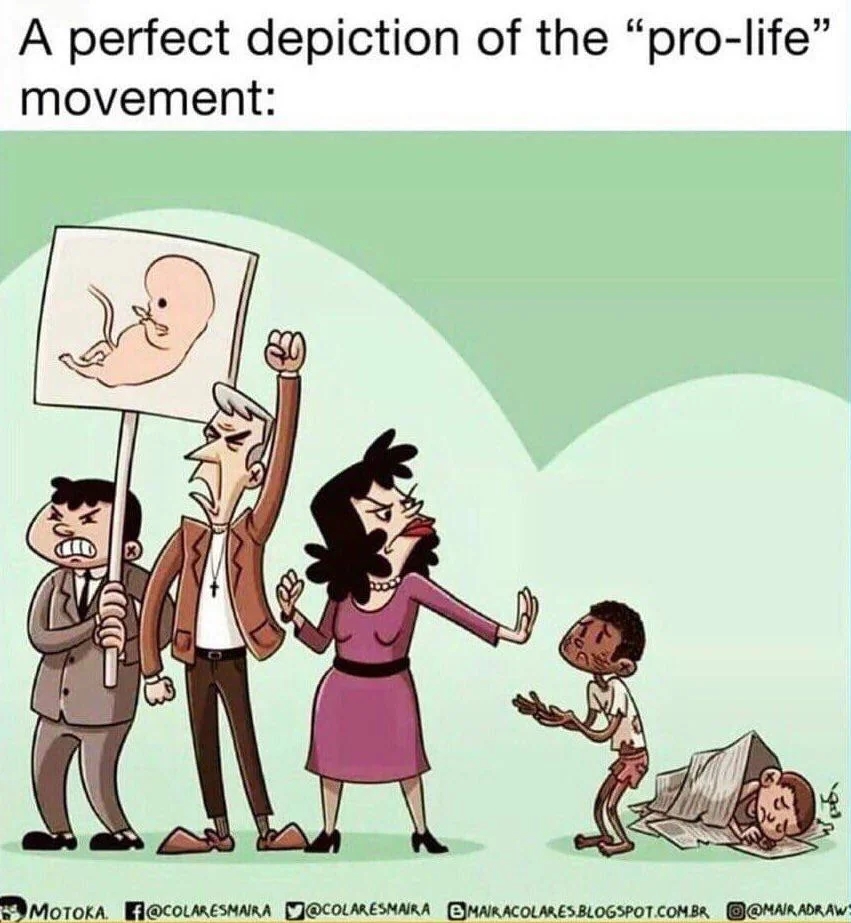
Having gotten that out of the way, the point of this essay is to critique a cartoon that has crossed my eyes over the years (there are a few variations on the theme), in which white conservatives are depicted holding signs demanding the protection of fetuses while snubbing poor and homeless children. In the one I saw yesterday, which I share below, one child is black (he is begging for handouts, a depiction telling us already that the cartoonist hadn’t completely thought through the implication of his composition). Another child is behind him sleeping in what appears to be a broken cardboard box. Those representing the “pro-life” movement are white. One of them is wearing a crucifix and they all have angry faces. I want to use this cartoon as a vehicle for criticizing progressive urban social policy. Think of this essay as yet another installment in my campaign to delegitimize the Democratic Party.
The cartoon
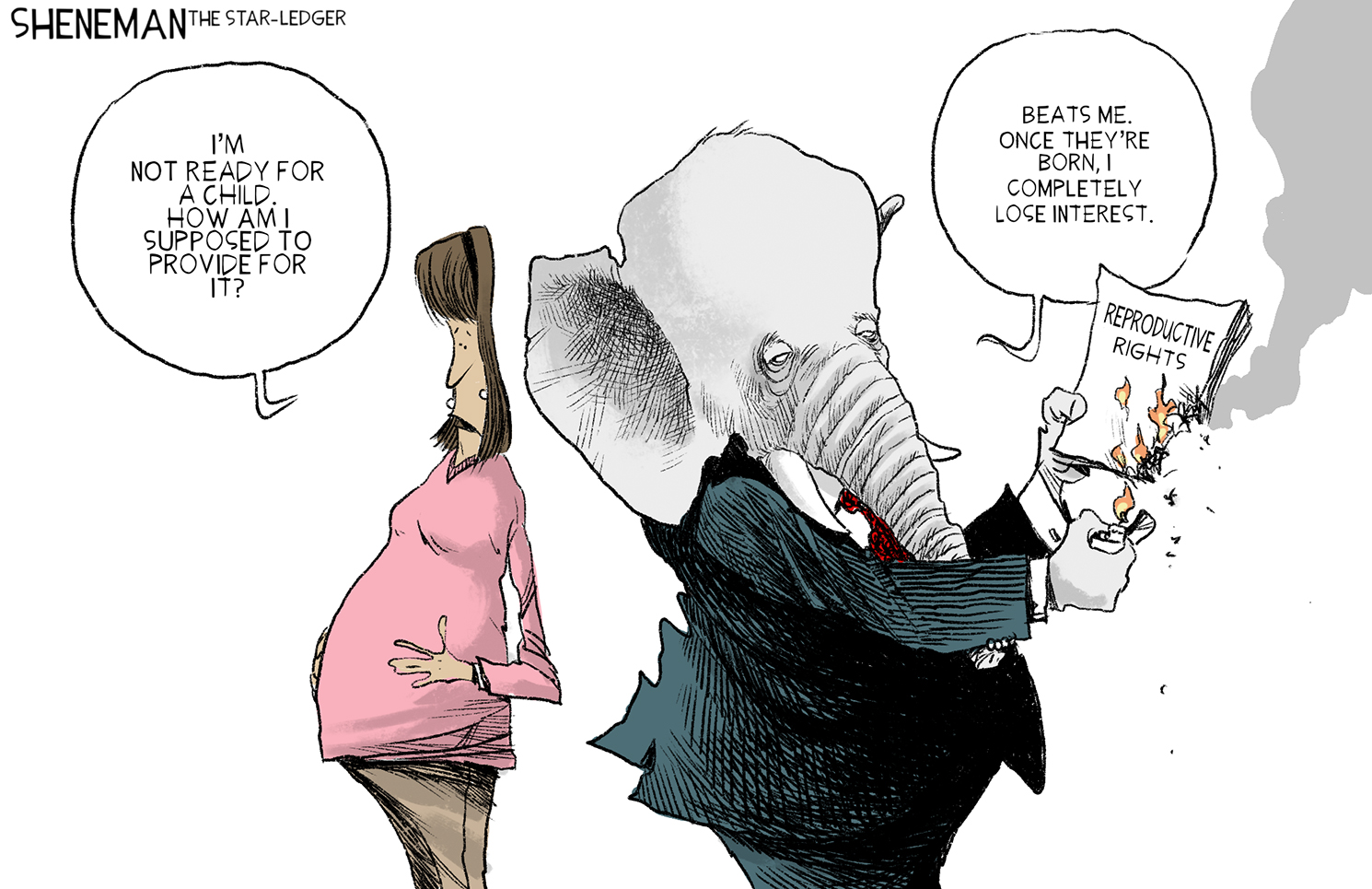
The premise behind the cartoon is fallacious for a few reasons. First, it assumes conservatives who oppose abortion don’t care about children. I’m sure there are conservatives who want to force women carry the fetus to term as punishment for having sex and have no interests in the fetus beyond that, but most conservatives will say (and I believe them) that their opposition to abortion is because the procedure takes the life of a child (I agree that it does, but I have a different reason for my support for a woman’s right to an abortion, as the essays linked to earlier explain). Second, the cartoonist cites child poverty as a reason abortions should be allowed (a cartoon I share below assumes this is a more obvious way). A rational person would ask whether killing born children is an acceptable response to poverty. If not, then why is it okay to kill unborn children? Third, the cartoon implies that conservatives are the cause of child poverty; not only because conservatives oppose anti-poverty programming, but also because a major cause of poverty is children.
It’s worth noting that Planned Parenthood clinics are overrepresented in areas with higher concentrations of poverty and minority populations, partly due to the organization’s mission to provide accessible healthcare to underserved communities. However, there appears to be another reason for this. Margaret Sanger played a major role in founding the precursor of Planned Parenthood, the Birth Control Federation of America. A eugenicist, Sanger promoted birth control as a means of improving the quality of the population and to reduce poverty. In 1939, the Birth Control Federation of America initiated the Negro Project. In a letter she wrote to Dr. Clarence Gamble in 1939, Sanger writes, “We do not want word to go out that we want to exterminate the Negro population, and the minister is the man who can straighten out that idea if it ever occurs to any of their more rebellious members.” Defenders of Sanger often try to rationalize her aims and attitudes, but the body of her work makes it difficult. In any case, the cartoon in question implies an affinity between the artist and Sanger’s aims and methods.
Approximately 78 percent of poor people in the United States live in urban areas, highlighting a significant concentration of poverty within cities. Urban poverty is a particularly challenging social problem due to the high costs associated with housing, transportation, and basic goods and services. In these areas, job opportunities are limited, making it difficult for residents to secure stable employment. Additionally, urban poor populations often contend with a host of social issues, such as high crime rates, overcrowded living conditions, and inadequate public services, including subpar education and healthcare systems. Racial minorities, especially black Americans, are disproportionately affected, frequently residing in disorganized and under-resourced inner-city neighborhoods. This concentration in impoverished urban environments exacerbates social inequalities and creates persistent barriers to economic mobility and overall quality of life.
Who runs these cities? Conservatives? No. These are blue cities. They’re run by progressives. Democrats dominate politics there. Progressives designed and implemented the policies that have, for example, drastically increased the number of children in single-parent households, three-quarters of which are female-headed, a situation that especially affects boys due to father absence. The percentage of children are born to unmarried black women now exceeds 70 percent. For white non-Hispanic children, the percentages is less than 30 percent. The desire to distract from the destruction of the black family is ultimately what lies behind the recent attacks on Florida congressman Byron Donalds (a black man), who condemned progressive urban policy by pointing out that the black family had to that point even survived Jim Crow segregation, a fact confirmed by no less of a historian of the black experience than Herbert Gutman. In his 1977 book The Black Family in Slavery and Freedom, 1750-1925, Gutman examined the resilience of African American family structures from slavery through the Jim Crow period, challenging notions that slavery had destroyed black family life, instead showing that blacks maintained strong familial ties despite the oppressive conditions of slavery and later, the harsh realities of Jim Crow.
What explains the situation of urban black families today? The problems stem from urban policies devised and deployed by progressives over the course of the twentieth century as blacks, during what has been dubbed the “Great Migration,” moved from the rural South to urban centers in the North, Midwest, and West between the 1910s and 1970. Driven by the search for better economic opportunities and to escape from the oppressive conditions of Jim Crow segregation, millions of black Americans left the agrarian South for industrial jobs in cities like Chicago, Detroit, and New York. The Great Migration fundamentally reshaped the demographic and cultural landscape of the United States, fostering the growth of vibrant black urban communities and contributing to significant cultural movements, such as the Harlem Renaissance. (I write about this and many other things in dissertation Caste, Class, and Justice: Segregation, Accumulation, and Criminalization in the United States, published in August of 2000.)
Franklin Roosevelt’s urban policy during the New Deal era (1930s-40s) had profound and lasting impacts on American cities. Through the Home Owners’ Loan Corporation (HOLC) and the Federal Housing Administration (FHA), the federal government implemented practices that systematically denied mortgages to residents of predominantly black American neighborhoods, a tactic known as redlining. This policy entrenched racial segregation and economic disparities by disinvesting in urban areas deemed “risky” due to their racial composition. Discriminatory housing policies perpetuated inequality and segregation, shaping the urban landscape by promoting suburban growth for white families while confining black families to underfunded, marginalized urban neighborhoods. The legacy of these policies contributed to the entrenched racial and economic divides that continue to affect American cities today. This is the period Richard Grossman identifies as the consolidation and institutionalization of progressivism in federal and city governments in the United States (see Richard Grossman on Corporate Law and Lore).
Douglas Massey discusses these issues extensively in his 1993 book American Apartheid: Segregation and the Making of the Underclass, co-authored with Nancy Denton. The book examines the systematic racial segregation enforced by policies such as redlining and how these practices have created and perpetuated an urban underclass. Massey and Denton analyze how government actions, including those during the New Deal era, contributed to the spatial separation of black and white Americans, leading to significant disparities in wealth, education, and overall quality of life. They argue that these policies institutionalized racial segregation and entrenched the socio-economic disadvantages faced by black Americans, shaping the enduring patterns of urban poverty and segregation observed in contemporary America.
Lyndon Johnson’s Great Society regime, launched in the mid-1960s, ostensibly aimed at combatting poverty and racial injustice through ambitious social welfare initiatives, accelerated the destruction of the black family while establishing the system dynamics maintaining a permanent and racialized underclass. The War on Poverty, a key component of the Great Society, proved unable to eradicate poverty as initially promised, and the expansion of federal programs led to bureaucratic inefficiencies and perverse consequences. Welfare benefits disincentivized work, as individuals received comparable or higher income from welfare compared to low-wage jobs. Welfare thus discouraged job-seeking and weakened labor force attachment. If individuals did work and transition off welfare, they faced higher effective marginal tax rates and regressive sales taxes; the loss of benefits outweighed the gains from work. Moreover, in areas where there was significant capital out-migration, often the result of crime and disorder, but also the consequences of the pull of globalization organized by the corporate state, low-wage jobs become scarce.
The permanent underclass is thus perpetuated by a vicious circle. Long-term reliance on welfare benefits fosters dependency on government, where individuals and families across generations rely on public assistance instead of seeking employment and self-sufficiency. The availability of welfare benefits thus undermines the work ethic, leading to a decreased willingness to engage in the labor market and a diminished sense of personal responsibility, complicating all the problem identified in the previous paragraph. Welfare programs perpetuate poverty by creating environments where individuals do not experience the necessity to seek employment, thus remaining trapped in a cycle of dependency. This dependency can be further exacerbated by the erosion of traditional family structures, where welfare benefits discourage marriage by incentivizing single parenthood. Urban policies, such as child welfare, cash supports, and housing programs, create a culture of dependency by disincentivizing work, fostering generational reliance on government assistance, leading to adverse social consequences, for example high rates of crime and violence (which I have covered extensively on Freedom and Reason).
The conservatives holding those signs in that cartoon are not responsible for these consequences. They didn’t formulate and implement the policies that produce and perpetuate poverty. Democrats held majority control of both the House of Representatives and the Senate for much of the time from the 1930s to the 1980s when this dynamic was established. Cities during this period were for the most part strongholds of Democratic power and influence. This trend was reinforced by demographic shifts and the rise of social welfare programs under Democratic administrations and major initiatives such as Roosevelt’s New Deal and Johnson’s Great Society. Indeed, conservatives and Republicans long opposed the policies formulated and implement by Democrats because they believed and continue to believe, correctly, that two parents are better than one and boys need fathers and that the best social welfare program is a job. Standing there with that sign demanding the protection of fetuses, those depicted in the cartoon also stand there believing not only that the solution to reducing poverty is the two-parent family, but that, moreover, even if poor, a two-parent household provides the stable environment conducive to law abidingness, personal responsibility, and a successful life.
Another cartoon, same theme
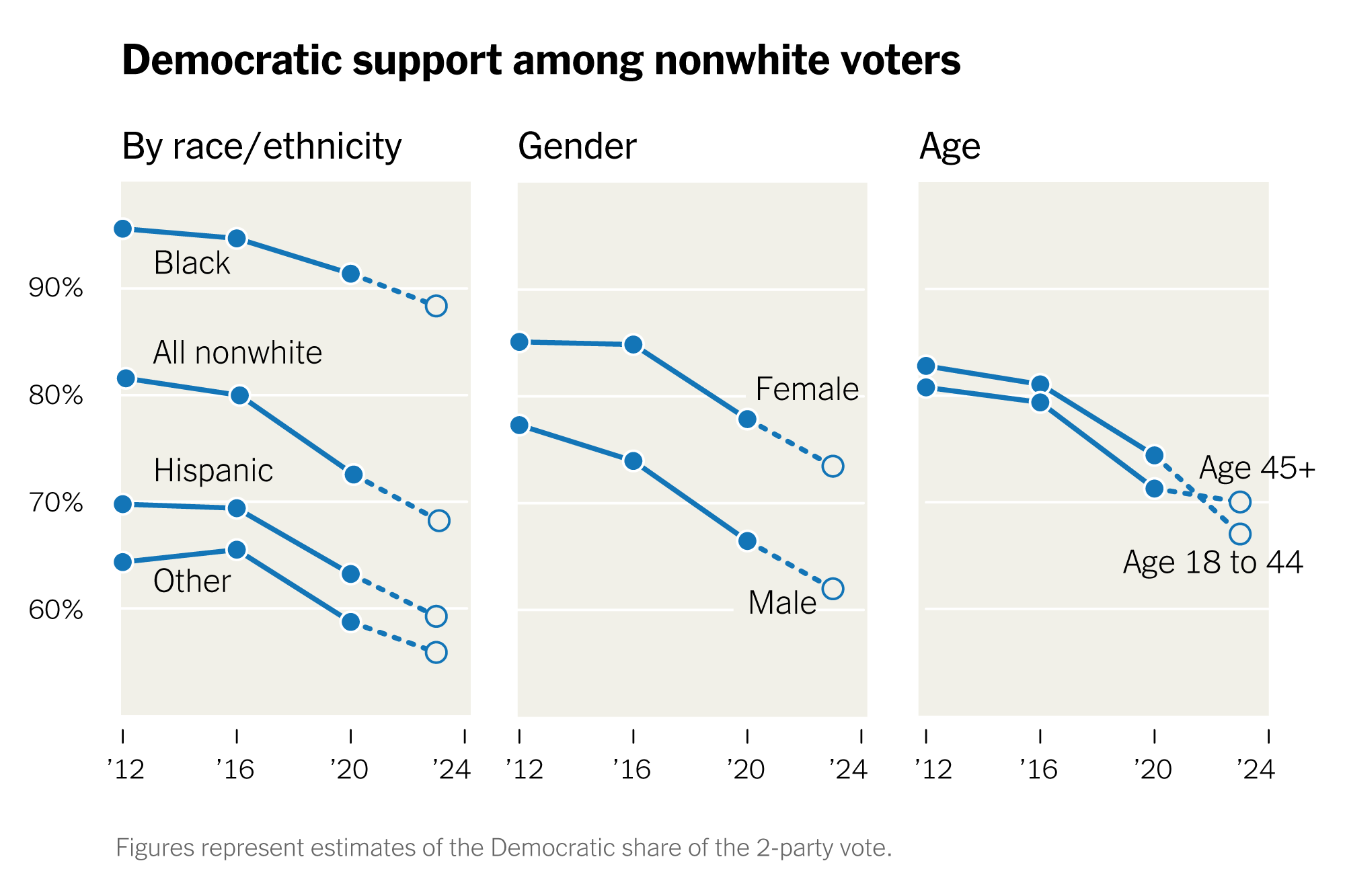
What the cartoon is really saying, then, is that progressives would rather poor people abort their fetuses than see children born into the poverty that progressives themselves created while signaling that they’re not going to do anything about, that this is the status quo. It is becoming all too obvious that progressives aren’t going to do anything about it because poverty is functional to the credentialed class that is the Democratic Party base. Perhaps this explains the erosion of support for the Democratic Party about non-whites over over the last dozen years; urban dwellers are waking up to the fact that their lumpenproletariat status was not so much the result of a system abolished over 160 years ago, but the work of the politicians they have been voting for over the last several decades—politicians belonging to the same political party that represented the slavocracy all those years ago.
What do I mean when I say that poverty is functional? Sociologist Herbert Gans, in his essay, “The Positive Functions of Poverty,” published in 1972, noted several functions of poverty that explain its persistence. On the economic front, poverty ensures a cheap and vulnerable labor pool that can perform low-wage, undesirable jobs that are essential for the functioning of the capitalist economy. These jobs often involve hard, dangerous, and dirty work that affluent individuals typically avoid. The existence of poverty allows for the availability of cheap goods and services, which subsidizes the lifestyle of the more affluent. Poor people work in industries that provide low-cost labor for wealthier consumers, such as agriculture, domestic work, and service sectors. Poverty generates a range of economic activities that might not otherwise exist. The poor often create informal markets and economies, which can lead to innovative survival strategies and business practices that foster and take advantage of them (e.g., the laundering of stolen vehicle parts).
Some of the functions of poverty in the mid-twentieth century when Democrats created the urban racialized ghetto are not longer functional. In the past, those who did this work, mostly black men and women, have been replaced by foreign labor abroad and at home. Capitalist flight and cheap immigrant labor means that, today, unemployment rates among black Americans living in urban areas is extraordinarily high even during times of economic expansion. Under normal conditions, high-poverty urban areas have unemployment rates significantly higher than the national average; in recent history, certain urban neighborhoods have experienced unemployment rates three and four times greater than the national average. High unemployment in these areas contributes to a cycle of poverty, where lack of jobs leads to further economic decline, which in turn leads to even fewer job opportunities.
There are also political functions. Poverty contribute to political stability by providing a population that is less likely to challenge the status quo—except when organized into riotous action to benefit the Democratic Parry, such as during the 2020 election with the death of George Floyd. Poor people, who often have fewer resources and less access to political power, may have limited capacity to organize and advocate for significant changes that may result in a trend towards collective prosperity. As I explain in The Black Panthers: Black Radicalism and the New Left the successful war waged against the black movement in the 1960s and 1970s by the CIA and FBI (COINTELPRO) devolved the black community to gang warfare. At the same time, Democrats perpetuate poverty to maintain a reliable voting base. By providing extensive social welfare programs and support systems in place of gainful employment, Democrats incentivize dependency on government assistance among those living in these communities. This dependency ensures continued electoral support from urban voters who rely on these programs for their livelihoods. Put simply, a demographic that works for a living has been replaced with a demographic that votes for a living.
As we have seen, Democratic policies create a cycle of poverty by disincentivizing work and fostering reliance on welfare benefits. Focusing on expanding welfare programs rather than promoting economic growth and individual responsibility, Democrats perpetuate conditions where individuals are more likely to vote based on securing government support rather than economic policies that promote job creation and self-sufficiency. Democratic governance in urban areas leads to a reliance on government handouts instead of fostering an environment conducive to economic empowerment and upward mobility. By emphasizing entitlements over economic opportunities, Democrats cultivate a political allegiance rooted in maintaining dependency rather than achieving long-term economic prosperity. Democratic urban policies hinder socioeconomic progress and perpetuates divisions by promoting identity politics and victimhood narratives among minority communities. By keeping urban populations reliant on government assistance and distracted by grievances, Democrats secure electoral support based on promises of continued welfare benefits rather than policies that encourage independence, economic growth, and broader societal integration.
Conservatives are not responsible for this situation. Indeed, they are vocally opposed to it. And for their principled opposition to policies that maintain the permanent racialized underclass, they are smeared as bigots and racists. The smear sticks because progressive Democrats control the academy, culture industry, mass media, and administrative apparatus. That’s the same hegemony that thwarts efforts by populist Republicans to make widespread their alternative for America—a national economic strategy built upon self-reliance and sovereignty, the restoration of a national culture rooted in the values of classical liberalism, and a return to the democratic-republican machinery necessary to actualize that culture in sustained prosperity.
“As bad as it is to tell people what they can’t say, it’s even worse to tell them what they must say. Freedom of conscience and individual autonomy mean freedom to refuse to say anything that runs counter to our values and beliefs, no matter how badly those in power want us to express views and ideas they support.” —FIRE, “Pronouns, free speech, and the First Amendment”
The pattern of close elections in Wisconsin over the last several years having made plain the power of citizens in determining their outcomes, I have changed my opinion on how much my vote matters in the election of US presidents. Here’s why I will cast my vote on November 5 not based on my aspirations, but to maximize the opportunity to prevent Democrats from holding public office: the Democratic Party is bent on imposing gender ideology of the nation and compelling citizens to think and speak in falsehoods. I am a citizen of a republic with a bill of rights that protects conscience, speech, and press. I refuse to live as a serf in the New Feudalism that the Party is establishing by, among other things, compelling citizens to adopt performances of devotion prescribed by gender ideology. It’s a slow creep we must get on top of before we find ourselves living in a world where we have to refer to men as women. It matters not whether our objection and resistance to such falsehoods is religious or scientific; it’s a matter of dignity and truth.
Congress, established in Article I of the United States Constitution, and granted by that article all legislative powers, is forbidden to make any law that interferes with a citizen’s rights to conscience, speech, and press. The executive is established by Article II of the Constitution, and the President is charged with taking care that the laws of the United States are faithfully executed. This includes the fundamental law of the United States as articulated by the Declaration, Constitution, and the Bill of Rights. The power to determine whether laws are constitutional, both in content and execution, resides in the judiciary, established by Article III, in one Supreme Court and inferior courts as Congress may establish. Alongside these three branches has grown up a fourth, the Administrative State, rendered here as a proper noun, not because it’s institutional validity, but because, despite being unconstitutional, unelected, and unacceptable, it has become the most intrusive in our daily lives. It is the agencies and offices of this monstrosity, captured by progressive ideologues, that seek the changes Biden is making in the law he is obligated to administer.
As the author of the Declaration of Independence, a founding document that clarifies the fundamental rights justifying the act of throwing off a monarchy and establishing a republic in its stead, the rights to life, liberty, and the pursuit of happiness, Thomas Jefferson, in his official capacity as US President, told the Danbury Baptist Church of Connecticut, in a 1802 letter, that “the legitimate powers of government reach actions only and not opinions.” Citing the prohibition the Constitution placed on Congress from intruding on matters of conscience, Jefferson wrote that, given that “the Executive [is] authorized only to execute their acts, I have refrained from prescribing even those occasional performances of devotion.” Now, in his official capacity as US President, Biden is implementing reinterpreted Title IX regulations that contradict fundamental law by threatening to compel citizens to speak and write in ways they otherwise would not by requiring them to adhere to prescribed doctrine and performances of devotion, not those of other Christian sects, but those of gender ideology. The Danbury Baptists had written to Jefferson worried about the establishment of a national religion. In light of the imperialist ambition of gender ideology, their concern is once more relevant. Compelling employees of public institutions to affirm gender ideology and its alchemic doctrines and accompanying ritual performances, such as referring to men as women by using “preferred pronouns” in speech or in writing, not only forces citizens to act in bad faith by intentionally misgendering others, it’s a blatant of citizens’ First Amendment rights. Anybody who wants this is a fascist.
The Biden administration published its new Title IX Rule in the Federal Register on April 29. It is a massive document that takes some time going through. It includes concerns and objections from those who responded during the public comment phase required of federal rule changes. Numerous alarm bell were rung. The new rule removes the due process protections established by former education secretary and imposes gender identity policies in schools. But there were also commenters who expressed a desire that the rule changes do more to compel employee and student speech. The National Association of Scholars (NAS) has warned that gender activists are expected to use the rule to compel speech, specifically requiring the use of preferred pronouns, which the Biden administration has been mandating for its agencies despite concerns about legality and constitutionality. (I published several essays on the matter of compelled speech last year on Freedom and Reason. See NIH and the Tyranny of Compelled Speech; The War on Fact and Reason: More on the Problem of Compelled Speech; The Tyranny of Rules Governing Speech; Punishment and Discipline in Today’s Workplace.) The new Title IX regulations include provisions related to gender identity, which can influence how schools address the use of preferred pronouns.
“While the final regulations do not purport to identify all of the circumstances that could constitute sex-based harassment under Title IX, a stray remark, such as a misuse of language, would not constitute harassment under this standard,” new rule states. The “misuse of language” directly refers to concerns voiced by commenters who “believe that misgendering is one form of sex-based harassment.” In light of the definition of harassment in the document, which is standard, as “unwelcome, subjectively and objectively offensive, and sufficiently severe or pervasive to limit or deny a student’s ability to participate in or benefit from a recipient’s education program or activity (i.e., creates a hostile environment),” one expects that persistent “misgendering,” as paradoxically conveyed by gender ideology, would fall under the scope of harassment by those determined to police thought and speech. As a consequence, an individual who does not obey doctrine will be compelled to misgender individuals against his instinct to accurately and truthfully apply pronouns.
Fortunately, numerous lawsuits have been filed against the Biden administration challenging this Title IX overreach, with 26 state attorneys general leading the most significant legal actions. These challenges are bearing fruit. A Texas federal judge has blocked the Biden administration’s efforts to extend federal anti-discrimination protections to trans identifying students. In his ruling Tuesday, Judge Reed O’Connor said the Biden administration lacked the authority to make the changes, accusing it of pushing “an agenda wholly divorced from the text, structure, and contemporary context of Title IX.” Title IX is the 1972 law that prohibits discrimination based on sex in educational settings, which I will come to in a moment. “To allow [the Biden administration’s] unlawful action to stand would be to functionally rewrite Title IX in a way that shockingly transforms American education and usurps a major question from Congress,” wrote O’Connor. “That is not how our democratic system functions.” Indeed, but Democrats, as recent history makes clear, are anti-democratic and the rule of law. “Threatening to withhold education funding by forcing states to accept ‘transgender’ policies that put women in danger was plainly illegal,” Texas Attorney General Ken Paxton said in a statement applauding Tuesday’s ruling. The Education Department said in a statement that it stands by its revised guidelines. “Every student deserves the right to feel safe in school,” the statement reads. In the progressive worldview “safe” means not only having to hear objectionable or truthful things, but also not being able to count on others to affirm the delusion of others. This illiberal desire is called “safetyism.”
Richard Nixon signed into law Title IX in June 1972. The law states: “No person in the United States shall, on the basis of sex, be excluded from participation in, be denied the benefits of, or be subjected to discrimination under any education program or activity receiving Federal financial assistance.” This legislation was deemed necessary in realizing the spirit of the 1964 Civil Acts, which aimed to end discrimination based on several protected classes. Sex was one of these categories. Of all the categories, it was the one most rooted in natural history. Sex was used in civil rights language because the propagandistic use of gender had not yet been widely socialized (see my essay Gender and the English Language). Because of the inherent and immutable differences between sexes, equity demanded sex-segregated opportunities and spaces where these differences precluded the application of strict equality resulting in disparate impact.
Central to these developments, and crucial to realizing the fundamental rights identified in the Declaration of Independence and in the Bill of Rights, is a proper understanding of discrimination and its application in the law. Discrimination in law is understood as occurring in the following forms: disparate treatment (intentional discrimination where individuals are treated less favorably because of their membership in a protected class); disparate impact (policies or practices that appear neutral on their face but have a disproportionate negative impact on members of a protected class); harassment (unwelcome conduct based on a protected characteristic that creates a hostile, intimidating, or offensive environment); retaliation (adverse actions taken against an individual because they have engaged in protected activities). As noted earlier, the mechanism progressives will likely use in compelling speech is discrimination in the form of harassment. However, any attempt to repurpose the definition of harassment to violate First Amendment principle is inherently authoritarian.
Freedom of conscience, speech, and press are fundamental rights that protect individuals from being compelled to express beliefs with which they disagree. This includes beliefs about gender identity and instinctive pronoun use. For United States citizens and those residing in the country, these rights are explicitly protected by the Constitution. I am free to believe, speak, and publish what I will. That also means that I do not have to believe, speak, or publish what I won’t. Speech and writing convey opinions, which, as a matter of conscience, all free men are allowed to hold and express or reject. Speech may be restricted if it incites imminent lawless action, constitutes true threats, or involves defamation or obscenity. Speech that is considered a form of harassment or violates privacy rights can also be limited. But limiting speech in this manner must be for rational cause and based upon clear and compelling evidence. Likewise, time, place, and manner restrictions are permissible as long as they are content-neutral, narrowly tailored to serve a significant governmental interest, and leave open ample alternative channels for communication.
In many jurisdictions and institutional settings, policies and laws have been developed or are in development to protect individuals from discrimination based on gender identity. Refusal to use preferred pronouns is said to contribute to an environment that marginalizes and harms transgender and non-binary individuals, potentially violating their rights to dignity and equal treatment. Discussions around freedom of conscience acknowledge the importance of respecting individual beliefs and convictions, but in the progressive worldview, these must be juxtaposed to the interests of those who subscribe to gender ideology. It’s typically put in these apparent innocuous terms: striking a balance between sides involves considering the rights and well-being of all parties involved. Organizations and jurisdictions have sought to accomplish this through inclusive practices that respect diverse beliefs while upholding anti-discrimination standards. Ultimately, we are told, navigating these situations requires empathy, sensitivity, and a commitment to fostering environments where all individuals can feel safe, respected, and valued.
But the tension here is not between two rational concerns, but between ideology and control on one side, and freedom and reason on the other. As somebody who doesn’t subscribe to gender ideology, who for rational reasons recognizes the doctrines as constituting a quasi-religious of neo-religious worldview, which, as an atheist I reject, how am I supposed to respond when I am unsafe, or not respected or valued? Isn’t a key part of human dignity the right to freely think and speak as one wishes as long as it doesn’t run afoul of the limits described above? Why should gender ideology trump the fundamental rights of persons that are unalienable, which means they stand outside ideology and politics as the birthright of every human beings? The check on this is to ask about whether, recognizing that Christians are a protected class in the Civil Rights Act of 1964, those who work around the Christian are required to express articles of faith indigenous to the Christian faith. To be sure, he is permitted his gold cross and armband asking, “What would Jesus do?” But he is not permitted to make me affirm his doctrines or participate in his rituals.
Of the forms of discrimination that Biden’s Title IX change, the one most likely to be used against employees is the charge of harassment. Harassment is behavior that is unwanted (not consented to) by the recipient. The conduct is based on a protected characteristic, which Biden is attempting to establish by including in the definition of sex the construct “gender identity,” the invention of a sexologist in the late 1960s (who also believed in dream telepathy). The behavior must be severe or pervasive enough to create an hostile, intimidating, or offensive environment that interferes with an individual’s ability to work or learn effectively—and it must be based on a legally recognized protected class, which in turn must represent an real and organic category. Harassment can take various forms, including verbal (such as slurs or derogatory remarks), non-verbal (such as gestures or displays), physical (such as unwanted touching), or electronic (such as cyberbullying or sending harassing emails). It can occur in workplaces, schools, public spaces, or online environments. Legal protections against harassment aim to ensure that individuals are treated with dignity and respect, and that they can learn, participate, or work in society without fear of discriminatory or hostile treatment based on their protected characteristics. It is one thing to harass a man because he wears a dress. It is quite another thing to regard that man as a woman because he desires that you affirm his gender identity.
Biden and the progressives were emboldened by a Supreme Court decision that approved the inclusion of “gender identity” within the meaning of the term “sex” is Bostock v. Clayton County (2020). In this case (which combined three cases, one involving a claim to gender identity), the Supreme Court ruled that Title VII of the Civil Rights Act of 1964, which prohibits discrimination because of sex, extends to protect employees from discrimination based on their sexual orientation or gender identity. The Court held that discriminating against an individual because of their sexual orientation or transgender status inherently involves treating them differently based on their sex. Justice Neil Gorsuch, writing for the majority, tortured language and logic in sating that “it is impossible to discriminate against a person for being homosexual or transgender without discriminating against that individual based on sex.” Three justices dissented. Justice Samuel Alito wrote a dissenting opinion, joined by Justice Clarence Thomas. Alito argued that the majority’s interpretation of Title VII was inconsistent with the understanding of the law at the time of its enactment in 1964. He contended that discrimination because of sexual orientation or gender identity is a separate issue from discrimination based on sex as traditionally understood. Justice Brett Kavanaugh also wrote a dissenting opinion wherein he acknowledged the significance of the issues at stake but argued that it was Congress’s role, not the Court’s, to amend Title VII to include protections for sexual orientation and gender identity explicitly. He expressed concern about the potential implications of the Court’s decision for other areas of law and urged Congress to address the issue through legislation. As John Marshall Harlan’s lone dissent in Plessy v. Ferguson (1896), history has shown is that those in the minority are sometimes right to dissent.
There is a lot at stake here and November 5, 2024 can change the direction of history. The Democratic Party is imposing on the citizens of a free republic an ideology to which most citizens do not subscribe (see Mouth Breathers in the Democratic Party). A majority of Americans believe that gender is determined at birth and is immutable. But even if no one believed that, it would be wrong to use civil rights law as a vehicle to impose upon the citizenry the ideological belief that gender is assigned at birth and can be changed. It is authoritarian to impose upon the citizens of a democratic republic any ideological system. Compelling a man to use preferred pronouns is identical in form to compelling a man to refer to the founder of Islam as the “prophet Muhammad” when speaking about him to Muslims or about Muslims.
In George Orwell’s Nineteen Eighty-Four, the Party employs extensive and pervasive techniques to compel citizens to believe whatever it dictates, regardless of reality. Through mechanisms such as propaganda, psychological manipulation, and surveillance, the Party enforces loyalty and orthodoxy. Central to this control is the concept of “doublethink,” which requires individuals to accept two contradictory beliefs simultaneously, erasing the distinction between truth and falsehood. The Ministry of Truth changes the meaning of words, revises history, and disseminates false information to ensure that the Party’s version of events is accepted as the sole reality. This relentless manipulation of truth and memory—the mass deployment of gaslighting—eradicates independent thought and reinforces the Party’s dominance, leaving citizens unable to question or resist its authority. This is the society Democrats seek. This is why my vote will be cast in the manner most likely to stop them from achieving the New Feudalism.





 freedom and reason