“Aurora’s police chef [sic], Todd Chamberlain, told NBC News that the city is ‘not overrun’ and that it remains ‘a very safe city’ with a ‘wonderful community that is incredibly diverse.’” Source: “Amid dangerous exaggerations about migrants, Trump says he’ll ‘rescue’ Aurora, Colorado,” MSNBC.
Mike Coffman, the mayor of Aurora, Colorado, is pro-immigration. He doesn’t want Aurora to be perceived in a negative light. Of course he doesn’t. What politician would? He wants Aurora to be attractive for corporate investment. City leaders of Aurora are driven by the same motives that drive city leaders in Springfield, Ohio. These takes are not to be trusted.
Source: FBI’s Crime Data Explorer for Aurora, Colorado, last five years.
Moreover, Coffman has a problem in his city that he doesn’t want widely known, namely the fact that, despite his city being 15 percent black, according to the latest statistics, over the last five years, blacks have committed 43 percent (the plurality) of all violent offenses in Aurora, whereas whites are 60 percent of the victims of violent offenses.
Source: FBI’s Crime Data Explorer for Aurora, Colorado, last five years.
Blacks committed almost 50 percent of all homicides and 56 percent of robberies during this period.
Source: FBI’s Crime Data Explorer for Aurora, Colorado, last five years.
The problem of crime in Aurora is driven both by immigrant gangs and the displacement of blacks in Aurora due to immigrant labor. The numbers will get worse if America pursues the policies politicians like Mike Coffman advocate. This is why Donald Trump was in Aurora, Colorado. Politicians like Coffman won’t do the right thing. We need a national leader who will.
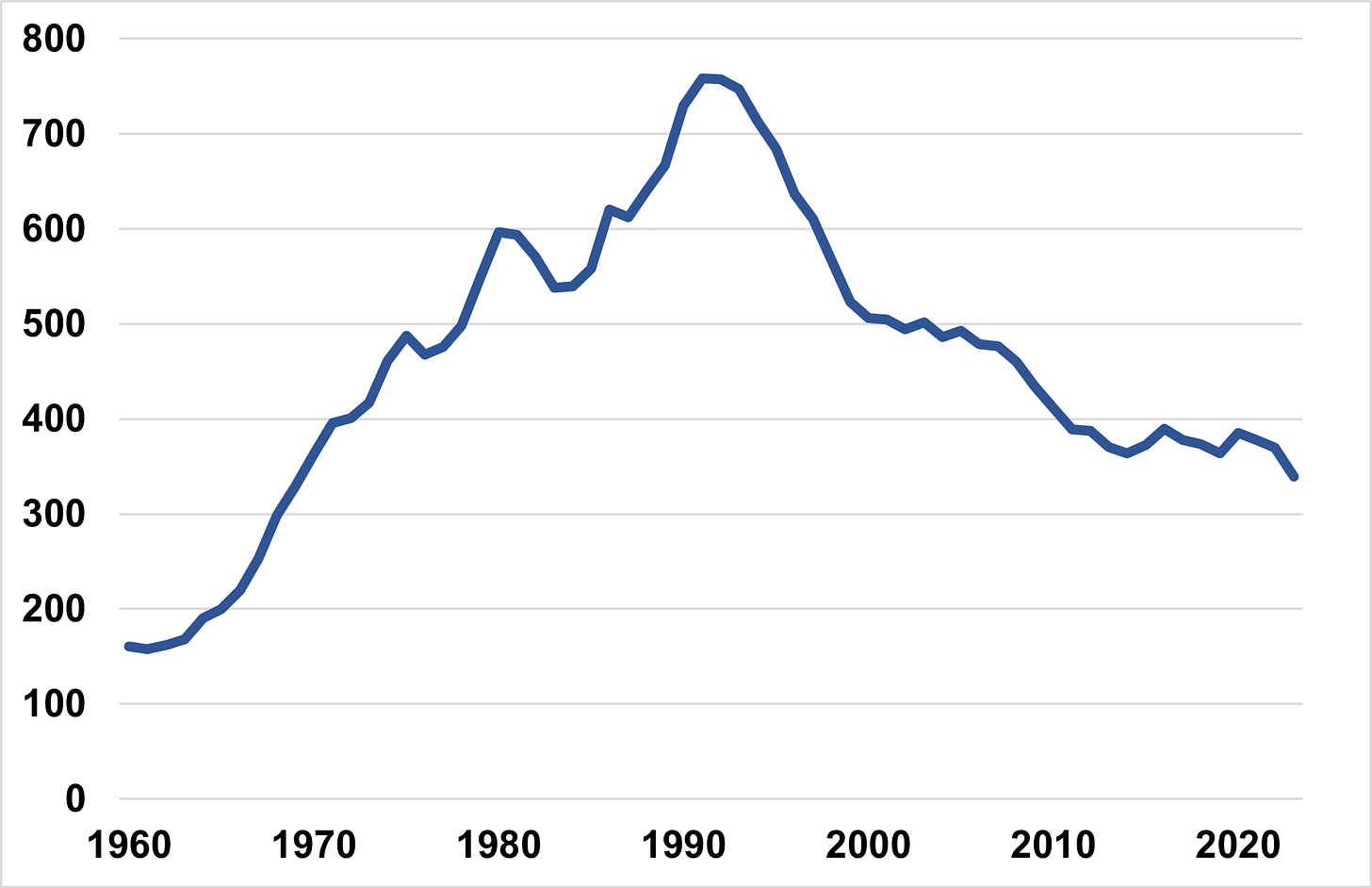
I am often asked why crime rates came down in the United States after the mid-1990s. There is the obvious reason that mass incarceration via the incapacitation effect that reduces crime by removing criminals from our streets. Sixty percent of state prisoners (most prisoners) are violent offenders (murder, rape, robbery, aggravated assault), and around half of nonviolent offenders are there for serious property offenses (burglary, theft-larceny, motor vehicle theft). More police on our streets has helped, as well, confirmed by the fact that depolicing is associated with a rise of crime over the last decade (which elites are partially obscuring by manipulating crime data).
The rise and fall in the rate of street crime 1960-2020 (Source: FBI Uniform Crime Report)
But there are other reasons. Getting lead out of the environment helped. Lead is a neurotoxin associated with aggression and impulse control. Another environmental factor is the constellation of synthetic estrogens that has emasculated the population; males in America are being feminized (along with other animals). On the technological front, the introduction and mass use of computers and video games has taken teenagers and young men off the streets and put them in front of screens (this has also had the effect of dropping fertility rates, exacerbated by the feminization problem). Since serious crime is largely perpetrated by young males (a fact well known for centuries), it follows that emasculating men and taking them out of the social environment will reduce crime.
There are no other reasons I can think of. The military is no longer absorbing young men. Indeed, recruitment is down. Social programs don’t suppress criminogenesis. On the contrary, these have the opposite effect through family disintegration. If you have any other ideas, let me know.
Crime remains high in black-majority inner-city neighborhoods comparatively. This is partly because of the aforementioned problem with family disintegration caused by social programming (government dependency) and the relatively low level of technological distraction (this is not to say that young blacks don’t have access to technology). But it is also because of the pathological subculture of violence associated with social programming and economic policy, especially the idling of black males through globalization (offshoring and immigration). This pathological subculture is reinforced by corporate culture industry targeting of the black demographic, which reinforces demoralizing libertine sensibilities.
It should be obvious to readers that what lies behind the continuing problem of crime in America (which is remarkable in comparison to other advanced industrial economies) is the corporate state project of transnationalism, which includes both offshoring of production and the importation of foreign labor, and the progressive social policy regime that Democrats have imposed on America’s cities.
“October 7 was kind of like the American Revolution. If you take away the context.” —Trevor Noah
“True, true.” —Ta-Nahesi Coates
A few days I ago, on the anniversary of that despicable act, I commemorated October 7, 2023 with the essay Facing Down Evil. A few days later I witness this conversation between Trevor Noah and Ta-Nahesi Coates. Trevor Noah says, “October 7 was kind of like the American Revolution. If you take away the context.” Did the American patriots cross the ocean, enter English towns, and, while some people participated in a festival and others in ordinary daily activities, massacre civilians, rape women, and take hostages? When did this happen? In what context would this ever be acceptable?
“October 7 was kind of like the American Revolution. If you take away the context.” —Trevor Noah
There is no context in which such an act is acceptable. There was zero moral justification for Hamas action that day. Hamas is a genocidal death cult, those who participated in these actions the result of conditioned sociopathy from birth. Sociopathy at this depth cannot be reasoned with. The only option is annihilation. That the promise of paradise in Islam is a lie is icing on the cake. To be sure, the martyrs will never know their obsession was for naught. But I will. Hell is an imagined someplace. Annihilation is nowhere. Like Islam’s paradise.
— Thomas Chatterton Williams (@thomaschattwill) October 11, 2024
Ta-Nahesi Coates: “The example I think about all the time is like Nat Turner, right? Like Nat Turner launches his rebellion in 1830. This man slaughters babies in their cribs. You know what I mean? And I’ve done this thought experience, this experiment for myself over and over. Does the degradation and dehumanization of slavery make it so that you can look past something like that? I try to imagine, and I think I can accurately imagine as much as possible, that there were enslaved people, no matter how dehumanized that said, ‘This is too far. I can’t do that.’”
He could have stopped there. But he didn’t. “Now, here’s the flip side of it,” he continued, “and I haven’t said this out loud, but I think about it a lot. Where I, twenty years old, born into Gaza, which is a giant open air jail [it’s not], and what I mean by that is if my father is a fisherman and he goes too far out into the sea, he might get shot by somebody off of, you know, inside of Israeli boats. If my mother picks the olive trees and she gets too close to the wall, she might be shot. If my little sister has cancer and she needs treatment because there are no facilities to do that in Gaza and I don’t get the right permit, she might die, and I grow up under that oppression and that poverty, and the wall comes down, am I also strong enough, or even constructed in such a way where I say, this is too far, I don’t know that I am. I don’t know that I am. I don’t know that I am.”
Everything Coates describes is the consequence of Palestinian resistance to peaceful coexistence with Israel. But put that aside for now. This is what is at issue: the problem of morality. Any truly moral person knows that this October 7 is too far. For such a person, perpetrating October 7 is unimaginable. A moral person does not excuse October 7 with an exercise in empathy that reimagines himself capable of such things, because such an exercise only dresses itself in empathy to engage in an exercise in justifying the indefensible. What brings a person to be able to think like this, to even suggest it? Deep seated hatred and loathing for victims of October 7—not for what they did (they did nothing), but for who they are.
The October 7, 2023, Hamas attacks killed approximately 1,200 people in Israel. As of 2023, Israel’s population is about 9.5 million. To scale this to the US population (approximately 331 million), the toll would be equivalent to around 42,000 deaths if the same proportion of the population were killed in an attack on the United States. Does anybody believe the United States wouldn’t flatten the country that killed 42,000 of its citizens?
Iranian missiles rain down on Israel, here seen from Ashkelon, Israel, October 1
Hamas, Hezbollah, and the Houthis are proxies of Iran. What we see today is effectively a war between Israel and Iran. Israel must destroy Iran’s proxies to thwart Iran’s attempt at regional superiority. But more than this, the forces represent clerical fascism, a modern-day instantiation of nazism. By destroying its proxies, and by striking targets in Iran, Israel may be able to destabilize the regime and create the opportunity for the Persian people to overthrow the Islamic state and restore their once-great civilization. This would bring peace to the Middle East.
Ever since Jimmy Carter and Zbigniew Brzezinski stood by while the Islamic Revolution overtook Iran—meanwhile destabilizing Afghanistan by organizing a coup d’etat in Kabul—the Persian people have lived in darkness. The continuation of this darkness was facilitated by both the Obama and the Biden regimes. Obama’s 2015 nuclear deal (cover for a balance of power scheme) lifted sanctions and allowed Iran to access billions in frozen assets, which it used to fund its military and regional proxies. Biden has done the same.
The West can’t be both for and against Israel. The Islamist wants only one thing: the eradication of Jews everywhere. He will never seek peace because all he seeks is death. He teaches his children from birth to be martyrs. He hate the Jews so much that he forsakes his own offspring. This is not hatred over white settler colonialism and any of those other rationalizations. This is a religious hatred. Islamists see Jews as an evil to be wiped off the fact of the planet. This is an instantiation of collective psychopathy in the same way that the Nazis were driven by irrational hatred and loathing of the Jews.
Israel is facing down evil. There is no sides-choosing is circumstances such as these. There is no balance of power between good and evil. Israel is facing an existential threat. So goes Israel so goes the West. Islam is on the move. It must be resisted everywhere.
I have published a couple of essays on the situation in Springfield, Ohio (The Racial Politics of Safeguarding Companion Animals; Is This the Second Coming of Hunter Biden’s Laptop is a Hoax?), and several on the issue of immigration more broadly (too many to list here). I have also published numerous essays over the years on the problem of conflating culture and race (again, too many to list here). The Springfield story has legs. And the conflation of culture and race has only grown worse in its wake. We’re in the final weeks of a presidential campaign, and one party, the Republican Party, has championed working class interests in addressing the mass immigration crisis, while the other party, the Democrats, has sought to delegitimize working class concerns by smearing them as “racist.”
This was not always the case. Democrats used to speak to working class interests. In this area, at least. In his 1995 State of thew Union address, Bill Clinton presented to Congress his administration’s position on the mass immigration problem in terms nearly identical to those of Trump. Clinton was also concerned about the high rates of crime ravaging the nation and he recognized that mass immigration plays a big role in driving up crime and disorder. (In the 1990s, responding to extraordinarily high rates of gang violence, the Clinton Administration and local law enforcement authorities pursued large-scale deportations of illegal aliens with criminal records.) Barack Obama presented similar views during his presidency.
Why the Democratic Party has shifted so drastically since is a question the media appears to have no interest in answering. This is because the role of the media is to represent the interests of the corporate elite, which has pursued globalization for decades. The Democratic Party enables globalization, so it was inevitable that it would embrace mass immigration. How they enable mass immigration is the problem I address in this essay.
Springfield, Ohio
The first part of this essay will examine the fallacious nature of this confusion (which is strategic). The second part will explore how this conflation obscures the establishment of a racialized split labor market. In Springfield, Ohio, for instance, Haitian migrants are exploited through a leasing system where temp agencies contract with local businesses in a way that resembles indentured servitude—but with a racial dimension—thus creating split-labor market situation that hurts native-born workers. I provide other examples of split-labor market exploitation. I will argue that the progressive conflation of culture and race serves to obscure the longstanding capitalist practice of exploiting racialized labor from the Global South. Indeed, it is not the residents of Springfield who are racists, but those who have imposed upon them the burden of Haitian migrants.
Culture and Race
As noted, criticizing someone’s culture often leads to accusations of racism, and many accept the smear as justified; however, this conflation is flawed—culture is not race. Culture is the set of shared artifacts, beliefs, customs, norms, and values that members of a society use to interact with, interpret, and negotiate the world around them. It encompasses tangible aspects, such as art, food, language, and music as well as intangible elements, like norms, ideology, religion, and traditions. Culture is a worldview, often coextensive with ethnicity, that motivates action and shapes attitudes and thought, passed down from generation to generation through enculturation and socialization, shaping the identity and practices of communities. It is, however, a non-genetic inheritance.
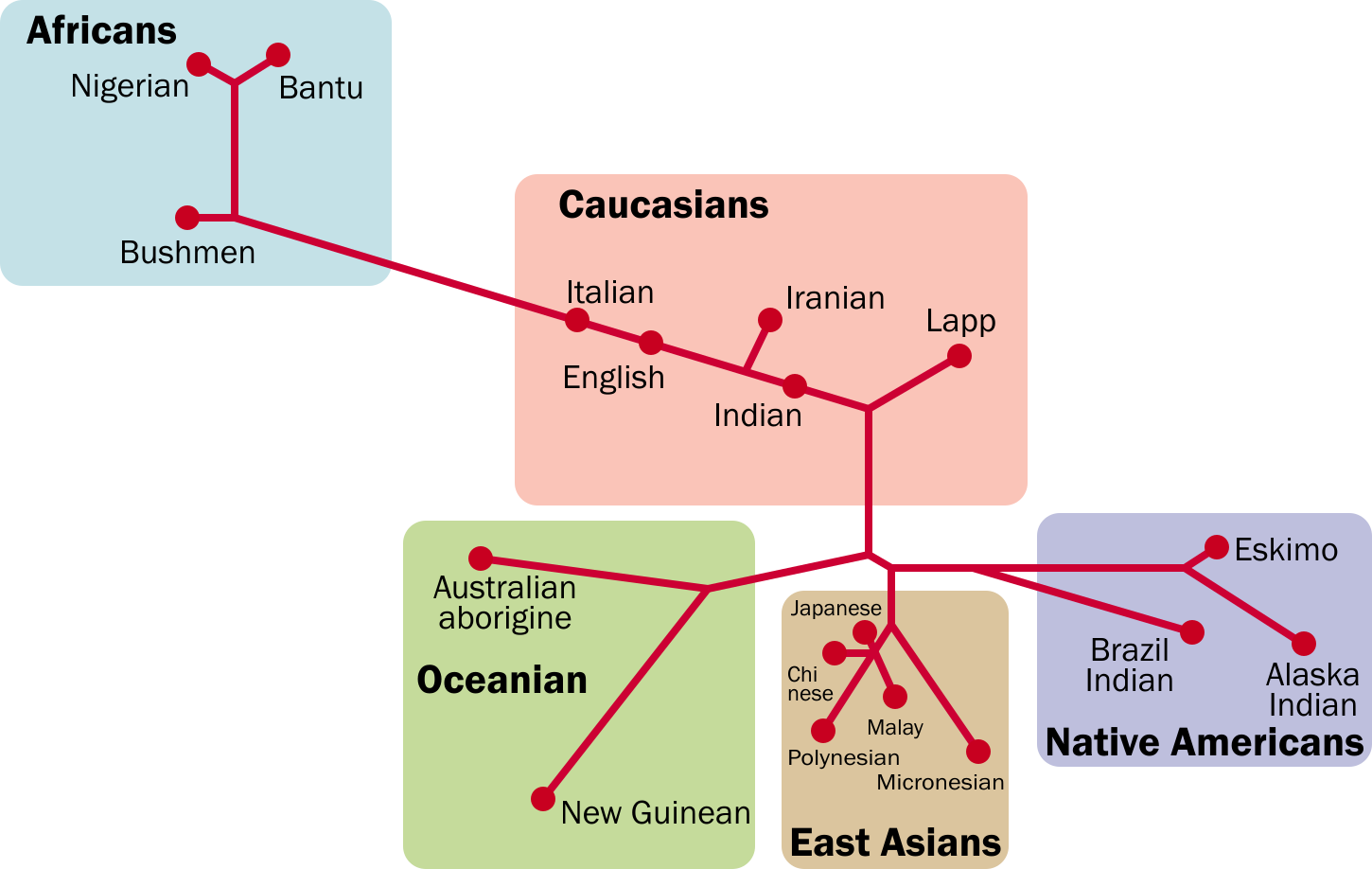
Race is, on the other hand, is a genetic inheritance. The concept refers to constellations of phenotypic traits, such as eye color, facial features, hair texture, and skin color, resulting from ancestry with intergroup variation that differentiates human populations. The resulting clusters show patterns related to geographical and historical contexts. Crucially, all races belong to the same species, Homo sapiens. The idea of race may carry significant cultural and social weight, affecting individuals’ experiences and opportunities in life, including discrimination and systemic inequality, but cultural and social weight do not make race cultural nor reduce it to a social construct.
Genetic distance map made in 2002 is an estimate of 18 world human groups by a neighbor-joining method based on 23 kinds of genetic information.
There is no evidence that cultural practices and systems reflect genetic differences between the races (although they can affect genetic differentiation). Two descendants of black African slaves may share a phenotype, i.e., the observable physical characteristics of an organism, which result from the interaction between genotype and environmental influences, but not share a culture. The fact that there are African and Asian cultures in which it is permissible to eat cats and dogs, practices that modern European cultures abhor and condemn, doesn’t mean that eating cats and dogs is inherent in a given racial type. Europeans are not missing the cat-eating gene. Europeans don’t eat cats because of a cultural prohibition against the eating of companion animals.
Progressives have deliberately fostered a confusion that frames criticism of culture as racism. The intent is to delegitimize the complaints of those who bear the consequences of mass immigration and capitalist labor practices. The conflation also functions to marginalize those who advocate for the assimilation of those who are allowed to stay. Individuals who assert the dominant cultural values of their nation—those recognizing the vital importance of shared heritage, language, legal systems, and social norms—are cast as bigots opposed to those who appear different rather than as citizens concerned with preserving their national culture and charting their own collective destiny. As I have noted in past essays, multiculturalism conflates criticism of cultural pluralism with opposition to multiracialism, discouraging any critique of culture by associating it with white supremacy.
One strategy social programmers use to instill this conflation in Western collective conscience is the promotion of cultural relativism in public education and popular culture. Cultural relativism subtly cultivates support for moral relativism, i.e., the belief that a person’s attitudes, behaviors, beliefs, and values should be understood and evaluated based on their own culture rather than judged by the standards of another—or by a universal standard. Judge a culture by your standard and you’re a chauvinist. Objectively, whether you are a chauvinist depends on whether your cultural viewpoint is aligned with universal standards. But relativism insinuates—and postmodernists insist—that there is no universal position from which to assess the adequacy or worth of any given culture.
One familiar with the woke rhetoric of our times will note that there is a paradox at work in this discourse. Those hailing from critical race theory (CRT) and postcolonial perspectives depict European or Western culture as imperialist and white supremacist due to its historical role in colonization, global power imbalances, and racial domination. These perspectives argue that Western culture, far from being one culture among many, has imposed its norms, values, and systems of power and right on much of the world, shaping global structures of inequality while corrupting indigenous cultures. Western culture is exempted from the terms of cultural and moral relativism. Europeans are not entitled to cultural and ethnic integrity. Indeed, one signals their virtue by condemning Western culture. This, too, is strategic—it seeks to justify the opening of borders to bearers of other cultures.
The condemners of Western culture content that European populations are not treated relativistically because whites are the architects and beneficiaries of systemic racism. According to this view, Western norms have been historically constructed to maintain white supremacy, an ideology that privileges whiteness while marginalizing non-white people. Western culture is critiqued for producing and perpetuating legal and social norms that uphold racial hierarchies, making it a proper target of scrutiny rather than a culture to be treated equally within a relativistic framework. In effect, this is a twist on Western exceptionalism. The West is not exceptionally good and right. It is exceptionally bad and wrong. A contradiction is thusly rationalized.
This makes mass immigration appear as a boomerang. From a postcolonial standpoint, Europeans, having globalized their practices and values through centuries of colonization, subjugating non-Western cultures by socializing the virtues of modern life (individualism, liberalism, rationalism, secularism), have reparations to pay—they have it coming to them. The imperialist legacy means that Western culture is not a source of enlightenment but of oppression, responsible for appropriating resources, dehumanizing colonial subjects, and imposing its worldview on indigenous and non-European societies. Treating Western culture as just one culture among many ignores the lasting impact of colonialism and the continued dominance of Western cultural, economic, and political power in a supposedly post-colonial world. Europeans are therefore justly subject to special disapprobation, one that requires the repayment of debt, both in the sharing of wealth and space. Foreigners to the West claim the value and wealth of the West for themselves (Reparations and Open Borders).
Of course, there is a universal positions from which to judge the adequacy and worth of culture: human nature determinable by science. What science determines about human nature, or what Karl Marx calls “species-being” (Gattungswesen), indicates that morality is a natural occurrence, its attributes common to all races. Species-being refers to the unique nature and potential of humans as a special mammal, particularly our capacity for consciousness, our creativity and inventiveness, and penchant for complex social interaction, including symbolic interaction. In Marx’s view, what distinguishes humans from other animals is our ability to shape and transform our environment through labor in a way that reflects conscious intention and shared interests manifest in cooperative action. This creative, purposeful activity is central to our essence as human beings.
Abraham Maslow’s hierarchy of needs
Abraham Maslow’s hierarchy of needs parallels Marx’s concept of species-being in that both emphasize the fulfillment of human potential through self-actualization that depends on the development of the individual’s abilities amid the conditions provided by their socio-economic environment. Maslow frames self-actualization as the highest level of personal development. Similarly, Marx argues that under ideal social conditions, free and cooperative labor would allow individuals to fully realize their potential. Human beings, in this sense, are inherently creative and social creatures, mammals capable of shaping social and natural history. Labor, in its ideal form, is not merely a means of production for survival, but an expression of our human essence, where individuals find fulfillment in creating something meaningful for themselves and others. In this light, cultural relativism, and the moral relativism the doctrine conceals, is but a vulgar form of romanticism that justifies practices that violate universal human rights.
What Cultural Pluralism Allows
Cultural relativism is what lies behind the underreporting of stories and the downplaying of foreign practices in the West that should scandalize societies that have enshrined, for example, women’s rights. Nearly all women living in Somalia have been circumcised, a practice referred to the international order as female genital mutilation or cutting (FGM/C). The United States forbids the practice. However, while the percentage of Somali girls in the United States who have been mutilated is significantly lower than in Somalia (precise figures can be difficult to determine due to the private and “sensitive nature” of the practice), estimates from studies and reports suggest that FGM/C affects between 25 and 40 percent of Somali girls and women in diaspora communities in the United States.
Those who defend cultural pluralism will often initially deny that FGM/C is happening in the United States. When cases are confirmed, they will say that many Somali families in the US have moved away from the practice due to increased awareness of health risks and legal prohibitions. It happens, but only on the margins. Yet the tradition persists, and this is due to cultural pressures and religious beliefs that cannot be fully suppressed without assimilating Somalis into Western culture. At some point the progressive will admit that it is happening but thinks this is okay because it’s the custom of another culture, and to criticize or interfere with the beliefs and practices of others is racist. In other words, once admitted, FGM/C is not really wrong. The conflation of culture with race thus harms girls and women by negating the criticism of Somali religious beliefs and ritual practices that oppresses them.
Women are disproportionately affected by cultural pluralism. Consider the veiling of Muslim women in Western societies. Muslim dress varies widely. The hijab is a headscarf that covers the hair, neck, and sometimes shoulders, leaving the face visible. The abaya is a long, loose robe covering the body from shoulders to feet, often worn over other clothes. The jilbab is a loose, long coat or outer garment that covers the whole body except the face, feet, and hands. The chador is a full-body cloak that covers the body but leaves the face exposed. The niqab is a face-covering that leaves only the eyes visible, paired with other head coverings. The burqa is a full-body covering with a mesh screen that hides the face, worn in some conservative regions. Confronted with the more extreme end of the dress code, the social programmers tell the public that the niqab and burqa are garments worn primarily for reasons related to Islamic principles of modesty and privacy. The niqab is worn to adhere to the Islamic belief that women should shield their beauty from non-family members, maintaining privacy while still allowing for interaction. The burqa offers an even more comprehensive form of coverage, worn to ensure complete anonymity.
Image from Margaret Atwood’s Handmaid’s Tale
But what underpins these cultural and religious interpretations of modesty? The male gaze—the same gaze Western liberal feminists decry—only this gaze is deeply opprressive. The niqab and burqa are signals of patriarchal control rather than mere expressions of cultural tradition or religious modesty. It is not as if Western feminists don’t see the problem in supposed future or imagined scenarios. After all, Margaret Atwood’s The Handmaid’s Tail has supplied the images used by feminists to portray conservative Christian beliefs about gender roles in the most authoritarian light. Yet when it comes to girls and women in Islam, they cannot see the signal of subjection.
These garments reflect and reinforce gendered power dynamics that restrict women’s autonomy and enforce strict norms about female appearance and behavior. The emphasis on covering women’s bodies is a way to control their movement and visibility in public spaces, indicating that women’s honor and worth are tied to their sexual being, conceived of in highly reductive form. It’s a form of extreme objectification and sexualization. Rather than empowering women through autonomy and choice, the imposition of such garments perpetuate the idea that women must adhere to male-defined standards of conduct and modesty, limiting their freedom and reinforcing patriarchal structures that regulate and constrain their roles in society—oppression sublimated as divine commandment.
For readers who may object that my interpretation of what these garments represents is one of many possible ones, let’s return to the example of circumcision, which is driven by the same species of gender ideology with fewer, if any, alternative interpretations. Viewed through the lens of bodily autonomy and gender equality, circumcision, particularly when performed on infants or young children, involves irreversible alteration of the body without the individual’s consent, raising concerns about the ethics of non-consensual medical procedures. Like female circumcision, male circumcision is justified by cultural or religious norms, as well as a medical practice, (which generates several hundred million dollars annually).
Both practices, regardless of gender, represent a form of control over the body that reflect broader issues of gender roles and norms and power, with the key difference having been until recently that male circumcision is typically performed under the guise of health or religious benefits.
Today, that difference has disappeared. Recoded as “gender affirming care” (GAC), FGM/C performed on girls and women has been legalized in many parts of Western society, a reflection of influence of the neo-religion of transgenderism on law and policy. It is also a reflection of corporate power and the insatiable appetite for profit. One suspect that this explains in part the affinity we see between Islamists and transactivists in recent protest actions against Western civilization.
Or consider that, in the United States, certain food practices from other cultures are disallowed or heavily regulated due to concerns related to animal welfare and public health. The consumption of cat and dog meat is illegal across the US, reflecting a broader cultural and ethical stance against eating pets that is not universally shared but legislatively enforced. Additionally, the slaughtering of animals without prior stunning, such as with halal and kosher, is subject to strict regulations to ensure compliance with humane treatment standards. While these religious practices are permitted, they must adhere to specific guidelines to align with broader animal welfare laws.
But should these practices be permitted at all? These examples highlight the tension arising between respecting cultural diversity and upholding universal human rights and concern for animals. Critics argue that some rights are fundamental and should be protected regardless of cultural context. Not allowing the genital mutilation of girls is a prime example. Banning the burqa seems reasonable in this light, but not the hijab. The question is whether the cultural practice in question violates civil and human rights or public safety. Even if we acknowledge that cultural understanding is important, it should not be misused to excuse or perpetuate practices that infringe upon the basic rights and freedoms of individuals.
We can have out these arguments. Some of these examples are edge cases. A woman wearing Islamic clothing may be a choice of self-expression protected by the First Amendment. Mutilating the genitalia of a young Muslim girls is not protected by the Constitution. However, criticizing practices such as genital mutilation, the eating of cats and dogs, and the imposition of certain forms of modesty clothing is not inherently racist, despite the complex cultural contexts in which these practices occur. When people note and object to the ritual practices in Haiti of sacrificing cats to manifest the protective magic promised by Vodou, or of the taking of ducks and geese from public ponds, they are not racist for doing so. They are objecting to Haitian culture (just as woke progressives object to American culture).
Cultural relativism is problematic because it obscures the fact that not all cultural norms and practices are equally beneficial or equitable. Some practices, such as imposed gender inequality, can be harmful or oppressive. By prioritizing cultural respect or diversity without critical evaluation, cultural relativism permits destructive practices to go unchallenged. Accepting all cultural practices as equally valid impedes efforts to address and correct those harmful practices. Instead, a more critical approach is needed, one that evaluates cultural norms against universal human rights standards. By focusing on protecting fundamental rights and ensuring the well-being of all individuals, societies can better uphold the dignity and respect every person deserves.
What is Racism
Since culture is not race, cultural criticism is not racism. But what is racism? Racism is the belief that some races are inherently better than others, grounded in the idea that certain races possess traits that make them naturally superior. When it is claimed that genetic or physical characteristics such as body structure, facial features, and skin color are linked to differences in behavior, intelligence, and morality, and that these differences are said to express intrinsic capacities and proclivities, this is evidence of racist belief. Racism has been used historically to justify discrimination, exclusion, and inequality. As the reader can see, most accusations of racism don’t work with respect to immigration because the speech or actions being condemned as such are not based on race but on culture or economics.
If saying that one culture is better than another is not racism, then what is it? It’s cultural criticism. The critique is either valid or it’s not depending on the facts presented in light of the universal standard. Whereas we cannot say that one race is better than the others, we can say that one culture is better than another because this is an objective matter. Is the culture in question is adequate to human dignity and thriving, or does it fail these demands? Does the culture uplift the individual, or does it degrade her? Those elements of cultures that uplift should be protected and promoted. Those that degrade should be dissuaded; if bad enough, forbidden. Telling an African migrant residing in Dayton, Ohio, that he cannot feed his family cats is not an instance of racism by an act of asserting cultural value. The community is not discriminating against the migrant; it is demanding that the migrant align his behavior with the superior culture.
The Split Labor Market
Progressives, who represent the spirit of the corporate state, conflate race and culture in order to advance the capitalists strategy of superexploitation through, among other things, the split labor market. Split labor market theory, proposed by sociologist Edna Bonacich, explains how class divisions and economic competition contribute to racial and ethnic tensions in labor markets. Bonacich focuses on how the labor market is divided along racial or ethnic lines, creating a situation where different racial or ethnic groups are paid differently for the same work. These divisions often benefit employers who exploit the cheaper labor of marginalized racial groups while keeping wages low for all workers by fostering racial competition rather than class solidarity.
In a split labor market, workers are divided into at least two distinct groups: a higher-wage group, typically composed of native or dominant racial groups, and a lower-wage group, often made up of immigrants or racial minorities. Employers benefit from hiring workers from the lower-paid group because it reduces labor costs, as these workers are often willing to accept lower wages and poorer working conditions due to systemic discrimination or economic necessity. This creates resentment among the higher-paid workers, who view the lower-paid group as a threat to their economic stability. Crucially, their resentment is rooted in fact: the presence of immigrants does brings down the wages of all workers—indeed, that is the purpose of mass immigration. It is never the case that governments cannot keep millions of immigrations from crossing the borders they’re charged with defending. If there is mass immigration, it is because the government is allowing it.
The presence of cheap racialized labor undercuts the higher-wage group by diminishing their demand and bargaining power. As employers exploit the cheaper labor, the overall demand for higher-paid workers decreases, pushing them to accept lower wages or risk being replaced. Over time, this drives wages down across the labor market, weakening workers ability to negotiate better conditions. Additionally, employers use the availability of cheap labor to justify not improving working conditions for the entire workforce. This dynamic fosters racial conflict rather than class solidarity, as higher-wage workers resist the racialized labor force as competitors rather than allies. This division undermines collective efforts to secure better wages and conditions, exacerbating economic inequalities and tensions between racial groups.
In systems where workers are controlled by intermediaries who extract surplus value from their labor, economic autonomy is severely restricted, and their vulnerability is exploited. Haitian migrants sent to Springfield, Ohio to work in various industries through temp agencies illustrates this dynamic. In form, if not in substance, this is a species of indenture servitude.
A bit of background on this matter. The once-thriving manufacturing hub of Springfield experienced a sharp economic decline following the closure of its factories, with many jobs shifting overseas. By around 2015, the city’s population had plummeted to under 60,000, a significant drop from its peak of 80,000 during the late 1960s and early 1970s. The shrinking population meant that companies moving to the area would struggle to find labor.
Just as factories offshore to take advantages of cheap labor overseas, so factories bring foreigners to America to take advantage of their cheap labor here. The native born of Springfield, Ohio suffer globalization on both of its fronts. With a city government eager to prostitute itself to corporations, and a federal government eager to change the demographic composition of the nation for electoral and ideological purposes, Springfield was opened to thousands of Haitian immigrants. Estimates are that Haitians now comprise 25-30 percent of this small city.
The immigrants, primarily from Florida, Haiti, and South America, began arriving in Springfield as word spread through personal networks—family members, friends, and acquaintances—about the city’s urgent need for workers in sectors such as manufacturing, service industries, and warehousing. Employers encouraged their Haitian employees to bring others from their communities to Springfield.
Various Christian organizations eagerly participated. Community and Refugee and Immigration service (CRIS) is an independent non-profit organization that serves the refugee and immigrant populations in Central Ohio. CRIS, an affiliate of Church World Service, works with the Department of State to directly receive and place refugees in towns and cities in Ohio. Catholic Charities is another church organization involved in placing refugees in Ohio, as well as across America.
Many of these workers were given for Temporary Protected Status (TPS), a federal designation that allows nationals from countries to remain in the US even if they entered the country illegally. This legal status made Haitian migrants particularly appealing to employers, as they could hire them for critical positions while staying within the bounds of immigration law.
This system of modern-day system of indenture servitude depends on an important intermediary in this labor dynamic: temporary staffing agencies. These agencies play a pivotal role in connecting immigrant workers to area businesses. Local firms are prohibited from directly hiring many of these migrants and must go through temp agencies to secure their labor. By contracting through these agencies, businesses avoid direct involvement in immigration compliance issues, as the agencies act as intermediaries, handling the legal complexities of employment authorization. The reliance on these staffing firms allows companies to meet labor needs while distancing themselves from the potential liabilities associated with hiring immigrant workers directly.
Temporary staffing agencies, then, form a critical link in this local economy, ensuring a steady flow of workers into industries that require manual labor rationalized as unattractive to the native population. The fact that temp agencies mediate the employment relationship reflects broader trends in labor markets where contingent and temporary work is increasingly normalized, especially in sectors reliant on immigrant labor. This arrangement allows employers to maintain flexibility in hiring while limiting their legal exposure, underscoring the complexities of labor in a post-industrial/re-industrializing city like Springfield.
Listen very carefully to what Brian Heck, city manager for the city of Springfield, Ohio, is telling the public about the situation in Springfield. He brags about how “our Springfield community is making notable progress that contributes to its growing appeal among new residents, including immigrants.” By progress he means development. “This development is underpinned by our city’s diverse and robust industrial base that encompasses the technology, automotive, food production, and distribution sectors. The growth in our workforce population has supported the expansion of local businesses, contributing to the stabilization of our local economy. Our commitment to promoting a business-friendly environment has attracted new enterprises to our region, and we will continue to focus on collaborating with industry leaders who seek to establish operations here.” In other words, the residents of Springfield are being subjected to chaos (the term “stabilization” here is meant in the neoliberal sense) for the sake of business interests.
Heck elaborates: “Springfield is at the forefront of advancements in aerospace technology, particularly in support of national defense. These technologies are set to enhance daily life in the coming decades.” What technologies are these? Weapons and other systems produced for the military-industrial complex—the war machine. “Springfield’s strategic location between the Columbus and Dayton markets,” he notes, “make [Springfield] a prime candidate for future development.”
Heck talks about “community partners” who the city is collaborating with to face the “challenges,” “strain on [the city’s] resources,” the influx of thousands of immigrants represent. I noted some of those community partners—the area businesses, church organizations, and temp agencies. The city is also “working with developers to increase our residential housing stock…. Over the next few years, we anticipate the addition of over 2,000 new housing units.” Presumably barracks for the migrant work force. Heck does not mention the corporations buying up housing to turn into rental property for migrants, a development that pushes out Springfield’s longtime residents.
In the case of indentured servitude, migrants were contracted for a fixed period, during which they had little or no control over the terms of their labor. They were often subject to harsh conditions, and although they were technically freed after their indenture expired, the system was designed to keep them in a subordinate, economically precarious position. This echoes the way temp agencies operate under contracts that block industries from directly hiring migrant workers, trapping them in temporary, often dangerous jobs. These workers might cycle through low-wage, insecure employment, with the agency skimming off a portion of the value produced by their labor—much like how the overseer in indentured servitude would appropriate much of the laborer’s productivity.
Moreover, both systems involve an external actor (the temp agency or the contract-holder in indentured servitude) controlling access to the labor market. This intermediary keeps the workers from realizing the full value of their labor or from negotiating better terms for themselves. The temp agency’s profit represents the appropriation of surplus value that would otherwise go to the worker, solidifying the analogy to indentured servitude, where the laborer was similarly denied full ownership of their output. In the modern instantiation of the system, the government plays a vastly expanded role, keeping the immigrant in subject by withholding his green card. When the migrant is no longer needed, he will be released to become one among the millions of illegal immigrants the Biden-Harris regime allowed in during their reign.
The exploitation of migrants under these conditions is what political economists called superexploitation, a condition where workers are subjected to extreme levels of exploitation beyond the norm; workers are not only exploited to an excessive degree but also face additional layers of oppression that exacerbate their exploitation. They are paid less than the market value of their labor under conditions where they have little bargaining power or are subjected to precarious employment. They face grueling working conditions, excessive hours, and unsafe environments. And they are forced to supplement their low wages by theft and other forms of criminality.
So what is the racism in this situation? What the Democrats are obscuring and defending: the racist exploitation of Haitian migrants.
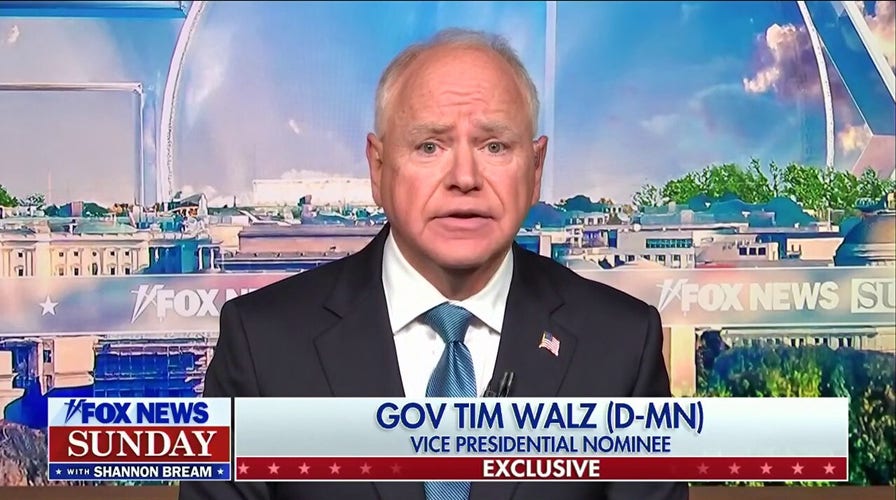
The Daily Beast reported today that Tim Walz outmaneuvered Fox News host as he was grilled on abortion. If you haven’t seen the interview, this is not at all what happened. Walz didn’t outmaneuver Shannon Bream at any point. He never answered the questions she put to him. What Walz obscures in his answers to this question is the fact is that his state allows abortion at any point. This situation is due to the state Supreme Court’s ruling in Doe v. Gomez (1995), which established strong protections for abortion rights under the Minnesota constitution. These protections ensure that abortion remains accessible throughout pregnancy in Minnesota, even if federal protections change.
A Minnesota law—on the books since 1976—required “responsible medical personnel” to use “[a]ll reasonable measures consistent with good medical practice” to “preserve the life and health of the born alive infant.” In 2015, Minnesota enacted the Born-Alive Infants Protection Act, requiring the state department of health to produce a report every year stating the number of babies born alive after an attempted abortion and what happened to them. Over the next eight years, the health department reported twenty-four babies born alive after an attempted abortion. All of the babies died. In eight of those cases it was reported that only comfort care measures were provided. Walz signed legislation in May 2023 that struck the word “preserve” and replaced previous wording with “to care for the infant who is born alive.”
Tim Walz appears on Fox News
As many of you know, I support a woman’s right to control her reproductive capacity. However, the rhetoric coming from Democrats about laws regulating abortion in various states makes those states appear to be extreme outliers in the West. I checked out the abortion rules in what are in the most progressive states in Europe—the Scandinavian states—and found that there are significant restrictions there. One would expect that many Americans, if presented with the facts not knowing from what state they were obtained, would identify them as rightwing countries.
In Sweden, abortion is permitted on request up to the 18th week of pregnancy. After the 18th week, abortions can only be carried out if the woman’s life or health is in danger, or if there are serious fetal abnormalities, and requires approval from the National Board of Health and Welfare. Sweden has the most liberal policy of the four states I looked at. In Norway, abortion is available on request until the end of the 12th week of pregnancy. After twelve weeks, a woman must apply to a medical board to have an abortion, which may be granted if continuing the pregnancy would have severe consequences for her health or life, or if there are serious fetal anomalies.
Denmark is similar to Norway; abortion is legal there up to the 12th week of pregnancy on request. After that, abortion is only permitted if the woman’s health is at risk, there are fetal abnormalities, or other special circumstances. Approval from a panel of doctors is required for later-term abortions. In Finland, abortion is legal on request up to twelve weeks, though it often requires approval from two doctors. After twelve weeks, abortion is permitted only in cases of severe health risks or fetal abnormalities and requires a permit from the National Authority for Medico-Legal Affairs.
Dobbs v. Jackson Women’s Health Organization (2022) upheld a Mississippi law banning most abortions after 15 weeks of pregnancy and, more significantly, overturned the constitutional right to abortion established under Roe v. Wade and reaffirmed in Planned Parenthood v. Casey. Had it just upheld the Mississippi law, conservative states would have moved in the direction of Scandinavia. Overturning the constitutional right to abortion allowed states to effective ban abortion from conception.
Under Roe v. Wade (1973), the Supreme Court had established a constitutional right to abortion by grounding the decision in the right to privacy under the Due Process Clause of the 14th Amendment. The Court’s ruling also introduced a framework to balance a woman’s right to privacy with the state’s interest in protecting both women’s health and prenatal life. This framework divided pregnancy into three trimesters, each allowing for different levels of state regulation.
During the first trimester, the decision to terminate a pregnancy was left entirely to the woman and her physician, with no government interference allowed. In the second trimester, the state could regulate abortion procedures but only to protect the health of the woman, not to restrict access to abortion itself. This meant that an abortion could be performed as late as the 26th week. In the third trimester, once the fetus reached the point of “viability,” i.e., the ability to survive outside the womb (around 24-28 weeks), the state could prohibit abortions, except when necessary to protect the life or health of the woman.
This trimester framework was later modified by subsequent rulings. Planned Parenthood v. Casey (1992) upheld the core holding of Roe but replaced the trimester system with the “undue burden” standard, allowing states to regulate abortions so long as they did not place a substantial obstacle in the path of a woman seeking an abortion before viability. The viability threshold continued to be a central concept, but states gained more latitude to impose regulations earlier in pregnancy. This opened the door to Dobbs.
Understand that my position on reproductive freedom does not move from the standpoint of the fetus, but of the mother, and that puts me in a minority. I recognize that I have radical position on the matter. Since Trump has promised that there will be no national ban and supports the exceptions of rape, incest, and life of the mother, is it possible for a federal law to be negotiated that allows abortion during the first twelve weeks, then afterwards if certain conditions are met?
To be sure, some US states ban abortion from conception. However, other states allow it to occur at any point during the pregnancy. The debate in America moves from those extremes. Could a compromise be found by adopting the position of the most progressive states in Europe? That would permit abortions while being more restrictive than the Roe standard but would not ban abortion from conception. Would resistance to such a law be more pronounced among conservatives—or would progressives decry it as too extreme?
In the Epic of Gilgamesh, Enlil unleashes torrents of rain. The floodwaters rise swiftly, consuming villages, fields, and forests, drowning living creatures in their path. The devastation is immense, a once-thriving world reduced to a waterlogged wasteland, bodies floating lifelessly on the surface. The flood leaves desolate silence in its wake. Even the gods express regret and sorrow at the overwhelming loss of life.
In the world beyond myth, Hurricane Helene has wreaked mass destruction across the southeastern United States, particularly in North Carolina. The storm brought catastrophic flooding, with Asheville and surrounding areas being hit the hardest. Floodwaters have destroyed homes, wrecked infrastructure, and triggered mudslides, leaving many trapped or missing. There are reports of bodies floating down rivers and stuck in trees. Heads and limbs are being discovered under debris.
The media says there’s more than two hundred dead. But the sense I’m getting from citizen journalists is that the death toll is in the thousands. Damage to bridges and power grids has hindered rescue and recovery efforts. Observers are describing biblical-level devastation.
Desolate silence is what meets many of the victims of the hurricane when they reach out for help from the government. Biden assured a reporter that everybody is getting everything they need. They’re happy across the board, he said. He said this after being reminded that a hurricane had occurred. He admitted to being unsure of which storm the reporter was talking about.
Perhaps Biden was thinking about the millions of illegal aliens he and Kamala Harris invited into our county—and the millions of dollars his administration has provided them at the expense of native-born Americans and the naturalized citizens who follow the law.
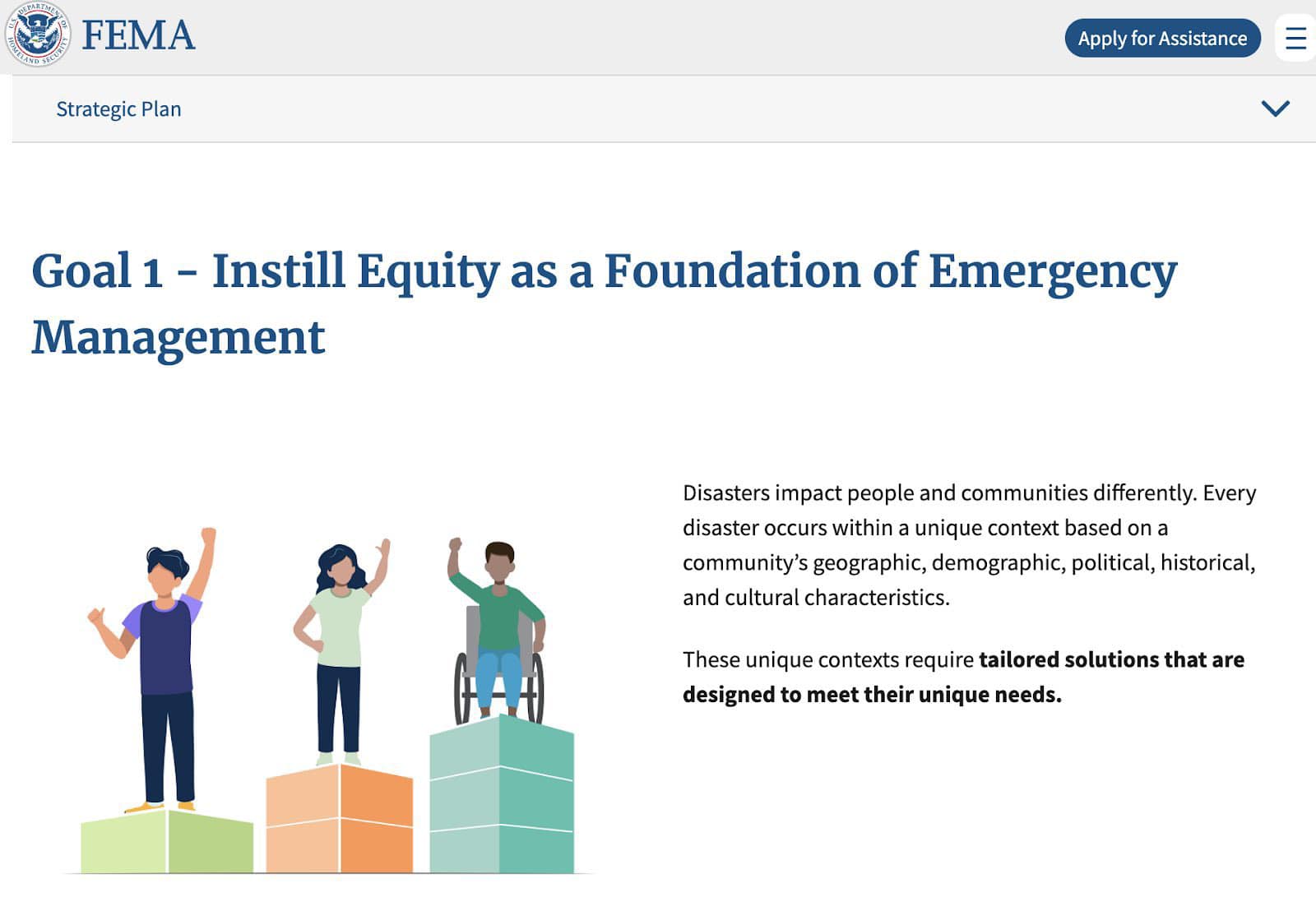
Harris talks a great deal about equity. Not everybody starts in the same place, she says, therefore we—that’s you and me—need to give some people more so that we can all end up in the same place. This is why I have referred to the Vice-President as Kamala Harrison Bergeron, after Kurt Vonnegut’s dystopian future world based on this idea.
However, this isn’t equity. It’s something else. If you were reminded of Karl Marx’s “From each according to his ability, to each according to his needs,” it’s not even that. Marx wasn’t an identitarian. Nor was he a corporate shill. What Harris is talking about is the redistribution of resources and value based on an ideology that sees the world not in terms of people but in terms of groups. She will decide which groups get more than others. And who those groups are is no secret.
Equity only works as an equality principle in a society based on individualism when the differences between groups are intrinsic, such as in the case of women’s rights (as we have seen, progressives don’t care about women’s rights, privileging the desire of dangerous and delusional men over the needs of girls and women). That’s why the application of equity identified in FEMA’s “Goal 1” is discriminatory and unjust: because it treats individuals as concrete personifications of abstract groups and then makes decisions on that basis that differentially affect their lives.
The problem of white privilege means that the millions of native-born whites suffering from Hurricane Helene in Asheville, North Carolina deserve less government aid than the Haitian migrants in Springfield, Ohio because Haitian migrants start off in a different place.
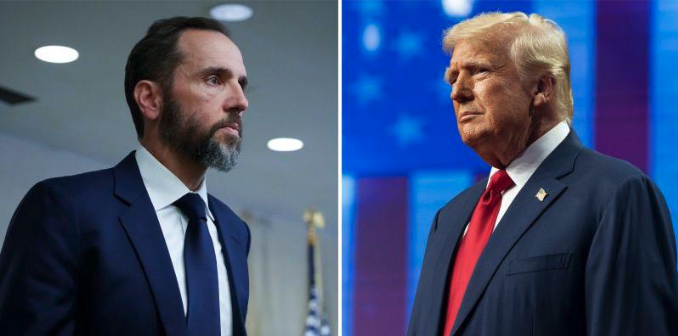
Democrats and the media that shills for them are warning the public that if Trump is elected he will weaponize the federal government to go after his political enemies. Yet this is what the Democrats have been doing for the last several years. Democrats impeached Trump on the claims of a whistleblower who admitted having not directly heard the call phone call to Ukraine’s Zelensky. Democrats impeached Trump a second time, charging him with incitement of a riot for telling a crowd in the context of a permitted First Amendment event to peacefully and patriotically let their voices be heard. Democrats have charged Trump with multiple counts in multiple venues for nonexistent crimes. Now Jack Smith is back with another document.
Jack Smith is back with another document
The DOJ threw Peter Navarro in prison for four months on a contempt charge by a kangaroo court. The DOJ, working at the behest of the same kangaroo court, threw Steve Bannon in prison for four months on a contempt charge (Bannon is still in there). The DOJ handed down lengthy sentences to Americans who merely entered a government building on January 6. The DOJ has traveled around the country harassing and intimidating citizens suspected of supporting Trump and the populist movement. Yet the Establishment tells the public that it’s Trump who will in unprecedented fashion weaponize the government. Believing these things, citizens have taken up guns and attempted to assassinate the President.
BREAKING: Tucker Carlson releases NEW footage of the Trump assassination attempt from Butler
This is some of the rawest footage we've ever seen of those moments. The camera was in the line of firepic.twitter.com/lW5LVesiNT
Many in the public have been tricked into falsely believing that Trump is a convicted felon and an adjudicated rapist. They falsely believe a conspiracy that he tried to overthrow the government and steal an election. They falsely believe that there was an insurrection on January 6—an insurrection by unarmed civilians either provoked by a police riot or allowed into the building by Capitol police officers. They falsely believes that police officers were killed on January 6. These false beliefs brings many of those who read Smith’s document to find in there what I cannot: a conspiracy to overthrow democracy. Indeed, it appears to me that conspiracy to overthrow democracy is itself a conspiracy to overthrow democracy.
How could such illusions be passed off as reality? How could millions be blinded to the reality that it’s Democrats who have weaponized the government against them and their leaders? This is power of the mass media moving across the terrain of a profoundly indoctrinated population. Propaganda is real and powerfully effective when aimed at a population conditioned from infancy to believe a particular ideology.
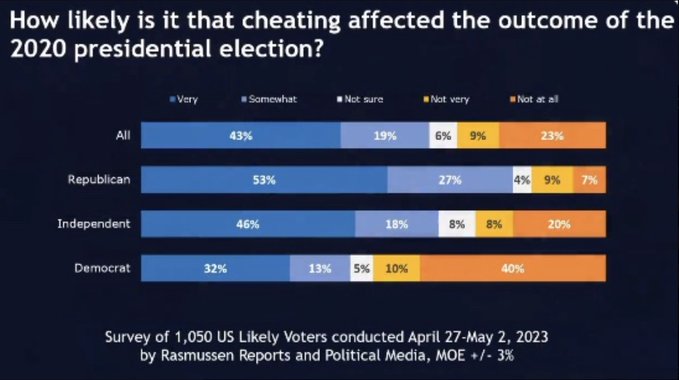
But not everybody is so easily deceived. In fact, on the problem of election integrity, according to Rasmussen Reports, most Americans suspect something was wrong in 2020 (62 percent of all thse surveyed believe it was “very likely” or “somewhat likely” that cheating affected the outcome)—and worry that something like this will happen against in 2024 (with 66 percent reporting that they believe it is “very likely” or “somewhat likely” that cheating will affect the outcome). There’s a reason why the corporate media and Jack Smith obsess over Trump’s claim of a rigged and stolen election; they need to manufacture the appearance that he or his supporters are alone in this belief. But they are not alone.
This is what lies behind the Jack Smith case. The Establishment is making an example of Trump because he disputed an election that the majority of Americans also find suspect. They need to obscure the reason why this election so close, namely because so many Americans believe deep down that the case against Trump is manufactured. If a majority of Americans believed the 2020 election was legitimate, then Trump wouldn’t be the nominee. And the fact that he could win this election speaks volumes about where the public is on the matter. The illusion of a democracy that the corporate state has manufactured is in danger of crumbling. Real democracy is poking through.
“There’s no guarantee to free speech on misinformation or hate speech, and especially around our democracy.” —Tim Walz
Tim Walz confirmed last night that he is an enemy of American’s free speech rights. Walz had said this before last night (The Liar Who Wants the Government To Censor You). Vance got Walz to admit before tens of millions of Americans that he still believes that the free speech right does not include protection for utterances and writings the government deems “disinformation” or “hate speech.” But it does. Indeed, that’s the point of the free speech right: to say and write things that contradict government pronouncements and actions. Walz told Vance that the Supreme Court test for suppressing speech is “yelling fire in a crowded theater.” Walz is wrong. That’s not the test for government suppression of speech.
Walz is making a reference to Schenck v United States, a 1919 case in which the Supreme Court unanimously upheld the conviction of two socialists who had distributed anti-draft leaflets during World War I. The case arose when Charles Schenck, a member of the Socialist Party of Philadelphia, distributed leaflets (in Yiddish) urging men to resist the draft, arguing that it violated the Thirteenth Amendment’s prohibition of involuntary servitude. The government charged Schenck with violating the Espionage Act of 1917, which made it a crime to interfere with military recruitment or operations during wartime.
Schenck argued that his conviction violated his First Amendment right to free speech. The Supreme Court, in a unanimous decision written by Justice Oliver Wendell Holmes Jr., upheld Schenck’s conviction. Holmes argued that in times of war, certain expressions that pose a “clear and present danger” to the nation’s security could be restricted. This gave rise to the famous analogy of falsely shouting “fire” in a crowded theater as an example of speech that could incite panic and harm. Holmes, known for other authoritarian decisions (e.g., upholding forced sterilization of persons deemed unfit to reproduce by the state by expanding the power of government to force citizens to take vaccines), said, “The most stringent protection of free speech would not protect a man in falsely shouting fire in a theatre and causing a panic.”
But the two socialists in the Schenck case weren’t yelling fire in a crowded theater. They were yelling fire because there was literally a fire burning across Europe—a conflagration called WWI. They were telling men to resist fighting in a war thousands of miles overseas that had nothing to do with national security (if you disagree, the First Amendment protects your right to do so). To repurpose the analogy, what these socialists were actually doing was yelling “fire” in a burning theater.
JD Vance and Tim Walz in the Vice-Presidential Debate
Over time, the standard for limiting speech evolved, with the “imminent lawless action” test established in Brandenburg v. Ohio (1969) replacing the “clear and present danger” test. Walz, a dyed in the wool progressive of the most extreme sort, is referencing a ghost to justify the instinct that inspires his decades-long fascination with the totalitarian regime of the Chinese Communist Party.
This is the spirit of today’s Democratic Party (Harris-Walz and the Corporate State). Progressives want to restrict—and have restricted—the First Amendment to prevent opponents of lockdowns, mandatory vaccination, forced mask wearing, and social distancing from criticizing government action (Walz lies about this last night). They also want the police American’s free speech right around matters go gender, race, and religion. As I wrote two days ago in my essay The Fate of Free Speech is In Our Hands, lovers of liberty have to vote against this ticket. The nation is in real trouble of Harris-Walz get their hands fully on Executive Branch power.
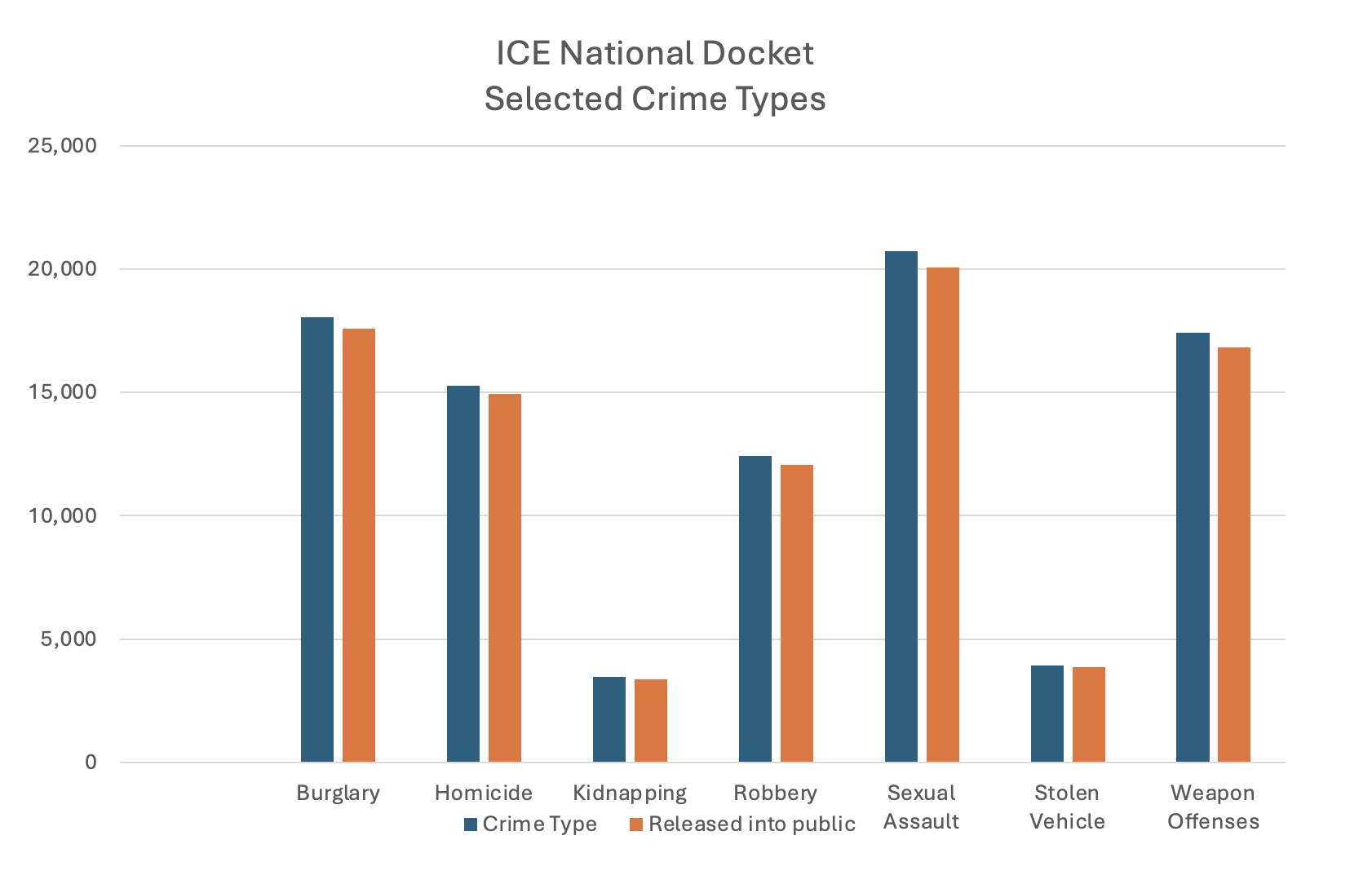
House Representative Tony Gonzales of Texas received a letter from the US Department of Homeland Security (DHS) US Immigration and Customs Enforcement division (ICE) detailing the number of noncitizens on ICE’s docket either convicted or with pending charges. According to the letter: “As of July 1, 2024, there were 662,566 noncitizens with criminal histories on ICE’s national docket. Of those, 435,719 are convicted criminals, and 226,847 have pending criminal charges.” Breaking these down by selected serious crimes, either convicted or with pending charges, with the number released into the general population cited, we find the following very troubling reality:
Of the seven million illegal immigrants being processed by ICE, 9.5 percent of them have significant criminal histories. The seven million number does not include got-aways. There are millions more immigrants who illegally entered the country thanks to the twice-impeached Alejandro Mayorkas’ open borders policy. Lack of information means that the criminal histories of the seven million is likely drastically unstated—and we know even less about the criminal histories of the millions of got-aways. Shockingly, between 96-98 percent of those who have been convicted or who have charges pending in the crime types cited above have been released into society, the vast majority of these convicted criminals.
The Biden-Harris administration’s immigration policy rightly raises serious concerns about public safety under Democrats (a concern reinforced by the staggering amount of crime in the cities Democrats control) and the integrity of the immigration system. Their actions undermine the rule of law, allowing individuals who pose a significant threat to communities to remain in the country rather than being deported or detained. The release of serious offenders exacerbates the problems surrounding border security and immigration enforcement, revealing that the current administration is prioritizing politics over the safety and well-being of American citizens. The character of these politics warrants serious examination. What are Democrats trying to accomplish?









 freedom and reason