Will Democrats Respect the Rule of Law or Attempt to Thwart the Popular Will?

Update (2:03 pm): Congress convened today to count the votes of the Electoral College and formally affirmed President-elect Donald Trump’s victory in the 2024 presidential election. Vice President Kamala Harris, who lost to Trump in November, presided over the joint session of Congress in her now ceremonial role as president of the Senate and announced the results of the vote (I discuss this change in the Vice-President’s January 6 duties in the essay). The ceremony, which is how we must describe it going forward, lasted less than 40 minutes, testifying to the now perfunctory nature of the proceeding. Unlike four years ago, when Democrats refused to ramp up security to protect the Capitol building, barriers and fencing were erected around the Capitol. These obstructions will remain in place until Trump’s inauguration later this month.

Before the certification, Vice-President Harris delivered brief remarks. As you might guess, she alluded to the event of four years earlier. “Today was obviously a very important day, and it was about what should be the norm and what the American people should be able to take for granted, which is that one of the most important pillars of our democracy is that there will be a peaceful transfer of power,” Harris said. “I do believe very strongly that America’s democracy is only as strong as our willingness to fight for, every single person, their willingness to fight for and respect the importance of our democracy. Otherwise, it is very fragile, and it will not be able to withstand moments of crisis.” The choice of the “fight” word is a curious one. Our democracy is not fragile, but we do need to fight for it.

* * *

Today is January 6. January 6 holds unique significance in the context of US presidential elections. It marks the date when a joint session of Congress convenes to formally certify the Electoral College results. This process is the final constitutional step in confirming the election of a President and Vice President, occurring after the states have counted their votes, resolved disputes, and sent their certified results to Congress. The event symbolizes the culmination of a central democratic process and the peaceful transfer of power in our republic. I will be closely watching the proceedings as I did four years ago, when an effort was mounted to return suspect certifications to the states for review.

On January 6, 2021, several Republican members of Congress challenged the certification of the 2020 presidential election results during the joint session of Congress. These challenges were led by a group of lawmakers, most notably Senators Josh Hawley of Missouri and Ted Cruz of Texas, along with several members of the House of Representatives, such as Mo Brooks of Alabama, Andy Biggs of Arizona, Paul Gosar of Arizona, Louis Gohmert of Texas, and Jim Jordan of Ohio, among others.

Their efforts were thwarted by a convenient riot involving several Trump supporters (most of whom are serving time in federal prison), encouraged by police officers firing tear gas and rubber bullets into the crowd, and quite possibility by several agent provocateurs. On the latter possibility, we have learned recently that there were numerous FBI informants present outside and inside the Capitol Building. Details to one side, when Congress resumed business, Congress members who had initially planned to object to the certification of the 2020 presidential election results withdrew or dropped their objections. The long-running coup d’etat against a sitting president and his America First agenda was successful and Joe Biden was installed as caretaker for the Establishment.

President-Elect Donald J. Trump

Four years later, suffering from persistent inflation and housing shortages, a disastrous foreign policy, and open borders and rampant crime, the People reaffirmed their commitment to the America First movement. On November 6, 2024, Donald J. Trump won re-election, garnering 312 electoral votes, as well as the popular vote (with Republicans regaining the Senate and keeping the House). However, both before and after the election, elected officials and activists signaled their intent to attempt to bar Trump from returning to office on January 20, 2025. The reason? Insurrection.

The law in question, written in the wake of the Civil War, and in the context of Reconstruction, is found in Section 3 of the Fourteenth Amendment, which states: “No person shall be a Senator or Representative in Congress, or elector of President and Vice-President, or hold any office, civil or military, under the United States, or under any State, who, having previously taken an oath, as a member of Congress, or as an officer of the United States, or as a member of any State legislature, or as an executive or judicial officer of any State, to support the Constitution of the United States, shall have engaged in insurrection or rebellion against the same, or given aid or comfort to the enemies thereof.”

In a press release on March 5, 2024, US Representatives Jamie Raskin (Maryland) and Debbie Wasserman Schultz (Florida) announced their intention to pass a law addressing the following: “The Supreme Court held that states cannot block insurrectionists from running for federal office unless Congress has acted first to identify and disqualify them under Section 5 of the Fourteenth Amendment. Although this ruling departs from the plain text and original purposes of the Fourteenth Amendment, the good news is that the Supreme Court never challenged the Colorado Supreme Court’s factual finding that Donald Trump had participated in the insurrection that took place on January 6, 2021.” More on the Colorado finding in a moment (for what it’s worth).

Raskin and Schultz concluded the press release with: “Because the Supreme Court has not provided any other way to settle the disqualification of an insurrectionist prior to the casting and counting of Electoral College votes, Congress must now develop a judicial mechanism for ascertaining such persons and Speaker Johnson must permit the House of Representatives to vote on it. If not, Section 3 of the Fourteenth Amendment could simply be rendered a dead letter or a dangerous flashpoint as applied to federal officeholders.” (To clarify, the reference to Section 5 in the press release is a reference to the self-executing function of the amendment.)

No such legislation has been passed by Congress. Indeed, in May 2022, Raskin and Schultz introduced HR 7906, which aimed to establish a civil action for disqualification under this section. The bill did not make it out of the Judiciary Committee. But what would be the point of such legislation given that the President was acquitted of insurrection at trial on February 13, 2021, nearly a month after he had peacefully transferred power to incoming president Joe Biden?

Let’s review the Constitution and recall the impeachment and trial of Donald Trump and see if there is anything there. The authority to bring and try such an indictment is found in Article II, Section 4, of the Constitution: “The President, Vice President and all civil Officers of the United States, shall be removed from Office on Impeachment for, and Conviction of, Treason, Bribery, or other high Crimes and Misdemeanors.”

The judicial process is found in Article I, Section 3 of the US Constitution. “The Senate shall have the sole Power to try all Impeachments. When sitting for that Purpose, they shall be on Oath or Affirmation. When the President of the United States is tried, the Chief Justice shall preside: And no Person shall be convicted without the Concurrence of two thirds of the Members present.” Section 3 continues: “Judgment in Cases of Impeachment shall not extend further than to removal from Office, and disqualification to hold and enjoy any Office of honor, Trust or Profit under the United States: but the Party convicted shall nevertheless be liable and subject to Indictment, Trial, Judgment and Punishment, according to Law.”

On January 13, 2021, just a week before the end of Trump’s term, the House of Representatives, led by Speaker Nancy Pelosi, voted to impeach the President. The charge was “incitement of insurrection.” The alleged crime occurred on January 6, 2021. On that day, as described above, there was a riot at the US Capitol that involved Trump supporters. The article of impeachment alleged that Trump had encouraged the riot, arbitrarily elevated to the level of insurrection, with his claims of election fraud and his speech at a rally earlier that day, where he used the common phrase “fight like hell” (a phrase of Democrats are quite fond).

The trial, occurring after Trump had already left office, raised constitutional questions about whether a former president could even be impeached and tried. The Senate nonetheless proceeded, arguing that accountability for high crimes and misdemeanors transcends a president’s term of office. Trump’s defense argued at trial that Trump’s speech was protected by the First Amendment and that the impeachment was politically motivated. That argument carried the day, the vote falling short of the two-thirds majority required for conviction. As a result, Trump was acquitted of the charge of insurrection. In principle, the prohibition of double jeopardy precludes retrying Trump on the charge of insurrection (see Fifth Amendment of the Bill of Rights).

Trump’s acquittal settles the question. Congress is the proper and only venue to bring such an indictment and try its merits. Article III, Section 2 of the Constitution states: “The Trial of all Crimes, except in Cases of Impeachment, shall be by Jury; and such Trial shall be held in the State where the said Crimes shall have been committed; but when not committed within any State, the Trial shall be at such Place or Places as the Congress may by Law have directed.”

Despite the finality the acquittal brought, during a five-day judicial hearing in Colorado, District Court for the City and County of Denver, presided over by Judge Sarah Wallace, concluded that President Trump had engaged in insurrection as defined in Section 3 of the Fourteenth Amendment. The court’s decision was subsequently reviewed and affirmed by the Colorado Supreme Court. When the case reached the US Supreme Court, the justices correctly ruled that states lack the authority to disqualify candidates for federal office, asserting that enforcement of Section 3 requires federal legislation. This negated several others states’ attempts to bar Trump from their ballots.

Then, despite the fact that Trump has been acquitted of insurrection, a House Select Committee to Investigate the January 6th Attack, active July 2021-December 2022, concluded Trump engaged in insurrection against the Constitution. Specifically, the committee determined that Trump unlawfully pressured Vice President Mike Pence to reject Electoral College votes for Joe Biden, a power the committee claims Pence did not possess. The principle of double jeopardy notwithstanding, the Special Counsel’s Office, upon the House Select Committee referral, brought a criminal case in Washington, DC charging Trump for his role in the event of January 6, 2021. However, upon Trump’s reelection, Special Counsel Jack Smith dropped the charge related to allegedly attempting to fraudulently overturn the 2020 presidential election (as well as the charge that Trump had unlawfully retained classified documents at his Mar-a-Lago estate).

It is important to note that the House Select Committee, in addition to its illegitimacy, faced criticism over its handling of evidence and witness selection. Evidence, including interview transcripts and internal communications, had been destroyed (or not preserved), raising concerns about transparency and accountability. Additionally, the committee was accused of selectively presenting evidence and calling witnesses, focusing on evidence and testimony that aligned with its narrative while excluding exculpatory evidence and witnesses offering a differing perspective. On the matter of the narrative, the House Select Committee enlisted the help of James Goldston, a former president of ABC News and an experienced television producer, to craft and present its narrative during public hearings. Goldston played a significant role in shaping the hearings into a compelling, story-driven format, utilizing video montages, graphics, and carefully curated witness testimonies to engage the public and convey the committee’s findings effectively. Put another way, the work of the House Select Committee was a show trial designed to manufacture the perception that President Trump has indeed orchestrated an insurrection—again, a charge of which he had already been acquitted.

The illegitimacy of the House Select Committee notwithstanding, it is important to note that the claim by the House Select Committee that Trump unlawfully pressured Vice President Mike Pence to reject Electoral College votes for Joe Biden hinges on an interpretation of the Vice President’s role during the certification of electoral votes. At the time, the Electoral Count Act of 1887 was in effect, which contained language about the Vice President’s authority during the process that could reasonably be interpreted to give the Vice President the power the committee claims he did not possess.

Ironically, Democrats affirmed this interpretation with subsequent legislative action. To prevent future disputes, the Electoral Count Reform Act was revised on December 29, 2022 changing the role of the Vice President in certifying Electoral College votes to a purely ministerial role, explicitly stating that the office does not have the power to reject or alter the results. The hearings and investigative work of the House Select Committee overlapped with the debates surrounding the need for reforms to the Electoral Count Act, which made office the game being played. However, since the US Constitution prohibits ex post facto laws in Article I, Sections 9 and 10, the revision has no authority in the case.

Credit where credit is due, the persistence of those who seek to bar Trump from taking office is impressive. In a column published in The Hill on December 26, 2024, Evan Davis and David Schulte (former editors of the editors in chief at the Columbia Law Review and the Yale Law Journal respectively) argue that Congress has the authority under the Fourteenth Amendment to object to electoral votes because Donald Trump is, in their words, “an oath-breaking insurrectionist.” They urge Congress to take action during the joint session to count electoral votes. The authors cite Trump’s second impeachment trial and the Colorado Supreme Court’s decision to disqualify Trump from appearing on the state ballot in 2024. Despite the aforementioned Supreme Court ruling in Trump’s favor, the authors argue that it did not challenge the finding that Trump engaged in insurrection. They maintained that Congress, not the Supreme Court, had the authority to reject electoral votes on constitutional grounds, as specified by the Electoral Count Act.

David and Schulte’s column rightly sparked intense backlash, with critics accusing them of attempting to undermine democracy. The authors’ stance represented an attack on the electoral process and the will of the people. Indeed, Trump supporters and others argued, Davis and Schulte’s op-ed is an attempt to overturn the 2024 election, itself tantamount to insurrection. But it’s not the only action attempting to thwart the will of the people. The House Select Committee’s referral to the Department of Justice that Trump be prosecuted under the criminal statute prohibiting insurrection also represents such an attempt. All this is lawfare, and the conspiracy to stop Trump from resuming his duties as Executive and even put him in prison, as well as during his first term in office, should be obvious to everybody with a working knowledge of our government and judicial process.

Here’s the brutal truth: No federal court has found Trump engaged in insurrection. He has not been found guilty under the Insurrection Act or any other federal law that would disqualify him from office under Section 3 of the Fourteenth Amendment. Derek Muller, a University of Notre Dame law professor, put it like this: “He’s not been prosecuted under the Insurrection Act, much less found guilty under the Insurrection Act, which would disqualify him. So there’s no existing statutory mechanisms enacted by Congress to determine his eligibility at this time.”

What Muller leaves out, as do Davis and Schulte, as well as the corporate state propagandists, is that Trump was tried for the crime of insurrection and acquitted at trial. In reality, the matter was settled on February 13, 2021. It is long since time to move on. Trump is the legitimate forty-seventh president of the United States of America.


So Easily Got: Suella Braverman and the Petty Brigade

Remember when Jonathan Pie used to be compelling? That fake reporter bit was pretty goddamned funny. That was then. This is now. The rise of populist-nationalism across Europe and the America has broken him.

Remember when John McCain’s running mate Sarah Palin told Charlie Gibson in an ABC interview that she could see Russia from her house? No, you don’t, because she didn’t say it.

Gibson asked Palin, “What insight into Russian actions, particularly in the last couple of weeks, does the proximity of the state give you?” Palin responded, “They’re our next door neighbors and you can actually see Russia from land here in Alaska, from an island in Alaska.” She explained, “I’m giving you that perspective of how small our world is and how important it is that we work with our allies to keep good relation with all of these countries, especially Russia. We will not repeat a Cold War. We must have good relationship with our allies, pressuring, also, helping us to remind Russia that it’s in their benefit, also, a mutually beneficial relationship for us all to be getting along.”

Sarah Palin sits down with Charlie Gibson of ABC for an interview in September 2008

Can one see Russia from Alaska? Yes, in fact one can. On a clear day, from Little Diomede Island in Alaska to Big Diomede Island in Russia, which are about 2.5 miles apart at their closest point, one can see Russia from Alaska across the Bering Strait. So why do so many people remember Palin telling Gibson that she could see Russia from her house? It’s what we know in social science as mass formation hypnosis. We use this term in psychology and sociology to explain how individuals predisposed to do so by their identification with a particular group and set of concerns lose their sense of charity and critical thinking upon subjection to certain stimulus. In the case of Palin, installing a false memory also has a purpose.

Recall the context in which Palin was discussing Russia. Palin was John McCain’s pick for Vice-President in his contest with Democrat candidates Barack Obama and Joe Biden. Obama and Biden were the corporate state picks. The corporate state needed Obama and Biden to put a progressive gloss on the neoliberal and neoconservative agendas. (It’s why they relentlessly mocked Al Gore to secure the election of George Bush and Dick Cheney.) Just days before she sat down with Gibson, Palin had lit up the Republican National Convention, breathing life into McCain’s candidacy. Mark Halperin, writing for Time, gave her performance a glowing review:

“Mother, fighter, small town girl, patriot, reformer, energy expert, hockey mom, McCain attack dog, America’s political sweetheart—she did everything she had to do, and more. The Alaska Governor was poised, stirring, charming, confident, snarky, cozy, well-rehearsed, biting, utterly fearless, unflappable, and self-assured. She read the teleprompter like a champ, with fine, varied pacing and conversational projection. Touched on her family story and then veered into a forceful political presentation, going hard after Barack Obama and selling John McCain with flowing admiration. She rocked the hall (and likely the country) with a tough, conservative message, steely offense, glowing optimism, and boundless charisma. The start of something truly big—or the best night of her candidacy.”

The culture industry and mass media apparatus swung into action, determined to make sure that it would effectively be the only good night of her candidacy by mocking her relentlessly. They struck pay dirt when, on NBC’s Saturday Night Live, Tina Fey, whose Palin impression was exceptional, saying in character, “I can see Russia from my house.” The line was put into the loop machine and now most American have in their heads a false memory. Not just those for whom a partisan political worldview had prepared them. Fey’s line was so ubiquitous and unchallenged that even Republicans came to believe she had said it.

Remember when the machine looped Mitt Romney’s “binders full of women”? Unlike the Palin Russia meme, Romney did say this, but the opportunity was the same. What did Romney mean? He said this in 2012 during the second debate with Obama, who was running for reelection. Romney, governor of Massachusetts at the time, was responding to a question about pay equity, referring to ring binders with résumés of female job applicants he was reviewing. How could that be turned into a meme and used to endlessly mock Romney? That it was testifies to the power of the propaganda machine in producing mass formation hypnosis. It also testifies to the gullibility and pettiness of a large swatch of the population. (I don’t have to say anything here about what the crowd does with Donald Trump’s speech except to merely make this note.)

Greece’s 25-mile wall along its border with Turkey

The United States is not unique for having a mass of gullible and petty people. The UK mass recently raised its visibility by mocking conservative Suella Braverman for her appearance on LBC talking about the wall Greece erected between that country and Turkey. Greece erected the 25-mile long wall because the government recognized their country proximity to the Islamic world meant that they were the gateway to Europe for migrants. Braverman explained that she had seen the wall when she visited Greece, which of course she had. Only she didn’t say Greece but instead “Italy.”

Recently, on Facebook, I was trying to explain religious liberty to people who were determined to push the straw man that religion had been banned from public schools in order to push for taxing the church. As I always do, I referenced James Madison as the man to consult in such matters. As the conversation unfolded, I used Hamilton’s name in place of Madison at one point. Obviously I meant Madison. But those who were pushing the argument saw it as an opportunity to execute the ad hominem ridicule. As if I don’t know the difference between the two men. Why would Hamilton’s name pop up? I don’t know, could it be because they were both Founding Fathers? Could it be that both of them worked on the Federalist Papers? Could it be that I had just been in another conversation where Washington’s first cabinet was the subject of discussion?

Anybody with any working knowledge of maps and a decent sense of charity knew Braverman didn’t mean Italy. Italy doesn’t share a border with Turkey. All the maps with circles showing that they don’t tell us that there are lot of petty people in England who jump at the opportunity to mock their political opponents over the most trivial thing. It’s not that mocking and ridiculing are necessarily wrong. But when one mocks and ridicules, it needs to be over something substantial, not wrongly naming a country in front of a microphone—especially when Italy and Greece (like Madison and Hamilton) are commonly thought of together given what both bequeathed to the West.

Whatever people think about Braverman’s politics, that she is an intelligent and knowledgeable person is not in question. So the avalanche of memes mocking her by suggesting she can’t read maps is disingenuous. It has a purpose. The purpose? The same purpose we saw with Palin and Romney (and Trump): to delegitimize a politician whose politics they wish to delegitimize. It’s the standard stuff of ad hominem: create a fake controversy and ridicule the person over it to poison listeners to the arguments that person makes.

What is in particular bothering people about Braverman? This is why I am spending any time at all on this. It directly relates to the substance of her comments about the wall between Greece and Turkey: the migrant crisis. Braverman speaks for the people when she praises the wall, condemns grooming gangs, and criticizes Labour—and even the Tories—for failing to turn back small boats of migrants crossing the English Channel. Home Office figures released on New Year’s Day show 36,816 people crossed the English Channel in small boats throughout 2024. “And what it is about these ‘small boats’?” That’s what it’s about. Migrants are turning the United Kingdom into a shit-hole. “But Muslims are only a small percentage of the UK population!” As if the major cities of that nation aren’t jammed up with Muslims praying the streets and on church grounds and rallying for Hamas. They are party of the Islamization project.

Here’s the tweet where Braverman clarifies that she meant Greece’s land border with Turkey. That she even had to clarify this tells us a lot about the character of those who persist in pretending that she actually meant that there was a land border between Italy and Turkey. The open borders crowd wish to make her an embarrassment to advance their agenda. In fact, they are, and this must be pointed out.

In responding to Pie’s tweet, I quipped that “Italy is doing a smart thing there.” With predictable results I substituted Italy for Greece on purpose to prove that the dog-pilers were uncharitable. That’s Pie’s tweet that begins this essay. You can see for yourself that particular dogpile. The notifications are so numerous I may need to mute the thread. If the so easily triggered can’t feel embarrassment, then I can feel it for them.

God Was Never Removed From the Public Square

You’ve seen the meme:

It’s an old argument, one I have heard all my life—and used to make myself long ago. It long ago became cliche. Then I studied the intent of the founders, in particular James Madison who wrote the First Amendment, and came to see the argument as deeply flawed. In this short essay, I explain why the cliche is wrong.

The First Amendment states: “Congress shall make no law respecting an establishment of religion, or prohibiting the free exercise thereof; or abridging the freedom of speech, or of the press; or the right of the people peaceably to assemble, and to petition the Government for a redress of grievances.” The First Amendment has been incorporated, meaning that the protections guaranteed by it have been applied to the states through the Fourteenth Amendment’s Due Process Clause, which states that no state shall “deprive any person of life, liberty, or property, without due process of law.”

Incorporation ensures that state and local governments, not just the federal government, must uphold constitutional rights. In practice, this means that no government body—federal, state and local, public schools, public libraries—can take a position on an establishment of religion. Government institutions are ideologically neutral. At least they’re supposed to be. This is because they belong to the citizenry in all its diversity—religious, etc. The government is not allowed to advocate for a particular religious or ideological viewpoint.

To grasp the importance of this one must understand the distinction between government and individuals. Every individual is entitled to freedom of conscience, speech, publishing, assembly, and association. A citizen does not lose his rights because he is religiously affiliated. A preacher is perfectly free to advocate for a particular political point of view from the pulpit. This does not violate the Separation Clause. What is not allowed is for a tax-exempt organization to fuse its organization with a political campaign. Nor is it allowed to lobby to influence legislation. The congregant remains free to participate in a political campaign or lobby legislators. 

School administrators, couches, counselors, paras, staff, and teachers are not permitted to indoctrinate children in whatever ideology to which they subscribe because that would violate the religious liberty of students. But every one of them is allowed to express his beliefs, including religious observances. Students, too, are allowed to express their religious and ideological views. The only restraint on the exercise of religion is time and place, which should be self-evident.

Would it be proper to tell the Muslim teacher that she can’t wear the hijab while teaching? To tell a Christian teacher that she can’t wear her cross? To tell a Jewish student that he can’t wear his Star of David? If the principal of the school doesn’t hang crosses on the school walls or compel the students to pray to Jesus, the Constitution has not been violated if a parent sees hijabs and crosses in their children’s school.

In the high school my kids attended, Muslims pray to Mecca in the building. The school accommodates them by giving them a hall in which to pray. The Somali girls wear the hijab. The Muslim students observe dietary rules. Etcetera. Religious liberty means they have a right to do that. What Muslims do not have the right to is to expect that the high school will require the kafir to adhere to Islamic pray, garb, or dietary rules. 

The same is true with gender ideology. A male teacher is free to identify as a female. The school is not permitted to compel students to use the wrong pronouns or festoon their classrooms with trans propaganda. The same is true with neoconfederacy. A man is free to believe this thing. He is not free to require his students to rehearse neoconfederate slogans or hang confederate flags on the walls of his classroom (not as a permanent fixture or as an act of affirmation). Scientologists aren’t allowed to audit the students or make them read Dianetics. Yet Scientologists are in the world practicing their religion. 

Religion was never removed from the public square. Because public spaces are for the public, and since the public is religious or not, the public has expressed its various religious and ideological views—or declined to participate in religion—all along. Nobody removed God from the classroom. Those who believe in God go to school. God goes with them. The meme’s premise is a canard. 

The reason why church and state are kept separate—and how they are kept separate matters—is as much to keep the state out of religious belief and practices as it is to prevent the state from respecting the establishment of religion. If the churches paid taxes, then they would demand respect, and the churches with the most influence would wield the government to secure their ends over against the citizenry—and that would violates the Constitution. 

The idea that tax-exempt organizations are disallowed from political advocacy is to not understand the tax-exempt principle even a little bit. The NAACP is tax-exempt. The organization is engaged in racial politics. The ACLU is political. Tax-exempt. Planned Parenthood is political. The HRC is political. So are the United Farm Workers of America, the American Federation of Teachers, the Chambers of Commerce. All tax-exempt. 

The Credentialed Class and the Betrayal of America

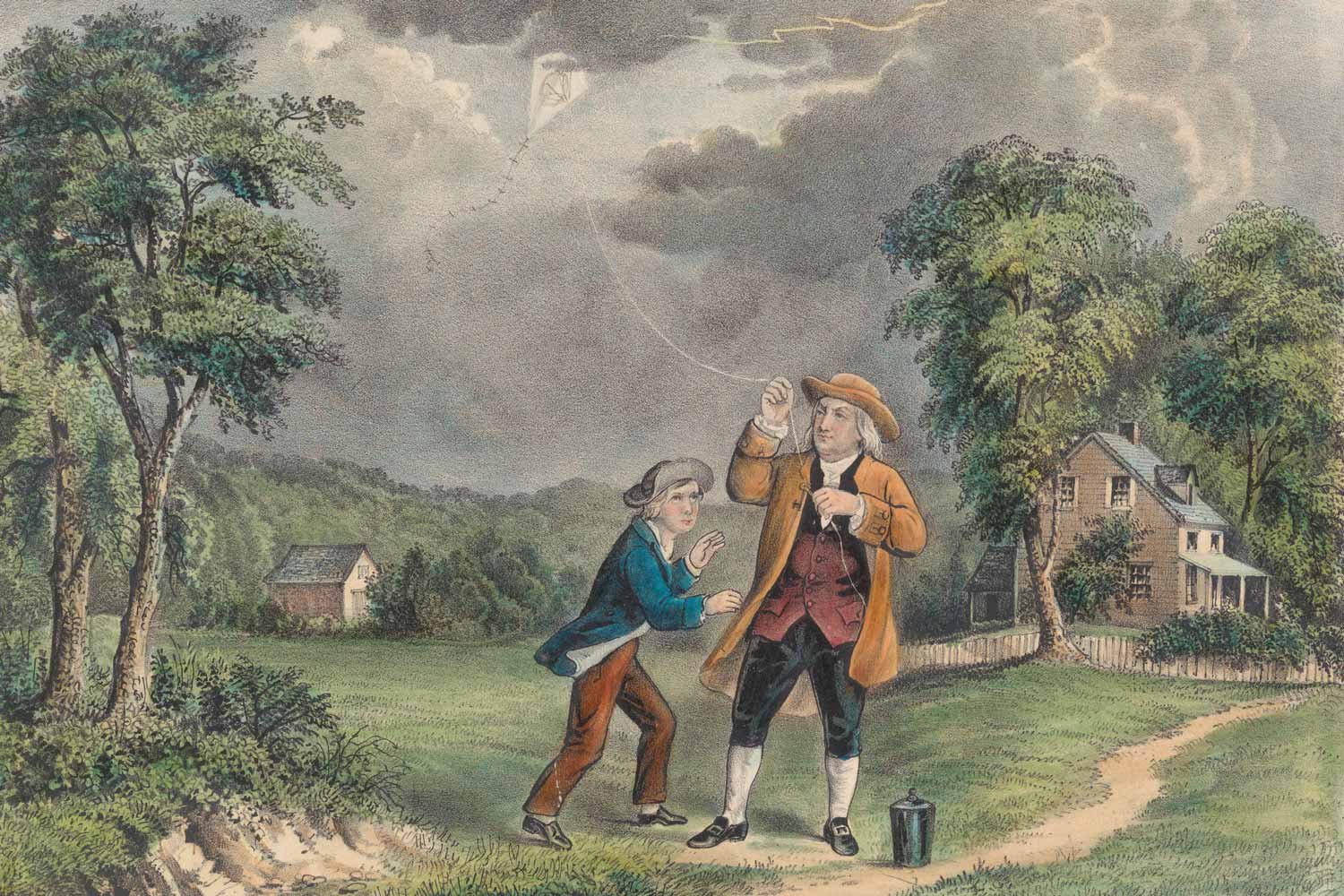
“Well, Doctor, what have we got—a republic or a monarchy?” was the question posed to Benjamin Franklin by a woman outside the Constitutional Convention in 1787. “A republic, if you can keep it,” he replied.

The New Year observance is a moment not only to look forward to the promise of a new stanza in our lives, personal and collective, but to reflect upon the past year, and those prior to it, to understand how we got to where we are and what we must do to ensure that we no longer repeat the errors of the past. That’s why we resolve to change the things about ourselves we don’t like and that make our lives less than what they could and should be. In this essay, the last of 2024, I want to be frank in accessing the present situation with respect to immigration so that we can wake up tomorrow from tonight’s celebrations with a sober outlook going forward.

Currier and Ives, “Franklin’s Experiment June 1752.” Metropolitan Museum of Art.

Mass immigration is class warfare, waged against low-skilled workers in labor-intensive industries, disproportionally black and brown, as we can see by the millions that have crossed—and are still crossing (with concierge service)—our southern US border, as well as the importation of tech workers in capital-intensive sectors, seen, for example, in the H-1B visa and related program. The purpose of these policies is to drive down wages and undermine class solidarity by replacing native-born and naturalized citizens with low-wage foreign labor seeking to live off of the riches generations of American citizens have built and sacrificed for. (There’s more to it, as I explain in my essay The H-1B visa Controversy: The Tech Bros Make Their Move, but undermining the American worker is the bottom line.)

The rationalization of the globalism dynamic by the credentialed class testifies to the role that strata performs in legitimizing the corporate state system; for if the bureaucrats, managers, and professionals who pull the levers of the administrative apparatus—those who devise the ridiculous rules wielded to tell the citizen what to do all day long, how he’s supposed to talk about his situation, what his life and his family’s lives are worth, and that at the same promote a select few into affluence and positions of command—represented the citizens of this nation and not corporate power, then they would have been in rebellion over immigration policy over the last four years. Be not like kings and prophets. See what you see. Hear what you hear.

Sure, some of the subaltern are scared to speak up, and I appreciate that they reach out to me privately to tell me that (while apologizing for their timidity), but most of the apparent equanimity is only superficially passive; the subaltern confess their sympathies by voting for the party that has organized the devastation of the proletariat, namely the Democratic Party and its fellow neoliberals and neoconservatives in the managed opposition, i.e., the establishment Republicans (even if they don’t vote for the latter, they rehabilitate their legacies and welcome them to the club—just ask Dick and Liz Cheney).

DHS Secretary Mayorkas listens as Pres. Biden speaks before signing an executive order on immigration, Tuesday, Feb. 2, 2021.

We can know the people who sell out the American citizen by the way they defend Biden, Mayorkas, and the rest of the traitors who betray the American Republic. We can see it in their silence about the mass media coverups and the brazen trashing of the deplorables. We know who they are by the way they tell the working people that they’re racist for voting for the nationalist and the patriot while pushing solidarity-destroying programs like affirmative action and DEI. Feeling safe and secure in their power, ensconced in offices of the technocratic behemoth, they openly smear those who defend the cultural and national integrity of the United States as “nativists.”

But what is the nativist, really? It’s the man who defends the cultural and national integrity of the country to which he has sworn his allegiance. This is his home. What is citizenship for, after all, if not to benefit the native in a republican situation—a situation the US Constitution requires of every state? The purpose of the rule of law in a free society is to advance the interests of the citizen, not to be used against them for the sole benefit of the aristocracy and their sycophants. That’s why it’s called a republic, if it genuinely is one. Yes, some of us mean to keep it, Doctor Franklin.

Support for open borders and mass immigration testifies to something else, as well. It testifies to the role of public employee unions in the academy and government in rationalizing the corporate state system—the same system that devastated private sector unions. I wrote about this in October of this year in my essay Co-optation and Negation: Understanding Corporate Hegemonic Strategy. You will find there a revealing chart concerning the shift in union participation from private to public sectors. See also Progressivism Hasn’t Been Betrayed—It’s Been Installed, an essay I penned in April 2022, lost in the stack of drafts, recently found and published a few weeks ago. That essay is the basis for many essays I have written since (and even before) concerning the role progressives play in weakening the democratic-republican foundation of our nation.

This is the type of content you will find on Freedom and Reason, which is enjoying its best year to date, with more than 7,000 visitors and 13.5 thousand reads. These are modest numbers, but the platform punches above its weight. Thank you for your attention. Happy New Year!

* * *

Update! Debrina Kawam is the name of the woman Sebastian Zapeta, a 33-year-old Guatemalan citizen who entered the US illegally, set on fire F train at the Coney Island-Stillwell Avenue station in Brooklyn on the morning of December 22. She was 57-years-old.

Deb Kawam

Zapeta was removed from the US back to Guatemala in June 2018—during Trump’s first term—after US Border Patrol encountered him in Arizona. We are uncertain of when he reentered. If it was under Biden, then we know how easy it must have been for this monster to reenter the country. If he returned under Trump, remember how the Democrats fought Trump every step of the way in his efforts to secure the Southern border. In the end, Kawam’s demise is on the open borders crowd.

People like to tell us that legal residents in the United States have a higher aggregate crime rate than immigrants. Illegal or legal immigrant? How would they know this? Supposing it’s true, consider the staggering levels of crime in America’s Blue Cities perpetrated by citizens; there is no Western country with comparable rates of crime. But the comparison is irrelevant, since if Zapeta were not here, Kawam would still be alive and living out her golden years.

It’s hard to exaggerate the depth of evil exuded by Biden and Mayorkas (see Trump is Right: Biden-Harris are Allowing in Serious and Violent Offenders). But there are other evil actors to be identified in this event. I watched the uncensored video of the burning woman. She stood and walked to the open train door, fat dripping from her body engulfed in flames. She lived for what must have seemed an eternity to her, while Zapeta fanned the flames with his jacket. Others were there. Nobody did anything.

The Daniel Penny prosecution made the responsibility diffusion problem worse. There was a cop there. He told Zapeta to clear out of the area. New York is fucked. If Democrats had their way, we’d all live in the fucked version of that once great city. They’ve had their way for far too long. Remember that two years from now when congressional elections come back around.

Ethnicity, Nation, and Race

For rational discourse to be a pragmatic thing, that is, a thing that moves matters forward with common purpose, a speech situation depends on shared meaning of the words in use. I have written about this a great deal recently on Freedom and Reason with regards to the words “gender” and “sex,” pointing out that the word “gender” has only recently come to exclusively mean behaviors, expectations, identities, roles, and typifications (stereotypes) that societies attribute to individuals based on (other or self) perceptions of femininity and masculinity. In earlier essays on this platform, I have written about the words “ethnicity,” “nation,” and “race,” and the way these words are manipulated for ideological purposes. Considering the recent controversy over immigration, I want to return to these words and clarify them once more to help bring the discourse back to a rational foundation. 

But before getting to that, it may be useful to summarize my point about the gender-sex distinction, as I intend to make a point later on that references it. The exclusive notion of gender holds that it is a cultural and social construct that varies across time and space, encompassing identities beyond the binary of female and male; this repurposing of the word is found among intellectuals concentrated in academic institutions, as well as the DEI departments of corporations and governments that find that distinction strategic, and a type of activist seeking to disrupt ordinary understandings of gender to normalize paraphilias. In this minority view, sex, in contrast to gender, is strictly a biological classification based on physical attributes such as chromosomes, gametes, hormones, and reproductive anatomy, typically classified as female and male, or (rarely) intersex. However, even here we find proponents of gender as a social construct disconnected from sex, arguing that sex is also a social construct—and that the science that reifies it is ideological system organized by oppressive power. (Postmodernism has successfully colonized our sense-making institutions, which explains why these institutions no longer make sense.)

A common objection I have encountered in socializing this point is that “words change,” an obvious and trivial observation. It’s similar to the command that “one shalt not kill.” Killing describes an action or an event. The actual command is that one shalt not murder. This is because one is interested in why someone kills. What was the reason? The relevant questions are seek to determine justification and motive. Words indeed change; the pertinent question is why they change. More to the point: who is changing them and what do they gain by changing them. It ought to be obvious that those who can change the meaning of works have the power to do so. Thus determining who is changing the meaning of words tells us a lot about who possesses power. How they are changing the meaning of words tells us a lot about what they are up to. Resisting the meanings they give to words is a crucial part of keeping discourse rooted in the universal and not in narrow group interests where words have self-serving value.

The artificial distinction between “gender” and “sex” was manufactured in the mid-twentieth century, particularly in anthropological, psychological, and sociological scholarship, which highlighted how gender roles are learned and socially enforced. Obviously gender roles are culturally and historically variable. However, as I have shown, gender and sex are synonyms and the terms “gender roles” and “sex roles” are interchangeable. One can thus make the observation that sex roles are culturally and historically variable—and that one possesses a “sex identity.” To put this another way, there is no gender role outside of the physical anthropological reality of gender, which is based on chromosomes, gametes, hormones, and reproductive anatomy, with gametes being the basic differentiation, binary and immutable. To say that the same is true of sex is to say that the words are synonyms. Therefore, the distinction between the words is in point of fact ideological.

Cole Thomas, The Course of Empire Destruction (1836)

Today, many authoritative voices tells us that race as a social construct used to categorize and divide people based on physical characteristics, such as facial features, hair texture, and skin color. According to this account, racial distinctions mostly rely on perceived biological differences, or phenotype, though its advocates will tell you—anthropologists, (some) psychologists, and sociologists primarily—that race has no significant genetic basis and is instead a product of social consciousness and historical contexts. So is race to postmodernist eyes analogous to gender? It’s assigned at birth. No, it is not analogous to gender, for while I am whatever gender I say I am (and I can change that whenever I want), I am not entitled to the race of another. Never mind that there is no reason behind the double standard.

Crucially, the concept of race emerged in the seventeenth century with the Enlightenment and the rise of modern science. It comes from the Italian word razza meaning “kind,” “breed,” or “lineage. Given that the physical characteristics identified above, which comprise phenotypes, exists independent of consciousness, and, moreover, are grouped (which can be demonstrated empirically with factor analysis), the notion that these are social constructs in the typical meaning of that concept—an idea or practice created and maintained by society, rather than being inherently natural or biologically determined—is fallacious.

Like gender, race does not exist because people collectively agree to give it meaning and significance thus shaping how individuals interact and perceive the world; race exists because it is a biological reality. Offspring look like their parents and, given geographical distribution, groups have emerged from the process of natural selection with significant differences between groups, to be sure distributions that do not negate the significant variability of attributes within groups, but that also do not negate the reality of phenotype. We may therefore describe race as geographically differentiated ancestry, what some anthropologists would like to define as “clines” to convey the gradual variation in certain biological or genetic traits across geographic regions or populations.

Ethnicity, in distinction to race, refers to shared cultural practices, language, traditions, and values associated with a group of people. The word comes from the Greek word ethnos, which means “people” or “nation.” Unlike race, ethnicity emphasizes cultural identity rather than physical characteristics. Cultural identity is sometimes associated with religious identity. In ancient and medieval periods in Europe, the Middle East, and North Africa, ethnicity often centered on Christian, Jewish, and Muslim. During the formation of nation-states, ethnicities became more organized around national identity, such as English, French, German, Irish, Swedish, etc. Ethnicity does sometimes include a racial component, since shared cultural practices are associated with common ancestry and therefore ethnic differences intersect with racial differences. however, the one is irreducible to the other. 

Unlike the distinction between gender and sex, the distinction between ethnicity and race is not manufactured, but real. Culture is not an expression of genetics, but a sociohistorical development. In fact, culture can drive natural history, as human beings just in the normal course of living collectively change their physical environments. In the case of ethnicity and race, it is the conflation of the terms that has in back of it an ideological motive. We see this in the accusation of racism when one criticizes culture, for example in the furor over Donald Trump and JD Vance drawing attention to the problem of Haitian migrants in Springfield, Ohio (see A Case of Superexploitation: Racism and the Split Labor Market in Springfield, Ohio).

Down through history, different ethnic groups have sometimes assimilated with other nations producing greater cultural homogeneity in the context of empires and nation-states. The paradigm of assimilation in the modern period is the United States. However, since the twentieth century, with the emergence of cultural pluralism, or multiculturalism, advanced by cosmopolitan elites in the service of corporate power, diverse ethnic groups are encouraged to keep their cultural particularities intact, while assimilation has become characterized as a racist desire—even though ethnicity and race refer to different things.

A nation is a large group of people united by shared cultural, historical, linguistic, or political ties, often inhabiting a specific territory. It can also refer to a political entity—a sovereign state or a country. In the first sense, nation and ethnicity are synonyms, in that both ethnicity and nation refer to a people. Early nations, like Egypt or Mesopotamia, were bound by centralized governance, geography, and language. In the ancient period, such as the Roman Empire, and then during the Middle Ages, a period of decentralized governance, the concept of a “nation” came to be used to refer to groups sharing cultural, linguistic, and religious ties. The modern idea of a nation was shaped by Enlightenment, as well as Romantic notions emphasizing shared identity and self-determination.

The concept of the nation-state—political entities defined by shared nationality—emerged from the latter notions, especially in Europe, with these notions organizing the world with the expansion of the capitalist world-system. The period of decolonization following the fall of Western empires (also a result of the expansion of the capitalist world-system) redefined nations, as many newly independent states created cohesive national identities among diverse populations.

The system of nations are today fraught, as the struggle between national sovereignty and the transnationalization of capitalist production with the rise of corporate governance have generated an ongoing debate about nationalism versus cosmopolitanism, with the latter advocating multiculturalism and smearing the former as “nativists” and “racists.”

What the cosmopolitan type desires has an historical analog. During the Middle Ages, economic systems operated through decentralized networks, distinct from the centralized model of nation-states where capital flows were constrained by the rule of law in some fashion answerable to the people. Bourges, a city in central France, served as a significant medieval hub for trade and culture, exemplifying the autonomy of city-states. Bourges, alongside Genoa, Hanseatic League, and Venice, thrived by participating in trade networks that bypassed larger feudal structures. We can thus draw a parallel between these historical examples and modern global economic systems, where digital platforms, financial institutions, and multinational corporations operate through decentralized networks, challenging the authority and structure of nation-states.

Understanding the meaning of these words is crucial to avoid misspecifying the dynamic that is presently undermining the modern nation-state, which has historically been based on shared culture, language, etc.

In light of this, we can conceptualize the modern nation-state to be of three sorts. The first, the ethno-state, where citizenship is based on ethnicity. Here we often find this status based on the principle jus sanguinis, a Latin term that means “right of blood,” i.e., establishing citizenship on the basis of that of the parents. A Swede, for example, is a citizen of Sweden because she was born to Swedes, who comprise an ethnic group. Thus this practice is also known as the principle of descent.

The second sort of nation-state is one based on civic nationalism, often found exercising the principle of jus soli, a Latin phrase meaning “right of the soil,” referring to the principle that a person’s citizenship is determined by their place of birth, commonly known as “birthright citizenship.” In this way of reckoning citizenship, one’s political identity is built not around culture or ethnicity as much, but more on a national creed and type of government citizens pledge to uphold. Historically, this has been the practice in the United States, justified by an interpretation of the Fourteenth Amendment (the same article used to rationalize corporate personhood).

The third type of nation, which is the one sought by the cosmopolitan type, is really a simulation, which is to say that it is no nation at all, but an artificial construct designed to serve the interests of global elites who define and redefine national boundaries as it suits them. This notion of nation is associated with multiculturalism, an ideology manufactured by organic intellectuals to justify the effective erasure of national identity, becoming the prevailing sensibility in sense-making and governing institutions. While ethnonationalism and civil nationalism are not mutually exclusive, the latter compatible with jus sanguinis (which ought to be the principle by which all citizenship is determined), the transnationalist concept is antithetical to nationalism, which ought to be obvious by the structure of the word itself; just as the praxis of transgenderism means to erase the gender boundaries, transnationalism means to erase national boundaries.

Transnationalists desire a world seen only in terms of economic relations, thus negating the concept of the nation as homeland. By effectively erasing borders, it seeks to uproot people from their culture and make them not servants of themselves but instruments for producing wealth and privilege for those who control the means of production. Without borders, the rule of law is determined by technocrats whose only allegiance is to transnational corporate power, not citizens. This is the desire for a high-tech feudal estate system. Thus the accusation of “nativism” is a derogatory term invented by multiculturalists to smear native Americans who advocate for national sovereignty and collective self-determination, all of which depend of cultural integrity, i.e., ethnicity or the nation.

Cole Thomas, The Course of Empire Desolation (1836)

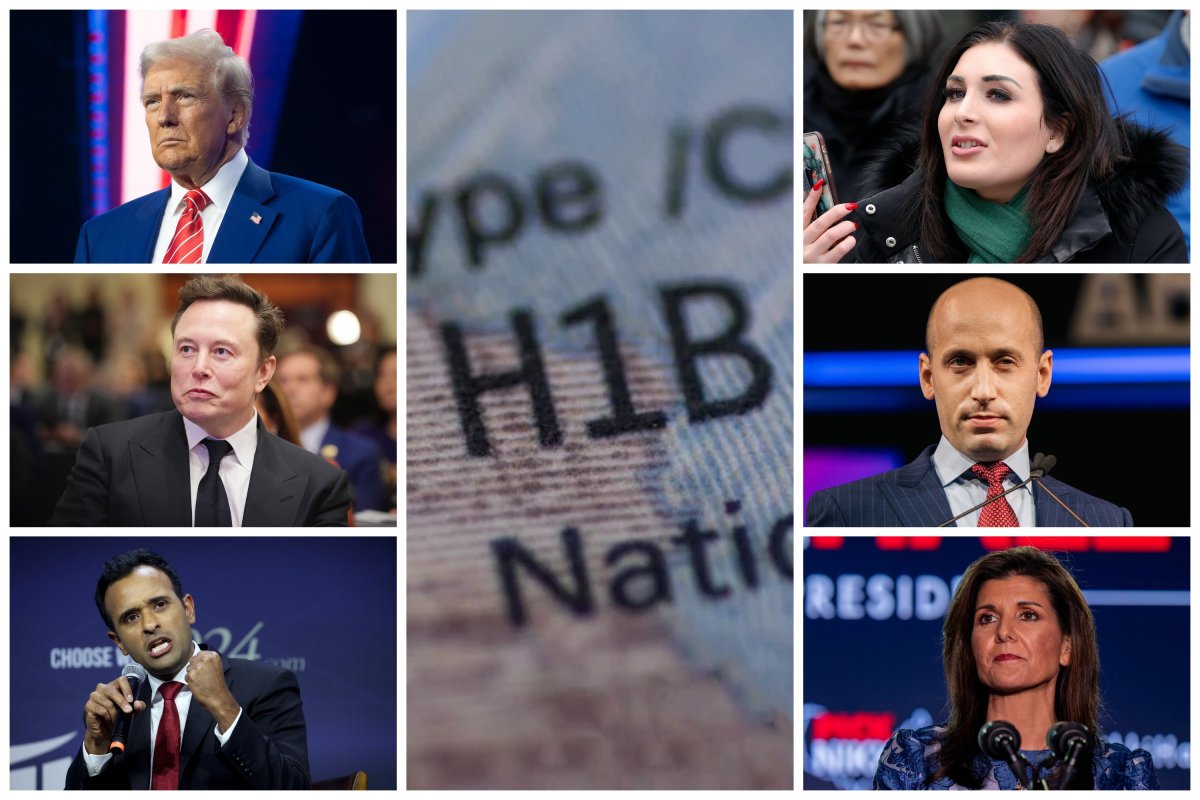
We thus hear in advocacy for the H-1B visa program, which enjoys the support of Elon Musk, Vivek Ramaswamy, and Donald Trump, transnationalist sympathies that are at odds with the populist-nationalism expressed by these three and many others during the 2024 campaign. They argue that we need this (and other) programs so corporations have access to talent around the world. This is not what is really sought by Musk and other capitalists; what is sought is cheap labor for the reasons explained in my previous essay, The H-1B visa Controversy: The Tech Bros Make Their Move.

But even if there were true, it would reflect imperialist desire rather than nationalism. As history has made clear, the emergence of empire is a sign of civilizational decay amid cultural disintegration. America as a civilization cannot survive the disintegration of its culture caused by the present pace of immigration. People are culture-bearers, and whatever economic contribution new arrivals might make, the cultures many of them bear are antithetical to ours, and without any determined plan to assimilate those who are amenable to it, the American Creed cannot survive the practice. We are great because of our creed. Our creed is the spirit of our republic. We cannot keep our republic if we lose it.

The H-1B visa Controversy: The Tech Bros Make Their Move

There’s been a lot of commotion in the social media sphere about the H-1B visa program over the last several days. On X, Elon Musk tweeted about the lack of native-born engineers and the need for engineers in the tech world, amplifying the H-1B visa controversy President-Elect Trump’s pick of Sriram Krishnan for senior advisor on artificial intelligence triggered; and while Musk desired to promote the practice, or at least defend it, the unintended consequence of his tweets was to raise awareness of, and thus opposition to the practice. Musk’s DoGE partner Vivek Ramaswamy worsened things by blaming American culture for the lack of native-born engineers. The United States prizes the jock over the nerd, Ramaswamy tweeted. Musk has since accused opponents of the H-1B visa program—the heart of the America First movement—of racism.

Progressives and the corporate state they shill for, all in on open borders, devoted to the cause of transnationalism and the high-tech serfdom that comes with it, love the schism this has produced between tech bros and MAGA, wondering aloud how the historically pro-business Republicans could oppose immigration when there is such a need for skilled immigrants. What they mean to accomplish is obvious enough: to set the central issue of the 2024 campaign on its head. Musk’s smearing of MAGA as racists, and his move to restrict the speech of some of the most prominent populists on X, couldn’t be more out of the corporate state playbook.

Source: Newsweek

To some degree, the controversy rests on a false dilemma, one that’s meant to make Republicans look like hypocrites, in addition to driving a wedge between Trump and his allies (Musk and Ramaswamy’s DoGE project is another obvious target). However, many rank-and-file Republicans aren’t against immigration per se. They’re for selective immigration and in opposition to illegal immigration.

To be sure, the H-1B visa program is a special problem. I disagree with Trump on this issue. My view is that international students can get an education here, then go back to their country and improve it for their fellow citizens. No automatic green card. No chain migration. Moreover, Moreover, community colleges should be exclusively for citizens of the United States; the point of the community college system is to provide an opportunity for working class Americans to develop skills to scale the socioeconomic ladder. For comparison, watch Trump explain his position:

How we go about legal immigration is the debate to be had. We should repeal the Hart-Celler Act of 1965. This is because what is really at the heart of the concern over immigration is national sovereignty and cultural integrity, since we cannot keep the first if we undermine the second. We should reform the H-1B visa program to exclude the automatic rewarding of a green card, as well as end the practice of chain migration. And we should invest billions in expanding our community college and technical school system and recruiting low-income students to them.

Many of those who hear my arguments concerning immigration probably suppose the same thing about me that they about MAGA Republicans—that I am anti-immigrant. But in my writings on this, I have always stressed that I do not categorically oppose immigration. My wife is an immigrant and a naturalized citizen (for more than twenty years now). I not only know and work with immigrants, but have hired and retained them.

The reason I rededicated myself to this platform, Freedom and Reason, in the summer of 2018 was having witnessed the migrant crisis firsthand during my research trip to Scandinavia. There I saw a stark difference between older arrivals to Sweden, for example Persians who escaped the tyranny of clerical fascism, and new arrivals from the Middle East and North Africa. One group has elevated Sweden. The other is turning it into a shit-hole. Culture matters.

My criticism of the prevailing immigration policy is primarily about the tolerance, even encouragement by Democrats and establishment Republicans, for large-scaled immigration from the Third World. This is especially true of low-skilled labor. The livelihoods of the most vulnerable among native Americans are undermined by cheap foreign labor (more on this in a moment). As for the need for high-skilled labor, we need to do a better job in our educational system of steering native-born talent into technical programs where they can learn the necessary skills. At the same time, because the tech sector is always expanding (exponentially so), there will likely always be a need for some foreign talent—but not the H-1B visa program as it currently exists.

But the tech industry wants foreign workers not merely because they can’t find the talent here. That argument has always been something of a ruse. It’s not only the best and the brightest being invited to learn, train, and/or work in America. The capitalist-intensive sector wants cheap high-skilled labor just as much as the labor-intensive sector wants cheap low-skilled workers—and these sectors are not mutually exclusive.

The business elite desire a system of modern indentured servitude, where foreign workers so desperate to escape the inferior conditions of their home country that they will settle for far less than the market can pay, thus driving up corporate profits. The bonus is the green card and the path to citizen. What about the Einsteins we’re told we’d be missing out on? After all, we built our space program using foreign talent, right? True. But look at the numbers. They were few. And they came from Europe, bearing European culture. And they assimilated. Not all cultures are compatible with American culture. Not all culture-bearer assimilate with American culture.

The purpose of promoting mass immigration from the Third World is manifold. First, the obvious: the superexploitation of cheap foreign labor. Second, capitalists strive to diminish opportunities and wages for native-born workers in low-income and labor-intensive sectors, millions of whom have already been ghettoized and made dependent on welfare. The displaced millions comprise Marx’s industrial reserve army, except the capitalists never intend to use them during expansionary periods. The first and second are strategies for the maximization of surplus value, and racism is central to the project. Third, capitalist disorganize the political organization and class solidarity among workers via cultural pluralism and unfair competition. This has long been a strategy in class warfare. And, four, the Democratic Party seeks to enlarge its constituency. By changing the nation’s demographic composition, and by creating more dependency on the party and big government, the party of the corporate state and transnationalism produces more of those who vote for a living.

This manifold strategy, with some articulation (e.g., many foreigners come with degrees that their home countries paid for), also works for highly skilled labor in capital-intensive sectors. And while it may seem more difficult to raise the skill level of potential American workers given circumstance, if Third World countries can do it, then that can be accomplished here, as well. After all, given circumstance, it’s hard to deploy the industrial reserve army in labor-intensive sectors—but we should. To be sure, there is in the way a profound obstacle, and not the one Ramaswamy claims. It’s not that we prize the jock over the nerd in America; it’s that the government rewards idleness and tolerates a subculture of crime and violence.

The propaganda depicting those who share my position as “anti-immigrant,”  “nativist,” “racist,” and “xenophobic,” is part of the four-fold strategy I just described, since mutual knowledge about the purpose of mass immigration builds popular support for a more restrictive policy and deportation of those who are illegally here. The propagandists are doing the same thing in Europe, because Europeans have had enough of it, too. The elite need to make those of us who care about national sovereignty and cultural integrity look backwards and prejudiced. They conflate race, culture, and immigration to produce an easily digestible meme to rule our subconscious.

I beseech you, don’t let the corporate state propagandists warp the populist-nationalist position concerning immigration. Ask instead why rank-and-file workers should support open borders and resist deportation. It’s not in their popular interests. Hold fast to principle. Trump has in back of him the will of a majority of Americans. It’s not merely what Trump wants. It’s what the people want. Indeed, in the end, it’s really about what the people want. As for Trump himself, he needs to reflect long and hard on any decision that would walk back the reason the multitude voted for him.

“The Republican says: ‘Oh, let the good times roll. Let anybody have anything they want.’”

In a recent post, The Red Shift and What it Means, I updated readers on the partisan political situation (Republicans control the federal government and most state governments) and made some observations about what that means for America. I said this (and other things) about why voters abandoned the Democrats: “They don’t want indoctrination camps masquerading as educational institutions. They’re tired of cultural managers telling them how to think and feel about things.” The sentiment is thus, as I posted to X a few days ago: I am only obligated to tolerate those beliefs and practices that do not harm others or intrude upon their liberty. I am not obligated to accept or affirm the beliefs of others.

Senator Joe Manchin of West Virginia

Today, on X, I ran across a CNN interview with Joe Manchin, the Senator from West Virginia, and founder of Enersystems, a coal brokerage company his family owns. He is leaving the Senate and, at a bar talking to a reporter, reflected on the state of the Democratic Party. In so many words, he said the same thing I just said. “The D-brand has been so maligned from the standpoint of—it’s just, it’s toxic.” He no longer considers himself a Democrat “in the form of what Democratic party has turned itself into.” The party has become toxic, authoritarian and censorious, contemptuous of ordinary Americans. “They have basically expanded upon the thinking: ‘Well, we want to protect you there, but we’re going to tell you how you should live your life from that far on.’” “They’re too extreme,” he says of the Democrats. They “go too far.” “The Republican says: ‘Oh, let the good times roll. Let anybody have anything they want.’”

What did this to the Democratic party? Woke progressivism. “Woke.” Blacks started using the term around the 1930s. Then, it strictly meant an awareness of issues affecting black people. Good enough. That was a useful exercise before the mid-1960s. What woke has come to mean is radically different from this original meaning. Today, it is the belief that there is a de facto hierarchy of oppression invented by various postmodernist epistemics (critical race theory, queer theory, postcolonial studies) in which white straight people and adjacents (such as Asians and Jews) are the oppressors and all the rest of the people—black, brown, trans—are the oppressed. In this fallacious way of seeing the world, the oppressors are depicted as using free speech, individualism, perfectionism, rational thinking, timeliness, etc., as means to keep down the oppressed. The oppressed therefore must wield group power based on identity (imagined communities in a post-truth world) and feelings, and confront reason and speech with suppression and violence. 

The woke are successful in this endeavor because the corporate elite have found woke ideology to be a powerful means for undermining political consciousness and class solidarity. For centuries, the ruling class used to use racism to divide the people. They still do. But racism does not fix the hierarchy. Woke progressives have flipped the hierarchy—and added to it an ever growing number of other oppressive groups. It’s the way kings maintained control of the territories they claimed. It’s an old model updated for our times. We thus see the perversity of woke in its atavistic, primitive, and tribalism notions of collective and intergenerational guilt and responsibility. As such, woke is antithetical to the democratic-republican and classical liberal foundations of the American Republic. The ethos of the United States is autonomy, individualism, free conscience, privacy, publishing, speech, and many other wonderful things.

Manchin denies ever having been on the woke progressive side. If you listen to the principles he espouses, he’s a liberal and a republican. His critique of the Democratic party’s stance on social issues: “First of all, as an American, and as someone in the Senate, and I’m going to take the Constitutional Oath, the Constitution that I take very, very, very, very seriously, I’m going to help every human being pursue the pursuit of happiness life in their life, pursuit of happiness. I don’t care who they are. I don’t care what color. I don’t care any of the things, live and let live, just do it and that’s you, and I’m going to make sure you have that opportunity in life to live your life. Just don’t make your life, if it might be on the extreme, or in the minority of few, make me believe that’s the norm or make me and my family believe, or my children believe or this or that. No, I will protect you. Just don’t try to mainstream it. And the Democratic party, the Washington Democrats, have tried to mainstream the extreme.”

This is essentially my view. Here’s the video:

What the Frenzy over Matt Gaetz Actually Signifies

The fact that the deep state and the establishment media brazenly lied about Hunter Biden’s laptop makes the Matt Gaetz case proof of the corporate state hegemony spearheaded by the Democratic Party and establishment Republicans (the neoliberal and neoconservative wing allied with progressives).

Yes, innocent until proven guilty, but I have seen the contents of the Biden laptop, and if reckoned rationally, and reported accurately, not only would the laptop have brought down the Biden regime, but likely would have prevented the last four years from happening at all.

We all know that if that laptop has belonged to Don Jr., with one-tenth of the incriminating evidence contained on it, it would have dominated the corporate propaganda cycle for months. The Democrats would have impeached Trump over it. Hell, they impeached Trump over trying to get to the bottom of the Biden laptop, which, as Chief Magistrate, was his duty, certainly his prerogative. Remember the phone call to Ukraine? That was what that was about.

Never forget this moment in history—the COVID-19 pandemic, the BLM color revolution, the impeachments, the rigged election, the censoring and deplatforming on social media, the imposition of gender ideology on our children, the celebration of Islamic terrorism, the (twice) attempted assassination of the President. If you couldn’t see it before, you have to be willfully blind to not see it now.

The great American sociologist C. Wright Mills called it more than 60 years ago when he told us about a power elite. Reading that book (which everybody should), it feels as if the situation were intractable. But that all changed with Donald Trump, Elon Musk, and RFK, Jr. Finally, there is hope. The sunlit uplands is in view. We’re not there yet, but the potential to reclaim the American Creed is greater today than at any point in my lifetime.

Merry Christmas to you all.

The Red Shift and What it Means

Update on the partisan political situation and some observations about what it means. I have some other comments, too, actually a few tweets to share, one with Ronald Reagan, the other Milton Friedman. First, the present situation.

As of December 2024: Republicans control 28 state legislatures, accounting for 59 percent of all states. Republicans hold 27 governorships across the United States, accounting for 54 percent of US state executive branches. The US Supreme Court is 6-3 conservative majority. Federal appellate courts are approximately 55 percent Republican-appointed. Over 60 percent of state supreme court justices are affiliated with or appointed by Republicans. In the House of Representatives, Republicans have secured at least 218 seats, the minimum required for a majority. In the Senate, Republicans have gained a majority with 53 seats. Republicans have captured the White House, with a majority of states, including all seven battleground states—Arizona, Georgia, Michigan, Nevada, North Carolina, Pennsylvania and Wisconsin. Crucially, there were no counties in the United States that shifted blue in 2024. Eighty percent of counties shifted red. All the states did.

Trump giving out MAGA hats

The quibbling over the size of Trump’s popular vote victory (the most votes of any Republican President) distracts from the more significant fact that Republicans are the majority party across America. This represents a significant change in partisanship during my life. When I was born in 1962 (the year Ronald Reagan switched parties) and many years after, aside from the Executive, Republicans were in the wilderness. Today, Democrats are in the wilderness, and by all indications will stay that way.

One might be tempted to ask Democrats to look at what they stood for when they were in the majority and then at what they stand for today. But this assumes that the party was substantially different when it was in the majority. Moreover, it assumes that the American populace has remained substantially the same over the last several decades. To be sure, some Democrats who have left the party have said the party left them (I think Reagan coined the cliche). But both assumptions are partly or entirely wrong. Democrats have been progressive and corporate statist for more than a century, and racialist from the start. The people, hammered by globalization—mass immigration, the transnationalization of production—have come to the realization that progressivism and corporate statism are the cause of their woes.

The people have finally come to the conclusion that don’t like neoliberalism and neoconservatism. They don’t want indoctrination camps masquerading as educational institutions. They’re tired of cultural managers telling them how to think and feel about things. They want an end of the forever wars. They want the freedom to hold and express opinions, including the right to criticize the things they don’t like or want. They don’t want big intrusive government. They want to return to the American Republic their ancestors established.

True, the Democratic Party shifted loyalties from private sector blue collar unions to the unions of the credential class. Union density peaked at the end of World War II. It began its decline with the Cold War. There were no public employee unions. That changed in the 1970s. By 2016, private sectors unions comprised only around seven percent of the population—the lowest level since the nineteenth century. At the same time, public employee union density is more than one-third. True, the Democratic Party walked away from the rule of law (after finding it in the 1990s). Democrats shifted on many other things, as well, most notably free speech and the right of the people to their own conscience. But the party’s core attributes—technocratic control of the population, identitarian politics—has not changed since Woodrow Wilson’s administration.

The cumulative effect of decades of Democratic Party control of the government on the American people changed them.

Newt Gingrich described the shift as a revolution back in 1994. With hindsight, he wasn’t wrong. He saw it coming. Ross Perot had a lot to do with that. We think of revolutions as sudden. But if you pay attention, the rate at which awakenings occur is variable across history. The slow moving (attempted) coup of MAGA during Trump’s first term told us that the revolution had substantially already occurred. The power elite saw it, too. But their counterrevolution failed. The revolution is restored.

“As I Understand It”: George Orwell’s Democratic Socialism

In his 1946 essay “Why I Write,” George Orwell writes, “Every line of serious work that I have written since 1936 has been written, directly or indirectly, against totalitarianism and for democratic socialism, as I understand it.” Orwell was a democratic socialist in the sense that he believed in addressing social inequalities through democratic means rather through authoritarianism or revolutionary violence. Therefore, as he understood it, it was not the way progressives and social democrats use that term, i.e., command of the administrative state and the technocratic apparatus, including the education system, to compel individuals to ape the language of the Party.

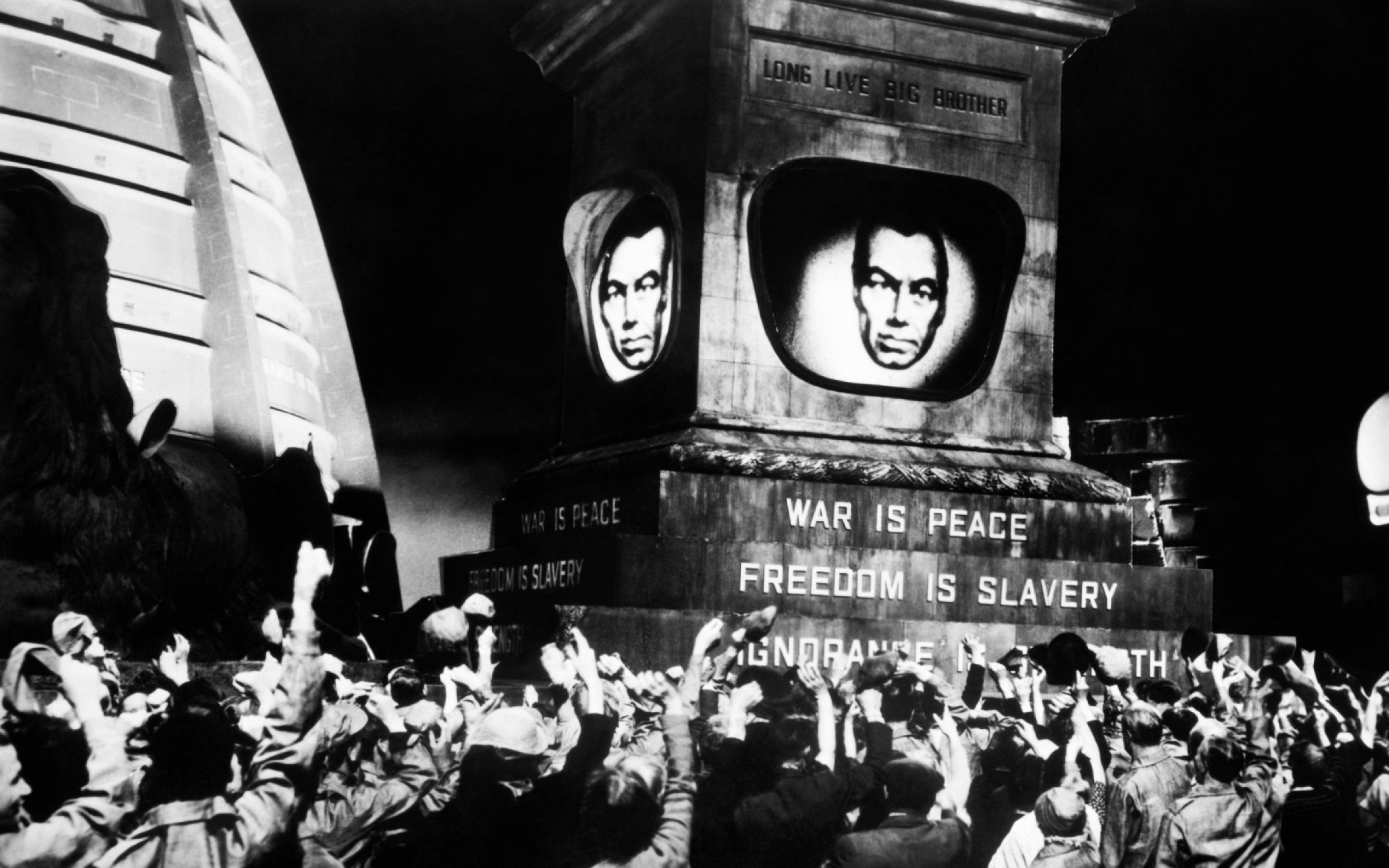
Still from a 1956 dramatization of George Orwell’s novel. 

Orwell would not have stood with the side claiming to be “on the left” today. He was clever enough to sniff out even the softest totalitarianism. What progressives and social democrats seek is what Orwell named “Ingsoc” in his masterwork Nineteen Eighty-Four. Ingsoc is Newspeak, i.e., short for “English Socialism,” the totalitarian ideology that governs the fictional society of Oceania, where the Party holds absolute control over every aspect of life. Ingsoc is a distorted and perverted form of socialism, co-opted by the ruling Party to maintain its dominance. Although it uses the language of socialism, such as equality and collective control over the means of production, it is ultimately a system of extreme oppression where the people have no real power. This tells you what Orwell understood as the true meaning of socialism, and it was not what the progressives have on tap.

The defining feature of Ingsoc is its totalitarian nature, with the Party exerting absolute control over not only political and economic life but also the personal lives and thoughts of citizens. Under the leadership of Big Brother, a figurehead (likely a third-order simulacrum) who symbolizes the Party’s omnipotent power, every action is monitored, and dissent is crushed through manipulation of information, surveillance, and fear of what will happen if one doesn’t obey Big Brother. The Party’s control is so complete that citizens cannot even think freely; the Party manages not only their actions but also their very thoughts. The famous formulation of “2+2=5” does not merely represent the desire that the people repeat the “truths” of the regime, but that they believe them, and do so without hesitation. Acceptance of the Party’s line is to mimic reflex.

Ingsoc uses Newspeak, a language designed to limit the range of thought. By simplifying language and eliminating words that could facilitate subversive thinking, Newspeak prevents rebellion by removing the means to express dissent. This manipulation of language is coupled with doublethink, the ability to accept two contradictory beliefs simultaneously. These methods allow the Party to control the perception of reality itself. Citizens are taught to accept the Party’s version of truth, no matter how obviously false or contradictory it may seem.

This desire is exemplified in the Party slogans, such as “War is Peace,” “Freedom is Slavery,” and “Ignorance is Strength.” These exemplify the contradictory thinking the Party encourages. Likewise, the modern slogans and demands of today’s Party—“Transwomen are women,” the rebranding of discrimination as “diversity,” the exclusionary demands of “inclusivity,” all which invert reality, as well as fallacious claims that “speech is violence” and “words are weapons,” and the pursuit of speech codes, cancel culture, and deplatforming—is authoritarian desire achieved through the control of thought via the manipulation of language.

There are many parallels between woke progressivism and Orwell’s nightmare dystopia world of Oceania. In that world, the Party rewrites history, using the Ministry of Truth to continuously alter past records, ensuring that the Party’s narrative always aligns with the present power structure. By erasing or changing historical facts, the Party ensures that it can never be questioned, as there is no objective past to compare against. Ingsoc’s control over history is a key method by which the Party asserts its dominance over the people, as citizens are unable to look back at past events for clarity or understanding. The constant surveillance by the telescreens and the ever-present threat of the thought police make it clear that no aspect of life is beyond the Party’s scrutiny. Big Brother represents the Party’s absolute surveillance and control, symbolizing the fear that the Party instills in the Proles, reminding them that they are always being watched, even in their private thoughts. And, of course, those who deviate from the line are sent to the Ministry of Love for rehabilitation.

The way this manifests today is through the establishment of something along the lines of neuro-linguistic programming (NLP), albeit not explicitly. The core premise of NLP is that the way people use language shapes their attitudes, cognition, emotional state, and ultimately their behaviors. According to NLP, by changing the language patterns of individuals, it’s possible to shift how they think, feel, and act. For example, if children are likely to grow up with an understanding of gender as binary and immutable, which children have since time immemorial, and the goal is to interrupt that naturally emergent pattern, something like NLP can be deployed to, through techniques like anchoring and reframing, alter those patterns, which leads to changed attitudes, emotions, thoughts, and thus behaviors sought by elites. By altering language, elites reprogram popular responses to various situations.

One of the ways individuals are so reprogrammed is to confuse corporate statism and dependency on the government for democratic socialism. However, in Orwell’s novel, Ingsoc, while using the rhetoric of socialism, is not concerned with improving the welfare of the people. Instead, it’s an authoritarian system that seeks to maintain power at any cost. In Nineteen Eighty-Four, this power is sought for its own sake, much like the situation in the Soviet Union. If the corporate state context, power is sought to secure an endless source of profit and privilege for the capitalist class.

In either case, Orwell’s depiction of Ingsoc is a warning about the dangers of any ideology—whether left-wing or right-wing—hijacked by authoritarian rulers who manipulate it to justify repression. Through the Party’s totalitarian control, Orwell shows how ideologies are constructed serve the interests of those in power, leading to a society where freedom and truth are obliterated in the name of maintaining absolute control—for whatever end.

We see this today in the demand for obligatory use of preferred pronouns in government and public agencies. I just finished arguing with somebody on X who deployed all the Orwellian tricks to argue that compelling children to use a teacher’s preferred pronouns is not only fair but necessary in order to avoid discrimination—as if speech acts signaling the truth of things and situations can be discriminatory—as if it is not a fundamental violation of the child’s right to freedom of conscience and speech.

Is compelling children to speak the language of gender ideology for the sake of power itself? Part of it, for sure. There are people who delight in forcing or shaming others into affirming their delusions. We describe such person with several words—narcissists, sadists, sociopaths. And they need this affirmation since either they themselves know they are not what they claim to be or the constant reminder they are not triggers their dysphoria. But the other part of this is the source of profit and privilege children represents to corporate elite. It’s the same thing that feeds the pharmaceuticals and foods industries, and the toy companies. This is why elites are eager to put children on the path for physiological and morphological modification in the medical-industrial complex: the profits are massive and, since they make permanent medical patients of the individuals ensnared, sustainable.

Orwell was pro-working class, as I am and have always been. Orwell was a populist, deeply concerned with the welfare of ordinary people, and therefore he believed, as I do, that economic systems should be structured to ensure equality and fairness, as well as to have provisions of care for those who could not take of themselves. But, then, even a hardcore neoclassical liberal like Friedrich Hayek believed that the state had an obligation to take care of the elderly and the affirm. In the end, Orwell believed in the common man and his right to free conscience, speech, publishing, assembly, association, the right to keep and bear arms, privacy, and the rule of law—and the democratic-republican process necessary to change the law.

In the X debate I referenced earlier, Trump and Musk were portrayed as “fascists.” If in their collective guts progressives sense Trump and Musk as the enemy, it is because Trump and Musk actually stand closer to Orwell, whereas progressives stand closer to the administrative state and technocratic control over populations, which they do not only because we can see them, but because they admit to what we see. This is why they have no trouble compelling speech in public schools. What is “misinformation” and “hate speech” is the information they want corporations to censor because it undermines their authoritarian ambitions. They see indoctrination as education. They see technocracy as democracy. They’re fascists hiding behind the language of sympathy.

I have quoted this passage before, but it’s relevant here given what I just said. CS Lewis: “Of all tyrannies, a tyranny sincerely exercised for the good of its victims may be the most oppressive. It would be better to live under robber barons than under omnipotent moral busybodies. The robber baron’s cruelty may sometimes sleep, his cupidity may at some point be satiated; but those who torment us for our own good will torment us without end for they do so with the approval of their own conscience. They may be more likely to go to Heaven yet at the same time likelier to make a Hell of earth. This very kindness stings with intolerable insult. To be ‘cured’ against one’s will and cured of states which we may not regard as disease is to be put on a level of those who have not yet reached the age of reason or those who never will; to be classed with infants, imbeciles, and domestic animals.”