“For truly I tell you, many prophets and righteous people longed to see what you see but did not see it, and to hear what you hear but did not hear it.” —Matthew 13:17
I want to tell you a story that gets to the heart of why so much organized energy is devoted to silencing certain views at universities across the West.
Once upon a time, there was an emperor who loved new clothes more than anything. He spent all his money on fine garments and enjoyed parading through the city to show off his latest outfits. One day, two swindlers arrived at the palace claiming to be master weavers who could make the most magnificent fabric in the world. Their cloth, they said, had a magical property: it would be invisible to anyone who was unfit for their position or hopelessly stupid. Intrigued by this promise, the emperor ordered them to weave a set of clothes for him.
The swindlers set up looms and pretended to weave, though there was nothing on them. Ministers and officials, sent to inspect the work, saw nothing but, fearing they would be thought unfit or foolish, they praised the fabric’s nonexistent beauty. When the suit was “finished,” the swindlers presented it to the emperor. Although he saw nothing, he too pretended to admire it, not wanting to appear unworthy. He put on the invisible garments and went out to parade before his subjects.
The townspeople, not wanting to seem stupid, pretended to admire his fine clothes. But a small child in the crowd spoke up: “But he isn’t wearing anything at all!” At first, the crowd was silent, but soon they began whispering and laughing, realizing the truth. “But he has nothing at all on!” at last they cried out. The emperor was upset, for he knew that the people were right. But, though embarrassed, he continued walking proudly, unwilling to admit his nakedness.
The Emperor’s New Clothes
Obviously, this is not an original story. You knew that already. “The Emperor’s New Clothes” is a classic fairy tale by Hans Christian Andersen. The typical interpretation of Andersen’s tale is that it highlights the dangers of the power of social pressure, pride, and vanity. It’s a parable that reflects real-life situations where people go along with falsehoods to avoid looking bigoted, foolish, and mean—because they know that is how they will be portrayed if they don’t. It also teaches that truth, even when spoken by a child, has the power to break illusions.
All these are indeed among the lessons of the parable, but I see something else in Andersen’s tale: the importance of mutual knowledge. Until the kid speaks up, everybody knows that the emperor is naked, but they don’t know that everybody else knows that the emperor is naked. The small child has not yet been socialized in civil inattention—or indoctrinated to withhold truths offensive to the emperor (this is why totalitarian desires command of early childhood education). That a child sees what a man sees gives the man confidence to publicly acknowledge the truth of what everybody sees: the emperor is naked.
Andersen’s parable applies to our universities under the hegemony of woke progressivism. Being called to account these days in public universities occurs when one’s pronouncements contradict the prevailing ideology. The demand that professors uphold a particular ideology by professing it, or at least by not openly criticizing it, is to deny the presence of a naked emperor; only by preventing mutual knowledge around the truth of things can fictions be sustained. When myths fall, actions lose their cloak of justice. The righteous become a mob.
Perpetuating fiction is what lies behind the demand, albeit often subtle, that professors engage in newspeak, Orwell’s term for a neurolinguistic project to change cognition. Manufacturing an illusion takes a great deal of effort, but illusions are always fragile, because they are just that: illusions. Therefore rule-following is crucial and the targeting of those who do not follow the rules necessary.
But whose rules? The rules humans have operated by for millennia? The rules that come with instinct? Rules based on reality and reason? Or the rules of a new minority demanding conformity to its ideology in order to sustain necessary illusions? In the case of new rules, it is particularly helpful to those wishing to impose them on others that the institutions and organizations in which they move demand that everybody follow them. It is moreover understandable that those who call the new rules into question make those who require them to feel unsafe.
Whether they think the new rules are good, every professor and student who reads this essay knows the rules and the pressure to follow them. Trepidation at violating them is palpable. The earnest professor who slips up and violates a rule feels terrible guilt and apologizes a second time after a sleepless night. Professors and graduate students talk about the tyranny of the rules in hushed voices at academic conferences. They’re talking about the emperor and they don’t want the emperor to overhear.
This is a bad place for the Enlightenment project. Open and free spaces are unsafe because they allow the truth to be spoken aloud and for mutual knowledge to be formed. They should therefore be unsafe in the sense rendered here. If we make them safe in that sense, we cancel the project. For if we are forced to appreciate the emperor’s new clothes when there are none (or even when the emperor is fully dressed, for that matter), then we live in an unfree society—at least not as free as we should have it. We must therefore secure those spaces with a different sense of safety.
Freedom requires more than reminding people about the right to free speech and the value of academic freedom. A man often needs to feel free to tell the truth. To be sure, that free feeling is only potentially obtainable when he is not told what to say or punished for saying what he is told not to. But some men need beyond reassurance that they may safely speak their mind encouragement to say the things that others wish they wouldn’t in an environment free of retribution. Finding that free feeling requires the active promotion by those in authority of the values that are central to the Enlightenment project, chief among them critique of all things existing.
Maybe a man will never find his courage. But other men will. Courage is contagious. And this is why so much organized energy is devoted to silencing certain views at universities across the West.
One of the abilities of a genius intellect is the ability to think about phenomena and problems in an abstract and global sense and then to use this understanding of systems and the interconnections among elements to make predictions, a practice closely linked to that of explanation, to see how things will work out based on first principles or initial states. Put another way, the ability to think abstractly, recognize deep interconnections, and predict outcomes based on first principles are hallmarks of genius. Both Albert Einstein and Elon Musk exemplify this trait, albeit in different ways, which I will come to later in this essay.
Albert Einstein and Elon Musk
But before I get the traits that mark Einstein and Musk as geniuses, I want to expand on the point that, in a deep and fundamental way, prediction and explanation are closely linked; one might even argue that they are two sides of the same coin. Both involve understanding the underlying structure of a system, recognizing patterns, and applying that knowledge to either anticipate future events (prediction) or clarify past or present phenomena (explanation). That prediction runs in both directions is crucial to recognize; we can test hypotheses about future and past causes and correlations.
Today’s essay concerns this matter because progressives are fond of creating boogeymen of those who contradict claims made in the service of their agenda, which is changing the world to fit their ideology, attributing to their enemies low intellect to make their own pronouncements appear in contrast the work of high intellect. This tactic is central to legitimizing the presence and practices of progressivism in technocratic governance, since the practice of elevating technocracy over democracy depends on the widespread assumption that common man just isn’t up to self-government. Like Trump, portraying Musk as having low intellect is a paradigm of this progressive tactic. Such portrayal was certain once Trump and Musk were drawn into politics, as their presence in government threatens progressive hegemony. Before then, they were admired, even celebrated.
In science, inference is central to the predictive power of theories. A good scientific theory not only explains why things happen but also predicts what will happen under different conditions. For example, Einstein’s theory of general relativity explained why Mercury’s orbit deviated slightly from Newtonian predictions, but it also predicted the bending of light around massive objects—something later confirmed during a 1919 solar eclipse. The fact that a theory successfully predicts outcomes is strong evidence that its explanations are fundamentally correct. Einstein had the ability to know phenomena or things existed without seeing them. He could determine the outcome of a process before it was set in motion because he grasped the nature of the initial state.
We see this in artificial intelligence and machine learning. Models that can accurately predict outcomes often have implicit explanatory power. This is why AI is such a powerful tool beyond computational speed. If a neural network can predict stock market trends based on certain inputs, it suggests that those inputs are meaningfully connected to market movements, even if the mechanism isn’t fully understood. Musk, in his engineering-driven mindset, often speaks about first principles thinking, which is essentially a method of both explanation and prediction. By understanding the nature of systems, Musk can predict the outcomes of changed system states. Crucially, something doesn’t have to have already happened to know what will happen if the system is changed and I want to spend a moment on that matter, as denying or obscuring this truth is a tactic progressives use to deny or obscure the deleterious effects of their policies.
Those who wish to advance ideological-political agendas are fond of saying in the face of pushback that the future states imagined by their opponents have not happened, or are infrequent, and that therefore their concerns are unfounded. When concerns were raised about males identifying as girls or women in female sports, those advocating allowing males into female sports dismissed those concerns by claiming that there was no or little evidence of negative effects, therefore the desire to exclude such males was an expression of prejudice against trans identifying males. However, scientific facts about the advantages males have over females, recognition of those differences and an explanation for them, accurately predicts that males would dominate females in female sports.
Similar predictions were made with respect to such males in female prisons. Rape and pregnancies were predicted, and these things subsequently happened. While these outcomes were expected, those who push the queer agenda denied them. At the same time, they wanted these outcomes, which is obvious in the way that men succeeding in women’s domains are celebrated by progressives. These outcomes are celebrated because progressives have changed the system via power derived from having colonized society’s sense-making and policy-making institutions. Thus, the claim that something undesirable will not happen is a lie; progressives desire the undesirable.
Leaving subterfuge to the side (ideology makes smart people stupid, so a lot of those pushing the agenda come by their fallacies honestly), a person pushing the queer agenda while denying or obscure its deleterious impact on girls and women is committing the fallacy argument from ignorance (argumentum ad ignorantiam). The argument from ignorance fallacy occurs when someone claims that a statement is true (or false) simply because it has not been proven otherwise. It’s an error in reasoning that relies on a lack of evidence as proof of something, rather than offering direct evidence to support the claim. Put another way, an argument from ignorance occurs when one assumes that because something has never happened or isn’t happening that it cannot or will not happen.
In the case of males in women’s sports, dismissing the predicted advantage in sports due to the relative absence of males assumes that because the condition (males being allowed) hasn’t been met, the predicted outcome (advantage) cannot or will not occur. This reasoning incorrectly assumes that the lack of evidence disconfirms the prediction. However, the advantage still exists if males were allowed to participate; the absence of that condition doesn’t prove the outcome won’t occur. We expect the outcome because of our knowledge of the facts, which are denied by the queer activist because the agenda seeks validation of the false claim that men who say they are women are women. Thus the progressive ostensibly rejects predictions based on the assumption that a lack of immediate or concrete evidence means the issue won’t materialize in the future.
This dismissive stance ignores the underlying factors, essentially focusing on the absence of past instances rather than on the rational prediction that can be made from known principles. The scientific facts about male and female physiology (such as physical strength, muscle mass, and hormonal differences) lead to logical predictions that males have physical advantages in certain sports, and similar reasoning about social and psychological factors can predict challenges in environments like female prisons. If these predictions are based on well-established principles, facts, or theories, the person dismissing them is overlooking the importance of reasoning from facts and the predictive power that comes with understanding initial conditions.
This dismissal is a failure (often intentional) to acknowledge the validity of predictions based on established knowledge and exposes the person as eschewing logical reasoning—in the case of queer theory to advance an ideological agenda; the denial of the potential consequences is based on an appeal a lack of direct evidence in the short term, instead of considering broader principles that logically lead to these predictions. Predictive thinking relies on a systems understanding—recognizing patterns and anticipating future outcomes based on those patterns, which are grounded in scientific facts. Ideology disorders the capacity to think in a logical way. We have thus allowed fallacious thinking to command our institutions, and the consequences of having allowed this have been consequential and widespread.
Here’s another example. Supposing there is at present no evidence that affirmative action or the lowering of standards with the objective to change race and ethnic proportionalities will increase the number of unqualified people in critical fields of endeavor, such as medicine, and that therefore such concerns that it is or will reflect not the predictive power of the person making the objection but instead reflect the objector’s race or ethnic bias. The claim is that his opposition is not based on an understanding of the nature of the situation but on an ideology that predisposes him to imagine such outcomes to thwart progress in the project to achieve race and ethnic equity.
In this way, the rational thinker is portrayed as an irrational one, driven by race and ethnic bias, which adds to the mix another fallacy, the ad hominem fallacy. But it is obvious that lowering the standards in medicine will increase the likelihood of incompetent doctors, which will result in poorer and even lethal outcomes. Why wait for these deleterious outcomes to manifest to abandon or prevent the initiation of policies that will lead to them? Setting aside the fact that determining the fate of individuals based on group membership is discriminatory (committing yet another fallacy, that of misplaced concreteness) and therefore should be stopped or disallowed for that reason, affirmative action leads to negative outcomes. Resort to name calling will not in the end obscure the results.
As with the problem of males in female sports, the person denying the predictions is dismissing concerns about the potential negative consequences of affirmative action (including discrimination on the basis of race and ethnicity obvious at inception) on the grounds that there is no immediate or concrete evidence to support them, assuming the absence of proof in the short term means the issue won’t arise in the future. This reasoning fails to consider the broader principles, historical patterns, and existing research that predict future outcomes, focusing instead on the lack of current evidence to dismiss possible long-term effects. The predictive power of established facts and theories about human behavior, socioeconomic trends, and systemic dynamics is ignored. This failure to recognize the validity of logical predictions, grounded in knowledge and reasoning, exposes the person as relying on a narrow, short-term perspective rather than considering broader, more reliable frameworks for anticipating outcomes.
There is a video widely shared on the Internet of a dialogue between Elon Musk and Don Lemon in which Lemon challenges Musk on the latter’s opposition to affirmative action and DEI on the grounds that it will increase incompetence in the field of surgery. Lemon asks Musk for evidence that this has happened. In the clip I provide above, Lemon denies that standards are being lowered. Musk contradicts Lemon’s claim by citing the case of Duke University. As Dave Rubin points out in his commentary (also in the clip) we know this happening across the nations in our universities and our high schools, thus providing a superb example of how to avoid the fallacy of argument from ignorance.
I shared that clip because of what Rubin adds to it, but it does not fully convey Lemon’s resort to ignorance. Below I provide a longer clip that shows Lemon engaging in the fallacy of argument from ignorance thereby providing a paradigm of the tactic progressives use to deny the consequences of the policies they foist upon the public. They deploy the fallacy as a “gotcha” device, that if you cannot identify a negative consequences then the policy must be a sound one. It is not a particularly clever rhetorical trick, frankly, but it can catch an opponent flat-footed if he doesn’t know about the fallacy. Logic and critical thinking is not typically included in public school curricula. For the progressive, whether he knows it is a fallacy or not is unimportant; he has been socialized to reflexively use it in debate. Progressives are well conditioned in the art of sophistry. Lemon engages in another logical error when he claims that because white doctors make mistakes, that Musk doesn’t have a concern. But this only provides Musk with an opportunity to demonstrate the logical way to think about the problem, avoiding the fallacy Lemon commits. (Lemon’s note about Tuskegee is absurd. The National Medical Association supported the Tuskegee Syphilis Study during its duration.)
I stress the point that without evidence of outcome incompetence is the predictable consequence of lowering standards. But the role of ideology here must also be stressed. Musk says what he does because he understands the situation. Musk is a logical thinker. Lemon cannot grasp Musk’s point because he believes, like other progressives, that blacks are underrepresented in the field of surgery because of racism and this belief derails whatever natural capacity he might have to understand. What is this ideology? That of critical race theory, or CRT. In his book, How to Be an Antiracist, Ibram X. Kendi argues that disparities are not indicative of the inherent abilities of different racial groups but are the result of racist policies and ideas. It is either one or the other, he insists, and so you can either only be an antiracist or a racist. Kendi emphasizes that acknowledging these disparities is crucial for identifying and dismantling the racist structures that perpetuate them. But this is a fallacious argument, and it’s part of the reasons Lemon can’t grasp Musk’s point.
The underrepresentation of blacks in fields like medicine need not be attributed to racial disparities in inherent abilities but can be attributed instead to a variety of factors, including cultural variation in attitudes towards learning and work, historical and systemic barriers to education, access to resources, and so forth. These barriers have created disparities in academic achievement and professional qualifications, making it more difficult for blacks on average to meet the high standards required in fields such as medicine, which is why they are underrepresented in those fields. Progressives must acknowledge this fact since they go to the heart of their claim that racism remains a problem. They take the fact of disparity as proof of its cause, but in doing so admit to the disparity. They are in a bind; whatever the explanation for these facts, efforts to change standards to increase representation will carry the same effect as if the differences in ability are innate; there will be an increase in incompetence which will in turn lead to negative outcomes, which in this case can be debilitating and lethal. Medicine is already dangerous enough without increasing the number of incompetent practitioners. Lower standards may lead to greater representation of blacks in medicine. But it will also lead to a greater number of incompetent doctors. Since medicine is about competency in practice, DEI goals have no place.
Progressives are fond of policies based on demographic abstractions, so the counterargument that not all black individuals are incompetent provides no refuge. Of course not all black individuals are incompetent. Dr. Ben Carson, a world-renowned brain surgeon, is black. But Carson did not earn his lofty reputation because he is black, rather because he is talented and dedicated to his craft. However, not all black men vying to be brain surgeons come with the same level of judgment, talent, and dedication to the art. Thus, while changes to standards may be seen as an attempt to address the effects of these inequities and provide more opportunities for underrepresented groups to succeed, the negative consequences of reducing standards are predictable. Why are there high standards in medicine in the first place if not to exclude incompetent practitioners and thereby reduce the likelihood of harmful consequences for patients? That’s common sense.
This is crucial to understand because the ability to predict future events based on known facts, such as the advantages males may have in physical sport, is itself explaining the dynamics of the situation. There is symmetry here; it works the other way around. When those predictions come true, it reinforces the original explanation. Denying such predictions would be ignoring both systemic reasoning and empirical observation and failing to consider how these explanations provide a framework for anticipating future events based on current knowledge. This ignorance allows people to assert in a self-satisfied way that, not only will the worst not occur if the state of the system is changed, but that because it has not occurred (at least to their knowledge), that the outcome will a good one. Thus, via fallacious reasons, progressives make their agenda appear desirable. Ultimately, whether we are explaining the past or predicting the future, we are engaging in the same intellectual process: recognizing patterns, identifying causes, and applying logical reasoning to understand the world. Progressives only recognize the patterns they wish to, and these are almost always in the service of their agenda.
All that said, let’s return to the matter of genius, since in deciding on which cognitive style to adopt, we should be looking to those who possess it, not to ideological hacks who only seek to advance an agenda. Presuming nobody would deny he was one, Einstein used first principles thinking to develop his theories of relativity, redefining our understanding of space, time, and gravity. Instead of accepting existing Newtonian mechanics as immutable, he questioned its foundational assumptions and built a new framework based on simple yet profound insights, such as the constancy of the speed of light. His ability to conceptualize the universe abstractly—through thought experiments rather than direct experimentation—demonstrates a deep systemic understanding of reality. Einstein is thus a ready exemplar of a rational cognitive style.
Musk, while not a theoretical physicist, applies similar principles in engineering and business. He has repeatedly stated that he solves problems by breaking them down to their fundamental truths and reasoning upward, rather than relying on conventional wisdom, and you can see this in how he works and what he has accomplished. His cognitive style has allowed him to revolutionize industries. For example, he saw that traditional rocket manufacturing was inefficient and vertically integrated SpaceX. His ability to foresee long-term trends, such as the importance of sustainable energy and space colonization, is rooted in this systems-level, predictive thinking.
Both Einstein and Musk demonstrate that genius is not just about knowledge but about seeing the invisible connections between things, predicting future possibilities, and reshaping the world according to reasonable ideas. Don Lemon is no genius. He could not see what Musk was saying. Based on the popularity of a version of that video clip circulating among and shared by those harboring great antipathy towards Musk, Lemon is not alone. The rank and file ensconced in the progressive worldview are rendered incapable of using the superior cognitive style. Those who steer them exploit the inferior cognitive style to organize popular support for their various projects.
There has been considerable speculation that Einstein may have been on the autism spectrum, though the diagnosis did not exist during his lifetime. We might point to traits such as his delayed speech development (not speaking fluently until around four years old), intense focus on his work, and a preference for solitude as possible indicators. Einstein also exhibited rigid behaviors, such as wearing the same type of clothing daily, and had an unconventional way of thinking, often disregarding societal norms. Additionally, some accounts suggest he struggled with social interactions and forming close relationships. To be sure, Einstein was also known to be engaging and humorous in the right settings (so is Musk). While Einstein’s neurological profile remains a topic of debate, the debate highlights the emerging conversation about neurodiversity and how historical figures might fit into modern frameworks of cognition and behavior.
Musk, on the other hand, has publicly stated that he is on the autism spectrum. During his Saturday Night Live (SNL) appearance in 2021, he revealed that he has Asperger’s syndrome, which is now classified under autism spectrum disorder (ASD). Musk displays some of the typical traits of autism, such as intense focus on specific interests, social difficulties, and a unique way of thinking. His awkward social interactions, literal communication style, and deep obsession with technology—all align with ASD characteristics. At the same time, Musk has shown adaptability, entrepreneurial skill, and strong leadership—all which demonstrate that neurodiversity can be a strength. (This brings into question whether psychiatry’s conflation of Aspergers and autism generally was a valid move.)
The attitude of progressives towards Musk’s neurodiversity considering their celebration of difference and diversity betrays their profound sense of elitism—whatever their position in the status hierarchy. If one has spent any time on social media, or watched corporate news outlets, the way progressives mock with extraordinary derision the physical appearance, speech, and behavior of those with whom they disagree is obvious. Accusing people of fatphobia while mocking Trump for being overweight is just one of a myriad examples one could provide. It is for this reason that I often say that progressives strike me as adult versions of the mean girls’ table in high school. I’m not saying that progressives aren’t smart. Progressives are some of the most intelligent people I have met. It is not much different here than it is for the religious faithful, who also believe in impossible things. It is also the case that people of average intelligence, if they adopt the superior cognitive style I am describing, can accurately explain and predict outcomes. This is why the average person knew that allowing men in women’s spaces will have deleterious effects, or why it is a bad idea to lower the standards in critical fields of endeavor. Again, it’s common sense.
Einstein’s exact IQ is unknown because he was never formally tested. However, various estimates place it somewhere north of 160, this based on his intellectual achievements and problem-solving abilities. For comparison, a score of 130 and above is typically considered “gifted,” whereas IQ scores of 160 and above are indicative of “exceptional” intelligence. Einstein’s groundbreaking contributions to physics suggest he was well within the exceptional range. To be sure, IQ may not always the best measure of genius, as creativity, insight, and perseverance also play crucial roles in groundbreaking discoveries, but the score is nonetheless widely recognized as a hallmark of genius. Musk’s exact IQ is unknown because he has never taken a publicly available IQ test. However, estimates place it in Einstein’s range based on his problem-solving abilities, technical knowledge, and success in multiple industries.
Einstein and Musk are thus both widely regarded as geniuses even while excelling in different domains with distinct intellectual approaches that nonetheless adopt the cognitive style I have described. Einstein’s intellectual strength lay in deep theoretical reasoning, often working in solitude to develop abstract mathematical models of reality. He valued contemplation and imagination, conducting thought experiments to explore the nature of space and time (his book The Theory of Relativity: And Other Essays, which I read as a child, had a profound impact on my thinking, and I will forever be grateful for the rich intellectual environment with which my parents provided me that included this and other great works). The practical applications of general relativity are found everywhere, from atomic energy to satellite communications.
Musk’s genius lies more in practical application, moving effortlessly between deductive and inductive reasoning, evidenced by his exceptional engineering skills and entrepreneurial prowess, with his focus on applying scientific and technological advancements to real-world industries. Tesla, SpaceX, Neuralink, and other ventures are revolutionizing transportation, space travel, and artificial intelligence. Nonetheless, while he is not a scientist in the traditional sense, Musk’s ability to integrate business strategy, engineering, and physics has allowed him to push the limits of innovation in multiple industries and demonstrate a cognitive style worth wide adoption. There is a reason Musk is the richest man in the world, and we would do well to emulate his approach. To be sure, that requires setting aside ideological concerns, but we would do well to do this, too.
Finally, I hasten to clarify that while IQ measures certain types of cognitive abilities, like pattern recognition, logical reasoning, and abstract thinking, success in fields like business or politics also involves a wide range of other qualities, such as emotional intelligence, strategic thinking, leadership, negotiation skills, and resilience—all of which can be just as crucial to achieving success as raw intellectual ability. Trump’s ability to build a business empire, run a presidential campaign, and win the presidency despite being a political outsider can be seen as indicative of his strong strategic thinking and unconventional problem-solving skills. Trump’s success suggests that he possesses a high level of intelligence, though it may not be captured fully by a traditional IQ test. I am closing with Trump because, as noted at the outset, progressives hold him in as much contempt as Musk since both have turned their talents to saving the American Republic, a project inimical to the corporate project of managed decline in order to prepare the masses for the big and intrusive technocratic world government progressives seek.
Let’s not forget that when Roosevelt took office in 1933 and began implementing his New Deal programs, he was accused of authoritarianism. Critics, particularly from the Republican Party and business sectors, argued that his extensive use of executive power to create agencies and programs represented a drastic departure from traditional democratic governance—that centralization of power in the federal government undermined individual liberties and “state rights,” a euphemism for our federalized system.
Franklin Roosevelt holds the distinction of signing the most executive orders in American history.
Republicans in particular expressed concerns that Roosevelt’s policies were leading the country toward a more centralized and potentially dictatorial government. For its part, the Roosevelt administration emphasized that the New Deal programs were necessary reforms, framing the initiatives as essential for protecting democracy and promoting economic recovery.
In a historic analog to X (Twitter), Roosevelt produced “Fireside Chats,” radio broadcasts that directly communicated with the American public to explain his policies and reassure citizens about his intentions and build public support. Roosevelt sought to build a broad coalition—labor unions, farmers, and progressive intellectuals—to strengthen the political base for his policies. When faced with legal challenges to the New Deal, his administration defended its initiatives in court. Roosevelt administration framed its actions as a legitimate response to a national crisis, positioning itself as a defender of democracy rather than a threat to it.
The progressive panic isn’t really about bold executive action. It’s about which party is taking bold executive action. Progressives might do better to argue policy rather than attempt to manufacture a moral panic. But they won’t because their policies are strongly disliked by the public. So, on second thought, what option do they have but the old playbook?
The question of which period of bold action was authoritarian is not my object here, but something I have explored in depth on Freedom and Reason. But I do want to note that, in the aftermath of Roosevelt, there was a gradual but significant shift in union density from the private sector to the public sector. Private sector unions represent the working class, which has been decimated by globalization (off-shoring and mass immigration). Public sector unions represent the credentialed class, the professional-managerial strata, reflecting the vast increase in the federal bureaucracy that progressives initiated and Roosevelt accelerated. Today, union density in the private sector is at a record low—under six percent. In contrast, public-sector union density now stands at 32.2 percent (even higher in local government).
This trend marks a shift in political power from the working class to the class that manages them for sake of the ruling class. Deconstructing the administrative state shifts power back to working people. Without private sector unions, the people now depend on populist government to represent them. Perhaps that is even better. Noting these facts in part answers the question about which period of bold action is authoritarian.
The degree to which progressivism has confused technocracy with democracy in popular consciousness is impressive. Now progressives are just embarrassing themselves. Victims of their own design. There is widespread panic that deconstructing the administrative apparatus is an authoritarian move instead of what it is: the restoration of democratic governance to a constitutional republic and getting the nation’s financial house in order.
One of the biggest panics to emerge over the last couple of days concerns the so-called Department of Government Efficiency (DOGE). Trump is an authoritarian, we are told, because he created a government agency without congressional approval, and it’s doing things. We now live in a fascist dictatorship and DOGE is Exhibit A. Support the brave federal employees resisting the fascist dictator! But did the President do this? It’s yet another false narrative. Hell, DOGE isn’t even new.
The office in question is officially the US DOGE Service Temporary Organization, formerly known as the United States Digital Service (USDS). That’s right, the office already existed. And progressives are going to love this part: USDS was established by executive order under President Barack Obama as part of his efforts to improve the federal government’s digital services and technology. Congress was not involved. The goal of DOGE, and USDS before it, is to modernize and streamline government services, making them more efficient and effective—to reduce the size of government and save the taxpayer money.
This good idea hardly begins with Obama (who had few good ideas, frankly, and a lot of bad ones). I wrote about this in a November 14, 2024 essay titled A Week Into a Four Year Term That Hasn’t Started—and Progressives Are Already Losing Their Minds. (Progressives were panicking about DOGE then, so we knew what was coming.) In that essay, I highlight Al Gore presenting his final report, From Red Tape to Results: Creating a Government That Works Better and Costs Less (a Report of the National Performance Review) to President Clinton in a ceremony on the South Lawn of the White House.
By 1999, estimates suggested that the initiative had saved around $136 billion through various cost-cutting measures, including workforce reductions, streamlining of federal agencies, and improvements in government procurement and service delivery. That’s no small sum of money given the federal budget at the time, which had not yet reached two trillion dollars. I did a little math and determined that, today, the US would save half a trillion dollars using the same approach. If DOGE is more aggressive, it could save a lot more than that. That’s a bad thing? I guess if you are progressive and want big, intrusive government to enlarge the number of those dependent on your power (see my recent essay Make Our Republic Great Again).
Despite the name, DOGE is not a federal executive department. It is well within the power of the president to reorganize existing agencies, combine existing functions, or create new offices within agencies through executive orders. We should want to see our government agencies run efficiently—or eliminated when detrimental or no longer useful. Do readers know how big the federal government is today? It’s approaching seven trillion dollars. And it’s deeply in the red. The present deficit is closing in on two trillion dollars annually. The government is adding trillions to the debt—which now exceeds 36 trillion dollars—every year. It’s time to whack agencies and offices.
The Washington Post story “USAID security officials on leave after refusing access to Musk allies” is Exhibit A in the problem of bureaucrats defying the will of the people and the need to whack programs. Once again, we confront the technocratic problem: agencies resisting directives of the executive. The term of art used here is “agency independence.” You hear this all the time from bureaucrats in corporatist style governments when asked what they would do if, say in Sweden, the Sweden Democrats came to power. Answer: ignore their directives. The idea is that if an executive enters office whose policies are seen by bureaucrats as detrimental to practices that they have deemed appropriate, then they are right to resist the executive.
CNN is reporting this morning that Elon Musk said President Donald Trump agreed the USAID should be “shut down” after its funding was frozen and dozens of employees were placed on leave. “With regards to the USAID stuff, I went over it with [the president] in detail and he agreed that we should shut it down,” Musk said in an X Spaces conversation Monday. He added that Trump confirmed this decision multiple times. Trump, when asked about USAID before the conversation, told reporters: “It’s been run by a bunch of radical lunatics, and we’re getting them out, and then we’ll make a decision” on its future.
Two top USAID security officials were placed on leave for blocking DOGE personnel from accessing the agency’s systems, despite threats to call law enforcement. Around sixty senior staff were also put on leave for attempting to bypass Trump’s executive order freezing foreign aid. Musk, co-hosting the X Spaces conversation with Senator Joni Ernst and Vivek Ramaswamy, criticized USAID as “incredibly politically partisan” and beyond repair. “USAID is a ball of worms,” he said. A Senate Foreign Relations Committee letter requested an update on the incident, raising concerns over security breaches and unauthorized access to sensitive data. However, Katie Miller, a Trump appointee to DOGE, confirmed, “No classified material was accessed without proper security clearances.”
USAID officials warn the State Department lacks the capacity to manage USAID’s vast development projects and that eliminating the agency would severely weaken US foreign policy. “We’re basically going to be punching with one arm behind our back,” a former senior USAID official said. It’s fine to express one’s opinion, but the future of the agency is not up to the federal bureaucrats appointed to run it. The future of USAID is up to the Executive. Indeed, the attitude expressed by action resisting democratic authority suggests Sheldon Wolin’s observations concerning inverted totalitarianism. If a nation is to avoid that situation, or to unwind it if substantially there, which we are, then it is imperative that agencies of the executive in a constitutional republic understand that they are duty bound to carry out the directives of the executive, who in our system is elected by the nation. Bureaucrats don’t choose the president or his policies. The people do. Bureaucrats carry out the policies of the president the people elected. If they aren’t prepared to do this, then they should resign. If they won’t resign, then they should be fired and locked out of their offices.
Here’s the reality: Bureaucratic inefficiencies and mismanagement are rampant at USAID—corruption, lack of oversight in aid distribution, wasted funds. But that’s just part of the problem. The mission is the problem. USAID-funded initiatives undermine local economies by flooding markets with free goods, discouraging local production. When the bureaucrats aren’t doing that, they encourage the production of goods that are not sought in the market, with the effect of destabilizing foreign economies. USAID promotes “democracy projects,” i.e., interventions in domestic affairs that advance the interests of transnational corporate power. USAID projects have prioritized US geopolitical interests, a euphemism for capitalist globalization, these deriving from neoliberal and neoconservative assumptions, over genuine development needs, which leads to dependency rather than self-sufficiency. Moreover, while USAID is pitched an independent agency of the US government responsible for providing foreign aid and development assistance, its operations provide cover for CIA operations. During the Cold War, USAID programs were used as fronts for intelligence operations in Latin America, Africa, and Southeast Asia. USAID is a weapon US intelligence operations and imperial adventures. It needs to be whacked.
Belief that USAID is necessary for delivering sustainable development solutions reveals at best a profound naïveté. But watch progressives lose their shit because it’s Trump and DOGE reforming the agency, pitching this as another instance of Trump’s authoritarianism by those who haven’t a clue about how the agency works, the power it serves, the ends it seeks. This is one more piece of evidence for my claim that the progressive left is not really left at all but handmaidens of the corporate state. What we call the left today is a customized rhetorical gloss of leftism, one rooted in the postmodern rot of CRT, postcolonial studies, and QT, i.e., ideologies that invent oppression or portray the normal as oppressive, and obscure the functional role of the progressive in transnational power schemes. But then progressivism was never really a working-class politics. It was from the beginning a corporate substitute for populism and genuine reform. This is why true populist figures and reforms are reviled and resisted by those who are now on the run.
I was telling my wife Friday on the way to dinner that, at this point, the constant panic reporting only serves the punctuate the reason why the corporate media and Democrats are no longer trusted. The propagandists and progressive politicians thought that when they told big lies that didn’t work that the problem was that their lies weren’t big enough. So, they kept telling bigger and bigger lies not realizing that the effect of the strategy runs in the opposite direction once the apparatus is viewed as illegitimate. It’s a habit they can’t kick, apparently. And a big part of the problem is that deny they are addicts. Liberating social media has made mutual knowledge an insurmountable problem for the propagandist. Progressive lies now only work on progressives, a dwindling proportion of the population. The Democratic Party is now more unpopular than at any time since the pollsters started asking people about it. If Democrats don’t change direction, then they’ll dwell in the wilderness for decades—where those who tenaciously cling to bad ideas should dwell.
This essay concerns two matters: Trump’s actions with respect to the FBI establishment and the Department of Justice, and the dire situation in Ukraine. Both matters concern the problem of the administrative and deep state apparatuses, which exist and operate beyond the Constitution and democratic norms, and have been heretofore unaccountable to the public interest.
But it’s a new day, and accountability has arrived in the figure of Donald Trump and an army of patriots at his back. Learning lessons from his first term as president, in which he and his allies failed to purge the Executive Branch of administrative and deep state actors determined to undermine the populist movement and its campaign to restore constitutional integrity and democratic-republic principle to the nation, Trump is this time around moving quickly and decisively to eliminate from government the globalists engaged in the managed decline of the American Republic.
FBI Headquarters, a monument to brutalist architecture
For the first matter, the matter of the FBI, I base the following in part on a reporting by several major corporate news outlets (ABC, CBS, The New York Times, etc.). According to these sources, the Justice Department has instructed Edward Martin, the Acting US Attorney in Washington DC, to dismiss prosecutors involved in investigating the January 6 Capitol riot. The order is detailed in a memo from January 31, written by Acting Attorney General James McHenry. The memo has been confirmed by multiple sources.
Crucially, in a scheme to preserve the deep state project, some of the prosecutors who had initially been hired temporarily to work on the January 6 investigation were made permanent employees before the presidential transition. The memo stated that their continued employment was interfering with the ability to execute the agenda of President Trump’s administration.
In a separate directive, Acting Deputy Attorney General Emil Bove has mandated a review of all FBI agents who were involved in the Capitol “insurrection” investigation. The memo states that these dismissals are to take effect immediately, listing specific individuals whose employment will be terminated.
Additionally, Bove has ordered the FBI’s acting director, scheduled to be replaced by Trump nominee Kash Patel, should he be confirmed by the Senate (which may call him back for further testimony considering these developments), to compile a list of current and former agents involved in the investigation to assess whether further personnel actions are needed. This includes a directive for the firing of eight high-ranking FBI executives. The action is expected by this Monday. The head of the Washington DC Field Office is also scheduled to be removed by February 10. In his memo, Bove argued that some of these FBI personnel could not be trusted to support the implementation of the President’s agenda and ordered further review of those involved in cases related to several sensitive issues.
This action follows a previous one in which more than a dozen federal prosecutors from the team that charged former President Trump in the documents case were also dismissed, with the Justice Department expressing doubts about their ability to carry out Trump’s agenda.
The purge of Justice Department and FBI employees is aimed at addressing politicization and weaponization of these agencies, and it extends beyond senior FBI officials; officials in charge of national security, cyber, and criminal investigations have also been targeted for forced resignations or retirements. The full scale of the personnel changes is still unfolding, but it promises to be deep and sweeping.
Predictably there has been pushback, for example, from the FBI Agents Association, which warns that such actions could weaken the bureau’s ability to protect national security. But this is cover for Establishment desire to preserve the deep state apparatus for purposes of shaping state action beyond democratic accountability and executive purview. If the public knew about the history of the FBI and its decades-long war on the American People, then Trump’s actions would not be seen as so controversial, at least not to their minds, and his speedy action in purging these elements from government will hopefully function to draw public attention to this history.
As for the second matter, this one involving the actions of deep state actors internationally, as many readers will already know, over the past fifteen years Ukraine has been marked by shifting alliances, protests, revolutions, and war. In 2010, pro-Russian Viktor Yanukovych won the presidency. His decision in 2013 to abandon the European Union (EU) trade deal in favor of closer ties with Russia sparked the Euromaidan protests. By early 2014, mass demonstrations led to Yanukovych fleeing the country, and a pro-Western government took power with oligarch Petro Poroshenko at its head. Poroshenko served as President of Ukraine from 2014 to 2019, his presidency marked by a strong pro-European and pro-NATO stance. Poroshenko’s tenure was marked by corruption and governance problems, which contributed to his defeat in the 2019 election, where Volodymyr Zelensky won in a landslide on promises of anti-corruption measures and reform.
It was during the Poroshenko regime that the Biden family entangled itself in the internal affairs of Ukraine running a global money laundering scheme. Knowledge of this scheme, and questions about a Democratic National Committee (DNC) server, is what led to President Trump telephoning Zelensky, a phone call that provided an opportunity for Democrats to impeach the president (which occurred on July 25, 2019), a charge of which he was acquitted in the Senate.
I want to share the relevant parts of the phone call because in hindsight those who are honest with themselves given everything they could now know should see Trump’s noble intent in getting to the bottom of schemes by the deep state to undermine his presidency and those enriching the Biden family, the head of which would likely be Trump’s opponent in the 2020 election. As it turned out, Biden was the establishment pick to assume the presidency, installed in the wake of the release of a weaponized coronavirus, manufacturing pandemic conditions used to rig the 2020 election, as well as a color revolution, which saw widespread rioting across American cities, violence driven by propaganda manufacturing false mass perception of systemic racial injustice.
“I would like you to do us a favor,” Trump began early into the phone call with Zelensky, “because our country has been through a lot and Ukraine knows a lot about it.” It was clear that this would be the intent of his phone call (and not to congratulate Zelensky on his recent victory). Trump continued: “I would like you to find out what happened with this whole situation with Ukraine, they say CrowdStrike [a cybersecurity company]… I guess you have one of your wealthy people… The server, they say Ukraine has it. There are a lot of things that went on, the whole situation. I think you’re surrounding yourself with some of the same people. I would like to have the Attorney General call you or your people and I would like you to get to the bottom of it. As you saw yesterday that whole nonsense ended with a very poor performance by a man named Robert Mueller, an incompetent performance, but they say a lot of it started with Ukraine. Whatever you can do, it’s very important that you do it if that’s possible.” After Zelensky said, in part, “I will personally tell you that one of my assistants spoke with Mr. Giuliani just recently and we are hoping very much that Mr. Giuliani will be able to travel to Ukraine and we will meet once he comes to Ukraine,” Trump responded, “Good because I heard you had a prosecutor who was very good and he was shut down and that’s really unfair.”
Before continuing with the transcript, some context is necessary. Rudolph Giuliani, the former mayor of New York City, and a close Trump ally, was a central figure in the Hunter Biden laptop scandal. Giuliani had copies of a hard drive belonging to Hunter Biden, Joe Biden’s youngest son.
Hunter Biden dropped off a liquid-damaged laptop at a Delaware computer repair shop in April 2019 and never returned to retrieve the device, which then became the property of the shop. With a subpoena in hand issued by a Wilmington grand jury (the US attorney’s office in Wilmington had been investigating Hunter Biden about lobbying and financial matters since at least 2018), the FBI took possession of it from the shop in December of 2019. The FBI verified that the laptop was authentic before the year was out.
A year later, in October 2020, Biden and then-Secretary of State Anthony Blinken arranged for an open letter to be composed by several dozen former high-ranking intelligence officers to misdirect the public by claiming that there was a high probability that it was Russian disinformation aimed at interfering with the 2020 election. In other words, evidence that would have likely harmed Establishment aspiration to install Biden as president was used in a scheme to undermine Trump’s reelection bid. Among many other things, this is precisely why Trump is moving so aggressively to purge the government of deep state actors—and why the Establishment was so desperate to prevent Trump from regaining the White House in 2024.
As the phone call suggests, Giuliani may have already been in possession of the laptop’s contents. With all this in mind, let’s continue with the transcript of the Trump-Zelensky phone call. Trump says, “I will ask him to call you along with the Attorney General. Rudy very much knows what’s happening and he is a very capable guy. If you could speak to him that would be great.” Trump then pivots to the Biden family: “There’s a lot of talk about Biden’s son, that Biden stopped the prosecution, and a lot of people want to find out about that, so whatever you can do with the Attorney General would be great. Biden went around bragging that he stopped the prosecution so if you can look into it… It sounds horrible to me.”
Trump is referring here to video of the Joe Biden admitting before a group at the Council on Foreign Relations that, as then-Vice-President (under Obama), he threatened to withhold military aid to Ukraine unless they fired a prosecutor that was looking into the Ukrainian natural gas company Burisma Holdings—a company on which his son Hunter had accepted a board seat. Biden bragged, “I said, you’re not getting the billion. I’m going to be leaving here in, I think it was about six hours. I looked at them and said: I’m leaving in six hours. If the prosecutor is not fired, you’re not getting the money. Well, son of a bitch. He got fired. And they put in place someone who was solid at the time.” This is why Biden gave his son Hunter a full and unconditional pardon (and soon after pardoned several close family members) for any federal crimes he may have committed during the period the pardon covered. Without this context one might wonder why the pardon so specifically covers the period from January 1, 2014, through December 1, 2024. No need to wonder now: that’s the period in which Hunter operated as bagman for the Biden crime family.
Apparently aware of all this, Zelensky responded, “I wanted to tell you about the prosecutor. First of all, I understand and I’m knowledgeable about the situation. Since we have won the absolute majority in our Parliament, the next prosecutor general will be 100% my person, my candidate, who will be approved, by the parliament and will start as a new prosecutor in September. He or she will look into the situation, specifically to the company that you mentioned in this issue.” (Was Zelensky talking about CrowdStrike or Burisma?) (For more on this, see my December 2019 essay The Conspiracy to Overthrow an American President and the follow up I Told You Joe Biden is Corrupt and Compromised.)
With this knowledge in hand, let’s return to the Ukraine-Russia conflict and recall that Russia annexed Crimea in March 2014 following Ukraine’s Euromaidan Revolution and the ousting of pro-Russian President Viktor Yanukovych. On March 16, 2014, a referendum was held in which over 90 percent of Crimean voters, most of the population ethnically Russian with cultural and linguistic ties to Russia, supported joining Russia. On March 18, 2014, Russian President Vladimir Putin signed a treaty formally incorporating Crimea into Russia. Predictably, the annexation of Crimea was widely condemned by Ukraine and the West, with Western countries imposing sanctions on Russia.
At the same time Russia annexed Crimea, it backed separatists in Eastern Ukraine, also ethnically Russian, with extended and immediate families on both sides of the borders. The pro-Russian separatists were primarily active in the Donetsk and Luhansk regions, collectively known as the Donbas. In April 2014, following Russia’s annexation of Crimea, armed separatists seized government buildings and declared the formation of the self-proclaimed Donetsk People’s Republic (DPR) and Luhansk People’s Republic (LPR). This led to a prolonged conflict with Ukrainian forces. Despite the 2019 election of Zelensky, who promised peace and reform, tensions escalated into a full-scale Russian invasion in 2022. In February 2022, just before launching its full-scale invasion, Russia officially recognized the DPR and LPR as independent states. Later that year, Moscow annexed Donetsk, Luhansk, Zaporizhzhia, and Kherson.
The Euromaidan protests are often described as a color revolution. Color revolutions refer to a series of purportedly mostly nonviolent, pro-democracy uprisings in post-Soviet states (for examples, Georgia’s Rose Revolution in 2003 and Ukraine’s own Orange Revolution in 2004). Euromaidan shared characteristics with these movements—mass protests, demands for democratic reforms, and opposition to a pro-Russian government. However, Euromaidan was distinct due to its violent escalation, as well as the direct role of external actors. Russia and pro-Russian voices dismiss it as a Western-backed coup. The evidence supports the Russian narrative.
As I discuss in my essay penned at the outbreak of the conflict (History and Sides-Taking in the Russo-Ukrainian War), the CIA played a large a role in the Ukraine conflict. The US intelligence agency provided covert support to Ukrainian forces and opposition groups even before the annexation of Crimea. In that essay, I provide evidence and analysis that the CIA’s involvement in training Ukrainian security forces, particularly after Russia’s 2014 annexation of Crimea and the outbreak of the conflict in the Donbas region. This support included not just advising on strategies to counter Russian-backed separatists and intelligence sharing, but military aid, and in some instances active involvement in aggression, often in association with neo-Nazis and other far-right elements.
To be sure, the agency’s role in this and other matters around the world are veiled in secrecy, and while apologists will argue that there is little concrete evidence to fully confirm or deny the extent of the CIA’s actions in Ukraine, the history of the CIA and the ongoing resistance to transparency, as well as the stated goals of the neoconservative establishment, speak volumes about the design. It reveals remarkable naiveté—and major-league dissembling for those in the know—to believe that the US was not playing a behind-the-scenes role in stoking tensions with Russia to support broader geopolitical goals. Indeed, this is a typical play by the intelligence service. All this is under the cover that US involvement is not a design to wage a proxy war against Russia, but a response to Russia’s illegal annexation of Crimea and its ongoing destabilization of Ukraine. The official stance of both the US government and intelligence agencies is reluctance to confirm direct involvement beyond what is publicly disclosed, which is downplayed. Again, one would have to be naïve, ideologically blinkered, or lying to deny the plot.
There are discussions about a UN peacekeeping force in Ukraine, which would likely put US forces on the ground in the crossfire. To be sure, such a mission is at present unlikely, as Russia remains a UN Security Council member. Meanwhile, however, Ukraine’s NATO membership bid has gained strong support from Western allies, especially after Russia’s full-scale invasion in 2022, an invasion provoked by NATO expansion. Why do I say provoked? During the negotiations over German reunification in 1990–1991, Western officials, including US Secretary of State James Baker, promised Soviet leader Mikhail Gorbachev that NATO would move “not one inch eastward” (my view then was that NATO should be dismantled, its function negated by the fall of the Soviet Union). Citing these negotiations, Russia has long held that NATO’s expansion into former Soviet-aligned states (Poland, the Baltic states, and later Ukraine and Georgia’s aspirations) broke that promise and posed a security threat to Russia and its allies—which obviously it has. (See The US is Not Provoking Russia—And Other Tall Tales. See also The US and NATO in the Balkans.)
Western leaders maintain that NATO’s open-door policy allows countries to freely choose their alliances, and that Russia was never given a formal guarantee limiting NATO’s growth. Convenient, no? NATO has stopped short of immediate membership, at least for now. However, Ukraine’s EU accession is progressing more tangibly, with candidate status granted in 2022 and ongoing reforms aimed at meeting EU standards. Ukraine’s alignment with the West continues to deepen, fueling geopolitical tensions with Russia. Trump could save a lot of lives by withdrawing US and NATO assistance to Ukraine and forcing the Zelensky government to the table for peace negotiations and territorial reappraisal. But then the military-industrial complex (MIC) would lose a lot of money.
Indeed, one of the barriers to accomplishing these ends are the neoconservatives, whom I have been writing about for two decades at this point (see War Hawks and the Ugly American: The Origins of Bush’s Middle East Policy). Neoconservatism is a political movement advocating a strong US foreign policy promoting “democracy,” a euphemism for transnational corporate power, and expanding the scope of military power (feeding trillions of dollars to the MIC) to achieve those ends. The neoconservatives are largely in favor of Ukraine’s EU and NATO membership and increased Western military support against Russia. They frame the Russia-Ukraine conflict as a frontline struggle between authoritarianism and democratic values, advocating for robust US and allied military aid to ensure Russia’s defeat. The warmongers argue that admitting Ukraine to NATO would deter future Russian aggression, while downplaying the obvious: NATO enlargement risks further and direct escalation with Moscow. One is not overreacting to worry that escalation could lead to World War Three.
The Establishment pitch is that a decisive Ukrainian military victory backed by Western support is essential for long-term European security and the New World Order. This is why war with Russia is a risk worth assuming. Yet they are in fact waging war with Russia via their proxy Ukraine—and the Ukrainian people are suffering terribly as a result. It is not enough to purge the Justice Department and the FBI of those who seek ends detrimental to the interests of the American People; Trump needs to purge the Executive Branch of warmongering neoconservatives and all others who represent a clear and present danger to the American Republic and the world. And he has to act fast; he only has one term in office, and there are actors who are seeking ways to remove him from power before that term expires. I like JD Vance, and I suspect he will be President one day, but I unsure of whether he is as purpose-driven a man as Donald Trump.
Trump has ordered federal employees to remove pronouns from email signatures by end of day today. “Pronouns and any other information not permitted in the policy must be removed from CDC/ATSDR employee signatures by 5.p.m. ET on Friday,” according to a message sent Friday morning to CDC staff. ABC News has confirmed that federal employees with the Department of Transportation and at the Department of Energy also received the memo. On his first day in office, Trump signed a pair of executive orders calling for an end to what his administration called “radical and wasteful DEI programs.” The orders moreover emphasized the move by the administration to restore “biological truth to the federal government.” Both orders were referenced in the Friday memos.
In April 2023, I wrote about the problem of compelled speech at the NIH (see NIH and the Tyranny of Compelled Speech). In that essay, I provided readers a link to an NIH document “Gender Pronouns & Their Use in Workplace Communications.” When I clicked on the link to the NIH document today it’s 404, a page unburdened by what has been. Fortunately, I took a screen shot of the sample signature blocks employees were instructed to use in their emails. You can find the sample signature blocks in my essay. They’re more than ridiculous, they’re tyrannical.
What used to be an employee guide to the use of gender pronouns
The NIH adapted its pronoun list from the “Gender Pronouns Guide from UW Milwaukee LGBTQ+ Resource Center.” I clicked on that link and it, too, is 404. As with the NIH document, I grabbed a screen shot from this page, as well, which you can also find in the essay cited above.
Where UW Milwaukee LGBTQ+ Resource Center gender pronoun guide used to be
UW Milwaukee and public universities across the nation receive federal money, so Trump’s actions are sweeping and taking hold nationally. And what a welcome development this is. Ending the practice of compelled speech and the chill that hysteria over pronouns puts into the air is a great victory for liberty. The man has been in office only a few days and already our society has become more open and democratic. I have been waiting a very long time for a president this dedicated to the principle of freedom and reason. (Readers really should spend some time reviewing these executive orders. They are amazing.)
Being a public employee, one of the concerns I have had over the last several years is having to die on that hill. If you sincerely can’t determine whether I am a man then your gender detection faculty has been corrupted. Humans are generally quite accurate at determining the gender of others based on body shape, facial features, movement, and voice. Women do a bit better than men, but studies suggest that people of either gender can correctly identify gender from facial images alone with around 95 percent accuracy, depending on factors like facial expressions, image quality, and lighting. When other cues such as voice and body motion are included, accuracy can increase further. If you know my gender but demand my pronouns anyway, then you are part of the reason why others have corrupted gender detection faculties. In the vast majority of cases, this is an exercise in compelled speech to advance and ideology. A free people must resist this.
Long ago, I became determined to never put my pronouns in my email signature or announce my pronouns at meetings or before a classroom, not just because I don’t subscribe to the ideology (it’s woo woo), but because it’s unethical for me or others to pressure individuals into rehearsing in a public setting speech codes associated with ideologies to which they may not subscribe. This is especially true with respect to students who may feel compelled to follow the direction of their instructor because he is an authority figure. Students are a captured population in the sense that many will feel like they can’t leave the room and thus feel compelled to speak in the manner their instructor is requesting. Organizations should not be about forcing employees to convey ideology. It is a subtle form of tyranny, but it is tyranny nonetheless.
Speaking of being unburdened by what has been….
* * *
Update (2.1.2025): This note is following up on the above concerning the removal of those ridiculous pronoun blocks in emails sent by federal employees and the taking down of pages promulgating the insanity of gender ideology. Trump’s action is the equivalent of purging the federal government of Scientology or the woo-woo of some other pseudoscientific ideology. This is a battle for the ages, as the anti-Enlightenment forces occupying our policy-making and, more deeply, sense-making institutions, are finally on the run.
Among the items you will find in this instantiation of panicked reporting by PBS is the taking down of public health information from the Centers for Disease Control and Prevention’s website, including lessons on building supportive school environments for transgender and nonbinary kids. Those who read Freedom and Reason and other platforms concerned with saving Western civilization from ideologues already know that such curricula testifies to the extent of the progressive project to reprogram vulnerable children in our public schools to produce adults who take gender ideology on faith and who will then support the policies of those who are promulgating the postmodern rot of queer theory.
While there are kids who identify as transgender or nonbinary (and parents, counselors, and doctors who identify them as such), no such person exists in our species. The existence of such a person as such is a purely ideological construction—and rejecting that construction does not erase the existence of those who have internalize it any more than denying the tenets of Islam erase the existence of those who identify as Muslim (just to get that bit of emotional and reputational blackmail out of the way). The claim of transgender or nonbinary existence is not a nonfalsifiable proposition of the sort that marks the presence of a true religious faith (e.g., the thetan in Scientology). Materially, there are two genders: male and female. This is incontrovertible; these facts have been confirmed: males cannot be female, females cannot be males, and neither can be both genders nor genderless. The natural history of our species completely contradicts claims to the contrary.
Indeed, the fact of the gender binary is essential to the evolution of all life that reproduces through a cycle where a gamete (haploid reproductive cell) with a single set of chromosomes combines with another gamete forming a zygote. This zygote then develops into an organism made up of cells with two sets of chromosomes (diploid)—and the cycle begins again. This includes not only all animals, but all plants, as well (however complex the cycle, so don’t trouble me with mosses and the like).
We cannot continue as a rational, scientifically-based civilization is we allow the truth of the life cycle to be denied by our governments and other public institutions. Churches and other religious institutions can deny such truths all they want. Individuals can deny truth, too. It’s their civil right to deny reality. But they cannot be allowed to corrupt public institutions with the falsehoods that obscure this truth. These institutions must work from scientific truth if they are to advance the material interests of the people they are established to represent in a secular society. See, not only are these forces anti-science, they are anti-civil rights and anti-democratic, to boot.
The Trump Administration is not at war with science but with science denialism, the postmodern rot that has corrupted our sense-making and policy-making institutions—not just in biology, but in every domain of knowledge and action, knowledge defined here as validated belief and action. This is one of the most significant, perhaps the most significant development in my lifetime. I have been sitting here for years feeling helpless while progressives have commandeered our public institutions and injected into the bloodstream of the masses a false narrative about the way the world works.
How thrilled I am to sit here today, now an old man, a man who now has hope for the future, watching a leader and movement standing up to the collective insanity that has warped mass consciousness and the workings of the institutions vital to the advancement of knowledge.
I am a liberal and a (small “r”) republican. This means I believe that (a) rights—such as conscience, speech, writing, assembly, association, privacy, due process, self-defense, and property—derive from nature and therefore inhere in each of us, and (b) constitutional government derives its authority from the consent of the governed. The People are sovereign both individually and collectively, not just nominally, but practically. I consider myself very fortunate to live in a country founded on these principles. Yet I am confronted by the reality that we are not living up to the principles our founders and the generations that followed bequeathed to us.
The Constitutional Convention, September 17, 1787 (Painting by Howard Chandler Christy)
The central question confronting the founders of this country was how to reconcile the tension between individual rights and democracy, or the popular will. To address this, they established a constitutional republic with a bill of rights applicable to all people residing within the nation, the scope of which is determined by judicial review. This rights framework enables democracy while avoiding the problem of majoritarianism, or the tyranny of the majority. Meanwhile, representative government mitigates the risk of the tyranny of the minority. In practice, then, the state must have the power to secure our rights while simultaneously being limited in a way that preserves the integrity of those rights, thereby checking both the popular will and the tyranny of the minority.
I sometimes use this analogy: according to the Bible, the devil only has the power that God grants him; God allows Satan authority in the world, but Satan’s power is limited. In this analogy, Satan represents the government, while the sovereign represents God. Under the ancien régime, the sovereign was the king; in a totalitarian society, the sovereign is the state; in a constitutional republic, the sovereign is the people—both collectively and individually. Another way to conceptualize this is through the analogy of parental authority: under absolutism and totalitarianism, the king or the state respectively acts as the parent, while in a constitutional republic, the people assume this role. Once I become an adult, I am my own parent.
Put simply, certain liberties cannot be stripped from individuals simply because the majority seeks to impose conformity with the popular will. Nor should a minority of the wealthy and powerful be allowed to impose its will on the people. Thus, both forms of tyranny are in principle checked. However, with the rise of the corporate state and the technocratic apparatus, this balance—always delicate—has become increasingly difficult to maintain. Indeed, in many ways, our society has become unbalanced.
I have written extensively on the problems of the corporate state and technocracy, but there is another issue at hand, one that is not disconnected from those problems. This is the demand that government should provide for the needs of its people. Meeting this demand carries inherent risks. When the government assumes responsibility for people’s well-being, they become dependent upon it. Consequently, their loyalty shifts away from themselves as autonomous individuals and their fellow citizens and toward the state—and the party that controls the state or that part of it that governs the dependent. The state, in effect, becomes the parent, and those dependent upon it become its children.
Dependence on government thus grants it power over the individual, compromising the integrity of our rights, and because we are a people, not just those who are directly dependent upon it. Just as children do not possess the same rights as their parents, a dependent populace is subject to restrictions on conscience, speech, association, privacy, defense of self and others, and other natural rights. Dependence on government compels all citizens—since this is a representative system—to accept obligations they did not voluntarily assume, potentially hindering their own prosperity and the rewards of responsible decision-making for themselves, their families, and their communities.
At the same time, structural conditions exist that are not the result of poor individual decision-making but rather the inevitable concentration of wealth and power in the hands of those who control the nation’s political economy. This is after all, a capitalist society, the deleterious conditions of which are made worse with the rise of corporate power. Without access to legitimate means of self-sufficiency, some individuals will experience material deprivation, and some will resort to illegitimate means to satisfy their needs and desires. Thus, public safety necessitates government intervention, which inevitably places burdens on others. This burden goes beyond the criminal justice response but in addressing the criminogenic conditions that make that response necessary.
For much of my life, I voted for Democratic candidates, believing that their policies best aligned with the principles of individual rights and equal opportunity while addressing the deprivation problem. However, as the party increasingly embraced a vision of expansive government intervention, and with this intervention compromising our rights and liberties, I found myself questioning whether this shift was compatible with the foundational principles of classical liberalism and republicanism. This growing intrusiveness occurred while I was gaining a greater appreciation for the founding principles. As government grew more intrusive, as it intruded upon my freedoms of conscience, speech, writing, privacy, etc., the risk of state dependency and the erosion of personal autonomy became too great to ignore. A pound of flesh was being extracted, and that pound of flesh was the rights and liberties to which I am entitled as a human being.
At the same time, the Republican Party, through its populist transformation, has returned in many ways to its roots as the Party of Lincoln—championing individual liberty, economic self-sufficiency, and the sovereignty of the people over an overreaching state. This evolution has drawn me toward the Republican side, not out of blind partisan loyalty, but because its current trajectory aligns more closely with the principles I have always held dear and now hold dearer. If we are to preserve a constitutional republic that empowers individuals rather than diminishes them, we must support policies and leaders who prioritize liberty over dependency and self-governance over bureaucratic control.
The challenge remains to reconcile the necessity of government action with the imperative of maintaining individual autonomy. If the state is too weak, it cannot create the conditions necessary for the meaningful exercise of rights. If the state is too powerful, it risks becoming the parent, rendering citizens dependent rather than self-governing. The solution is not to reject government intervention outright but to ensure that any intervention preserves the sovereignty of both the individual and the people. This requires designing institutions and policies that empower individuals rather than enfeeble them, fostering conditions in which people can provide for themselves rather than becoming wards of the state. It also necessitates resisting both the tyranny of the majority and the tyranny of concentrated wealth and power, recognizing that each presents a distinct but related threat to republican liberty.
Ultimately, a free people must resist the temptation to trade autonomy for security, even when government action is necessary. The strength of a constitutional republic lies in its ability to mediate these tensions without eroding the principles that sustain it. The goal must always be to ensure that government serves the people, not that the people serve the government. The moment the latter occurs, sovereignty is lost, and the republic risks becoming something else entirely. Not all our problems can be solved by government. At the risk of being accused of being a Reaganite, many times government is the problem.
In June of last year I published The Persistence of Medical Atrocities: Lobotomy, Nazi Doctors, and Gender Affirming Care. In addition to comparing gender affirming care (GAC) to lobotomy in that essay, I compared GAC to female genital mutilation (FGM). Concerning the latter, the federal government of the United States banned FGM as part of the Illegal Immigration Reform and Immigrant Responsibility Act of 1996. In 2021, the law was strengthened with the passage of the STOP FGM Act of 2020, increasing penalties and expanding jurisdiction to cover more situations, including acts performed outside the US that involve US residents. Moreover, FGM is illegal in many US states, with laws that provide additional penalties. The mutilation of girls and women, as well as boys and men, and that is what GAC is, should be banned across the United States and its territories. The double standard in this case is very troubling.
What I will say next will become significant when I turn to President Trump’s executive order of January 28, 2025, Protecting Children from Chemical and Surgical Mutilation. I want to return to the matter of lobotomy, a medical practice that was largely and quietly discontinued over a lengthy period of time, and contrast that with the prohibition of female genital mutilation (FGM). The prohibition on FGM contrasts sharply with the historical acceptance of lobotomy, despite both involving invasive and often non-consensual bodily harm. FGM, widely condemned as a human rights violation, has been outlawed in many countries due to its irreversible physical and psychological damage. This is also true of lobotomy in several countries across the globe. Even the Soviet Union banned lobotomy, making it one of the first countries to do so, proclaiming in 1950 that lobotomy was harmful and inhumane. Soviet psychiatrists criticized the procedure for its severe side effects, including deterioration in cognitive function and disorganization of the personality.
This stance stands in stark contrast to the widespread use of lobotomies in Western countries, particularly in the United States and Europe, during the mid-20th century. Lobotomy was widely practiced throughout the mid-twentieth century, often without patient consent, including on children who cannot consent due to their immaturity. Although lobotomies were eventually abandoned due to advancements in psychiatric treatment (I will leave the problematic character of these treatments to the side for this essay) and ethical concerns, they were never explicitly prohibited in the same legal and moral framework as FGM. This discrepancy highlights how societal and medical perceptions shape the regulation of bodily interventions, often influenced by cultural, gendered, and institutional biases. A key institutional bias comes in the corrupting force of the profit-motive, a force that drives the medical-industrial complex. The profitability of GAC overrides the same ethical standards that led to the eventual discontinuance of the lobotomy, the latter not nearly as profitable. Given the power of this corrupting force, it cannot be left to the medical-industrial complex to act on their obligation to medical ethics.
Trump continues his wave of executive orders
FGM is a deeply entrenched patriarchal practice that perpetuates the subjugation of girls and women by enforcing harmful beauty, purity standards, and gender stereotypes. The severe physical and psychological consequences, including chronic pain, childbirth complications, and trauma, underscore its oppressive nature. In the past, progressives were supportive of the prohibition on FGM, viewing the practice as a form of gender-based violence that violates the right of girls and women to live free from a harm caused by gender ideology. I want to make this clear: FGM is a practice governed by a gender ideology that see physically altering the body of girls and women as necessary to bring their bodies into alignment with the stereotypes of a patriarchal society. Progressives argued that cultural traditions cannot justify practices that inflict harm and reinforce gender stereotypes. I don’t see any distinction between the practices of FGM and GAC. Both accomplish the same thing and are motivated by parallel ideologies, not just in form but in substance. What happened in the case of GAC? When did genital mutilation become okay? Why the double standard?
I have explained this matter on Freedom and Reason. I document how it happened in Gender and the English Language. Why it happened is analyzed in several other essays (see, e.g., Fear and Loathing in the Village of Chamounix: Monstrosity and the Deceits of Trans Joy). I will leave the reader to those and other essays. Right now, I want to put on my sociology hat and discuss the power of culture and ideology in normalizing extreme and harmful action against girls and women.
From a sociological standpoint, cultural traditions refers to the beliefs, norms, and values that shape perceptions of reality and reinforce systems of power. Culture functions as a tool for maintaining dominant ideologies by normalizing certain worldviews while marginalizing others. Through institutions like education, media, and religion, cultural narratives legitimize social hierarchies while socializing individuals into accepting, often uncritically, beliefs, norms, and values that make likely certain ends, making those ends appear natural and inevitable, even necessary. This process influences everything from economic behavior to gender roles, dictating what is considered acceptable or deviant. Culture is thus not just a reflection of society but an active social force that delivers and perpetuates ideology, shaping how individuals understand their place in the world and interact with power structures. For progressives, GAC is acceptable while FGM is deviant, despite the fact that both are instantiations of genital mutilation demanded by ideology. Gender ideology and queer praxis underpins the double standard and misdirects public consciousness to uncritically accept one while rejecting the latter on reason. This is an instance of what George Orwell in Nineteen Eighty-Four calls “doublethink.”
If the principle that underpins the prohibition of FGM—the rejection of harmful cultural practices—were taken seriously by rational minds, then these same principles must be consistently applied across all forms of extreme body modification, including genital mutilation. Just as FGM has been recognized as a violation of human rights despite its cultural justifications, other medical interventions that permanently alter bodies in ways that reinforce ideological norms should be subject to the same scrutiny. GAC is driven by gender ideology, a set of beliefs, norms, and values that shape perceptions of reality and refinance systems power—while generate large and sustained profits for the medical-industrial complex. Culture has the power to shape what is considered abusive or ethical, and it should not be allowed to obscure the fundamental question of whether a practice truly serves individual well-being or simply reinforces existing power structures. The prohibition against FGM defies cultural demands, putting health and safety of girls and women above ideology. A society committed to protecting vulnerable individuals must critically examine all medical interventions through this lens, regardless of the prevailing cultural or political narratives that seek to legitimize them.
To this end, President Donald Trump signed an executive order doing just that, establishing a federal policy prohibiting the funding, promotion, and support of gender transition procedures for minors under 19 years old. It accurately defines these procedures as “chemical and surgical mutilation,” including puberty blockers, hormone treatments, and gender-affirming surgeries. The order asserts that such interventions cause harm and lack scientific integrity, the lack of which I demonstrate in numerous essays on this platform (more than this, disconfirmation of its claims), instructing the Department of Health and Human Services (HHS) to review and amend policies that rely on guidance from the World Professional Association for Transgender Health (WPATH). I discuss the WPATH in the essay “Fear and Loathing in the Village of Chamounix” cited above. Crucially, Trump’s order mandates the defunding of medical institutions that provide these treatments to minors by restricting federal research and education grants, research often aligning with WPATH assumptions.
There’s more. The Secretary of HHS is directed to take regulatory actions limiting access to gender-affirming care for children, including revising Medicare and Medicaid standards and rescinding previous federal protections. The order further directs the Department of Defense to exclude such procedures from TRICARE coverage, the Office of Personnel Management to ensure federal employee health insurance plans do not cover pediatric transition-related treatments, and the Department of Justice to prioritize enforcement against practices it deems deceptive or harmful. It also calls for new legal avenues for individuals seeking recourse against medical professionals involved in gender-affirming care, including reviewing Department of Justice enforcement of section 116 of title 18, United States Code, and prioritizing enforcement of protections against female genital mutilation. It calls for convening states’ attorneys general and other law enforcement officers to coordinate the enforcement of laws against female genital mutilation across all American states and territories. It moreover targets state laws and policies that remove custody from parents who oppose such treatments.
There is more still, so I encourage readers to following the link and read the order themselves. I will conclude by noting that Trump’s decisive action in strengthening protections against harmful medical interventions reflects a commitment to safeguarding the rights and well-being of vulnerable individuals and those who cannot consent to having their bodies medically altered by an for-profit industry. By reinforcing the prohibition of female genital mutilation by extending similar protections to minors facing the irreversible medical procedures covered by GAC, the administration has prioritized ethics, human dignity, and science over ideological pressures. The executive order ensures that federal resources are not used to promote treatments lacking scientific integrity. Through strong regulatory measures and a clear stance against coercive medical practices, the Trump administration has reaffirmed the government’s role in protecting children from harm. This stance should be expanded to cover adults, as well. Nonetheless, the policy underscores a broader commitment to defending fundamental human rights and resisting cultural narratives that seek to normalize irreversible medical interventions on minors.
I have voted for Ralph Nader in 2008. I regret not voting for him in 2000 and 2004. Why? Nader’s political commitments align with mine. Ralph Nader has been a longtime critic of America’s food system, condemning corporate control, unsafe food practices, and weak government regulation. He has argued that agencies like the FDA and USDA are too close to industry lobbyists, leading to lax oversight and frequent food contamination issues. Nader has also spoken out against factory farming, citing its environmental harm, poor animal welfare standards, and negative health effects. He has criticized agribusiness giants for monopolizing the industry, reducing competition, and squeezing out small farmers, ultimately limiting consumer choice and food quality.
Nader’s criticisms of the medical-industrial complex also align with my longstanding views on the matter. Nader has opposed the pharmaceutical industry, accusing it of prioritizing profit over public health. He has highlighted the patent abuses that block competition and misleading direct-to-consumer advertising that encourage overmedication. He has also criticized the close relationship between government regulators and pharmaceutical companies, as corporate influence weakens safety standards and allows unsafe drugs to reach the market.
Kennedy before the Senate Finance Committee
What I stated about Nader’s views and activism can also be attributed to Robert F. Kennedy Jr. Kennedy, who was my preference for president in the 2024 election because he was the most effective critic in the race of corporate control over the food system, the influence of industry lobbyists on regulatory agencies like the FDA and USDA, and the environmental and health consequences of industrial agriculture. Kennedy has campaigned against factory farming, highlighting its role in environmental degradation, animal cruelty, and the consolidation of power by agribusiness giants that harm small farmers and consumer choice. Like Nader, Kennedy is a critic of the pharmaceutical industry’s profit-driven practices, particularly its influence over government regulators and the high cost of prescription drugs. Like Nader, Kennedy has criticized Big Pharma for monopolistic practices, aggressive patent extensions that stifle competition, and misleading advertising that prioritizes profits over patient well-being.
The Democratic Party have aggressively sought for decades to marginalize Nader and Kennedy’s views and thwart their work, especially where they might enter the political sphere where they could have the greatest impact on food, medicine, and other industries that detrimentally impact the lives of working class American and their children. As you sit today and listen to Kennedy’s confirmation hearing today—or whenever you get a chance to sit and listen to it—you would have to be profoundly ignorant or profoundly ideological blinkered to not see how the statements and disagreements testify to the vital role of the Democratic Party in advancing the interests of the oligarchy, as well as the professional-managerial and the credential strata whose serve those interests, that together constitute the corporate state and the technocratic apparatus.
The White House budget office has ordered a pause on all federal grant and loan programs, potentially affecting trillions in government spending. Predictably, there is opposition to this move by those affected by it. In this essay I will explain why the administration finds this necessary and why the credentialed and professional-managerial strata are panicked over it.
How many trillions are we talking about? Three trillion dollar was spent last year on federal assistance programs to businesses, nonprofits, universities, businesses, and state and local government grants. To clarify, this is not assistance to individuals. Social Security and Medicare, the trust funds, are not included in the pause, although they stand to benefit from slashing the federal budget.
That three trillion figure is mind blowing one. Leaving aside the trust funds, the two largest federal budget items are military and interest on the national debt. Department of Defense funding bill provides just over 824 billion dollars for 2024. It was increased several tens of billions in the 2025 budget. In 2024, interest on the national debt was $1.1 billion—$251 billion more than in 2023. Taken together with other discretionary spending, the 2024 budget was $2.7 trillion dollars. This means that spending on the programs Trump has paused exceeds all discretionary annual spending plus the cost of servicing the debt. The federal government has been stacking trillions upon trillions of dollars onto the national debt. The debt now exceeds $36 trillion, with approximately 1.7 trillion dollars added annually.
Interest on the national debt goes into what accounts? Foreign and international investors, including countries like Japan ($1.1 trillion) and China ($749 billion), now hold $7.9 trillion (29 percent of publicly held debt). The Federal Reserve’s holdings have risen to $4.8 trillion due to monetary policy actions, while intra-governmental holdings, such as Social Security and Medicare, account for $7.1 trillion. That means that the government is borrowing from the trust funds generated by payroll taxes. Domestic private investors, including mutual funds ($3.8 trillion) and banks ($1.7 trillion), play a significant role. State and local governments hold approximately 2.1 trillion dollars of debt, largely for pension funds and reserves, while other domestic and international investors collectively hold about $6 trillion. Whoever owns it, the interest represents $1.2 trillion dollars that crowding out other investments.
Debt financing comes with another problem. When a government borrows money to finance its deficits, it issues bonds, which require interest payments. The amount of government borrowing can influence interest rates because, if the government issues large amounts of debt, it may need to offer higher interest rates to attract investors, particularly if there are concerns about the government’s ability to repay the debt. Borrowing demands push up the cost of money in the economy overall. As interest rates rise, it makes borrowing more expensive for the private sector. This is known as “crowding out.” Thus private businesses that want to borrow for investment—such as to expand operations, build new facilities, or develop new products—find it more costly to do so. Consumers are also discouraged from taking out loans for things like homes or cars. As a result, government borrowing reduces the amount of investment in the private sector, stifling economic growth.
Therefore, apart from the government spending a significant portion of its budget on servicing debt, which results in less fiscal flexibility to invest in other important areas, such as education, infrastructure, or public services, as well as perpetuating a vicious cycle, increased demand for borrowing—both from the government and the private sector—pushes interest rates higher, making it more difficult for businesses to secure financing at affordable rates.
Those who think the government can print its way out of this, whether they want this or not, if they have their way, which they largely have, must know that risks turning us into a Third-World county. Combined with support for mass immigration from the Third World, this seems to be what they want. The historical examples of excessive money printings are many. These cases highlight the consequences of a practice that can lead to runaway inflation, eroding the value of currency and causing severe economic instability. I will review some of the worst cases so readers can get an idea of the problem.
In the aftermath of WWI, to pay reparations under the Treaty of Versailles, the Weimar Republic printed money at an unsustainable rate, causing hyperinflation and a plummeting of the mark’s value. By 1923, the exchange rate reached 4.2 trillion marks to one US dollar. In Hungary after World War II, the government printed money to cover wartime expenses, resulting in one of the worst instances of hyperinflation in history. By 1946, Hungary’s inflation rate was so severe that prices were doubling every fifteen hours, and the pengő became worthless.
There are more recent examples. In Argentina during the late 1980s, the government printed excessive amounts of money to finance budget deficits, leading to an inflation rate of 12,000 percent in 1989, destabilizing the Argentine peso. Bolivia faced a similar situation in the 1980s when economic crises prompted the government to print money, resulting in annual inflation of 24,000 percent by 1985. During the early 1990s, Yugoslavia experienced hyperinflation as the breakup of the country, war, and sanctions led the government to print money to fund its operations, driving inflation to 313 million percent by 1993. Zimbabwe began printing money to finance its budget deficit, sparking hyperinflation that peaked at 79.6 billion percent in 2008. The Zimbabwean dollar became worthless and the country abandoned its currency the following year. In Venezuela, beginning in the mid-2010s, the government printed money to deal with declining oil revenues and economic mismanagement, resulting in hyperinflation that reached over a million percent by 2018. This led to the collapse of the bolívar and widespread economic hardship.
Several factors influenced the inflation problem in the United States today, and the increase in the money supply during the COVID-19 pandemic is one of them. In response to the economic downturn caused by the pandemic, the federal government implemented large fiscal stimulus measures, including direct payments to individuals, unemployment benefits, and business relief programs, while the Federal Reserve kept interest rates low and engaged in large-scale asset purchases, known as “quantitative easing.” This combination of fiscal spending and monetary policy aimed to prop up the economy but led to a significant increase in the money supply. While this increase helped support demand during a time of economic shutdown, it also triggered inflationary pressures as supply chains were disrupted and labor shortages emerged. We can attribute the currently problem of inflation, particularly in goods and services, to this large influx of money into the economy without a corresponding increase in production. The scope of the problem is so big that it will take a while to wring inflation out of the system.
Biden isn’t entirely to blame for this. Following the 2008 financial crisis, the Federal Reserve undertook a series of unconventional monetary policies, most notably quantitative easing, to stabilize the economy. The Fed purchased large amounts of government bonds and mortgage-backed securities to lower long-term interest rates and inject liquidity into the financial system. This monetary stimulus aimed to encourage borrowing, spending, and investment to help revive the economy. While inflation remained subdued during most of Obama’s presidency, the increase in the money supply during this period contributed to higher asset prices, such as stocks and real estate. The long-term effects of expansive monetary policies laid the ground for future inflationary pressures.
Part of undoing this involves a bottom-up review of the budget. the Trump administration can’t leave that review to the same people who put the nation in this situation. This is what folks mean when they talk about deconstructing the administrative state. A paradigm shift must happen at some point to save the republic. I will probably not agree entirely with the program array when it all comes back on line, but cut will have to be made. There will be pain. The pain is unavoidable.
There is some confusion about all this works. Congress holds the power of the purse, meaning it’s responsible for appropriating funds through the passage of laws, including budgets and spending bills. This appropriation determines how much money will be allocated to various government departments, programs, and initiatives. Once Congress has appropriated the funds, the Executive is responsible for managing and utilizing them, sometimes according to the guidelines set by the legislature, but which generally leaves management matters to the various agencies. Federal agencies and departments under the executive branch implement programs, ensuring that appropriated funds are spent effectively and in compliance with legal requirements. This arrangement reflects the principle of separation of powers.
Historically, the Executive has had the power to impound funds, i.e., delaying or withholding the spending of funds Congress has appropriated for specific purposes. This allows the executive branch to control the use of budgeted funds, either temporarily or permanently, rather than spending them as intended by Congress. The Impoundment Control Act of 1974 restricted the president’s ability to withhold funds without congressional approval. But the Executive still retains discretion in managing appropriated funds. Agencies can shift funds between accounts or purposes. The OMB still controls the timing and rate at which funds are distributed, in part to prevent overspending. Moreover, the Executive can determine how programs are administered or prioritized within the scope of legislative intent. If money is being spent in ways not intended by Congress, or within the scope of the Executive’s priorities, the Executive has a responsibility to address these matters.
This idea is that Congress has control over appropriations while the president manages them. Trump paused certain programs to determine whether they’re being used appropriately and effectively. It’s part of the comprehensive review of the administrative state he promised during the campaign.
The administrative state, often referred to as the “fourth branch of government,” operates within the executive branch and is largely staffed by a credentialed class of professionals whose expertise drives the implementation of government policies. This class shares a natural affinity with the professional-managerial class found in academia, think tanks, and nongovernmental organizations, as both groups benefit from expansive government operations. Their professional interests are closely tied to the continuation of large budgets, sustained appropriations, and a steady flow of grants and loans, which fund their programs, secure their positions, and support their institutional objectives. This dynamic creates a vested interest in maintaining the status quo of big government and can lead to resistance against efforts by Congress or the Executive to curb spending or shift priorities. Such resistance arises from both practical concerns over job security and ideological commitments to the policies and projects they administer, presenting significant challenges to elected officials aiming to reform or restrain administrative practices.
Many in my line of work—I am an academic—identify as on the left and talk a good game about the working class, the interests of which they purport to advance and defend. However, this is not the class to which they belong, and their opposition to the grant and loan programs Trump has paused is rooted in the interests of their class, the new middle class, not in the interests of the working people they say they represent. In the way, the new middle class are the functionaries of the corporate state.
In his Prison Notebooks, written while in an Italian prison during the fascist period, Antonio Gramsci provided us with useful distinction that can help us understand the problem. Gramsci distinguishes between “organic intellectuals” and “traditional intellectuals.” Organic intellectuals emerge from or are tied to specific social classes. Depending on their class commitments, such intellectuals can either challenge or transform existing power structures, or they can defend the status quo and perpetuate the system. In either case, they articulate the interests and values of their class, helping to build its consciousness and capacity for political action. In contrast, traditional intellectuals are detached from class struggles and linked to long-standing institutions, such as academic or religious institutions. They consider themselves independent and perpetuate the status quo by remaining aloof from it. Gramsci argues that the distinction is not fixed; time can institutionalize organic intellectuals; traditional intellectuals can realign with new hegemonies.
One may conclude that the professional-managerial class within the administrative state operates as a modern iteration of Gramsci’s “traditional intellectuals,” ostensibly detached yet deeply invested in maintaining the systems that sustain their status and power. While their rhetoric often champions the working class, their actions and priorities reveal a closer alignment with their own class interests. This contradiction underscores the importance of identifying true “organic intellectuals,” those who represent the working class, challenging entrenched power structures rather than perpetuating them. Only through such realignment can the interests of the broader population take precedence over the self-preservation of an insulated elite.
At the same time, there can be organic intellectuals within academia, such as administrators drawn from corporate or political ranks, as well as business professors who embody and articulate the interests of the capitalist class. These individuals, while situated within educational institutions, often serve to reinforce and legitimize the values and priorities of the economic elites they represent. Their presence shows that organic intellectuals are not confined to popular movements but can emerge in institutional settings to advocate for dominant class interests. Understanding this dynamic is crucial to understanding how academia, like other institutions, can perpetuate hegemonic power.
The federal grant and loan programs in question often serve the interests of specific elites and professional classes rather than directly benefiting the working class. For instance, grants to universities fund research projects that may advance academic careers or institutional prestige but offer little immediate or tangible benefit to working-class communities. Most of the knowledge academics produce is esoteric and of no practical value to working people. At the same time, it can be of considerable value to those classes who exploit working people. Indeed, those who work in institutions of higher learning, many of whom proclaim solidarity with working people, are nearly unanimous in their defense of open borders, a policy that harms the interests of working people.
Similarly, loans and subsidies to businesses and nonprofits frequently bolster the corporate sector or professional-managerial institutions, reinforcing their dominance while leaving the material conditions of the working class largely unchanged. Even programs aimed at aiding state and local governments can disproportionately benefit administrative bureaucracies rather than addressing the pressing needs of working-class citizens. This allocation of resources reveals a misalignment between the stated goals of these programs and the realities of who benefit from them.
The Democratic Party, traditionally perceived as the party of labor, has undergone a significant transformation over the past several decades, aligning itself more closely with the interests of the credentialed and professional-managerial class, the class that serves as functionaries for the corporate state. This shift, exemplified by Clinton’s embrace of globalization and market liberalization, prioritized policies that benefited elites in academia, finance, and technology while leaving many working-class Americans behind. In contrast, the Trump presidency represents a populist reorientation of the Republican Party, challenging the corporate state’s dominance and addressing issues critical to the working class. Trump’s efforts to deconstruct the administrative state, reprioritize federal spending, limit immigration, and adopt a more nationalist economic agenda signal a break from the traditional Republican alignment with global corporations. This approach, while controversial among those seeking to sustain the status quo, reflects a genuine attempt to empower ordinary Americans and prioritize their economic and social well-being over the entrenched interests of the managerial and elite classes. Thus the pain imposed is not out of a desire to hurt working class citizens, but to establish the conditions in which they can regain control over their lives in the republic that was meant to serve their interests.
Capitalism isn’t going anywhere. The question for the left is what sort of capitalism will best serve the interests of the working people, which includes their ability to live their lives beyond the scope of an expansive and intrusive government. It also means that those made dependent on government by progressives will have a change to become more self-reliant and enjoy the dignity that comes with work. With mass deportations, there will be jobs that need to be filled. It’s time to transition the idled from their idled lives to lives lived productively. Everything follows from this, most importantly the reestablishment of the nuclear family among those most harmed by progressive social welfare and other policies. One of the consequences of getting Americans back to work is the amelioration of the criminogenic conditions that make citizens unsafe by generated the individuals who populate our prisons.



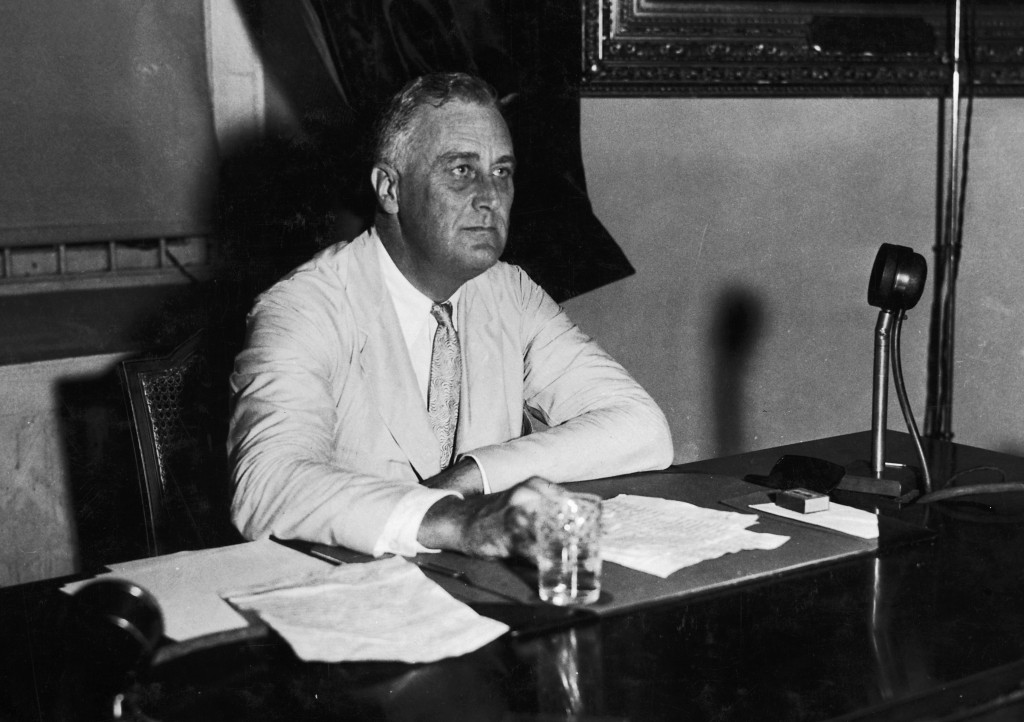








 freedom and reason