
A tentative ceasefire agreement has been reached between the United States and Iran. The details have yet to be finalized, and Iran has not ceased striking regional targets. However, a key demand—that Iran reopen the Straits of Hormuz—appears to have been secured. Oil prices have dropped as a result. Given global dependence on the free flow of oil, this development compels nations opposing the joint US–Israel intervention in Iran to take an interest in defending the principle of international waters. Baby steps.
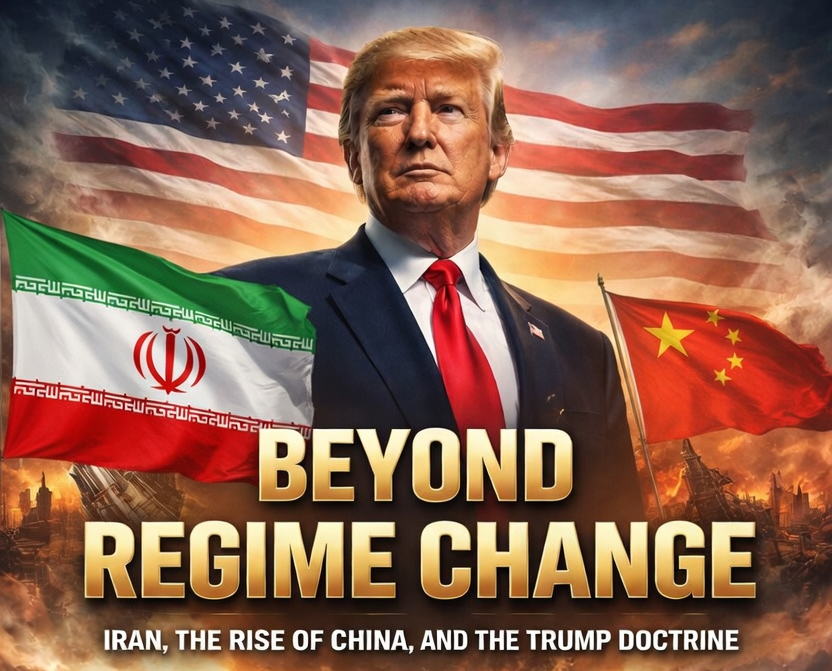
More significantly, the results advance Trump’s project of restoring full US hegemony in world affairs (see Donald Trump’s Grand Vision: Make Western Civilization Great Again and embedded links). The project seeks to revitalize Western civilization, which, under the pressures of transnational corporate power and broader geopolitical shifts, has been diminished over recent decades. This explains why progressives are so disappointed that Trump did not act on what they framed as a genocidal threat involving nuclear weapons.
To be sure, they predictably rationalized their disappointment. Social media users flocked to the digital platforms to gloat about what they spun as Trump’s capitulation to the Islamic Republic. “There’s nothing to celebrate about reopening the Straits of Hormuz,” they argued, noting that the straits were open before the joint US–Israel intervention. This is true. However, as I pointed out in comments to several threads, Iran also possessed a navy, an air force, missile systems capable of threatening Europe, and an advanced nuclear program before the intervention.
The closure of the straits was an Iranian response to the joint US–Israel action that significantly degraded Iran’s military capacity. Today, its navy has been largely destroyed, its air force severely weakened, its missile capabilities curtailed, and its nuclear program set back by several years. These developments form a major part of the administration’s strategy to weaken not only Iran but also its regional alignment with China, Russia, and other actors antagonistic to the United States and its allies. This infuriates the globalists who pretend not to understand Trump’s strategy.
Now that a ceasefire has been reached—after Trump threatened the regime with annihilation, underscored by a demonstration of force at Kharg Island—social media commentary has shifted. Critics now portray the president as having backed away from his earlier threats. This rapid shift—from accusations of impending genocide to the refrain that “Trump always chickens out” (or “TACO”)—reflects a broader effort to diminish his political standing. The flip of the switch telegraphs the intensity of opposition to his approach to global reordering.
Meanwhile, Democrats, who in recent weeks have discussed invoking the Twenty-Fifth Amendment, are now preparing potential articles of impeachment, which they will almost certainly pursue if they win the 2026 midterm elections. No good deed goes unpunished, as they say. It is not that Democrats don’t understand what Trump is doing. It is because they understand the Trump doctrine, and they don’t like it. It interferes with the managed decline of the West.
For many progressives, opposition to US–Israel action is less of a defense of the Islamic Republic itself and more of a concern over the broader implications of Trump’s geopolitical vision. Secretly, escalation, especially the use of nuclear weapons, would strengthen the case for his removal, thereby restoring prior US foreign policy approaches that emphasized global integration and enabling China. Hence, the shift from hyperbole of genocidal belligerence to the belittling charge of cowardice.
Globalist ambition explains why the authoritarian nature of the Islamic Republic is downplayed (there was no outrage over the Islamic Republic’s slaughter of civilians demanding liberation from tyranny). But the regime’s authoritarian nature is hardly in question from a rational standpoint, nor is the moral necessity to confront it. As discussed in a previous essay (No, Trump Did Not Signal Genocide. He’s Signaling the Destruction of the Islamic Republic), eliminating the Islamic Republic as a strategic threat can be likened to the Allied effort to defeat Nazi Germany. Critics deny this comparison by conflating a political regime with an entire people, which was the purpose of misrepresenting Trump’s post on TruthSocial.
However, the Islamic Republic does not represent the full breadth of Persian civilization. It is a Shi’a Islamic project for regional domination, analogous to the National Socialist ambition of a Greater German Reich, pursuing regional proxy conflicts—particularly against Israel—while advancing capabilities that could contribute to a broader global conflict. The Islamic Republic’s ambitions to establish a wider Islamic order are analogous to expansionist ideologies of the twentieth century. Allowing such a regime to develop unchecked, especially given its ideological orientation, is a failure of responsible nations to defend democratic principles. This failure is strategic, ultimately serving the interests of a transnational corporate order.
As noted in prior essays (e.g., War, Sacrifice, and the Abandonment of Principled Discernment; Trump Never Promised to Eschew Military Power to Confront Tyranny), I am generally opposed to regime-change wars. I opposed US interventions in Afghanistan and Iraq that sought regime change, for example. However, in the case of Iran, I view the situation differently due to the unique ideological and strategic threat the Islamic Republic poses. This view is informed by historical experience with totalitarian expansionism—an experience progressives obscure.
I hold similar concerns about China’s global ambitions, though I recognize that military regime change there would likely trigger a world war. In China’s case, a more viable strategy would involve addressing the dynamics of state-driven economic power within the global system. In this context, intervention in Iran marginalizes China and restores the West’s strategic dominance. It forces Iran to the negotiating table under terms distinct from those pursued by previous administrations. The issue of the Straits of Hormuz underscores the importance of maintaining international waterways and highlights the need for long-term strategic thinking, particularly in light of China’s ambitions.
The rise of China is linked to decades of economic globalization and the expansion of transnational corporate influence. The normalization of US–China relations in the 1970s—initiated under President Richard Nixon—was intended to exploit the Sino-Soviet split and rebalance Cold War geopolitics. However, it also created space for China to transition from rigid central planning to a hybrid economic model combining state control with market mechanisms.
Over time, this model has enabled China to integrate into the global economy while maintaining political control, leveraging foreign investment, export-led growth, and industrial policy. Initiatives like the Belt and Road Initiative and participation in multilateral groupings such as BRICS reflect China’s growing influence and its efforts to reshape aspects of the global order.
From this perspective, intervention in Iran is not only a response to a regional threat but also as part of a broader effort to counterbalance these global dynamics. So, while I would like to have seen regime change in Iran, the present situation, if it holds, carries much promise in the project to reassert Western influence in the world, which depends on populist-nationalist reclamation of Western nations. Military intervention in Iran has significantly advanced Trump’s project.
* * *
I also noted in yesterday’s essay the emergence of right-wing voices critical of Trump who argue that the US–Israel intervention was driven by a Zionist agenda. I pointed out that such claims often draw on conspiratorial frameworks with antisemitic roots, and that some who adopt these views are influenced by particular strands of ideological or religious thought.
Historically, elements within Christian theology—especially in parts of the Catholic tradition—advanced the “deicide charge,” i.e., the claim that Jews collectively bear responsibility for the death of Jesus. While not universal across all places and times, this idea contributed to discrimination and violence against Jewish communities in medieval Europe. But antisemitism did not disappear with the rise of capitalism. Indeed, as we saw in the case of National Socialism in Germany, and as we see today with the Red-Green Alliance, the specter of antisemitism continues to cast its shadow over the West. The Red-Green Alliance is a leftist development, and reflects the antisemitism that inheres in Islamic thought. However, antisemitic attitudes persist on the Christian right. There, religious identity becomes intertwined with ultranationalist or conspiratorial ideologies, manifesting as hostility toward Jews or toward Israel. In this view, Trump is a marionette whose mouth and limbs are operated by the Zionist puppetmaster.
This explains why a right-wing faction, whose interpretation of America First is distinctly isolationist, has broken with Trump (contrast their isolationism with my position articulated in America First is Freedom First). Indeed, this faction, like the progressive left, has taken up a defense of Islam. Forty-seven years of the Islamic Republic are not enough for this crowd. The irony is that their opposition to the Trump Doctrine, by fracturing the MAGA movement, enables the transnational corporate project to usher in the new world order they have historically decried. One might even suspect a grand conspiracy is at work here, one that seeks to turn conservatives against themselves to return America to the path of managed decline.

 freedom and reason