
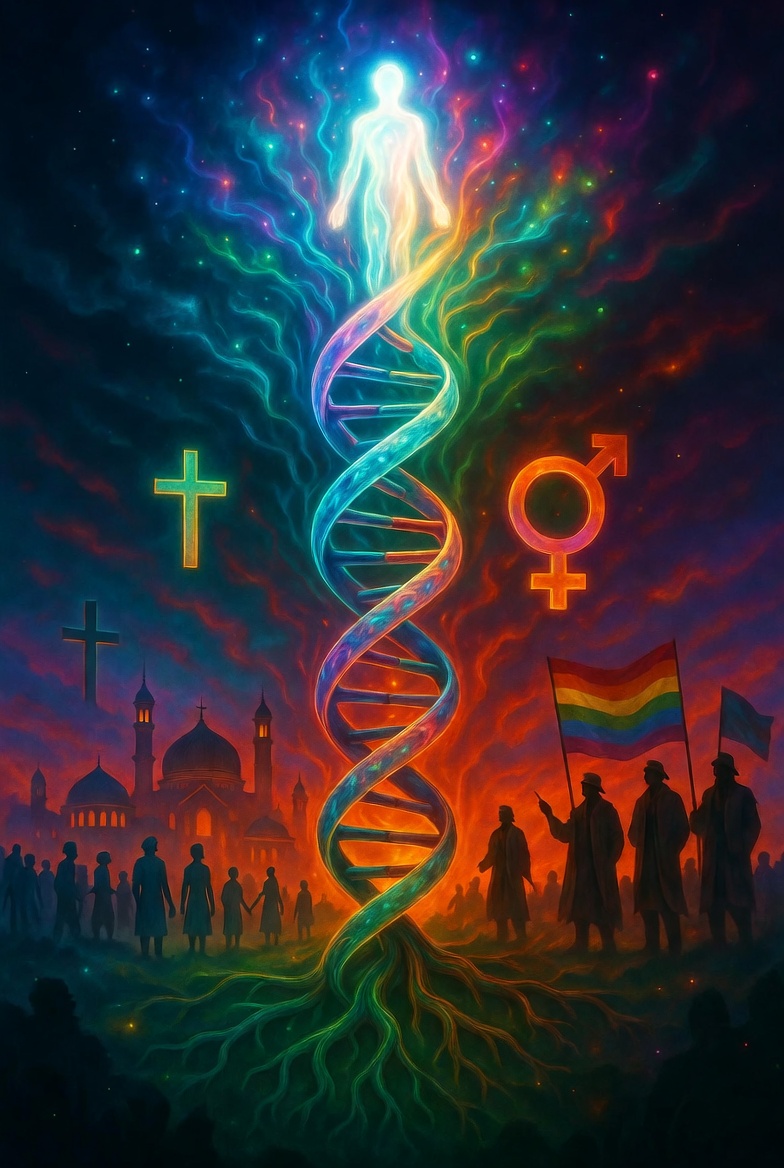
Research consistently shows that religiosity has a substantial genetic basis and, moreover, that the relative influence of genes versus environment shifts over the course of a person’s life.
In childhood and adolescence, religious belief and practice are shaped primarily by culture, family, and the shared social environment, with genetic factors playing a modest role—typically estimated at around 10–15 percent. During these years, children largely adopt the beliefs and behaviors of their parents and the surrounding community.
As individuals reach adulthood and gain independence, however, the influence of the shared environment declines sharply, while genetic predispositions become more pronounced. By adulthood, studies indicate that genetic factors account for roughly 40–45 percent of the variation in religiosity. In short, people tend to grow into their innate dispositions once they are free to choose their own beliefs and practices.
This pattern holds cross-culturally, though the balance between genetics and environment varies with the religiosity of the surrounding culture. Genetic influences appear stronger in more secular or pluralistic societies, where traditional religious norms exert less uniform pressure. For those societies with a high degree of religiosity, because individuals are less free to deviate from the societal standard, they are more likely to express the religious belief associated with that standard.
These findings help explain why secular societies often see quasi-religious ideologies—such as gender identity doctrine or the critical race standpoint—emerge to fill the void left by declining traditional religion. They also account for the persistent attraction to collectivism and statism among many secular individuals, who appear to seek a theocratic analogue.
Among progressive Christians, the ideology of gender identity aligns naturally with a hyper-emphasis on empathy and kindness, which also underlies support for expansive welfarism and open immigration. Progressive Christians are more likely than Christians of other persuasions to embrace the perpetrator-victim model that inheres in wokism. By contrast, both conservative and traditional liberal forms of Christianity tend to inoculate adherents against belief in such doctrinal absurdities, as well as against excessive statism. Conservatives are much more concerned with traditionalism and literal interpretations of Christianity. Traditional liberals are committed to the principle of individualism and Christian ethics, while less devoted to the theistic piece (a standpoint reflected in the thinking of many of America’s founders).
The quasi-religious character of gender identity becomes clearer when viewed as a modern analogue to the soul: an unfalsifiable, faith-based assertion whose validity rests entirely on doctrine. For those oriented towards the secular with a more atheistic worldview, this ideology satisfies an innate need for transcendental belief while simultaneously justifying a powerful role for the state and other authorities—so long as those authorities align with their ideological preferences.
This underlying need for religiosity or spirituality helps explain the alignment between woke progressivism and more overtly theocratic orientations, such as Islam—commonly known as the Red-Green alliance. Progressives see in radical Islam a model of theocratic control they wish to emulate, even if they reject its specific doctrines, such as the subordinate role of women in society and its stance regarding homosexuality. Both ideologies seek to order society according to their sacred beliefs. Both express an antipathy to freedoms of conscience and speech. In this sense, the Muslim extremist and the authoritarian progressive are birds of a feather.
Grasping innate religiosity helps one understand why it often feels impossible to engage in rational discussion with woke progressives and why they become so hostile when their views are challenged. Their views do not withstand fact and reason, so the typical response is to shut down while accusing those who challenge their beliefs of bigotry or, at the very least, intolerance. Gender identity, as a species of primitive belief, lies beyond the reach of empirical adjudication.
Like Islam, woke progressivism resists rational critique because its adherents embrace it not through evidence or logic, but through a deep-seated genetic predisposition toward religious belief, spiritual experience, and tribal loyalty under conditions of pluralism and secularism. Viewed from this primitive standpoint, the disbeliever becomes a heretic or an infidel. So, while pluralism and secularism are the desirable features of a free society, they have no bearing on the variability in the species’ susceptibility to religiosity. One suspects this is why, ignorant of the modern science of genetics, but having sufficient experience with the variable proclivities of mammals, the framers of America’s founding documents systematically codified the freedoms of conscience and speech.

 freedom and reason