
For decades, I’ve heard that America, as the world’s hegemon, is an imperial power projecting influence globally and, in the view of critics here and abroad, exploiting the planet’s resources and oppressing its peoples worldwide. But what is this argument really saying? What do America’s critics hope to achieve by diminishing the United States as a superpower? Why should the world hegemon, having achieved its status by delivering the world from the scourges of communism and fascism, and standing as a beacon of liberty and republicanism for 250 years, thereby legitimizing its power as the global authority, diminish itself?
The United States has rivals: totalitarian states, such as China, and totalitarian ideologies, such as Islam. These totalitarianisms pose a threat not only to the United States but to all of those who cherish or desire freedom. If the United States—or the West more broadly—were weak, these rival powers would dominate the global system in its stead, and Americans could lose everything they hold dear: the freedoms of conscience and speech, of assembly and association, and the rights to publishing and privacy. And Americans would not be the only ones to lose these precious things. People around the world would lose them, too, or those currently living under oppressive rule would find it more difficult to build for themselves a world where those things were possible.
The only way to safeguard these rights and keep the promise of freedom alive for others is for the United States to remain a superpower capable of protecting and advancing them. Because freedom is the birthright of all humans, we must hope to see people around the world enjoy it, as well. The United States cannot influence global movements toward greater freedom and human rights if it is a second-rate power. We cannot extend the promise of America to the world if we cannot keep the promise for ourselves.
But do all Americans wish to keep the promise? Unsurprisingly, those who seek totalitarianism want to weaken American power, as this creates more opportunities for them to shape the world order according to their interests. They leverage international organizations, like the United Nations, to advance this aim. Yet, in effect, if unintentionally, some actors within America and other Western countries—progressives and social democrats—align with those forces. Some of them want a totalitarian world because they have come to despise their country and the freedoms it affords. Others align with totalitarian states and movements under the naïve belief that they, too, will wield totalitarian power. They seek this power to impose on everybody an ideological system that denies reason and truth. They envision a global world order built on values other than the Enlightenment principles that made the West free and prosperous. We see this ideological system in atavistic beliefs about gender, race, and knowledge.
This is why “America First” is mischaracterized as a call for isolationism. Some who identify with the label may indeed favor America’s withdrawal from the world, but America First and isolationism are fundamentally incompatible. Ensuring the long-term prosperity and security of the United States requires active engagement in the world, not retreat. In a global system shaped by competing powers with vastly different political values and visions, American strength abroad is inseparable from American freedom at home. A retreat from global leadership invites other powers to shape the international order in ways contrary to American principles. While some in the West may wish for this, they must not succeed.
In a world where such rising and rival powers set the rules, Americans will inevitably feel the consequences—through economic coercion, geopolitical pressure, or technological imperative. Indeed, the West already sees these effects of global reordering and the influence of totalitarian ideologies. The world order has been substantially altered by powerful actors seeking a less free world. They have colonized the West’s sensemaking and policymaking institutions and are recruiting soldiers and twisting law and policy to advance their agenda. We see their soldiers on the streets of America. We see those who bear the culture of totalitarianism colonizing the West. Transnational financial and corporate power lies behind these movements.
In my last essay, Donald Trump’s Grand Vision: Make Western Civilization Great Again, I argued that, in reconfiguring the world order to thwart Chinese ambition, halting the spread of Islam, and reversing the transnational corporate project, President Trump is not only making America great again, but advancing the promise of liberty and republicanism, keeping alive and thus making possible a free life for all of humanity. Maintaining a strong global presence is thus not about abstract ideals of dominance or empire, but about safeguarding the conditions that allow American society, and potentially the world, to flourish. Economic prosperity, sovereign nations, secure trade routes, strategic alliances, and technological leadership all depend on continued engagement and leadership. The United States is the paradigm of a free society; its engagement must be forceful and its leadership hegemonic. A diminished United States would face a world less aligned with its interests and values—and more susceptible to coercion or instability.
American influence has historically played a critical role in expanding and defending individual liberties beyond its borders. While imperfect, the broader international system shaped by US leadership has fostered political pluralism and insisted on basic human rights. If Americans believe these freedoms are worth preserving at home and making available globally, it follows that they have a compelling interest in supporting a world where such principles can endure and spread. This requires the United States to remain the world hegemon and to shape the world order in a way that preserves the West. This means marginalizing those forces inside the West who steer their nations in the wrong direction. Progressives and social democrats are the enemies within.
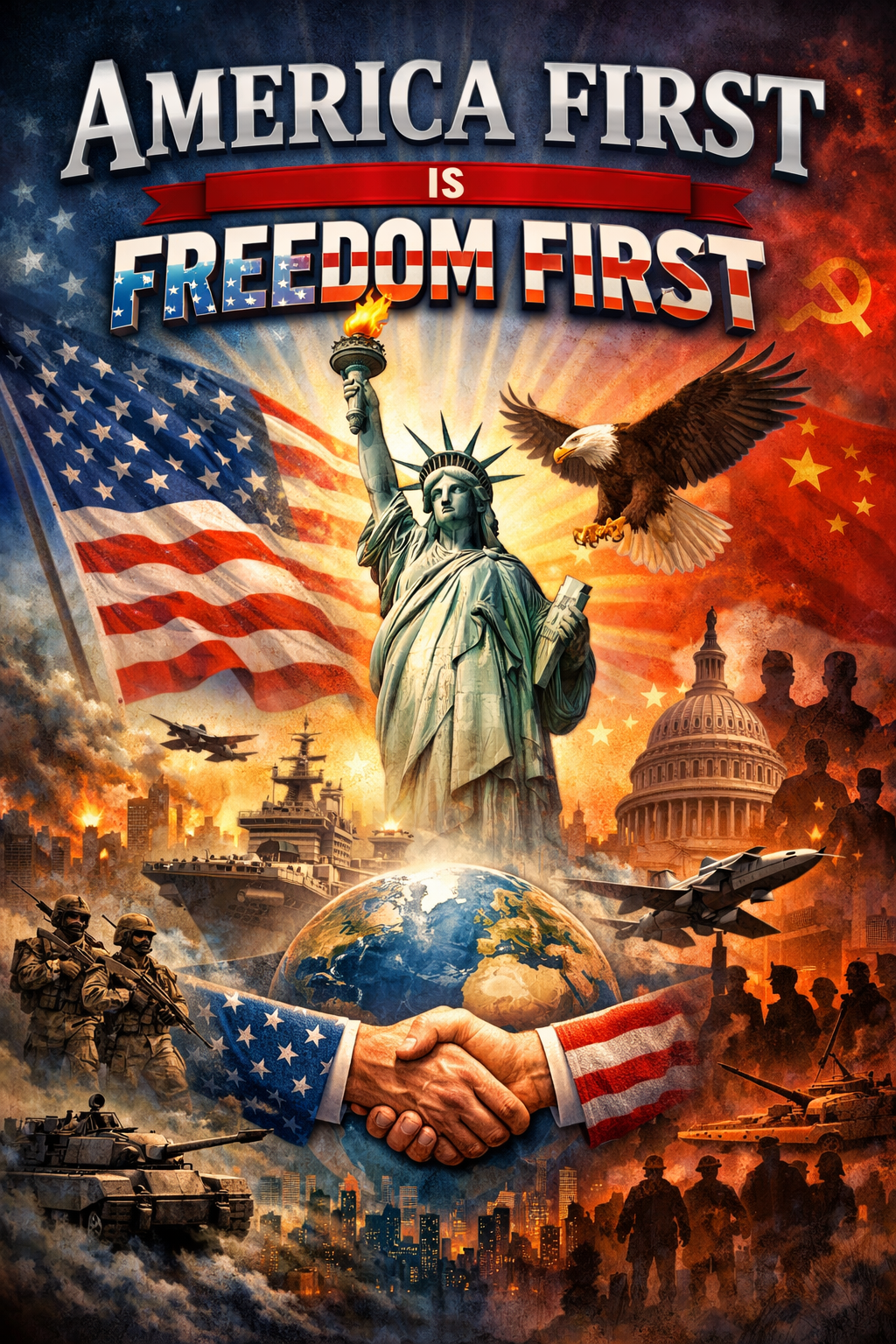
“America First” cannot mean America alone. American liberty, prosperity, and security are inextricably tied to the fate of the world. America First is Freedom First. Sustaining that role through economic dominance, political influence, and strategic military prowess is not a contradiction of national interest but a necessary expression of it. The projection of power is not inherently unjust. That determination depends on whether the power that’s projected is righteous. If America is morally right and virtuous, which its history affirms, then America’s actions are just. America can remain free only if the enemies of freedom are subordinate to American authority. And a freer world depends on their subordination.

 freedom and reason