
President Donald Trump went easy on NATO last night. Several commentators on the America First network noted the omission during post-address analysis. However, the President’s decision to avoid criticisms of Europe should help those skeptical of his commitment to “America First” better understand the broader strategy at work. Making America great again requires making the West great again.
“America First” cannot be conceived in narrow or purely isolationist terms. America’s long-term prosperity and security depend on halting the transnational corporate project, restoring the economic nationalism at the heart of the American System, and reestablishing the full scope of US hegemony in the world. In other words, “America First” must be embedded within a larger framework: West First.
Trump has articulated elements of this approach before, most notably in his National Security Strategy (see Trump’s National Security Strategy and the Case for Democratic Nationalism). That document marked a clear departure from the post–Cold War bipartisan consensus, which assumed that increasing economic interdependence and the diffusion of political authority beyond nation-states—in a word, globalization—would naturally produce peace and prosperity.
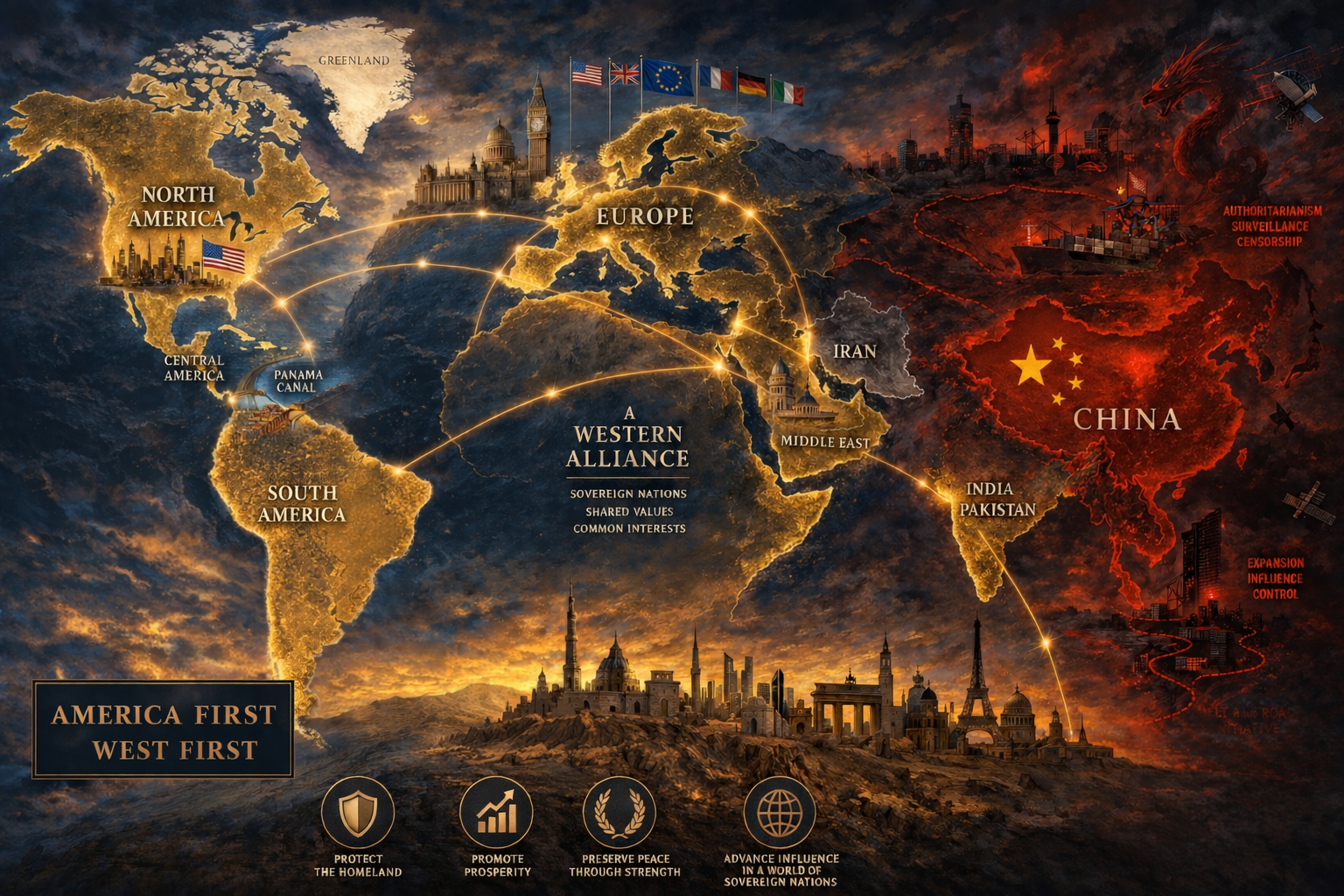
The Trump strategy rejects those premises, which essentially constitute a plan to denationalize the world (see Will They Break the Peace of Westphalia or Will We Save National Sovereignty for the Sake of the People?). Instead, the Trump doctrine grounds US national security in four core commitments: (1) protecting the American homeland; (2) promoting American prosperity; (3) projecting peace through strength; (4) advancing US influence in a world of sovereign nations.
The fourth commitment is key, beginning with the Western Hemisphere. Trump signaled this early through rhetoric surrounding Greenland and the Panama Canal (see Monroe Doctrine 2.0). Beneath that rhetoric lies a recognition of the need to confront China’s growing influence in the West, an effort facilitated by economic and political actors in North America and Europe (see Countering China’s Influence).
His posture toward Venezuela reflects this logic. Trump’s spectacular intervention in Venezuela and the removal of socialist dictator Nicolás Maduro are designed to push South America in a liberal direction (see The New World Order as Given). Trump’s focus on Central and South America—culturally tied to the Western tradition—represents an opportunity to unify the Hemisphere around Western ideals. If the United States can help foster governments aligned with Western political and economic norms, a more unified Western Hemisphere becomes possible. This goal is also reflected in the administration’s stance towards Cuba.
Yet consolidating the Americas alone is insufficient. Reasserting Western influence globally—and countering China, freedom’s principal strategic competitor—requires a broader coalition that includes Europe and parts of the Middle East. The intervention in Iran, the Shi’a Muslim stronghold in the region, governed by the most extreme form of Islam, the apocalyptic Twelvers, not only degrades the capacity of an existential threat to Central and Western Asia, but also checks the rise of China. By neutralizing the threat of Iran, the United States strengthens its relationship with states in the MENA space, as well as India and Pakistan, and closes avenues for China’s ambitions.
Europe is central to the strategy. Trump has told European leaders what he thinks of them, but at the same time, he wants Europe to be part of the global alliance marginalizing China and halting the spread of Islam. What is required here, as in Central and South America, is cultivating more liberal, conservative, and populist-nationalist political movements. What Trump seeks is to strengthen the Western civilizational bloc, not only to prevent totalitarian state monopoly capitalism (of which China is the paradigm), thus weakening the transnational corporate push for a new world order, but also to confront the threat of Islam to the Christian West.
In reconfiguring the world order to thwart Chinese ambition, halting the spread of Islam, and reversing the transnational corporate project, Trump needs Europe. He must avoid alienating member states while promoting nationalist political movements that will reclaim Europe’s greatness. Trump’s actions are not random or disconnected moves. It’s a strategy: consolidate a Western-aligned bloc across the Americas, Europe, and key parts of the Middle East, and use that to simultaneously counter China’s expansion and halt Islam in its tracks.

 freedom and reason