
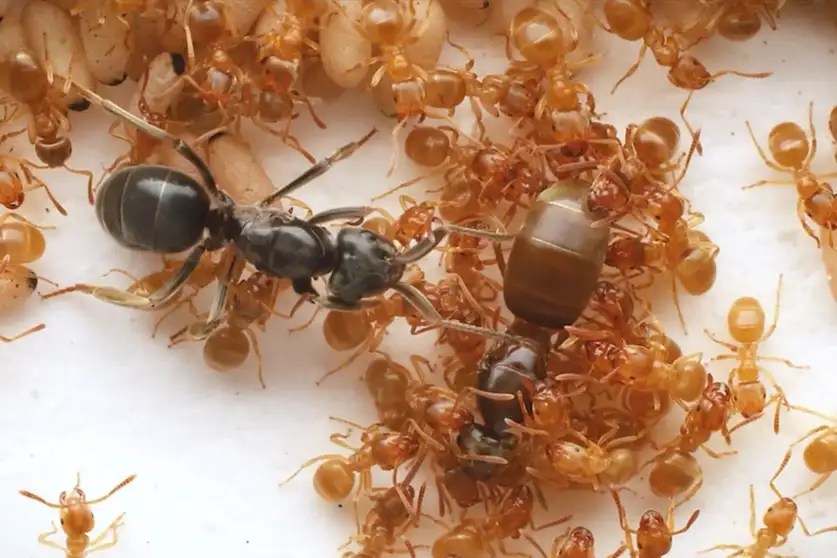
This popped up in my X feed, and I found it to be a powerful analogy. The species described in the post is the parasitic queen of Lasius orientalis (the “bad-smell ant” in Japanese), which invades colonies of the host species Lasius flavus (the yellow meadow ant). A similar behavior has also been documented in Lasius umbratus invading Lasius japonicus (or related hosts). He uses the nature of this ant species to convey the problem of Islam in America and the cultivation of allies who work to undermine national integrity.
Burmawi’s poetic description captures the essence of the analogy beautifully. Lasius orientalis is a real-world example of infiltration, chemical manipulation, and regime change, and thus effectively illustrates the problem of social parasitism. Burmawi is the author of Islam, Israel and the West: A Former Muslim’s Analysis, published by Gerasa Books in 2025, so we know the ideology he has in mind. (Full disclosure: I have not read Burmawi’s book. I did not know about his work until this morning.)
“This is how ideological takeover works,” he writes in his X post.
“A destructive foreign ideology takes the scent of familiar ideas and walks in as if it belongs. It speaks the native vocabulary—justice, equality, compassion, rights, and progress. It uses these words and quietly changes what they point to. Then it moves inward. It alters how foundations are perceived. Responsibility is made to smell like cruelty, law like oppression, borders like hatred, tradition like danger, history like guilt. At that point, the civilization turns on itself. Its courts, universities, churches, media, and bureaucracies begin treating their own foundations as threats. They believe they are defending the system. They are enforcing what now smells legitimate. They do not see the intruder because it sounds exactly like them.”
I expect some readers will object to arguments using the description of an insect to describe the work of human agency and doctrine. They will see it as dehumanizing. I, too, used to think this way. I then realized that the unspoken assumption in the objection treats human beings as apart from nature; it smuggles in theology to set humans apart from the animal kingdom. It obscures the fact that, like the ant, humans are the result of natural history, a process that entails the evolution of protective instincts to survive in a world of predators, including members of our own species, differentiated by worldview. It also obscures the fact that, like humans, ants are social animals. This is why human populations have always worried about strangers and, frequently, have resorted to violence to defend the integrity of the in-group from out-group threats. Progressive ideology, e.g., multiculturalism, does more than weaken this protective instinct—it turns some groups against themselves.
Comparing humans to other animal species has broad applicability in understanding threats to safety and well-being. I have been writing about the problem of sex by deception for a while now (see, e.g., Sex by Deception and Distorted Notions of Revenge; The Queer Project and the Practice of Deceptive Mimicry; Lesbians, Men, and the Homophobia and Misogyny Underpinning Queer Theory). This phenomenon exemplifies deceptive mimicry in the animal kingdom, including human populations.
In deceptive mimicry, one sex—typically the male—exploits the sensory biases, emotional recognition systems, and mate-choice criteria of the other by mimicking high-value signals that promise commitment, fidelity, mutual desire, resources, or status. In human populations, this pattern manifests through behavioral and psychological mimicry tailored to gender-specific preferences shaped by evolutionary pressures. Men more frequently feign emotional commitment, love, or sincerity to secure short-term sexual access, mimicking the cues women use to assess investment and loyalty. Conversely, women may mimic cues of enhanced physical attractiveness or sexual willingness through appearance alterations or online profiles (see Is this Dating Site Encouraging Deception and Fraud?) to extract attention or access under false pretenses.
Both sexes may, and often do, exaggerate mate value, thereby hijacking the perceptual rules the opposite sex relies on for mate selection. This is not always exploitative or harmful. But sometimes it is. In the case of transwomen deceiving lesbians into sexual intimacy, predatory males disguise themselves as women, withholding the truth of their gender to gain access to women who are, for the most part, sexually attracted to other women.
In yesterday’s essay (Those Who Can Make You Believe Absurdities…), I detailed the case of Rose Mulet, who posted a video on X criticizing a transman for saying that those who identify as a gender other than what they were “assigned” at birth are obligated to tell someone with whom they’re about to have intimate relations that they are trans. Mulet has previously posted (in 2022) about the need to charge women who defend themselves with lethal force against sexual predation with murder. Not only does Mulet deceive women via simulated sexual identity, but he promulgates an ideology that, if normalized, would transform those who defend themselves from sexual predation into a type of bigot, namely a “transphobe,” and even a criminal.
Sex by deception is aggressive mimicry at its most intimate; the mimic does not merely blend in but actively weaponizes the target’s own preferences and decision-making machinery against them, turning honest communication channels of attraction and bonding into exploitative traps. Just as the Lasius orientalis queen mimics the colony’s scent to bypass defenses and turn the workers against their own queen, human sexual deception turns desire, emotional investment, and trust into the mechanisms of manipulation.
The problem Burmawi identifies with his analogy is deceptive mimicry at scale. In several essays on this platform (see Revisiting the Paradox of Tolerating Intolerance—The Occasion: The Election of Zohran Mamdani; Defensive Intolerance: Confronting the Existential Threat of Enlightenment’s Antithesis; Human Nature and the Limits of Tolerance: When Relativism Becomes Nihilism; Epic City and The Muslim Problem: Confronting the Presence of Exceptional Doctrine in American Society), I have warned about the problem of Islamization and, given that the First Amendment to the United States Constitution, suggested ways to handle the existential threat Islam presents to Western civilization without running afoul of religious liberty and free speech, crucial freedoms that at the same time render society vulnerable to deception.
Another barrier to preventing Islamization is Article VI, Clause 3 of the US Constitution: “The Senators and Representatives before mentioned, and the Members of the several State Legislatures, and all executive and judicial Officers, both of the United States and of the several States, shall be bound by Oath or Affirmation, to support this Constitution; but no religious Test shall ever be required as a Qualification to any Office or public Trust under the United States.” The Supreme Court has incorporated this clause at the state and local levels. For this reason, Zohran Mamdani could not be barred from becoming mayor of New York City.
Since individuals residing in the United States have freedom of conscience, and the “no religious test” clause prevents governments from screening out those whose beliefs are antithetical to the American ethos, Muslims are allowed to practice their faith, and, moreover, those who are citizens of the United States are permitted to run for political office. Therefore, preventing social parasitism requires reducing the presence of Muslims in America.
The most immediate way to do this is by effectively barring Muslims from entering the United States by restricting immigration from Muslim-majority countries (while granting refugee status to those who are not Muslim). In both of his terms in office, Donald Trump did precisely this, and the Supreme Court has affirmed his authority to do so.
The Supreme Court decision upholding Trump’s so-called “Muslim ban” is Trump v. Hawaii, 585 US 667 (2018), decided in June, 2018. The court found that the President acted within the broad authority granted by 8 USC. § 1182(f) of the Immigration and Nationality Act (INA). The statute allows the President to suspend the entry of aliens (or classes of aliens) when he finds that their entry “would be detrimental to the interests of the United States.” The Court emphasized the wide deference given to the executive in national security and immigration matters.
But more needs to be done. The federal government should deport those who are not permanent residents or naturalized citizens, and consider denaturalizing those not born in the United States (I recognize the difficulties in doing this). Additionally, the natural-born citizen requirement in Article II, Section 1, Clause 5 of the US Constitution regarding qualifications for President should be expanded to include all elected public offices in the United States, including state and local elected offices. While this would not preclude Muslims born in America from assuming political office, it would reduce the pool of potential candidates.
Making these changes will not only shrink the presence of Muslims in America but also alert the population to the problem Islam represents. High-profile government efforts to restrict Islam in America signal the importance of recovering the protective instinct that has been eroded by multiculturalism. We are already seeing popular desire to recover this instinct with various state legislation, enacted (for example, in Texas) and proposed, banning the implementation of Sharia.
Predictably, there have been and will be objections to the imperative of strengthening cultural and national integrity. But these objections also carry a signaling function: by allowing patriots to see who among their countrymen holds opinions antithetical to the imperative of national preservation.
One last thing. For those who read this and find it racist, they will find it so because they are victims of a highly successful propaganda campaign to make cultural and irreligious criticism selectively appear as a form of racial prejudice. But Islam is self-evidently not a race. It is a political-religious ideology.
To help those who automatically perceive warnings about the pernicious spread of Islam get over their conditioning, I ask them to consider the case of fascism. That fascism is an ideology is easily recognized. If Burmawi’s analogy had warned the public about the way fascists insinuate themselves into positions of power, nobody in their right mind would perceive the analogy as racist.
Moreover, Islam is not only like fascism in that it is an ideology, but Islam and fascism are highly similar in their respective contents. I have described Islam as a species of clerical fascism. This is why, during World War II, Amin al-Husseini, the Grand Mufti of Jerusalem, met with Adolf Hitler in November 1941 to secure support from the Nazis for Arab independence, expressing the view that the Nazis and Palestinians shared a common enemy in the Jewish people. He expressed solidarity with Nazi Germany’s goal of annihilating the Jewish population in Europe and encouraged Arab resistance against the Jewish communities in Palestine.
The imperialist and predatory ambitions of Islam are undeniable, which a cursory survey of history will confirm.

 freedom and reason