
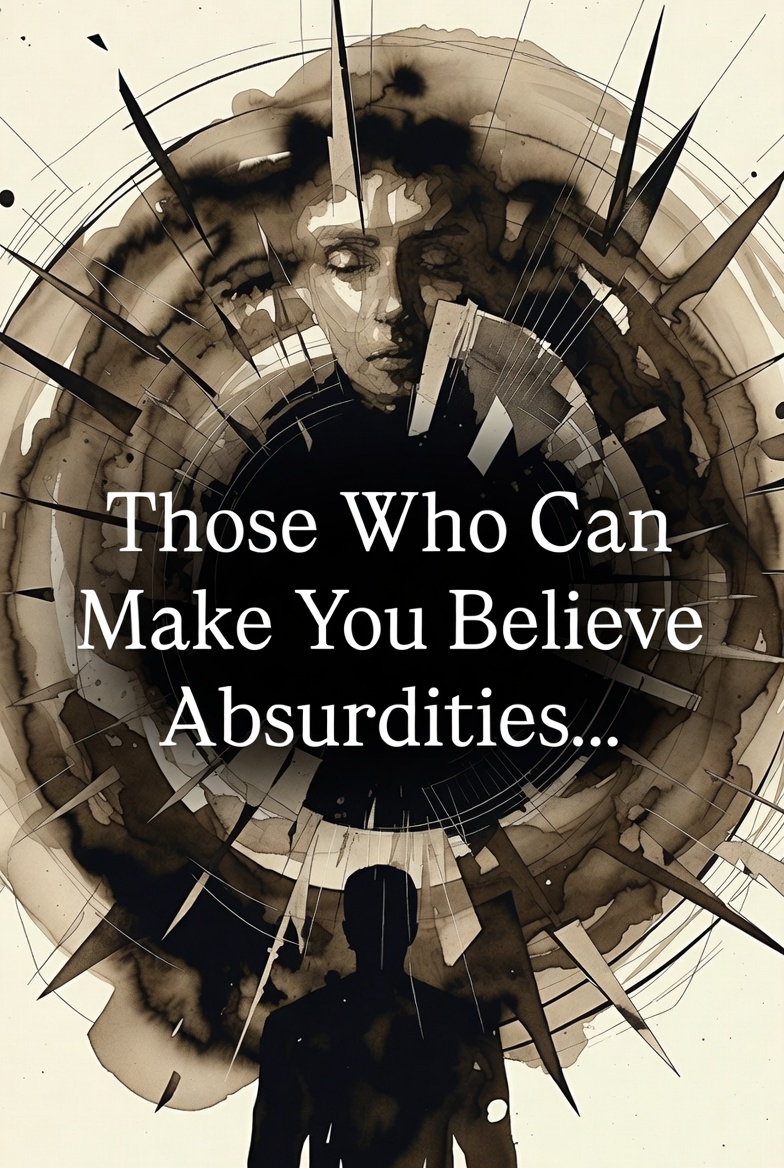
« Ceux qui peuvent vous faire croire des absurdités peuvent vous faire commettre des injustices. » —Voltaire, Questions sur les miracles (1765)
“The Ministry of Truth—Minitrue, in Newspeak—was startlingly different from any other object in sight. It was an enormous pyramidal structure of glittering white concrete, soaring up, terrace after terrace, 300 metres into the air. From where Winston stood it was just possible to read, picked out on its white face in elegant lettering, the three slogans of the Party:
WAR IS PEACE
FREEDOM IS SLAVERY
IGNORANCE IS STRENGTH”
—George Orwell, Nineteen Eighty-Four (1949)
The Voltaire line roughly translates to “Those who can make you believe absurdities can make you commit injustices.” Today’s essay is about the injustices that the absurdity of gender identity doctrine seeks to justify. It concerns an X user, Rose Mulet, who shared a video on March 17 attacking a transman for saying that those who identify as a gender other than what they were “assigned” at birth are obligated to tell someone with whom they’re about to have intimate relations that they are trans.
The transman does not provide a reason for her opinion, but as I have written about on this platform, an obvious one would be that, failing to do so, perpetrates sex-by-deception, which is a form of sexual assault. Given what Mulet has said in the past, this is the relevant concern.
What prompted me to find Mulet’s video is a post on X where Mulet claimed in 2022 that women do not have the right to use lethal force in defending themselves from sexual assault. The right to use lethal force to defend one’s person from assault is a basic human right. Killing somebody in self-defense is by definition not murder, since murder is the unlawful killing of another person, and self-defense is not in principle unlawful. One must be suspicious of an ulterior motive in such an argument.
In a recent essay, Lesbians, Men, and the Homophobia and Misogyny Underpinning Queer Theory, I asked the reader to consider the scenario in which a lesbian takes home who she presumes is another woman, only to find out that it is a man portraying himself as a woman. Had the man told the lesbian the truth, she almost certainly would not have invited him to come home with her. What is his purpose in lying to her? Is it not obvious? Most transwomen are heterosexual males.
Rose Mulet’s video is nine minutes of quick-cut rationalizations, which are instructive rhetorically, psychologically, and politically.
Rhetorically, when people say “trans women are women,” they are using an Orwellian slogan designed to invert truth. George Orwell provided several examples of this in his novel Nineteen Eighty-Four, which I cited above. The truth of the slogan “trans women are women” is easily extracted from the formulation: trans women are men. An actual woman would not need to rationalize her gender to a partner—unless she were a transman. The formulation “transmen are men” is the same Orwellian inversion from which the truth is easily extracted: a transman is a woman.
Mulet wants society to drop the “transwomen” part and just say “women,” since, if trans women are women, then there’s no reason to use a bad slogan. Mulet thus admits that the truth the slogan disguises is easily revealed. Society has become wise to the attempt to deceive. Moreover, the charge of bigotry leveled against those who are concerned about genitalia—or where genitalia used to be, or where a simulation appears—no longer works. It is not enough to shame people who care about sexuality, so deception is needed if one wishes to force oneself on others. What is needed, then, if one seeks to more effectively deceive others—and oneself—is to pretend as if there are no differences between female and male. This moves deception to a deeper level.
The psychological piece is that Mulet is desperately trying to deny that he is male, and in so doing, convince himself of something he’s not to more effectively lie about what he really is. This approach enables a predatory male in his own mind to deny the moral gravity of deception in intimate relationships. Attempts to convince oneself that a lie is the truth facilitate dishonesty without remorse. This is a sign of predatory psychopathy.
Rationalizing deception raises concerns about Mulet’s intention. A person prepared to lie to another person to achieve sexual intimacy is a dangerous animal. Mulet must know at some level, however hard he attempts to deceive himself, that there are people who, if they knew that he was a transwoman, would not have intimate relations with him. (There is another level of deception here that I will leave aside to avoid appearing cruel.)
More broadly, the purpose of disordering truth about gender in this way is to prepare the public to believe obvious lies, or, as Voltaire would have it, absurdities. Disordering truth thus has a general application; the queer project is part of the larger postmodernist project to erect a new social order upon absurdities so that injustice may be normalized. This is a political project that disrupts prevailing common sense via transgressive discursive formation, to use the jargon of queer theory.
Mulet or anyone who seeks to drop the “trans” designation knows that the need for the qualifier proves that the biological category differs from the performed gender; if it were truly indistinguishable, the extra word would be redundant. The slogan doesn’t describe reality—it attempts to rewrite it by linguistic fiat. That’s not semantics; it’s a deliberate attempt to control thought by controlling the dictionary. It is, as Orwell describes it in his novel, Newspeak.
As readers may be aware, whether under pressure from activists or part of the political agenda, many established dictionaries (Merriam-Webster, Oxford) added to the definition of “women” the circular construction that a woman is a person who identifies as such. However, in the wake of pushback against trans madness, lexicographers have returned to the apolitical definition. To be sure, trans activists still use the circular definition (as I noted recently in An Ellipse is a plane figure with four straight sides and four right angles, one with unequal adjacent sides (in contrast to a circle), but this development is promising.
* * *
Mulet’s video collapses categories to alter ordinary standards of consent. Informed consent requires that both parties understand the material facts about the person they’re about to be physically intimate with. Biological sex is as material as it gets—chromosomes, gametes, reproductive anatomy, secondary sex characteristics, etc. Withholding that information is deception by omission. Linking Mulet’s argument with his earlier argument against using lethal force against a rapist, he appears to be engaged in preparatory rationalization, that is, creating a justification before taking an action he intends.
Rhetorically and psychologically, the rant is a paradigm of motivated reasoning: the speaker has to maintain the internal fiction (“I am a woman”) so thoroughly that he can sell it to others without hesitation. The deeper he buries the knowledge that he is male, the smoother the deception becomes. This is self-gaslighting in service of external gaslighting. The goal is sexual access; the level of commitment to the lie is dangerous precisely because the man has demonstrated that he is willing to override another human being’s sexual boundaries for his own gratification.
Mulet should be told that the rationalization won’t work. Courts in multiple countries have already treated analogous cases as sexual assault or rape by fraud, e.g., in cases where someone conceals a spouse, a venereal disease, or a prior sterilization. The “I identify as…” defense doesn’t magically erase the physical reality the other person is interacting with. If a person had not consented had they known the truth, then the consent was never valid. The person who is deceived is the victim of a crime.
I note in my essay Lesbians, Men, and the Homophobia and Misogyny Underpinning Queer Theory, that those who are concerned about this problem are accused of “obsessing” over the transgender phenomenon. I am a criminologist. A criminologist is concerned about criminals and their victims. It would be irresponsible for a criminologist to ignore a problem in this area because members of a social movement desire to escape responsibility for their predatory behavior.
* * *
I conclude by noting that I have used the correct pronouns when discussing this case. My stance on pronouns is consistent with my broader point about the power of language in shaping thought. If biological sex is real and observable, then referring to an adult human male as “she” is the true act of misgendering; it’s the ideological term that’s doing the distorting.
Refusing to play along isn’t “bigotry,” “hate,” or “misgendering”; it’s refusing to participate in a collective delusion that has downstream consequences for women’s activities and spaces—sports, bathrooms, prisons, and, as I am highlighting in this essay, sexual consent.
Language isn’t neutral when it’s being weaponized to invert observable reality, and the sooner society at large refuses to participate in absurdities designed to disorder common sense, the sooner society will return to normality.

 freedom and reason