
The increasing rationalization of society, the contradiction between such rationality and reason, the collapse of the assumed coincidence of reason and freedom—these developments lie back of the rise into view of the man who is ‘with’ rationality but without reason, who is increasingly self-rationalized and also increasingly uneasy.” —C. Wright Mills, The Sociological Imagination
“Have you not heard of that madman who lit a lantern in the bright morning hours, ran to the marketplace, and cried incessantly: ‘I seek God! I seek God!’—As many of those who did not believe in God were standing around, he provoked much laughter. Why? Has God gone? He has. God remains dead. And we have killed him—you and I.” —Friedrich Nietzsche, Thus Spoke Zarathustra
In an era marked by rapid economic, social, and technological transformations, it becomes imperative to synthesize the disparate observations individuals may make into a cohesive theoretical framework. My platform, Freedom and Reason, with its subtitle “A Path Through Late Capitalism,” serves as a chronicle of contemporary history viewed through the lenses of anthropology, history, and political sociology. In this essay, I sketch the theoretical synthesis I use to map the path through late capitalism.
I ground my writing in a commitment to scientific inquiry, particularly in anthropology, biology, sociology, and social psychology—fields that inform my analyses of issues such as gender, identity, and race, without descending into pseudoscientific racialism. The nearly daily essays I publish are not isolated commentaries but contributions to an overarching theory of the contemporary world.
My essays dissect how seemingly unrelated phenomena—critical race theory (CRT), gender ideology, immigration policies, and medical-industrial tyranny—function both as paradigms of societal confusion and as windows into a broader transnational project, as well as a critique of the morality-crushing force of rationalization, in which instruments and means become devoid of ethical meaning, indeed, who human beings are transformed to instruments and means to ends serving elite power and privilege. What I sketch here is an overarching theory that explains how these elements converge in the terminal phase of capitalism, leading us toward a post-capitalist corporate statism that threatens the very foundations of freedom and reason. Indeed, the link between freedom and reason has largely been severed, and what is breaking through presages a new dark age.
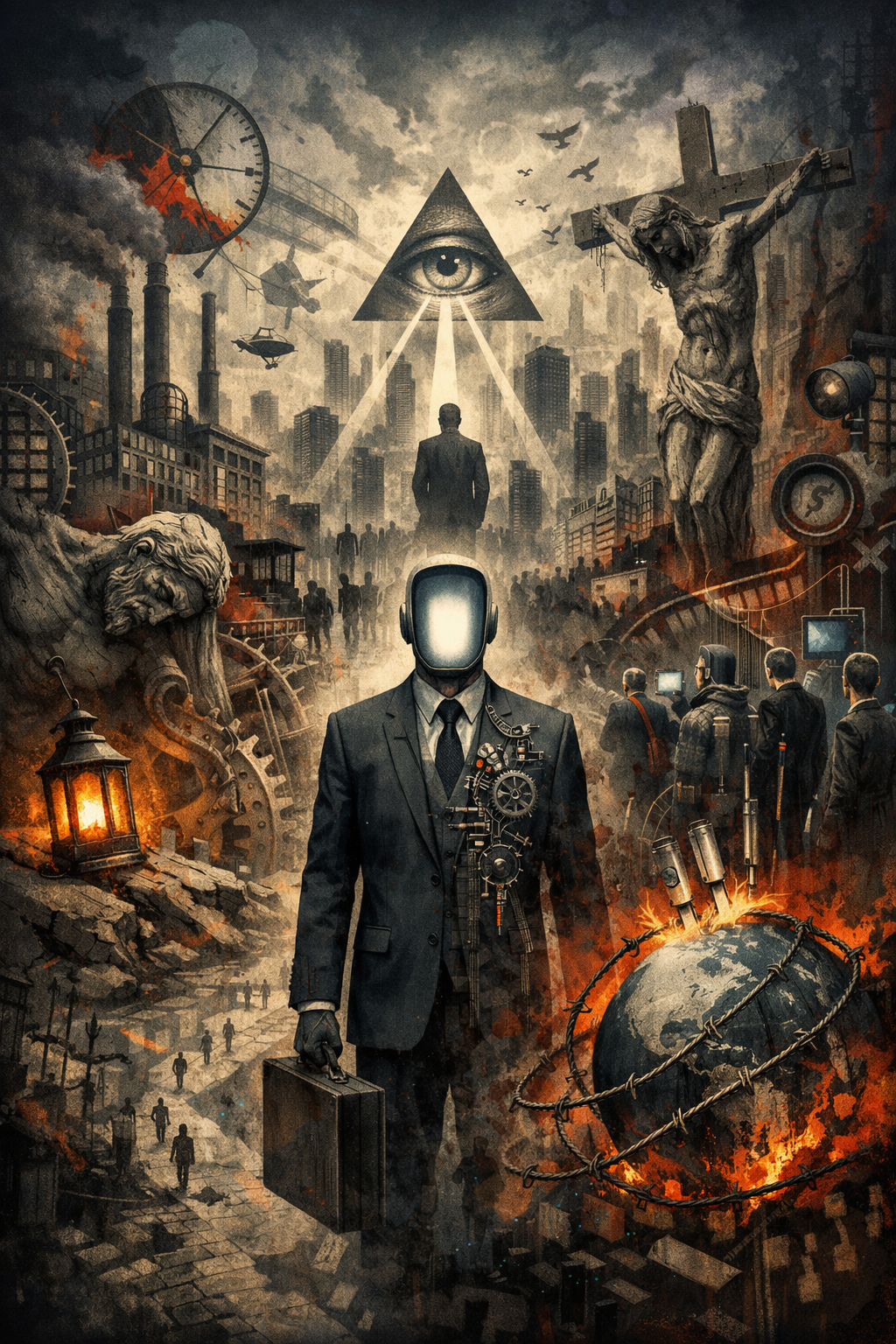
The title of my platform draws from C. Wright Mills’s The Sociological Imagination (1959), where he observes the decoupling of freedom and reason in the overdevelopment of modern society, what he calls the “Fourth Epoch.” He writes, “The ideological mark of the Fourth Epoch is that the ideas of freedom and of reason have become moot.” Mills characterizes the breakdown of this connection: rationalization becomes dominant; efficiency and organizational logic become ends in themselves; individuals adapt to these systems and lose autonomy and critical capacity; and freedom diminishes even as society becomes more “rational.” He introduces the figure of the “cheerful robot” to illustrate a person who has internalized rationalization without exercising reason—rationality without discernment. For Mills, this is the paramount problem for freedom in the modern age.
“Rationally organized social arrangements are not necessarily a means of increased freedom—for the individual or for the society,” Mills writes. “In fact, often they are a means of tyranny and manipulation, a means of expropriating the very chance to reason, the very capacity to act as a free man. Only from a few commanding positions or—as the case may be—merely vantage points, in the rationalized structure, is it readily possible to understand the structural forces at work in the whole which thus affect each limited part of which ordinary men are aware.”
This insight is not unique to Mills. It echoes earlier thinkers such as Max Weber, who in The Protestant Ethic and the Spirit of Capitalism (1905) and Economy and Society (1921) describes the consequences of rationalization under capitalism, particularly the rise of bureaucratic power.
Weber writes in Economy and Society:
“No special proof is necessary to show that military discipline is the ideal model for the modern capitalist factory, as it was for the ancient plantation. However, organizational discipline in the factory has a completely rational basis. With the help of suitable methods of measurement, the optimum profitability of the individual worker is calculated like that of any material means of production. On this basis, the American system of ‘scientific management’ triumphantly proceeds with its rational conditioning and training of work performances, thus drawing the ultimate conclusions from the mechanization and discipline of the plant. The psycho-physical apparatus of man is completely adjusted to the demands of the outer world, the tools, the machines—in short, it is functionalized, and the individual is shorn of his natural rhythm as determined by his organism; in line with the demands of the work and procedure, he is attuned to a new rhythm through the functional specialization of muscles and through the creation of an optimal economy of physical effort.”
In The Protestant Ethic and the Spirit of Capitalism, he concludes:
“Since asceticism undertook to remodel the world and to work out its ideals in the world, material goods have gained an increasing and finally an inexorable power over the lives of men as at no previous period in history. Today, the spirit of religious asceticism—whether finally, who knows?—has escaped from the cage. But victorious capitalism, since it rests on mechanical foundations, needs its support no longer. The rosy blush of its laughing heir, the Enlightenment, seems also to be irretrievably fading, and the idea of duty in one’s calling prowls about in our lives like the ghost of dead religious beliefs. Where the fulfilment of the calling cannot directly be related to the highest spiritual and cultural values, or when, on the other hand, it need not be felt simply as economic compulsion, the individual generally abandons the attempt to justify it at all. In the field of its highest development, in the United States, the pursuit of wealth, stripped of its religious and ethical meaning, tends to become associated with purely mundane passions, which often actually give it the character of sport.
“No one knows who will live in this cage in the future or whether at the end of this tremendous development entirely new prophets will arise, or there will be a great rebirth of old ideas and ideals, or, if neither, mechanized petrification, embellished with a sort of convulsive self-importance. For of the last stage of this cultural development, it might well be truly said: ‘Specialists without spirit, sensualists without heart; this nullity imagines that it has attained a level of civilization never before achieved.’”
Karl Marx had, years earlier, similarly critiqued how capitalism alienates individuals from their labor and from their species-being (Gattungswesen). What all three thinkers identify is modernity as a double-edged development: it brings scientific progress, material abundance, and expanded liberties, yet also engenders alienation, disenchantment, and domination. Friedrich Nietzsche’s proclamation of the “death of God” captures the resulting metaphysical vacuum.
This metaphysical void fosters irrationalism, allowing primitive and nihilistic elements to permeate society. Postmodernism, particularly in its institutionalized form within higher education, intensifies this condition by relativizing truth and undermining rational discourse. While Marx would likely have framed the issue differently, Nietzsche’s insight nonetheless resonates with Marx’s concept of estrangement. Weber, for his part, appears more directly aligned with Nietzsche’s cultural diagnosis.
These problems intensify in what has been described as capitalism’s late or terminal phase, particularly in its advanced corporate form, as theorized by Ernest Mandel in Late Capitalism (1975). We are witnessing the unraveling of a system once propelled by liberal capitalism—a system I have come to prefer over socialist alternatives, despite earlier sympathies, on the grounds that socialism has historically produced profound unfreedom rather than greater human liberation.
Mandel poses a critical question: What happens when human labor is eliminated from production through full automation? In such a scenario, the labor theory of value implies that value itself would collapse, since value depends on human labor. A fully automated society would produce goods without generating income, undermining the very logic of exchange.
In response to these contradictions, global elites—often articulating their visions openly through institutions such as the World Economic Forum and major financial actors, such as BlackRock (of late attempting to walk back what was said a little too soon and too explicitly)—appear to be shifting away from liberal-democratic forms toward technocratic, corporate-statist arrangements.
My conceptualization of this emerging order draws on Sheldon Wolin’s idea of “inverted totalitarianism,” described in his 2008 Democracy Inc.: Managed Democracy and the Specter of Inverted Totalitarianism, as a dissimulated form of total control that operates through Antonio Gramsci’s concept of “ideological hegemony.” Here, the work of George Orwell is also instructive. Elites seek to preserve their power, privilege, and wealth in a world where traditional hegemonic strategies fail amid Jürgen Habermas’ “legitimation crisis” (Legitimation Crisis, 1973), a situation in which the state can no longer effectively steer capitalism.
An attendant ideology facilitates this transition: contemporary progressivism, which often functions to justify the technocratic rationalization of social life. Doctrines such as critical race theory, postcolonialism, and queer theory contribute to a broader delegitimation of Enlightenment values and shared epistemic standards, thereby enabling new forms of ideological management. These are not mere intellectual exercises but tools to disorder the populace and incorporate the global proletariat into a new world order.
As was the case in Mills’ The Power Elite, my conceptualization of the problem of the emergent totalitarian state is shaped by observations made by Franz Neumann in his 1942 Behemoth: The Structure and Practice of National Socialism. There, Neumann argues that National Socialism, the fascism particular to Germany in the WWII period, represented an irrational, terroristic form of corporate statism operating through a technocracy, eschewing democracy altogether. The Nazi state is, at its core, totalitarian monopoly capitalism.
Today, technocratic governance intersects with a disorganized and fragmented populace. Prevailing ideologies often generate confusion, preparing societies for reconfiguration. Language itself becomes a tool of power, echoing Orwell’s concept of “Newspeak.” Concepts such as “manufactured consent,” associated with Noam Chomsky and Edward Herman, and rooted in earlier work by Edward Bernays, remain instructive: the manipulation of perception becomes central to governance. The assault on the truth prepares the population to believe lies.
This ideological apparatus extends to the corruption of institutions: academia through ideological co-optation, corporations through regulatory capture (regulations themselves designed to tame the excesses of corporate avarice and thus save the system from its ravenous appetites), and science through scientism. The rhetorical abuse of scientific language advances elite agendas. On the partisan political front, in the United States, the Democratic Party spearheads this project, paralleled by social democratic and labor parties in Europe, including those in Great Britain and the European Union.
The goal is a post-capitalist world—not a socialist society, but one organized by neofeudal arrangements—as geographer Joel Kotkin describes in his 2020 book The Coming of Neo-Feudalism: A Warning to the Global Middle Class. Kotkin argues that modern societies—especially in the United States and parts of Europe—are developing a hierarchical structure reminiscent of the feudal orders of yesteryear. According to him, this emerging system is organized around a small oligarchic elite composed largely of financial capital and technology; a “clerisy” of credentialed professionals and cultural authorities in academia, bureaucracy, and media; a shrinking property-owning middle class; and an expanding dependent class with limited economic mobility and security. His fellow geographer David Harvey describes this dynamic in his analyses of neoliberalism, even if he eschews Kotkin’s terminology (see A Brief History of Neoliberalism).
There are others who describe the situation using similar terminology. Yanis Varoufakis argues that contemporary capitalism is evolving into “techno-feudalism,” a system in which large digital platforms function like digital fiefdoms: instead of competing through markets in the classical capitalist sense, they control proprietary platforms where advertisers, sellers, and users operate and pay forms of “rent” for access.
Jodi Dean, in her 2025 Capitalism’s Grave, theorizing from a Marxist political standpoint, describes contemporary capitalism as developing “neofeudal tendencies,” emphasizing extreme concentration of wealth, new forms of dependency mediated through digital networks, and the transformation of social media participation into a system of hierarchical control rather than democratic communication. Financialization, monopoly power, and weak profitability produce these patterns—oligarchic concentration and rent extraction—that resemble feudal structures while still operating within the dynamics of capitalism, albeit in corporate form.
The best science fiction often anticipates such a future. Neoliberal policies—privatization, deregulation, and market fundamentalism—entrench elite power, producing a stratified society reminiscent of feudal hierarchies but mediated by high-tech corporate control. FX’s series Alien: Earth (premiering in 2025 to wide acclaim and winning a second season) vividly illustrates this dystopia. Set a century into the future, it depicts five corporations—Dynamic, Lynch, Prodigy, Threshold, and Weyland-Yutani—ruling the planet, managing populations in fortified high-tech estates akin to modern serfdom.
Back in the real world, a critical element of this project is a new eugenics aimed at population control. Historically, capitalism depended on population growth to suppress wages (a role often and now filled by immigrants), expand consumer bases, and fuel expansion. In its terminal phase, however, elites view excess and redundant populations as “useless eaters,” a lumpenproletariat to be managed and diminished.
Organic developments, such as women’s workforce participation delaying family formation and reducing birth rates, intersect with engineered policies: promotion of abortion, birth control, and queer ideology, which often results in sterility or non-reproduction among adherents. The 1960s “population bomb” panic, popularized by a neo-Malthusian, the late Paul Ehrlich, and the contemporary climate change narrative, has for decades justified reducing energy systems and food production, further straining demographics. The result of these developments has been a population death spiral: fewer workers supporting an aging, welfare-dependent populace and the unemployed, exacerbating Habermas’ legitimation crisis. The species is not replacing itself. To be sure, some dynamics are organic, but the situation is also the result of intentional engineering, evident in elite-driven initiatives that prioritize sustainability rhetoric over human flourishing.
These tendencies are further intensified by the rapid rise of artificial intelligence, automation, and robotics—including the development of increasingly sophisticated humanoid robots designed to replicate not only human labor but aspects of human interaction. What earlier thinkers such as Mills could only describe metaphorically in the figure of the “cheerful robot” now acquires a literal dimension.
As machine learning systems displace cognitive labor and robotic systems encroach upon physical and service work, the space for meaningful human agency risks further contraction. At the same time, these technologies extend the reach of rationalization into ever more intimate domains of life: decision-making becomes algorithmic, social interaction becomes mediated by platforms, and human judgment is increasingly subordinated to technical systems optimized for efficiency rather than ethical reasoning.
In such a context, the danger is not merely economic displacement but the deepening of a form of subjectivity adapted to systems it neither controls nor fully understands—a population rendered more predictable, more manageable, and potentially more willing to internalize the logic of the systems that govern it. The question Mills posed—whether individuals will become cheerful robots—thus becomes not only metaphorical but civilizational.
My daily essays chronicle these and other currents, weaving them into a critical sociological framework to feed data points into this overarching narrative. The globalization project represents the culmination of capitalism’s contradictions, steering toward a corporate-dominated post-capitalist era in which freedom and reason are subordinated to elite control and the link between them fractured. By recoupling these concepts through rigorous, science-informed critique, I hope to inform and encourage readers to resist this trajectory. My work invites readers to engage not just with isolated issues but with the systemic whole, fostering a sociological imagination capable of envisioning alternatives rooted in genuine democracy and human reason.
My essays are not standalone pieces but building blocks, occasionally restated to remind readers of the bigger picture. I am today clarifying my approach (as I did in more summary form on the welcome page to this platform), because I don’t want that purpose to be missed by readers stopping by to read my last piece on this or that. Given the level of traffic on my platform of late, I thought I should take some time to explain what I am up to.
Thanks for reading Freedom and Reason. While you wait for the next essay, ask yourself whether you can be made to want to become a cheerful and willing robot.

 freedom and reason