
Why the principle of legal innocence (“innocent until proven guilty”) is so important is demonstrated by the latest release from the Epstein files—the claim by a woman that Trump molested her when she was a teenager. The revelation also demonstrates why it is crucial to the practice of rational judgment and justice to consider why cases are not brought when there are allegations of wrongdoing. Allegations are not enough. Evidence is required for charging a man with wrongdoing.
An accusation of wrongdoing is not evidence of wrongdoing. Those who bring allegations against others may not have evidence for a variety of reasons. But they may also be lying, and people lie for all sorts of reasons. They may not even know they are lying, which makes false allegations seem convincing. But the degree of apparent conviction with which a belief is held is no better reason to believe it.
It is a well-known truth that people misremember events, often incorporating claims made by other people into their own memories, what psychologists describe as “confabulation,” or “false memory syndrome” (see the work of Elizabeth Loftus). This is why, when people say they remember something that I don’t, I don’t believe them unless they provide compelling evidence for what I am supposed to remember. Indeed, people who pretend to be so sure of their memories understand, if unconsciously, that others are not so sure of theirs. This is why they express their memory with such confidence.
The phenomenon of false memory is a serious problem in the criminal and civil justice systems. People have been convicted and locked away for years, even decades, based on the false claims of alleged victims and eyewitnesses. This is why the default position of a rational mind is to disbelieve people when they level accusations against others or make claims without evidence. They made the claim; they shoulder the burden to demonstrate the claim. Everybody needs to provide evidence for the claims they make. And, if the claim is extraordinary, then extraordinary evidence is required.
This is no less true when the target of false accusations is somebody others strongly dislike, often for ideological or political reasons. Have you heard this claim that Donald Trump and other elites slid their fingers into the vaginas of minors to determine their depths and tightness? This is an extraordinary claim. A reasonable person disbelieves such a claim. It would take extraordinary evidence to convince them that such an incredible claim were true. I don’t believe that claim. In fact, the claim is so incredible that it is reasonable to call into question the veracity of other claims one finds in the Epstein files.
In the latest disclosures from investigative files related to Jeffrey Epstein, a woman told the FBI in 2019 that she had been trafficked by Epstein as a minor (when she was around 13–15 years old). She alleged encounters with powerful men, including Trump. When she told the FBI this, she would have been in her late 40s or early 50s, plenty of time to develop a false memory (assuming, for the sake of argument, that she was not lying). Authorities have not taken legal action based on these claims because the material consists of interview summaries documenting allegations rather than corroborated evidence. Put bluntly, what we have here is a woman claiming that decades earlier she was molested by Trump with no evidence for the claim. She asserts her claim like a trailer park woman claiming to have been abducted by aliens—or Tucker Carlson telling his wife that the scratches on his back and sides were the result of a demon attack.
Prosecutors generally—and ideally should always—require supporting evidence, such as physical proof, records, and witnesses, to bring charges. In this case, investigators said the claims were unverified and insufficiently substantiated. In other words, they followed the rule of legal innocence and the requirement of evidence in claim-making. No prosecutions have resulted from the woman’s claims for a rational reason. It would be irrational to believe her claims without evidence.
This is why the slogan “Believe all women” is so dangerous. Not potentially, but historically. The “Me Too” movement was a nightmare scenario for many men. Men lost their careers and reputations. Today, men are losing their careers and reputations because of allegations in the Epstein files. The rational principle would be this: “Believe no women unless there is sufficient evidence to believe them.” If everybody did this, we would avoid moral panics that consume time and lives. (See Beyond the Realms of Plausibility: The Trump–Epstein Allegations as Moral Panic; Epstein, Russia, and Other Hoaxes—and the Pathology that Feeds Their Believability; The Epstein Obsession: Conspiracy, Control, and Credibility; Big Lies and the Illusory Truth Effect.)
Those who take the unsubstantiated and unverified claims and run with them suffer from what philosophers and psychologists described as “motivated reasoning.” I have written about this on my platform. To summarize here, motivated reasoning is the tendency for people to process information in ways that support their existing beliefs, desires, or goals rather than evaluating evidence objectively. It often operates unconsciously, leading individuals to favor information that confirms what they already believe, while dismissing, or reinterpreting (rationalizing) evidence that contradicts their beliefs.
Motivated reasoning is especially common in areas like politics and social issues, where emotions, identity, and tribal affinity are at play. Someone who adamantly opposes a political figure is prone to accept unfavorable news uncritically while discounting the lack of evidence. In short, motivated reasoning causes people to “reason” toward conclusions they want to believe rather than those the evidence supports. (See When Thinking Becomes Unthinkable: Motivated Reasoning and the Memory Hole; Why People Resist Reason: Understanding Belief, Bias, and Self-Deception.)
Motivated reasoning is especially strong in those who suffer from Trump derangement syndrome. Frankly, in my nearly 64 years on this planet, I have never seen the problem of motivated reasoning at scale at this level. It’s an instance of mass psychogenic illness, an outcome prepared by the inversion of reality I have described in other essays. Everything Trump does is bad because Trump is a priori judged to be a bad man without evidence that he is (and plenty of evidence that he isn’t). We see this with the mindless repeating of the claim that Trump is a “convicted felon.” We see it, as well, in the persistence of belief in things Trump has allegedly said, even when it can be shown he did not say these things or context changes the meaning of snippets of his words—“good people on both sides,” “inject bleach,” “drink fishtank cleaner,” and many other fake or decontextualized quotes. (One finds another decontextualized moment in the claim that Trump shared a racist video of the Obamas as chimps and gorillas; see Trump Did Not Share a Racist Video: These Times Will Be Remembered as the Era of Hoaxes and Moral Panic.)
I’ve said this before (see Kafka World: The Bizarre Case of E. Jean Carroll; “Trump is a Felon!” The Squawking of Party Parrots), but it bears repeating: read Franz Kafka’s The Trial to understand the horror of prosecuting a man based on vague charges pursued by partisan prosecutors and adjudicated in kangaroo courts, which is what those felony convictions in the Trump trial represent (convictions for which no sentence was handed down, effectively setting aside the jury’s muddled verdict). The Trial tells the story of Josef K., a bank officer who is arrested by “authorities” for an unspecified crime. Despite never grasping the nature of the accusation, K. is compelled to navigate a bewildering and opaque bureaucracy and contradictory rules. As he struggles to defend himself, he becomes increasingly abject, confronting arbitrary procedures amid claims of wrongdoing that are unknowable.
Whereas K. is finally broken by the system (the man is, in the end, executed “like a dog”), Trump has so far proved impervious to attempts to hold him accountable for things he did not do or wrongdoings that don’t even exist. But, for many, far more satisfying than justice is the ritual of hate.
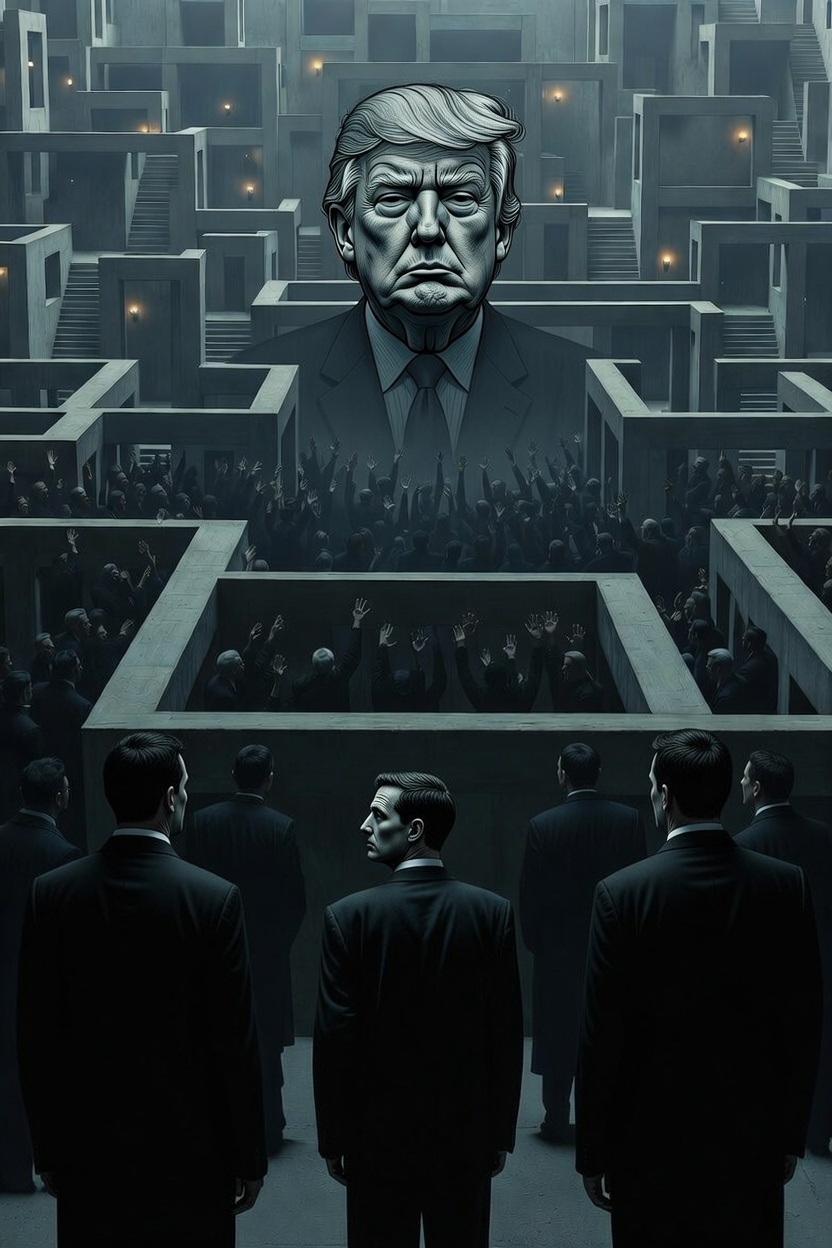
Remember that from George Orwell’s Nineteen Eighty-Four? The hate ritual comprises intense, controlled outbursts of collective and manufactured anger and fear that Party members are expected to direct at the Party’s enemies during orchestrated events, which are known as the “Two Minutes Hate.” In these moments, citizens are shown propaganda films depicting the Party’s enemies—most famously Emmanuel Goldstein—followed by the venting of irrational rage and screaming. Orwell uses the ritual to illustrate how authoritarian movements and totalitarian regimes manipulate emotions, uniting people through shared animosity and reinforcing loyalty to the Party.
The ritual demonstrates the psychological power of propaganda: it generates and channels feelings, like fear and frustration, into politically useful aggression, suppressing independent thought while deepening conformity. Trump is today’s Emmanuel Goldstein. And, today, too many Americans love Big Brother.

 freedom and reason