
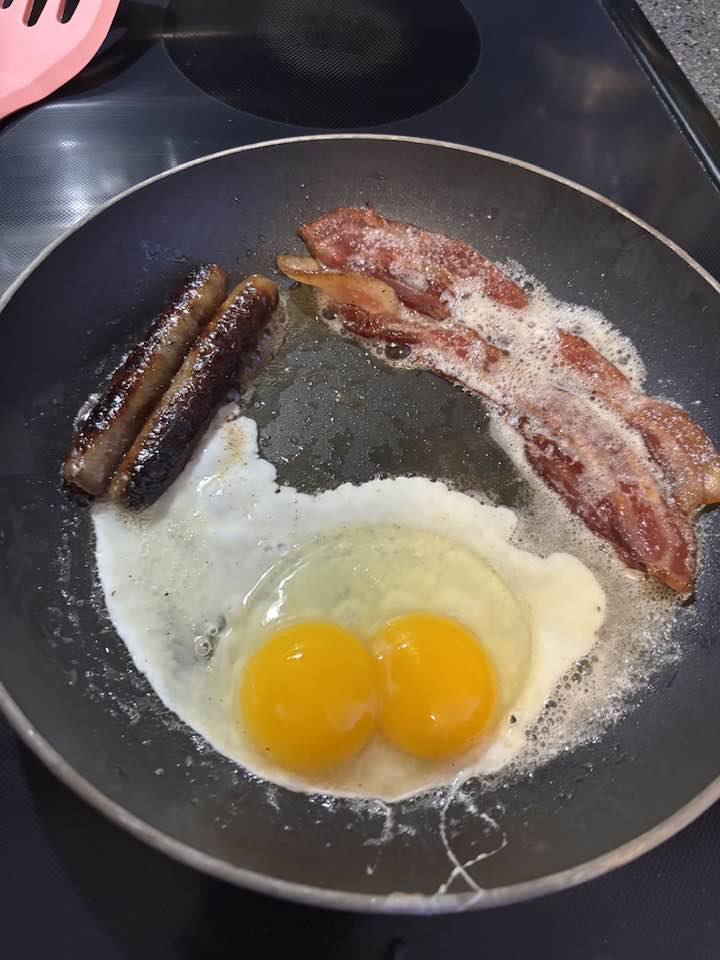
I’ve been sharing pictures on Facebook of double-yolk eggs from my breakfast routine. My last carton had twelve of twelve double yolks. Someone suggested I buy a lottery ticket. But it wasn’t luck.
If the distribution of eggs were purely random, the odds of a whole carton being double-yolked are roughly 1 in 10³⁶. Consider that the number of stars in the observable universe is roughly 10²² to 10²⁴ stars. Getting all twelve double-yolk eggs by chance is about as likely as randomly selecting Betelgeuse from the cosmos.
What actually happened is that the eggs were deliberately sorted, likely from a flock of young hens prone to laying double yolks, and distributed to the supermarket down the road from where I live.
I did a deep dive into this to prove I’m not lucky (I don’t believe in luck). This happened to me before, several years ago, when eleven of twelve eggs in a carton were double-yolked, but I never followed up on it. What I found is interesting (a friend suggested this on one of the posts—and she was right).
In commercial egg production, younger hens—usually 6–8 months old—are more prone to laying double-yolk eggs. Some egg producers capitalize on this by collecting eggs specifically from flocks of young hens and packaging them together as “double-yolk” cartons.
My carton wasn’t labeled as such, but it can happen another way: When eggs are sorted into small, medium, and large, the large eggs are more likely to be double-yolked. Some producers go further, during the candle test (where they can see the eggs’ contents), and set aside double yolks. At the end of the day, the double-yolked eggs are packaged and distributed simply as large eggs.
So rather than luck, what I got was the result of either targeted or routine agricultural practices during careful sorting. It’s a bit like buying a pack of jumbo strawberries. It’s not fate that had me cracking double yolks several days in a row, but the way eggs are sorted and packed. Experience demystified.
By the way, while I was researching this, I searched the likelihood of twinning among chickens. Searching this way yields a different result since it is a different question. Whereas the probability of double yolks is around 1 in 1000, the probability of two chicks being born from the same egg is estimated to range from 1 in 100,000 to 1 in 1,000,000 eggs where fertilization occurs. God knows the odds of twelve fertilized eggs in a row yielding twenty-four chicks.

 freedom and reason