“Before we go further, we need to acknowledge that our trans community needs abortion care, too.” —James Talarico, Texas Democratic candidate for Senate
Progressives drag conservative Christians continually, mocking them for their cultural traditions and religious beliefs. Progressive hatred of the common man is palpable. Conservative Christians are condemned for their resistance to progressive ideas such as abortion, gender identity doctrine, mass immigration, and racial self-loathing. Conservative Christians are portrayed as authoritarian, backwards, bigoted, and racist—even fascist. Progressives claim that conservatives have twisted the faith and that the progressive Jesus is the true Jesus. As I explained in a recent essay (A Cross of Suicidal Empathy: The Woke Emasculation of Christianity and the Road Back to Integrity), Christianity in the hands of progressives is a Christianity designed to disarm patriots and secure a monopoly over righteous violence for those who seek the erasure of Western Civilization (see Manufacturing Their Own Christs: The Violence of Progressive Christianity).
The reality is that progressives, whether professing or feigning Christianity, hold to more bizarre beliefs (if traditional Christian belief can be described in that way), such as the idea that whiteness is a “virus” or that the faith warrants arresting puberty in normally-developing children or physically altering their bodies with cross-sex hormones and mutilating surgeries. In truth, the Christianity of progressives is not really Christian at all, but the quasi-religion of woke progressivism. The woke wrap the language of Christianity around their ideology and politics because they know America is founded on Christian ethics and that a majority of Americans are Christians, and thus that the attack on American institutions—freedoms of conscience, speech, and publishing, the doctrines of individualism and voluntarism, etc.—is profoundly antithetical to the foundation of the nation.
Woke Christianity is a Trojan horse. The appeal to faith—and especially to a revisionist retelling of Christology—is a central element of a hegemonic strategy aimed at electoral success. It seeks to deceive a significant portion of the public into believing that progressivism is native to American culture, or, sidestepping the fact that America is a republic with a constitution, that democracy allows for a radically different America. It even questions whether America is a valid thing at all. By draping progressive ideology in Christian language, progressives redefine righteousness in a way that marginalizes patriots who are committed to preserving the American Republic to advance the post-national project.
The Texas politician James Talarico is the paradigm of woke in today’s electoral politics. More than a representative of wokism, having studied criminal psychology for decades, it took only a few clips of Talarico speaking to see the indicators of psychopathology—the superficial charm, the manipulative tactics, the bizarre beliefs. I sense danger in this man.
For those unfamiliar with Talarico, he is a Democratic politician who became the youngest member of the Texas House of Representatives in 2018. Before entering politics, Talarico, a Presbyterian seminarian, worked as a public school teacher—a chilling thought given the things he professes (which I will come to). There, he honed his persona, a dark Mister Rogers. Recently, he has appeared on various talk shows to promote his rise in American politics. Only days ago, he defeated Jasmine Crockett in the primary for the Party’s candidate for Texas Senator. In public forums, Talarico is obsessed with explaining how his Christian beliefs shape his views on education and social justice, while twisting Christianity to align with his woke ideology. Some of my acquaintances and friends don’t believe he will succeed. But they should not be so sure. He has the establishment behind him.
I confess, Talarico was not on my radar screen. The rise of his star forced him into consciousness only a few days ago. As I watched his speeches to learn more about him, memories of a distant experience percolated up from the recesses of my unconscious mind: the phenomenon of Jim Jones and the tragic events at Jonestown in Guyana.

In 1978, I was a junior in high school. My history teacher rolled a television into the classroom and switched it on. The classroom watched in horror as helicopters hovered over hundreds of bodies strewn about a compound. Lying on the ground were the bodies of men, women, and children who, at the command of their religious leader, Jones, had drunk cyanide-laced Flavor-Aid (this is the origin of the phrase “He drank the Kool-Aid”). We learned later that some of Jones’s followers had been reluctant and forced at gunpoint to drink the concoction. Mothers squirted cyanide into the mouths of babies too young to drink the poison from paper cups.
The story of Jim Jones and the tragedy of Jonestown remains one of the most disturbing episodes in modern American religious history. As a sociologist interested in mass hysteria and moral panics, I have spent quite a bit of time studying the careers of men like Jones. However, I unconsciously avoided incorporating his tale into my lectures on the subject. Instead, I used faith healers, such as the German Pentecostal evangelical Reinhard Bonnke, who founded the ministry Christ for All Nations in 1974 and came to be known as the “Billy Graham of Africa,” as well as the 1980s Satanic panic, to draw out the implications of Adolf Hitler’s National Socialism. I will have to expand my lectures on the subject to include Jones.
The lessons of Jonestown, however, appear to have been forgotten by most people. I suppose many don’t know the origins of the reference to drinking the Kool-Aid. Those who do remember associate Jim Jones solely with the 1978 event and reduce it to a mass psychogenic moment. To be sure, it was a manifestation of mass psychogenesis, but what is oftentimes lost to memory (or never learned) is that Jones was a Christian minister who built his movement within the cultural and institutional framework of an American Christianity, one rooted in liberation theology with Maoist and Third Worldist characteristics. In a word, Jim Jones was woke before the world knew what woke was. I fear that James Talarico, his preachments drenched in wokism, is here to take his place.
When asked to define woke, many people get stuck. It’s one of those you-know-when-you-see-it things. So let’s define it. Appearing in the early twentieth century, the term meant being aware of social injustice, particularly discrimination and racism against black people. In fact, it comes from black vernacular and was used in phrases like “stay woke,” which encouraged people to remain alert to systemic inequality and unfair treatment in society. The expression gained wider usage during contemporary social justice movements such as Black Lives Matter, where it referred to being informed about issues like racism, police brutality, and other forms of discrimination—forms of discrimination that no longer exist, but remain rhetorically useful to movement politics. The word soon expanded to include awareness of other social issues, most notably trans rights and the normalization of queer praxis.
The repurposing of woke to represent a quasi-religious movement was manufactured by the progressive hegemonic apparatus in the post-Civil Rights era. In reality, it is a dissimulated corporate-engineered ideology. (I have documented this history in numerous posts on Freedom and Reason). Talarico personifies the expanded form of woke.
Because he is a rising star, and because the Overton window has shifted so far to the left that Taralico’s vision for America has become mainstream, the public needs to understand what he represents and the destructive potential of his presence in the federal government. To do that, we must recall what came before him.
Before I come to Jones, for those unfamiliar with the concept of the Overton window, it’s a political concept that describes the range of ideas, policies, or standpoints considered acceptable or mainstream within public discourse and opinion at any given time. Ideas inside the window are seen as politically viable—politicians can advocate for them without being dismissed as too extreme and still hope to enjoy broad support and win elections. Ideas outside the window are viewed as radical, unthinkable, or unacceptable to the majority.
The term originates from Joseph Overton, a policy analyst at the Mackinac Center for Public Policy. Originally calling it the “Window of Political Possibility,” Overton developed the idea to explain why politicians tend to stick to a limited set of options shaped by public acceptability rather than their personal beliefs. Shifting the Overton window means that ideas once viewed as extreme become mainstream. The views advanced by Jones and the People’s Temple were seen in their time as unacceptable. They have now become viable politics, as is obvious in the rise of queer praxis, manifest in gender affirming care and the postmodernist problematizing of the gender binary (see my recent essay The Party Flips the Switch: Compulsory Misgendering and the Technique of Rectification).
Jones founded a religious organization known as the Peoples Temple in the 1950s in Indianapolis. At its outset, the movement resembled a typical Pentecostal-style Christian church. Services included Bible readings, healing services, and revival-style preaching. Jones presented himself as a Christian pastor and invoked the teachings of Jesus Christ, focusing on identitarianism and social justice. In the racially segregated Midwest of the 1950s, Jones’s racially integrated congregation and his emphasis on social equality—a forerunner of the contemporary repurposing of equity—attracted attention and followers.
Jones preached against racism and promoted the idea that Christianity demanded practical concern for the poor and marginalized. These themes resonated with many Americans during the early civil rights era, so Jones has a pool of people receptive to his message. As a result, the Peoples Temple grew steadily and eventually moved its headquarters to California, first to Ukiah and later to San Francisco and Los Angeles, where it became involved in community organizing and local politics.
Over time, Jones’s theology leaned ever more determinately into social justice rhetoric, anticipating the woke theology that now animates left-wing politics in America. It is perhaps to state the obvious to note that this rhetoric has become the ideological core of the rank-and-file progressive Democrat. The virtue of these beliefs is promoted by academia, the corporate media, and the culture industry. The more progressives came to dominate the Democratic Party and America’s sense-making institutions over the last half-century, the rhetoric of social justice became normalized—the Overton window shifted.
It is no exaggeration to say that Jones’s worldview is now the worldview of millions of Americans. The ecumenism of left-wing religious teaching—the embrace not only of other Christian sects, but also of Islam, an ideology antithetical to Christianity and Western culture—smuggles into popular culture Jones’s anti-Enlightenment standpoint. This is why it is imperative to learn about the phenomenon of Jim Jones. It’s not just his early use of social justice rhetoric to manipulate his flock that one needs to pay attention to. He had in mind a political movement, and he would use his followers to show the world the future.
By the late 1960s and early 1970s, Jones had begun criticizing the Bible as a tool that had historically been used to justify oppression. He repurposed Christian teachings to advance a collectivist ideology that stood diametrically opposed to Christian civilization and the individualism it codified. Instead of presenting himself merely as a minister, he subtly elevated his own authority within the movement, portraying himself as a prophetic, even messianic figure. His interpretation of Christianity was the true one. The example of Jesus was refracted through the prism of his Christology—woke Christianity. The religious language remained, of course, but the underlying structure of the movement shifted toward a cult of personality and ideas that lay beyond Christianity rather than adherence to orthodox Christian belief and the natural law interpretation of Enlightenment thinkers—the men who founded the American Republic.
Before postmodernism, Jones incorporated elements of socialist ideology into his preaching, especially Maoist and Third Worldist concepts and theory (I have published several essays on this platform showing how these concepts infect contemporary left-wing thinking). He described the Peoples Temple as a model of communal living that rejected capitalism and racial hierarchy. His rhetoric revolved around what would become the core of critical race theory (CRT), most directly in an attack on “whiteness.”
The frame is now familiar to those who follow CRT thinking: the “victim-perpetrator” model, where oppressed nonwhites are depicted as struggling against white capitalist power. The US was a racist, imperialist system, Jones told his followers, evil at its inception, responsible for the misery of billions of people around the world. The Temple community served as the ideal alternative. Members were encouraged to share property, devote their labor to the collective, and view the Temple as a community standing against what Jones described as the corruption and injustice of Western society.
Increasing scrutiny from journalists and defectors eventually pressured Jones to relocate the community outside the United States, where he could protect his followers from deprogramming. In the mid-1970s, he established an agricultural commune in the South American nation of Guyana. The settlement, known as Jonestown, was presented to his followers as a utopia where they could live free from imperialism and white supremacy—the imaginary forms of persecution he convinced his followers were real. He brainwashed his followers into believing they were the victims of oppression, from which his vision would liberate them.
In reality, life in Jonestown was an authoritarian nightmare. Residents lived under constant surveillance and were cut off from outsiders. Loyalty tests known as “White Nights” were conducted in which members rehearsed collective suicide as a demonstration of devotion. Jonestown is a paradigm of how mass psychogenic illness can be induced.
The situation reached its catastrophic climax in November 1978 after a visit from US Congressman Leo Ryan, who had traveled to Guyana to investigate allegations of abuse within the settlement. Family members had become concerned about what was happening to their loved ones at Jonestown. Members of Jonestown deliberately cut off contact with family and outsiders—they had gone, to use today’s grooming term, “no contact.” Going no contact was a key control mechanism used by Jones.
When Ryan and several defectors attempted to leave Jonestown, Jones’s gunmen attacked the group at a nearby airstrip, killing the congressman and several others. The killings were captured on video, although unedited footage is difficult to obtain (you can find some footage here supplied by the FBI). Later that day, Jones ordered what became known as the Jonestown Massacre, where members of the community were instructed to drink Flavor-Aid mixed with cyanide, resulting in the deaths of more than 900 people. Readers can find other footage of the tragedy by searching the Internet. I encourage readers to review these materials, but I hasten to warn you that it is a disturbing memory hole to go down.
The history of Jim Jones raises obvious problems about authority, religious rhetoric, and anti-Western ideology. Jones elevated himself as a Christian minister and used Christian language and institutions to build a destructive movement. The trajectory of the Peoples Temple demonstrates how the appeal to religion can evolve dramatically when leadership becomes organized around charismatic figures and promises of liberation. By the time of the Jonestown tragedy, the movement had departed so far from conventional Christianity (if it ever was conventional) that it functioned not as a church at all, but as an isolated ideological community centered on Jones himself. The Overton window had not yet shifted; the majority of observers could then see the destructive potential of such movements. Now the window has shifted, millions no longer see what they see or hear what they hear.
The lesson of Jonestown extends beyond small cult-like movements. We can find a paradigm of not seeing and hearing not only in the normalization of woke progressivism, but in the destructiveness of religion-as-politics in the Islamic world, which has come to the West via mass immigration and intellectuals, politicians, and pundits who promote Islam with the language of multiculturalism. Compulsory tolerance of Islamization is a central tenet in the woke progressive faith. They open the door wide for the barbarian to pass through—and condemn as bigots those who know history and grasp the peril of Jihad.
Understanding ideology and the techniques of mind control is essential to understanding Jonestown. But it is also necessary for understanding the trajectory of progressivism and social democracy in the West. As noted earlier, Jonestown was a demonstration project—it taught elites how to capture the minds of impressionable people and amass an army of zealots who can, on command, take to the streets. The wokism of today presages Jonestown at scale, an ideology cultivated by major sense-making institutions captured by progressives with the backing of transnational elites.
I have documented the rise of progressivism in previous essays, but to summarize here, at its inception, progressivism couched itself as a reformist project to put a humanitarian face on capitalism, which it portrayed as unjust in its liberal form. The goal was the normalization of the corporate person, a legal entity that clinical psychologist and expert on psychopathology Robert Hare has identified as the prototypical psychopath. Once progressivism became fully institutionalized in the administrative state and technocratic apparatus under the presidency of Franklin Roosevelt (see the work of Richard Grossman), it became the core teaching of the sense-making apparatus. It was inevitable that it would move to the educational system and popular culture, raising up generations of Americans who took the ideology on faith.
The parallels between Jones and modern wokism are clear. The anti-American and anti-Western protests in major cities across the transatlantic space even echo Jones’ rhetoric about Israel and Jewish power behind US imperialism and global oppression. We see the return of this ancient hatred in the Red-Green Alliance. A ready army of true believers is mobilized against the obstacles to the transnational corporate reordering of the world.
The phenomenon of suicidal altruism, which I have documented in essays on this platform, echoes the devotion of the true believers drawn to Jones. The Jonestown tragedy did not emerge from a vacuum; the mass psychogenic event was not spontaneous; it developed out of a religious movement that wrapped itself in a recognizable form of American Christianity but was ultimately something very different. The ideas that animated the Peoples Temple have been normalized. This has shifted the Overton window.
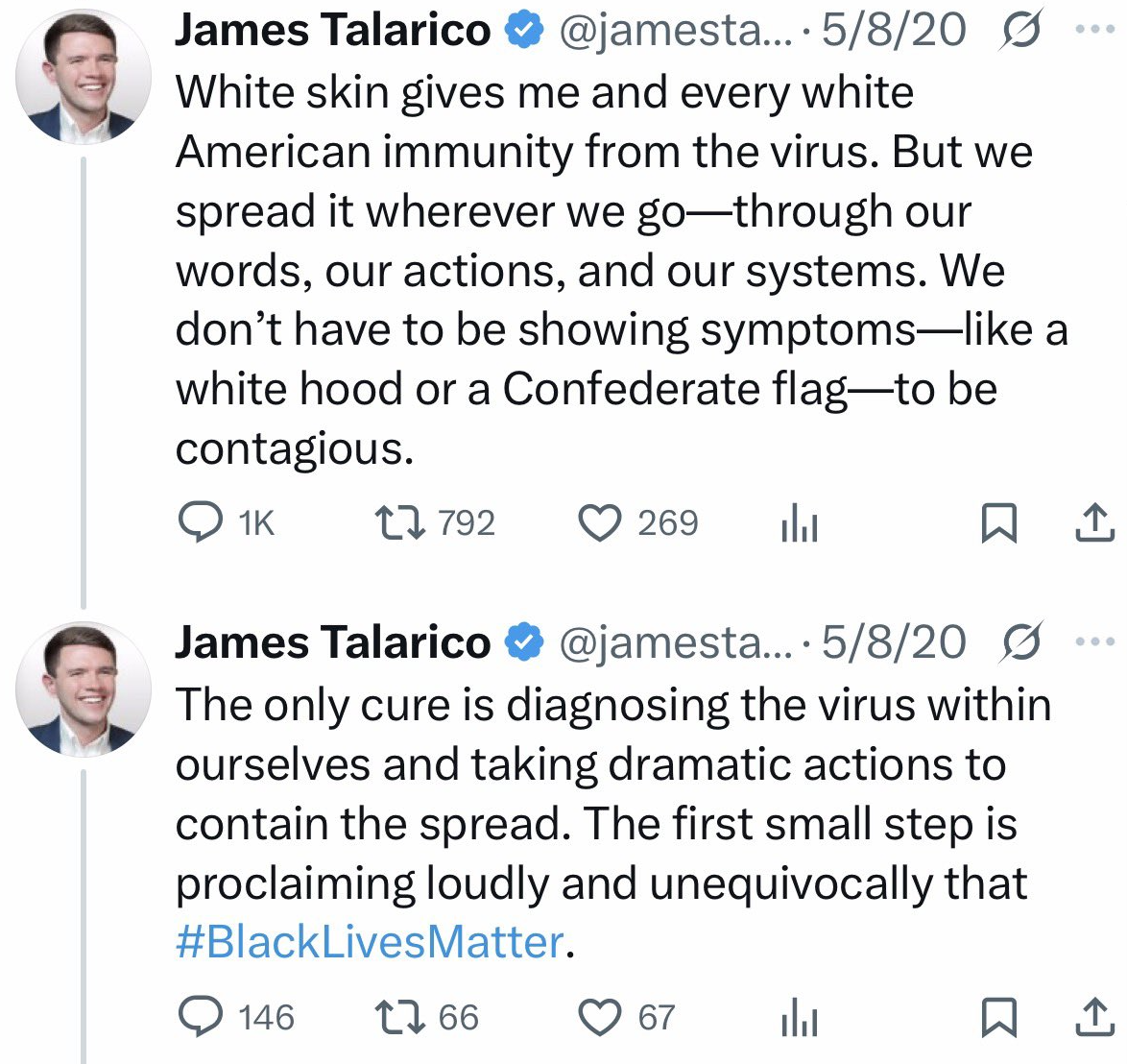
In light of the preceding analysis, James Talarico stands as a quintessential embodiment of contemporary woke ideology elevated to electoral prominence—someone who has fully imbibed the Kool-Aid of progressive orthodoxy, repackaging the ideology in the language of compassionate Christianity while promoting views that a reasonable person should regard as profoundly at odds with traditional Christian doctrine and American foundational principles. His rhetoric consistently portrays racism as a pervasive “virus” inherent to whiteness, declaring in resurfaced 2020 statements that “white skin gives me and every white American immunity from the virus,” positioning whites as unwitting carriers who spread it through actions, words, and systems—framing whiteness itself as a collective moral failing requiring ongoing reckoning, self-diagnosis, and dramatic containment.
We witness the moral rot in the Twin Cities in Minnesota and other cities in America. The normal person is horrified when he sees whites in supplication to Black Lives Matter, licking the boots of black militants who demand atonement for sins the bootlicker never committed. This is the perversion Talarico personifies. We hear it in his references to grappling with his “own whiteness” through warped appeals to prophetic voices like Jesus, aligning the Gospel with anti-white narratives, emphasizing blood guilt, collective punishment, white privilege, and systemic condemnation over individual character and shared humanity.
But it is more than appealing to anti-whiteness. On the matter of transgender ideology, Talarico has been similarly forthright, asserting on the Texas House floor that “God is non-binary,” describing God as “both masculine and feminine and everything in between,” insisting that “trans children are God’s children, made in God’s own image,” appealing to “our neighbors with a uterus”—positions that fuse biblical interpretation with advocacy for gender fluidity, youth transitions, and opposition to restrictions on male presence in female spaces, male participation in sports, etc. But trans children are not made in God’s image. They are made in the image of the gender identity doctrine manufactured by sexologists and transformed into simulated sexual identities by the medical-industrial complex. Talarico’s preachments demand we affirm a delusion and normalize child mutilation.
Talarico exemplifies the scaling of Jim Jones-style fusion: charismatic religious rhetoric repurposed to advance collectivist social justice, identity-based liberation theology, and anti-Western critiques under a Christian veneer. His party is the party of transnational corporate ambition. The psychopathic indicators add to the trepidation normal people feel when they hear his speeches and observe his mannerisms. Far from preserving orthodox faith, Talarico’s approach subordinates scripture to progressive priors, mirroring the Peoples Temple’s evolution from integrated revivalism to authoritarian, anti-capitalist, anti-imperialist communalism that, in the end, left hundreds of people and their leader dead (Jones put a bullet in his head surrounded by his dying flock).
In an era when such ideas permeate institutions, media, and politics, Talarico represents woke theology at scale—not as fringe cultism, but as a hegemonic force cloaked in moral and spiritual authority, poised to further erode the cultural and constitutional foundations he claims to champion through “love” and “neighborliness.”
As I have written in essays on this blog, beware the rhetoric of “kindness” (see my recent essay The Problem of Empathy and the Pathology of “Be Kind”). Jones’s suicidal cult following has been raised to the level of suicidal empathy, the force that is erasing Western civilization. Woke progressivism is already a very real problem in the halls of government. To be sure, many have awakened to the awokening. Yet, despite our making progress in containing it, wokism remains a destructive force in our world. What took decades to build won’t be toppled in a single election. Nonetheless, whoever wins the runoff in the Republican primary—John Cornyn or Ken Paxton—Texans need to vote for the man. Heaven help us if men like James Talarico ascend to Washington.

 freedom and reason