
The critique of Christianity as a “morality of weakness” is most sharply articulated by Friedrich Nietzsche in On the Genealogy of Morality (1887), targeting the emphasis on virtues like forgiveness, humility, and “turning the other cheek” (Matthew 5:39). Such teachings, Nietzsche argues, arose from ressentiment among the powerless, transforming meekness, passivity, and self-denial into exalted “goodness” while demonizing assertiveness, prude, and strength as “evil.” This he characterized as a “slave morality” that tames the noble and life-affirming instincts of man.
Nietzsche regarded the emergence of slave morality not as a cynical invention or deliberate distortion imposed by powerful elites to subdue and pacify the masses, but as something intrinsic to the religion’s very origins. He traced its roots to the priestly class among the ancient Jews under foreign domination—unable to overcome their oppressors through strength, they instead inverted the values of the noble and powerful. What the strong had celebrated as good, the priests recast as evil, while exalting their submission as virtuous. This reactive transvaluation, born from the powerless’s need for spiritual revenge (where they had no real power), became the foundation of Christian doctrine itself, embedding a morality of weakness directly into its core rather than layering it on later as a tool of control.
For Nietzsche, the pacifying effect on life’s affirmative instincts was thus no accident of manipulation by the mighty, but the natural and inevitable consequence of the faith’s genesis among the defeated and resentful. While there may be something to this rationalization in the face of marginalization, today the slave morality is a technique of control by powerful forces to keep the masses subservient to corporate state power and eager to defend the advance of collective denationalization amid globalization. This is how we see in today’s progressive appeal to Christianity an interpretation of the Gospel, amplified in modern pacifist readings of the scriptures, that emasculates the faith by memory-holing or marginalizing its militant dimensions—while more recently elevating a militancy based on a secular ideology that presents as a quasireligious system, what we call “woke.” Such a reading, if embraced by the majority and legitimized by the corporate state apparatus, leaves Christian civilization vulnerable to erasure by barbarians from without and the machinations of elite power from within.
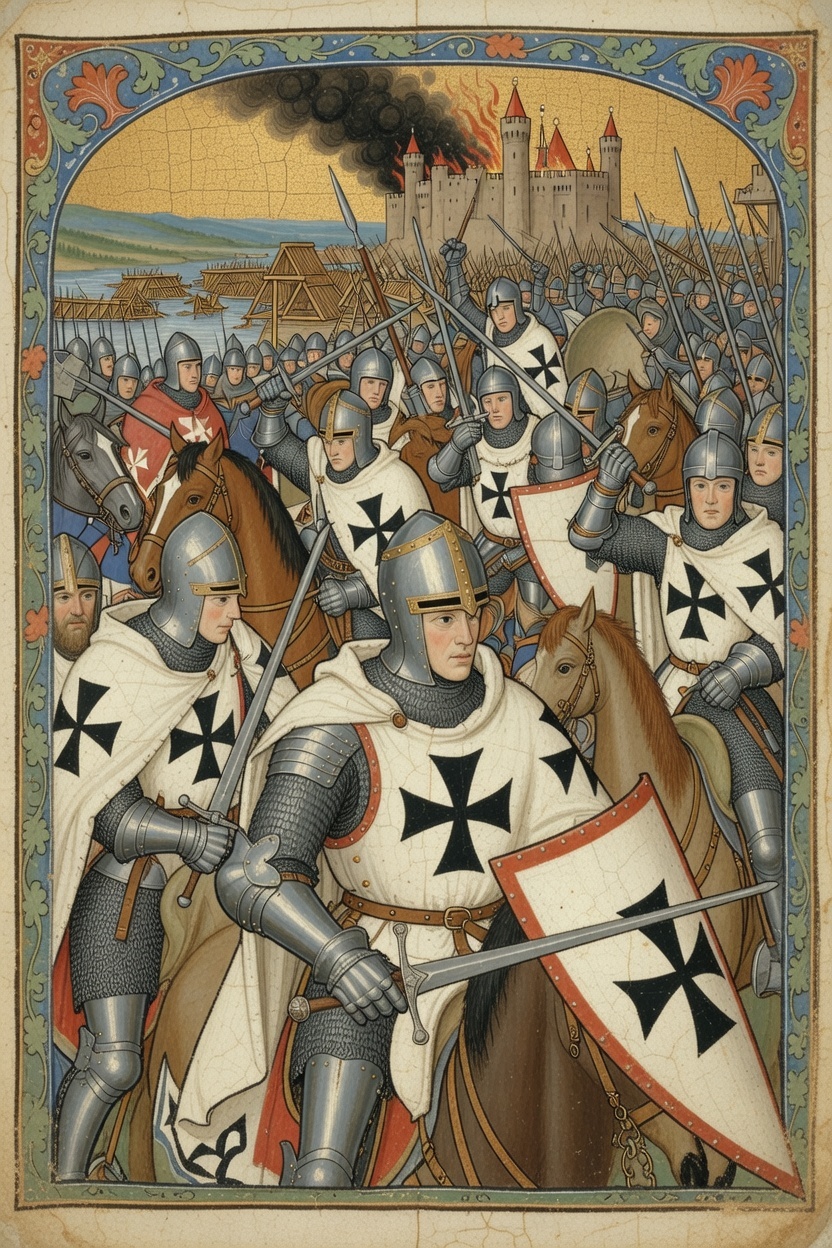
One can demonstrate by appealing to scripture that this is a false reading—or at least a reading narrowed by the elites and propagandists who wish to weaponize the Christian faith against Christians to achieve a transnational corporate world order. The Gospels themselves contain explicit counterpoints to pacifism, such as Jesus’ instruction in Luke 22:36 to “sell your cloak and buy a sword,” which—despite being rationalized as symbolic rather than a call to collective self-defense—acknowledges the need for force and violence amid hostility. This understanding saved Christian civilization from the barbarism of Islam in the Middle Ages, finding vivid expression in medieval military orders, such as the Knights Hospitaller (Order of St. John), who combined monastic devotion with armed resistance. Originally founded in Jerusalem in 1099 to care for pilgrims, the Hospitallers evolved into warrior-monks who fought fiercely in the Crusades, defended Rhodes against Ottoman advances for centuries, and later held Malta in the 1565 siege, playing a pivotal role in halting Islamic expansion into Europe and preserving Christian civilization through martial vigor. Christians did not then submit to the existential threat posed by Muslims. But we should be concerned that today they will not.
Far from embodying weakness, Christianity has in the past fused spiritual ideals with the sword when existential threats demanded it, challenging any one-sided portrayal as inherently emasculating or pacifist. What we see today on the progressive side is not principled pacifism, but a selective rhetoric of passivity coupled with a tolerance of the mob. The rank and file are supposed to presume the good in Muslim immigrants and in those citizens with sacral identities (these determined by woke ideology) who harm and prey upon other citizens. Unconditional positive regard for the worst of the worst. Yet, at the same time, they obstruct and even resort to violence against the Christians and patriots who rise against the alien invaders and domestic predators in their midst. Woke progressivism only feigns empathy while demanding it from its adversaries.
This Janus-faced perversion of Christian teachings exemplifies the enduring contradiction at the heart of slave morality—preaching meekness and forgiveness toward existential perils, be they invading barbarians or predatory criminals—while unleashing vitriol and even violence against those who embody the faith’s historical militancy in defense of civilization.
Progressive interpretations, amplified by emasculated elites—or at least elites preaching emasculinity, seen in the damning of so-called “toxic masculinity”—invert the Gospel’s call to both mercy and the sword, fostering a culture where the faithful are urged to “turn the other cheek” to threats that disorder their culture, disorganize their nation, and erode their heritage, while demonizing as bigots or extremists those who rise to defend and preserve it. This is how a laudable goal embedded in the phrase “Make America Great Again” is reduced to a racist slogan. Wearing a hat with the slogan can provoke punishment and even violence by those preaching empathy and inclusivity.
Concomitant with this hypocrisy is the tragic abandonment by progressive women of their traditional role as guardians of the family, redirecting their protective instincts from their children toward aliens and outlaws who undermine societal order, thus accelerating the very dissolution they purport to heal through misguided compassion—or something darker. Wokism is a powerfully disordering force in the West.
We see this, as well, in the double standard in the policing of speech. Those who condemn Islam and gender identity doctrine, who call out the violence and madness, are scolded for “demonizing” those whose beliefs they find disagreeable and obstructive. Their appeal to tolerance is obnoxious. Meanwhile, those who criticize and condemn the pernicious ideologies are called various names: bigot, fascist, Islamophobe, racist, transphobe. We saw this recently when Robert De Niro, pushing through tears, talked about “raising each other up,” and “coming together” to defend the country against the tens of millions he had just demonized as the “enemies of the nation.”
To save Christian civilization from this self-inflicted vulnerability, believers must reclaim the robust, life-affirming ethos of their forebears—the Hospitallers’ sword alongside the cross—lest the ressentiment of the weak consign the noble to oblivion. Christians need to stand with broad shoulders and face the threat to Western Civilization, and if they need me to put that call in the language of Christendom, I am more than happy to accommodate.
As many readers know, I am not a Christian, but I am eager to stand with Christians who don’t want their children to be crucified upon a cross of suicidal empathy. If Islam prevails, human freedom is lost. And it is not just the Muslims who threaten democracy. Behind them lurks the transnational corporate state. Indeed, the globalists use the Muslim as a weapon to weaken nations. Nations are an obstacle to their vision of a New World Order where proletarians become serfs in a planetary neo-feudalist structure. Christians should recognize that, from their worldview, this is not only a struggle over material stuff, but a spiritual fight for their lives.

 freedom and reason