
“In individuals, insanity is rare; but in groups, parties, nations, and epochs it is the rule.” —Friedrich Nietzsche, Beyond Good and Evil
In earlier editions of the Diagnostic and Statistical Manual of Mental Disorders, Third Edition (DSM-III) and later the Fourth Edition (DSM-IV), the American Psychiatric Association (APA) classified transgender-related experiences under the diagnosis “Gender Identity Disorder” (or GID), which framed the identity itself as a mental disorder. GID was first recognized by the APA in 1980, framing identifying with a gender different from one’s assigned sex as a psychiatric condition.
Before the DSM-III introduced the diagnosis GID, earlier editions used different terminology. The First Edition did not include a specific diagnosis for transgender identity at all. The Second Edition introduced the category “Transvestism,” defined primarily as cross-dressing associated with sexual arousal in heterosexual males, and grouped it under “Sexual Deviations.” This diagnosis focused on behavior rather than gender identity itself and did not clearly distinguish between cross-dressing, gender identity, and what would later be recognized as transgender identity.
As the queer movement gathered steam and the medical-industrial complex saw in gender confusion a profitable path, this diagnosis was increasingly criticized for pathologizing transgender people rather than focusing on distress felt at being “born in the wrong body.” Labeling gender identity as a disorder reinforced patterns of discrimination, social marginalization, and stigma, activists and the industry argued. A person’s subjective claim should be affirmed, not pathologized. Paradoxically, by depathologizing the disorder, the APA would affirm its existence as an actual thing.
In the Fifth Edition (DSM-5), published in 2013, the diagnosis was changed to “Gender Dysphoria,” shifting the emphasis away from identity and toward the psychological distress that may arise from the mismatch between one’s “experienced gender” and “assigned sex.” This change expanded access to medical care and insurance coverage for those experiencing clinically significant distress. Additionally, it changed the character of care. Instead of helping the afflicted overcome a delusional belief, care shifted to altering the body to simulate the gender identity supposed by the patient and his doctor. Clinicians and policymakers recognized a practical need to retain a diagnosis to ensure access to medical treatment and insurance coverage. The APA claimed it was reducing stigma while maintaining clinical utility, reflecting both growing social acceptance and ongoing political debates about anti-discrimination law, civil rights protections, and healthcare access.
That the queer movement and the medical industry influenced professional organizations to reconsider how diagnostic language affects social attitudes raises questions about the scientific status of psychiatry. It illustrates a quirk in the discipline: namely, that it occupies a philosophically unique position among the sciences because it evaluates beliefs not solely on empirical grounds, but also within corporate, cultural, political, and social frameworks. While science is a universal method used to determine reality, psychiatry is, at its core, relativistic and subjectivistic; yet it asserts its status as a field in medical science.
Let’s problematize this by considering two claims. First, the claim “I am God.” It is inherently unfalsifiable, since the concept of God is defined as transcendent and beyond empirical verification. Second, consider the claim “I am made of glass.” Though empirically falsifiable, if it’s supported by a subculture and industry that accepts it as true, is it, for all intents and purposes, true from the standpoint of psychiatry? If readers believe that psychiatry is solely about diagnosing and treating mental illness, they may be mistaken; psychiatry appears to normalize certain pathologies—and this character seems baked into the field.
I begin with the concept of delusion. One might think that a man who falsely believes he is a woman is in a delusional state of mind. His claim is unfalsifiable and therefore has no possible scientific status. However, psychiatry does not ultimately distinguish delusion from non-delusion purely on the criterion of falsifiability (the objective scientific test), but rather on the relationship among belief, shared reality, and social consensus.
The modern clinical definition of delusion, as articulated by the APA in its diagnostic framework, emphasizes that delusions are (1) fixed beliefs that are not amenable to change in light of conflicting evidence and (2) are inconsistent with cultural or religious norms. This definition asserts that social context plays a central role in determining reality. Psychiatry, therefore, does not claim the authority to determine metaphysical truth. Instead, it assesses whether a belief reflects a breakdown in the individual’s capacity to participate in a shared social world.
Many widely accepted religious beliefs—such as belief in divine providence and purpose, God, the soul, etc.—are unfalsifiable in principle. By definition, a transcendent being cannot be falsified or verified through empirical observation. The construct makes itself immune to empirical demonstration. Therefore, psychiatry cannot rely on scientific falsification to evaluate such a claim. Psychiatry does not classify these beliefs as delusional when they are culturally shared and do not impair functioning. This would put the field at odds with religion and faith-belief.
Instead, psychiatry evaluates whether the belief is idiosyncratic or socially shared. If an individual alone maintains a belief in defiance of their entire cultural environment, it may indicate a disruption in personal alignment with shared reality. The man who claims to be God suffers from a grandiose delusion only if others do not affirm his claim. If the belief is accepted within a religious community or cultural tradition, it ceases to function as a marker of psychopathology. Jesus claimed to be God. Christians believe him. Therefore, neither Jesus nor his followers is delusional.
Sigmund Freud makes this point in his 1927 monograph The Future of an Illusion. Freud is not concerned with adjudicating the metaphysical claim, but rather why man comes to believe such a thing. He argues that belief in God arises primarily from psychological needs rather than rational evidence. Humans feel helpless in the face of death, natural forces, and suffering, and therefore create the idea of a powerful, protective father figure to provide comfort and a sense of order. Additionally, religion reinforces moral rules by presenting them as divine commands, making them more authoritative. Freud views belief in God as an “illusion”—not necessarily false, but rooted in wish fulfillment, especially the desire for justice, meaning, and protection in an uncertain and threatening world. It is not a delusion.
Belief itself does not change in its logical structure or evidentiary status; what changes is its social validation—or affirmation. But what of falsifiable claims? Consider the second thought experiment: the man who claims to be made of glass. This case reveals even more starkly than religion that psychiatric classification depends on social context. In ordinary circumstances, the man who believes he is made of glass would be considered delusional because it is empirically falsifiable and contradicted by common experience. The physical properties of glass differ clearly from those of human tissue, and such a belief would isolate the individual from shared reality. However, if an entire culture were to accept that certain individuals are literally made of glass, the belief would no longer isolate the individual socially. It would instead form part of the culture’s shared ontology, or model of reality.
Would psychiatry operating within a culture where people believed glass men walked the planet refuse to diagnose the belief as a delusion because believing men can be made of glass would not represent a deviation from shared understanding? It is objectively impossible for a man to be made of glass, but it’s not delusional to believe this because the culture believes there are men made of glass. The claim is falsifiable. As an objective matter, there are no glass men. Yet a psychiatrist would assume there are such things, at least pragmatically, because people believe it’s true?
If so, and this is the stance of the field, it follows that psychiatry is an ideology that tolerates beliefs that not only have no basis in reality but that directly contradict reality. This reveals a profound epistemological truth about a field that claims to rest on medical science: psychiatry relies on intersubjective consensus rather than objective falsifiability as its operational standard. Intersubjective consensus means that beliefs are stabilized through mutual agreement among members of a social group. Humans do not experience reality purely as isolated individuals; they experience it through socially reinforced frameworks of meaning. Psychiatry is therefore unscientific.
There is a long tradition in the social sciences of supposing reality is intersubjective in character. American sociologist William Thomas’ “definition of a situation,” often referred to as the “Thomas Theorem” (although it is not a theorem), states: “If men define situations as real, they are real in the consequences.” The sociologist Émile Durkheim argued that social reality is constituted by collective belief and shared symbolic systems. The postmodernist philosopher and “Godfather of Queer Theory” Michel Foucault argued that the boundary between madness and sanity has historically shifted with changes in the institutional and social forces, rather than purely scientific discovery.
In his 1979 essay “Male and Female Created He Them,” Thomas Szasz writes, “Like much of the medical‐psychiatric mendacity characteristic of our day, the official definition ‘transsexualism’ as a disease comes down to the strategic abuse of language—epitomized by confusing and equating biological phenomena with social roles.” Szasz puts his finger on a very real problem. A man who believes he was born in the wrong body, if science is to accept this claim, and the man seeks treatment, becomes medicalized. This is the paradox I earlier identified: the claim to normalize the belief by accepting the truth of the unfalsifiable claim subjects the person to medical intervention.
Szasz saw early on the implications of accepting gender identity as a thing in itself. In that same essay, he writes, “Because ‘transsexualism’ involves, is indeed virtually synonymous with, extensive surgical alterations of the ‘normal’ human body, we might ask what would happen, say, to a man who went to an orthopedic surgeon, told him that he felt like a right‐handed person trapped in an ambidextrous body and asked the doctor to cut off his perfectly healthy left arm?” (See my essay, Thomas Szasz, Medical Freedom, and the Tyranny of Gender Ideology for a lengthy discussion of this.)
From a modern clinical perspective, the primary concern is not whether a belief corresponds to ultimate metaphysical truth, but whether it reflects a breakdown in the individual’s ability to function within their shared social environment. Human cognition is fundamentally relational; our sense of reality is stabilized through agreement with others. When an individual holds a belief that isolates him from this shared framework, it may signal a disruption in cognitive integration. Conversely, when a belief is socially supported, it reinforces rather than disrupts the individual’s relationship with their community.
Thus, psychiatry avoids asserting that culturally shared beliefs are objectively true. Rather, the field adopts a pragmatic stance: its purpose is to maintain psychological functioning and social coherence, not adjudicate metaphysical reality. The distinction between delusion and accepted belief is therefore grounded not in empirical falsifiability, but in the social function of belief. A belief becomes clinically relevant when it isolates the individual, impairs functioning, or reflects a broader breakdown in cognitive organization. Psychiatry does not care whether a person believes in an impossible thing as long as everybody else believes the thing along with him.
We know psychiatry retains the same stance in the case of falsifiable claims as it does with respect to unfalsifiable beliefs because, in the case of the man who believes he is a woman, his gender can be confirmed by examination of gametes (large or small), karyotype (XX/XY), and reproductive anatomy. One can determine with absolute certitude whether a person is a man or a woman. Gender is not an unfalsifiable matter. A man can no more be a woman than he can be made of glass. To get around this, after repurposing sex’s synonym gender (John Money performed the groundwork here in the 1940s-50s), psychiatrists in the 1960s (Robert Stoller most notoriously) invented the construct “gender identity,” which is by definition subjective and therefore unfalsifiable—like God. They made a falsifiable claim unfalsifiable by redefining gender, turning it from an objective fact to a subjective belief. (Did this trick even need to be performed?)
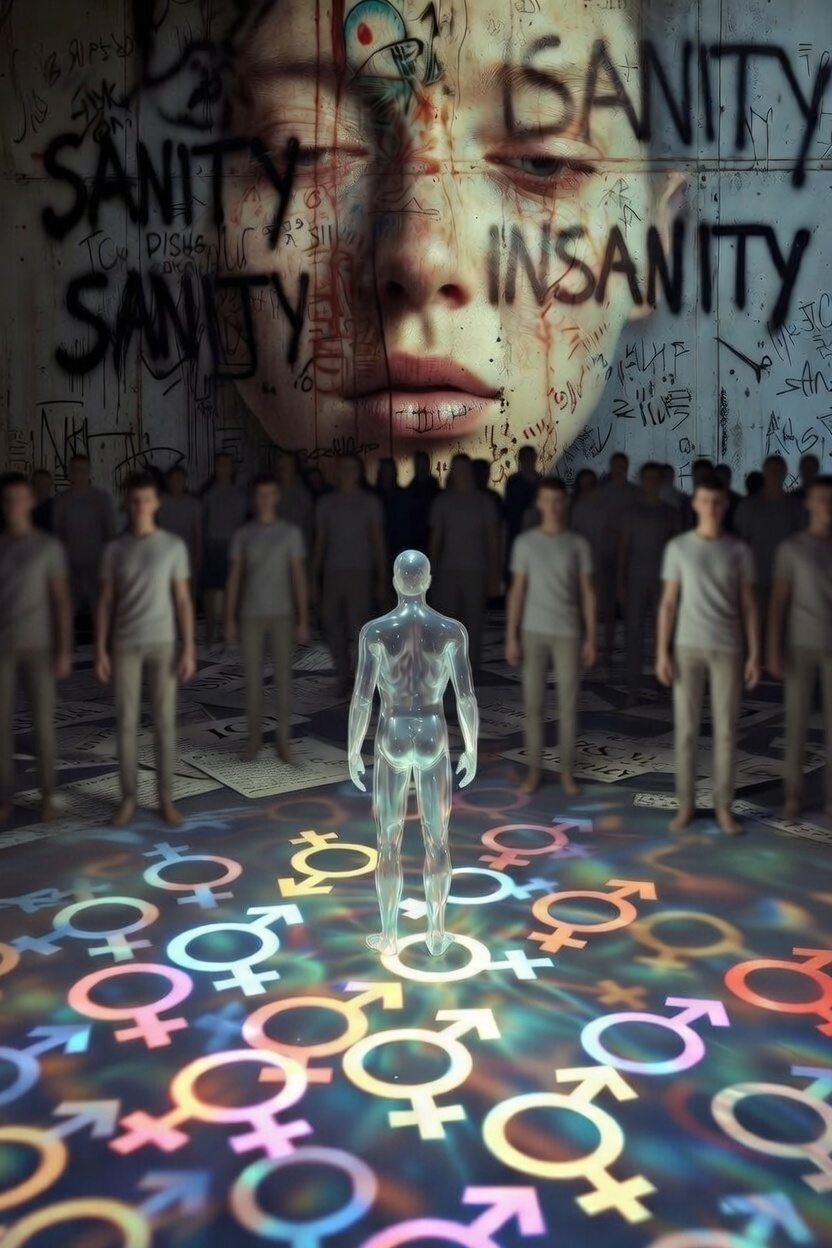
Yet, even here, if the culture rejects the subjective claim, the man is not a woman. Would it not? In a culture where gender identity is not recognized, would the embedded psychiatrist diagnose the man with a mental disorder? If the culture believes a man can be a woman, then the man who claims to be one can be one. He is not delusional because everybody else is delusional with him. This is captured by the philosophical aphorism: If everybody is delusional, then nobody is. But if the culture rejects the claim, then he would be delusional, since he believes a thing that everybody sees as plainly false.
What about the person who refuses to go along with the crowd? Suppose a man who insists on remaining grounded in reality despite those around him taking flight from it. Does he now become delusional? Is he not the victim of gaslighting? The answer to the first question is yes, since he denies something everybody believes is true. He believes that gender is binary and immutable, when everybody else believes that gender is on a spectrum and changeable, and so the man is delusional. This follows from the psychiatric definition: he holds a fixed belief that is not amenable to change in light of conflicting evidence that is inconsistent with cultural or religious norms. As for the second question, yes, he is being gaslit, since if every single person denies that gender is binary and immutable, they would be objectively wrong—and those who misled them about the gender binary know they are. Indeed, it was the aim of the sense-making institutions to lead the people to a false belief.
Does the reader now understand the point of compelled speech about gender, e.g., obligatory preferred pronouns? Forcing people to accept an ideology that makes real the claim that men can be women is a project to make a delusional belief common sense, to normalize the falsehood, in which case the belief is no longer delusional, but intersubjectively real, and thus amenable to the production of simulated sexual identities (see Simulated Sexual Identities: Trans as Bad Copy).
In this situation, the man who refuses to accept the normalization of the abnormal and self-evidently false claims about gender becomes the delusional one, as well as an oppressor. The goal of queer theory is to negate a delusion by making everybody delusional. It makes the crazy person sane by making sane people crazy. Queer activists and the medical industry hypostatize gender identity—treating an abstraction as if it were a real, concrete thing that exists independently—and use the reification of gender identity to justify medical atrocities.

 freedom and reason