
It is striking how pro-capitalist ideologues react when capitalism is described as exploitative. They often assume that the claim is an attack on capitalism itself. Nothing could be further from the truth.
In political economy, exploitation is a descriptive, analytical concept—not a moral verdict. It refers to a structured process by which value is extracted from resources found in ecosystems, labor, land, raw materials, and social capacities within a given mode of production.
To say that labor is exploited, in this sense, is simply to describe how surplus is generated and appropriated through institutional arrangements like wage labor, property rights, markets, and the state.
The surplus is the portion of total social labor that exceeds what is necessary to reproduce the labor power of workers and the material conditions of production at a given historical level. It is the product of surplus labor time—labor performed beyond what is required to produce workers’ means of subsistence—and it appears in capitalism as surplus value, later distributed in transformed forms such as profit, interest, and rent.
The social surplus is not defined by individual firms or transactions but at the level of society as a whole, reflecting a class relation in which one class controls the conditions of production and appropriates the surplus produced by another.
How the social surplus is generated, appropriated, and allocated determines the structure, dynamics, and historical trajectory of a mode of production, making it a central analytical category rather than a moral judgment.
The term identifies a mechanism of value transfer; it does not, by itself, determine whether that mechanism is lawful, fair, or socially desirable.
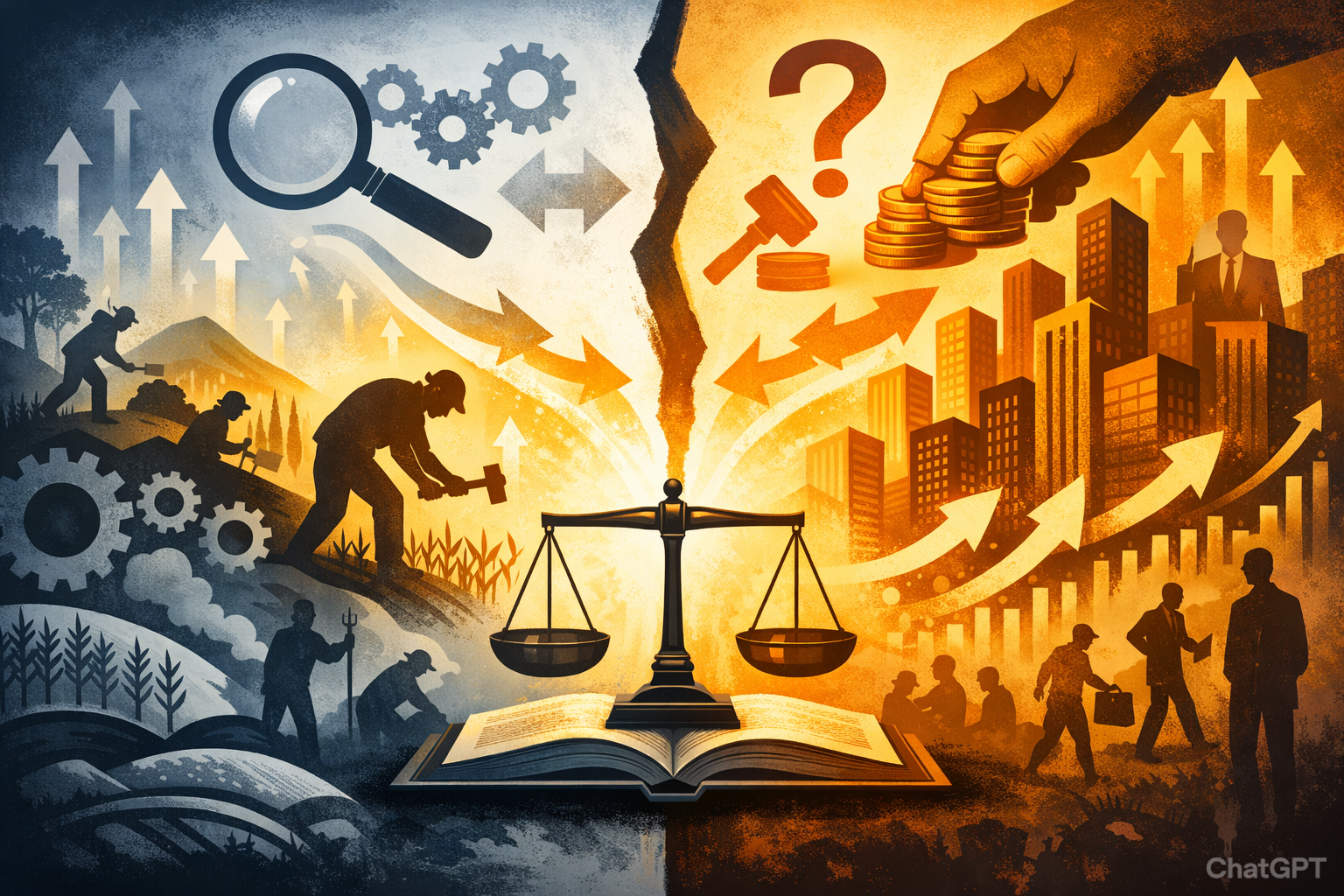
This usage differs sharply from the popular meaning of exploitation, which typically implies abuse, coercion, or illegality. In everyday discourse, exploitation is often synonymous with injustice and wrongdoing. In political economy, by contrast, exploitation can be entirely legal, routine, and foundational to economic organization.
Classical political economists and Marxian theorists alike use the term to explain how profits, rents, and surplus arise under capitalism and other modes of production. Whether exploitation is seen as efficient, inevitable, or unjust is a separate question from whether it exists.
The confusion arises when descriptive and normative levels of analysis are collapsed.
Descriptively, exploitation names a relationship: one actor or class systematically extracts value produced by another through socially recognized rules. Normatively, scholars and political actors may argue that such extraction is justified, unjust, or reformable—but those judgments are not contained in the term itself.
Put another way, treating exploitation as inherently immoral imports ethical conclusions into what is, at its core, an explanatory concept.
Within political economy, exploitation functions much like terms such as accumulation, appropriation, or surplus extraction. It allows analysts to map how economies actually work before taking a position on how they ought to work.
I wrote this essay following a discussion on a Facebook thread by the Working Families Party (WFP), in which pro-capitalist ideologues attacked my observation that the WFP errs in suggesting that capitalism is uniquely problematic because of its exploitative practices. (The WFP also errs in its support for mass immigration, which is intrinsically harmful to American working families.)
The pro-capitalist ideologues misunderstood my initial post, where I argued that one cannot eliminate exploitation without overthrowing capitalism. But even this point was misread: since all economic systems are exploitative in some form, eliminating capitalism would not eliminate exploitation as such.
One finally admitted that I was right, but said that, since exploitation originally conveyed wrongdoing, I was misleading people. But the earliest meaning of the term did not originally mean wrongdoing. Its earliest meaning was neutral and economic. People misunderstand because they are uncharitable and can’t be bothered to learn. But I can be bothered to educate.
Here’s the reality: The problem of exploitation cannot be “solved.” Exploitation is inherent in humanity’s relationship with nature—including relations among humans themselves. This is true even in hunter-gatherer societies.
The question, then, is whether the system within which exploitation occurs is just. That is a moral question about capitalism as a system, not about exploitation per se. When we examine what constitutes a just system of exploitation, we have to ask whether our lives are better under one productive modality compared to another. Are we better off now than we were or could otherwise be? This question is not only about the material conditions, but also about whether we are free.
Socialism is unfreedom.

 freedom and reason