
And the Racist Meme that Trump Never Shared
Congress shall make no law respecting an establishment of religion, or prohibiting the free exercise thereof; or abridging the freedom of speech, or of the press; or the right of the people peaceably to assemble, and to petition the Government for a redress of grievances. —First Amendment to the United States Constitution
In the 2026 Virginia General Assembly session, a bill has been introduced that will define Islamophobia in state law for the purpose of addressing bias-motivated crimes, particularly hate-motivated assault and battery. The bill was introduced by State Senator Saddam Azlan Salim.
Senate Bill 624 (SB 624), sponsored by Democratic lawmakers, proposes a statutory definition of “Islamophobia” as “malicious prejudice or hatred directed toward Islam or Muslims” and directs that definition to be used in identifying and classifying bias-motivated offenses under existing criminal statutes. The bill instructs the Virginia Department of State Police to incorporate the definition into the state’s hate-crime reporting system.
Advocates emphasize that the bill does not create a new standalone crime or criminalize speech; rather, it clarifies how prejudice against Islam may be considered when evaluating criminal conduct already prohibited by law. Yet Islam is a belief system, and this raises a fundamental question: can the government criminalize prejudice or hatred toward an ideology? Would it be acceptable for a state to pass a law protecting fascism or fascists in the same way? Sounds ridiculous, right? Because it is. But it’s more than that. It’s fascisticum per se. (See Islamophobia has no Place on the Left.)
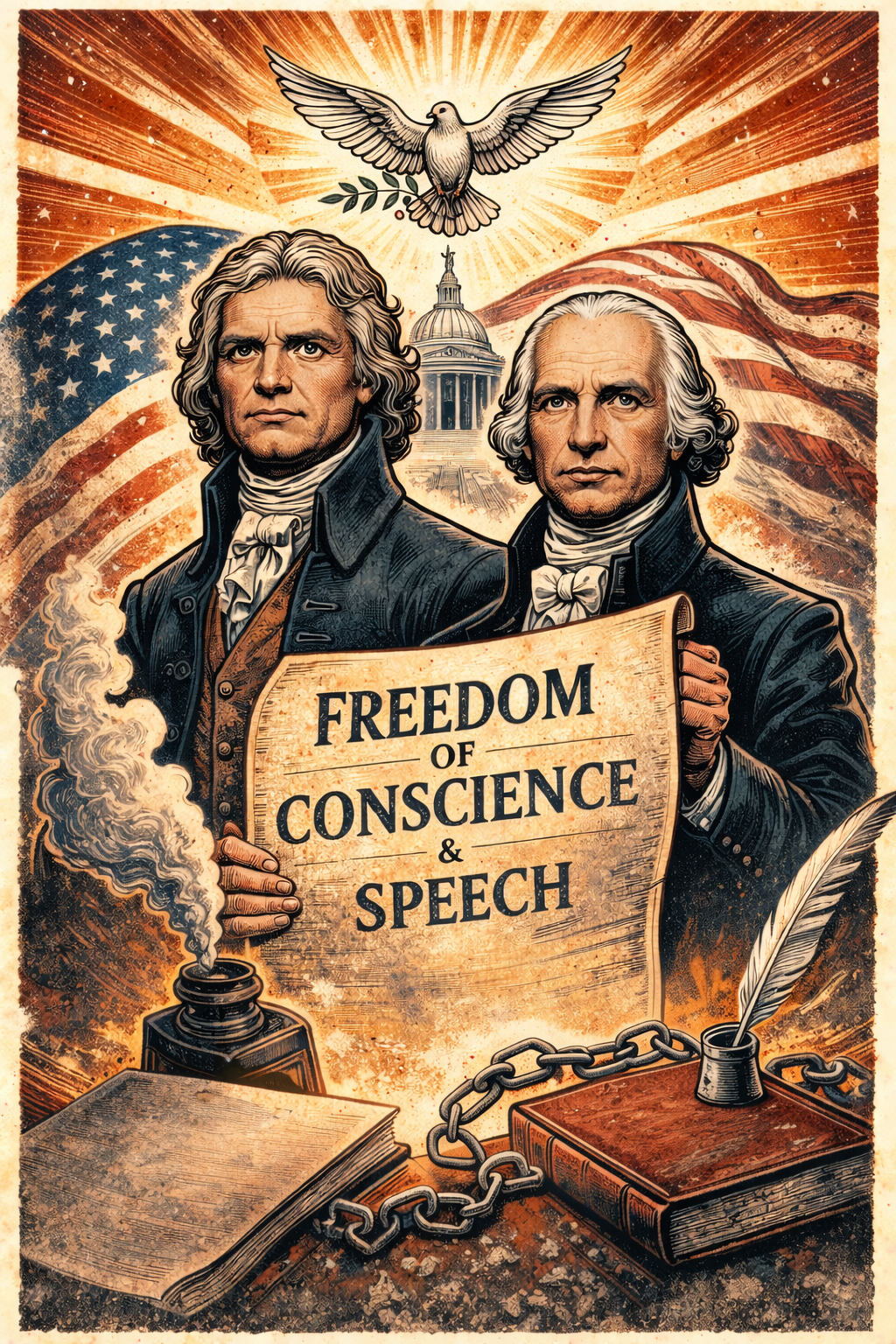
The principle that government may regulate actions but not opinions has deep roots in American history. Thomas Jefferson, the primary author of the Declaration of Independence, explained in his 1802 letter to the Danbury Baptist Association that the “legitimate powers of government reach actions only, and not opinions.” He meant that while the government can regulate people’s outward behavior to protect public order and the rights of others, it has no authority over what individuals think or believe inwardly or utterances based on these beliefs. These are the freedoms of conscience and speech that fellow Virginian James Madison enshrined in the First Amendment to the US Constitution.
In his letter, Jefferson explicitly tied this principle to the Constitution, emphasizing that freedom of conscience is a natural right beyond the reach of civil law. Earlier, the Virginia Statute for Religious Freedom, drafted by Jefferson in 1777 and championed by Madison, was enacted in 1786 as a landmark law establishing that government has no authority over individual beliefs, particularly in matters of religion. The statute declared that compelling people to support or participate in religion—or what today we might recognize as ideology—violated natural rights and corrupted both faith and government. It insisted that civil rights should not depend on religious beliefs.
Although the statute focused on religious liberty rather than speech alone, it advanced the broader principle of freedom of conscience: that opinions and beliefs are beyond the reach of law and punishment. This reasoning, expressed in one of the foundational laws of the American Republic, helped cement the nation’s commitment to protecting thought, belief, and expression from government coercion.
Late in life, Madison reflected proudly on these achievements. In an 1832 letter to Reverend Jasper Adams, written when Madison was 81, he reaffirmed that religion—and, by extension, conscience—flourishes best when independent of government. He praised the American system for rejecting religious establishments and pointed to both the Virginia Statute for Religious Freedom and the First Amendment as deliberate measures to prevent government intrusion on belief. (For an in-depth discussion of the matter, see Rise of the Domestic Clerical Fascist and the Specter of Christian Nationalism.)
Madison emphasized that historical government involvement in religion led to corruption and coercion, while freedom produced genuine faith. Taken together with his later Detached Memoranda, his reflections show that the separation of church and state was not a youthful theory he outgrew, but a principle he remained deeply committed to—and took lasting pride in—until the end of his life.
We must never outgrow that youthful principle. The day the republic ceases to honor and take pride in the boundary between conscience and state is the day the republic ceases to exist. Why is the state of Virginia betraying its two greatest statesmen—the two men most responsible for establishing the freest republic in world history? (See Tim Kaine and the Enemies of Liberty and Rights; Natural Rights, Government, and the Foundations of Human Freedom.)
This is the key difference between liberals (like me) and the progressives who dominate the administrative state, the culture industry, and the media apparatus—and command the Democratic Party. Progressives are not unintentionally adopting the fascistic stance of punishing people for their speech and thought. This tyranny is baked into progressive ideology (see The Tyranny of Rules Governing Speech; The Real Threat to Liberty Isn’t Trump—It’s Technocratic Rule). It is also baked into Islamic doctrine (see Threat Minimization and Ecumenical Demobilization; Man’s Rights to Belief and Conscience). This is the heart of the Red-Green Alliance: to use government to suppress speech and thought (see The New Orwellian Slogans; Antisemitism Drives Anti-Israel Sentiment; “Free, Free Palestine!”; Is the Red-Green Alliance Ideologically Coherent?). The analogy I used above is not an analogy. It is the thing itself. Legislating prejudice is fascistic. You can’t tell people what to say or think in a free society.
* * *
Le scandale du jour is President Trump sharing on TruthSocial (then deleting) a meme video of Democrats as zoo animals that opens with Michelle and Barack Obama depicted as apes (it also depicts Joe Biden as a monkey). Except that Trump didn’t share the video. He (or likely an aide) shared a clip from a documentary on the 2020 election that, at the end, grabbed a second of an autoplay of the next video suggested by the algorithm. The scandal is yet another hoax that elevates offense-taking to obscure the content of the actual video Trump shared. Progressives are attempting to throw a monkey wrench into the SAVE Act.
NPR writes that “Trump has a history of making racist remarks toward Black people and other people of color.” The examples the propaganda organ cited: “For years he pushed the false narrative that Obama was not born in the U.S., and he has previously used derogatory language to describe African countries.” How is suspecting Obama of not being a natural-born citizen racist? Because Obama is black? That doesn’t follow. How did Trump describe African countries? “Shit-holes.” How is that racist?
This is why definitions matter. Racism is not merely the recognition that human beings belong to different races—understood as constellations of phenotypic characteristics—but as the belief that these races can be hierarchically ranked according to traits such as behavioral tendencies, cognitive abilities, and moral aptitude. That constitutes the ideology of racism. Racism in practice, by contrast, is a system of institutions, laws, and policies organized around and enforcing that hierarchical worldview. There is nothing in Trump’s history that supports a claim that he is a racist, either ideologically or practically. (See What’s Racist About Islamophobia? Not What You Think; Race, Ethnicity, Religion, and the Problem of Conceptual Conflation and Inflation; Muslims are Not a Race. So why are Academics and Journalists Treating Them as if They Were?)
I have some advice for the fragile: if opinions hurt your feelings, get over it. Don’t try to control or punish those who say things you don’t like. They don’t live for you. They are not children, and you are not their father. Nor are you a child who needs protection from expressions and opinions you find offensive. Grow up. Life isn’t the third grade. But we know what this is really all about (see Offense-Taking: A Method of Social Control).

 freedom and reason