
Note: I am using the terms “left” and “right” in this essay because these are standard in analyses comparing communism and fascism. As noted in a recent essay (Why “Left” and “Right” Are Useless Political Labels—and Probably Always Were), the left-right distinction that emerged from the French Revolution is highly problematic. Read that essay for clarification.
In a recent essay, I asked Grok (xAI) to modify a possibly AI-generated cartoon that first appeared on platforms operated by Alan Doshna and was widely shared by social media influencers, removing the communist symbolism lurking in the background and replacing it with references to corporate statism and globalization. Here’s the result:
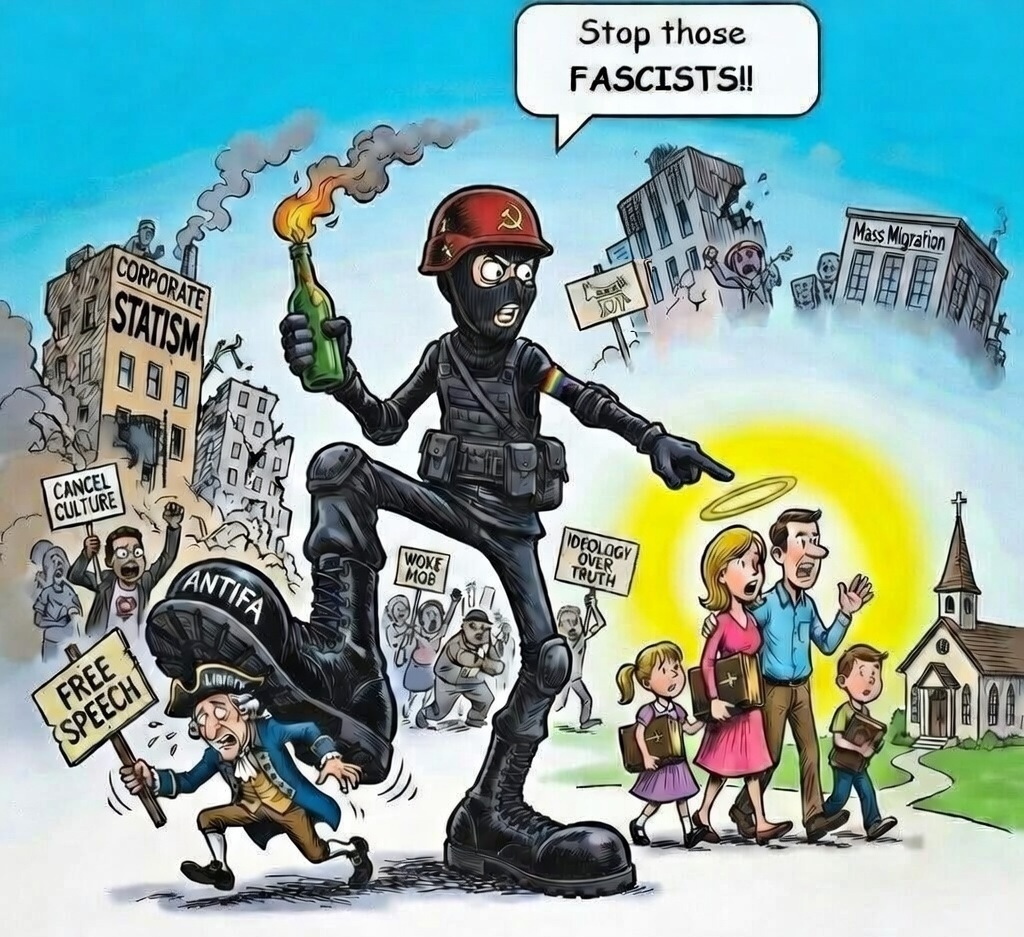
My ask was due to my frustration, experienced for quite a while now, about the confusion on the right about what actually lies behind the chaos we see unfolding across the West. Many conservatives take the rank-and-file woke progressives at their word, that they are anarchists and communist revolutionaries. But there is a dark truth that lies behind popular leftist symbology.
To be sure, many of the protestors do identify as such. However, as I explain in a recent essay (On the Atavistic Side of Pattern Variables: The Primitive Emotive Force of Woke Progressivism) and many other essays, what lies behind the woke mob is corporate statism. Those who seek to rule the earth—and already substantially do—have no intention of letting vulgar socialists run anything except street-level antagonisms. Even here, elites control the messaging. They mean to use the rabble to weaken nations to prepare the world proletariat for inclusion in a new world order, which I describe on Freedom and Reason as the “New Fascism.”
It helps to understand what the terms “communism” and “fascism” mean and what systems based on these terms entail in sorting all this out. People who seek heat instead of light will downplay this task as “semantics.” But semantics is important because it shapes how ideas are challenged, evaluated, and understood. Precise word choice helps ensure that everyone is thinking about the same thing, rather than working from different interpretations of key terms. When definitions are clear, knowledge becomes more accurate and sound, reducing confusion and preventing misleading claims. Semantics also matters because even subtle shifts in wording can frame an issue in a manipulative way, influencing how an audience perceives claims. Persuasion should rest on the force of logic, not twisted meanings.
Communism, as it appeared in the Soviet Union and similar regimes, refers to a system inspired by Marxism-Leninism in which a single-party state claiming to rule on behalf of the working class abolishes most private ownership of the means of production and organizes the economy through centralized planning rather than markets. In practice, these societies develop highly centralized bureaucratic states that control agriculture, industry, and the distribution of goods and services, suppress political pluralism, and use coercive institutions, such as secret police and party structures, to maintain power. While theoretically aimed at achieving a classless, stateless society, Soviet-style communism instead produced state-controlled economies and authoritarian political systems in which the ruling party and its elite wielded dominant power.
Fascist arrangements, while superficially comparable to elements of communism, are qualitatively different, whether in their original Italian form (Giovanni Gentile and his coauthor Benito Mussolini detailed the social model in their 1932 pamphlet The Doctrine of Fascism) or in Italian fascism’s German National Socialist cousin led by Adolf Hitler. In contrast to communism, fascism is a far-right authoritarian and anti-Marxist/communist political ideology and system of government characterized by (ostensibly) ultranationalism, the suppression of political opposition, a cult of leadership, and the subordination of individual rights to the perceived needs of the nation or state.
A central economic feature of classical fascism is corporatism, which does not crudely mean obvious rule by modern private corporations but rather a state-managed system in which society is organized into officially recognized occupational or economic “corporations,” such as agriculture, industry, labor, and professions. In this model, the state mediates and controls these groups, suppresses independent unions and class conflict, and claims to harmonize interests in the name of national unity. However, unlike under communism, private property remains in force under fascism. Ultimately, their interests are conveyed by the authoritarian state; banks and corporations control history. Their weapon—the authoritarian state—is made in their image.
Thus, the key difference between Soviet-style communism and classical fascism lies in their respective economic structures, ideological goals, and social visions. Soviet-style communism is equalitarian and officially internationalist in theory: it abolishes private ownership of major industries, replaces markets with central planning, and claims to rule in the name of the working class with the long-term goal of eliminating class distinctions. Fascism, in contrast, is fundamentally hierarchical and rhetorically nationalist: it seeks to strengthen the state in the name of a nation through authoritarian rule, while preserving private property and organizing society through state-controlled corporatist structures that suppress class conflict while maintaining social inequality.
In practice, both systems produce highly centralized, authoritarian states that restrict political freedoms and concentrate power in a ruling elite; each justifies this power using different ideological narratives—class struggle and socialist transformation in communism versus national unity and tradition in fascism—, but the consequence for the Common Man is unfreedom. It is no problem for corporate state operatives to wrap their agenda in the language of communist revolution, since the people’s experience will be the same in the end.
As I have written about in numerous essays on this platform, George Orwell occupies a distinctive place in twentieth-century political thought precisely because he opposed totalitarianism from within the left rather than from outside it.
Having fought for the anti-fascist cause in the Spanish Civil War—where he was nearly killed by a sniper—Orwell understood fascism as an immediate and brutal threat. Yet it was Soviet-style communism that became the principal object of his sustained critique, not because he underestimated fascism, but because communism, unlike fascism, had won the moral allegiance of Western academics, intellectuals, and much of the democratic left.
This is why Orwell haunts my essays on late capitalism.
The corporate elite have captured the imagination of young, disaffected Americans and Europeans with the promise of a communist utopia. In sociology courses and across related disciplines, Marxism remains a staple of the curriculum, where it functions as the theoretical core of lectures and publications framed in the language of social justice, that is, the “perpetrator-victim” frame (critical race theory, etc.). Fascism, by contrast, may only be taught as an object of condemnation—rightly so.
While there are defensible reasons to teach Marx, particularly insofar as his material conception of history parallels Charles Darwin’s account of natural history, this is not how Marx is typically employed by the contemporary academic left. Few engage seriously with his work as a scientific theory; fewer still have studied it in depth. What matters instead is what they believe Marx meant—a moral narrative that was grotesquely distorted by actually existing socialist regimes, which progressives excuse as a series of failed but well-intentioned experiments. On this view, those failures do not indict the ideal itself, but merely its execution, leaving intact the hope that the egalitarian utopia they long for remains achievable. But what does utopia mean? It literally means “nowhere.”
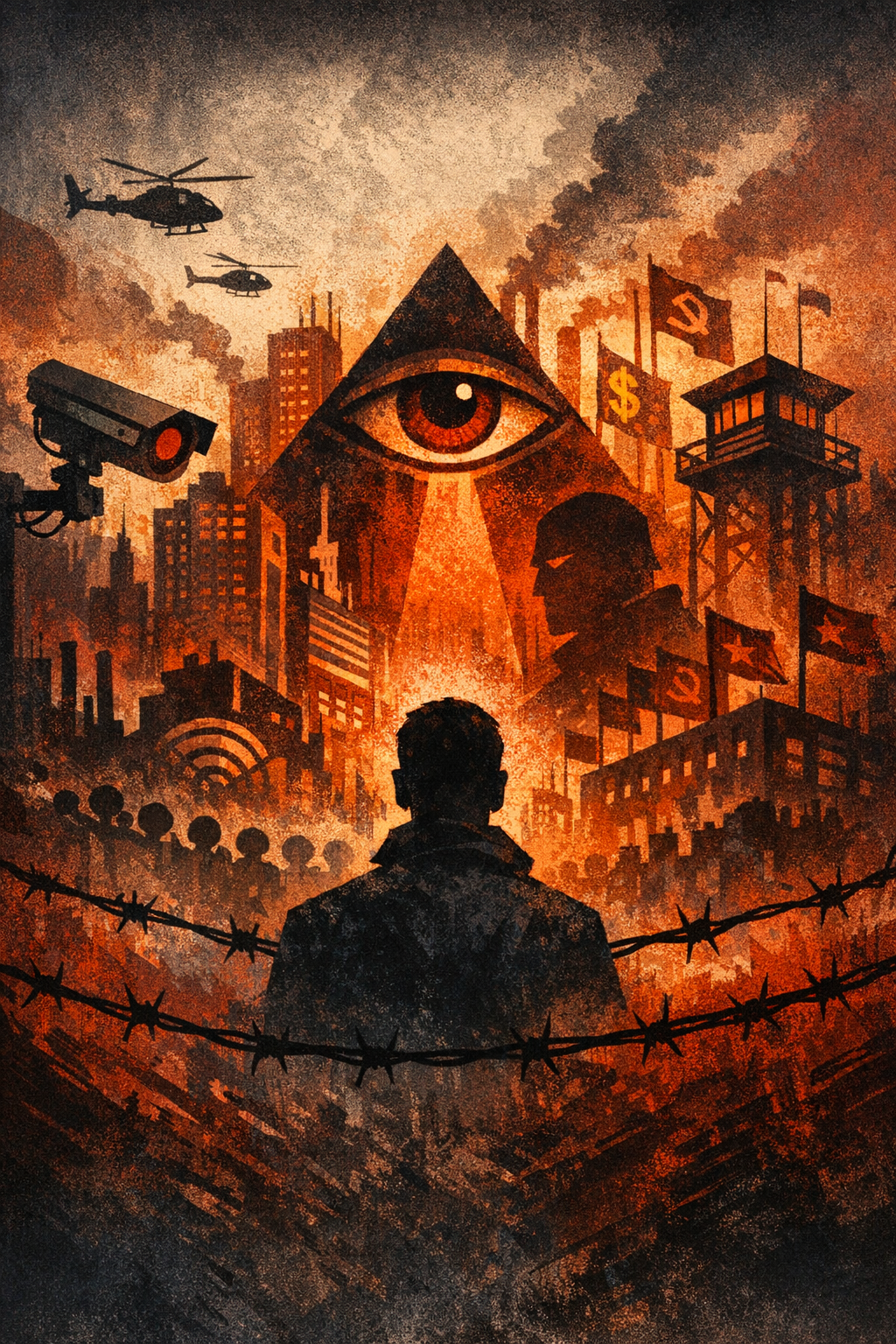
Orwell regarded this infatuation as a profound betrayal of the very values—democratic institutions, free inquiry, and individual liberty—that the left claimed to defend. In works such as Animal Farm and, most fully, Nineteen Eighty-Four, he demonstrated how revolutionary rhetoric can mask the emergence of a new ruling elite and how systems ostensibly dedicated to equality could converge with fascism in their practical outcomes: centralized power, manipulation of language, pervasive surveillance, and the annihilation of truth.
Orwell’s warning was not merely that communism could become tyrannical, but that any ideology willing to sacrifice freedom and reality to power—whether justified in the name of class or race—would inevitably culminate in an authoritarian order indistinguishable in its effects, if not in the end its slogans. All animals are equal, but some animals are more equal than others.
As Sheldon Wolin suggested in Democracy Inc., fascism would not come in its classical form. It would come in the form of inverted totalitarianism. Here we see the convergence of elements of both communist and fascist formations. This convergence is vitally important to grasp so that conservatives and liberals accurately grasp the character of the chaos unfolding in cities across America. Progressivism is an amalgam of totalitarian traits wrapped in kindness.

 freedom and reason