CNN is reporting that Alex Pretti broke a rib in an altercation with federal agents a week before death. Pretti had a history of physically confronting law enforcement. Evidence is emerging indicating that Pretti was an operative in a highly organized and coordinated clandestine operation to disrupt immigration enforcement in sanctuary cities. This operation is more than domestic. There is evidence that this is a piece of the transnational project to dismantle the American Republic.
This afternoon’s essay expands on my morning essay Deadly Force and Objective Reasonableness. To understand the killing of Alex Pretti, it is necessary to step back and consider intent and context rather than reacting to a simplified narrative. Context matters when evaluating the actions of individuals, law enforcement, and the broader political environment in which such events occur.

In that essay, I asked readers to consider the case of Kyle Rittenhouse. I understand why he carried a rifle in Kenosha. At the time, looting was widespread, and law enforcement was failing to prevent property damage. Rittenhouse and others went to Kenosha for two reasons: firearms deter looting, and firearms are necessary for self-defense in chaotic situations where interpersonal violence is likely. Riots associated with the Black Lives Matter uprising in the summer of 2020 drew Rittenhouse and other patriots to Kenosha.
Rittenhouse was not targeting the police. He was performing a private, informal policing function. When police arrived, he raised his hands and attempted to surrender. When they waved him on, he returned home and later turned himself in. This behavior reflects responsibility rather than malice.
In contrast, the case of Alex Pretti raises different questions. The issue is not whether Pretti had the right to be armed—he did. The crucial question is why he was armed. Unlike Rittenhouse, Pretti was not defending property or deterring looters. Pretti was there to disrupt ICE and Border Control operations. Based on the context, he appears to have carried a firearm to defend himself against federal law enforcement officers. When confronted by police, Pretti resisted lawful orders and struggled with officers. Now we know Pretti has a history of physically confronting law enforcement.
According to available information, Pretti was not merely a protester but an operative in a coordinated effort to obstruct federal immigration enforcement, part of a broader conspiracy to foment insurrection in Wisconsin. This conspiracy allegedly involves political elites and was exposed through access to Signal chat logs organizing these activities.
FBI Director Kash Patel has announced that the Bureau is investigating encrypted Signal group chats in Minnesota that were used to monitor ICE and Border Patrol in the sanctuary city. The chats—first reported by journalist Cam Higby—shared real-time alerts, color-coded vehicle identification guides, and training invitations from state representative Brad Tabke.
The probe follows three shootings since early January, including the deaths of Pretti and Good, during federal operations targeting illegal aliens with criminal records. Patel stressed that the investigation is focused not on lawful, peaceful protest but on incitement and obstruction of law enforcement. The fact pattern indicates a conspiracy to interfere with immigration enforcement that reaches into the upper echelon of Minnesota state government.
To understand the larger context, readers should turn to fellow at the Hoover Institution, Stanford University, Peter Schweizer and his new book The Invisible Coup: How American Elites and Foreign Powers Use Immigration as a Weapon. Schweizer argues that our national debate on immigration focuses almost entirely on what happens after migrants arrive. But we’ve ignored a critical question: who is sending them, and why?
For decades, establishment elites framed mass immigration as a compassionate extension of the American Dream—a peaceful melting pot that would strengthen the nation. You have heard the rhetoric. Yet beneath the propaganda lies a troubling reality. Mass migration has become one of the most potent political tools ever turned against the United States, driven by powerful interests at home and exploited by adversaries abroad. This is the context that explains Minneapolis.
When an armed operative involved in an organized effort to obstruct federal law enforcement fights with officers, the risk of lethal outcomes increases dramatically. Yet many observers ignore this context and accept a media narrative portraying federal agents as having murdered a civilian protester. That narrative oversimplifies the situation and prevents serious analysis.
Let’s presume the ICE officer killed Pretti without justification. Should we abolish ICE? I noted in this morning’s essay that the police kill more than a thousand civilians every year. A handful of those are not justified. Should we therefore abolish the police? If we abolished the police, who would enforce the criminal law? Obviously, the call to abolish the police is effectively a call for more crime and disorder. We might leave it solely to citizens to enforce the law, but take a moment to think about what that would look like. It would be the Wild West, not the good order our constitutional government has established.
The call to abolish ICE is not a rational response to the killing of Alex Pretti—at least not from the standpoint of public safety and national security. Pretti’s killing is being exploited to abolish ICE. If immigration law goes unenforced, the tens of millions of illegal aliens won’t face deportation. Abolishing ICE effectively negates the popular will and leaves the nation vulnerable to forces domestic and foreign that seek America’s destruction—and the West more broadly.
Why isn’t this obvious? Recall George Orwell’s concept “doublethink,” a central control element used by the Party in the dystopian world he describes in Nineteen Eighty-Four. Doublethink is the ability to hold two contradictory beliefs at the same time and accept both as true—often without noticing the contradiction—by selectively forgetting, reinterpreting, or compartmentalizing facts.
However, it’s only doublethink for those who call for the abolition of ICE but do not also call for the abolition of the police because they sometimes kill citizens. It’s not doublethink for those who want to make immigration laws dead letters. They understand that it would take a long time to repeal the immigration laws on the books. And they’re not sure they could achieve that, since immigration control is popular (as it is in every other country on the planet). Abolishing ICE is the quickest route to neutralizing immigration law.
The circumstances of the shooting certainly matter. Video evidence shows that during the struggle, an officer disarmed Pretti. Pretti then appeared to reach for something, and officers observed an empty holster, indicating that a firearm was unaccounted for. Within seconds, someone shouted that Pretti had a gun. From the officers’ perspective, this was a reasonable inference under extreme stress, and they fired. From this perspective, the shooting was justified.
If one argues that Pretti should never have been put in that situation, the responsibility lies not with the officers enforcing federal law but with the organized effort to obstruct immigration enforcement. Federal law is the supreme law of the land, and interfering with its enforcement in pursuit of secessionist aims is what ultimately put Pretti in danger. Pretti is one of a multitude of Americans suffering from suicidal altruism (see Wokedom and the Problem of Lethal Altruism). The transnational elite have weaponized this multitude to carry out their agenda.
Progressives now citing corporate opposition to ICE operations as a reason why ICE should leave Minneapolis should not come as a surprise. Of course, corporations oppose mass deportations, not only to advance the transnationalist agenda, but to exploit foreign labor to drive down wages for American workers and drive up corporate profits. Nor is it surprising that Democrats—the party of the oligopoly leading the transnationalization of the global order—oppose mass deportations. They need illegal aliens for political advantage. These same economic and political imperatives protected the slavocracy in the American South. The economic motive behind chattel slavery is obvious, so I will leave that to one side to focus on the political motive.
Southern planters leveraged chattel slavery into political power in several ways. The Three-Fifths Compromise inflated Southern representation in Congress and the Electoral College by counting enslaved people for apportionment while denying them rights, giving slaveholding states disproportionate influence over federal policy and presidential elections. Wealth generated by slave labor funded political networks and enabled Democratic elites to dominate state governments, shaping laws that protected slavery. At the national level, the “Slave Power” bloc used this enhanced representation to control key committees, broker compromises, and secure federal policies—such as the Fugitive Slave Act and territorial expansion—that preserved and extended slavery.
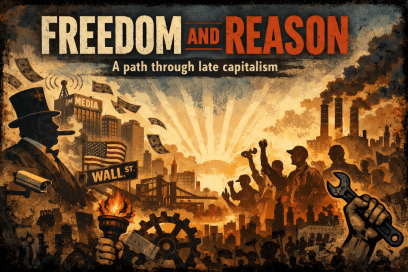
Understanding this history sheds light on the present and the future. With the rise of transnational corporate power, world elites have put the world on the path to global neo-feudalism. I have written about this matter in several essays since 2020 (see, for example, George Soros, Philanthrocapitalism, and the Coming Era of Global Neo-Feudalism). I have relied on the work of Urban Affairs fellow at Chapman University in Orange, California, who analyzes these dynamics in his book The Coming of Neo-Feudalism: A Warning to the Global Middle Class.
Contemporary capitalism is rapidly becoming a system that mirrors aspects of medieval feudal society—but a high-tech version that encompasses the world. In this framework, economic resources, political influence, and digital power are becoming heavily concentrated among a nexus of elites—technology companies, social planners, and ultra-wealthy individuals. Meanwhile, much of the population faces unstable work conditions and limited economic security, leading to shrinking opportunities, reduced social mobility, and weakened democratic influence.
One important feature of this development is the role of large technology platforms as modern-day “landowners.” Companies that control digital infrastructure, online marketplaces, and data ecosystems effectively set the rules for participation in the digital economy. By charging fees, collecting user data, and controlling access to markets, they extract ongoing value from individuals and smaller businesses that depend on their systems to function. This is rent-seeking on a world scale.
Open borders policies constitute a crucial factor in the global neofeudalism framework because, along with the portability of capital, they expand the supply of labor in ways that benefit large corporations and elites while increasing competition and precarity for workers. When labor (and capital) can move freely across borders without strong protections, employers gain access to a larger, more flexible workforce that can be used to drive down wages, weaken unions, and reduce job security.
This dynamic erodes the bargaining power of domestic workers and accelerates the shift toward contract, gig, and informal employment. In the neofeudalism frame, open borders reinforce a system in which capital and powerful institutions become more mobile and influential, while workers become more dependent, interchangeable, and vulnerable within a globalized economic hierarchy. Global neofeudalism is thus a description of the growing power of corporations and wealthy elites relative to governments. Transnational firms and financial institutions influence policy, shape regulations, and operate across borders in ways that exceed the authority of individual states. This dynamic weakens public oversight and reduces the ability of democratic institutions to regulate economic power effectively.
Associated with global neo-feudalism is neoserfdom, wherein workers are technically independent (indeed, atomization is beneficial to power) but practically constrained by their reliance on corporations and digital platforms. Their ability to change jobs, earn income, or improve their situation is dictated by systems they do not control, limiting their autonomy despite formal freedom. Fanatic opposition to Trump’s efforts to return to the American system and reconfigure the world economy to put nations first—the populist response to globalization—is a manifestation of elite resistance to popular attempts to reclaim democratic republicanism. If populist movements in the West can be defeated, the neoserfdom is the fate of the world population.
Here, Sheldon Wolin’s theory of inverted totalitarianism and managed democracy, detailed in his landmark 2005 Democracy, Inc., is crucial to take up (I have referenced Wolin’s work in several essays on this platform, most recently in The Real Threat to Liberty Isn’t Trump—It’s Technocratic Rule). Managed democracy is the technocratic organization of social life, which is what progressives mean when they talk about “defending democracy.” From their standpoint, reclaiming constitutional republicanism and national sovereignty, i.e., actual democracy that defends individual liberty and represents the popular will, is an assault on the technocratic arrangements they euphemize as democracy.
In global neo-feudalism, the protection of concentrated wealth and private assets centralizes power and undermines democratic forms of governance. Instead of accountable institutions and competitive markets, power becomes privatized and insulated from public influence. Global neofeudalism represents a shift away from liberal capitalism toward a system dominated by entrenched private power structures. Mass immigration must be understood in light of the emergent totalitarian system. History is only accidental to a degree. There are people with power and, as the late Michael Pareti told us, corporate elites have always wanted only one thing: everything. They’ve mobilized suicidal altruism against the open and rational institutions of the Enlightenment to realize what they have always ever wanted.

 freedom and reason