
“Insanity in individuals is something rare—but in groups, parties, nations, and ages it is the rule.” —Friedrich Nietzsche, Beyond Good and Evil (1886)
I want to share with you today something I teach in my college course, Freedom and Social Control. I believe this observation is broadly useful right now, in light of the unfolding insurrection in Minneapolis and the promise of more rebellion in other cities across the United States. Insurrection is a social contagion, one with a quasi-religious character, and without a reason to rise against the government, and for the sake of collective sanity, the contagion must be interrupted.
In The Future of an Illusion (1927), Sigmund Freud argues that religion is a collective psychological construction arising from deep human wishes („Wunscherfüllung“): the desire for protection, transcendent meaning, and a benevolent father figure, especially in the face of civilization’s constraints (necessary to check das Es, or the it or Id) and nature’s dangers and uncertainties.
While religious doctrines are ontologically false, Freud contends they persist because they fulfill profound emotional needs and help maintain social order. Like Karl Marx (in the Preface to “A Contribution to the Critique of Hegel’s Philosophy of Right,” published in 1844 in Deutsch–Französische Jahrbücher), Freud is sympathetic to religion, even if he does not personally believe in God, because he recognizes the comfort and moral structure it provides (Marx is sympathetic for other reasons, while also highly critical of false consciousness as a manifestion of alienation).
Central to Freud’s thesis is the distinction between delusion and illusion. A delusion is a belief held in contradiction to evidence, reality, and reason (e.g., believing that gender is interchangeable), whereas an illusion is a belief motivated by wish-fulfillment—false, perhaps, but not defined solely by its falsity. Religion, Freud insists, is an illusion because it arises from universal human desires rather than a psychotic denial of reality. This makes it distinct from delusion, which is a personal subjectivity incongruent with the objective reality around the person. Delusion is pathological for this reason.
Freud predicts that as scientific rationality advances, humanity will gradually outgrow religion, replacing it with a more sober, reality-based ethic. Yet he demonstrates a profound understanding—or Verstehen, in the German sense—of religious belief: religion provides moral guidance, psychological comfort, and, perhaps, necessary social control at this stage of cultural development, especially for those who cannot tolerate life’s anxieties without it. Here, his idea intersects with Marx’s notion of religion as a painkiller—the “opiate of the people” („das Opium des Volkes“).
In my lectures, I situate Freud in a larger discussion of Paul Ricœur’s 1965 “Master of Suspicion” thesis (“les trois penseurs de la suspicion”), alongside Friedrich Nietzsche’s critique of religion, the “Death of God” thesis („Gott ist tot“, an observation that also influenced Max Weber, as noted in previous essays on this platform). Freud claims to avoid Nietzsche systematically, confessing that he feared he might discover ideas too close to his own—but the overlap is striking. German intellectuals were swimming in Nietzschean waters, so the man’s influence over Freud (as well as Weber and others) was likely inevitable.
Both Freud and Nietzsche understood religious belief as a human projection: religion sublimates unconscious drives over rational self-understanding, and morality is historically contingent rather than divinely grounded. Nietzsche’s critique of religion as a response to human weakness and suffering parallels Freud’s account of religion as wish fulfillment. Nietzsche’s psychological style of conveyance anticipates Freud’s method: interpreting beliefs as symptoms rather than truths.
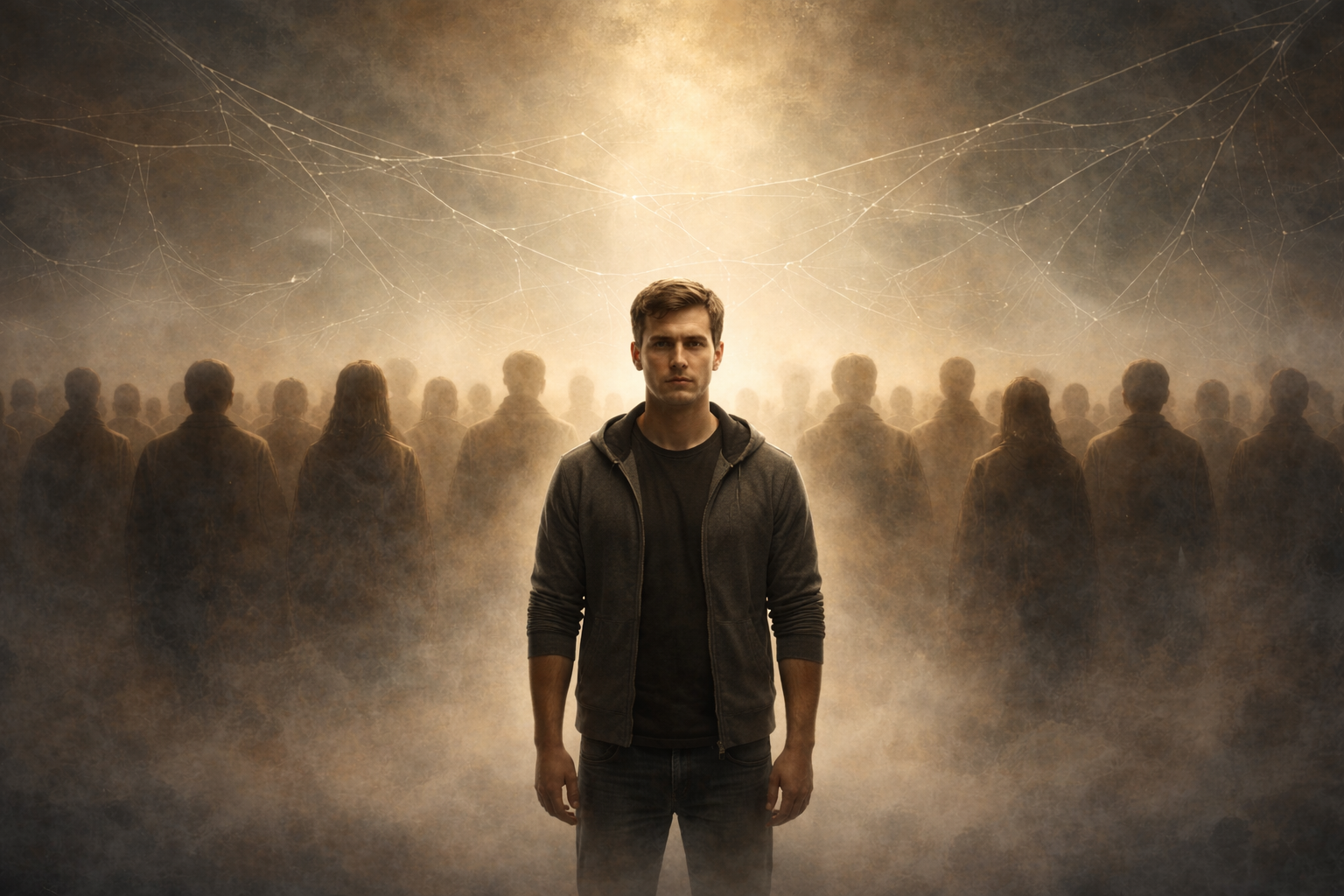
In lecture, I often recall Nietzsche’s line from Beyond Good and Evil (quoted at the top of this essay). Overstated perhaps, but strikingly relevant today: what counts as madness in an individual—cruelty, irrational beliefs, self-deception—can become normalized, even revered, when shared collectively. Social scale can convert pathology into “morality” and “truth.” (Did the man call it or what? Whatever one thinks of Nietzsche, that his perception was high-powered is undeniable.)
Nietzsche’s insight anticipates Freud’s treatment of religion as a mass psychological phenomenon: not private psychosis, but a culturally sanctioned illusion that persists because it is shared. Their approaches diverge, however: Nietzsche frames these beliefs as mass psychogenic illness; Freud frames them as a universal, developmentally understandable aspect of the human condition. Nietzsche emphasizes decadence, herd mentality, and social power; Freud emphasizes the psyche’s readiness to accept comforting illusions. Nonetheless, both recognize culture’s capacity for collective irrationality.
This is why I emphasize in lectures and public pronouncements the moral imperative to tell the truth and avoid leading impressionable people astray—whether accidentally or intentionally; one has an ethical responsibility to know what’s going on. A man can be charitable, compassionate, and understanding, but when belief becomes pathological and destructive, he must criticize it. Reforming character at scale requires identifying the vulnerabilities that make people susceptible to harmful illusions—and those who take advantage of those vulnerabilities. This demands brutal frankness and the courage to offend even those we hold close.

 freedom and reason