
Article I, Section 8 of the US Constitution grants authority to the federal government:
“To provide for calling forth the Militia to execute the Laws of the Union, suppress Insurrections and repel Invasions;
To provide for organizing, arming, and disciplining, the Militia, and for governing such Part of them as may be employed in the Service of the United States, reserving to the States respectively, the Appointment of the Officers, and the Authority of training the Militia according to the discipline prescribed by Congress.”
Article II, Section 2 grants this authority, among others, to the President:
“The President shall be Commander in Chief of the Army and Navy of the United States, and of the Militia of the several States, when called into the actual Service of the United States.”
This is the office that calls the military into national service.
Article VI, Clause 2—the Supremacy Clause—states:
“This Constitution, and the Laws of the United States which shall be made in Pursuance thereof; and all Treaties made, or which shall be made, under the Authority of the United States, shall be the supreme Law of the Land; and the Judges in every State shall be bound thereby, any Thing in the Constitution or Laws of any State to the Contrary notwithstanding.”
The Tenth Amendment cannot plausibly be interpreted to grant states the right to thwart the authority or laws of the national government. There is no such thing as “states’ rights.” States are granted powers; people retain their rights. State power exists only at the pleasure of the national government. The rights of the people are limited only by reason.
This constitutional framework provides all the authority the President needs to nationalize the Minnesota National Guard—or the National Guard of any other state—when necessary to provide troops for a legitimate federal purpose.
However, if there is any question about this authority, Congress made it explicit in the Insurrection Act (10 USC §§ 331–335, enacted in 1792).
Section 331 — Federal aid for State governments states:
“Whenever there is an insurrection in any State against its government, the President may, upon the request of its legislature or of its governor if the legislature cannot be convened, call into Federal service such of the militia of the other States, in the number requested by that State, and use such of the armed forces as he considers necessary to suppress the insurrection.”
Leaders of states in rebellion against the national government often emphasize the phrase “upon the request of its legislature or of its governor,” while ignoring the subsequent sections, which override state consent.
Section 332 — Use of militia and armed forces to enforce Federal authority states:
“Whenever the President considers that unlawful obstructions, combinations, or assemblages, or rebellion against the authority of the United States, make it impracticable to enforce the laws of the United States in any State by the ordinary course of judicial proceedings, he may call into Federal service such of the militia of any State, and use such of the armed forces, as he considers necessary to enforce those laws or to suppress the rebellion.”
Section 333 — Interference with State and Federal law further states:
“The President, by using the militia or the armed forces, or both, or by any other means, shall take such measures as he considers necessary to suppress, in a State, any insurrection, domestic violence, unlawful combination, or conspiracy, if it—
(1) so hinders the execution of the laws of that State and of the United States within the State that any part or class of its people is deprived of a right, privilege, immunity, or protection named in the Constitution and secured by law, and the constituted authorities of that State are unable, fail, or refuse to protect that right, privilege, or immunity; or
(2) opposes or obstructs the execution of the laws of the United States or impedes the course of justice under those laws.
In any situation covered by clause (1), the State shall be considered to have denied the equal protection of the laws secured by the Constitution.”
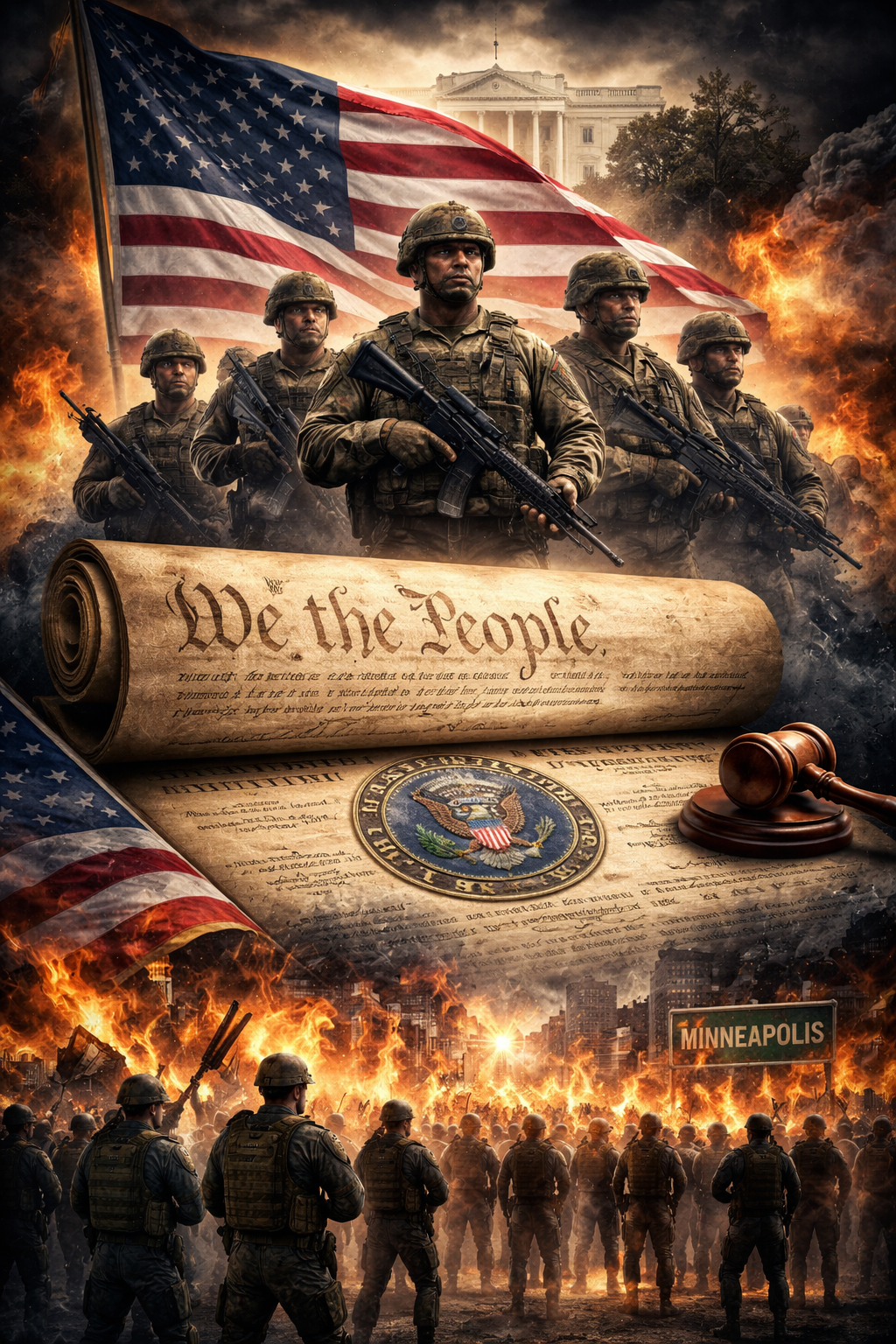
What is occurring in Minneapolis constitutes an insurrection. Minnesota is in rebellion against the national government. The governor of Minnesota, Tim Walz, and the mayor of Minneapolis, Jacob Frey, are failing to defend the civil rights of the citizens of that state and of the Republic. The state is interfering with the execution of federal law.
The President not only has the authority to deploy the military into Minneapolis—he is obligated to do so. Failure to act would constitute a failure in the President’s core duties as Chief Executive of the United States. History regards as heroic those Presidents who act:
In 1871-72, President Ulysses S. Grant used federal troops to suppress domestic insurrection carried out by the Ku Klux Klan during Reconstruction. Acting under the Enforcement Acts of 1870–1871, particularly the Ku Klux Klan Act of 1871, Grant declared martial law in parts of South Carolina, suspended habeas corpus, and deployed federal troops to arrest hundreds of Klansmen. The KKK was effectively dismantled for a generation. Grant justified these actions because state authorities were either unable or unwilling to protect the civil rights of citizens guaranteed by the Constitution, making federal intervention both lawful and necessary.
In 1957, President Dwight D. Eisenhower federalized the Arkansas National Guard and deployed the 101st Airborne Division to enforce the Supreme Court’s decision in Brown v. Board of Education. Arkansas Governor Orval Faubus had used the state National Guard to block the integration of Little Rock Central High School. Eisenhower responded by removing the Guard from state control, placing it under federal command, and sending active-duty troops to protect Black students. Eisenhower acted under Article II authority and the Insurrection Act, making clear that state defiance of federal court orders would not be tolerated.
In 1962-63, President John F. Kennedy used federal force to enforce civil rights during confrontations in Mississippi and Alabama. In 1962, when Mississippi Governor Ross Barnett resisted the court-ordered enrollment of James Meredith at the University of Mississippi, Kennedy federalized the Mississippi National Guard and deployed U.S. Army troops to restore order after violent riots erupted. In 1963, Kennedy again federalized the Alabama National Guard to enforce desegregation at the University of Alabama over Governor George Wallace’s objections. In both cases, Kennedy acted on the principle that when states obstruct federal law and deny constitutional rights, the President not only may act—but must act.
On November 5, 2024, I voted for a man of action. I voted for law and order. I voted for the United States Constitution. I have regretted some of the votes I cast in the past. I do not want to regret this one. Action is needed now. If the President does not act, the nation risks descending into civil war. History will judge harshly Trump’s failure to act in this moment.

 freedom and reason