
Many of us have seen these videos—or perhaps readers have experienced this personally, tragically, sometimes, even with a loved one—where a person shouts repeatedly phrases like “Fuck off!” or “Go kill yourself!”
You may have noticed that the phenomenon is almost exclusively associated with woke progressive types, especially trans-identifying individuals. I say “almost” to be charitable; I’ve never heard conservatives or liberals do this (strong executive function). There may be some, but there’s a reason why this is characteristic of those who identify as queer or woke, which I will come to.
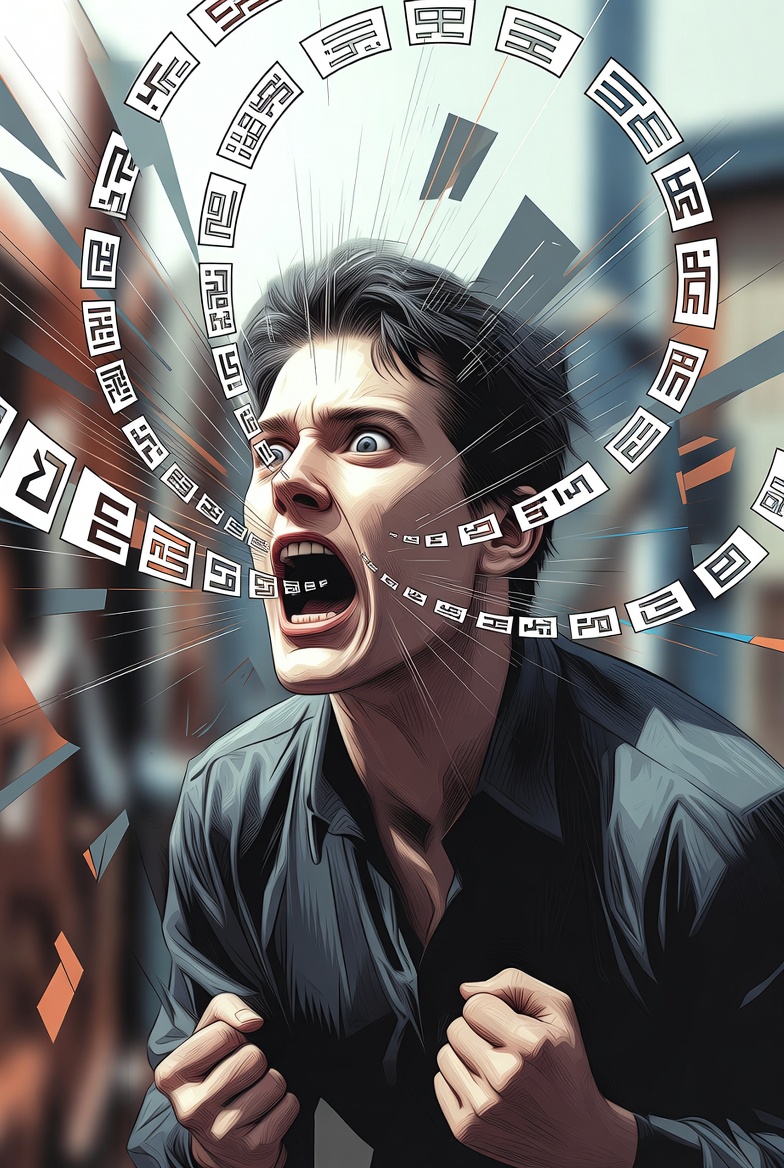
The phenomenon has features indicative of mental illness, which may or may not be organic. Have you ever heard of perseveration? This is a state in which a person’s speech (or thought) becomes stuck in a loop, causing them to repeatedly chant the same phrase, often at the top of their lungs in monotone (or internally, such as in cases of selective mutism, which sufferers attest to).
This happens when executive control over language breaks down. Instead of choosing words deliberately, the brain locks into automatic, high-emotion speech patterns that repeat without flexibility. This feedback loop is a sign of dysfunction in the frontal lobe. It can result from a structural defect or chemical imbalance, external triggering in defective or primed individuals, or intoxication.
Brain-locking instances occur during intense emotional arousal, such as panic, rage, or stress, or when the deep animal part of the brain is disinhibited. We can call it “panic-chanting” or “rage-chanting” for shorthand. In these moments, the brain’s threat system overwhelms the parts responsible for inhibition and reasoning, causing speech to become aggressive, primitive, and repetitive.
Emotionally charged phrases like “Fuck off” or “Go kill yourself” are especially likely because they’re easy to produce and carry strong emotional force, even though the person may no longer be consciously intending their meaning (trance states often accompany the phenomenon).
In humans, such phrases are emotionally high-salience, socially aggressive, and conditioned through past use; the person deploys them whenever confronted by triggering stimuli. We see this in other mammals, as well, such as stressed cats howling. It signals that the mammal is potentially dangerous, but it also signals danger in primates, as well—even those with big brains. When a physically restrained detainee chants, “I can’t breathe! I can’t breathe!” “Don’t touch me!” “I’m disabled!” or any number of other phrases common in police encounters, one must be especially cautious. The police understand this, which is why they deploy restraint holds or devices.
A person in a brain-lock cannot control their actions, obviously. This was why straitjackets and tranquilizing drugs and devices (which immobilize the person) have been part of institutional psychiatry for decades. Indeed, the phenomenon often suggests neurological injury or a psychiatric condition. When I cover the history of this in my course Freedom and Social Control, students often gasp, “How could we have been so cruel?” But the reality is that these interventions work; what is unleashed by internal dysfunction can be contained by external restraint. What appear as torture devices have a calming effect. Not wanting to experience them again builds in self-control (although some seek out weighted blankets and the like).
We see this in anti-ICE protests and transactivism (sometimes manifesting in the latter as literal barking), but we also see it in other public settings, such as the recent video of a woman who objects to men duck hunting. Have you seen this video? The hunters laugh it off, but it’s disturbing to watch.
We also saw it in a recent video in a park where a woman, after being asked a question by a reporter, David Zeer, childlike chants a limited catalog of short, insulting phrases. It can weird out even normal people. Zeer tries to reason with her, but it’s only by getting away from the situation that the woman calms down. She appears normal again at a distance. Even for otherwise normally appearing persons, when triggered, intrusive thought loops in humans collapse vocabulary into repetitive high-charge phrases. The phrases are simultaneously command-like, insulting, and profane.
Alcohol or drug intoxication can increase the likelihood of this kind of speech lock. Many observers have wondered whether the woman triggered by the Zeer in the park is intoxicated. Zeer encountered other people with this tendency that day, one of whom he was actually able to calm with his relentless calm demeanor (Zeer is a remarkably patient man). You can see that many in the park that day are emotionally dysregulated individuals.
This is not Tourette’s or coprolalia (involuntary utterance of obscene or aggressive phrases), but more like echolalia-like looping (repeating others’ words), only auto-generated.
As implied by the foregoing, the loop can continue until interrupted by an external distraction. Sometimes it resolves with a shock intervention, such as overpowering command voice, macing (CN gas) and pepper spraying, or flashbangs (stun grenades), but not always. Fatigue can also resolve the loop; I have seen people exhaust themselves incessantly repeating the same phrase. However, some people are almost indefatigable, which stresses out everybody around them, amplifying the danger.
Cops are human, too, which is why anti-ICE demonstrators blow whistles (I have taken to calling them “cicadas,” those annoying insects prominent in the southern United States where I grew up). The whistles are not to warn “neighbors” of ICE operations but to trigger a reaction from cops, which can then be used for anti-government propaganda. The chanting often begins as a tactic to provoke officers, then brain-locking follows.
Physical removal from the situation allows for emotional cooling, which is why police are quick to separate such individuals from reinforcers in the environment, putting them in the back of a patrol car. It’s sad to see. It’s tough to watch. But intervention or removal is often necessary for the sake of the person. The recent instance of a woman pulled from her car is presented by the media as overreach by law enforcement, but you can see all the signs of brain-lock in the video. The repetition is self-reinforcing: hearing the phrase triggers it again, creating a loop, which is why action is often necessary.
Another reason for removal is that brain-lock is often triggered in mob situations where it becomes contagious. A crowd of people can be swept up in the chanting—what we know as mass psychogenic madness—even those who do not suffer from whatever is disordering the brain-locked. Such is the madness of crowds.
If readers will permit me a moment of digression, which will become significant at the end, The Madness of Crowds was the title of a book by Douglas Murray published in 2019. Murray argues that modern Western societies have descended into a form of collective hysteria driven by identity politics, particularly around the topics of gender, race, sexuality, and transgender issues. He posits that these discussions, once grounded in the pursuit of equality and justice, have devolved into rigid, unforgiving orthodoxies that stifle nuance, free speech, and rational debate, often fueled by activist movements and social media platforms.
The phrase “the madness of crowds” originates from the 1841 book, in three volumes, Extraordinary Popular Delusions and the Madness of Crowds by Scottish journalist Charles Mackay, an early study of crowd psychology that chronicled historical examples of mass hysteria.
Murray structures his critique around metaphors like “hardware” (biological realities) and “software” (cultural constructs), contending that misapplications of these concepts lead to societal divisions, victimhood hierarchies, and a “grand derangement” where facts are subordinated to feelings and power dynamics. He calls for a return to universal humanist principles to counteract what he sees as divisive, quasi-religious fervor in progressive causes, warning that such madness risks undermining the very progress achieved in civil rights.
In such cases of mass hysteria, especially after triggering, it’s no longer necessarily a deliberate attempt to communicate or insult, but a sign that emotional and speech systems are running without higher cognitive control. Mobs are especially dangerous, as we have seen in the anti-ICE protests or witnessed during the 2020 Antifa/BLM riots. It’s why Trump should invoke the Insurrection Act to interrupt the train before it reaches the station. (He should have invoked the Act early in the Antifa/BLM riots, but he got bad advice from those around him during his first term as President. See Send in the Troops.)
This is yet another reason why the manipulation of fragile people by Democrats is so objectionable. Democrats are quite cruel in this regard, especially when they affirm the delusions associated with people prone to chanting—delusions they often put into the heads of people they seek to control and weaponize. These are the people who are flooding our streets to protest ICE and Trump. You can see the depth of ideological indoctrination when leftists irrationally insist that Trump is a “fascist” or a “king.” It’s typical of the disorder we recognize as Trump derangement syndrome (TDS). You know from experience that such persons are impossible to reason with. The reasoning part of the brain is suspended. The vulnerable are primed with TDS.
One sees the derangement when woke types claim that abstractions are real without evidence, such as with the claim of “systemic racism” or “white supremacy” attributed to conservatives, while ignoring the best case for systemic racism, namely Democratic control over America’s central cities (the “Blue City”), where they impoverish and make dependent minorities with predictable results, such as high levels of crime and violence. (I have published several essays on this topic on this platform over the years.)
One of the early indicators of a person susceptible to chant-triggering is the constant re-telling of the same stories—not over time or in different settings, but after having already told the story in the same setting. Most of us have met these types of people. I’m not telling many readers something they don’t already know. I could give examples, but out of respect for their identity and reputation, I won’t.
Such vulnerable types, many primed by indoctrination, others primed by unresolved trauma, are perfect subjects for the New Fascism, as we saw during the COVID-19 pandemic, where progressives were eager to see the state engage in a wide range of authoritarian action against those they are instructed to find disagreeable for one reason or another.
These types are drawn to cult-like movements. It’s why progressives seek affinity with Muslims. They fit perfectly the diagnosis detailed by Erich Fromm in his Escape from Freedom, where he specifies the authoritarian personality type. In previous essays, I have characterized such individuals as “zombies,” walking around chanting “Brains! Brains!” Or, alternatively, “parrots,” squawking things like “Trump’s a felon! Trump’s a felon!” or “Trump’s a pedo! Trump’s a pedo!” (See “Hey, Ma. The Zombies are Marching Again”; “Trump is a Felon!” The Squawking of Party Parrots.)
Some of them even come on my Facebook posts and chant and squawk like this. However, the platform X is full of zombies and parrots. I have had to systematically ignore transactivists who repeat the same phrase incessantly. “Trans women are really women!” or “Trans rights are human rights!” repeated a dozen or more times as a list. This happens in other settings, as well. Have you seen the woman? This goes on for several minutes. It is uncomfortable to watch.
I’ve been asked by Facebook friends why I don’t unfriend them. It’s because I’m charitable and tolerant. I pity them, frankly. However, I confess, I’m tempted to, and occasionally I do unfriend them. On occasion, I have had to block them. I had to do it with one individual during the Paris Games during the controversy over male boxers allowed to compete in the women’s sport. The man kept chanting insults. I banned him as much for the sake of others as for my own sake. Some individuals are insufferable and, unlike the police, I don’t have to deal with them on the street. The police have the patience of saints. I don’t have that much patience. But I try.
Earlier, I said that I have not personally seen conservatives or liberals do this. I also noted the phenomenon of the madness of crows. Reflecting on these observations, I want to close with a personal anecdote.
In 2011, during the protests over Wisconsin Governor Scott Walker and state Republicans eliminating collective bargaining rights for teachers (Act 10), I was caught up in crowd madness (I reflect on my participation in those protests and compare them to what occurred on January 6 here: The Relative Ethics of Occupying Capital Buildings). I had yet to shed the progressive influence on my politics, but my liberal core remained; nonetheless, after waiting in the cold for hours waiting for Walker to show up at a business meeting in Green Bay, after most of the crowd had gone home, Walker finally showed up (strategically late, I suspect), I joined the mob in chasing Walker’s convoy to the gates, which were closed by security, leaving the mob to chant “Recall Walker!”
There was a cadence to the chant that entrained me, and I felt the rational part of my brain retreat, leaving me in a trance-like state with Id exposed. Even though I opposed the government’s action (I believe in organized labor, albeit its co-option by progressivism has admittedly greatly weakened my sense of solidarity), I left for home feeling deeply ashamed at having allowed myself to get caught up in the madness. I was ashamed not only because, as a sociologist who teaches the problem of the mob abstractly, I should have known better, but as a man who strives to be reasonable, I should have concretely known better. As readers might imagine, Douglas Murray’s 2019 book helped quite a bit here. As did Mattias Desmet’s The Psychology of Totalitarianism, published in 2022 (see The Future of a Delusion: Mass Formation Psychosis and the Fetish of Corporate Statism for an application of that work).
I had never behaved that way before. And I have never behaved that way since. It was a wake-up call. Indeed, shaken by this moment, I began my journey back to liberalism, sparking a process of self-deprogramming by purging progressive elements from my thought (it took me nearly a decade to get all the nonsense out of my head). I, too, am a mammal, I recognized. But I also recognized that I have a capacity for reason. Because I am a higher-order mammal, I forgave myself, but only after making sure that I would never again allow my capacity for reason to be diminished by the madness of crowds. So ashamed by this, I have apologized publicly to family and friends, making enemies of those angered that I left the tribe. To my credit, except for heavy metal concerts, I only ever chanted once. Chanting with others to call back Judas Priest for an encore is getting my money’s worth. Chanting with crowds of radicalized others is dangerous business.

 freedom and reason