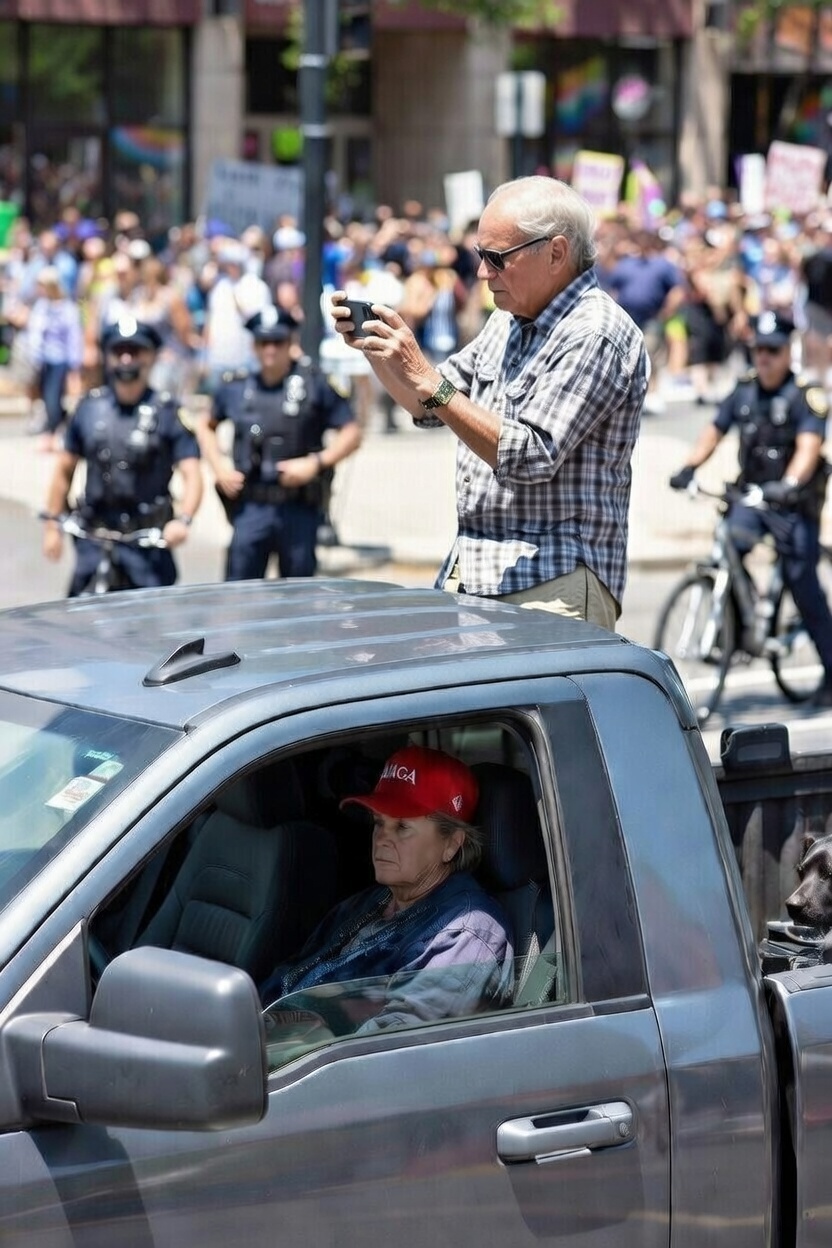
Imagine a scenario in which a woman, let’s call her Loretta, wearing a red MAGA hat, her dog Skeeter in the back of the truck, and her husband, Richard, in the passenger seat, parks a truck perpendicular to traffic, blocking the road, to interfere with a permitted gay pride parade, which police officers are protecting with their presence.
Loretta and Richard don’t like gay people. They’re part of a small group of conservative activists who drive around disrupting gay pride parades. The police have been given the heads up about Loretta and Richard and their little group of disrupters.
While Loretta dances to country music in her truck, Richard gets out to record the situation with his cell phone, which the couple will later post on their social media accounts for clicks. They mean to fuel a wider movement against the LGBT community with their content.
One cop, Bob Jennings, circles the truck on foot to assess the situation, videoing the interaction for the record. He passes by Loretta, who, with a smirk on her face, says, “I’m not mad at you, bro.”
Jennings moves to the back of the truck, where Richard awaits to taunt him. Richard continues to harangue Jennings as the officer walks along the passenger’s side, Skeeter looking on cluelessly with his tongue hanging out of his mouth.
While this is happening, other officers arrive at the driver’s side and order Loretta out of the truck, pulling on the locked door handle.
As Jennings walks around to the front of the truck, completing his 360° survey, Richard smacks the side of the truck and yells, “Drive, Loretta! Drive! Drive!” Loretta guns it and strikes Jennings in the hip. Only a few months before, Jennings had been dragged several hundred feet by a suspect fleeing in a car, the officer’s arm trapped in the window. It took 33 stitches to close the wound on one of his legs.
Simultaneously with the truck’s acceleration, Jennings reacts in a split second and discharges his weapon. Three shots ring out, one or more of the bullets striking Loretta. Loretta is dead, foot still on the accelerator, her truck careens into parked cars down the street.
Jennings, in shock at just having to kill a woman, exclaims, “Fucking bitch.”
If you ask me whether this was an appropriate exercise of lethal force, I would, without hesitation, say yes. I would have to say this because the facts are plainly in front of my face. The fact that I disagree with Loretta and Richard’s actions—I’m pro-gay, and they’re assholes, for the record—must be entirely put aside if I am to be objective in my assessment. The officer did what he was trained to do—what he had to do. It is not only that the MAGA couple were wrong for trying to kill a law enforcement officer; they had no business being parked perpendicular in the street in an attempt to interfere with a permitted gay pride parade. Loretta and Richard put Loretta in that situation,
Would anybody out protesting today over the Renée Good shooting give two shits about Loretta (and whatever happened to Skeeter)? Would they condemn Jennings for enforcing the law so that a permitted gay pride parade could proceed over the objections of anti-LGBT activists?
We all know they wouldn’t. We all know they would say Loretta had it coming. And they would demand Richard be held to account for the attempted murder of a police officer. After all, Richard gave the command for Loretta to gun a locked-and-loaded pre-positioned two-and-a-half-ton truck at a law enforcement officer. Some, if not most, of them would even argue that the goal in that moment was to run over the cop.
But they would arrive at this assessment not because they’re exercising objective judgment but because Loretta and Richard are not members of their tribe—they’re members of the enemy tribe. The cop justifiably killed Loretta because she was protesting a gay rights parade. The homophobe deserved it. Fucking transphobe. Loretta’s actions affirm the progressive characterization of MAGA as the worst people on the face of the planet. It was a righteous kill.
How would MAGA respond? Would they be out on the streets of American cities with bullhorns blocking traffic? Or do you think they would wonder why Loretta and Richard fucked with law enforcement that day? Would Loretta even get a candlelight vigil? I can see conservatives heckling a gay pride parade as it passed by their houses. But that’s free speech. Interfering with the parade? Maybe. I can’t speak for MAGA. I can tell you what I think, though: Loretta had it coming. Not because I support gay rights (which I remind you that I do), but because Loretta tried to kill a police officer, or at the very least put herself in a position where death was a likely outcome. And Richard gave the command. (The police need to arrest and charge Richard.)
Folks shouldn’t be blocking traffic—whoever they are. Folks shouldn’t try to run over police officers—whoever they are. What Loretta and Richard did was objectively illegal. Loretta and Richard put Loretta’s life in danger. If I am to claim to be a rational person, I have to call it as it is.
A day or so ago, on the X platform (find me and follow me on @andrewwaustin), where my follower count has been dropping (I suspect) due to my defense of ICE operations in Minneapolis, I was asked whether I am capable of analyzing the officer’s use of lethal force in Minneapolis without prejudice.
I responded that I am not sure any human is entirely free of prejudice. I’m a left-liberal who believes in limited government, including constitutional constraints on policing. I’ve taught criminal justice courses for thirty years—not from a criminal justice administration perspective, but from the standpoint of critical criminology. So yes, I have biases, if we choose to call them that.
I left the conversation there, but, to clarify, I view these biases more as a normative framework than in the usual sense of the word, but I am happy to call them prejudices for the sake of discussion. These prejudices predispose me to prioritize civil liberties and critique state power.
Reflecting on this, it surprises me that anyone could read my posts as representing anything else. While I have evolved on certain issues, I have never departed from my core liberal values, which I have held my entire life. In fact, my recent evolution has been toward an even greater degree of liberalism. It is my liberalism that prevented me from being absorbed into the progressive worldview that enveloped me during my years in graduate school and as a college teacher.
That said, my commitment to civil liberties and skepticism of state power does not prevent me from recognizing that what happened to Renée Good is a textbook example of appropriate use of lethal force. I think I just demonstrated that in the hypothetical scenario I provided above.
I have also been asked on X, in my capacity as a criminologist, whether I am familiar with the Department of Justice’s policy on lethal force in situations like this. Yes, I am, and I am happy to clarify it now: The DoJ generally prohibits firing at a moving vehicle unless all of the following conditions are met: (1) the vehicle is being used in a way that poses an imminent threat of death or serious bodily injury; (2) the threat cannot reasonably be mitigated by other means (for example, moving out of the vehicle’s path); and (3) deadly force is necessary to stop the threat.
I can also clarify the law governing those who interfere with federal law enforcement action: 18 USC § 111 makes it a federal crime to forcibly assault, impede, interfere with, intimidate, oppose, or resist federal officers performing their official duties, with penalties varying from fines/imprisonment (up to 1 year for simple assault) to more severe penalties (up to 3 years or 10 years if a dangerous weapon or bodily injury is involved).
I have reviewed the video from every available angle. The video the struck officer, Jonathan Ross, records during his investigation is the clearest video of the event, as it provides a 360° view. The video is easily reviewable on the Internet. Ross walks in front of the car, moving to Good’s left, continues past Good on the driver’s side, and around to the back of the vehicle, where he is taunted by the other woman outside the car, Becca Good, Renée’s wife. The taunting continues on the passenger side. At the same time, another officer approaches the driver’s side door, which is locked, although the window is down, and commands Good to exit the vehicle. Good then puts the car in reverse, backs up, and turns the wheel toward the officer as he starts to cross back in front of Good, completing his 360° tour of the vehicle. When Ross is in front of the vehicle, Becca repeatedly shouts, “Drive, Baby! Drive! Drive!” Good accelerates on Becca’s command. The officer does not have time to move out of the vehicle’s path and, in the split second he has to react, discharges his weapon as he is struck.
This is the exact same fact pattern in my hypothetical scenario at the top of this essay. Only the ideological identity of the actors was swapped.
I should not have to repeatedly walk readers through this sequence of events. They can just watch the officer’s video for themselves and determine whether they can see what happened for what it is, or whether they’re guided by motivated reasoning, which results from their prejudices warping their perception.
Motivated reasoning is the cognitive process in which a person forms or favors conclusions based on their beliefs, desires, or emotions rather than on objective evidence. Sometimes this is unconscious. They really do see something other than what a reasonable person sees. Without deprogramming, it is impossible to persuade such a person. Other times, a person can see where the facts take him but rationalizes them to save the viewpoint he feels compelled by tribalism to preserve. Such a person may be just as impossible to reach with logic and facts and the truely deluded believer.
One sees rationalization in the act of dissembling, where the person disguises his own recognition of the facts by arguing that the officer should not have walked in front of a vehicle. Perhaps there is an opening here to reason. While police officers are generally trained to avoid standing directly in front of a vehicle whenever possible, in real-world situations, officers often must move around vehicles to perform duties like arrests, documentation, providing aid, and a myriad of other reasons, which can and often do place them in dangerous positions.
Training emphasizes minimizing risk, but it cannot eliminate every potential threat, and a second of objective thinking would guide a person to that understanding. Ross was performing a 360° survey of the situation. How could he have anticipated that Good would attempt to run him over? Can one really fault him for assuming initially that she had no homicidal intent? He was returning to the passenger side when she accelerated, deliberately positioning her vehicle to interrupt his path. He had begun to draw his weapon a moment before, finally seeing intent in her eyes. Whether he should have been there is largely immaterial; what matters is that she chose to rapidly accelerate toward him (had the wheels not spun on the frozen pavement, she would have run over him).
We hear other rationalizations, as well, such as shooting out tires. This is similar to the shoot them in the legs fallacy, only more absurd. Even supposing he was in a position to do that, does anybody believe that a flat tire would stop an SUV from traveling the short distance needed to run over the officer?
In the end, none of the rationalizations one can dream up are relevant to the question of lethal force justifications. The only relevant matter is the criteria I earlier stated.
From the vantage point of this video and the known context, an objective assessment of the fact pattern and context cannot see the incident as anything other than a legitimate instance of justified lethal force. I regret that Good was killed—not only because of the loss of life, but because her death is being used to further a political agenda that is destructive to the republic.
We have to tell the truth if we want to save lives and the republic: Good’s death was the consequence of the choices she made that day. Her wife may have culpability (I think she does), but no one outside the dyad does—at least not criminally. However, others are indirectly responsible for Good’s demise, chiefly the Democratic Party. Party rhetoric endangers the lives of its followers by telling them to confront and resist law enforcement (see Wokedom and the Problem of Lethal Altruism).
Those who demand that Officer Ross be tried for the murder of Renée Good are entitled to their opinion—but they are not entitled to riot in an attempt to coerce the state into prosecuting a crime that did not occur. This is a case of justifiable homicide. Nor are those who oppose ICE operations entitled to interfere with those operations. It is a federal crime to do so.
Beyond the fact pattern and correct attribution of blame, we must make something very clear: every individual has the right to self-defense, including law enforcement. Officers and soldiers do not forfeit this right because they are serving in the cause of public safety or national security (in the case of ICE, it is both). Society should internalize this principle: civilians must avoid behaving in ways that officers could reasonably interpret as a threat. Parents should teach this to their children.
At the same time, progressives should refrain from teaching young people that police are inherently classist or racist. This goes for clergy, journalists, politicians, and teachers, too. While critiques of policing as a system are valid (I do it all the time in my classroom), the individual officer is a working person, just like the majority of civilians. Moreover, whatever the critique of police as an institution and the function it serves, the evidence for the following claim is irrefutable: without public safety, the lives of working people would be more degraded than they already are.
I have now watched a great many videos of progressives committing federal crimes across social media platforms over the last several days. Not nearly enough of them are being arrested. My hope is that the patience of federal officers will wear thin and they will start hauling these insurrectionists to jail. Democrats should be a responsible party and inform their followers about the law and the potential consequences for violating it. That Democrats are encouraging their followers to rebel against law enforcement is a deeply troubling development. Why they are doing this should be front and center in all of our minds. We have to ask this question because the corporate state media won’t.
That’s what these so-called protests are: insurrection. As I have shown in several essays on this platform, the US Constitution is largely a response to the problem of insurrection in early America, the Articles of Confederation providing the national government with insufficient authority to address the problem of mob violence. The Founders gave the federal government the authority to deal with the problem. The Trump Administration now must act on that authority. (See Our Constitution and the Federal Authority to Quell Rebellion; Concerning the Powers of The US Constitution—And Those Defying Them.)

 freedom and reason