
I have been thinking about why progressives seem so incapable of seeing the Israeli–Gaza conflict through the same historical and moral framework that they apply to World War II, particularly the struggle between the Allied and Axis powers in Europe. The relevant historical touchstone is Nazi Germany. Under Hitler, the Nazis pursued the elimination of the Jews from Europe—a process that culminated in systematic extermination. At that time, the Jews were uniquely vulnerable. They had no capacity for collective self-defense, no army, no sovereign nation. Their survival depended entirely on the eventual intervention and victory of the Allied powers. Liberation came from the outside. That fact alone is terrifying. Now that Jews have the capacity for collective self-defense, they are condemned when they use it to collectively defend themselves, as the world witnessed in the war following the October 7, 2023 pogrom against Jewish citizens in Israel carried out by Hamas, the Islamist government of Gaza.
An often-overlooked but historically significant part of this story of World War II involves Haj Amin al-Husseini, the Grand Mufti of Jerusalem, who rose to prominence during the British Mandate period. During World War II, al-Husseini fled to Nazi Germany, where he lived from roughly 1941 to 1945 and collaborated with the Nazi regime. He became a propagandist, recruiter, and ideological ally to Hitler’s regime. Al-Husseini was deeply antisemitic and militantly opposed to Zionism, or Jewish nationalism. In November 1941, he personally met with Adolf Hitler in Berlin. Surviving German diplomatic records make clear that their conversation concerned the “Jewish question,” particularly its future extension beyond Europe. Many Muslims in the Middle East were eager to eliminate Jews from the terrorities under the thumb of Islam. (See Jew-Hatred in the Arab-Muslim World: An Ancient and Persistent Hatred.)
It is important to be precise here. Neither Hitler nor the Mufti spoke in the blunt language of “extermination” or “genocide” as we would frame it today. Nazi discourse habitually relied on euphemisms—destruction, elimination, removal, solution—language that deliberately obscured intent while authorizing violence. This rhetorical indirection was characteristic of Hitler’s leadership style and of the bureaucratic culture of the Nazi regime. By late 1941, these euphemisms had already acquired a lethal meaning in practice. Mass shootings by Einsatzgruppen, Schutzstaffel (SS) paramilitary death squads, were underway, and extermination was transitioning from improvised killing to systematic policy.
Within that context, Hitler told the Mufti that Germany’s objective was the elimination of the Jewish element not only in Europe but eventually in the Arab sphere as well. He explained that Germany could not act in Palestine, historically Judea before the Roman Empire renamed it as punishment for the third and final Jewish-Roman War (second century AD), until Britain—then the mandatory power—was defeated. Once that obstacle was removed, the Jewish problem there would be “solved.” The Mufti welcomed this logic. He fully endorsed Nazi antisemitismand the Holocaust in Europe and sought to extend its application to Palestine and the broader Muslim world. He later acted on this alignment by broadcasting Arabic-language Nazi propaganda, recruiting Muslims into Waffen-SS units, and repeatedly intervening to block Jewish escape routes from Europe, including efforts to rescue Jewish children.
As history records, Germany lost the war. The Allies liberated the Jews. And, in the aftermath of that catastrophe, the State of Israel was created. For the first time in nearly two thousand years, Jews possessed a sovereign nation and, crucially, a military. The lesson drawn from history was unmistakable: never again would Jews wait defenseless for salvation from outside powers. If genocidal movements arose again, Jews would be capable of resisting them directly.
That lesson now collides with another ideological tradition—one rooted in politicized Islam, which is distinct from secular Arab nationalism. Arab nationalism, while often hostile to Israel, is not inherently fascist (no nationalism is). But movements such as the Muslim Brotherhood and especially Hamas represent something different. Drawing on Christopher Hitchens’s terminology, this tendency can be described as clerical fascism: an authoritarian, totalizing ideology grounded in religious absolutism, animated by conspiratorial antisemitism, and explicitly genocidal in aspiration. Hamas fits this description. Its founding documents, rhetoric, and genocidal and terroristic behavior make clear that its goal is not coexistence with the Jews, but their elimination in the land they inhabit. “From the river to the sea.”
On October 7, 2023, Hamas launched a mass attack on Israeli civilians. This was not merely an act of resistance or retaliation; it was an assault animated by genocidal ideology. As noted, the crucial difference from the 1940s is that Israel now exists and can defend itself. The Jewish nation need not wait for external liberation. It can respond directly. And it did. With overwhelming force. Israel’s goal in the wake of October 7 was to annihilate Hamas and liberate Gaza from clerical fascist rule. Only an international push to broker a ceasefire deterred Israel from its goal. I am adamantly opposed to a ceasefire, and have been highly critical of the Trump Administration’s leading role in securing it.
As I noted in The Danger of Missing the Point: Historical Analogies and the Israel-Gaza Conflict, when images of devastation in Gaza circulate—civilian casualties, destroyed neighborhoods, rubble—the dominant narrative in many political and media spaces portrays Israel as the villain and Palestinians as the victims. I argued in that essay that the historical parallel between Germany’s and Hamas’ wars against Jews is rarely acknowledged. During World War II, Allied bombing campaigns devastated German cities—Dresden, Hamburg, Berlin, Cologne, Frankfurt. Estimates suggest between 350,000–500,000 German civilians were killed in Allied bombing campaigns and ground offensives. In Operation Gomorrah alone, carried out in 1943 against Hamburg, as many as 40,000 civilians were killed. Yet no serious moral framework treats Nazi Germany as the victim of Allied aggression, nor are Roosevelt or Churchill remembered as war criminals for prosecuting the war to defeat fascism.
This is where symbolism and historical archetypes exert extraordinary power. Before Hitler, history had its monsters—Attila the Hun, for example, for a thousand years was the human embodiment of evil—but in the decades after WWII, Hitler became the archetype of genocidal evil. A person is ethically suspect merely for donning the dictator as a costume. And those whom the left despise are smeared with his name (Trump is the latest target). The swastika and other Nazi imagery carry a unique moral charge. That is why public displays of Nazi symbols are banned in many European countries and why marches under Nazi banners would provoke universal condemnation, even when the marches involve only a handful of emotionally dysregulated misfits. By contrast, other symbols associated with mass death and totalitarianism, more notably the Soviet hammer and sickle—often provoke little reaction. Indeed, today, mass marches in the streets of America proudly display the communist emblem. Hitler, not Stalin, has become the universal icon of wickedness. Correspondingly, in this context, Jews became the archetypal victims of genocidal ideology.
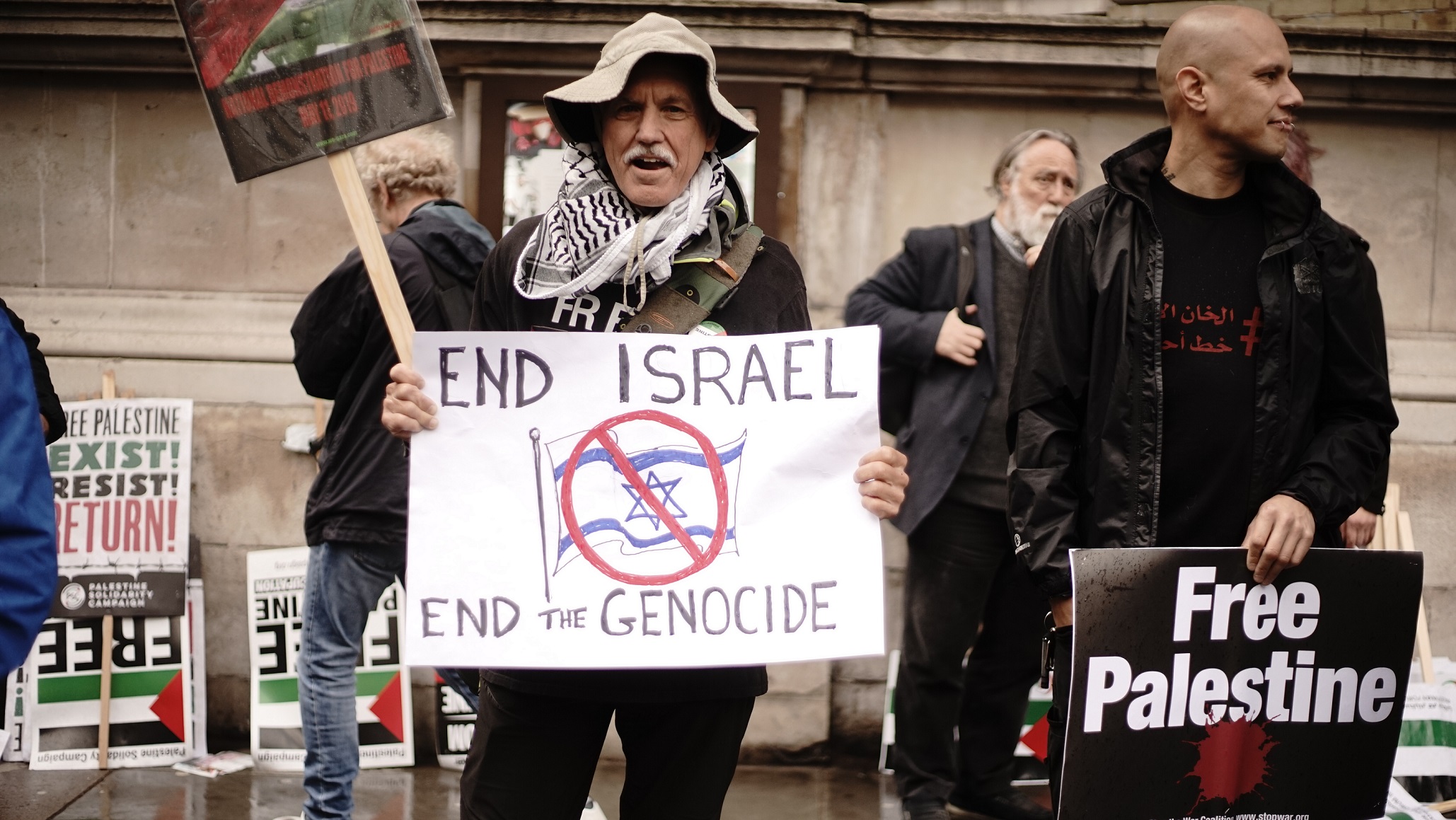
Something strange has happened since the creation of Israel. Now that Jews have a nation, an army, and a nationalist ideology—Zionism, or Jewish self-determination—they are cast, particularly on the political left, as the new archetypal villains. Israel is accused of apartheid, genocide, and unique moral depravity, while far worse regimes around the world receive comparatively little attention. This occurs despite the continuous Jewish presence in the land for over three millennia and despite Israel facing enemies who openly articulate genocidal aims.
This is a fact with which we must grapple: when Hamas commits atrocities, and Israel responds militarily, the moral framework is inverted. Hamas—the aggressor, animated by clerical fascism—is treated as the victim. Gaza’s population and leadership are framed analogously to the Jews of Europe, while Israel is implicitly cast in the role once occupied by Nazi Germany. Israeli leaders are labeled war criminals for defending their country, while Allied leaders who destroyed German cities to defeat fascism are rarely subjected to comparable moral judgment. This inversion collapses historical memory, ignores ideology and intent, and erases the lesson that led to Israel’s existence in the first place: that Jews must never again be defenseless in the face of genocidal movements—whether secular fascism or clerical fascism.
When I see images of devastation in Gaza, I cannot help but also think of the bombed-out cities of Germany. The suffering is real and tragic, but it is morally intelligible within a framework in which defeating genocidal regimes sometimes requires devastating force. That is the parallel I am drawing. And the reason I believe the dominant narrative so profoundly misunderstands what is happening? Antisemitism on the left. (See Antisemitism Drives Anti-Israel Sentiment; Israel’s Blockade of Gaza and the Noise of Leftwing Antisemitism.)
* * *
There is a valid and historically grounded way to understand Hamas not merely as a reactive militant organization, but as the latest institutional expression of an ideological lineage of Jew-hatred that predates the creation of Israel. This lineage is not organizational in the narrow sense—there is no unbroken chain of command or formal inheritance, albeit there are direct linkages as I have established—but rather at its core it is conceptual, rhetorical, and theological. It consists of recurring assumptions about Jews, power, and violence that emerged in the early twentieth century and were radicalized through contact with European fascism. To be sure, its origins are much older than this; Jew-hatred is thousands of years old. But, for this essay, I am focused on the twentieth century.
The Grand Mufti of Jerusalem represents a fusion point in the genealogy between antisemitism and fascism. Al-Husseini combined religious authority with modern political antisemitism and explicitly aligned himself with Nazi ideology during Hitler’s Judeocide. While al-Husseini did not originate genocidal antisemitism, he absorbed and endorsed its most radical implications, including the legitimacy of eliminating Jews as a collective. What he took from Nazism—what he was primed to accept given the depth of Jew-hatred in the Islamic world—was not merely hostility to Zionism, but a conspiratorial worldview in which Jews were seen as a civilizational, indeed metaphysical threat whose removal was both necessary and therefore justified. No means were ruled out of bounds to achieve this end: the eradication of Jews from Muslim territories.
The Muslim Brotherhood functioned as the principal transmission belt for this worldview after the war. Founded before World War II but transformed during and after it, the Brotherhood integrated European antisemitic tropes, for example, the Protocols of the Elders of Zion, a forged antisemitic conspiracy document produced in the Russian Empire around 1902–1903 by members of the Tsarist secret police (Okhrana) or their collaborators, into Islamist political theology and preserved them long after the defeat of Nazism. In Brotherhood literature and preaching, Jews were no longer treated simply as religious rivals or political adversaries, but as cosmic enemies embedded in a global conspiracy against Islam. Violence against Jews was sacralized, framed not as contingent resistance but as an enduring religious obligation.
Hamas emerges from this intellectual environment as a more explicit and operationalized embodiment of the same ideological framework. As an offshoot of the Muslim Brotherhood, it did not need to invent a new antisemitic worldview; it inherited one already fused with political militancy and religious absolutism. What distinguishes Hamas from earlier figures like the Mufti is not greater extremism of intent, but rather greater capacity for implementation. It is the Nazi project brought to Gaza to effectuate anti-Jewish hatred embedded in Islamic ideology. Hamas institutionalized clerical fascism in its founding documents, governing structure, and a military apparatus, openly articulating the goal of eliminating Jews rather than merely opposing Israeli policies.
We can thus show a direct ideological lineage, even in the absence of formal organizational continuity. The continuity lies in the fusion of conspiratorial antisemitism, religious authority, and the moral legitimization of total violence. Hamas does not represent a historical anomaly or a purely situational response to modern events; it represents the maturation of a line of thinking that originated in the interwar period, was shaped by collaboration with European fascism, transmitted through Islamist movements, and adapted to contemporary conditions.
* * *
Jew-hatred is not only a problem in the Islamic world, as should be obvious to readers given the prevalence of the inverted perpetrator-victim narrative I’m describing in this essay. The inversion has been taken up by the left in the West. At the end of last year, I analyzed this phenomenon in Is the Red-Green Alliance Ideologically Coherent? There, I note that, academically, Islamist violence is best understood as a distinct form of religious extremism rather than being forced into Western left–right political categories, even though it shares traits with far-right authoritarianism. Rightwing or not, Islamism’s theocratic goals and rejection of liberal values should set it apart from Western secular ideologies.
Yet the “Red-Green” alliance, an alliance between segments of the left and Islamist movements, is driven less by ideological coherence than by shared hostility toward deontological liberalism, Western power, and the State of Israel, expressed through anti-capitalist, anti-imperialist, and identity-based narratives, as we see in rhetoric conflating religion with ethnicity, such as in the adoption of the Islamist propaganda term “Islamophobia” or the condemnaton of “white” conservative Christianity. I argue in that essay that this alliance is pragmatic and historically temporary, not because the left wishes it to be so, but because Islamists will ultimately sideline their leftist partners once power is secured. (Is all that coming undone in Iran?)
The crucial point I was making in that essay is that labeling Islamism as right-wing extremism, which I am very much inclined to do given its characteristics, masks a broader convergence of leftist, Islamist, and corporate forces that collectively challenge the free and open society. In this monstrosity, contradictions don’t matter because they serve to advance the respective agendas. This challenge will remain as long as these threats are tolerated in the West—freedom and openness will disappear from the face of the Earth, no matter which of them prevails in the end. However, although we are moving rapidly towards a one-world order governed by corporate power, presently hampered by a resurgence of populism in the West, the latter possibility of a global Caliphate is very real. (See last year’s final essay, 2025: The Year in Review and Notes on the West’s Islamic Problem.)
The point of the present essay was to explore a double standard to show that the ideological glue that holds the Red-Green Alliance together is eliminationist antisemitism combined with anti-capitalist, anti-Christian, and anti-Enlightenment sentiment. This is what determines the shifting perpetrator-victim narrative—the archtypical evil of Nazism today, the wickedness of the Judeocide testifying to that fact; the archtypical evil of Hitler’s victims tomorrow, the wickedness of Jews demonstrated by their state’s response to a genocidal death cult at its border. Indeed, when not smearing populists and nationalists with Nazi symbology, the conflation of opposites makes Zionism appear as the paradigm of modern-day fascism, obscuring the reality that Hamas, and Islamism more broadly, is not only a fascist threat in the Middle East, but a fascist threat worldwide. This is why global corporate power—the other fascist threat—is using Islam to undermine the West. Today’s left supplies the project with an endless stream of useful idiots.
That such a small proportion of the world’s population, the most persecuted people in history, with only a tiny nation in a very large and dangerous world to defend the collective security interests of its people, should loom so largely in the minds of the left testifies to the presence of a mass psychogenic illness in our midsts. The left has been made susceptible to this madness over decades of progressive politics and the destruction of reason in the West’s primary sense-making institutions. If the left hates the Jew, then it must love the Jew’s supposed victims—the Muslim. Hence, the outpouring of support for the Somalis in the Midwest, even while this population, enabled by the Democratic Party, drains public resources and defauds the taxpayer.
As I write this, leftist mobs are marching in the streets of Minneapolis, attacking federal officers enforcing immigration law and uncovering corruption. The mobs are attacking local police who are trying to contain an insurrection (whether the police know it or not). Offering up a martyr for the cause, a woman was shot yesterday while attempting to run over an ICE agent. Every attempt at reestablishing order today is warped into proof of the authoritarianism inherent in the rule of law. In this frame, self-defense against domestic terrorism becomes itself a terroristic act. The cause that yields martyrs? Cancelling the American Republic.
Such madness knows no reason. It only knows violence. And it should be met with violence. What America needs now is an overwhelming show of force wherever the useful idiots show up with destructive and violent intent.


 freedom and reason