
In recent essays, I have explored deontological liberalism through an epistemic framework that grounds rights and morality in natural law, which I argue aligns closely with Christian theism. This alignment suggests that Christian ethics serve as a valid moral system, even if one disagrees with—or proves incorrect (were that possible)—the ontological foundation of Christian theism itself. In essence, Christians arrive at correct moral principles based on an ontology that, in reality, emerges from the facts of hominid evolution and natural history, and thus natural law, sublimated at Christian theism. Other religions don’t mirror natural history in this way. This is why the recognition of universial human rights develops in the Christian world and nowhere else.
While I reserve a deeper dive into this argument for a later essay (as promised at the end of last year), the argument I am building underscores the potential for moral convergence across seemingly divergent foundations. For the present essay, the key observation I wish to make is that progressives have cultivated a widespread perception of holding the moral high ground, largely through their dominance over sense-making institutions, when, in truth, the progressive reference to an ethical foundation, even when articulated, is illusory, as progressivism is fundamentally anchored in consequentualism and utilitarianism—pseudoethical approaches that ultimately devolve into subjective preferences shaped by political ideology and enforced through institutional power. Woke progressivism is organized nihilism rationalized by postmodernist babble and the force of the state.
A prime illustration of organized nihilism is the institutional endorsement of medical interventions for children, such as puberty blockers, cross-sex hormones, and surgeries, treating puberty as an optional condition and gender as malleable and subject to voluntarism (see, e.g., Orbiting Planet Madness: Consenting to Puberty and Other Absurdities). Of course, “gender affirming care” does not alter an individual’s gender; gender is an unalterable binary. But the understanding and science and truth are easily perverted by ideology, especially among the highly indoctrinated segments of the population, and those suffering from emotional dysregulation and psychiatric maladies. As I have shown in numerous essays, the rise of woke progressivism is associated with an effectively post-truth worldview.
To circumvent material reality, queer activists, drawing on the postmodernist epistemology to give the madness the gloss of intellectual legitimacy, repurposed “gender” to detach medical and moral concepts from material science and natural history, positing instead that reality is constructed through “discursive formation,” a construction suggesting that humans call things into existence with words. They further held that the social power constituted by discourse determines the definition of words, their meanings, and usages. Reality is not, as material science would have it, an external, mind-independent thing potentially grasped with accurate and precise language; reality, such as it is, is observer-dependent and, therefore, truth is plural. The assumption of the multiplicity of truths allowed queer theories to recast gender as an internal and fluid subjective state.
Discursive approaches yield no objective morality, reducing everything to ideology, politics, preferences, and power. What about religion? Christianity gets us closer to an objective morality than any other discourse; however, as I argue in an upcoming essay, God, as an axiom, can simply be a term denoting the objective structure of the universe, including biological truths. Resolved in this way, we observe that we are not under divine command but rather the command of natural history, which has made us human, with brains capable of sublimating nature into ethereal forms. On this ground, which readers might recognize as the Feuerbachian method (wisdom is human, imagined as divine), I advocate for rooting rights in an ontology of natural law, as conveyed to the ethical system of deontological liberalism, akin to the US Founding Fathers’ vision. In this view, puberty is not a medical ailment but a natural life stage, gender is not a subjective internal identity but an immutable binary, and “transitioning” merely simulates a sexual identity, thus making “gender affirming care” not only unethical but destructive.
It is not just gender that postmodernist thinking has “problematized”; the postmodernist project reflects a broader ideological and political strategy to establish a system in which plural truth is dictated by language manipulation and social power rather than by empirical observation or an objective moral foundation. We see the project at work in the language of “systemic racism,” which manufactures the illusion of white supremacy and roots moral action in the social justice frame of “perpetrator” and “victim.” Fallacies such as that of misplaced concreteness and unjust legal practices of collective and intergenerational punishment become possible when logic is abandoned and replaced with sophistry, and when progressives command the state.
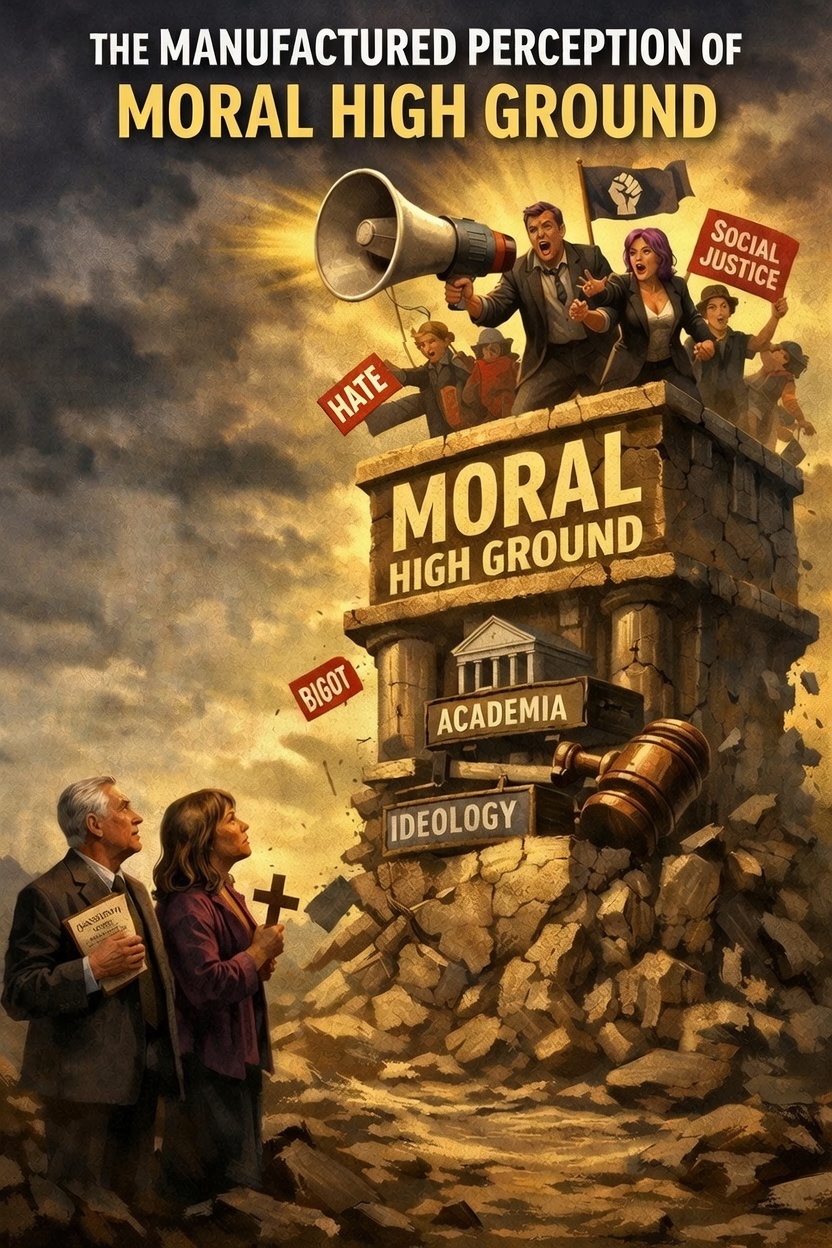
This brings me to the problem of this essay: the false perception that progressives occupy the moral high ground. Commanding the moral high ground is useful for manufacturing consent around progressive administration of society. One of the most striking features of contemporary political debate is the asymmetry of moral confidence between progressives, on the one side, and their conservative or classical liberal critics on the other. Progressives routinely claim the moral high ground, even while operating from an ethical framework that lacks stable deontological commitments. Hence, those who appeal to rule-based moral systems—constitutional restraints, duty-bound ethics, natural rights—are frequently dismissed not through argument but through moral labeling: “chauvinist,” “racist,” and so forth. These labels function less as substantive critiques than as mechanisms of exclusion, foreclosing debate rather than engaging it. The puzzle is how such moral authority came to be established in the absence of a shared epistemic foundation. I have put the pieces together, but I wish to elaborate it here.
As I argued in my previous essays, traditionally, Western moral and political thought rested on deontological frameworks (see Epistemic Foundations, Deontological Liberalism, and the Grounding of Rights; Moral Authority Without Foundations: Progressivism, Utilitarianism, and the Eclipse of Argument). As noted, this is the foundation upon which the American Republic is erected. Whether grounded in divine command or natural law, moral claims are here justified by reference to constraints and duties that bound all actors equally. Even fierce disagreements assume a shared expectation of argument: that moral claims require reasons, that means matter independently of ends, and that one’s opponent is owed charity and fairness. This framework does not eliminate moral conflict; rather, it structured it, thus avoiding nihilism or at least instrumental reason shorn of moral precepts.
Progressive moral discourse largely departs from this tradition. As I showed in the essays cited above, its ethical orientation is broadly utilitarian, though often implicitly so, emphasizing outcomes—happiness, well-being—rather than principles. Moral weight is assigned through the lens of disparity, group vulnerability, or harm reduction, rather than through inviolable rights and universal duties. This is the style of social justice. Crucially, in the current period, utilitarianism is no longer really even philosophical in the Benthamite sense but postmodernist and sociological in the vein of Saint-Simon’s positivism and the desire for technocracy wrapped in the pretense of morality: legitimacy is conferred by alignment with narratives of historical injustice and oppressive power structures organized around identity.
It follows that analyses hailing from this standpoint—critical race theory and its ilk—define outcomes such as income inequality as definitionally racist and so forth, as if the outcome is its own cause. The moral unit is no longer the individual bound by duty, or guaranteed equality before the law, but the group defined by status. There is no need to show how outcomes are the result of racist structures; they are, on their face, racist because the system is assumed as white supremacist; therefore, equality defined as equality of outcome is warranted; any person who defends the system or is opposed to equity so defined is by definition a racist.
Within this framework, disagreement predictably becomes morally suspect. Indeed, if an argument is said to “cause harm” or “reinforce oppression,” then it is not merely incorrect but immoral. As a result, moral condemnation replaces rebuttal. Labels such as “bigoted” or “racist” do not function as falsifiable claims but as status judgments that expel the speaker from the moral community. Once expelled, deontological arguments no longer merit engagement; they allow the consequentialist to dismiss the argument, and morality along with it, out of hand.
This is not an accidental degeneration of discourse; it is a rational strategy within a self-proclaimed moral system that lacks deontological constraints on means, which then allows means to serve ends selected based on preference, imposed by power—not just institutional, but personal, hence the notion that arguments and opinions are violence to be met with violence. Academia, the culture industry, and mass media elevate progressivism as a moral standard while portraying classical liberals and conservatives as standing against the moral order. Violence on the left becomes extraordinary but justified. The inversion is not a swapping of moral alternatives, since the morality of the classical liberal and the conservative rests on a reasoned moral foundation, whereas progressivism does not and cannot. Again, this inversion becomes possible because of progressive and social democratic command of the West’s sensemaking apparatus.
The absence of constraints undermines democracy and liberty. This is why classical liberals and conservatives have to fight to reclaim the moral foundation of the West. Deontological ethics impose limits on means independent of desired ends. Utilitarian-progressive ethics recognize no such inherent limits. If the goal—protecting the vulnerable groups or reducing harm they define and identify—is sufficiently moralized, then institutional suppression, rhetorical exclusion, or reputational destruction becomes not only permissible but obligatory. Moral seriousness is demonstrated not by restraint, but by zeal. Without a real moral foundation, progressivism easily leads to authoritarianism and political extremism, which we witnessed during the COVID-19 pandemic. The evidence of this is ample (COVID-19 is just one example among many, including the organizational enforcement of preferred pronouns and the diminishment of women’s rights), but it follows theoretically; it is the predictable result of abandoning deontological liberalism, an abandonment that represents a precondition for the corporate state to govern the masses.
Ironically, this dynamic leaves those who operate from principled moral frameworks at a rhetorical disadvantage. Deontological ethics require tolerance of disagreement, good-faith engagement, procedural fairness, and the presentation of facts, not presupposition. These ethics prohibit treating dissent as evidence of moral depravity, even when those dissenting are moral depraved. In a pseudomoral environment that rewards denunciation and punishes restraint, this commitment is mistaken for guilt or weakness. The very virtues that once defined moral seriousness—humility, rational justification, and restraint—are recast as complicity. The liberty of those judged guilty are thus rightly constrained.
We see this when an empirical finding inconvenient to a progressive position is dismissed or rejected, not on a rational basis, but to sustain a standpoint. The charge is that facts will be misused by the other side, which it has no moral right to do, and therefore antiwoke voices have no right to the facts. For example, Johanna Olson-Kennedy, the lead researcher on a large, federally funded study on puberty blockers and mental health outcomes in transgender and gender-diverse youth, found no clear mental health benefit from puberty blockers. Rather than release the findings, Olson-Kennedy withheld publication of key results for years because she said she did not want the findings to be “weaponized” by critics of gender-affirming care or used in legal and political fights over treatment for transgender youth. The absense of a moral foundation in Olson-Kennedy’s suppression of research contradicting her opinion is astounding—but not at all exceptional. The fact that Olson-Kennedy’s actions are generally unknown by the public illustrates the power of captured institutions to memory hole research.
Does the reader now see how progressives came to occupy the moral high ground so convincingly? The answer lies in the purposeful collapse of shared metaphysical foundations. As classical liberal moral philosophy, natural law reasoning, and religious authority lost cultural legitimacy, the result of decades of progressive command of Western institutions, moral justification migrated from principles to identities. Standing with the oppressed became a surrogate for moral grounding itself. In this context, questioning the framework is no longer philosophical dissent but moral transgression. The framework immunizes itself against critique by redefining critique as harm. The result is a political culture in which moral authority is asserted rather than argued, and in which ethical language is weaponized to silence rather than persuade.
This is the essence of contemporary totalitarianism. It moves society from individualism towards collectivism via the rhetoric of identity that parallels past hierarchical arrangements, but with their presumed victims in nominal control and alleged perpetrators becoming subjects worthy of controlling. All the while, the corporate state is in back of all this, the presumed victims managed by valorizing their grievances and elevating them to the status of totems of white and other manufactured guilts. Collectivism lies at the core of ostensibly very different systems, namely communism and fascism, both appealing to the rhetoric of socialism. Widespread confusion among conservatives over terms notwithstanding, the contemporary case is state corporatist and therefore an expression of soft fascism, albeit becoming hardened in many European states and under the Biden regime.
This does not mean that progressive concerns about injustice are necessarily illegitimate; classical liberals and conservatives are also concerned about injustices. Nor does it mean that deontological frameworks are beyond criticism, which is the point of this critique. It does mean, however, that a self-proclaimed moral system unwilling to subject itself to argument forfeits the very authority it claims; moral high ground that cannot explain itself without condemnation is not moral reasoning—it’s an illegitimate exercise of presummed moral power, which can be made into mass perception via political power.
To recover genuine moral discourse requires more than civility. It requires a renewed commitment to principles that bind all parties equally, including rules on how moral disagreement is conducted, and these rules must be grounded in a common ontology if it is to be universally obligatory, and that common ontology must rests on objective grounds. Until then, the paradox will persist: those most committed to moral foundations will be treated as morally suspect, while those least constrained by moral rules will speak with the loudest moral certainty. We see the effects of this in strategic language and, sometimes, bad faith, where people convince themselves of untruths to survive. To break out of the loop, classical liberals and conservatives have to assert themselves and not allow moral entrepeneurs to bully them.

 freedom and reason