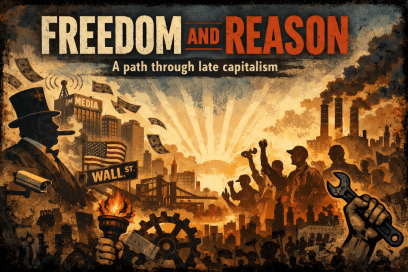
In my previous essay, Epistemic Foundations, Deontological Liberalism, and the Grounding of Rights, I argued that deontological liberalism—the secular moral foundation of the American Republic—draws heavily on principles rooted in Christian ethics, yet remains fully intelligible and defensible without religious belief. Against contemporary tendencies to reduce morality and politics to ideology, preference, or utility, I claim that any society committed to human dignity, individual rights, and the rule of law requires a reflective epistemic foundation in which moral truths can be sown to exist independently of human opinion—i.e., a stance-independent foundation. In that essay, I cited YouTube debater Andrew Wilson as having inspired the essay. I do not agree with Wilson’s argument that Christian ethics necessarily require divine command, but I will take that up in a future essay in which I will present my moral argument, which rests on natural law.
However, I argued, among progressives, a view many Americans know as liberalism generally (failing to distinguish the tendencies), are not liberal in the deontological sense but instead utilitarians, where ends justify means, however immoral those means are. Progressives dress their moral impoverishment in the language of “empathy,” an early twentieth century term derived form the German Einfühlung, a matter I wrote about in a recent essay, The Problem of Empathy and the Pathology of “Be Kind.”
Anticipating that future essay (which will have to wait until the new year), I concluded my last essay by demonstrating that atheists and humanists can coherently operate within this framework. In that case, their moral reasoning—particularly in opposition to authoritarianism and in defense of human dignity—would exemplify a secular form of deontological liberalism grounded in the universal moral insights of Christian ethical thought, especially the inviolability of the individual and the moral limits of political power.
In today’s essay, I explain how progressives claim the moral high ground despite having no certain epistemic foundation for organizing a moral ontology. Readers may have noticed a widespread perception that progressives are the moral ones, perhaps excessively so, whereas classical liberals and conservatives lack empathy of the downtrodden and marginalized (migrants, trans kids, etc.). However, its moral relativism in particular, exposes progressivism as morally impoverished, since there is no deontological basis in this view for appealing to rights. Moral relativism is the view that what is morally right or wrong depends on cultural, personal, or social contexts rather than on universal moral principles. This renders human rights impossible.
Historically, moral claims in the West are grounded in a deontological framework. On secular grounds, these are constitutionalism, natural law, and rights understood as pre-political constraints. Here, moral disagreement takes the form of argument: Are these duties real? Are these rights correctly specified? Are the means legitimate regardless of ends? Even when people disagree sharply, there is at least a shared expectation that one justifies moral claims by appealing to principles that are binding for everyone, including oneself. By rejecting the republic’s foundational deontological framework, progressivism represents an authoritarian tendency in American politics and in the West generally.
Progressive moral discourse (such as it is) breaks with the American tradition. Its authority does not rest on fixed moral precepts or universal duties, but on outcomes, e.g., the reduction of harm to designated vulnerable groups, selectively chosen to advance ideological and political goals. Again, this is a form of utilitarianism, but one filtered through sociology (yes, my discipline—and not just in its warp form—has played a central role in the corruption of moral understanding) rather than philosophy: moral weight is assigned by group status, historical grievance, and measured disparities.
Crucially, because the metric used in the progressive standpoint is harm reduction and promotion of happiness (as progressives define it) rather than principle, disagreement over means is treated as evidence of moral defect. If an argument is said to “cause harm,” then the arguer is not merely wrong but immoral. He is a “bad actor.” That is why disagreement is moralized (as a rhetorical or strategic act) and personalized in the progressive worldview, rather than addressed substantively.
This shift explains the prominence of moral labeling. Terms like “bigoted,” “Islamophobic,” “nativist,” “racist,” “transphobic,” and “xenophobic” function less as descriptive claims (defined by progressives in any case) than as status judgments, marking someone as standing outside the moral community. Once a person is assigned that status, their arguments no longer require engagement. The targeted man is effectively erased as a citizen with the right to speak his mind and engage in the political process; there is no need to engage with him. It’s an easy jump from here to perpetrating violence against him. The cases of progressive violence against conservatives are mounting.
This is not accidental; it is a feature of a moral framework that lacks deontological limits. If there are no inviolable duties, then exclusion and violence become legitimate moral tools. Moral high ground is asserted not by coherence or consistency, nor by reference to an actual moral epistemic, but by alignment with the approved moral narrative. It is only nominally moral. Arguably, there is no amoral stance among humans, since to act outside a moral order is itself to engage in immoral behavior. Philosophers like Aristotle, Kant, and many virtue ethicists agree that choosing to stand outside a moral order is itself a moral choice, and thus open to moral judgment. Progressives cannot rationally escape the dilemma.
The tactical irony is that those who do operate from an epistemic moral foundation—constitutional restraints, natural rights, rule-based ethics—are especially vulnerable to this tactic. The deontological framework I have outlined requires toleration of disagreement and restraint in judgment (this framework provides the rules for Jürgen Habermas’s ideal speech situation, elaborated in his 1981 The Theory of Communicative Action); it prohibits treating opponents as morally illegitimate merely for disagreement or dissent. Utilitarian-progressive frameworks, by contrast, have no such internal brake. If the end is moralized strongly enough, almost any rhetorical or social means become justified.
The question today’s essay addresses is how progressives came to be seen as holding the moral high ground. The short answer is that this has occurred largely because of the collapse of shared metaphysical commitments. As classical liberal moral philosophy, as well as natural law and religion, lost cultural authority, the language of moral legitimacy migrated from principles to identities. Claiming to stand with the “disadvantaged,” “downtrodden,” “migrant,” “oppressed,” and “victims” became a surrogate for moral justification itself. In this environment, to question the framework is not seen as philosophical dissent but as moral betrayal.
The longer answer will come in another future essay in the new year. Readers won’t have long to wait. It will suffice to say for now that the asymmetry I’m describing is real, and I wanted to cap off the year with this observation. I’m confident most readers recognize this reality. It is not that all progressives lack a moral framework altogether; rather, it’s that their framework treats disagreement as a moral failure and labels it as a sufficient moral rebuttal. Those committed to deontological ethics appear to be in the weaker moral position, not because their foundations are thinner (quite the contrary), but because they refuse to abandon reasoned argument for moral denunciation. Ironically, that restraint—once the hallmark of moral seriousness—is now portrayed as guilt.
The dilemma, then, is that those who operate from a deontological framework, incorporating charity, compassion, sympathy, and tolerance, confront those who have no moral foundation who advance morally illegitimate positions. At some point, those who work from deontological commitments are going to have to assert their epistemic authority over those operating without one and insist that, if anyone stands beyond the pale, it is the person claiming the moral high ground without a coherent moral epistemic.


 freedom and reason