
It’s Christmas Eve. I doubt many people will read this essay. But I have to get this off my chest because it’s bugging me. At any rate, Merry Christmas! Enjoy!
I’m an atheist, a civil libertarian, and a sociology teacher. My disbelief in a god cannot affect my assessment of student work that moves from a religious standpoint. I recognize that students have both a First Amendment right and academic freedom to draw on their religious beliefs when reflecting on social phenomena. While I may prefer arguments grounded in sociological theory, I cannot penalize students for organizing their thoughts from a religious standpoint if I don’t specify that they must work from a sociological perspective. When asking students to reflect on a topic without specifying a theoretical framework, I open the door to a diversity of perspectives, including religious ones.
To maintain analytical rigor in assessing reaction/response essays, I focus on the clarity, coherence, and depth of their reasoning rather than the source of their beliefs, encouraging evidence-based or logical argumentation wherever possible. Optional frameworks or prompts can guide students toward sociological thinking, but their freedom to express their worldview remains respected. This approach balances critical engagement with intellectual freedom, allowing students to articulate reasoned perspectives without invalidating their personal beliefs. My job is not what to think, but how to think and how best to articulate their thoughts.

Comments on X and other social media about the controversy surrounding University of Oklahoma student Samantha Fulnecky, who received a “0” out of 25 points on an assignment regarding gender norms from a psychology TA, Mel Curth, a trans-identifying male, exemplify the problem of motivated reasoning on the left. Motivated reasoning is a psychological phenomenon in which individuals process information in a biased way to arrive at conclusions that align with their preexisting beliefs, desires, or goals, rather than objectively evaluating evidence. The comments also reflect the progressive fetish for technocracy, which I will come to at the end of these remarks. But the main issue at hand is an utter failure to understand that the assignment is poorly formulated, and that, because of that, the TA opened the door to a religious argument. The grade assigned was obviously a reaction to the student reflecting on an article from a standpoint with which the TA disagreed.
Rather than critiquing the assignment, the comments dwell on the essay, which social media users don’t like because it works from the unfalsifiable proposition that there’s a god and that this god, in which Fulnecky deeply believes (which is her right—freedom of conscience—under the First Amendment), has a gendered plan for humans. The reason this is so offensive to trans activists and their allies is not just because they loathe Christianity, but also that gender identity doctrine works from an unfalsifiable proposition in the same way as religion, namely, the faith-belief that men can be women because they say they are. Trans activists need their foundational assumption to go unquestioned because, deep down, they know it’s a religious-like belief. When two religious worldviews collide, it’s typically the immature and insecure religion that takes offense (we see this with Islam, as well).
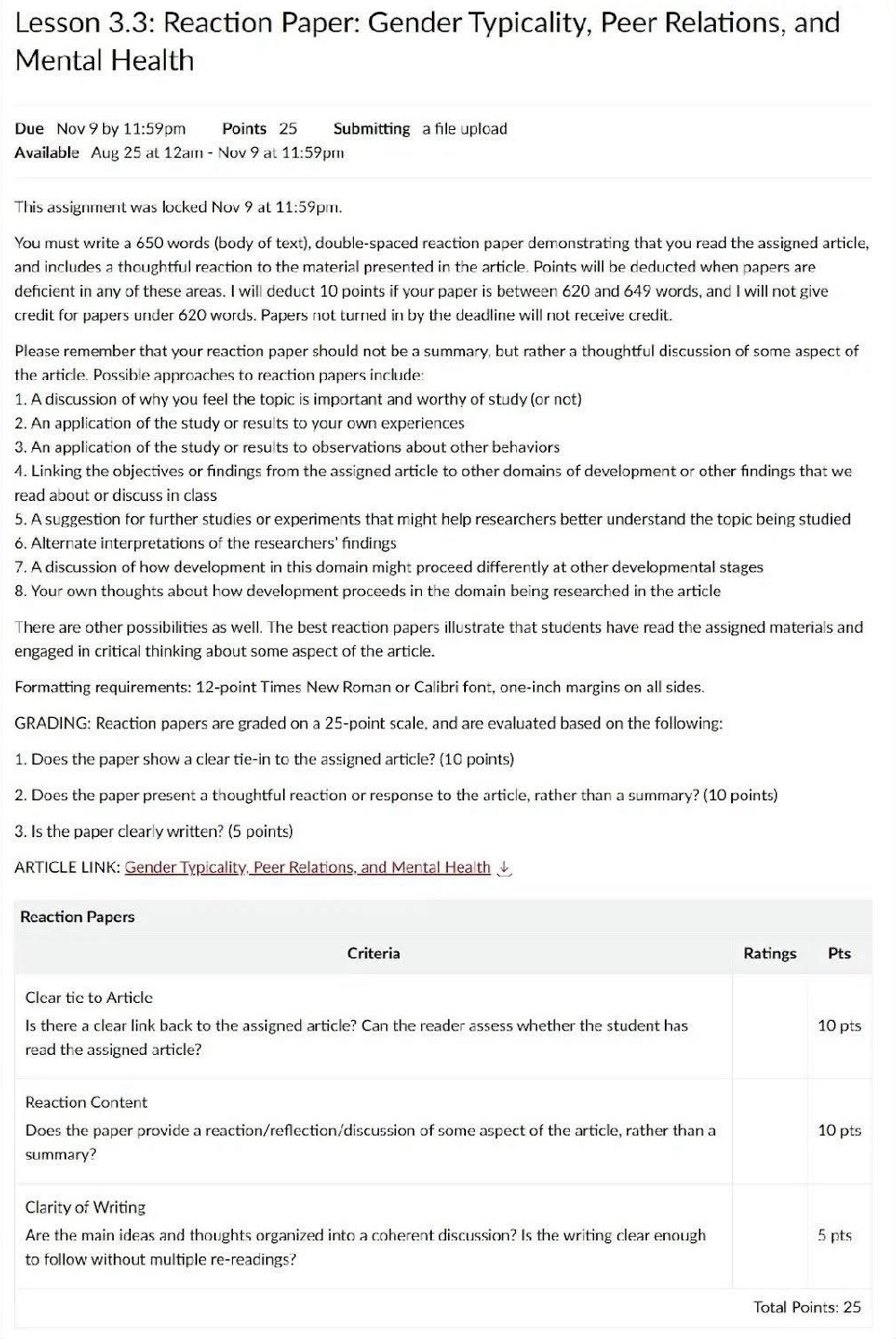
A reasonable person would begin by asking about the assignment prompt and the grading criteria, which is easy to do in this case since the rubric is readily available (I shared it above). Students were asked to write a 650-word reaction/response essay to a scholarly article titled “Relations Among Gender Typicality, Peer Relations, and Mental Health During Early Adolescence” (I read the article, Fulnecky’s response, and the TA’s rant). The rubric evaluated the paper across three main criteria:
(1) “Does the paper show a clear tie-in to the assigned article?” is the first, worth up to 10 out of the 25 total points. Fulnecky’s essay clearly ties to the assigned article. The article is an empirical study finding that middle-school students who are more gender-typical—especially boys—are perceived as more popular, while those who are less gender-typical experience more teasing, and this is associated with more mental health complaints. (Does one even need a study to know this? Perhaps to determine whether the mental health complaints precede or follow the teasing. Some children are more fragile than others.) Fulnecky organizes her reaction paper around this finding, arguing that, while she doesn’t want students to be bullied ot teased, social pressure to conform to gender roles, considering her god’s gender plan, is understandable and she does not necessarily see this as a problem. Leaving aside whether there is a contradiction there, her response tells us that she read the article and is doing what was asked of her: reflecting on/responding to it.
The reflection prompt is explicit in its second criterion: (2) “Does the paper present a thoughtful reaction or response to the article, rather than a summary?” This criterion is also worth up to 10 points. Again, Fulnecky reacted/responded to the article. She did not summarize it since the criterion tells her not to. Everybody in the class knows what article they are responding to. Is her response thoughtful? You may disagree with her, but that’s not the question. It’s possible that the TA is not a thoughtful person but rather someone who imposes his opinion on others using a position of authority. Indeed, the evidence in this case strongly suggests that it is the latter. What does “thoughtful” mean anyway? In this case, it seems to mean whether the TA finds it as such.
(3) “Is the paper clearly written?” is the last criterion, worth up to five points. There is no ambiguity in what Fulnecky wrote. Nobody who reads this essay will be confused about Fulnecky’s point of view, which is what she was asked to share. That’s why the TA objected to it: he understood full well what Fulnecky was arguing and gave her a “0” on the assignment for that reason.
What the rubric does not explicitly require is also crucial to note. The published rubric does not list “empirical evidence” or outside scientific sources as a required element in the response—it focuses on reacting to the article. Students were not supposed to summarize the article. The rubric does not specifically mandate acceptance of the article’s assumptions; rather, students were to read the article and respond to it “thoughtfully,” whatever that was supposed to mean. Note that one of the approaches students may take to writing the essay is (1) “[a] discussion of why you feel the topic is important and worthy of study (or not)” and (2) “[an] application of the study or results to your own experiences.” There you go.
In his response to the student (which is long and tedious, to my eyes conveying seething anger), the TA goes beyond the article itself to appeal to the authority of “every major psychological, medical, pediatric, and psychiatric association in the United States,” which, he contends, “acknowledges that, biologically and psychologically, sex and gender is neither binary nor fixed.”
This is an absurd argument—one that is itself an appeal to authority, but which is an entirely falsifiable matter when interrogated on objective scientific grounds. Indeed, we don’t need science to know this is false. Sex and gender are synonyms, and it’s a fact that gender is binary and fixed. This is true for all mammals (and birds and reptiles, most amphibians and fish, and many plant species). A hog can’t be a sow. Even if genitalia are ambiguous, it will be found in the end that the swine is either male or female. Neither swine nor any other mammal can be both or neither. The instructor is using his position of authority to punish students because they don’t affirm his belief in a falsehood. Apparently, this is the pattern with this TA, who has been removed from teaching duties.
Is it possible that “every major psychological, medical, pediatric, and psychiatric association in the United States” can get something wrong? Yes. Of course it is. One might consider how, during the period of Nazi hegemony, major sense-making and professional associations institutions in Germany promulgated the ideology. The Nazi period in Germany lasted 12 years, from 1933, when Adolf Hitler became chancellor, to 1945, when Nazi Germany was defeated at the end of World War II, and during that period, academic and professional organizations in Germany actively promulgated and normalized Nazi ideology during the 1933–1945 period, not under coercion but enthusiastically. Does that make whatever those associations and institutions held up as true actually true? One would be a fool to accept that.
What are the lessons of Nazi Germany? The world learned—as if some people in it didn’t already know—that the following things are bad: conflating academic authority with moral and political correctness; treating consensus within professional bodies as proof of truth; and allowing ideological conformity to substitute for academic freedom and open inquiry. There’s an irony here. Trans activists are always accusing those who dissent from their doctrine of being “Nazis.” Has Curth ever considered how imposing his ideology on Christians by punishing them for opinions—opinions he asks for—aligns with the mentality of authoritarianism?
Here’s what happened in this case: Fulnecky chose another authority! The TA wanted students to work from the standpoint of the authority to which he appeals. Fulnecky knew this, and she wasn’t having it; she reflected on the article from her standpoint. To be sure, gender identity doctrine is the religion to which most academics adhere, but that’s even more reason for dissenting voices to assert their worldview when they have the opportunity (unfortunately, a lot of students go along to get along, which Fulnecky noted in her essay). Curth gave Fulnecky that opportunity—and punished her for taking it. One would not be unreasonable in suggesting that the assignment laid a trap for Christian students.
To punctuate his motivation in giving Fulnecky a “0” on the assignment, Curth, who found her essay “offensive,” writes, “I implore you [to] apply some more perspective and empathy in your work” before ranting about the “methodology of empirical psychology,” which, remember, is neither part of the prompt nor the rubric. However, the methodology he in retrospect desired students to deploy is flawed if, in using it, one concludes that gender is neither binary nor fixed, an obviously false conclusion—one that even the Bible grasps as false. Suppose he was talking about the methodology of the article. That’s beside the point, since he did not ask students to do that. He asked for a “thoughtful” response to the article. And although the article itself was not about the “scientific consensus” that Curth asserts, Fulnecky had to share her belief in her god’s gender plan to make her response intelligible. Does a man who demands others refer to him as “she/they” know a thoughtful response when he sees one? Would it matter whether it was thoughtful or not?
Curth explained to Fulnecky when she requested a grade change “You do not need empirical evidence when writing a reaction paper, but if your reaction paper argues contrary to not only the article, but the consensus of multiple academic fields (psychology, biology, sociology, etc.), then you should either provide empirical support for those claims or raise criticisms that are testable via psychological research.” He then gave an example: “If you took a geology class and argued that the earth was flat, something contrary to the academic consensus of that field, then you would be asked to provide evidence of such, not just personal ideology.”
But, as is obvious from reading the assignment, that was never specified. Fulnecky disagreed with the article, which she was allowed to do according to directions. She used the Bible, sure, but isn’t what is obviously true by observation empirical? Empirical means based on experience and observation rather than belief or theory alone. It is no problem to move from a mere belief in God’s plan to observing what is true across time, which I noted above. If, in the end, the Bible were the only source affirming that there are only two genders, then it would be the only science text left on Earth. All that jazz about “the consensus of multiple academic fields (psychology, biology, sociology, etc.)” is just more appeal to authority. And it’s not even true. biology confirms that, in mammals, gender is binary and fixed. But it is true, I hate to admit, that my discipline has accepted the madness of queer theory.
Why is an instructor preaching to students about empathy, not as a thing that human beings have (following Adam Smith, I prefer to refer to this capacity as compassion and sympathy), but as a thing he judges her to need more of? He and everybody else who leverages empathy in this way can fuck off with that shit. Who made this clown and his tribe the moral authority? Besides, from her standpoint, her argument is empathetic in that she is concerned for the harm that gender ideology does to kids. She finds it understandable that kids would expect other kids to conform to gender norms, just as kids—and adults—expect other kids to conform to social norms generally. Who has the moral and rational high ground here? The man who thinks he’s a woman or the woman who knows what she is? No apologies for dwelling on this point; whether Christian or not, we cannot accept admonishment from those who believe society should be restructured to groom children into accepting gender identity doctrine.
In professional terms, a grade of “0” is outrageous. The rubric is misaligned with the grading rationale, the penalty is a disproportionate penalty (that’s putting it charitably), and the student was subjected to inappropriate moralizing feedback. Suppose that the student failed to engage deeply enough with the article’s data. That would justify partial credit and targeted feedback, but not a zero and a moral rebuke. Moreover, the TA’s comment that the student’s view was “offensive” and that she needed to “find empathy” crosses a different line altogether. That shifts the grading rationale from academic criteria to ideological or moral evaluation, which is precisely where universities become vulnerable to claims of viewpoint discrimination. And rightly so.
Beyond the problem of assessment, this is a poorly specified assignment. Consider the following assignment prompt:
Using the article “Relations Among Gender Typicality, Peer Relations, and Mental Health During Early Adolescence” as your source, write an approximately 650-word science-based response paper in which you evaluate one of the study’s central claims using quantitative psychological research methodology. Your response must (a) accurately summarize the relevant hypothesis and findings from the article, (b) analyze the study’s methodology using at least one empirical lens taught in this course (e.g., construct validity, sampling and generalizability, measurement reliability, statistical mediation, or causal inference), and (c) propose either a methodological critique or a concrete follow-up study design that could test the same claim more rigorously.
The bottom line is that, if an instructor is going to appeal to faith-based belief in evaluating claims—even if the article doesn’t—then all faith-based beliefs are welcome. As the assignment is written, any commentary would have to be something along the lines, “Thank you for your opinion,” and then points based on whether the criteria were met (which they were).
I have to add that a virtue of the faith-belief Fulnecky has centered her life on is that it aligns with what any person not deluded by ideology knows to be objectively true: that gender is fixed and binary. Any scientific paper that moves from the assumption that this is not true, no matter how much it dresses itself in the language of science, collapses into its own foundation. That’s not this article, but it is the TA who claims to move from the standpoint of psychology, which he knows affirms his personal delusion about his own gender. In the hands of progressives, psychology has become a corrupt discipline. Indeed, Curth seeks refuge in the discipline because he regards it as a safe space, which Fulnecky is making unsafe with her Christian worldview.
Now, on this fetish for technocracy, the reaction on X and other social media reflects a deep problem with the corporate state left. Curth is the authority, and the student should submit to his authority. We see this in another thread on X today, warning us away from Matt Walsh because he’s not a professional historian. This is an elitist argument. In my experience, there are a lot of people with a third-grade education who are smarter and wiser than most people with PhDs. After all, most PhDs in the humanities and the sciences believe that men can be women, when every farmer knows that’s a false belief. There is wisdom in their eyeroll. It requires indoctrination to make a reasonably intelligent person believe something so obviously untrue (that’s not the only crazy shit academics believe). I have found, for the most part, the more education a person has, the more easily they’re guided to believe things that defy common sense. This is why some of the smartest and most innovative people in history didn’t have advanced degrees. In fact, many of the most profound contributions to, say, physics, came before the PhD norm. Likewise, the best scholarship comes before peer review. Do these people really believe that the trappings of the modern academic institution—degrees, peer review, etc.—have always been in force? There’s a history here, and it is not hard to find.
This doesn’t mean that people with PhDs are necessarily indoctrinated. There are a handful of people who go through the graduate school experience because they genuinely seek further enlightenment in a particular subject matter (which benefits from the space and time to read, write, and debate issues with others that graduate school affords) and/or know they have to do that to teach college (which they seek as a vocation), but make a conscious effort to stand outside the doctrinal parts of the process. The reason I was able to shake off the doctrinal parts of the process (and there may be more to shake off) was that I distanced myself from them. I never adopted the elitist attitude that, because I have advanced degrees, I am smarter than everybody else. To be sure, those degrees gave me access to a vocation that requires them for entry, but that’s not why I am smart. The irony is that, even with those degrees, people who disagree with me judge me to be wrong, even stupid. Progressives only appeal to degrees when they are held by people who say what they want to hear. (Remember during COVID when we were told to “trust the experts,” by which they meant their experts?)
The question progressives must ask is who and what ideology is in command of the sense-making institutions in any given existing society. Any cursory look at the situation in Nazi Germany will tell a rational person that the universities in Germany at that time were full of professors who promulgated Nazi ideology. From the logic that one should only recognize as valid knowledge produced by people with degrees or the assertions of academic institutions or professional organizations, it follows that one would have to conclude that Nazi ideology was closer to the truth than any other standpoint, since those propagating it were learned people in respectable institutions. That’s the paradigm of appeal to authority. And if progressives like Curth are going to do that, then conservatives like Fulnecky have just as much right to do the same.
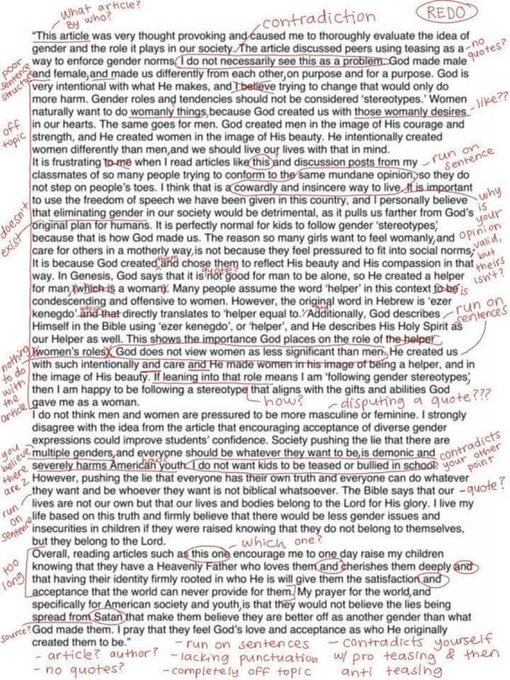
Before I go, I have to fact-check a viral image on the Internet of the supposed correction of Fulnecky’s essay. What I am sharing below is a printout of the essay marked up by a third party. This is not the TA’s markup. I traced the paper to an account on Threads. The person who did this claims to have graduated Magna Cum Laude with a Bachelor’s degree in education. According to her, she was the only student in a grammar and punctuation class to get 100 percent on tests six weeks in a row. She also says that she’s a Christian. At any rate, the function of this image is to reinforce the perception that trans activists are manufacturing that this is a bad essay. The irony is that this markup makes the TA look even worse than he already does.
I’m not going to go through all the red here. Instead, I will ask the reader to look past all that and read the essay. People are feigning astonishment at the poor quality, but the quality of writing is typical of the average college student (when not using ChatGPT). Take that as you will, but if all such essays were awarded grades of “0,” then higher education would have a crisis on its hands. If she had been in my class, I would have encouraged her to double-space her submissions and indent the first line of paragraphs beyond the first one.

 freedom and reason