
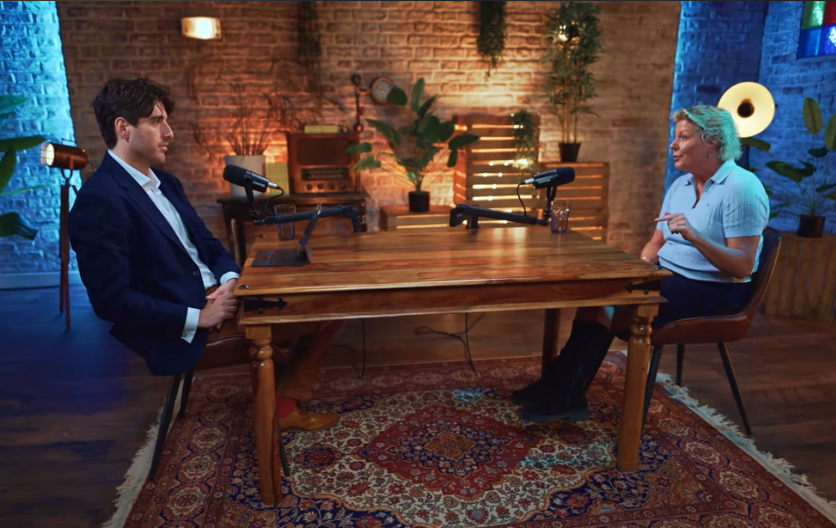
I watched the Andrew Gold podcast heretics with a doctor who provides “gender-affirming care.” I shared the video on Facebook last week and told my friends and followers that her arguments were circular. I want to expand on that observation here.
The doctor’s name is Helen Webberley. Gold asked her why anorexia is a mental illness (she agreed it was), but gender dysphoria isn’t. Her answer was self-sealing: anorexia is classified as a mental disorder; gender dysphoria isn’t. It used to be classified that way, she acknowledged, but it isn’t anymore—therefore it isn’t. She insisted this wasn’t something to argue about; it was simply true. Her appeal to psychiatric classification boils down to this: something is a mental illness if and only if psychiatrists currently say it is. She pointed out that homosexuality used to be classified as a mental illness, but no longer is, so it isn’t one. Once, psychiatrists said it was; now they say it isn’t. End of story.
But doesn’t that admit that psychiatrists declare things true or false not because of objective findings but because their collective opinion has shifted? When was there any evidence that homosexuality was a mental illness? Homosexuality is as old as humanity itself (and practiced among thousands of other mammalian, as well as avian species). What does that say about psychiatry as a scientific field? It doesn’t exactly sound scientific. Medicine does change, of course, but normally based on observable facts and rational interpretation. Would this doctor have agreed that homosexuality was a mental illness back when the manuals said it was? I doubt it. So why lean on that argument now?
Why, exactly, did psychiatrists change their minds about homosexuality? We know it wasn’t because of new objective criteria. As I just explained, if the change had truly been driven by objective observation, they would simply have noted that same-sex attraction is a natural, cross-cultural, historically constant fact. No, it was largely political pressure. Norms governing sexuality were changing, and the gay movement accelerated that change by squeezing the medical profession and other institutions.
If psychiatrists suddenly declared tomorrow that anorexia was no longer a mental illness, would we stop treating it as one? Using the doctor’s own logic: “Gender dysphoria isn’t a mental illness; it’s about their bodies, and they know best who they are.” Fine—then don’t anorexics also know what their bodies “should” look like? Who are we to tell a starving girl she’s not actually fat? She looks in the mirror and sees fat. That’s her lived reality.
Doctors describe anorexia as a form of body image distortion: the person perceives parts of their body as larger or “too fat” even when they are objectively underweight. We diagnose this not just from what patients say but from the observable fact that they are starving themselves to death. We infer the distorted subjectivity from the objective behavior. This is not analogous to homosexuality. It is, however, analogous to gender dysphoria. Indeed, they are species of the same genre of mental illness. But allow me to continue demolishing the doctor’s logic for a little while longer. I wish to leave no doubt as to the madness of her worldview.
To demand that we “normalize” anorexia because the girl insists she’s fat is, at bottom, a demand that we all adopt the anorexic’s subjectivity as shared reality. We mustn’t call her skinny if she doesn’t experience herself that way. But if we do that, we are denying the observable fact that she is emaciated. That would be lying—and lethal. Once you abandon objective reality, why not offer bariatric surgery or liposuction to starving patients? Any doctor who did so would be guilty of blatant malpractice. A responsible physician does not affirm a starving person’s belief that she is fat; the doctor treats the illness, which may well originate in a brain-based body mapping problem.
So why is a girl who insists she is a boy treated differently? The objective fact is that she is female. She appears to suffer the same species of body image distortion as the anorexic—only in her case, the distortion is about sex rather than fatness. She perceives herself as the opposite sex when she is not. Yet instead of treating this as the delusion it parallels—one in which subjectivity is incongruent with objective reality (and some clinicians still describe it that way)—doctors affirm the delusion, prescribe cross-sex hormones, and sometimes surgically alter the body to simulate the opposite sex. They can’t actually change male genitalia into female genitalia or vice versa; they can only create an approximation. They must know they are lying to the patient.
Webberley argued that since she herself, as a woman, would be horrified to have a “willie” (the term both she and Gold used), a patient should have the right to have theirs removed. The identical logic applies to anorexia: a skeletal person believes she has excess fat; she is horrified at the thought of being forced to keep it; so why shouldn’t she have the right to demand liposuction? If someone is objectively thin yet subjectively experiences fat on her body, what possible reason is there to deny her the surgery she wants?
The parallel Webberley draws between homosexuality and gender identity is completely fallacious. They are not the same thing at all. One is an objective, observable behavior that requires no medical intervention. The other is a subjective claim that directly parallels anorexia or even the delusional schizophrenic: the person believes something that is objectively untrue. What in the fuck are doctors doing affirming delusions—and getting rich doing it?
Finally, Webberley explained that she became convinced when a girl who said she was a boy managed to persuade her that she really was one. The evidence? The girl seemed to really, really believe it. I said to my wife, who was watching the podcast with them, Is this a real doctor? Are medical schools actually handing out degrees to people who base life-altering treatments on whether a patient successfully sells them their delusion? This isn’t medicine. This is a corporate model.
For the record, Webberley refused to define what a woman is. She skirted it by saying it was a “gotcha question.” But it’s not. It is the question. Unless you have a non-tautological definition, you are not even in the ballpark of defining reality. Science is not possible without conceptual definitions that capture the objective world. That means that scientific theory is impossible. This is true in mathematics, as well. A rectangle is not a thing we define as a rectangle. A rectangle is a plane figure with four straight sides and four right angles, one with unequal adjacent sides (in contrast to a square). Sure, one may find a book that calls that geometric shape a circle (if one ever does, toss it), but it wouldn’t change what the shape is objectively. A woman is not somebody who says he or she is. A woman is an adult female human, in contrast to a man.

 freedom and reason