
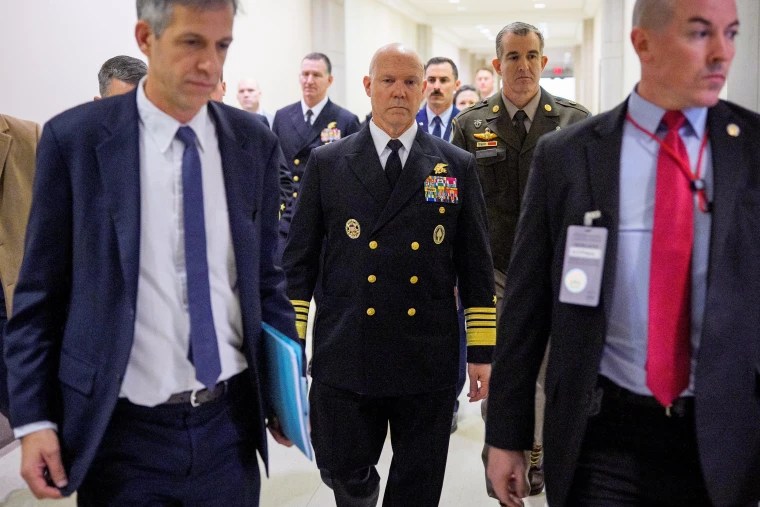
Admiral Frank Bradley met with Congress behind closed doors concerning the double-tap strike of the drug boat, a semi-submersible, to explain his reasoning behind the operation. Democrats and Republicans emerged from the meeting with different opinions about the legitimacy of the admiral’s actions. Only one side’s opinion is correct—and it’s not the Democrats.
As you probably know, on September 2, a DoD helicopter crew fired two Hellfire missiles at a fleeing narco-vessel in the Caribbean Sea. The first missile disabled the vessel’s propulsion; the second, fired minutes later, ensured it sank along with its multi-ton cargo of cocaine and the two traffickers who remained aboard attempting to right the ship, potentially allowing the operation to continue. The point of the DoD operations is to prevent either the delivery or recovery of the boat’s cargo. This necessarily involves killing agents attempting to deliver or protect illicit cargo.
One may believe that extrajudicial killing is immoral, but beneath the partisan noise around the question lies a straightforward legal reality: as I explained in an essay published on my platform yesterday (The Legality of Extrajudicial Killing and the Convenient Forgetting of History), such actions are lawful under long-standing US statutes and case law. Read the essay for the deep legal basis for conducting such operations and to learn about how the Obama administration used this same authority in a far more aggressive manner than the Trump administration. In today’s essays, in light of yesterday’s meeting, I want to review the two primary domestic legal authorities upon which such actions rest: (1) the Maritime Drug Law Enforcement Act (46 USC. §§ 70501 et seq.) or MDLEA; (2) Use of Force (RUF) and the joint Standing Rules of Engagement (SRE) (10 USC § 284).
First, the MDLEA asserts US jurisdiction over drug trafficking on the high seas, even by foreign nationals aboard foreign or stateless vessels. Courts have repeatedly upheld this assertion when the ship is stateless or when the flag state consents (explicitly or tacitly). Second, the RUF and SRE for these missions explicitly authorize deadly force—up to and including the complete destruction of the vessel—when lesser means fail to stop it. The double-tap was a straightforward instance of mission completion.
These semi-submersibles are designed to remain afloat even when disabled. As long as the hull remains afloat, the cargo can be recovered by follow-on boats. Video evidence shows the vessel still moving under residual momentum and two crew members actively working on deck after the first strike. From the lawful perspective of the helicopter crew, the objective—preventing the cocaine from reaching its destination or being recovered—had not yet been achieved. The second missile finished the job the first strike started.
Critics who decry the action as extrajudicial killing are importing a framework that doesn’t apply. This was a law-enforcement interdiction on the high seas against a stateless criminal enterprise. No sovereign state has ever successfully challenged these operations in an international forum, and dozens of Latin American and European nations have signed bilateral agreements facilitating them.
Those who condemn the strike while ignoring precedent should recall that materially identical operations occurred under every administration from Reagan to Biden. As I noted in the previous essay, buttressed by law passed in the aftermath of 9/11, the Obama administration conducted hundreds of drone strikes—some killing American citizens and many more killing uninvolved civilians—in countries with which the United States was not at war, under legal theories far more expansive than those used in the Trump case. I criticized the Obama Administration for some of these actions; the question of their lawfulness was never challenged by Democrats. They’re only objecting here because Trump is the President. It is purely partisan noise—meant to reinforce the video of Seditious Six (see below).
Ultimately, the legality of such strikes is not a function of who occupies the White House but of who controls the statutes and the courts. Congress may amend the MDLEA or restrict DoD counter-drug support tomorrow if it wishes. They have chosen not to do so for more than four decades because the American political consensus has supported the disruption of the cocaine supply chain, even when disruption requires lethal force at sea. They would also opt to repeal enabling legislation passed in the wake of 9/11. Until that consensus changes and is codified, any order to sink a fleeing drug boat, including with a second missile when the first proves insufficient, is a lawful order by definition.
Again, I want to emphasize that one may still find the practice morally troubling. Reasonable people can debate whether the problem of narcoterrorism justifies such actions. But these debates are about what the law ought to be, not what it currently is. As it stands, the helicopter crew that fired the second Hellfire acted well within US domestic law, international treaty obligations, and decades of unbroken precedent. The footage is dramatic. But the law is settled until Congress unsettles it. The rest is partisan politics—and a continuation of the coup the Establishment put into action even before Trump entered the White House for the first time. Don’t let the signal be drowned in noise. Make the moral argument—which would, on principle, require criticizing the law itself—but don’t use this case to undermine the legitimacy of the federal republic.

 freedom and reason