
Trump’s New York “hush-money” case is a farce, a textbook show trial. The purpose of the case was not justice. It was so party parrots could clack around squawking “34 felonies! Rraaawk!, 34 felonies!” “Trump’s a felon! Rraaawk!” They’re still squawking.
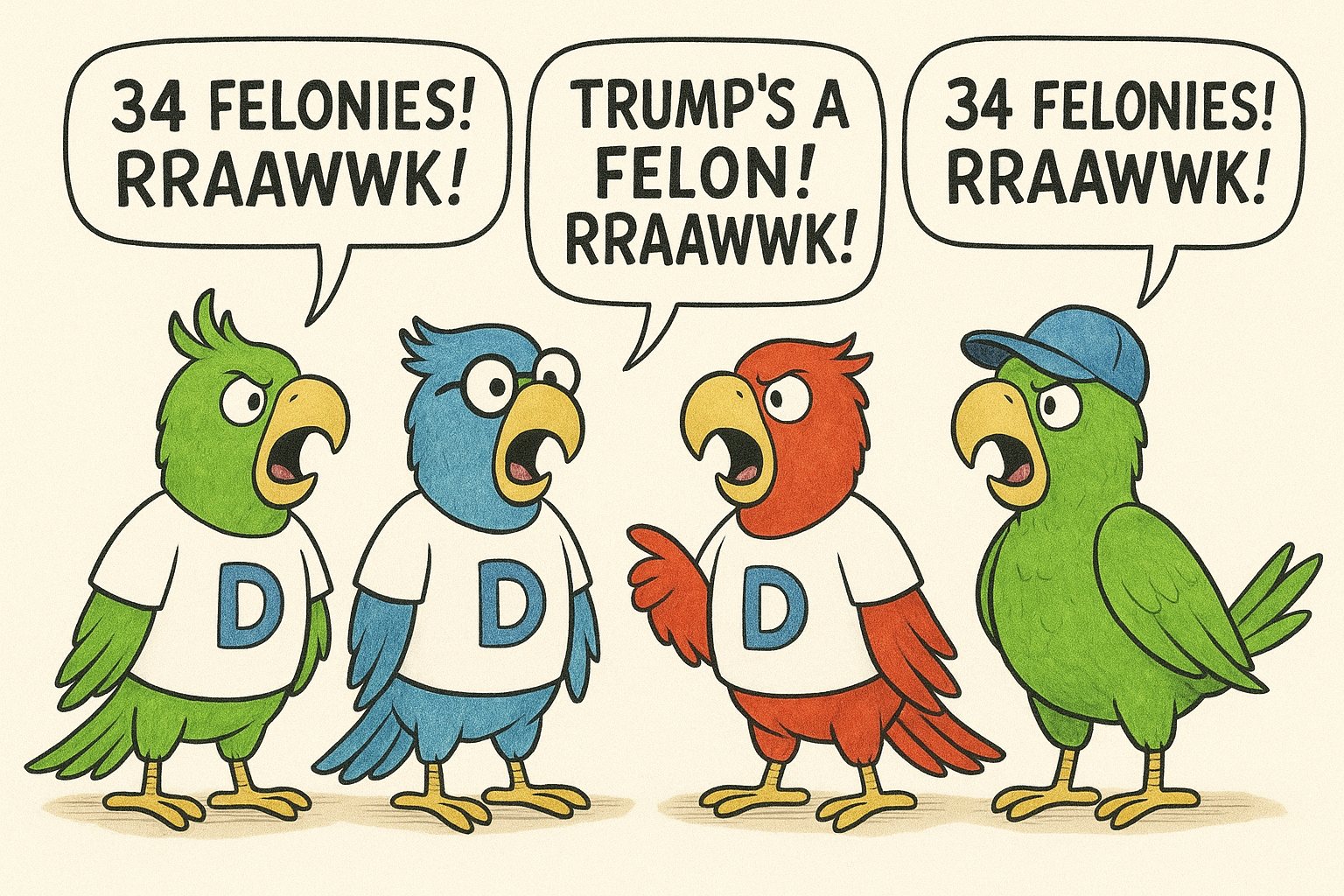
In what is known in the business as a “zombie case,” prosecutors elevated misdemeanors beyond the statute of limitations to felony status by alleging that records were falsified to conceal another crime. How fake was this? Totally fake.
The fakery was present all along. The indictment did not specify exactly what the underlying crime was, pointing opaquely to “election-related” or “financial-related” violations, which, at the outset, denied Trump clear notice of the charge he supposedly intended to conceal. The first question any objective and rational person asks when they see this is how a criminal trial proceeds based on an indictment containing no underlying crime specified.
It gets even more absurd from there. The judge’s jury instructions required jurors to unanimously agree that Trump falsified business records, but did not require them to unanimously agree on which underlying crime Trump intended to commit or hide. In other words, jurors could rely on different theories of what the unspecified underlying felony was, just so long as they unanimously returned a felony conviction.
See the problem? I hope you do. I want to believe you do. All that mattered was that jurors said Trump was guilty of something, but they didn’t have to determine what he was guilty of, which prosecutors never told them, since they prosecuted Trump, wielding an indictment that never specified a crime.

This is why I often respond to the squawking of parrots with the question, “Have you ever read Franz Kafka’s The Trial?” In Kafka’s story, the precise charge against the accused, Josef K, is elusive, the logic of the accusation shifts (there is no logic, really), and K is expected to defend himself against something that is never clearly or fully articulated. K is trapped in a process where the form of legal procedure proceeds with great seriousness while the substance remains phantasmagoric. K is executed, never knowing what he was being executed for.
Adding to the insanity, after the verdict was delivered, the judge, Juan M. Merchan, imposed an unconditional discharge—no prison time, no fine—despite having allowed a conviction structure to stand that could not reasonably be expected to survive appellate review. Merchan could have set aside the verdict, but then he participated in a farce. He allows the show trial to go through the motions. And the point of the whole thing was to train party parrots to squawk a squawk. “34 felonies! Rraaawk!, 34 felonies!” “Trump’s a felon! Rraaawk!”
Even the way the parrots squawk the squawk is brainless. Trump wasn’t convicted of 34 felony counts. He was convicted of one felony offense (whatever it was). So even if one accepts that Trump was legitimately convicted of something, it would not be “34 felonies” but a “34-count felony.” The 34 counts? Every one of them was a misdemeanor that had expired.
There are certain things people say that disqualify them in my eyes from having anything to say worth listening to. This is one of them. Every time I hear somebody say that Trump is a felon, I know they haven’t a clue about the case or the law. Scarier is that they believe that show trials appropriate to the Soviet Union under Stalin should be run in America. They want Trump to be a felon because they loathe him, not because they have a shred of integrity or commitment to the rule of law.
There is a term for that: Trump derangement syndrome, or TDS. In Epstein, Russia, and Other Hoaxes—and the Pathology that Feeds Their Believability, I reference Manhattan-based psychotherapist Jonathan Alpert, who has noted that TDS resembles a genuine psychological condition he has observed in his practice (see also What Explains Trump Derangement Syndrome? Ignorance of Background Assumptions in Worldview). A crazy case only seems sane to a crazy person.

 freedom and reason