
One of the persistent assumptions in public discourse, the grand narrative promulgated by those who control the means of intellectual production and the distribution of perceptions, is that the people most vulnerable to indoctrination are the so-called “dumb” or “unsophisticated”—those with little formal education, who hold to traditional or fundamentalist religious beliefs, or who are simply remote from elite institutions and the world of higher learning (i.e., have not endured the full course of indoctrination in progressive ideology). This view, expressed by progressives, treats “common people” as uniquely susceptible to propaganda because they reside outside the intellectual class or are too unintelligent to listen to reason. It is often implied that their commitments—whether to inherited norms, local knowledge, or religion, particularly certain strains of Christianity—are evidence of gullibility or ignorance.
This picture falls apart under sociological scrutiny. Historically, in the West, Christianity is intertwined with the Enlightenment itself; it is not simply a system of manipulation for the masses. Christianity, in particular Protestantism, is the wellspring of individualism and personal liberty. More to the point of this essay (I had to get that out of the way), empirical experience shows that highly educated people—those with multiple degrees, professional credentials, and roles in knowledge-producing institutions—are often among the most thoroughly indoctrinated individuals in society. Their indoctrination is not despite their intelligence but, in some sense, because of it. Elite education does not simply transmit knowledge; it transmits the ideological frameworks and loyalties that legitimate existing institutions.
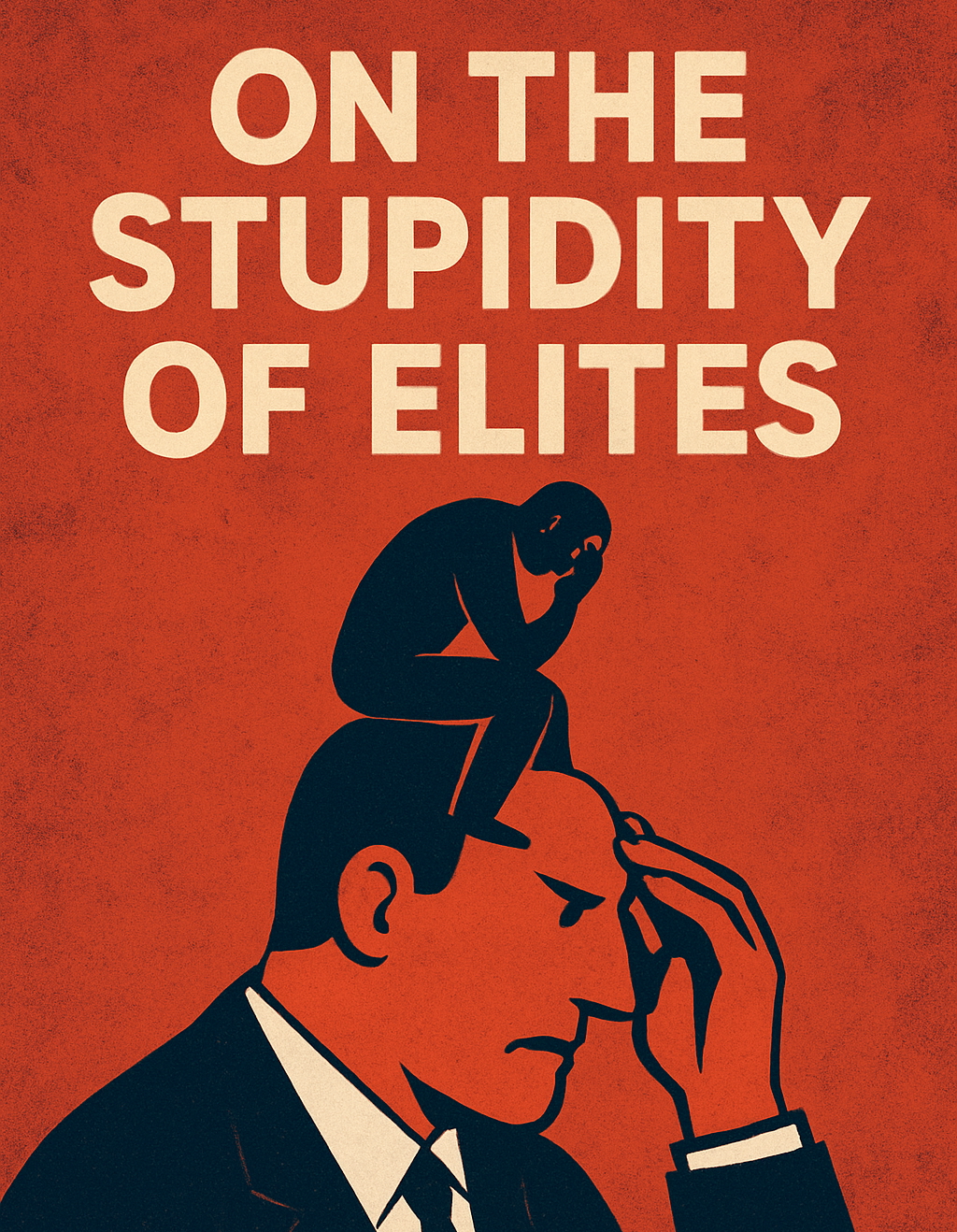
I have before quoted Karl Marx’s observations in The German Ideology (a mid-nineteenth century text that finally appeared in the early 1930s). His words bear repeating here:
“The production of ideas, of conceptions, of consciousness, is at first directly interwoven with the material activity and the material intercourse of men, the language of real life. Conceiving, thinking, the mental intercourse of men, appear at this stage as the direct efflux of their material behaviour. The same applies to mental production as expressed in the language of politics, laws, morality, religion, metaphysics, etc., of a people. Men are the producers of their conceptions, ideas, etc.—real, active men, as they are conditioned by a definite development of their productive forces and of the intercourse corresponding to these, up to its furthest forms. Consciousness can never be anything else than conscious existence, and the existence of men is their actual life-process. If in all ideology men and their circumstances appear upside-down as in a camera obscura, this phenomenon arises just as much from their historical life-process as the inversion of objects on the retina does from their physical life-process.”
One finds this passage in Section A, “Idealism and Materialism.” How does such an upside-down world come to be projected into consciousness? In Section B, “The Illusion of the Epoch,” Marx writes:
“The ideas of the ruling class are in every epoch the ruling ideas, i.e. the class which is the ruling material force of society, is at the same time its ruling intellectual force. The class which has the means of material production at its disposal, has control at the same time over the means of mental production, so that thereby, generally speaking, the ideas of those who lack the means of mental production are subject to it. The ruling ideas are nothing more than the ideal expression of the dominant material relationships, the dominant material relationships grasped as ideas; hence of the relationships which make the one class the ruling one, therefore, the ideas of its dominance. The individuals composing the ruling class possess among other things consciousness, and therefore think. Insofar, therefore, as they rule as a class and determine the extent and compass of an epoch, it is self-evident that they do this in its whole range, hence among other things rule also as thinkers, as producers of ideas, and regulate the production and distribution of the ideas of their age: thus their ideas are the ruling ideas of the epoch.”
The argument I am making here (and have been making for years) aligns with observations made by Noam Chomsky, who has argued that cultural and political elites must be the most deeply indoctrinated segment of the population, precisely because their function is to reproduce and defend the status quo.
In an interview clip featured in the 1992 documentary Manufacturing Consent: Noam Chomsky and the Media, Chomsky identifies two different targets for propaganda. The first is “what’s sometimes called the political class. There’s maybe twenty percent of the population which is relatively educated, more or less articulate, plays some kind of role in decision-making. They’re supposed to sort of participate in social life—either as managers, or cultural managers like teachers and writers and so on. They’re supposed to vote, they’re supposed to play some role in the way economic and political and cultural life goes on. Now their consent is crucial. So that’s one group that has to be deeply indoctrinated. Then there’s maybe eighty percent of the population whose main function is to follow orders and not think, and not to pay attention to anything—and they’re the ones who usually pay the costs.”
If the system benefits them—or depends on them—then internalizing its worldview is not merely likely; it is structurally necessary. Recall George Orwell’s quip in his 1945 essay “Notes on Nationalism” (published in the British magazine Polemic) that “One has to belong to the intelligentsia to believe things like that: no ordinary man could be such a fool.” Orwell points to the same dynamic I’m identifying in this essay: intelligence and education provide the tools for ideological sophistication and rationalization, not immunity from propaganda.
To be sure, as the foregoing implies, susceptibility to indoctrination is universal, but it expresses itself differently across social strata. The working class may inherit a religious or traditional worldview—with all its protective benefits. But the professional-managerial class, steeped in the incentives and norms of elite institutions, in the command of the ruling class, internalizes ideological narratives with far greater depth and rigidity—narratives that in practice cause great harm to persons and society. In this sense, the very people who most confidently diagnose “brainwashing” or stupidity in others may themselves be among the most thoroughly shaped by the ideological apparatus of the corporate state and its attendant professional culture. Intelligence of the sort useful to elites does not inoculate its possessor from propaganda; under certain conditions, it enhances vulnerability to it.
We see this dynamic at play in today’s politics. Those who support Donald Trump (and Trump himself), or who dissented from the authoritarian measures elites deployed during the COVID-19 pandemic, or who reject or express skepticism about the “scientific medical consensus” regarding the concept of gender identity or pharmaceutical products such as vaccines, are routinely portrayed by progressives as “conspiracy theorists,” “mouthbreathers,” or “rubes.” Meanwhile, progressives celebrate obviously shallow and ridiculous figures like Alexandria Ocasio-Cortez and Jasmine Crockett, presenting them and others as the future of America. They embrace demonstrably fallacious and hateful ideologies like critical race theory and queer theory, and their attendant concepts: collective punishment, gender identity, intergenerational guilt, white privilege, etc.
Consider the fact that it was the bourgeois elite who developed and promulgated the ideology of cultural and moral relativism. In his 1953 Natural Right and History, Leo Strauss made an argument that is often paraphrased as “if all cultures are equal, then cannibalism is just a matter of taste,” which readers may have seen in a meme shared on social media. Strauss did not say exactly this, but it is an accurate distillation of what he did say. Strauss criticizes cultural and moral relativism by pointing out that if a society’s acceptance of a practice is the only standard for its legitimacy, then cannibalism would be just as valid as that of any civilized society. His point: if we deny any natural or objective standard of right and wrong, then we lose the ability to morally judge even the most extreme practices.
The appearance of this idea is no accident. Cultural and moral relativism is one of the elite intellectual products designed to dispossess those who undergo the course of ideological indoctrination of common sense. We see this today with progressives rationalizing the treatment of gays and women under Islam—and a myriad of other destructive and unjust ideas. For Strauss, cultural and moral relativism leads to nihilism, since all values become mere preferences, lacking any higher justification. Cannibalism is the paradigm that shows why a universal moral standard—natural right—is necessary. The truth is, and any reasonable person who escaped progressive brainwashing sees it, that not all cultures are equal. Some are better than others. Western culture is better than most. But it’s been corrupted by postmodernism and primitive ideas. And this explains the sharp rise in nihilism among today’s youth.

 freedom and reason