
The Fourth Industrial Revolution follows the Information Age. It describes the evolving interplay between technologies such as advanced robotics, artificial intelligence, and genetic engineering and the physical, digital, and biological realms. The term is meant to convey that these technologies—and the domains they touch—are converging, rapidly transforming the world into an era of integrated cybernetics. One area that has been fundamentally changes is the world of scholarly production. In this essay I focus on the revival of an old relationship in a new form: the interaction between those who generate ideas and the methods by which those ideas are realized in tangible media.
What has been lost with the mid-1970s emergence and normalization of word processing and the demotion of secretaries to administrative assistants is that, before the Information Age, intellectual work was rarely a solitary endeavor. In the decades before the computer scholars (as well as executives) depended upon a small army of secretaries and typists who translated thought into text. These individuals occupied a crucial position in the production of knowledge. A professor might draft notes or a manuscript in longhand or dictate thoughts aloud or via Dictaphone recordings, leaving it to the secretary (or amanuensis) to turn those rough ideas into polished, neatly typed manuscripts. The relationship between scholar and secretary was, in many ways, the prototype for our contemporary interaction with digital writing tools.
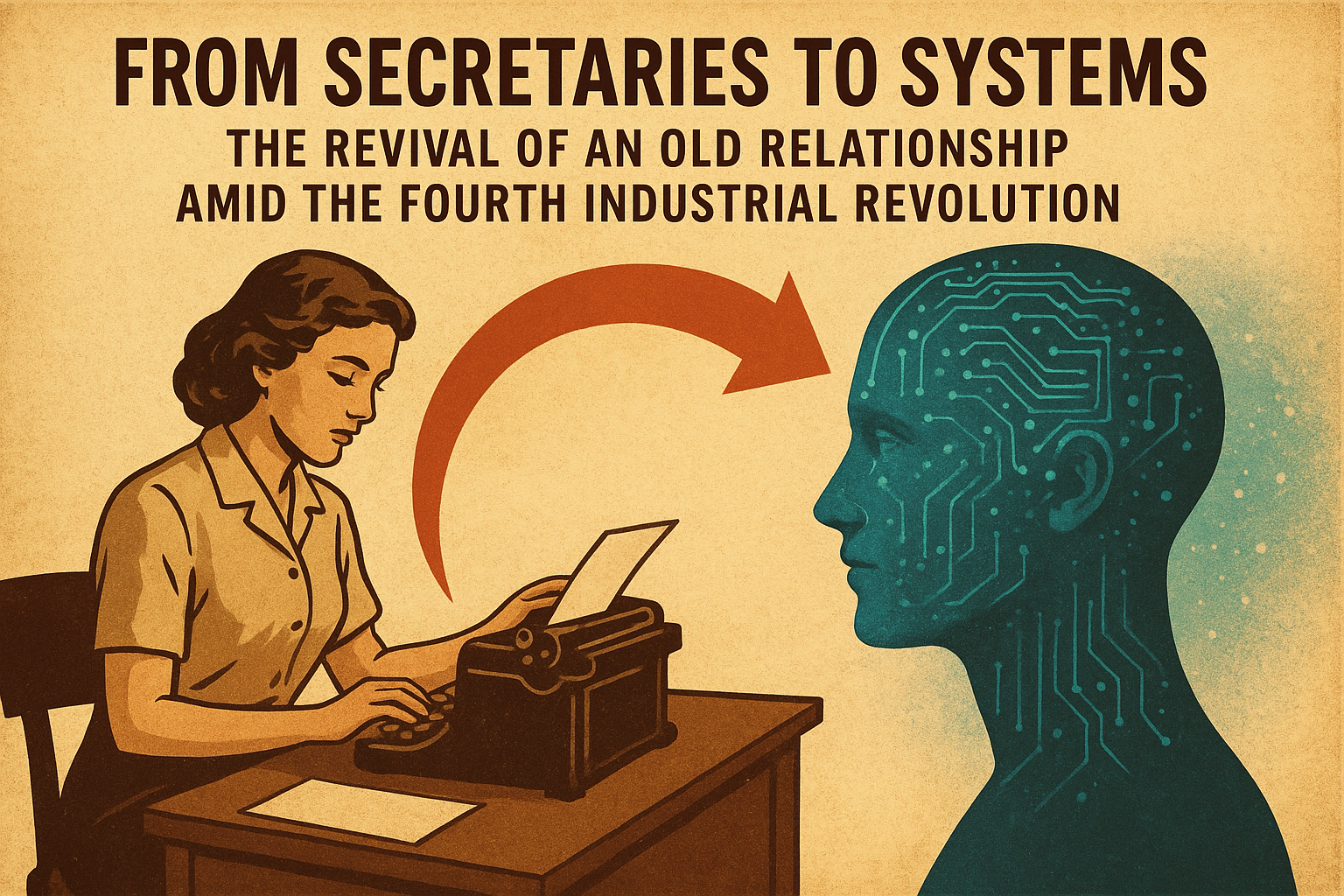
Typing was a technical art: accuracy, formatting, and legibility required both speed and mastery of a machine that, by the late nineteenth century, had become standard office equipment. The typewriter allowed little room for error. Once a draft was prepared, the scholar would review it by hand—crossing out words, inserting phrases, and marking corrections—before returning it for retyping. This process would usually repeat several times until a clean copy emerged, ready for submission to a journal or publisher for review.
It is crucial to recognize, in recovering our historical memory of this period, that the best secretaries did far more than transcribe. Those who worked in academic or literary environments were skilled interpreters of their employers’ thoughts. Through long familiarity with a scholar’s voice and habits of expression, secretaries developed a sensitivity to author intent, the meaning sought, and tone. They quietly served as copy editors, correcting grammar, clarifying syntax, and smoothing transitions, even strengthening arguments. Secretarial training in the early and mid-twentieth century included rigorous instruction in audience, composition, and grammar, so that by the time they entered universities or research offices, they were not merely typists but literate professionals capable of improving the evolving manuscripts they handled.
Both my parents taught at universities, and I remember fondly my conversations with their secretaries and how impressed I was with their knowledge of the various disciplines of the departments in which they worked (and their patience in entertaining my questions when my parents were busy with other things). I observed on numerous occasions professors handing secretaries rough drafts and notes to translate into typed texts. Secretaries would also moonlight, rendering for graduate students their papers, theses, and dissertations in clean and polished form. By the time I was in graduate school, I had to do all the work myself on a word processor and ask family, friends, and peers to critique my work—if they were so inclined and had time. More often, I would pore over the same draft, feeling as if I would never finish the paper by the deadline.
The collaboration that developed between scholar and secretary was one of synergy; the intellectual content originated with the scholar, but the clarity and polish of expression owed much to the secretary’s linguistic and technical skill. In most cases, these contributions went uncredited. Authorship, both then and now, is defined by conceptual ownership—the creation of ideas—while the labor of refinement remains invisible. Editors, copy editors, and proofreaders occupy a similar position today: they may shape a work profoundly, yet they rarely share in its authorship. Their task is to enhance a voice without adding content or altering its identity. In many ways, their success is measured by their invisibility.
But who can afford copy editors and proofreaders today? This is especially problematic for those working in most public colleges and universities today, where those who fulfilled these roles historically have been demoted or eliminated, and where constrained budgets allow for no functional alternative.
In this light, the recent return of dictation and editing technologies represents not so much a revolution in content generation but the revival of an old relationship. The scholar speaking into a microphone and feeding the result into an AI system like ChatGPT is reenacting a century-old pattern. Voice-to-text applications play the role of the stenographer or typist, producing an initial transcript from speech. The language model then assumes the role once held by the skilled secretary—organizing, clarifying, and copy-editing the raw material into coherent prose. The human author remains the source of ideas, of course; to delegate that task to the system would take the joy out of creative and scholarly pursuits. Moreover, many would regard using AI-generated content as ethically problematic. However, used responsibly, the machine serves as the intermediary that converts thought into a publishable form, just as the secretary did before the word processor.
To be sure, this digital secretary still lacks the intuition and personal familiarity of its human predecessor, but this limitation will soon be overcome as the technology becomes more advanced and personalized. Moreover, and this development has been overlooked, the digital secretary democratizes the production of publishable content. Where only professors or executives once had access to trained assistants, now anyone can summon one with a microphone and a prompt. The workflow—dictation, editing, revision, shaping—remains strikingly like that of the mid-twentieth century, but the economic and social barriers are falling away. Thus, generative AI has revived the practice of spoken composition, making dictation once again a natural mode of authorship. Anyone who has worked with speech-to-text technology has noted the vast increase in productivity that it allows, and with AI’s sophistication, the common errors of translation are increasingly a problem of the past.
The continuity across these technological changes suggests that the fundamental rhythm of intellectual labor has not altered. Human thought still requires translation into tangible form; ideas still depend upon instruments and intermediaries to become legible. What has changed is the nature of the intermediary—from a human presence seated at a typewriter to a silent, algorithmic collaborator on a screen. In both cases, the assistant bridges the gap between mind and text, between the messy spontaneity of speech and the disciplined structure of writing. The days of countless drafts on a word processor, a development that, as noted, has seen the demotion of secretaries to administrative assistants (who may themselves soon become obsolete or at least ever more remote from specific departments to which they were initially assigned as they’re assigned ever larger areas of responsibility, increasingly aided themselves by AI), are increasingly becoming a historical feature of what we can now see as an interregnum—the period between human and artificial assistance. The loss of the human secretary is lamentable, but that role’s replacement by technology was, in hindsight, inevitable.
Thus, the modern writer using voice-to-text and AI editing stands in a long tradition. From the professor dictating to a secretary in 1940 to the scholar speaking into a microphone on a device in 2025, the relationship between intellect and instrument remains one of interdependence. Technology has changed; collaboration has not. What was once the sound of clacking typewriter keys has become the quietness of digital processing—but in both, we hear the same underlying dialogue between human thought and mechanical expression in tangible media. To be sure, that artificial intelligence presents a daunting challenge to the world of work, and in some aspects, imperils the world (which is why regulation of this technology is vital—although, admittedly, I don’t know what that would look like and, frankly, I don’t expect it to occur), mankind must learn not to fear this particular aspect of AI. Some scholars will resist the revival of an old relationship in its new form, but as the technology progresses, fewer will be able to do so. For those who have not yet grasped the reality of the situation—newsflash: the future is here.
I hasten to add, as I conclude this essay, that this is true not only for scholarly work, but for art and architecture, as well. One could, if he had the means, contract with an artist to represent his idea in a compelling image, or he could convey to an AI program the same idea and have the system render the image in mere seconds without compensation. Like the loss of the human secretary, the loss of the human artist is lamentable, but here as well the production of ideas in artistic form is being democratized. Readers of this blog will have already noted that I use OpenAI’s Sora to generate novel images conveying the theme of the essays in which these images appear. I credit Sora (or sometimes Grok when Sora is stubborn), but I wonder sometimes whether I need to. At any rate, I simply do not have the resources to employ human artists to do this work, and my own skill at artwork has diminished amid the many other commitments that are made—and that I make—upon my time.
I can assure the reader that I will never delegate the bulk of my creative work in music production to AI, although I confess to having relied on AI-generated bass, drum, and synthesizer loops in quickly putting ideas down to tangible media, some of which I have made available to the public. But AI-generated guitar and vocals? Songwriting itself? Those are bridges too far. While a man makes use of technology to convey his ideas to the world, he mustn’t lose his voice to technology.
When I was young, except for an overdrive or wha-wha pedal between me and the amplifier, I refused to use effects pedals in the chain. No choruses, delays, phasers, flangers, or synthesizers. I wanted nothing to come between me and the conveyance of my ideas. When I voiced my purism to the keeper of a music shop on the square of my hometown, he pointed out to me that stretching cat gut across a hollowed out gourd to generate resonating frequencies is an effect. The instrument allows the man to convey his ideas without resorting to his vocal cords. Everything is an effect, he said. It all comes between the artist and the expression of his ideas. He then asked me, What do you hear in your head? More than I can express, I responded. Then use what helps you express your ideas, he said with a smile.

 freedom and reason