
Those who were present at the news conference where the man (not Gordon Findlay, the global brand director for Novo Nordisk) fainted reported that, since three doctors were tending to the man, it was not imperative that Kennedy, who is not a doctor, immediately do so.
A rational person understands that not everybody responding to a health crisis has to behave in the same way. But in this age, on one side at least, rationality is only embedded in the system, not in minds. In either case, the behavior is irrational.
On planet earth, what Kennedy did, besides making room (my initial interpretation, since he was not the only one to leave the gaze of the camera—moreover obvious in the handlers shooing reporters from the room, which observers do see), was retrieve a chair. If you watch the sequence of events, the man first started falling, and Kennedy thought he just needed to sit. Kennedy also got a wet towel for the man, too, a common thing to do when an individual faints.
So, no, Kennedy wasn’t fleeing the scene. He was responding rationally to the situation. He’s known as a steady man.
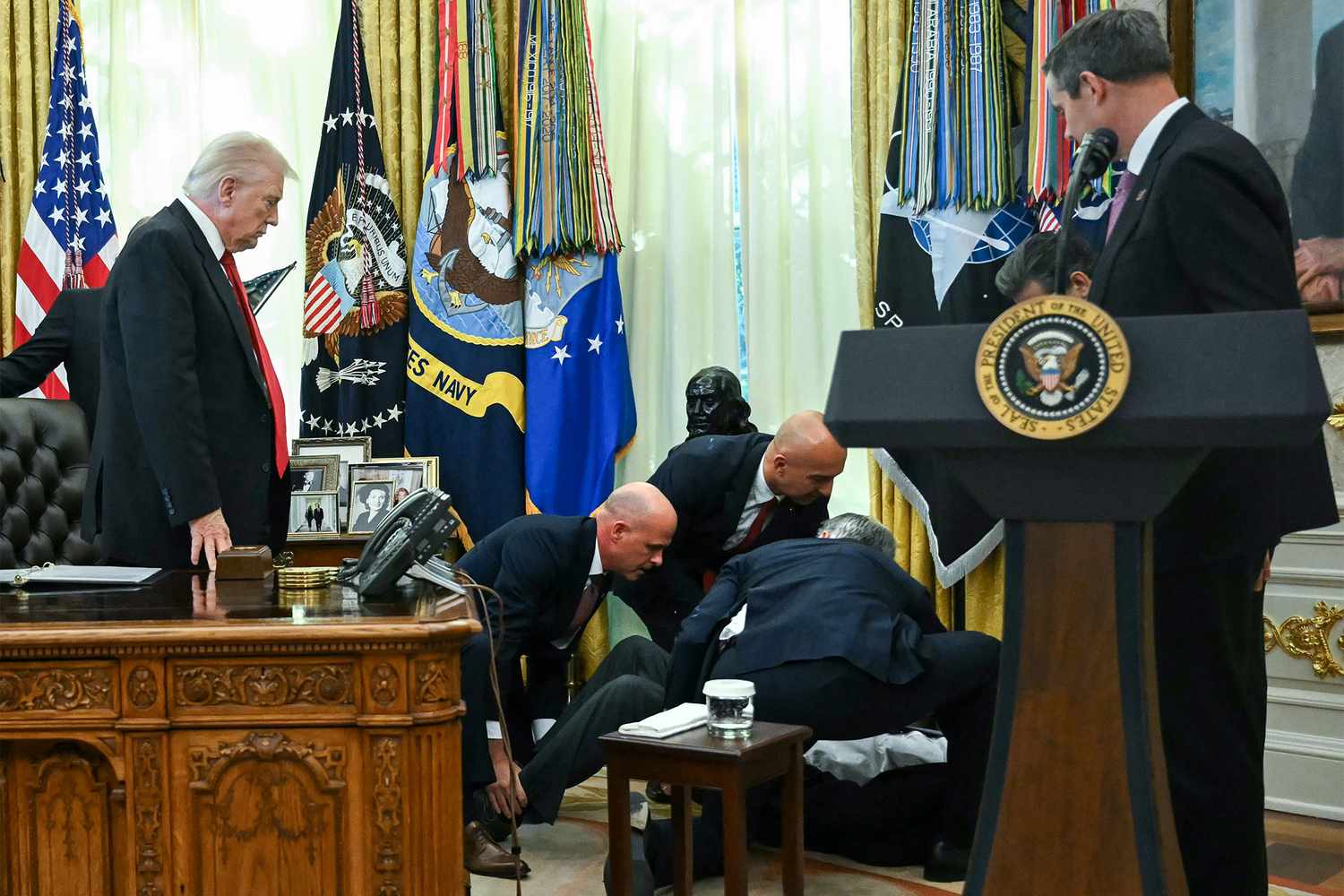
Why people wrongly interpreted Kennedy’s actions, just as they wrongly framed Trump’s response (which was one of concern, if you don’t rely on a single conveniently curated still image), is a cognitive fallacy known as “motivated reasoning,” where one’s perception of a situation is shaped by an ideological or partisan worldview, often without charity, in this case a worldview eager in every instance to attribute to Kennedy and Trump untoward motives. Those afflicted cannot see it any other way. And the corporate state media leaves them to it.
Concerning Trump’s actions that day: “I wanted to speak to the wife to let her know what was happening, but also comfort her,” Dr. Oz reported. “The president saw me in the corner and said, ‘Who are you talking to?’ I said, sort of sheepishly: I was talking to the wife. And he said, ‘Give me that phone.’”

 freedom and reason