
Yesterday, I drafted an essay concerning the passing of Dick Cheney, a warmonger who held numerous positions in government over the last half a century, most recently as Vice President under George W. Bush (2001-2009), the son of former CIA director and appointed minder of President Ronald Reagan, George H. W. Bush. I hope to publish that essay tomorrow, but the election of Zohran Mamdani as Mayor of New York City pushes it back.
I will, however, provide readers with a bit of a preview because it is relevant here: My forthcoming essay will illustrate why one must avoid dwelling on personalities and instead understand world-historical developments and the dynamics driving their ambitions. I critique Thomas Carlyle’s influential “great man” theory of history. Recalling Georg Hegel’s concept of the “world-historical figure,” Carlyle contended that the actions of extraordinary individuals primarily shape the course of history; society advances because of rare figures whose courage, moral force, and vision enable them to influence the destiny of nations and civilizations. For Carlyle, historical change reflects human greatness, with the masses and social structures playing subordinate roles. Making history is, in his words, “the biography of great men.”
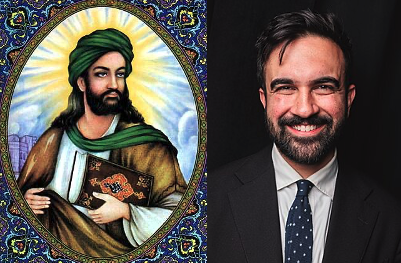
Although I emphasize the role of social structures in shaping historical events and the personalities that appear in our history books, there is something to Carlyle’s thesis. Muhammad, born in Mecca around 570 CE, regarded in Islam as the final prophet, received from the Archangel Gabriel God’s message to humanity. His revelations were later compiled into the Qur’an. Muhammad authorized and personally led numerous military expeditions after establishing Islam in Medina, and over the next decade, the Muslim polity expanded through warfare and the submission of other tribes. By the time of his death in 632, most of the Arabian Peninsula had come under his political and military authority. The regime was cruel and unforgiving. The case of Muhammad is certainly illustrative of the force of personality.
The ambitions and cruelties of Islam did not end there. The attempted Islamic conquest of Europe began soon after the rise of Islam, in the seventh century, as Arab forces expanded rapidly across the Mediterranean. Muslim armies entered Europe through two main routes: across the Strait of Gibraltar into Spain and through Anatolia and the Balkans toward Constantinople. Frankish forces halted further northward advance at the Battle of Tours in 732, but Muslims controlled the Iberian Peninsula for centuries, while Islam spread east and south across the planet.
Muslim rule in Spain ended in 1492, when the Catholic monarchs Ferdinand of Aragon and Isabella of Castile captured Granada, the last Muslim stronghold on the Iberian Peninsula. This event concluded nearly eight centuries of Islamic presence that had begun with the Umayyad conquest in the eighth century. The fall of Granada marked the completion of the Reconquista, the long Christian effort to reclaim territory from Muslim rule, and it coincided with Spain’s emergence as a unified Christian kingdom and global power. Without the bravery of the European Christians, the American Republic would not exist.
Muslim expansion into eastern Europe was largely halted by the strength of the Byzantine Empire, which successfully defended Constantinople during two major Arab sieges, preventing a direct route into the Balkans. Difficult terrain, long supply lines, and the rise of powerful regional forces created rather intractable military and political barriers. These factors together limited further advance and kept Islamic rule from extending deeply into eastern and central Europe during the early centuries of Islamic expansion.
However, Muslims could not be content with controlling much of the world east and south of European Christian civilization (for a map of Islam’s present reach, see my recent article Whose Time Has Come?). In the ensuing centuries, Islamic imperialists recalibrated their strategy of attack, in recent years, by invading Europe by invitation and preying on the misplaced humanitarianism of a people plagued by generational guilt and self-loathing.
Who ushered in the barbarians? Europe was betrayed by its own leaders. Transnationalists, bent on disempowering the indigenous peoples of Europe by changing the demographic composition of that continent and amalgamating nations in a single superstate governed by corporate power, threw open the Western gate to Islam. Today, Muslims enjoy ethnoreligious enclaves across Europe, and have successfully elected to government representatives of a totalitarian political movement. London’s mayor, Sir Sadiq Khan, is a Muslim. Like New York City, London is a world city, a hub of transnational corporate power.
Tragically, the United States is not immune to this development, namely the Islamization of the West, as mass immigration from Muslim majority countries over the last several decades has established ethnoreligious enclaves here—not just on the East Coast, but in America’s heartland. And, like the United Kingdom, this has resulted in the election of Muslims to public office, and, as we witnessed last night, to the financial capital of the corporate world order.
As an atheist, I dread the slide of the Christian West into clerical fascism. As critical as I have been over the decades of Christianity, the followers of that religion have been good to me. The historical record indicates that Muslims won’t be so kind. More than its record, there is a problem intrinsic to this ideology. Jesus preached peace and gave his life for his followers. The Founders of the American Republic, most of them Christians, established the paradigm of secular government. A Christian extremist, if he holds true to the teachings, can only be more like the teacher. The wristband he wears—“What would Jesus do?”—carries a rather benign slogan. However, the Muslim extremist is a man who strives to be more like Mohammed. He bears a different slogan—the slogan of a warlord—and he wears it on his forehead. He comes demanding surrender and submission.
That’s the difference doctrine makes. Not all religions are the same, and naive religious tolerance is a manifestation of suicidal empathy—and a strategy for conquest.

 freedom and reason