
That 42 million Americans utilize SNAP, the federal government’s food assistance program, came as a surprise to many Americans, an awareness triggered by the Democrats’ shutdown of the government in their attempt to continue government subsidies to the medical industry to provide health care to illegal aliens.
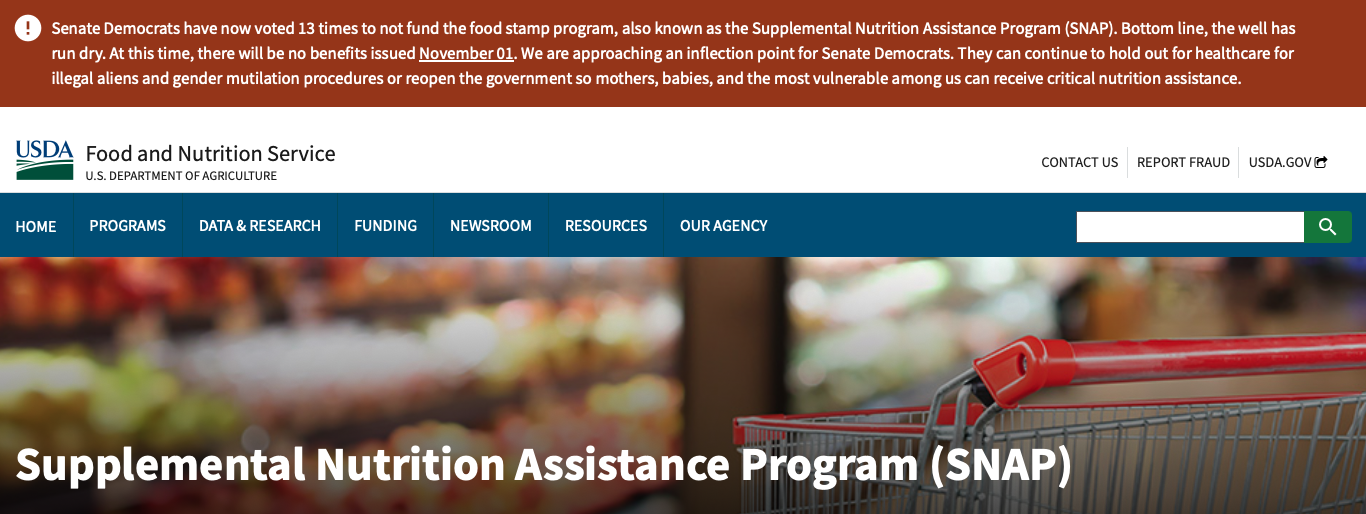
Predictably, Democrats are blaming Trump for not using SNAP’s emergency reserves to feed Americans dependent on the program who will lose access on November 1. However, an emergency is a serious, unexpected, and often dangerous situation requiring immediate action. The government shutdown is a choice Democrats made. It is not unexpected. It is intentional; Democrats want to drain emergency SNAP reserves so they can continue holding the American people hostage for policy goals the public did not endorse. With the rise of populist nationalism, Democrats lost their majorities in Congress, so they are using the government shutdown to obtain what they could not at the ballot box.
The only way the Democrats can sustain any illusion about who’s responsible for the government shutdown is because of corporate state media complicity. This is where it becomes critical that every individual use their rational skills of cogitation to see what is plain before their eyes. An important initial step in clearing the path for clear reason, therefore, is recognizing that the corporate state media is a propaganda apparatus that provides a platform for progressive social engineering. This is at the behest of global corporate power and the project of managed decline. The propaganda is becoming increasingly shrill because the network of alternative media bears the truth of the situation. We can thank populist nationalism for weakening the ideological hegemony of the power elite—and Democrats for poor timing.
The reason why 42 million Americans depend on SNAP is a direct result of the free trade policies pushed by Democrats and RINOs. It is, moreover, the result of containing black and brown citizens in impoverished inner-city urban areas, which is an adjunct to the globalization project. Ever wonder why Red States get a relatively greater share of government resources directed to the poor than Blue States? In part, it’s because half of all blacks live in the US South, and they are overrepresented in impoverished inner-city urban areas. But that’s not the only reason the program has expanded over the years. Nor is progressive social policy unrelated to the reasons SNAP has grown exponentially.
Free trade—offshoring of manufacturing and mass immigration—has hollowed out our nation’s industrial core and driven down the wages of American workers by exploiting cheap foreign labor abroad and domestically. These developments have harmed tens of millions of our citizens. As for the ghettoization of black Americans, I will be publishing an essay next week that will go into detail about the dynamics and history of progressive containment of particularly black Americans in impoverished inner-city urban areas. It will have to suffice here to say that ghettoization has decimated the black family and given rise to a culture of poverty and violence.
The expansion of SNAP has come with a myriad of problems. For example, according to the USDA’s Economic Research Service, 42 percent of women who participated in the SNAP program were obese, compared with 30 percent of eligible nonparticipating women and 22 percent of women with incomes above the eligibility limit. This means that it is not just about meeting the needs of people displaced by globalizaiton, but about expanding government to the detriment of people who have been made dependent upon it. The program must be reduced both by restructing the global economy to put American workers first, and by reforming the SNAP program itself.
With the help of ChatGPT in obtaining statistics, I took some time this morning to analyze trends in SNAP utilization, as well as changes in the demographic profile. These findings are quite revealing. Today, more than 1 in 8 Americans, or 12-13 percent of the population, receive SNAP benefits. In 1969, it was only around 1 in 100 Americans, or 1.4 percent of the population. Let that sink in. In 1969, before globalization began taking its toll on American workers, fewer than three million people used SNAP. Today it is 42 million Americans.
Moreover, the demographic profile of SNAP utilization has drastically changed. In the early years of the modern food stamp program (late 1960s–1970s), participation was heavily concentrated among low-income households with children, particularly in urban areas, and the caseload was disproportionately black due to both higher poverty rates and targeted regional rollout patterns. Through the 1980s and 1990s, as eligibility rules evolved and poverty became more geographically widespread, due to the ramping up of globalization and rising inequality, SNAP participation became more geographically and racially diverse, with growing numbers of rural and white households enrolling.
Another important and related demographic feature of the change is that the age profile of recipients slowly expanded: children have consistently made up a large share of participants, but the proportion of adults has grown steadily. This is the consequence of job loss and falling wages caused by free trade. By the 2010s and into the 2020s, a greatly expanded social program was serving a more varied cross-section of the population—geographically, racially, and by household type. The program reached its highest share of the population in 2013, during the aftermath of the Great Recession, when about 15 percent of Americans—nearly 48 million people—received benefits. Participation declined gradually, especially under Donald Trump, but then rose again during the Biden years and has remained around the 12–13 percent range.
Overall, between 1969 and 2025, SNAP transformed from a narrowly concentrated anti-hunger program into a broad, stabilizing support used by low-income working families and households across every demographic category in the country. What started out as a social program targeting the very poor has become a safety net for a significant proportion of the American population.
Returned to office in 2024, Trump is presently taking a beating in the polls (the most accurate poll, Rassmusen, has Trump at 45 percent approval for the week) because of his heroic efforts to reconfigure the global economy (and stave off World War Three), which will address the problem of dependency on SNAP and other government programs. In the long run, if he is successful, America will have a real shot at reversing the damage Democrats and RINOs have visited upon this nation over the last several decades. This will take more than economic restructuring, however. Trump must also address the rising fallout from artificial intelligence and other technological advances. Americans need jobs so they can support themselves free of big, intrusive government.

 freedom and reason