
“All science would be superfluous if the outward appearance and the essence of things directly coincided.” —Karl Marx, A Contribution to the Critique of Political Economy (1859)
It’s important to know what fascism is if we’re going to fight it. This is one of the great frustrations in contemporary discussions of antifascism: some of what is described as antifascism has a definite fascist character. To recognize something, we must first clarify what it is. Such clarification must proceed based on objective factual analysis—that is, science. It must examine the thing in itself, not in its surface appearances. As Karl Marx famously argued, if the surface appearance of a social phenomenon perfectly revealed its underlying structure, then science would be unnecessary. In other words, the purpose of science is to look beneath appearances to understand the real forces and structures shaping the world.
Historically, and particularly in its German variety, fascism often goes under the name “National Socialism” (Nazism). Yet the ideology of Nazi Germany was neither nationalist nor socialist. It was, in truth, anti-nationalist (globalist) and corporatist. The name given to the movement was clever party propaganda, designed to confuse workers over their interests by appealing to their patriotism and class interests. As Franz Neumann explains in Behemoth, fascism is best understood as a form of totalitarian monopoly capitalism—or corporate statism. Failing to grasp this structural foundation conceals fascism’s true nature from its observer.
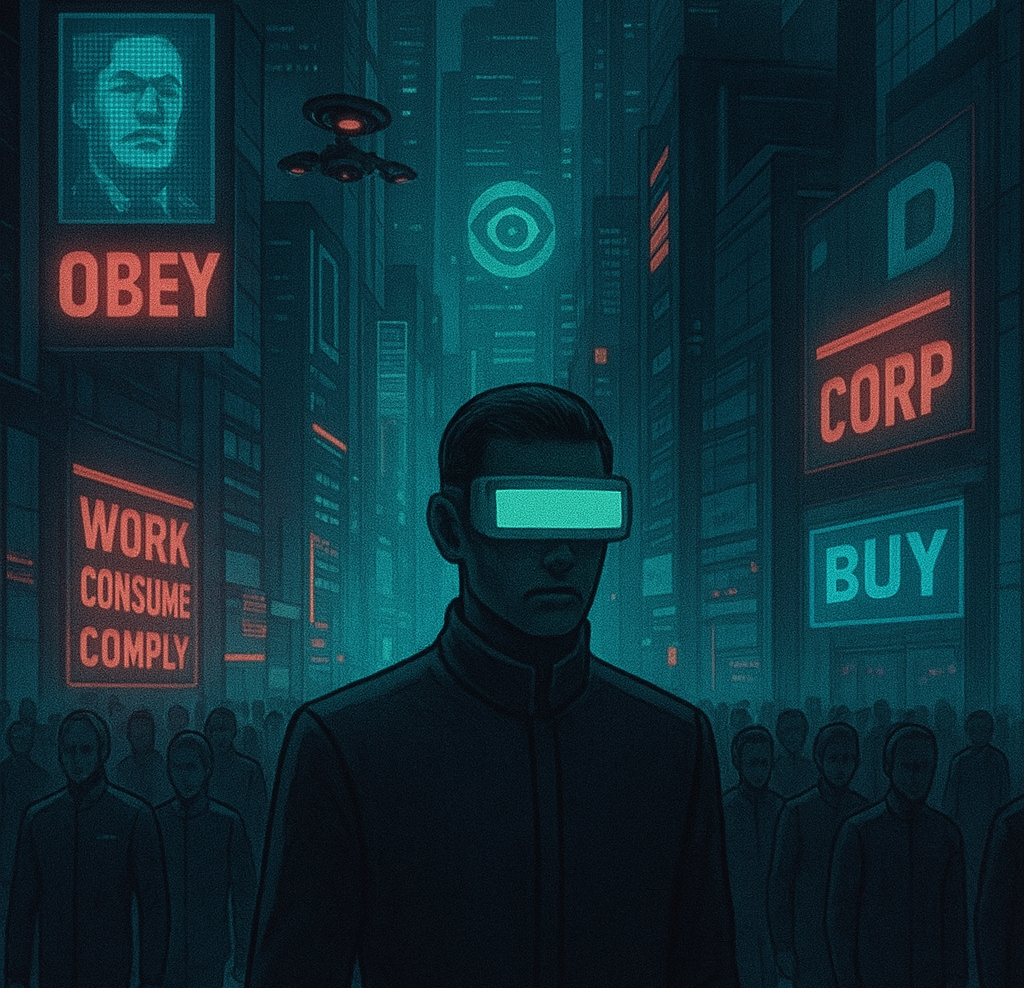
Many who voice (or at least feign) concern about fascism rely too heavily on surface-level descriptions, such as those found in Robert Paxton’s The Anatomy of Fascism or Umberto Eco’s list in The New York Review of Books, “Ur-Fascism,” commonly known as the “Fourteen Points of Eternal Fascism” (you can find the list here). These types of (typically ideographic, even while feigning the nomothetic) analyses are superficial, offering historicist explanations that do not penetrate to the deeper structure of fascism. Such oversimplifications lead many wannabe antifascists to misidentify certain social phenomena—nationalism, populism, and traditionalism—as inherently fascist. Indeed, these are attributes that fascists have historically borrowed to manufacture hegemony. However, they are not intrinsic features of fascism itself. But it helps that people want them to be (hence the power of motivated reasoning).
Readers of this platform know that I often use the materialist conception of history to interrogate the structure of social formations. This method works from the observation that the development of human societies is primarily shaped by material conditions rather than beliefs or ideals. According to the method, the material base of a society—that is, the forces and relations of production—determines its social, political, and intellectual life.
Historical materialism asks the observer to consider that history is a dynamic process rooted in the material conditions of life, where the conflict between opposing classes is the engine of social change and thus the true ground of politics. This does not mean that we disregard ideology. Rather, it means that we understand ideology as a way the ruling class justifies the material arrangements that benefit them. Fascism employs a “double movement” in its tactics: elite interests are portrayed as popular interests, while elites feign an embrace of common sentiment. This is, as Antonio Gramsci explains in his Prison Notebooks, the social logic of ideological hegemony.
Nationalism, in essence, is the political philosophy supporting nation-states and, in the American context, government in the form of constitutional republicanism. Populism, properly understood, refers to popular democracy and citizen participation in law and policy formation. Traditionalism—community concern, pro-family values, and religious faith—predates fascism by millennia.
Again, although historical fascism has used nationalism, populism, and traditionalism to legitimize its rule, none of these is inherently fascist. What is central to fascism are these things: administrative control and the technocratic organization of society, i.e., bureaucratic and elite command over the population. An easy way to understand this is to take your experience with any corporation and imagine that to be your government. It has little to do with nationalism, populism, republicanism, or traditionalism. Indeed, at its eternal core, it has nothing to do with them.
Understanding deep structure must be the starting point for any serious analysis of fascism (or any other social formation) because fascism today will not look as it did in the past; its old symbols and rhetoric would only serve to alert the public to its reemergence. We aren’t studying fascism for general knowledge, but to know how to combat it. This was the central insight of Sheldon Wolin’s Democracy, Inc., which described modern fascism as “inverted totalitarianism.” Wolin’s term refers to a form of corporate statism that hides technocratic governance behind the appearance of democracy—a “managed democracy.”
Of course, historical features of fascism are important to keep in mind, as these may have bearing on the present manifestation of this phenomenon. For example, paramilitary organizations remain important to recognize within this theoretical framework. Paramilitary groups have appeared under both nationalist and socialist movements.
The original Antifa, for instance, was founded in 1932 by the Communist Party of Germany (KPD). It served as a vehicle for organized street-level violence under Marxist-Leninist direction, aimed at overthrowing the Weimar Republic—an aim shared by the Nazi Party and its Brownshirts. Both sought not only to overthrow the republic but also to export their totalitarian ideologies internationally. Today, there is no equivalent to the Nazi Party or Brownshirts on the right. However, Antifa exists. But to what end?
To answer questions like this, one has to employ a comparative methodology. To wit, the essential difference between the totalitarian systems discussed above lies in who wields control over the technocratic state. Communists seek to eliminate the capitalist class, transferring economic power to party elites and their intellectual cadres. Fascists, on the other hand, aim to maintain corporate and financial elites’ control over the population through the state. Both abolish genuine representative democracy and liberal freedoms—freedom of conscience, speech, and writing. Elections may continue, but they become mere formalities within a “managed democracy”—if any appearance of democracy is allowed to exist at all.
In light of this, without a deeper structural understanding of fascism, modern forms of inverted totalitarianism are easily mistaken for their opposites. Leaders can appear to tolerate anarchist, communist, or socialist rhetoric to maintain the illusion of popular struggle, while using these movements for what Barrington Moore Jr. called “revolution from above.” This dynamic is plainly visible in contemporary Antifa movements. Although members often identify as anarchists, communists, or socialists their actions—designed to disrupt public order—serve elite interests by destabilizing republican governance and advancing corporate statism. This mirrors how the Nazis used the label “socialist” to disguise what was: a corporate-capitalist form of totalitarianism.
Indeed, today’s fascism manifests in what is commonly described as the “progressive left.” However, progressivism is not truly left-wing in the historical sense. Were it so, it would defend liberal freedoms and meaningful public participation in governance. Instead, progressivism represents corporate statism and technocratic control. It promotes an expansive state apparatus designed to manage the population for the benefit of corporate power and profit.
Antifa’s street-level actions support the corporate project by undermining republicanism and public safety. Progressives, in turn, portray constitutional republicanism as authoritarian—an inversion that reveals their hostility toward democracy itself. Resisting this totalitarian drift need not involve reciprocal violence. Rather, citizens must use what remains of democratic machinery—most importantly, the ballot box. But progressives seem determined to bring the other side to violence.
Moreover, while National Socialism is widely recognized for its regressive and reactionary features, it shares ideological and structural elements with early progressivism and social democracy, particularly in its embrace of state-directed social engineering and corporatist organization.
One prominent example is the eugenics movement, which cut across political lines in the early twentieth century. Progressive reformers in the United States and Europe often advocated eugenics as a means to improve public health, reduce poverty, and optimize the population. Similarly, the Nazi regime integrated eugenics into its social policies, though in an extreme, coercive, and ultimately genocidal form. In both cases, there was a belief that society could be scientifically engineered toward a “better” future through centralized planning and intervention.
From a critical theory standpoint, particularly through the lens of the Frankfurt School, transhumanism—manifested today in the Promethean drive to advance artificial intelligence, robotics, and cybernetic integration—represent not liberation but a technocratic aspiration toward total control. This impulse to transcend human limitation through technological means mirrors the dialectic within historic fascism, which combined atavistic nationalism and traditionalism with a fetishization of modernity and machine power. The fascist glorification of technology as an instrument of domination and transcendence reemerges in the contemporary faith in technological progress.
Under the guise of rational planning and human improvement, such projects risk reproducing the same totalitarian logic that critical theorists like Adorno and Horkheimer identified in Enlightenment reason itself—the reduction of life to systems of administration and control. In this sense, the technocratic and biopolitical mechanisms of modern governance, from public health regimes to population management to transgenderism, echo both the authoritarian and the progressive sides of this Promethean legacy.
Beyond biopolitics, there are structural similarities in how the state interacted with economic and social life. Both National Socialism and progressive and social democracy are rooted in corporatist arrangements—mechanisms that organize society into functional, state-regulated sectors, such as labor, industry, and agriculture. In progressive contexts, corporatism aimed to mediate class conflict, regulate labor relations, and streamline economic planning for social welfare purposes. Under Nazism, corporatism was a tool for authoritarian control, subordinating labor and industry to the goals of the state rather than to the interests of social justice. In essence, the formal structures—state oversight, planned coordination of economic actors, and emphasis on social engineering—bear resemblance across these political currents.
These parallels illustrate that the distinction between “progressive” and “reactionary” is not always structural but also often ethical and ideological. Both progressivism and Nazism embraced rationalized social planning and scientific approaches to social improvement; yet, the outcomes depended on whose well-being was prioritized and whose autonomy was suppressed. The historical lesson is that seemingly technical or administrative innovations—central planning, corporatist arrangement, population management—can be morally harnessed or perverted depending on the regime’s ultimate vision for society.
The 2024 election illustrates the dynamic at play: The public, by electing a Republican government, demonstrated its ability to restore policy and governance to align with constitutional republicanism. Yet this democratic action is often distorted by academia, the culture industry, and the mass media—institutions that have been deeply compromised by the very corporate statism they claim to oppose.
Nationalism, populism, and traditionalism are now misrepresented as fascist tendencies when, in fact, they may serve as antidotes to real fascism. This ideological inversion signals how far the corporate state project has advanced. If Democrats and progressives regain power, they could complete the totalitarian transformation of the United States. The election of Donald Trump temporarily halted this process, which explains the widespread institutional hostility to his presidency. But Republican dominance in politics is not guaranteed.
Thus, Trump’s election alone has not eliminated the danger. The only safeguard is to prevent Democrats from returning to power. This is why the public must recognize the true nature of movements such as Antifa and color revolutions, such as Black Lives Matter and “No Kings,” as well as the influence of transnational corporate power, the deep state (which I explained in my last essay is real), and the corruption of media, medicine, and science. The reality is that the 2020 election represented a four-year coup to deny democratic choice, followed by an interregnum marked by lawfare and attempts to prevent Trump’s return to office. The evidence before us makes this plain. The ongoing desperation of progressive elites and their street-level operatives is further confirmation of their totalitarian ambitions—an identity that becomes unmistakable once one understands the deep structure of fascism.

 freedom and reason