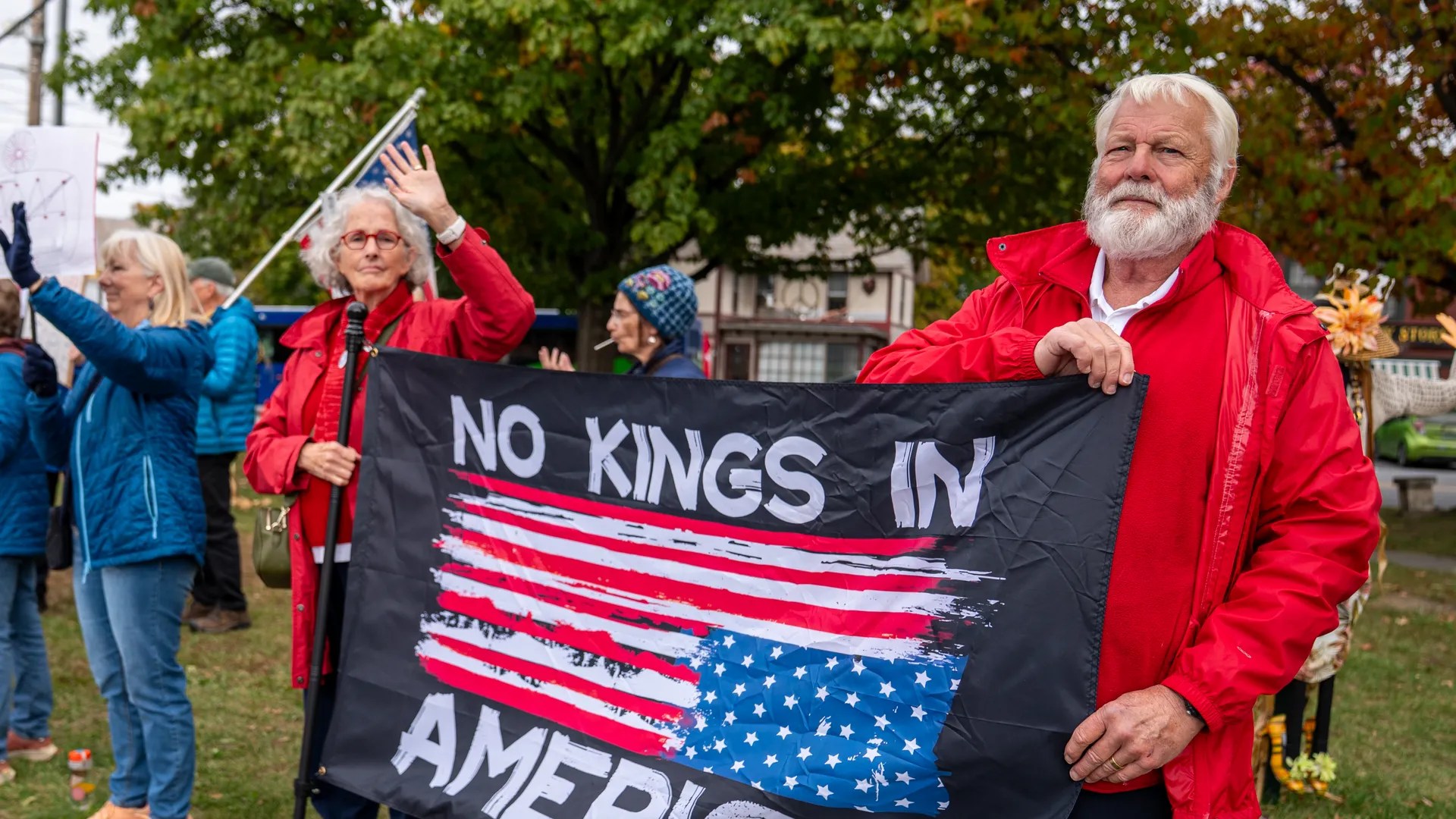
How did the organizers of the “No Kings 2.0” protests do? Let’s look closely at the rallies from October 18, 2025, and do a bit of observational, statistical, and analytical work. I have relied on OpenAI’s ChatGPT for reverse image searches, aggregation of estimates of attendees, and statistical calculations using Bayesian modeling.
Organizers have claimed the nationwide turnout was more than 7 million people at around 2,700 events. If taken at face value, that would make October 18 the single largest protest day in US history—bigger than the Women’s March in 2017 and peak Black Lives Matter demonstrations in 2020.
Keep in mind that similar large estimates for past protests were later revised downward. There are obvious reasons organizers inflate numbers, foremost among them, exaggerating turnout rewards participants and amplifies the protest’s perceived impact. The present exercise is important because these protests, like so many others, are propaganda exercises. We are to believe that the American masses have turned against Trump, believing he is an autocratic ruler. Since polling does not support this claim, organizer and media amplifications are used to manufacture the perception.
If one divides 7 million evenly across 2,700 events, that’s roughly 2,600 people per event. Of course, events are not evenly distributed. Most of the “No Kings 2.0” events were in towns and small and mid-sized cities. I reviewed numerous social media photos from smaller population sites: many show four or five people, a couple dozen, or perhaps a few hundred. One post explicitly notes that he was the lone demonstrator. This suggests that, to reach the millions claimed, turnout in major metropolitan areas would have to be enormous—hundreds of thousands across dozens of cities.
There are images of the larger protests, but what immediately strikes the objective observer is green foliage and other features inconsistent with October 18 in the Northeast and upper Midwest. Yes, it has been a long and warm summer, but skepticism is warranted. When those images are run through reverse-image tools or compared to known archives, many can be traced back to earlier protests. There have been claims that some media outlets used old video or misattributed images—if true, that distorts public perception about turnout.
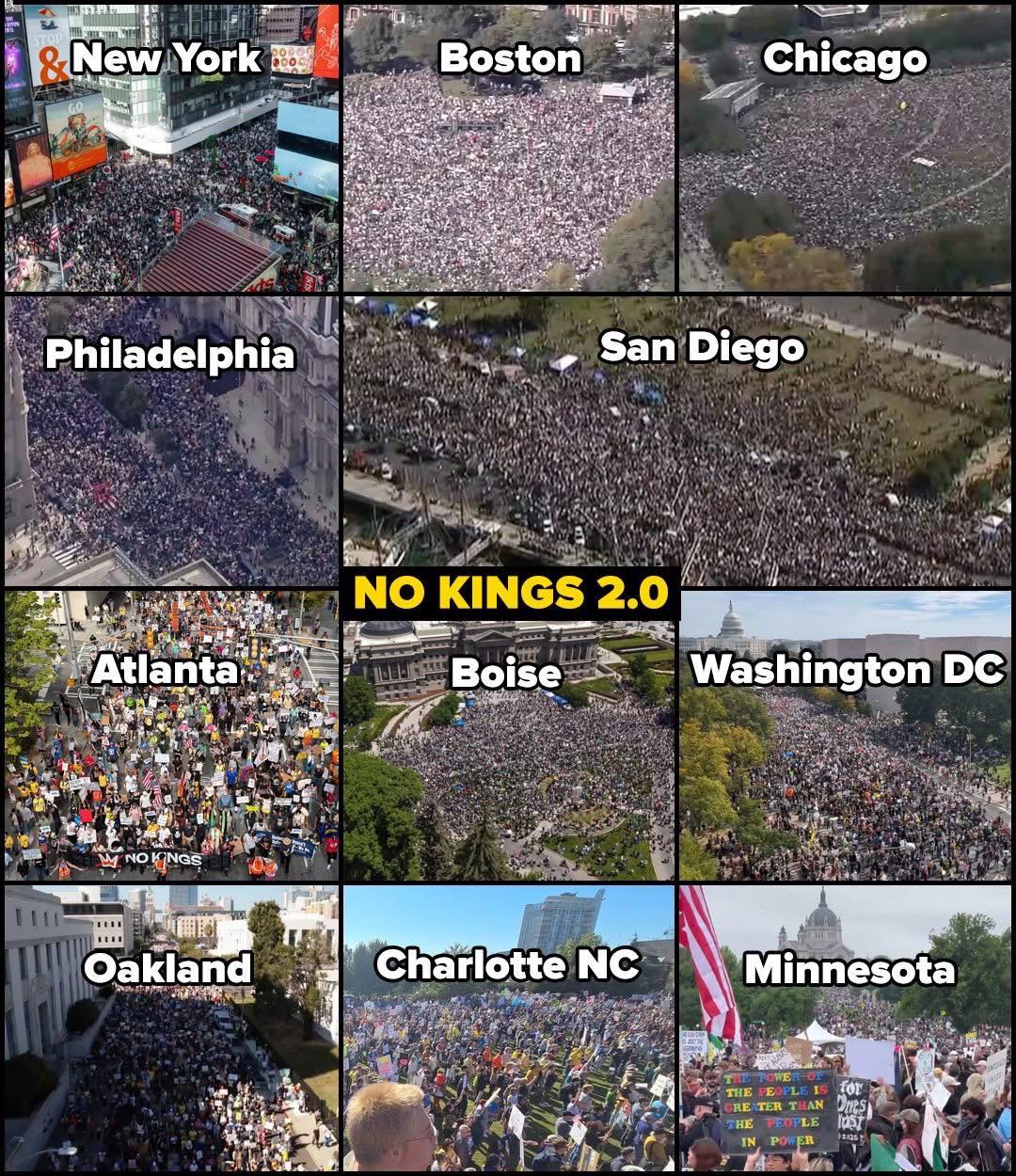
A collage widely shared on social media labeled “NO KINGS 2.0” (shared above) shows large protest crowds across multiple cities, but reverse image searches show that several of these images are from the summer 2025 protests, or are repurposed from unrelated events, such as Black Lives Matter protests in 2020, Women’s Marches, or other large demonstrations. Additionally, some of the images are mislabeled. Whenever and wherever these images were taken, the combined estimates of crowd sizes from these ten cities on October 18, 2025, are around 750,000. Lower estimates put the number at fewer than 500,000.
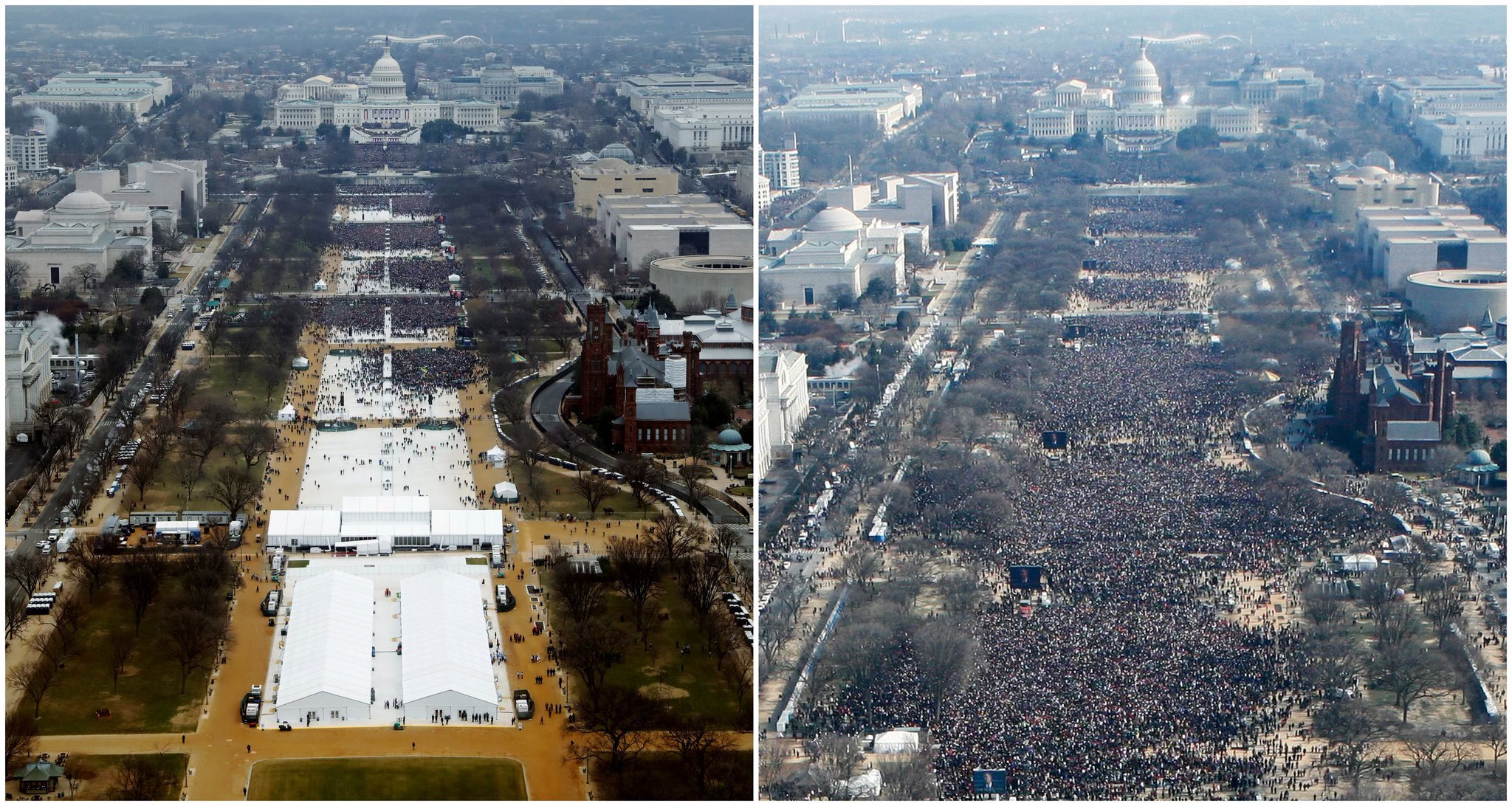
Other social media memes are obvious fabrications. Consider the side-by-side of photos (see above) purportedly comparing Trump’s inauguration (left) to the “No Kings” protest (right) in Washington, DC. The right image has been darkened. Why? Because the original image is not from “No Kings” on Saturday, but Trump’s January 20, 2017, inauguration, a few hours later, after the crowd filled in. If you zoom in, you can see Trump’s face on the big screens. These screens were not there during “No Kings.” This propaganda image does double duty: it misrepresents crowd sizes at Trump’s first inauguration and misrepresents the size of the crowd on October 18, 2025 by using an irrelevant image. What drew my skepticism is that both images appear to be from the same fixed camera angle.
Enhanced and recycled images are used to distract from the weak turnout on Saturday in cities across the country. For example, estimates of the largest crowd during the Wisconsin Act 10 protests in Madison in early 2011 vary, but a commonly cited figure is around 100,000 people on Capitol Square and the surrounding area. I was there protesting against Act 10. The crowd was enormous. If it had not been so cold, the crowds would likely have been larger. The crowd on Saturday in Madison, in good weather, was significantly less, around 15,000.
If you feed the available data—past protest sizes and downward revisions, population distributions, and photographic evidence—into a prior probabilistic model (Bayesian statistical modeling), it finds that the 7-million claim is highly unlikely. A generous estimate might yield 2–4 million. A cautious, media-skeptical estimate could be 1–2 million. A conservative, lower-bound estimate might be several hundred thousand. Different biases and methods produce different answers, but the bottom line is that 7 million is statistically highly improbable.
Beyond headline counts, there are claims about paid protesters and organized staffing that raise questions. Some professional organizers receive steady funding and compensation; others are day laborers or people who respond to recruiting ads. One sees many of the same faces from “No Kings” at pro-Palestinian and anti-ICE protests. It is well documented that funding comes from NGOs provided by billionaires, such as George Soros and his Open Society Foundations and Neville Roy Singham, currently living in Shanghai and married to Jodie Evans, co-founder of the activist group Code Pink. Singham has funded or been linked to a network of nonprofits, NGOs, and media outlets that promote narratives aligned with the Chinese government (including pro-Beijing or anti-US/anti-Israel narratives).
Soros, Singham, and other wealthy donors are globalists. Of course, they are allowed to spend their money as they wish, but, by the same token, we are free to report on how they spend their money and what ends they seek. These ends are anti-American, technocratic, and transnationalist. The point is that, if thousands were paid to participate, and if protest materials were externally supplied, that would materially affect how we interpret the movement’s spontaneity and grassroots character. Admittedly, the exact numbers of paid protesters and the amount of externally-provided materials are hard to verify, but the fact of paid protestors and externally provided materials is well-documented. Also well-documented is the general ignorance of many in the audience about why they are even protesting. The mainstream media skirts these facts.
Finally, while many No Kings events were peaceful and featured patriotic symbolism, there were also documented instances of violent rhetoric and extreme imagery at some rallies. There were protesters in the crowd cosplaying Charlie Kirk’s assassin. There were shirts and signs reading “86 47,” code for assassining the current White House occupant. There is video of Chicago teacher pantomining the Kirk’s execution. And there is video of a speak calling on the crowd to kill ICE agents (see above). These instances were documented on alternative media while mainstream outlets focused on the peaceful majority. That contrast in coverage influences how the events are perceived nationally.
At the very least, one should be skeptical of the headline “7 million” number, which the media admit is the number organizations have provided (the media should be one of skepticism not promotion). It’s prudent to assume a sizeable protest (the crowd in Chicago was quite large, albeit the marches were smartly channeled down streets), but to expect downward revisions as independent counts and photographic verification happen, and to recognize the incentive in exaggerating crowd sizes. Treat claims about recycled images and paid demonstrators as important investigative leads rather than settled facts—they change the interpretation dramatically if proven. Several of the images used have already been exposed as recycled. At the same time, a video of the protest in Boston may have been misidentified by Grok as having been shot during a 2017 protest.
Another thing that’s striking about the protest is how few minorities were present. It’s true that the majority of the US is white, but blacks are around 13 percent of the population, and I see almost no blacks in my review of hundreds of pictures taken of the protest. Granted, many of the pictures are from different angles of the same protests to make the crowds appear larger, but you’d think, given the rhetoric, that the protests were driven in major part by concerns of racism and ethnicism. One would expect to see more minorities. There are also few Hispanics in these pictures. To be sure, most Hispanics are white, and have many shades of skin tone, so I could be missing them in the sea of whites cosplaying civil rights marchers and Antifa members.
Also, while most color revolutions involve youth groups, the “No Kings” protests featured a great many elderly white people. This makes sense because the elderly have time on their hands and often seek community and reputational redemption, the latter since they feel the need to rehabilitate their tarnished image as “Boomers” responsible for the troubles of younger generations. I agree with many commentators that a significant proportion of the elderly were radicals from the 1960s and early 1970s trying to recapture their youthful idealism. Nothing wrong with that, I suppose.
However, that the obstacles faced by the younger generations have to do with progressive governance over the last several decades eludes those out on the streets with signs and symbols manufacturing the illusion that ordinary Americans (MAGA) and a liberal businessman from Queens who love their country are authoritarian is beside the point; this is not a rational expression of actual grievances but the rational deployment of irrational semiotics and symbology by elites to advance the project of managed decline for the sake of globalist ambition.
A big Halloween party is an apt way to describe the event. Remember when progressives mocked conservatives for wearing bandages on their ears in solidarity with their candidate whose life was nearly taken? Or the ridicule of tea baggers? (I’m guilty of that one, I must confess; I was highly critical of the Tea Party protests, even while I opposed Obama from the beginning.) However, those silly displays can’t hold a candle to what I see in the pictures from yesterday. That was maximum silliness—although I wouldn’t put it past progressives to eclipse October 18, 2025, in the future. Very powerful people have a lot riding on stifling Trump and the America First movement.
The premise of “No Kings” is, on its face, silly. Donald Trump is doing what he said he would do. He was elected because he said he would do these things. He won the popular vote, the electoral college, swept all swing states, and secured majorities in both the House and the Senate. How is that authoritarian? How is that monarchy? The premise of “No Kings” is an insult to the tens of millions of patriotic Americans who voted for Trump—and to the intellect of rational men.
In truth, “No Kings” is an expression of a minority of Americans, organized by elites, against the wisdom ordinary Americans expressed in November 2024. The throng substitutes protests for popular will. They hope that by documenting their presence in parks and streets, chanting slogans and pumping signs, amplified through the mainstream media, which has a well-documented anti-Trump bias, a perception will be manufactured that a free and fair democratic moment was in truth an authoritarian moment. This is a plainly false claim, but they do have the right to assemble and protest. Assembly and protests are signs of a free and open society. It is worth nothing then, then, that assembly and protests against the government are not allowed in authoritarian regimes or absolute monarchies.

 freedom and reason