
The American Federation of Teachers (AFT) is one of the organizers of the “No Kings” protest being held today. AFT says that “America is about democracy, not dictatorship.” This depiction of the American Republic does not reflect well on an organization that claims to represent education. More accurately, America is a constitutional republic with expansive federal authority to defend and protect the United States from enemies, foreign and domestic. A dictatorship, on the other hand, is a system of government in which absolute power is concentrated in the hands of a single ruler or a small group, leaving citizens with little or no participation in political decision-making.
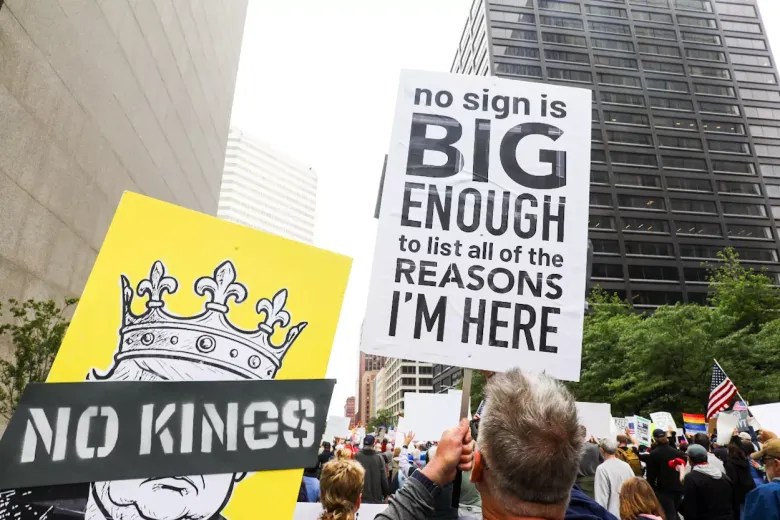
I’m seeing a lot of memes on social media asking how a “No Kings” day could happen in a dictatorship. Not a bad question, but let’s charitably suppose the organizers of these protests aren’t assuming that we already live in a dictatorship, but rather they’re worried that a dictatorship is coming. That means we should see signs of it on the horizon. Let’s take a closer look to see if we can find any, since, presumably, we all agree that dictatorship would be a bad thing. To do this, we need to identify the characteristics of a dictatorship so we know what we’re looking for.
In a dictatorship, authority is highly centralized, and opposition parties, free elections, and independent media are either abolished or sharply restricted. I don’t see any of this. Do you? No opposition parties have been banned. No elections have been canceled. Some might point to the temporary suspension of a late-night television show, but that was a private corporate decision, not a government act. Nothing here suggests dictatorship.
Dictators rule by decree, implementing laws and policies without the consent of the people or a representative body. I don’t see any of this, either. Do you? We voted freely in November 2024, and the current administration has the consent of the people through that election. Executive orders, the authority of presidential rulemaking, have long been used by chief executives of both parties, and those actions operate within a framework of checks and balances. Nothing unusual there. Obama and Biden issued plenty of Directives and Executive Orders.
To maintain control, dictators rely on coercion and force through military or police power. We have to be careful here, since there is nothing intrinsically wrong with coercion and force; the key question is whether the deployment of coercion and force is legal and just. The US Constitution empowers the federal government to use the military to repel invasion, suppress insurrection, and enforce the law. Article II recognizes the president as commander-in-chief and chief magistrate, responsible for maintaining order and ensuring that laws are faithfully executed. All this involves coercion and force—but it is constitutional, not dictatorial. I don’t see anything beyond those limits. Do you?
Historical examples of dictatorships include Adolf Hitler’s Nazi Germany and Benito Mussolini’s Fascist Italy, both of which certainly illustrate the dangers of unchecked political power. How does anything happening in America resemble those regimes? I’ve studied these historical regimes for many years now, and I think I would know it if I saw their reconstitution in the present day. However, I cannot be sure that others would—hence, “No Kings.”
Right—the event is called “No Kings.” Are kings dictators? Let’s take a look at this, too, keeping in mind that not all monarchies are the same. We’ll keep it simple and look at two types: absolute and constitutional monarchies. An absolute monarchy is one where the monarch has almost total control over the government and laws. A good example is Saudi Arabia, which closely resembles a dictatorship because the ruler’s power is relatively unchecked. Does America look like Saudi Arabia? I don’t see it.
A constitutional monarchy, by contrast, limits the monarch’s powers through a constitution or parliament. The United Kingdom is a good example. In such systems, the monarch mainly serves a ceremonial role, and real political power lies with elected officials. The United States is allied with these types of countries. Does America look like the United Kingdom? Some might wish it did, but the systems are fundamentally different. The US has a constitutional and federal system, which one can easily distinguish from the system governing the UK.
So, no dictatorship appears on the horizon. Nor is there a nascent monarchy in the US. Then what’s the point of the “No Kings” protests? According to numerous sources, the event is funded by several well-resourced organizations and NGOs, such as George Soros’ Open Society Foundations, and the event itself appears as what is classified as a “color revolution.”
Color revolutions are characterized by mass street protests and civil disobedience campaigns that claim to oppose election fraud, government corruption, or “rising authoritarianism.” They feature coordinated youth movements (although in the US there are lot of elderly conscripted into these events), opposition coalitions, and heavy use of colors, slogans, and symbols to create the appearance of cultural and political affinity, shared identity, and social solidarity. legacy and social media play a major role in spreading the message and organizing participants, while also attracting domestic and international attention. NGOs, professional unions (lke AFT in the US), or other external actors help organize protests to advance political objectives, often framed as “democracy promotion.” This can include coordination through social media and networks designed to mobilize participants, raise awareness, and generate attention.
The true purpose of “No Kings” is to confuse the public mind about the peril facing the American Republic. What progressive Democrats commonly call “democracy” is less a true exercise of popular sovereignty (progressives loathe populism) than a system of technocratic control via an administrative state and command of society’s sense-making institutions (academic, culture, media). The very techniques that enable color revolutions—careful coordination of social movements, opposition coalitions, media amplification, and symbolic messaging—reflect a broader logic of managed democracy, in which public participation is channeled, choreographed, and ultimately contained within boundaries set by entrenched power.
Sheldon Wolin, in Democracy, Inc., identifies this phenomenon as “inverted totalitarianism,” a form of governance that does not resemble the overt dictatorships of the past but instead subtly concentrates authority in the hands of bureaucratic, corporate, and financial elites. Fascists aren’t so stupid as to rehash fascism’s historical and transient forms. This is why you have to understand what fascism is at its core, not by its surface appearances, e.g., the coalitions it cobbles together to appear popular, but in its deep structure. What is fascism really? State monopoly capitalism that seeks a world order without democracy. Big corporate and financial power that commands the state and the sensemaking institutions to advance its ambition: a corporate state apparatus that controls the masses.
As a critical analysis of corporate statism shows, just as historical fascism was rooted in a constellation of administrative, corporate, and financial power, its modern instantiations under late transnational capitalism achieves the same ends through ostensibly democratic forms—elections, NGOs, and public protests operate within a controlled framework, giving the appearance of popular engagement while real decision-making remains in the hands of entrenched technocratic and powerful economic entities. The spectacle of mass mobilization, coordinated civil disobedience, and international attention is part of a system that manages consent, rather than allowing genuine democratic self-determination.

 freedom and reason